This Week in Spanish Civil War History – Week 6: 22 – 28 August 1936

Week 6: 22 – 28 August 1936

August 22

With Republicans constantly attacking with multiple militias in different areas with different affiliations, the number fighting on their side is still unconfirmed. They have around 90,000 in total, with 33,000 paramilitary, and 7,000 officers, 22 generals and their 50,000 soldiers. Meanwhile, the Nationalists have around 130,000 men – 40,000 soldiers including the Moors from Morocco accompanying 50,000 metro army and Guardia Civil. They are commanded with 17 generals and 10,000 officers. They have 60% of all Guardia Civil guards and only 40% of the assault guards, meaning the Nationalists have far superior trained men, a situation making itself clear in fighting all over the country.

August 24

Italy and Germany join the Non-Intervention agreement officially, which means they can be part of the official blockade of arms and equipment into Spain, and to the Republicans. But because both the Germans an Italians have warships in Spanish waters, they can prevent anyone else from entering Spain and helping the Republicans, while the Nationalist still have them as allies.

August 26

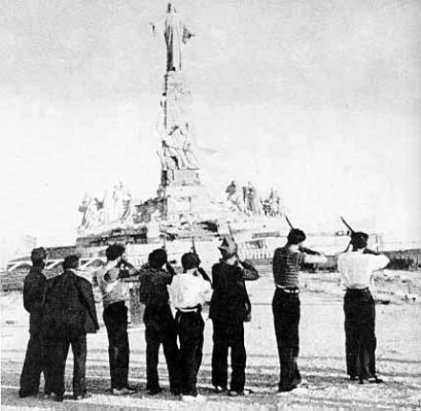
The Catholic Church and the Pope are behind the Nationalist cause, despite their brutal killing. With the Republicans burning churches and killing priests (many priests are ‘second sons’ of wealthy families in their area, making them even more of a target), they are being cited by international media as barbarians. The unsubstantiated claims of nuns being raped has circulated to vilify the Republicans cause, though nothing was ever proven. Meanwhile, Nationalist troops are told via radio announcements that raping women is a perk or bonus and it should be done as often as the chance arises. The soldiers have not needed any encouragement.

SpanishLeftistsShootStatueOfChrist

August 28

The fifth regiment, based out of Madrid, is now at about 6,000 men. Set up by the Antifascist Worker and Peasant Militias (MAOC), the regiment is the only one that is well organised and running efficiently, with the Communist leaders well trained. The fifth regiment is open to people other than Communists and is gaining popularity in Madrid fast, after beating back the Nationalist north of Madrid city earlier in the month.

~~

This is not a detailed analysis, just a highlight (lowlight?) of the week’s events. Feel free to suggest an addition/clarification/correction below. All photos are linked to source for credit

This Week In Spanish Civil War History – Week 3: 1 -7 August 1936

Week 3: 1 – 7 August 1936

August 1

France changes its mind and doesn’t want to support the Republicans, after being pressured by Britain, who don’t want to intervene in a war. The two governments, along with Italy, Portugal, Germany, and Russia, forge a Non-Intervention Committee and sign an agreement of non-intervention in the civil war. This will become a major error and huge turning point.

Spanish King Alfonso XIII, who has been in exile for five years, begs Mussolini for help and they send more planes and trained pilots to the Nationalist rebels, paid for by a Spanish billionaire known for illegal and dodgy deals. But two planes crash on their way to Morocco to collect troops, making the news, showing Italy has already broken their non-intervention plan. Still, other major countries sit on their hands and refuse to assist.

sa01-09-001The Non-Intervention agreement

August 2

Troops head out of Seville, having secured the city and made it their southern base, marching towards Madrid, over 550 kilometres away. The leaders plan to attack major areas like Badajoz, Toledo and Talavera along the way.

August 3

The shipment of refugee children is already underway, with children being sent to other European countries such and Belgium, France and Britain for their safety.

Nr:185498 9SP-1936-0-0-A1-35 Spanischer B¸rgerkrieg 1936-39. - Ankunft von Fl¸chtlingskindern aus Spanien auf dem Bahnhof von Gent (Belgien).- Foto, 1936. Photo: AKG Berlin Teutonenstr. 22 / D-14129 Berlin Tel. 030-803 40 54 / Fax 030-803 35 99 Bankverbindung Dresdner Bank Berlin BLZ 100 800 00 Konto 462732500 USt.Id DE 136 62841
Children leave for Belgium

August 4

As the war as broken down much authority, the collectivisation of Spain is strengthening, particularly in Catalonia and Aragon. Workers are grouping together and gaining control of land and businesses, mostly under the guidance of the CNT and FAI anarchist organisations. Worker control is being established, training and education is being given, state and church control is being eliminated, all while looking to defeat the rebels.

300px-Milicianas_em_1936_por_Gerda_TaroWomen start training in the militia outside Barcelona

August 6

North of Madrid in the Sierra de Guadarrama, Josep Sunyol i Garriga, the deputy of the Catalonian Republican left party and also the president of the Barcelona Football Club, is murdered by Nationalist troops. Sunyol is a politician, leader and journalist, having founded a left-wing newspaper in the 1920’s. He was captured during fighting and shot, and then dumped in a shallow unmarked grave (and wouldn’t be found for 60 years. This system of taking left-wing sympathisers, from battles or just their homes, murdering them without a word and dumping them in the wilderness is the start of what will result in 100,000 – 200,000 Spaniards ‘disappearing’, many still not found today).

indexJosep Sunyol

Francisco Franco makes his move, and leaves Morocco and flies to Seville, to be on the ground as his troops continue their bloody march towards Madrid, the start of severe killing through Spain’s south and west.

~~

This is not a detailed analysis, just a highlight (lowlight?) of the week’s events. Feel free to suggest an addition/clarification/correction below. All photos are linked to source for credit.

This Week In Spanish Civil War History – Week 1: July 17 – 24 1936

Here is the first installment of a new series, a weekly post chronicling the Spanish Civil War, 80 years after the uprising in July 1936. The Spanish Civil War is a complex subject, but if you are new, here is a super simple round-up.

A country with a rocky past, but the more recent Spanish troubles started in 1931, when the monarchy was exiled, creating the Second Spanish Republic. Left-wingers won an election, but as people tried fighting for basics, like fair wages, workers’ rights, women’s rights, education etc, nothing went well, no one agreed, and right-wing conservatives and the church resisted in every which way. Power switched in every direction, but when the Republican left-wing Popular Front took power in February 1936, the military considered an uprising to restore conservative control. Tensions ran high for several months, and when several prominent left and right-wing leaders were murdered in Madrid in July, the match was lit for battle.

The Republicans, the Spanish left, consisted of the Popular Front government, combined with socialists, communists, anarchists, workers’ unions, Marxists, leaders of autonomous Spanish regions like Catalonia and Galicia, and later the International Volunteers. The Spanish right consisted of the military, the Falange fascists, the religious Carlists and the monarchists.

People quickly had to decide which side they were on, though this would have been obvious in most people’s lives already. Within days, thousands were killed for being on the ‘wrong’ side, depending on the consensus of their town or city. What happened next was three years of bloody murder, fighting and executions.

Week 1 – July 17-24 1936

July 17

A military rebellion starts in Morocco, with the Spanish Legion soldiers killing or imprisoning their Generals. Guardia Civil police try to hold back the military in Tetuán and  Larache, resulting in bloody battles. Within a day, Spanish Morocco has fallen to the rebel soldiers. Three Generals – Franco, Mola, and Sanjurjo, all recently demoted within the army, have set up much of the plans. Franco declares a state of war, a call for soldiers to rebel all over mainland Spain and take control of their towns and cities. Anyone who resists gets a bullet.

The Prime Minster, Santiago Casares Quiroga, does nothing to arm the population of Spain, instead spending all day on the phone, ensuring no military barracks decide to rise up in support of the angry Generals.

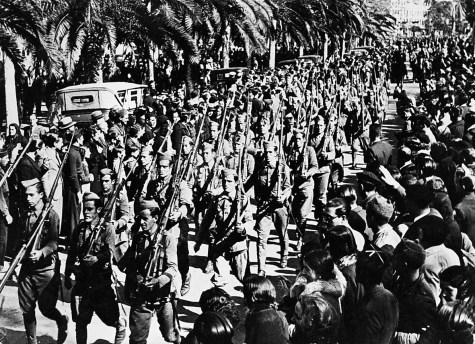
Armed workers’ militia in July 1936

July 18

Word has spread and the socialists, communists, anarchists and workers’ unions are ready to fight to preserve the Republican government. By dawn, Pamplona, Segovia, Cadiz, Avila, Salamanca and Zaragoza are already overcome by the military, with many deaths. Zaragoza was a stronghold of the anarchists, so it is a huge blow to the Republicans.

The rebel Nationalists already have 1/3 of the country under their control and systemic executions start as other locations rise to protect themselves. Unions offer to help if given weapons, but are refused. Workers strike and start building barricades in the streets.

July 19

By dawn, the prime minister has resigned, and after negotiations, José Giral takes over, giving weapons to the population to defend themselves after formally disbanding the army.

tof-02-035aWeapons handed out to the populace

Seville fights but is defeated by the rebels. Much of southern Spain is invaded and executions begin. Navarre in the north falls to the rebels in a bloody massacre. The city of Burgos has no fighting, totally in support of the military.

Jaén, San Sebastian, Santander and Malaga manage to hold back the rebels. The important cities of Madrid and Barcelona have not yet been taken by the military. Madrid is on a knife-edge as workers are armed, ready to do battle, the assault guards personnel on their side.

General Franco leaves his post in the Canary Islands to take control in Morocco. Barcelona faces battle in the streets, with armed workers and police fighting the large military contingent. The police divisions could not hold the city on their own, and arms are given to the public to help with the siege.

July 20

After two days fighting in the streets, Barcelona is won by the Republican population. In Madrid, workers lay siege to the military barracks, killing many and saving the capital city with people power, as in Barcelona.

condorsMallorca, Coruña, Vigo, Bilbao and Granada are all won by the rebels. Valencia is still in confusion, when the army did not take sides. Fighting begins as workers strike and attack the military barracks.

The rebel military leader, General Sanjurjo, flies from exile in Portugal but is killed when his plane crashes due to plane overloading.

July 21

All chances of ending the rebellion is over, although Seville is the only main city controlled by the military.

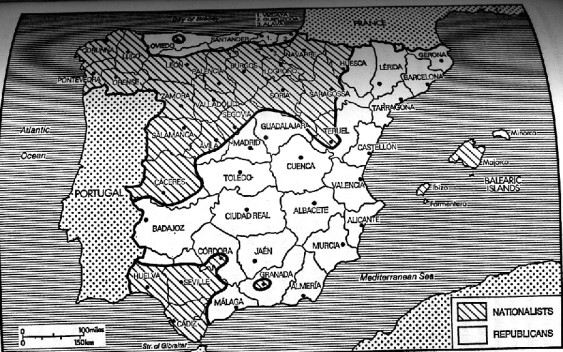
SpanishCivilWar_DivisionOfSpain_193607endAreas controlled by Republicans and nationalists in the early days of the war

The Siege of the Alcázar starts in Toledo, south of Madrid. The Alcázar (castle/fort) is filled with rebels and their hostages as Republicans fight to free the women and children inside and defeat the rebels.

July 22

The People’s Olympiad, (an event held in protest against Germany holding the Olympics) get cancelled with the outbreak of war, with many athletes in the city at the outbreak. Many were trapped in Barcelona as fighting started; some choose to fight.

The navy is loyal to the government and the Republicans. Sailors got word of the uprising and defied and killed most navy officers, saving the navy from the rebels. The air force never intended to turn against the government, but didn’t have much in the way of planes or power anyway.

808-0001-001People’s Olympiad poster

July 23

The Nationalist rebels start their own military government, the Junta de Defensa Nacional, based in right-wing Burgos. General Miguel Cabanellas is their leader.

All areas are suffering from killings and prisoner-takings, regardless of who won the uprising.

July 24

The Durruti Column, led by leader Buenaventura Durruti volunteer to leave safe Barcelona and head to Aragon to start fighting back the rebels. About 3000 workers leave in their first group to begin  a take back of rebel-held areas.

~~

From now on, each weekly round-up will be posted on a Monday. All photos are linked to original sources for photo credit.

This is not an in-depth analysis, merely a weekly highlight (lowlight?) round-up. Comments on any extra details anyone wishes to add are welcome.

SPAIN BOOK REVIEW: July – The Spanish Civil War 80th Anniversary – Part 2: Fiction

Following on from yesterday’s post –SPAIN BOOK REVIEW: July – The Spanish Civil War 80th Anniversary – Part 1: Non-fiction, here is part two, novels based around the Spanish Civil War. It is a particularly difficult task to pluck suggestions from so many books on offer, so I stuck to just a few of the books I have read, and only ones in English. I included my own book because… well, I can! Great to have a selection of female writers, as part one was sorely lacking. If you have an suggestions, let me know.

All cover art and blurbs are via their amazon links
51u5aolRDoL
BLOOD IN THE VALENCIAN SOIL: LOVE AND HATE HIDDEN IN THE LEGACY OF THE SPANISH CIVIL WAR by Caroline Angus Baker

Pleasure is as fragile as glass… Spain, March 1939 – the Spanish Civil War is coming to an end. Five young Republicans in the small town of Cuenca know they are on the losing side of the war. History only recognises the winners, and the group know they could die, all destined to become faceless statistics. They concoct a plan to go to Valencia in search of safety, but not all of these young men and women are going to survive? Seventy years later, bicycle mechanic Luna Montgomery, the granddaughter of a New Zealand nurse who served during the Spanish Civil War, has made Spain her home. A young widow and mother of two little boys, Luna wants to know what became of her Spanish grandfather. He is one of the ‘disappeared’, one of the hundreds of thousands of Spaniards who were murdered and hidden away during and after the war. On a quick trip to Madrid, Luna forms an unlikely friendship with an intelligent and popular bullfighter, Cayetano Beltran, but as Luna presses on to delve into Spain’s history for answers, Cayetano struggles with truths he wished he had never found out. In an ever-changing society that respects and upholds family ties, betrayal by the people who Luna and Cayetano hold dear will hurt them more than they could have realised. There are old wounds that have yet to heal underneath Spain’s ‘pact of forgetting’.

This is my first book series based entirely in Spain, and this is the first book in a three part series. The first book is based during the war, the others during and at the end of Franco’s reign. See my Secrets of Spain category for all the details. 

51acqUu++xL._SY346_WINTER IN MADRID by C J Sansom

1940: The Spanish Civil War is over, and Madrid lies ruined, its people starving, while the Germans continue their relentless march through Europe. Britain now stands alone while General Franco considers whether to abandon neutrality and enter the war.

Into this uncertain world comes Harry Brett: a traumatised veteran of Dunkirk turned reluctant spy for the British Secret Service. Sent to gain the confidence of old schoolfriend Sandy Forsyth, now a shady Madrid businessman, Harry finds himself involved in a dangerous game – and surrounded by memories. Meanwhile Sandy’s girlfriend, ex-Red Cross nurse Barbara Clare, is engaged on a secret mission of her own – to find her former lover Bernie Piper, a passionate Communist in the International Brigades, who vanished on the bloody battlefields of the Jarama.

In a vivid and haunting depiction of wartime Spain, Winter in Madrid is an intimate and compelling tale which offers a remarkable sense of history unfolding, and the profound impact of impossible choices.

Winter in Madrid is one of the most popular civil war novels available. I found some of the characters annoying, but I suppose that’s proof the author can make people authentic. Read my review here
index

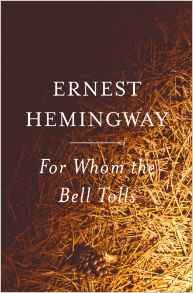
FOR WHOM THE BELL TOLLS by Ernest Hemingway

The story of Robert Jordan, a young American in the International Brigades attached to an antifascist guerilla unit in the mountains of Spain, it tells of loyalty and courage, love and defeat, and the tragic death of an ideal. In his portrayal of Jordan’s love for the beautiful Maria and his superb account of El Sordo’s last stand, in his brilliant travesty of La Pasionaria and his unwillingness to believe in blind faith, Hemingway surpasses his achievement in The Sun Also Rises and A Farewell to Arms to create a work at once rare and beautiful, strong and brutal, compassionate, moving, and wise. “If the function of a writer is to reveal reality,” Maxwell Perkins wrote Hemingway after reading the manuscript, “no one ever so completely performed it.” Greater in power, broader in scope, and more intensely emotional than any of the author’s previous works, it stands as one of the best war novels of all time.

THE Hemingway war novel. Just read it – why haven’t you already? Read my review here
51g3j++Uj6L

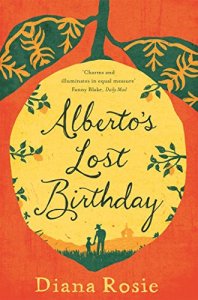
ALBERTO’S LOST BIRTHDAY by Diana Rosie

A little boy and his grandfather embark on a quest to find the old man’s missing birthday in Diana Rosie’s debut novel, Alberto’s Lost Birthday.

As a child, Alberto lost his birthday in the Spanish civil war. Now an old man living a simple life, he rarely thinks about his disappeared past.

But when his grandson discovers his Apu has never had a birthday party, never blown out candles on a birthday cake, and never received a single card or present, he’s determined to do something about it.

As the two set off to find Alberto’s birthday, they have no idea it will be a journey that takes them through Spain’s troubled past, to places – and people – that Alberto once knew.

But in a country that has vowed to move forward, looking back can be difficult. Will they be able to find the memories they’re searching for?

A sweet and interesting take on historical memory in Spain.

51rvAH5wS2L._SY346_GUERNICA by Dave Boling

n 1935, Miguel Navarro finds himself on the wrong side of the Spanish Nationalists, so he flees to Guernica, the most ancient town of the Basque region. In the midst of this idyllic, isolated bastion of democratic values, Miguel finds more than a new life-he finds a love that not even war, tragedy or death can destroy.

The bombing of Guernica was a devastating experiment in total warfare by the German Luftwaffe in the run-up to World War II . For the Basques, it was an attack on the soul of their ancient nation. History and fiction merge seamlessly in this beautiful novel about the resilience of family, love, and tradition in the face of hardship.

Guernica is a widely loved novel based in the Basque region and its unimaginable destruction in the late 30’s. A place mostly untouched by the world became the testing ground for misery.
51XhKOoyleL
SOLDIERS OF SALAMIS by Javier Cercas

In the final moments of the Spanish Civil War, fifty prominent Nationalist prisoners are executed by firing squad. Among them is the writer and fascist Rafael Sanchez Mazas.   As the guns fire, he escapes into the forest, and can hear a search party and their dogs hunting him down.

The branches move and he finds himself looking into the eyes of a militiaman, and faces death for the second time that day. But the unknown soldier simply turns and walks away.

Sanchez Mazas becomes a national hero and the soldier disappears into history.  As Cercas sifts the evidence to establish what happened, he realises that the true hero may not be Sanchez Mazas at all, but the soldier who chose not to shoot him.  Who was he?  Why did he spare him?  And might he still be alive?

Another hugely popular book translated into English, and well worth the read. Read my review here
518m1QBD+1L._SY346_

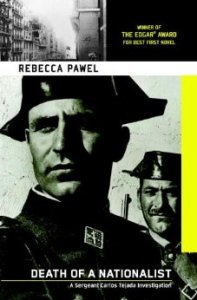
DEATH OF A NATIONALIST by Rebecca Pawel

Madrid 1939. Carlos Tejada Alonso y León is a Sergeant in the Guardia Civil, a rank rare for a man not yet thirty, but Tejada is an unusual recruit. The bitter civil war between the Nationalists and the Republicans has interrupted his legal studies in Salamanca. Second son of a conservative Southern family of landowners, he is an enthusiast for the Catholic Franquista cause, a dedicated, and now triumphant, Nationalist.

This war has drawn international attention. In a dress rehearsal for World War II, fascists support the Nationalists, while communists have come to the aid of the Republicans. Atrocities have devastated both sides. It is at this moment, when the Republicans have surrendered, and the Guardia Civil has begun to impose order in the ruins of Madrid, that Tejada finds the body of his best friend, a hero of the siege of Toledo, shot to death on a street named Amor de Dios. Naturally, a Red is suspected. And it is easy for Tejada to assume that the woman caught kneeling over the body is the killer. But when his doubts are aroused, he cannot help seeking justice.

This is the first book in a series featuring the same characters. Great to see an author taking this line of fiction.

518YpuS4apL._SX334_BO1,204,203,200_

THE CARPENTER’S PENCIL by Manuel Rivas

Manuel Rivas has been heralded as one of the brightest in a new wave of Spanish writers influenced by Spanish and European traditions, as well as by the history of Spain over the past seventy years.

A bestseller in Spain, The Carpenter’s Pencil has been published in nine countries.

Set in the dark days of the Spanish Civil War, The Carpenter’s Pencil charts the linked destinies of a remarkable cast of unique characters. All are bound by the events of the Civil War-the artists and the peasants alike-and all are brought to life, in Rivas’s skillful hand, with the power of the carpenter’s pencil, a pencil that draws both the measured line and the artist’s dazzling vision.

Originally written in Galician, this is another great opportunity for readers to enjoy Spanish (Galician) authors on the subject.
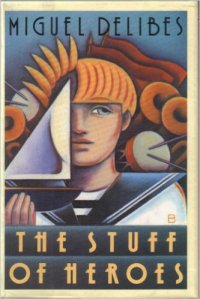
51s-joC4ONL._SL500_SX331_BO1,204,203,200_THE STUFF OF HEROES by Miguel Delibes

Set in the 1930s during the Spanish Civil War, Delibes’s ( The Hedge ) plot chronicles the shifting fortunes of the De la Lastra family, which finds itself divided by politics. Much of the story is seen through the eyes of young Gervasio, who dreams of becoming a military hero. While Gervasio enlists in the Navy in order to fight the Communists, his father, a naturopathic doctor, is imprisoned for more liberal beliefs. The surrealistic horror of war, which directly touches every member of the family, is lightened by farcical domestic dramas. Gervasio’s haughty sister has her marriage to a homosexual annulled, only to find herself involved with a Fascist. Gervasio’s nurse, who tries to turn him against his family, outsmarts herself and is dismissed. As Gervasio daily comes closer and closer to battle, he faces his own conservatism, and finally must answer the question posed by Delibes: Which side of this bloody confrontation is indeed just?

This book can be hard to find, but worth it, being a little complex and quirky. Proof the war had few winners.
51PWAxZMQPL

IN THE NIGHT OF TIME by Antonio Muñoz Molina

October 1936. Spanish architect Ignacio Abel arrives at Penn Station, the final stop on his journey from war-torn Madrid, where he has left behind his wife and children, abandoning them to uncertainty. Crossing the fragile borders of Europe, he reflects on months of fratricidal conflict in his embattled country, his own transformation from a bricklayer’s son to a respected bourgeois husband and professional, and the all-consuming love affair with an American woman that forever alters his life.

A rich, panoramic portrait of Spain on the brink of civil war, In the Night of Time details the passions and tragedies of a country tearing itself apart. Compared in scope and importance to War and Peace, Muñoz Molina’s masterpiece is the great epic of the Spanish Civil War written by one of Spain’s most important contemporary novelists.

This book is quite a read, it took me months to get through it all. Epic is the only word I would use to describe the novel.

41VE3FGZQ0L._SX312_BO1,204,203,200_

SEVEN RED SUNDAYS by Ramón J Sender

The time is 1935. The place is Madrid, a city beset by labor unrest which has raised fears―and among some, hopes―of revolution. At an overflow meeting of workingmen, the military intervenes and three of the workers’ leaders and a member of the socialist party are killed. A public funeral ends in street fighting, sabotage, and the prospect of a general strike throughout Spain. From these events Ramón Sender has fashioned a novel of terror and beauty―one of the great unsung works of the 20th century. Behind the confused and conflicting theories of the revolutionaries who are the central characters of Seven Red Sundays, Mr. Sender discovers a sublime faith and a spirit of self-sacrifice. But whether these idealists with guns represent hope or despair is a haunting question which the reader must decide.

Another book that can be hard to track down. The books focus on the lives of ordinary people in the lead up to the outbreak of war.
51fedMq6L-L._SY346_

SHADOW OF THE WIND by Carlos Ruiz Zafón

It is 1945 and Barcelona is enduring the long aftermath of civil war when Daniel Sempere’s bookseller father decides his son is old enough to visit the secret Cemetery of Forgotten Books. There Daniel must ‘adopt’ a single book, promising to care for it and keep it alive always. His choice falls on The Shadow of the Wind.

Bewitched, he embarks on an epic quest to find the truth about Julian Carax, the book’s mysterious author. Soon Daniel is consumed by strange discoveries about love and obsession, art and life, and how they become entangled within the shadow world of books.

The Shadow of the Wind is a mesmerising love story and literary thriller, which twists and turns and enthralls with its cast of vengeful souls, threatening spectres and innocent hearts.

The Shadow of the Wind series is not to be missed. About more than just the war, its aftermath and a gothic mystery feel are added. While the second book in the series, The Angels’ Game, is less war related (but incredible), the third in the series is about prisoners during the civil war. Stop reading this and go and get these books. Now.

51W5N3aBEaL

THUS BAD BEGINS by Javier Marías

As a young man, Juan de Vere takes a job that will haunt him for the rest of his life. Eduardo Muriel is a famous film director – urbane, discreet, irreproachable – an irresistible idol to a young man. Muriel’s wife Beatriz is a soft, ripe woman who slips through her husband’s home like an unwanted ghost, finding solace in other beds. And on the periphery of all their lives stands Dr Jorge Van Vechten, a shadowy family friend implicated in unsavoury rumours that Muriel cannot bear to pursue himself – rumours he asks Juan to investigate instead. But as Juan draws closer to the truth, he uncovers more questions, ones his employer has not asked and would rather not answer. Why does Muriel hate Beatriz? How did Beatriz meet Van Vechten? And what happened during the war?

As Juan learns more about his employers, he begins to understand the conflicting pulls of desire, power and guilt that govern their lives – and his own. Marias presents a study of the infinitely permeable boundaries between private and public selves, between observer and participant, between the deceptions we suffer from others and those we enact upon ourselves.

This book, again in Marías’ flowing prose, is the author’ latest work, about a man digging in the his bosses war past and a bit of a journey into voyeurism. Read my review here
51dytUzQfgL._SX324_BO1,204,203,200_

NADA by Carmen Laforet

One of the most important literary works of post-Civil War Spain, Nada is the semiautobiographical story of an orphaned young woman who leaves her small town to attend university in war-ravaged Barcelona. Edith Grossman’s vital new translation captures Carmen Laforet’s feverish energy, powerful imagery, and subtle humor. Nada, which includes an illuminating Introduction by Mario Vargas Llosa, is one of the great novels of twentieth-century Europe.

“Laforet vividly conveys the strangeness of Barcelona in the 1940s, a city that has survived civil war only to find itself muted by Franco’s dictatorship…The spirit of sly resistance that Laforet’s novel expresses, its heroine’s determination to escape provincial poverty and to immerse herself in ‘lights, noises, the entire tide of life,’ has lost none of its power of persuasion.”

This book is based in the aftermath of the war and one I couldn’t put down. Read my review here
51z2Kr3ReQL._SX313_BO1,204,203,200_

MAZURKA FOR TWO DEAD MEN by Camilo José Cela

The Spanish Civil War intrudes almost casually on the characters’ picaresque doings in Cela’s amorphous, bawdy novel, first published in Spain in 1983. Set in the mountainous region of Galicia and redolent with the Spanish countryside’s wild beauty and its inhabitants’ folkways, the work depicts a gallery of sinners, fools and misfits in overlapping yarns that span several generations. The plot involves Lionheart Gamuzo, who was shot in the back in 1936, and his brother Tanis, who in 1940 avenges the death with trained killer dogs. The blind Gaudencio, who works as an accordionist in a whorehouse, plays the same mazurka to commemorate these deaths, framing a sprawling canvas peopled with an enormous Rabelaisian cast, including jazz musician Uncle Cleto, who vomits whenever he’s bored; the widow Fina, who is fond of bedding priests; and Roque Gamuzo, who is famed for his colossal member. Winner of the 1989 Nobel Prize for literature, Cela ( The Family of Pascual Duarte ) garrulously conveys the impression that “mankind is a hairy, gregarious beast, wearisome and devoted to miracles and happenings.” The musical translation captures his lyricism and colloquial flavor.

I love this author and all his works are worth taking the time to find and read. This book is a bit all-over-the-place but still worthy of attention.
index

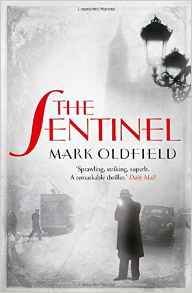
THE SENTINEL by Mark Oldfield

You can’t escape the past.

He was the cold steel behind Franco’s regime. The fear behind Franco’s power.

57 years ago, Comandante Leopoldo Guzmán disappeared without a trace. They know what he did, but they don’t know where he’s gone.

Madrid, winter 1953: the snow lies thick on the ground and Comandante Guzmán of the Brigada Especial is preparing a dawn raid. His job is to hunt down opponents of Franco’s regime and destroy them. Feared by all in Franco’s Spain, Guzmán takes what he wants: food, drink, women.

That is about to change. Guzmán is going to find himself on the wrong side of Franco, and on the wrong side of history. It’s not the first time Guzmán has been on the wrong side. But there’s no one left alive who knows about that… until he gets a message from a dead man…

Madrid, 2009: Ana María Galindez is a forensic scientist investigating a mass grave from the Franco era. Now she is hunting for the hidden ledger of secret policeman Leopoldo Guzmán – a man who disappeared without trace in 1953. But there are those who would rather the secrets of Guzmán’s ledger stay buried. Galindez’ pursuit of the past has revealed a battle for the present…

This is the first in a three part series, and a long read worth your time.  Read my review here. Book two, The Exile is also available. Read my review here

SPAIN BOOK REVIEW: A Englishman in Madrid by Eduardo Mendoza

An Englishman in Madrid

Anthony Whitelands, an English art historian, is invited to Madrid to value an aristocrat’s collection. At a welcome lunch he encounters José Antonio Primo de Rivera, founder and leader of the Falange, a nationalist party whose antics are bringing the country ever closer to civil war.

The paintings turn out to be worthless, but before Whitelands can leave for London the duque’s daughter Paquita reveals a secret and genuine treasure, held for years in the cellars of her ancestral home. Afraid that the duque will cash in his wealth to finance the Falange, the Spanish authorities resolve to keep a close eye on the Englishman, who is also being watched by his own embassy.

As Whitelands – ever the fool for a pretty face – vies with Primo de Rivera for Paquita’s affections, he learns of a final interested party: Madrid is crawling with Soviet spies, and Moscow will stop at nothing to secure the hidden prize.

~~

An Englishman in Madrid has been in my reading pile since it was released two years ago. When I posted on Twitter last week about starting to read, I expected (at least those interested in Spain) to scoff that I was last to read it. But it seems not. Perhaps they had the same hesitations that I did – an ageing academic goes abroad and bound to have an unlikely affair with some girl a third of his age. We’ve read that before, more times than we care to remember. Was this book the same? Actually, it was combo I have never read before.

Anthony Whitelands, the ‘hero’ of the story, is fresh from Cambridge university, an art nerd of undetermined age, but with the usual male middle-aged thoughts of life and his career. An ex-wife in the distance, Anthony is busy dispatching with his married lover, Catherine. Perhaps she has made a lucky escape. From the beginning, the police are tracking him, only he is too thick to notice.

Anthony is an art specialist, who loves to compare literally anything – paintings, conversations, people, probably shrubs, to Velazquez (who was a painter in Spain in the 1600’s, if painting isn’t your thing). Anthony is no stranger to Madrid, but in the spring of 1936, shiz is going down all over the place, the prelude to the civil war, which broke out in July that same year. Our hapless character knows all is not well as soon as he arrives, but he is fairly dim, so it takes him a long time to figure out the realities of wandering into an-almost war zone.

The book covers everything, from toffs of the upper class, to the poverty of the times and the social and political realities everyone is facing. The prelude to war is described brilliantly by an author who has taken the time to get things right. Between protests, street killings and strikes, Spain is preparing for implosion and bumbling Anthony has wandered into the eye of the storm.

Our self-confessed art genius finds himself at the beck and call of the Duke of La Igualada, who wants to offload his Spanish art collection, to pay to get his family out of Spain. Selling off the family silver (literal and proverbial) isn’t something particularly legal, but the Duke is a chatty dude, and has Anthony dancing to his tune soon enough. If Anthony’s description is ever written, I have already forgotten it. But he must have been one hell of a looker, because the Duke’s teenage daughters are taken with him in a heartbeat, ready to profess their love before dinner’s first course is even served. Anthony wouldn’t win them over with charm, let’s just say. As an author, I realise how convenient ‘love at first sight’ is for moving a story along, but this group is a crazy set-up, with minimal interactions, yet pounding hearts (real or imagined, anyway). Between the charming Duke, his dim-witted duchess (sticking to stereotype here), the two daughters and the up-and-coming wannabe fascist son, and heir to the money, Anthony accidentally walks into the history books.

The Duke’s paintings are duds, and also a cover-up. Because Paquita, the eldest daughter (with wandering thoughts and as cold as a fish) lures Anthony to see the real treasure – an undiscovered Velazquez in the basement of the palace. Anthony sees his name in lights with the discovery, but knows he simply can’t steal a 300-year-old treasure. He is so blinded by the thought of fame and his never-that-apparent love for the girl he met five minutes ago, Anthony makes mistake after mistake.

The author of this book moves the story on Spain-time, but no matter what others think, this book blows away many similar books written by British authors. I would take on stories with this buffoon-style protagonist before many I’ve read before him. The author wanders into chit-chat about Velazquez so often he is almost holding an art class, and I admit to skipping pages because of it. This is not a criticism, because I admire the author’s research. When it comes to the realities of Spain, Madrid in particular, in that dangerous spring of 1936, the quality is excellent. It can’t be faulted. It is this setting that kept me going.

I like to think I’ve eaten pretty much anything Spain can throw at a stomach, but Anthony, our so-called gent, has weird things like beer and squid in the morning. Um, eww, bit early, my gentleman colleague. He is ethically clueless at times, like giving his passport and wallet to a stranger, who took him to an underage prostitute, whom he bones at her mother’s place. WTH, Anthony? You have no class sometimes. He parties with the hooker and her family, he parties with the Duke (snore-fest), his daughters, and also José Antonio Primo de Rivera, leader of the Falange fascist party, who will eventually align with Franco and be with the rebels (read: baddies of the civil war). The Duke won’t let all-talk, no-action José Antonio marry Paquita, but she loves him while dancing around Anthony (maybe, she doesn’t know herself half the time). She has as little sense as everyone else. Don’t get me started on the little sister, Lilí.

Running with the fascists, the elite, the working class, the police, and hanging with the Prime Minister himself, and pretty much everyone in the mess called Madrid, Anthony nearly gets his head blown off, sees others suffer the fate, and generally can’t figure out who the Communist Russian spy trying to kill him really is. But all because he wants to the art historian who found a Velazquez, he finds himself vying for an item that could invoke an entire civil war.

This book is part art history, part Madrid history teller, part war correspondent, all laced with fictional and not-so fictional characters who make you shake your head (or hope they get theirs blown off). I love the author’s use to detail to set the scene for war, and his use of French-farce type characters lost in world completely screwed in a mess of its own making, makes for something better than the usual old academic/hero and young duchess/whore/idiot that graces these types of books. Sometimes you want Anthony to escape, sometimes you wish someone would just pull the trigger. Will the end satisfy you? Is this book a thriller, a history lesson, or a comedy? The whole lot. Definitely recommended.