This Week in Spanish Civil War History – Week 17: 7 – 14 November 1936

Week 17: 7 – 14 November 1936

(see Week 16: 1 -7 November 1936 for the Madrid lead-up and maps)

Republicans orange, Nationalists blue

November 7

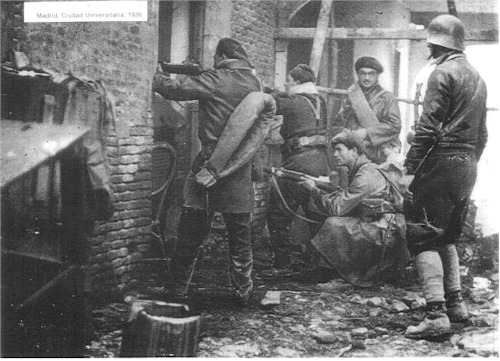
The attack on Madrid begins. All major bridges are attacked by Nationalist troops, most taken easily on the first day of fighting. General Varela attacks from the north, and troops pour into the Casa de Campo and through Ciudad Universitaria. Nationalist troops fight Republican militia in man-to-man combat, and killing occurs one building at a time as Nationalists swarm the city. The death count rockets on both sides. Despite their soldiers’ training and weapons, Colonel Yague sees over 300 of his Legionnaires Moroccan troops killed on day one. Franco expects the Nationalists will have won within a day, unaware the International Brigade troops are one day from arriving from east, along with the Durruti Column anarchists from Barcelona, in time to back up huge number of Spanish militia and hold back the conquering of Madrid.

The start of the massacres in Paracuellos del Jarama, a small area in the north of Madrid. Political prisoners, most soldiers and priests arrested at the outbreak of war, are taken out of the city to be executed. Between November 7 until December 4, the 5,000 prisoners are moved, as the Republicans don’t want hostile Nationalist prisoners inside the city. Some are moved away from the front, but Paracuellos del Jarama is the site of multiple executions. Over the first few days, 1,000 prisoners, all Nationalist sympathisers, will be shot. The death toll will be unknown; many say 2,000-3,000, some up to 12,000.

International Brigades in Casa de Campo

November 8

The major launch on Madrid begins. General Mola attacks with 20,000 soldiers, mostly the Moroccan troops. The Condor Legion from Germany launches air strikes on the city. German officer Wilhelm Von Thoma leads German tanks alongside light amour support from Italy.

The Republicans have more men, and send 12,000 to Carabanchel, but the larger force of 30,000 heads to Casa de Campo. The problem lies in the detail; the Republican men have had little or no training at all, and have only ten rounds per rifle. Only sheer numbers hold off the Nationalists. Small groups of Moroccan regulares soldiers manage to get over the Manzanares River to Model Prison, which is the set target for the onslaught. One of the Republican leaders, General Miaja, took his scared men forward himself to try to force the soldiers back. Radios all over Madrid repeatedly called the classic ‘­­¡No pasarán!’ (they shall not pass!) slogan, calling everyone to help in the fight against the siege.

By evening, the first International Brigade arrives, the XIth battalion, from Albacete in the east. There were small in numbers, but they provided morale and back-up for the fighting Madrileños. The men had not finished their basic training. They were greeted on Gran Via as a Soviet Union battalion, though they were a mix of German, Polish, Italian French and small numbers of other countries.

Telegrams are sent to the War Ministry in Madrid, congratulating Franco on his victory; no Nationalists are in Madrid, and neither side has won anything.
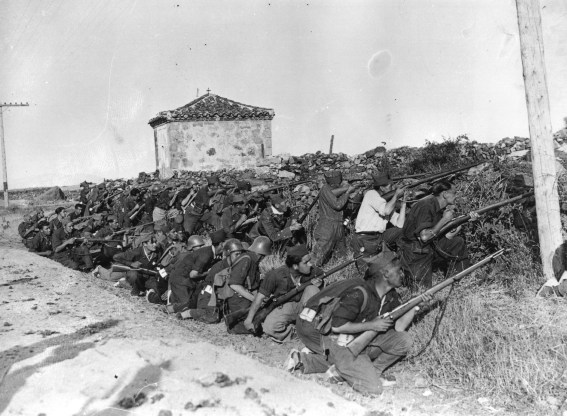
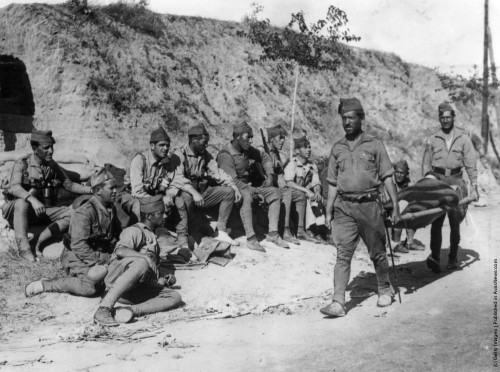
Nationalist soldiers at the front

November 9

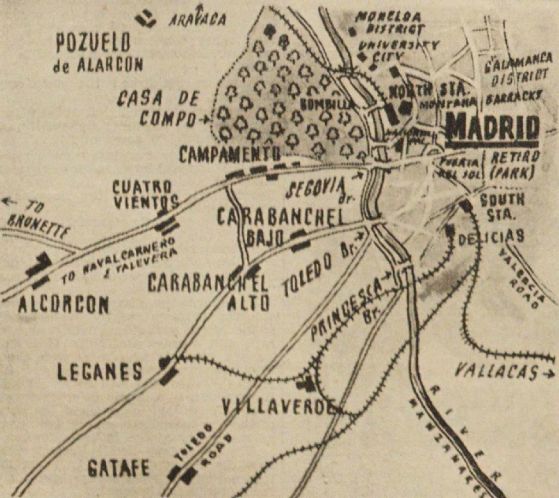
The Nationalists focus on taking the southern Carabanchel suburb. The Moroccan soldiers are trained in open-country fighting and not the urban battle they need to fight. Republicans, who work and live in the area, have the home ground advantage, and there are many Nationalist casualties as the Republicans again hold the enemy back.

The XI International brigade, 1,900 men, start their fighting in Casa de Campo alongside Republicans in the evening. Heavy fighting sees 2/3 of the Internationals killed, though the Nationalists do not advance into Madrid. Fighting will last for several days, with both sides suffering losses. The Nationalist no longer see Casa de Campo as a way into Madrid, though this is not just due to international fighting, but their presence is good for propaganda.

The San Fernando bridge, which flanks the left of the Nationalist-held area over the Manzanares River, is retaken by the Republicans.

Air strike damage

November 10

Ciudad Universitaria in the city’s north is under Republican control, though the Nationalists are prepping the take the area. Around 150 Nationalists are killed on the front line around the north of the city, a total of 2,369 casualties since the start of the siege.

The Durruti Column, a group of 3,000 anarchists from Barcelona, arrive in Madrid, ready to help defend Casa de Campo. They had been marching to Zaragoza to recover the city from the Nationalists, but had no success and carried on to Madrid to help. They are led by famous anarchist Buenaventura Durruti.

University City area held by Republicans

November 11

Another 1,000 Nationalist prisoners are killed in the Paracuellos del Jarama reportedly by the Fifth Column, a communist led group of Spanish militiamen, who are well-organised and well-trained, unlike most in the area. The prisoners, all taken from the Model Prison in inner Madrid, are shot and bodies are dumped, in retaliation for the Nationalists attacking the city. The killings are one of the Republicans’ sides most vicious single-acts against civilians.

The arrival of the Durruti column causes some discontent as the placement of the men is up for debate, as the anarchists and Madrid-based militia try to work together. Regardless of any tensions within Madrid, the Nationalists are still held outside Madrid for another day.

Refuge from bombing in the Madrid subway

November 12

The XII International Brigade arrives in Madrid and launches an attack on Cerro de los Ángeles hill, south of Madrid, only just taken by the Nationalists. This is to ensure the Nationalists cannot advance east of Madrid and claim the road to Valencia. The attack fails, but the road to Valencia is still secure. The brigade of Spanish, French, German and Austrian fighters are suffering from lack of training and supplies, and communication trouble, but the 1,500 strong brigade returns to the safety of Madrid, with minimal losses.

The children of Madrid

November 13-14

The battle continues in Carabanchel, and man-to-man fighting continues right in the military hospital, with the Republicans losing many men but still holding the area.

Fighting along the south and west of the city continues, with air strikes on the city combined with close combat fighting. The Nationalists are preparing to take Madrid via the northern Ciudad Universitaria area, as Casa de Campo and Carabanchel manage to hold safely. The International Brigades are basing themselves in the north now to hold the Nationalists back.
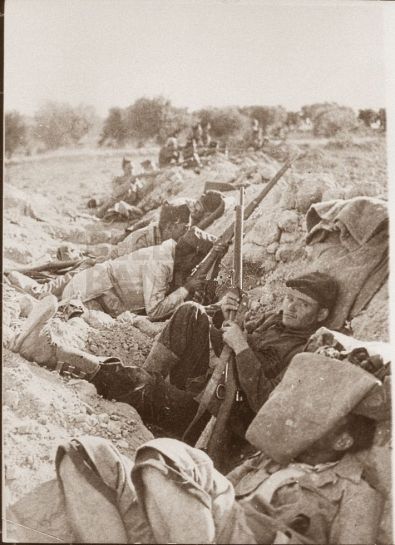
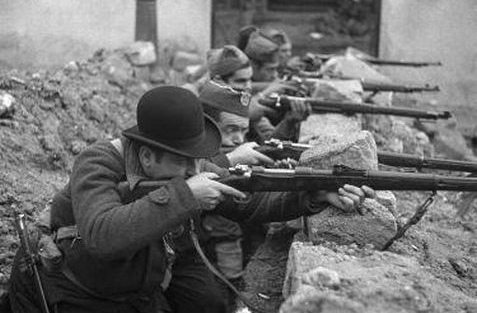
Republicans at the front

~~

This is not a detailed analysis, just a highlight (lowlight?) of the week’s events. Feel free to suggest an addition/clarification/correction below. All photos are linked to source for credit

This Week in Spanish Civil War History – Week 16: 1 – 7 November 1936

Week 16 sees the starts of the Siege of Madrid, which will last until the end of the war in 1939. Also, the Republican government leaves Madrid for Valencia

November 1

The Nationalist army, which has been marching north from Seville since the outbreak of war, has now reached the outskirts of Madrid. Around 90% of Republican fighters in Madrid are civilian militia, and the government has little control, as they have been set up by the trade unions and communist groups. All the small towns surrounding Madrid have now been taken by Nationalists and the Republicans are now backed into the city. Nationalist numbers are at now 25,000 but the Republicans have double the men. But the Nationalists are highly trained and battle ready, while the Republicans are not soldiers or have proper weapons and supplies. Propaganda leaflets are dropped over Madrid city by Italian planes, warning the public that Madrid will be wiped off the earth if they do not rise up and take the city for Nationalists.

The government has no faith in their side and expect General Mola and his Nationalist men to take the city, and plan to evacuate, including the Prime Minister. General Mola states to the English media that his four columns of regulares soldiers and Moroccan fighters will take the city, despite the difficulty of surrounding Madrid, and his fifth column, of powerful Spanish right-wingers, already in the city, will take inner Madrid. This strikes paranoia in the inhabitants, and starts killings between civilians as ‘traitors’ need to be found and executed.

tumblr_mvq9t063nn1t00990o1_500

Troops in the city’s north of Ciudad Universitaria

November 2

The Republicans finally get air defense over Madrid. Russian Chatos planes have arrived just in time and start air strikes over surprised Nationalist ground troops. The public are unsure of the air strike and do not take cover. Several Russian planes are shot down by Italian retaliation for the Nationalists. The Madrid public fear German planes, and when a Russian pilot parachutes to safety after a strike, he is killed by a mob when he is mistaken for a German Condor Legion pilot.

The town of Brunete, only 15 miles west of central Madrid, is the scene for a battle between opposing sides. The Republicans lose the stronghold, giving the Nationalists a chance to get even closer to the city from the west.

The Republicans have one advantage. The Manzanares River runs through the city, providing a barrier, keeping the Nationalists from walking directly into the west and south of the city. The Casa del Campo, an open park area on the west of the city centre, is chosen as the main strike area, with forces crossing the Puente de los Franceses (Bridge of the Frenchmen). Republicans are already defending their bridge. The northern Ciudad Universitaria (University City) area of Madrid is also prepared for an attack, likewise Carabanchel in Madrid’s southwest, which has only a  small river defense.

Nationalist troops retreat with their wounded

November 4

The anarchists now join the Republican government, with four ministers involved. As the anarchists are the largest group of civilian militia fighting for the Republicans country-wide, they need their voices in government. The Republicans must reply of all factions coming together to save their country.

The south Madrid suburb of Getafe is occupied by the Nationalists. It is at the basin of the Manzanares River, giving easier access to troops. The Moroccan troops attack, with tanks and overhead air strikes, crushing the Republican protectors. Vicious General Verela, a man leading so many massacres, is proud to tell the media that he shall have destroyed Madrid within the week.

Only 115 Nationalists are killed in the Getafe battle, but southern suburbs are working class and heavily populated, meaning it is not a good place to engage in street battles. Verela instead plans to attack Ciudad Universitaria in the north, where the population have fled for the safety of the inner city.

Republican militia defend their barricades in the south

November 5

The Republican reinforcements of Russian planes and pilots have some success when they bomb surrounding Nationalist troops, and an impeding northern assault of the city is beaten back.

tof-01-057

The Republicans defend the outskirts of the city

November 6

The Nationalist troops continue their southern assault under cruel Colonel Yague, and conquer Carabanchel and take the Cerro de los Angeles hill, the geographical centre of Spain, and prime lookout area over the plains around southern Madrid. The Nationalists are now all-but in the inner city of Madrid, with Republicans ever squeezed into the capital. The new Junta de Defensa de Madrid (military government team) is set up under General Miaja and is ready to take Madrid.

Propaganda is rife

The Republican government flees to Valencia, 350kms to the east on the coast. While this means men in ‘power’ are safe, as well as the government itself, the civilians and fighters of Madrid are left to face the Nationalists, with their German and Italian fascist back-up, on their own.

A simplified map of the Madrid suburbs

November 7

The attack on Madrid begins. All major bridges are attacked by Nationalist troops, most taken easily on the first day of fighting. General Verela attacks from the north, and troops pour into the Casa del Campo and through Ciudad Universitaria. Nationalist troops fight Republican militia in man-to-man combat, and killing occurs one building at a time as Nationalists swarm the city. The death count rockets on both sides. Despite their soldiers’ training and weapons, Colonel Yague sees over 300 of his Legionnaires Moroccan troops killed on day one. Franco expects the Nationalists will have won within a day, unaware the International Brigade troops are one day from arriving from east, along with the Durruti Column anarchists from Barcelona, in time to back up huge number of Spanish militia and hold back the conquering of Madrid.

The attack begins

~

This is not a detailed analysis, just a highlight (lowlight?) of the week’s events. Feel free to suggest an addition/clarification/correction below. All photos are linked to source for credit
This Week in Spanish Civil War History – Week 14 and 15: 17 – 31 October 1936

Week 14 and 15: 17 – 31 October 1936

Sorry for the delays, as the website was hacked and is only just back online now. Normal service is resumed.

Week 14

October 18

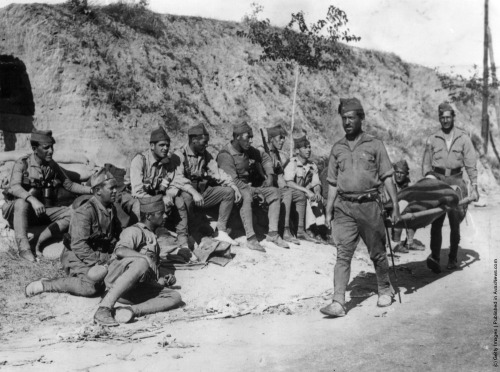
The Republican government creates the ‘Mixed Brigades’. This combines the army units which remained loyal during the initial rebellion, and militia groups of all forms fighting around Spain. This mix is titled the Popular Army, the name coming from the Popular Front party in government. While anarchist groups are not art of the government (yet), their militias are still able to be part of the Popular Army.
.
Week 15

October 24

The first shipment of gold arrives in the Soviet Union; the first shipment of over half the Spanish supply which will be sent to Moscow. It is worth around $35 per ounce, a total of around almost $600 million, though Spain only gets half its worth.

October 27

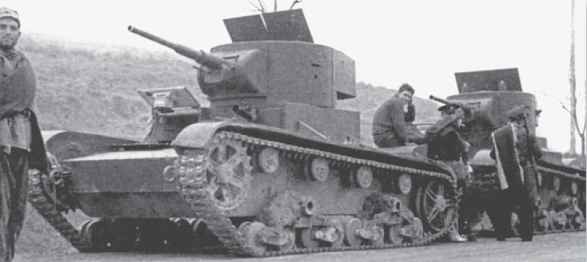
Russian tanks finally get to Madrid to defend the city. T-26 tanks, around 10 tonnes in weight each, are dispatched from Madrid main’s train station and head straight to the front. The Nationalists outside the city already have tanks, supplied by Italy and Germany. The Republicans have been using Molotov cocktails to hold back the Nationalists until now and are in desperate relief to save the city.

.

T-26 tank outside Seseña

October 27

The Nationalist unleash an air raid on Madrid. Six bombs are dropped in Plaza Colón, a major square in the city, heavily populated. A queue of women and children are waiting to get milk and a bomb lands directly on them. A total of 16 are killed, another 60 seriously injured. The air raid comes from a Junker Ju-52 with a German pilot. The bombing is labelled the first bombing in history that served no purpose. It was designed solely to bring terror to 900,000 Madrileños. Madrid has no way to stop planes flying overhead and bombing them as they are becoming surrounded by Nationalists, setting the stage for the coming mammoth siege of Madrid.

October 28

A squadron of Soviet Tupolev ANT-40 planes, named Katiuska bombers, drop bombs over the city of Seville, which has been in Nationalist hands since July. This Republican-supported bombing leads the Germans to send more planes and supplies, and set up the Condor Legion in Spain, to overcome the Soviet forces.

Aftermath of the air raid in prep for the Madrid siege

October 29

The town of Seseña is 30 kilometres (18 miles)  south of Madrid, near destroyed Toledo. The Nationalist army, who have marched and massacred their way north are now ready to take Madrid. The Republicans who hold Seseña attempt to hold their town. The new Mixed Brigades, led by Spanish and Russian colonels, lead their mixed-nation/loyalty troops with newly arrived tanks. However no one has any training, other than one Russian tank expert. The Nationalists have their highly trained Spanish and Moroccan troops and Italian tankettes on their side. The Republicans head south of Seseña to engage with the Nationalists about only gain around 1.5 kilometres (1 mile) before they are attacked.

The Republican were able to destroy 11 Italian tankettes and kill 600 soldiers, losing only eight men and three tanks in the fighting. However numbers were on the Nationalists’ side and they won the battle of Seseña when the Republicans were forced to retreat.

The showdown for the siege of Madrid is ready to begin.

~~

This is not a detailed analysis, just a highlight (lowlight?) of the week’s events. Feel free to suggest an addition/clarification/correction below. All photos are linked to source for credit

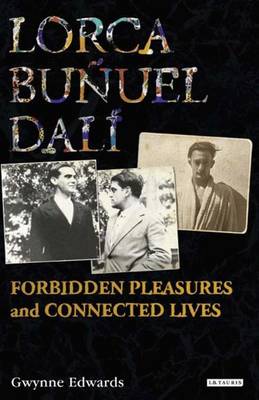
SPAIN BOOK REVIEW AUGUST: ‘Lorca, Buñuel, Dalí – Forbidden Pleasures and Connected Lives’ by Gwynne Edwards

Lorca, Buñuel and Dalí were, in their respective fields of poetry and theatre, cinema, and painting, three of the most imaginative creative artists of the twentieth century; their impact was felt far beyond the boundaries of their native Spain. But if individually they have been examined by many, their connected lives have rarely been considered. It is these, the ties that bind them, that constitute the subject of this illuminating book.

They were born within six years of each other and, as Gwynne Edwards reveals, their childhood circumstances were very similar, each being affected by a narrow-minded society and an intolerant religious background, which equated sex with sin. All three experienced sexual problems of different kinds: Lorca, homosexual anguish, Buñuel sexual inhibition, and Dalí virtual impotence. They met during the 1920s at the Residencia de Estudiantes in Madrid, which channelled their respective obsessions into the cultural forms then prevalent in Europe, in particular Surrealism. Rooted in such turmoil, their work — from Lorca’s dramatic characters seeking sexual fulfilment, to Buñuel’s frustrated men and women, and Dalí’s potent images of shame and guilt — is highly autobiographical. Their left-wing outrage directed at bourgeois values and the Catholic Church was sharpened by the political upheavals of the 1930s, which in Spain led to the catastrophic Civil War of 1936-39. Lorca was murdered by Franco’s fascists in 1936. This tragic event hastened Buñuel’s departure to Mexico and Dalí’s to New York and Edwards relates how for the rest of his life Buñuel clung to his left-wing ideals and made outstanding films, while the increasingly eccentric and money-grubbing Dalí embraced Fascism and the Catholic Church and his art went into steep decline.

cover art and blurb via amazon

~~

I can’t remember where I got this book – probably on one of my book buying binges (say that three times fast) – but it has sat unread on my shelves for to-reads. Since I wrote my Lorca 80th anniversary article just over a week ago, I thought I could dedicate this month’s book review to the man as well.

Federico García Lorca, Manuel Buñuel and Salvador Dalí are three very well-known men. All born wealthy around the turn of the century, by the early 1920’s they were already established in their fields: Lorca with his writing, Buñuel with plays and film creation and Dalí with his painting. Each was rare and unique in a world filled with many artists exploding onto the European scene at the time. All housed at the Residencia de Estudiantes in Madrid to study, these three artists came together to bond, collaborate and touch each others lives forever.

This book doesn’t necessarily reveal any new information about the trio, rather tells details, big and small, in a clean, easy-to-read way. Four pages in I was already enjoying the book, with its interesting yet gentle flow of the lives of these men. The book does lean on info about Lorca a lot, but he was always a strikingly interesting soul. The book discusses Lorca’s love for Dalí in the 20’s, and doesn’t suggest impotent Dalí ever accepted any of the advances, but it doesn’t clearly say he didn’t either. These men have intensely interesting sex lives, each forever influenced (scalded?) with the Catholic faith. Lorca and his homosexuality interwoven with his depression, and pain of never having children, Buñuel and his religious thoughts that sex was sinful, even when married, and Dalí with his impotency, voyeurism and his wife’s need to find sex elsewhere. Every aspect of their lives is deeply shaped by what Spain was, and wanted to become.

Things became strained with the threesome in the late 20’s and early 30’s with Lorca leaving the country for some recuperation. Buñuel continued to live his strict, regimented lifestyle while pursuing films and abusing his wife, and Dalí continued to be a real dick (literally incapable of being a functional adult after a weird childhood), and showing off, plus his desire for fame and fortune totally went to his head. Lorca meanwhile continued to produce incredible works and establish his career. Then the war came along.

The outbreak of the civil war, and the state of Spain is well covered to the point the book needs, to show what the men faced. Lorca’s last weeks are well covered, from the moment he decided to leave Madrid for Granada to save his parents. Buñuel begged him not to go, as it would not be safe. Lorca’s time there and his attempts to help his beloved family are covered, along with his mysterious and tragic execution in the forest. There are many places in which to read about Lorca’s last days, but this book does a great job on the subject.

Buñuel went into exile in Paris, much different from Lorca’s need to jump headfirst into Spain’s crisis. Dalí was the opposite; he turned his back on his country and went off making money from rich Americans. When he was ready, Dalí and his wife returned to Spain as fascism lovers, supporting Franco, since that was the in-vogue thing to do. His life fell apart, and being so, well, douchey, Dalí had it coming. Buñuel too had moments of bad behaviour, though his art never suffered for it, continuing to create films on his own terms. In many, many writings and interviews, Buñuel continued to talk of Lorca, his work, and their time together, forever touched by their connection. After Lorca’s execution, Buñuel and Dalí unsurprisingly grew apart, and Dalí’s feelings for his murdered friend never really made sense, or could be trusted.

As I said, this book covers the lives of well-known men, so information isn’t necessarily new, but it does bring all very important parts together in one book, and shows the intertwining links of these three men, and the things which separated them. Never has Spain had such a generation of artists, and maybe never will again. A wonderful read.

This Week in Spanish Civil War History – Week 7: 29 August – 4 September 1936

Week 7: 29 August – 4 September 1936

Bonus: 28 August

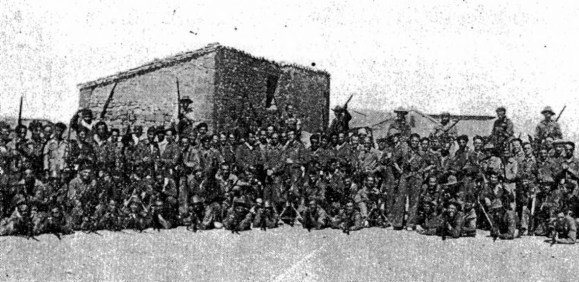
The battle of Monte Pelado, a mountainous area between Almudécar and Huescar, 300 kilometres west of Barcelona, is fought between the Nationalists and Republicans. The battle was significant because the Republicans, the Francisco Ascaso column, are Catalonian anarchists flanked by the Matteotti battalion, a group of Italian fighters who have freshly arrived in Spain to help. The Nationalists have around 500 soldiers on the mountain, a major gun emplacement. A four-hour dawn battle sees the Republicans win, though they suffer huge losses including prominent Italian anarchist Mario Angeloni. Many columns have been marching out of Barcelona since 17 August, now all placed west or southwest of the city, attempting to take control of major locations.

Anarchists and Italian volunteers in Monte Pelado

31 August

Just 30 kilometres north of of the town of Andújar (near Jaén), in the mountains of the national park, 1,200 right-wing supporters, including Guardia Civil members and women and children, are hiding in the Nuestra Señora de la Cabeza church sanctuary. The town was not initially taken by the Nationalists, and the Falange supporters fled into the hills to hide. They have now been hiding for over a month, surviving on stolen items in the mountains, and are ready to defend themselves in a major siege against the Republicans, which is only days from starting.

Santuario de la Virgen de la Cabeza before the battle begins

3 September

A battle begins in Talavera de la Reina, 140 kilometres west of Madrid. The Republicans have been unable to hold back Nationalist troops marching from Seville, and are constantly losing ground. The Nationalists have won hundreds of miles without any fighting, but the Republicans have 10,000 men in Talavera ready to block the troops’ way to Madrid.  The battle begins at dawn, with the Nationalists taking the train station and aerodome immediately. Many Republicans panic and flee the town, deserting their fellow fighters and the public. A full attack takes place throughout the day, and while the Nationalists lose 1,000 of their trained soldiers, they win the town, and killed 500 Republicans, and capture another 1,000 to execute or imprison. Now, the capital city of Madrid has nothing to protect it from vicious Colonel Yague and his soldiers.

Massacre at Talavera de la Reina

Two weeks after the Republicans surrounded the island of Mallorca, they have not made much progress in getting to the prime inland heart of the island. The Nationalists have soldiers and equipment, and planes to bomb the Republicans on the coastline. The Republicans retreat in a hurry, leaving behind weapons and equipment and even some of their men.

September 4

Already the Republican government is undergoing changes, and Francisco Largo Caballero replaces José Giral. The new government is made up of six Socialists, four Republicans, two Communists, plus a Republican representative of Catalonia and a Basque nationalist, bringing the two areas into the fold. The anarchists still refuse to join the government, despite fighting alongside them in battle. The CNT now have a solid voice in the government.

~~

This is not a detailed analysis, just a highlight (lowlight?) of the week’s events. Feel free to suggest an addition/clarification/correction below. All photos are linked to source for credit