This Week in Spanish Civil War History – Week 25: 1 -7 January 1937

January 1

By the 25th week of the war, neither side would be able to say their plans had been executed the way they hoped. The Nationalists had hoped to invade, take Madrid and rule the nation within weeks or months. The Republicans came together, multiple factions with similar principles, hoping to oust the fascists. At no stage were they prepared enough to see through their goals. 1937 would see Franco’s plans to take Spain become more established. Franco had much help from Hitler and Mussolini, while the Republicans still had the Soviets on their side, due to the large Communist faction in Spain. But with Republicans made up of many groups and no one clear leader, divisions were one of the main forces at play in the war, with Anarchists and Communists splitting constantly from the Socialists and workers’ militias. As with all wars, the regular people were constant losers.

January 3

The third battle for Corunna Road, just northwest of Madrid city, commences.  General Orgaz Yoldi has gained more Nationalist reinforcements and begins the offensive, known as the Battle of the Fog. The Nationalists retake the town of Boadilla del Monte, as the Republicans are still suffering from their earlier losses. The Republican have five divisions working together, along with the XIV International Brigades, but have little ammunition and have to surrender the town and that portion of the crucial supply route of Corunna Road.

January 4

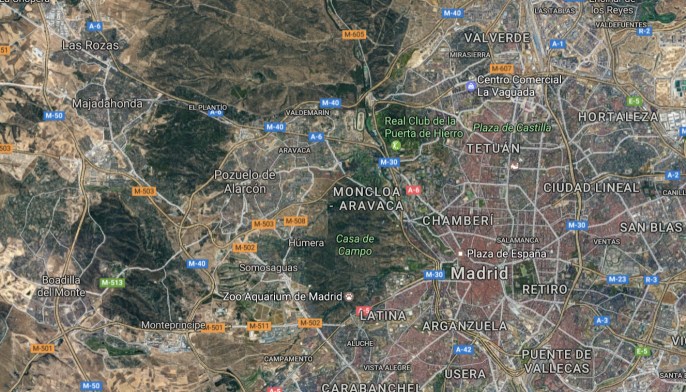
With surging numbers of Nationalist soldiers coming from the right, the Republicans have to retreat even further away from Boadilla del Monte and also lose the town of Las Rozas, just 11km north of Boadilla del Monte. The weather is at freezing point all day and night and the fog continues to make battle ever more difficult.

The Republicans deploy more units from Pozuelo, ten kilometers west of Madrid city. The Modesto division, a brigade of four units combined, manage to secure the front while other units retreat from advancing Nationalists. The fog continues to thicken, aiding to secure the front for the Republicans and keep the Nationalists at bay, though the strategic towns have been lost. But once the fog lifts, the Republicans know they are in trouble.

Some of the Thaelmann battalion prior to battle

January 5

As the fog lifts, the Nationalists, with 18,000 troops and air support, attack Pozuelo, where many Republican forces are in retreat. The Republicans run out of ammunition, including for the T26 tanks from Russia, which have destroyed 25 German tanks throughout the day. The Republicans have to scatter, without weapons or communication, being split by the attack. Republican General Miaja tries to get the German Thaelmann battalion of the XIV International Brigade back together, along with Lister’s Communist unit, in order to try to regroup. The Nationalists continue to widen their hold over Corunna Road and also take the opportunity to bomb the city of Madrid, mostly by day.

All of the XIV International Brigades are forced far back from Boadilla del Monte and the Nationalists have Corunna Road. They meet up with other Republican groups and are ordered to retake Las Rozas, but they lack the men or firepower to do so. Among the young foreigner volunteers was untrained machine-gunner 17-year-old Esmond Romilly, nephew of Franco-sympathiser Winston Churchill. (It was rumoured that Romilly was Churchill’s own son, Churchill having bedded his wife’s sister. The sisters’ mother was a notorious cheater, and their real father(s) is unknown. Several men are options, one being the grandfather of young Romilly’s wife – meaning the young couple were first cousins. The rich do like to make their own rules, and the family is fascinating/bizarre.)

January 7

The Nationalists bomb Las Rozas from the air, destroying the town and killing almost all the Republicans and International Brigades huddled nearby for safety. The locals of the town have already long fled, hiding in caves in the Hoyo de Manzanares mountains nearby. All but 35 Republicans are killed, those not killed manage to retreat wounded. Those foreigners who survived, such as young Romilly, are sent home with wounds and illness. Romilly went on to write a book named Boadilla, all about the slaughter of  the battle. The Nationalists are in total control of the area, and ready to begin their final push to control all of Corunna road. Both sides have now lost around 15,000 men each.

I’ll will post a review when I get the chance

~~

This is not a detailed analysis, just a highlight (lowlight?) of the week’s events. Things get lost in translation – Feel free to suggest an addition/clarification/correction below. The more the world remembers, the better. All photos are linked to source for credit.

Francoist Street Names Are Out. Women’s Accomplishments In Spain Are Finally In

2016 saw the 80th anniversary of the start of the Spanish Civil War, and the 41st celebration of Francisco Franco‘s death. Yet on many streets all over Spain, the men who fought and assisted Franco though his 39 years of war and dictatorship are still revered with street names, vile and cruel men who harmed untold thousands. It is long past time to remove these names, and the opportunity to name streets after women has finally arrived.

Spain’s political situation is a hot mess – the December 2015 election ended in a stalemate, and subsequent efforts for coalition and even new elections have produced not a lot. The left-wing Podemos party, made of newcomers and small groups coming together to gain power, have found their place in some cities, such as Madrid and Barcelona. Spain has the History Memory Law, enacted in 2007, which provides rules to allow the reburial of SCW victims, and removal of all Franco (and Franco cronies) monuments, dedications and street names (the law has a wide range of powers; this is just an example). While many cry about leaving the past in the past, those with a wider view want to put right as much as can possibly be done. It is time to use Article 15 of the memory laws to change the streets named after men who murdered their way to power and used fear to stay there.

Some examples of names changes is in Calle de Soledad Cazorla (Spanish link), named after Spain’s first female public prosecutor, who used her position to fight gender violence. Until now, the street was named after Andrés Saliquet (Spanish link), an old-school General and fascist party member, serving in the war and the dictatorship. The notorious General José Varela loses his street name to journalist Carmen de Burgos in Granada, likewise Federica Montseny, Spain’s first female minister, will replace Colonel Chápuli.  Madrid’s Plaza Caudillo (if you’re new, Franco was referred to as the Caudillo, the leader) will be Plaza Mayor in El Pardo.

Places like León have just 5% of female street names, Cadiz has just 3%. People ask why it matters – the naming of a street in your honour is a great privilege; it shows prominence. The lack of female names shows that they are considered better at home than out in the world. Women’s achievements are simply not being recognised in this traditional way of having a street in their honour in Spain. Madrid has 137 streets which are named after the Virgin Mary, but not streets named after real women. Women’s roles are confined to being imagined virgin saints, not actual accomplished members of a community.

Valencia has a new law, meaning that 80% of new names, or streets in need of a change, must be female names. In the Poblet area in the west of the city, eight new streets are needed, and are being decided by public suggestion. Author Carmen Martín Gaite is in the running, along with Las Trece Rosas, 13 women murdered by a firing squad in Madrid in 1939.

The northern city of Oviedo has 22 new streets, a majority going to women. Alicante has a new law ensuring women are included while 50 Francoist streets are removed, and northern Bilbao and southern Cadiz now have mandates in place guaranteeing female names. Cadiz has only eight female street names, all saints, a situation about to be rectified.  In Santander, a motion is in place to remove Francoism from the city and celebrate women, a move which has faced steady criticism (aka fascist man tears).

Without surprise, all this comes with its complainers. The usual cries of ‘that’s just complaining feminists, don’t indulge them’ is rife, with machismo still strong in Spain. Giving women the same rights and rewards as men scares many, as does the notion of altering traditions, even when traditions are inappropriate. Somehow, giving a street name to a fascist murderer is okay, as is keeping the name because ‘tradition’. Changing the name to erase an evil man from memory, and embracing a successful woman still frightens many delicate flowers.

The 2007 memory law has had little success in its nine years. Granada alone has 4,000 victims still dumped in mass graves, Seville has only reburied two of the 104 mass graves in the region. You only need to look at the maps of each region on the Historical Memory Association website to see how many mass graves (fosas) country-wide are ongoing. As family members of the victims pass away themselves, voices are becoming lost and the commitment to the past needs to be honoured. Trouble is, Europe is doing its terrifying swing to the right. Spain is no stranger to the Hitler-fascist salute, regularly done at Francoist sites (especially Valle de los Caídos), and Nazi groups have been springing into violence recently in Madrid. Spain needs to be un-Francoed as fast as possible, and that level of hate needs to be eliminated.

It can be easy to say that what happened in the Franco years is in the past and no longer relevant. But as long as dedications to remarkable women like Dolores Ibárruri are opposed by those in power (due to her left-wing work), the past is still haunting the present. Guadalajara, near Madrid, has the highest number of female street names at a tiny 9.5%, all-but named after virgins and saints. The names are dedicated to women who are bound in legend and many hundreds of years out of date. Women are overlooked in history, so inaccuracies are ever-present. Meanwhile, Spain has a plethora of successful feminists, leaders, scientists, teachers, and modern sports stars who could be honoured, yet are forgotten.  Why not Calle Maruja Mallo (artist), Avenida Clara Campoamor Rodriguez (suffragette), or Paseo Margarita Salas (biochemist). Spain needs more streets named after women like Ángela Iglesias Rebollar (Spanish link), murdered by Franco’s killers, remembered for their struggles.

It’s not like Spain isn’t in need of change; young women need role models, advertised the way men are exposed to their role models, and largely take for granted – because they’ve always been right in front of them. Why have streets and plazas named after Nazi-style killers when you can have streets named after María Mayor Fernández de Cámara y Pita, who fought against the English in 1589, or Manuela Malasaña Oñoro who saw off the French from Madrid in 1808, or pianist Alicia de Larrocha from Barcelona who was an extraordinary composer, or Rosalia Mera Goyenechea from A Coruña who became the richest female entrepreneur worldwide and used her riches to help other women, as such as fighting anti-abortion laws.

Another issue is not just the lack of female names, it’s irrelevance of those that do exist. Margaret Thatcher was given a plaza in Madrid, hardly a popular move. Madrid also has Calle de Quiñones,  homage to the first female run printing workshop, but without her full name, how can anyone look up Maria de Quiñones from the 17th century (did any of you reading this know that until now?).

Galicia is leading the way by looking through historical information to find forgotten women, as is Barcelona, and making sure people can find information about all people awarded a street name. The southern city of Córdoba has passed a law saying 50% of new names must be female, which currently boasts just 6% of female names.

My personal suggestions (in addition to the ones above) –

Isabel-Clara Simó i Monllor – Valencian writer, one of the most important writers in the Catalan language

Clara Campoamor Rodriguez – women’s right campaigner

Federica Montseny Mañé – first female cabinet member – minister of health

Carmen Amaya  – influential flamenco dancer

Alicia de Larrocha – extraordinary pianist and composer

Margarita Salas – biochemist and geneticist

Rosalia Mera Goyenechea – world’s richest female entrepreneur, co-founder of Zara

Rosa Montero Gayo – journalist and author

María de los Ángeles Alvariño González – fishery research biologist and oceanographer

Magdalena (Magda) Bermejo – primatologist

Emilia Espinoza Hazelip  – pioneer of the concept of synergistic gardening

Patri Vergara – professor in Physiology, first woman President of the International Council for Laboratory Animal Science

Dolors Aleu i Riera – first female Spanish doctor

Ana María Matute Ausejo – writer and member of the Real Academia Española

Emilia Pardo Bazán  – Galician novelist, journalist, essayist, critic and scholar

María Josefa Crescencia Ortiz Téllez- Girón/ Doña Josefa Ortiz de Domínguez – insurgent and supporter of the Mexican War of Independence

Rosalía de Castro – Galician writer and poet

It’s not about women being elevated above men, it’s about women being given their due. It’s about successful people (yes, women are people) not being forgotten, their accomplishments out there for all to remember.

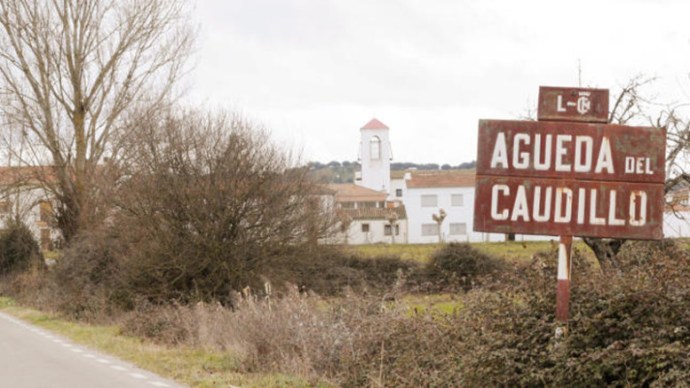
Sign at entrance to town of Águeda del Caudillo. Photo: Gaceta de Salamanca


This Week in Spanish Civil War History – Week 19 and 20: 21 November – 5 December 1936

division-of-spain-in-february-1937

Weeks 19 and 20: 21 November – 5 December 1936

“I will destroy Madrid rather than leave it to the Marxists” – Francisco Franco, November 1936

November 21

The Nationalists attack the Model prison and Don Juan barracks. Using bases by the Asilo Santa Cristina Hospital and Dr Rubio Research Institute, they manage to get as far as Parque del Oeste, but are bombed by their German counterparts.

The Commune de Paris column fighting for the Republicans recapture the Hall of Philosophy and Letters Building. Books are used to protect themselves inside. It takes around 350 pages to stop a bullet.

November 22

The ground assault in Madrid has failed and the Nationalists now only have their German pilots to bomb the city constantly, in an effort to weaken the Republican lines.

Carabanchel barricades after the fighting

November 23

Battle of Madrid ends with both sides decimated. Franco pulls back from the outskirts of the city with huge losses and no way into Madrid. The death toll on both sides is unknown after two weeks of killing, though around 2,000 civilians in the city have been killed, and some estimates say a total of 10,000 are dead on both sides. The aerial bombing has been a huge failure; while much of city has suffered serious damage, it hasn’t killed many people and the population are not afraid. The worst aerial bombing of Madrid is now over for the remainder of the war, as Republican supplies increase and pilots gain experience in fighting back. The Nationalists’ plans of storming their way into Madrid and taking the country is over, and now a war will have to rage for another 2.5 years. The Republicans hold the city with  the front line the Manazares River, around the Casa de Campo and Ciudad Universtaria in the north and the Carabanchel suburb in the south.

Madrid is left to clean up

November 27

Operation Ursula, a group a German submarines have been active in the Mediterranean. They had been out in the Atlantic for around a week, but enter the Med on around November 27 to take over patrols done by Italian submarines. They primarily survey Alicante and Cartagena, but have constant trouble identifying any targets coming and going from the ports and have constantly failing torpedos. The submarine operation is a total failure; only one Spanish submarine is sunk, and that was an internal error, though the Germans attempt to claim it as their success. They will sail out of the Mediterranean on December 3.

November 29

The First Battle of the Corunna Road starts, with the Nationalists retreating northwest from Madrid, so try to cut off the city by holding Corunna Road. The Republicans are ready and attack soldiers on the road, and keep the road open for Republican movements.  The fighting lasts for five days as Nationalists try to cut off water and electric supplies from the Sierra de Guadarrama to Madrid. Some 3,000 soldiers under Colonel Varela fight a single Republican brigade and lose, forcing a retreat. They take the small towns of Boadilla del Monte and Villanueva de la Cañada and wait to make another attack on the region.

November 30

The Villarreal Offensive starts, and fighting will last for a month. Basque soldiers, fighting on behalf of the Republicans want to launch an attack Vitoria, in order to pull Nationalist soldiers away from Madrid. The Basques have 4,300 men from the Basque Army and now want to take Villarreal.

The Basques are keen to fight but have little supplies and no aerial back-up. The Nationalists only have 600 men but they have machine guns, plenty of supplies, civilians on their side, and their planes from Burgos have already spotted incoming Basques.

The Basques move into the mountains around Vitoria and surround Villarreal, 3 kilometers from Vitoria. Heavy ground fighting sees 1,000 Basques killed and they do not take Villarreal. The first two weeks of battle sees constant fighting with no outcome, as back-up will not arrive until December 13.

Retreat is a common outcome for both sides at present

*Apologies for the delay, I have been in hospital. Posts will be two-weekly through December.

~~

This is not a detailed analysis, just a highlight (lowlight?) of the week’s events. Things get lost in translation – Feel free to suggest an addition/clarification/correction below. The more the world remembers, the better. All photos are linked to source for credit.

This Week In Spanish Civil War History Extra: José Antonio Primo de Rivera Executed

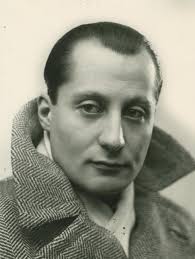
Would you look at this creep? Was there a vampire lookalike contest in Madrid?

José Antonio Primo de Rivera y Sáenz de Heredia, a mouthful of a name for a man who, at first glance, had a standard rich boy’s life, then got himself in with an equally awful man and got his name into history.

Born in Madrid on 24 April 1903, he got to inherit the noble title 3rd Marquis of Estella, from his father Miguel Primo de Rivera, Spain’s dictator through the 1920’s. He started with a typical aristocratic lifestyle, learning from home while being raised by his aunt, riding horses on the rich family’s estates, and then stumbled through university. Over six years, he received an excellent bachelors and doctorate in law while running a group opposing education policies. He graduated the same year his father became Spain’s dictator, assuming he could a better job than politicians. The sense of entitlement was huge in this family.

Baby Rivera went to do his one-year military service while Daddy Rivera started imposing his will on the country. Baby Rivera then got court-martialed for punching his superior officer. The officer had written a letter against Daddy Rivera and his son felt that violence would be the answer. But, naturally, a dictator’s son can hardly receive much of a punishment. (To be fair, the officer was Gonzalo Queipo de Llano, a nasty human being in his own right).

By 1925, Baby Rivera was back to being a lawyer in Madrid, working quietly in his office. With Spain going down the toilet for a variety of reasons, Daddy Rivera was forced to give up his hold on the country in early 1930, and died in Paris shortly after. Now, Baby Rivera was ready for politics.

Spain was in turmoil by the time of the 1931 election, and Rivera strangely ran for office as a monarchist for the Unión Monárquica Nacional party, and also oversaw (which was in opposing competition) the Agrupación al Servicio de la República. The monarchy fled Spain, and Second Republic was born. Rivera was on the wrong side of history. He managed to get his first arrest a year later in the 1932 Sanjurjo coup (also a failure).

But this young fascist was no quitter. By 29 October 1933, he launched his new Falange Española party in Madrid. His opening speech included his feeling that violence was important and democracy… not so important. He stressed that change could not come by elections, but by force. Despite a lack of serious numbers to the party, they could be noticed by the ‘right’ people (meaning rich and mean).

A month later, Rivera ran for office in the election again, for the Unión Agraria y Ciudadana, part of the CEDA (Confederación Española de Derechas Autónomas) group of parties. This time he won, to represent Cadiz in the far south. In February 1934, the Falange merged with the Juntas de Ofensiva Nacional-Sindicalista, and they became known as the Falange Española de las Juntas de Ofensiva Nacional-Sindicalista, with Rivera as leader. Then things really went south.

In early 1935, the Falangists started attacking Jewish stores, believing that violence was acceptable, because both Jews and Freemasons had too greater influence. Any meetings or rallies involving Rivera and the Falange were the scene of constant fighting and racism. The country was becoming a whirlpool of disaster – perfect for a violence-loving man like Rivera.

February 1936 saw another election, with the left-wing Popular Front winning. The Falangists only gained a mere 0.7% of the vote. But hate was on Rivera’s side. Despite the appalling turnout, right-wing sympathisers flocked to the tiny fascist party in the wake of the election, with 40,000 haters quickly signing up to the Falange. Suddenly the amount of voices spouting fascist rubbish was growing, stability was at nil, and the Falange were telling everyone to obey their leaders and prepare for burden.

Rivera hated everything. He spouted fascist rhetoric from Germany and Italy, despised democracy, had a thirst for war, believed women were useless, that people shouldn’t even be allowed to vote, and generally sounded like the Trump of his time. He liked to write poems, mostly about Spain being saved in its hour of truth, ruling with iron fists, blah blah.

Rivera got arrested in Madrid on 14 March 1936, on a charge of illegally possessing a firearm. They held him in custody for nine weeks and shipped him off to Alicante on the eastern coast. Sadly, things were too relaxed there and Rivera could still work with his party to be part of the group planning a military coup against the government. Rivera also wrote with General Franco, and had guns and ammo in his cell.

July 17 saw the outbreak of the Spanish Civil War, the Falange party standing alongside the rebels as the military rose up and killed thousands. Rivera remained behind bars, now in solitary confinement doing nothing while Spain burned. Franco was busy taking over a country with violence, but Rivera languished in jail. Franco never liked Rivera (calling him a foppish playboy) and Rivera played no role in the uprising. The Republicans even tried to swap Rivera for one of their prisoners, and Franco didn’t want him back. Franco took the rhetoric, took the support, and left Rivera to rot.

As Spain heaved through immense pain, it wasn’t until October 3 that Rivera got officially charged with conspiracy against the Republic and military insurrection. As a lawyer, he defended himself, with another failure on his part. He was convicted on November 18, and executed at dawn on November 20.

The Falange party was small, but they did one thing for Franco – while the soldiers were fighting on the front lines, the fascist nut-jobs were running in among the population, carrying out murders to aid the war. Franco had the army, and the fascists, the carlists and the monarchists, the churchmen and their followers, on his side, in every town and city. The Falange party was swallowed in 1937 when Franco killed their new leader, Rivera’s deputy, and gave the job to his brother (talk about a booby-prize). But Franco used Rivera, and his death, as propaganda. A facsist leader, embodying all the evil behaviour necessary to be a right-wing leader, was a great symbol for the haters who fought for Franco. Dead Rivera was named the 1st Duke of Primo de Rivera. When the war ended in 1939, Franco had Rivera’s body put in the royal El Escorial temporarily, and then moved in to Franco’s own super tomb, Valle de los Caídos, in 1959 at its grand opening. Franco also died on November 20, making the day a real super-freak anniversary.

Check out the anniversary of Franco dying  – The Beginners Guide to the 40th Anniversary of Franco’s Death

Check out the 80th anniversary of the death of someone great instead – 80 Years Since The Death of Buenaventura Durruti – 20 November 1936

~~

This is not a detailed analysis, just a highlight of Rivera’s life. Unlike most posts, there is no room for comments, as I don’t want to talk to anyone who supports fascism. I also do not want any more photos of him, his work, his Falange symbols or anything else on my site.

This Week in Spanish Civil War History – Week 18: 14 – 21 November 1936

Week 18: 14 – 21 November 1936

Simplified if you don’t read Spanish –

Numbers are labelled by position of where which column (group) is located on November 16-17. Blue squares are Nationalist, Red are Republicans, and orange are French (and associated supporters) supporting the Republicans. Grey lines – front line. Stars – volunteers in position. Blue arrows – Nationalists making their attack. Spotted blue arrows – aircraft flights, with bombs dropped (blue dots).

November 15

Nationalist soldiers (Morrocan regaulres and Legionaires)  cross the Manzanares River and take over in Ciudad Universitaria (University City). The XIth International Brigade for the Republicans men counter attacks at the ‘Hall of Philosophy and Letters’, however the whole column make it over the river. The Republican factions take the Hall and force the Nationalists to either be killed or run for cover, with over 85% being killed as they flee.

Nationalist soldiers make it as far as  Plaza de la Moncloa inside Madrid, some as far as  Plaza de España in central Madrid before being attacks by the Durruti Column and forced out again. At this point, most bridges over the Manzanares River are now destroyed.  The Nationalists build the ‘pasarela de la puerte’ (passageway of death), a makeshift bridge, which comes under machine gun from the university all day long.

November 17

The Nationalists take the Asilo Santa Cristina Hospital. The Republican Durruti Column attack them, and stretch out to fight in University City and the Casa de Campo. But the  Durruti Column does not have enough supplies and need to retreat back to University City.

November 18

Italy and Germany both recognise Franco as the head of the new Spanish ‘government’. After over a week of battling over Madrid, the leaders all expect Madrid to be taken. Franco is ready to take all the credit but has barely lifted a finger himself in the bloody battle for control.

German aircraft are still bombarding Madrid. This is done to weaken the Republican government into surrendering (though the official government has already gone), and to hurt civilians. The Germans are throwing everything at Madrid in a bid to strengthen their ties to the new Spanish government led by Franco.

The attack north of central Madrid in University City is now three days old and is at breaking point. The Anarchist Durruti Column from Barcelona has been at the front line the whole time, and now their 3,000 strong column is down to only 400 men. The Nationalist side too have lost 1290 men. The University City suburb is largely cut off from central Madrid but neither side have any advantage.

November 19

The Durruti Column launches its dramatic big assault in University City. The Nationalists have taken the hospital and the Buenaventura Durruti men launch an attack.  The Republicans are under prepared and have little supplies; the Nationalists are not used to combat in urban areas. Fighting results in 262 Nationalist killed with no ground gained at all. The Nationalist leaders, Colonel Yague and Colonel Mola are both close to losing faith as they do not want to fight in close quarters, a fight they cannot win.

The Nationalist and Republican/International Brigades fight for control if the Hospital Clínico in the east of the University City. After heaving fighting, the sides fight with grenades and bayonets, one room and floor at a time. Both sides suffer heavy losses.

The outskirts of the city

Buenaventura Durruti is shot while on the front line in the early afternoon in the Casa de Campo.  A bullet pierces his right lung, possibly entering through his back. No one knows (or claims to not know) what actually happened. Which weapon shot him is unknown, and some speculate he was shot by his own side rather than the enemy. The true story will never be definitively uncovered.

NB: There will be a ‘This Week in Spanish Civil War History; Extra’ on Durruti on November 19, including eye-witness accounts of his death and the ‘cover-up’ story.

November 20

Buenaventura Durruti dies at 6 a.m, 16 hours after being shot in the chest. He is aged just 40 and it strikes not just a blow to end his life but also to the end of the propaganda surrounding the Durruti Column, a huge blow to the Anarchists. Durruti dies in the Ritz Hotel, which is now a makeshift hospital, and the bullet is not taken out of his heart. No autopsy is performed.

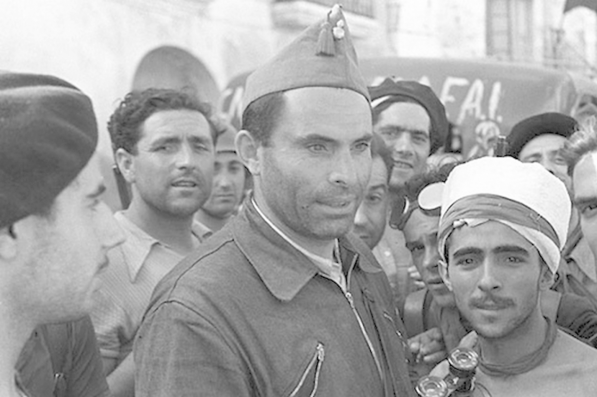
Buenaventura Durruti – anarchist fighter (and character in my next SCW novel)

November 20

Another 294 Nationalists die while fighting to take Carabanchel and Vertice Basurero to the south of Madrid. Again no gains are made in the urban assault, weakening the entire plan to take Madrid  by force.

José Antonio Primo de Rivera, son of former Spanish dictator Miguel Primo de Rivera is executed in Alicante, two days after being sentenced. Primo de Rivera has been a prisoner there since the start of the war. The Communists holding him decide to try him in a civil court before a Communist governor, as they can no longer wait a decision from the government. He is the leader of the fascist Falange party, and is killed by firing squad at dawn.  Spanish PM Largo Caballero is angered at the Communists for taking their own action, but the Republicans rely so heavily on Soviet supplies and men. The Spanish Communist party is continuing to strengthen and is becoming a state within a state.

NB: There will be a ‘This Week in Spanish Civil War History; Extra’ on Primo de Rivera on November 20.

Jose Antonio Primo de Rivera – Fascist leader

November 21

The Nationalists attack the Model prison and Don Juan barracks. Using bases by the Asilo Santa Cristina Hospital and Dr Rubio Research Institute, they manage to get as far as Parque del Oeste, but are bombed by their German counterparts.

The Commune de Paris column fighting for the Republicans recapture the Hall of Philosophy and Letters Building. Books are used to protect themselves inside. It takes around 350 pages to stop a bullet.

The siege is now days away from its end.

Books as protection seen by Robert Capa

~~

This is not a detailed analysis, just a highlight (lowlight?) of the week’s events. Feel free to suggest an addition/clarification/correction below. All photos are linked to source for credit