Francoist Street Names Are Out. Women’s Accomplishments In Spain Are Finally In

2016 saw the 80th anniversary of the start of the Spanish Civil War, and the 41st celebration of Francisco Franco‘s death. Yet on many streets all over Spain, the men who fought and assisted Franco though his 39 years of war and dictatorship are still revered with street names, vile and cruel men who harmed untold thousands. It is long past time to remove these names, and the opportunity to name streets after women has finally arrived.

Spain’s political situation is a hot mess – the December 2015 election ended in a stalemate, and subsequent efforts for coalition and even new elections have produced not a lot. The left-wing Podemos party, made of newcomers and small groups coming together to gain power, have found their place in some cities, such as Madrid and Barcelona. Spain has the History Memory Law, enacted in 2007, which provides rules to allow the reburial of SCW victims, and removal of all Franco (and Franco cronies) monuments, dedications and street names (the law has a wide range of powers; this is just an example). While many cry about leaving the past in the past, those with a wider view want to put right as much as can possibly be done. It is time to use Article 15 of the memory laws to change the streets named after men who murdered their way to power and used fear to stay there.

Some examples of names changes is in Calle de Soledad Cazorla (Spanish link), named after Spain’s first female public prosecutor, who used her position to fight gender violence. Until now, the street was named after Andrés Saliquet (Spanish link), an old-school General and fascist party member, serving in the war and the dictatorship. The notorious General José Varela loses his street name to journalist Carmen de Burgos in Granada, likewise Federica Montseny, Spain’s first female minister, will replace Colonel Chápuli.  Madrid’s Plaza Caudillo (if you’re new, Franco was referred to as the Caudillo, the leader) will be Plaza Mayor in El Pardo.

Places like León have just 5% of female street names, Cadiz has just 3%. People ask why it matters – the naming of a street in your honour is a great privilege; it shows prominence. The lack of female names shows that they are considered better at home than out in the world. Women’s achievements are simply not being recognised in this traditional way of having a street in their honour in Spain. Madrid has 137 streets which are named after the Virgin Mary, but not streets named after real women. Women’s roles are confined to being imagined virgin saints, not actual accomplished members of a community.

Valencia has a new law, meaning that 80% of new names, or streets in need of a change, must be female names. In the Poblet area in the west of the city, eight new streets are needed, and are being decided by public suggestion. Author Carmen Martín Gaite is in the running, along with Las Trece Rosas, 13 women murdered by a firing squad in Madrid in 1939.

The northern city of Oviedo has 22 new streets, a majority going to women. Alicante has a new law ensuring women are included while 50 Francoist streets are removed, and northern Bilbao and southern Cadiz now have mandates in place guaranteeing female names. Cadiz has only eight female street names, all saints, a situation about to be rectified.  In Santander, a motion is in place to remove Francoism from the city and celebrate women, a move which has faced steady criticism (aka fascist man tears).

Without surprise, all this comes with its complainers. The usual cries of ‘that’s just complaining feminists, don’t indulge them’ is rife, with machismo still strong in Spain. Giving women the same rights and rewards as men scares many, as does the notion of altering traditions, even when traditions are inappropriate. Somehow, giving a street name to a fascist murderer is okay, as is keeping the name because ‘tradition’. Changing the name to erase an evil man from memory, and embracing a successful woman still frightens many delicate flowers.

The 2007 memory law has had little success in its nine years. Granada alone has 4,000 victims still dumped in mass graves, Seville has only reburied two of the 104 mass graves in the region. You only need to look at the maps of each region on the Historical Memory Association website to see how many mass graves (fosas) country-wide are ongoing. As family members of the victims pass away themselves, voices are becoming lost and the commitment to the past needs to be honoured. Trouble is, Europe is doing its terrifying swing to the right. Spain is no stranger to the Hitler-fascist salute, regularly done at Francoist sites (especially Valle de los Caídos), and Nazi groups have been springing into violence recently in Madrid. Spain needs to be un-Francoed as fast as possible, and that level of hate needs to be eliminated.

It can be easy to say that what happened in the Franco years is in the past and no longer relevant. But as long as dedications to remarkable women like Dolores Ibárruri are opposed by those in power (due to her left-wing work), the past is still haunting the present. Guadalajara, near Madrid, has the highest number of female street names at a tiny 9.5%, all-but named after virgins and saints. The names are dedicated to women who are bound in legend and many hundreds of years out of date. Women are overlooked in history, so inaccuracies are ever-present. Meanwhile, Spain has a plethora of successful feminists, leaders, scientists, teachers, and modern sports stars who could be honoured, yet are forgotten.  Why not Calle Maruja Mallo (artist), Avenida Clara Campoamor Rodriguez (suffragette), or Paseo Margarita Salas (biochemist). Spain needs more streets named after women like Ángela Iglesias Rebollar (Spanish link), murdered by Franco’s killers, remembered for their struggles.

It’s not like Spain isn’t in need of change; young women need role models, advertised the way men are exposed to their role models, and largely take for granted – because they’ve always been right in front of them. Why have streets and plazas named after Nazi-style killers when you can have streets named after María Mayor Fernández de Cámara y Pita, who fought against the English in 1589, or Manuela Malasaña Oñoro who saw off the French from Madrid in 1808, or pianist Alicia de Larrocha from Barcelona who was an extraordinary composer, or Rosalia Mera Goyenechea from A Coruña who became the richest female entrepreneur worldwide and used her riches to help other women, as such as fighting anti-abortion laws.

Another issue is not just the lack of female names, it’s irrelevance of those that do exist. Margaret Thatcher was given a plaza in Madrid, hardly a popular move. Madrid also has Calle de Quiñones,  homage to the first female run printing workshop, but without her full name, how can anyone look up Maria de Quiñones from the 17th century (did any of you reading this know that until now?).

Galicia is leading the way by looking through historical information to find forgotten women, as is Barcelona, and making sure people can find information about all people awarded a street name. The southern city of Córdoba has passed a law saying 50% of new names must be female, which currently boasts just 6% of female names.

My personal suggestions (in addition to the ones above) –

Isabel-Clara Simó i Monllor – Valencian writer, one of the most important writers in the Catalan language

Clara Campoamor Rodriguez – women’s right campaigner

Federica Montseny Mañé – first female cabinet member – minister of health

Carmen Amaya  – influential flamenco dancer

Alicia de Larrocha – extraordinary pianist and composer

Margarita Salas – biochemist and geneticist

Rosalia Mera Goyenechea – world’s richest female entrepreneur, co-founder of Zara

Rosa Montero Gayo – journalist and author

María de los Ángeles Alvariño González – fishery research biologist and oceanographer

Magdalena (Magda) Bermejo – primatologist

Emilia Espinoza Hazelip  – pioneer of the concept of synergistic gardening

Patri Vergara – professor in Physiology, first woman President of the International Council for Laboratory Animal Science

Dolors Aleu i Riera – first female Spanish doctor

Ana María Matute Ausejo – writer and member of the Real Academia Española

Emilia Pardo Bazán  – Galician novelist, journalist, essayist, critic and scholar

María Josefa Crescencia Ortiz Téllez- Girón/ Doña Josefa Ortiz de Domínguez – insurgent and supporter of the Mexican War of Independence

Rosalía de Castro – Galician writer and poet

It’s not about women being elevated above men, it’s about women being given their due. It’s about successful people (yes, women are people) not being forgotten, their accomplishments out there for all to remember.
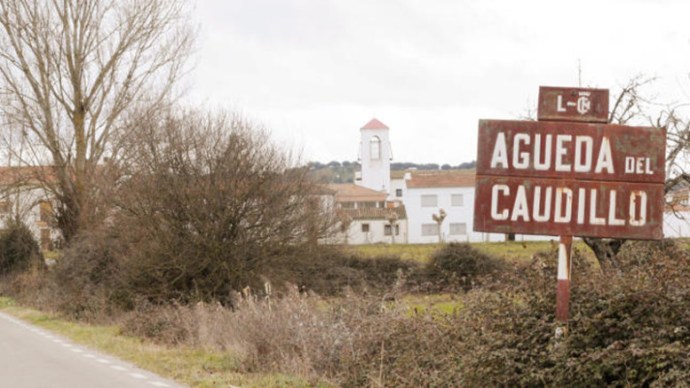
Sign at entrance to town of Águeda del Caudillo. Photo: Gaceta de Salamanca


This Week In Spanish Civil War History Extra: 80 Years Since The Death of Buenaventura Durruti – 20 November 1936

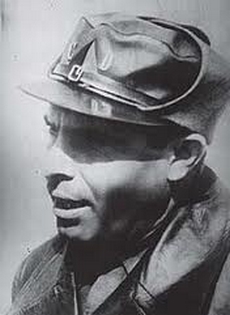
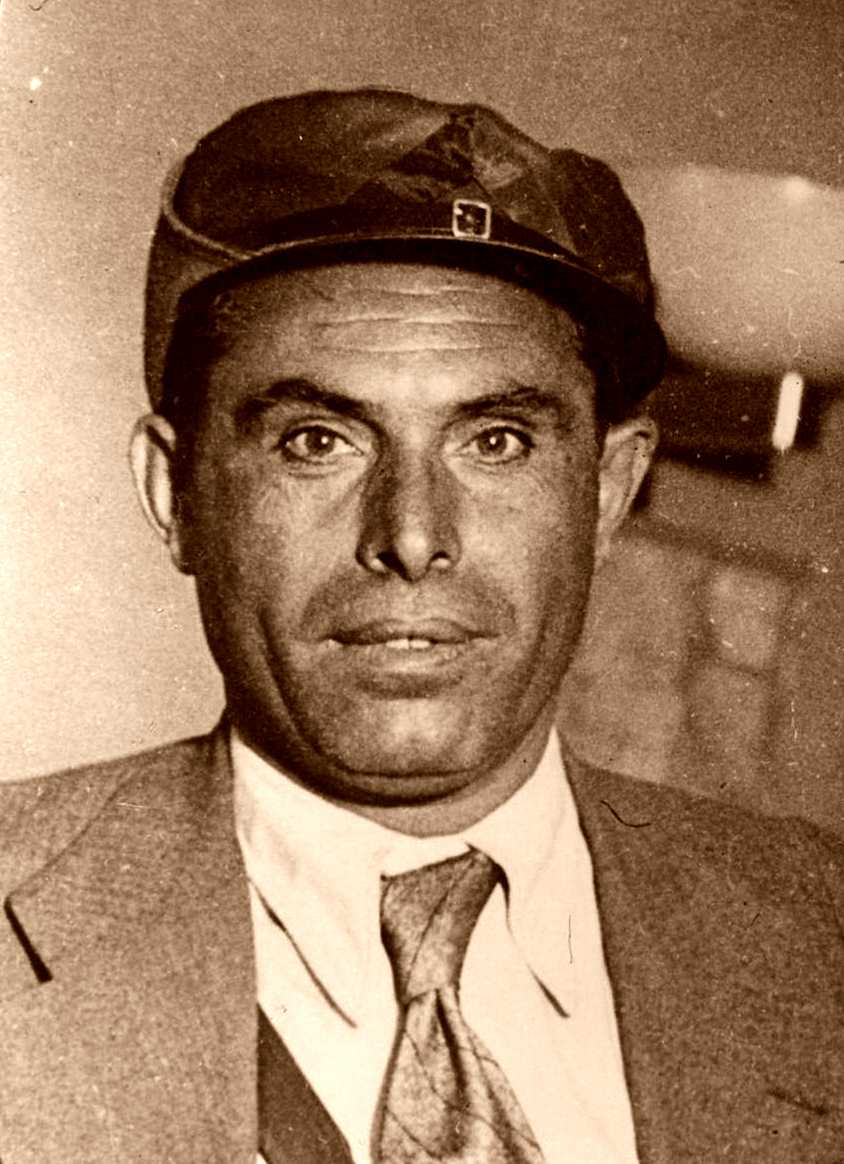
José Buenaventura Durruti Dumange was born 14 July 1896 in León, northwest Spain, as the second of eight boys born to Anastasia Dumangue, and Santiago Durruti, a railway worker and self-described socialist.

Durruti left school at 14 and started as mechanic on the railway with his father. The pair became members of the UGT, Unión General de Trabajadores (socialist General Workers Union). This quiet start to life changed in August 1917, when the UGT took part in a strike, when the government struck down an agreement between unions and their employers. To stop the general strike, the army was brought in to stop them, killing 70 and harming another 500. Another 2,000 were jailed without being tried for any crime. Young Durruti escaped the fighting, but exiled himself to France for safety, where he found company in fellow anarchists over the border.

The harsh treatment by the Spanish government on its people changed Durruti forever. He made his way to Paris and worked there as a mechanic for three years, before deciding to return home. He got over the border and onto nearby city San Sebastian on the northern coast. By now he was an anarchist, and set up his own group named Los Justicieros (The Avengers) with well-known local anarchists Suberviola, Ruiz, Aldabatrecu and Marcelino del Campo, and others keen to fight. While Durruti had been in Paris, thousands of workers had been fighting, jailed or killed by the government while defending their rights, and Durruti wanted a high place in helping them all.

On 15 August 1921, San Sebastian had the inauguration of the Gran Kursaal, a beautiful La Belle Époque style building for the city, with casinos, restaurants and a flourish of the cosmopolitan city’s wealth. King Alfonso XIII attended the opening, and Los Justicieros made their first large play – to assassinate the King. The King, a symbol of all workers were oppressed by, was already under fire for losing 10,000 soldiers in Morocco a month earlier, and had suffered assassination attempts before, but Durruti’s plan failed.

buenaventuradurrutiSoon after this failure, Durruti got approached by the leader of the CNT, Confederación Nacional del Trabajo (National Confederation of Labour), a strong anarchist union. Durruti took the offer of going to Barcelona, where workers and CNT members were being jailed, harmed and killed by the government. Members of the Los Justicieros including Durruti moved to Barcelona, where Durruti met Francisco Ascaso and Juan García Oliver, men, along with other prominent anarchists, would become from friends and start the Los Solidarios (Solidarity) group in early 1922. By this time, members  of the CNT including their president were being assassinated, thrown in jail, or hurt in armed stand-offs as people tried to defend themselves and their fights against the government.

In 1923, Durruti and Ascaso carried out the assassination of Cardinal Juan Soldevilla y Romero, a man wealthy on gambling and hater of the common man. That year was huge in Spain, with Miguel Primo de Rivera taking power in Spain and launching his dictatorship of the nation. Durruti, Ascaso and their allies retaliated by launching attacks on military barracks both in Barcelona and along the border stations which led into France. Often, these attacks harmed more anarchists than government supporters. With so many unsuccessful attempts to upset the regime, Durruti, Ascaso and Oliver left Spain. They went to Cuba, before travelling South America, robbing banks throughout Argentina and Chile. All Latin American countries have been told of Durruti, and he wasn’t safe anywhere.

In 1924, Durruti and Ascaso sent to Paris, to again attempt to assassinate King Alfonso XII. Another failed attempt saw both men in jail for a year. Release saw them awaiting extradition to be executed in Argentina, after being convicted in their absence for crimes committed there. But the French anarchists rose up, and the pair were not extradited, but were exiled from France. They fled to Germany, but were denied asylum, and Belgium and Luxembourg offered no help. They fled back to Paris, and lived in secret on the charity of anarchist sympathisers. They moved to the French city of Lyon but were caught by police, so fled illegally to Belgium before making their way back to Germany. Germany again refused asylum and Belgium took them in after a change of heart. Through all this, the USSR were becoming interested in Durruti’s rising status, but the pair refused to take up ‘communist hospitality’ and live in Russia.

Meanwhile in Spain, a secret anarchist meeting in Valencia saw the opening of the FAI, Federación Anarquista Ibérica (Iberian Anarchist Federation) to bring together various militant groups working for the anarchist cause, and become part of the CNT.

It wasn’t until 1931 when the monarchy was overthrown and exiled, and the Republican government won elections did Durruti and Ascaso came home to Spain. Durruti was influential now, and his presence stirred already-forming splits within the anarchist CNT. Arguments about supporting the Republican government formed, splitting the CNT in two, with the leader Angel Pestaña leaving to form a new party and support the government, and loyal CNT/FAI members, including Durruti, to remain loyal to their anarchist principles. Throughout the year, workers were being killed for striking, with hundreds killed in Barcelona, Seville and elsewhere. Durruti and Ascaso kept robbing banks to give money to workers, but change was coming. Durruti married and had a baby on the way, and he needed to step back.

But in January 1932, the Catalonian FAI staged a violent uprising, and the army retaliated by arresting 120 prominent anarchists, Durruti and Ascaso among them. All were immediately deported to Spanish Guinea, Durruti separated from his wife and two-month-old baby. But continuing surges in violence saw the army back down, and all were sent back to mainland Spain three months later. On his return, he tried to play it safe, with what are called his black years. He joined the Textile Workers’ Syndicate in Barcelona and did factory work, but he was constantly hounded by police for his constant work for unions and the anarchist movement.

By October 1934, Spain was in near collapse. Uprisings by Catalan Nationalists in Barcelona, Madrid and the northern Asturias region saw massive violence. In the Asturias, where workers were well organised, with anarchists, socialists, Stalinists and neo-Trotskyists all working together against their enemy, the Catholic church and the government. The University of Oviedo and the Bishop’s Palace were destroyed, churches we burned, priests shot and nuns raped. Coal miners were striking, and General Franco and his army were sent in to quell drama, killing 1,300 people, mostly the coal miners. Another 3,000 were wounded and another 30,000 jailed, mostly in the Asturias region. The violence saw the rich moving towards fascism to keep themselves safe, while the workers of the country continued to spiral against a system crushing them. The government, now the right-wingers, were looking for blood.

By February 1936, the Republicans returned to power, with full socialist support, but not with the huge anarchist movement, or the smaller communist supporters. Now, the ever increasingly angry fascists, the wealthy and the right-wing religious were ready to pull down the government. Durruti was still in Barcelona, and was forced into hospital in July for hernia surgery, just as war would break out.

The rich right-wing haters declared a rebellion on July 17, but fighting did not reach Barcelona until the 19th. Durruti, with his wound still open, left hospital and took up arms to squash the army and police seizing the government. Fighting in the streets went on for hours, and the workers, the civilian militia, were winning. At dawn on July 20, Durruti and best friends Ascaso launched an assault on one of the two remaining army barracks not defeated, but Ascaso was shot and killed alongside Durruti as they ran towards the soldiers.

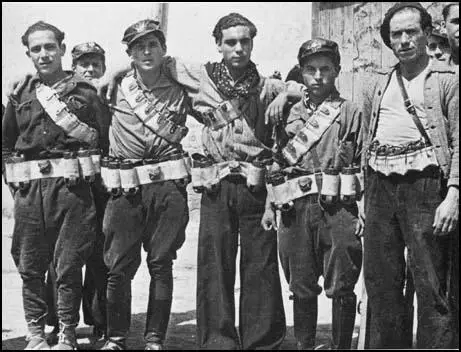
Durruti Column members

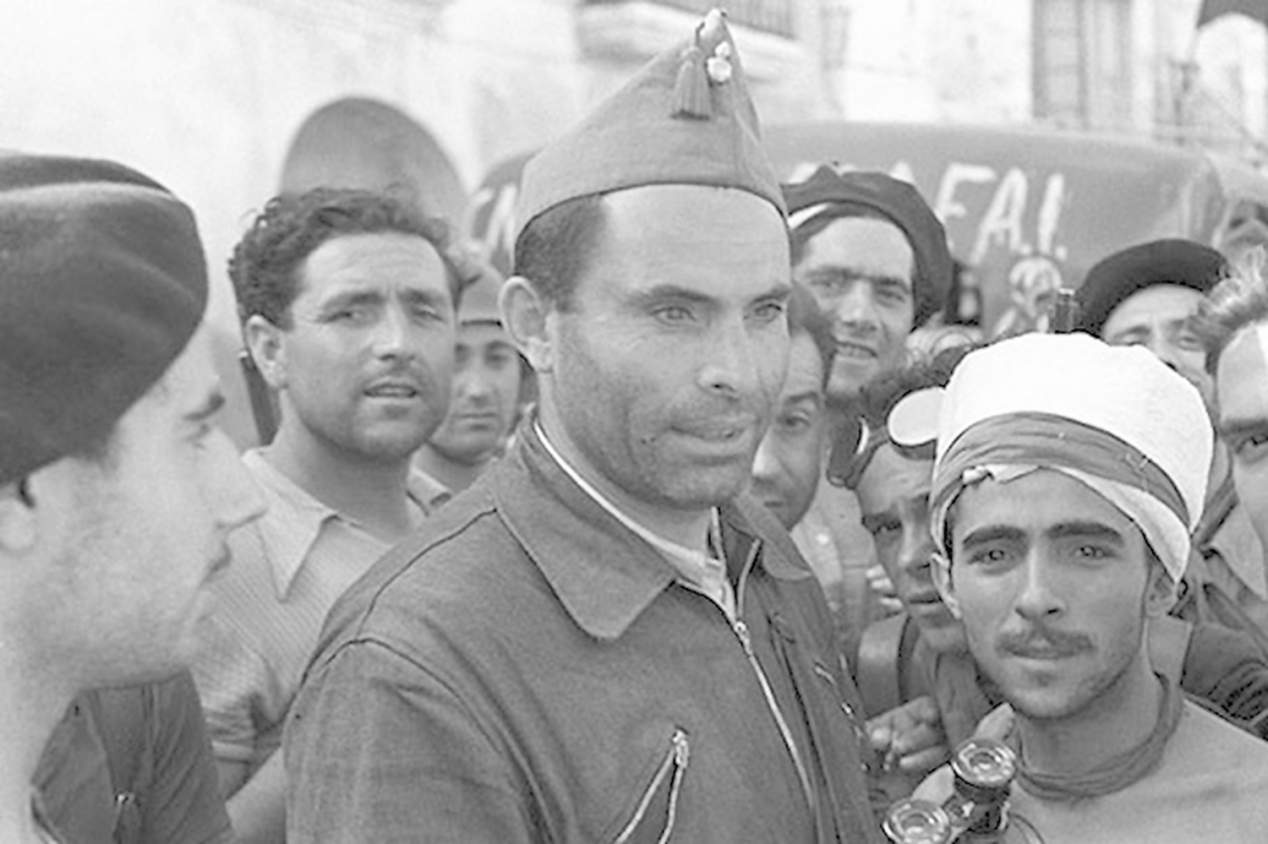
A day later, Durruti along with his other longtime companion Oliver visited the Catalan government leader, still dirty and armed from the attack. They negotiated for the anarchists to join the government and rise up together. The Anti-Fascist Militia’s Committee was formed, bringing together all groups the CNT, the FAI, the UGT, the neo-Trotskyists and a number of Republican groups, taking over as government of Catalonia. Just a week later, teamed with Ascaso’s brother, Durruti and Oliver they formed the ‘Durruti column’ a band of men loyal and ready to take back Spain.

On July 23, Durruti left Barcelona with 1,000 men, ready to save nearby Zaragoza from the army. By the time they marched to Zaragoza, they had between 8,000 and 10,000 men, while other columns worked on saving smaller towns, this large group prepared to save Zaragoza city, though the attack never occurred.  By now, as much of Spain was controlled by the fascists and the army, with people being executed by the thousands, but the Aragon and Catalonia regions were in anarchist hands.

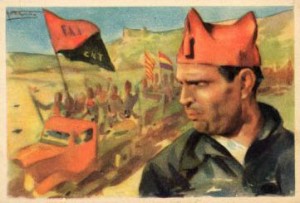
Popular propoganda poster

The Durruti column set out for Madrid, and the group of around 3,000 marched the 350kms to the capital. They arrived on 12 November, just as International Volunteers also arrived to help fight back the siege on the capital. The Durruti Column fighters battled mostly in the north of the city in the Ciudad Universitaria region. Madrid was under full siege, with German planes bombing at night, soldiers attacking by day in every direction, with no escape.

The tide was starting to turn; the Republicans, their supporters and the volunteers were starting to hold off the army. But on November 19 at around 2pm, Durruti was shot in the chest while in the northern region of Madrid. Little was said about the incident as Durruti was rushed to the Ritz Hotel, now a makeshift hospital and surgical theatre. There was little that could be done, and Durruti died at 6am, November 20. The bullet was not even taken from his heart, where it was lodged. He was only 40.

The news of Durruti’s death spread fast, and calls for his body to go home to Barcelona and his family were made. No autopsy was performed on his body, so the calibre of the bullet was not recorded. This made it harder to certify what happened.

The story emerged that Durruti was shot by a sniper. His driver said he had stopped his car on Avenida de la Reina Victoria, the area totally destroyed near the Hospital Clinica. He saw some of the militia leaving the front, and ordered them to return. As Durruti returned to the car, bullets came flying from surrounding destroyed buildings. As Durruti tried to get in the car, a sniper’s bullet shot him in the chest.

Republicans fighting in northern Madrid

This story was relayed over and over, everyone assuming their leader to have died a hero. On November 22, his body arrived back in Barcelona, and half a million people poured in to join the funeral procession. They followed to Montjuïc cemetery where he was laid to rest, and his funeral was the last large gathering of anarchists throughout the rest of the war.

Barcelona funeral

To some, Durruti was a criminal and a bully. To others, he was their salvation against the oppressors. His stories and actions were used for morale and propaganda to help the Republicans cause; this asset now lost. But the story of him dying in a haze of sniper’s bullets continued to circulate, a propaganda story in itself.

But later inquires heard of different stories, from the men who claimed to witness Durruti’s death. Rather than killed by the hiding enemy, the story told was one of simpler disaster. It was said, while planning an attack, one of Durruti’s friends shot him, when a rifle went off by accident. This friendly fire was a common problem due to the poor quality supplies the Republicans fought with. Other rumours suggested Durruti was planning an attack, a sort of suicide mission, and someone shot him to prevent it, though none of that was ever proven. The accidental shooting stayed quiet, the snipers story better to rally the cause.

The Durruti Column was broken up and folded into other groups several months later and while the war did not end until 1 April 1939, the battle to hold Madrid and the Aragon/Catalonia/Valencia regions were the only large success the Republicans had, before eventually falling and suffering another dictatorship for almost 40 years.

~~

This is not a detailed analysis, just a highlight of Durruti’s life. Things get lost in translation – Feel free to suggest an addition/clarification/correction below. The more the world remembers, the better. All photos are linked to source for credit.

This Week In Spanish Civil War History – Week 1: July 17 – 24 1936

Here is the first installment of a new series, a weekly post chronicling the Spanish Civil War, 80 years after the uprising in July 1936. The Spanish Civil War is a complex subject, but if you are new, here is a super simple round-up.

A country with a rocky past, but the more recent Spanish troubles started in 1931, when the monarchy was exiled, creating the Second Spanish Republic. Left-wingers won an election, but as people tried fighting for basics, like fair wages, workers’ rights, women’s rights, education etc, nothing went well, no one agreed, and right-wing conservatives and the church resisted in every which way. Power switched in every direction, but when the Republican left-wing Popular Front took power in February 1936, the military considered an uprising to restore conservative control. Tensions ran high for several months, and when several prominent left and right-wing leaders were murdered in Madrid in July, the match was lit for battle.

The Republicans, the Spanish left, consisted of the Popular Front government, combined with socialists, communists, anarchists, workers’ unions, Marxists, leaders of autonomous Spanish regions like Catalonia and Galicia, and later the International Volunteers. The Spanish right consisted of the military, the Falange fascists, the religious Carlists and the monarchists.

People quickly had to decide which side they were on, though this would have been obvious in most people’s lives already. Within days, thousands were killed for being on the ‘wrong’ side, depending on the consensus of their town or city. What happened next was three years of bloody murder, fighting and executions.

Week 1 – July 17-24 1936

July 17

A military rebellion starts in Morocco, with the Spanish Legion soldiers killing or imprisoning their Generals. Guardia Civil police try to hold back the military in Tetuán and  Larache, resulting in bloody battles. Within a day, Spanish Morocco has fallen to the rebel soldiers. Three Generals – Franco, Mola, and Sanjurjo, all recently demoted within the army, have set up much of the plans. Franco declares a state of war, a call for soldiers to rebel all over mainland Spain and take control of their towns and cities. Anyone who resists gets a bullet.

The Prime Minster, Santiago Casares Quiroga, does nothing to arm the population of Spain, instead spending all day on the phone, ensuring no military barracks decide to rise up in support of the angry Generals.

Armed workers’ militia in July 1936

July 18

Word has spread and the socialists, communists, anarchists and workers’ unions are ready to fight to preserve the Republican government. By dawn, Pamplona, Segovia, Cadiz, Avila, Salamanca and Zaragoza are already overcome by the military, with many deaths. Zaragoza was a stronghold of the anarchists, so it is a huge blow to the Republicans.

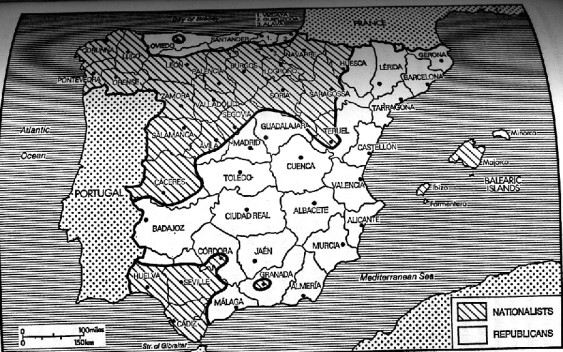
The rebel Nationalists already have 1/3 of the country under their control and systemic executions start as other locations rise to protect themselves. Unions offer to help if given weapons, but are refused. Workers strike and start building barricades in the streets.

July 19

By dawn, the prime minister has resigned, and after negotiations, José Giral takes over, giving weapons to the population to defend themselves after formally disbanding the army.

tof-02-035aWeapons handed out to the populace

Seville fights but is defeated by the rebels. Much of southern Spain is invaded and executions begin. Navarre in the north falls to the rebels in a bloody massacre. The city of Burgos has no fighting, totally in support of the military.

Jaén, San Sebastian, Santander and Malaga manage to hold back the rebels. The important cities of Madrid and Barcelona have not yet been taken by the military. Madrid is on a knife-edge as workers are armed, ready to do battle, the assault guards personnel on their side.

General Franco leaves his post in the Canary Islands to take control in Morocco. Barcelona faces battle in the streets, with armed workers and police fighting the large military contingent. The police divisions could not hold the city on their own, and arms are given to the public to help with the siege.

July 20

After two days fighting in the streets, Barcelona is won by the Republican population. In Madrid, workers lay siege to the military barracks, killing many and saving the capital city with people power, as in Barcelona.

condorsMallorca, Coruña, Vigo, Bilbao and Granada are all won by the rebels. Valencia is still in confusion, when the army did not take sides. Fighting begins as workers strike and attack the military barracks.

The rebel military leader, General Sanjurjo, flies from exile in Portugal but is killed when his plane crashes due to plane overloading.

July 21

All chances of ending the rebellion is over, although Seville is the only main city controlled by the military.

SpanishCivilWar_DivisionOfSpain_193607endAreas controlled by Republicans and nationalists in the early days of the war

The Siege of the Alcázar starts in Toledo, south of Madrid. The Alcázar (castle/fort) is filled with rebels and their hostages as Republicans fight to free the women and children inside and defeat the rebels.

July 22

The People’s Olympiad, (an event held in protest against Germany holding the Olympics) get cancelled with the outbreak of war, with many athletes in the city at the outbreak. Many were trapped in Barcelona as fighting started; some choose to fight.

The navy is loyal to the government and the Republicans. Sailors got word of the uprising and defied and killed most navy officers, saving the navy from the rebels. The air force never intended to turn against the government, but didn’t have much in the way of planes or power anyway.

808-0001-001People’s Olympiad poster

July 23

The Nationalist rebels start their own military government, the Junta de Defensa Nacional, based in right-wing Burgos. General Miguel Cabanellas is their leader.

All areas are suffering from killings and prisoner-takings, regardless of who won the uprising.

July 24

The Durruti Column, led by leader Buenaventura Durruti volunteer to leave safe Barcelona and head to Aragon to start fighting back the rebels. About 3000 workers leave in their first group to begin  a take back of rebel-held areas.

~~

From now on, each weekly round-up will be posted on a Monday. All photos are linked to original sources for photo credit.

This is not an in-depth analysis, merely a weekly highlight (lowlight?) round-up. Comments on any extra details anyone wishes to add are welcome.

SPAIN BOOK REVIEW: March – ‘Forgotten Places: Barcelona and the Spanish Civil War’ by Nick Lloyd

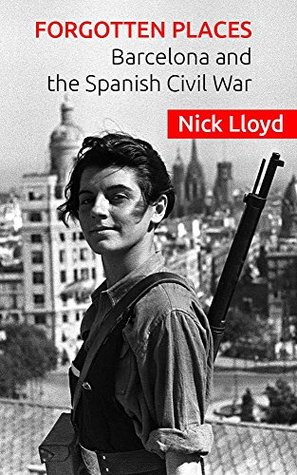
Nick Lloyd: Forgotten Places

This is a guide to Barcelona in the Spanish Civil War, beginning in the 19th century with the conditions and movements which led to the social revolution of 1936, and ending with the fall of the city on 26 January 1939 when Franco’s tanks drove down the Diagonal and set about destroying everything the Republic and the revolutionaries had built. Stories from the aftermath of the war, the exile and the Franco regime are also included. In addition with dealing with the more obvious issues such as anarchism, the Spanish Republic, Catalonia, George Orwell, the aerial bombing, and the May Days, etc, the book also looks at themes such as the People’s Olympiad, the American Sixth Fleet in the city, Barça, urbanism, Nazis in Barcelona, Robert Capa, the Spanish in the Holocaust, poster art… Intertwined in the text are contemporary quotes and a few personal accounts of people who experienced the war or its aftermath. There are also biographies of figures such as Salvador Seguí, Ramón Mercader, Andreu Nin, Francesc Boix and Lluís Companys. The book is divided into two main sections: a history of the war from the perspective of Barcelona, followed by a guide to related sites which have often been included as an excuse to tell stories or illustrate wider issues. The book ends with an extensive glossary. Nick Lloyd has been running Spanish Civil War tours in Barcelona since 2009.

Cover art and blurb via amazon

~~

It’s no secret that I’m a big fan of Nick Lloyd. I first met Nick in 2013 while I was on book research trip and took his amazing civil war tour of Barcelona.  At that time, Nick was still putting together his Spanish Civil War book to accompany the tour, which has taken thousands of people through the events that took place in the Catalonian capital in the late 30’s. Every city and town in Spain has its own story to tell, but Barcelona’s journey is truly unique, as a city ready to take on a bold new world, one where everyday people were ready to join forces and change their lives and country forever. Everyone has seen the posters of workers uniting, of children bombed by fascist planes, or nuns’ bodies dug up and put on display. But as people shuffle through the iconic areas of Barcelona, most have no idea what happened in the very places in which they stand.

Nick Lloyd has dedicated years to putting his impressive and exclusive tour together, giving everyone the chance to feel and experience the real history of Barcelona’s war story, with stories from the famous, to the international athletes in the city on the fateful day that war got declared, to the workers and union men and women who dared to take on the oppression. From the ambitious beginnings, to the arrival of optimistic international volunteers, to the infighting and breakdown of alliances, to the aerial bombings and street fights, to the eventual demise of the Republic and following executions, Nick takes the reader through the war, just as he could on his tour. Both the details of this ancient city’s struggles and maps, photo and details can take a reader on the journey the author has made his own.

A reader could use this work to learn more about Barcelona, attempt to follow in its footsteps around Barcelona, or use it as a companion on one of Nick’s tours (book your own tour HERE). Forgotten Places is a culmination of work by a man who has dedicated himself to Barcelona’s civil war history, and is unrivalled in his field. This book belongs on the shelf alongside the greats of the genre.

SPAIN BOOK REVIEW: ‘A Body in Barcelona’ by Jason Webster

Tensions in Spain are rising: political violence and social unrest have suddenly re-emerged. Madrid is trying to keep a tight leash on Catalonia, where the call for independence is getting louder by the day. The last time Barcelona moved to break away, in the 1930s, Spain quickly descended into civil war.

Down in Valencia, a shallow grave is found among abandoned orange groves just outside the city. Chief Inspector Max Cámara, now heading up the new Special Crime Unit, is put on the case. But this is no ordinary murder. Behind it, Max uncovers a tangled web that could awaken ghosts from the past, decimate Barcelona and destabilise the whole country

It’s all down to Max, but the stakes are higher than anything he’s ever known.

cover and blurb via amazon

~~

I love a huge lover of the Max Cámara, though after the last installment, I wondered how this book would be able to top its predecessor. Turns out that the book had no interest in doing that, rather swinging in an all-new direction. If any book could be listed under #topical, this book would be it.

Max and Alicia are in trouble, and that is no surprise after the ending of Blood Med. I like that the author did not gloss over the effects of Max and Alicia’s last dramatic case, which could have been easy. Rather, realism is put into the relationship between these two.

As ever, Max is jaded and the police headquarters where he world seems to be some type of stagnant, stuffy atmosphere. But up in Barcelona, death and revolution is rumbling. Catalonia wants independence from Spain, and this issue is well addressed in this book (and no, it’s not boring!), so you get a dose of politics with your murder mystery.

Max has to investigate the murder of a child, son of a very wealthy and powerful man. But as Max tries to bring a child killer to justice, he finds himself being dragged toward Barcelona and the boiling state of the people. People are lying, and a mysterious man seems to have plenty of answers, but doesn’t seem to help.

In this book, we see more than just Max’s perspective, as a right-wing nutball Legionarios soldier wants to stop Catalonia from regaining its independence (yes, regaining, do some homework if you are new). Added to that a father and son duo from Valencia who Max sees at their soup kitchen have also gone to Barcelona. Under the spectacular backdrop of the La Sagrada Familia, Max and all the others will come together for an explosive showdown in a city trying to be reborn.

Did I enjoy this book? Yes, and I read it quite quickly too. For me, there was no confusing information, but I think readers unaware of Spain’s political state should be fine. Sometimes I want to shake Max, sometimes hug him, and the fact he isn’t perfect makes for a great main character. I will keep my Catalonian independence opinion to myself, but I do hope that if and when Barcelona becomes free of Spain, it happens with far less bloodshed than the 1930’s.

You could read this book on its own, but treat yourself and start at the beginning of the series. Bring on Max Cámara book 6!