NOW AVAILABLE IN NEW EDITION HARDBACK, PLUS PAPERBACK AND KINDLE
The moderate man shall inherit the kingdom.
That man needs to be the Queenmaker.
London 1529 – Cardinal Wolsey has ruled England in King Henry VIII’s name for most of his reign. Now Henry wants to leave his extraordinary Spanish wife of twenty years, Queen Katherine, to marry Anne Boleyn and secure a male heir for the kingdom. Only God can end a marriage, through his appointed voices on Earth, the powerful Cardinal Wolsey, and Cardinal Campeggio sent from Rome in the Pope’s place. Wolsey’s faithful attendant, commoner Thomas Cromwell, has the mind, the skills and the ambition to secure a royal annulment.
Cromwell’s forgotten past in Italy reappears with Campeggio’s new attendant, Nicóla Frescobaldi, the peculiar son of Cromwell’s former Italian master. While the great cardinals of Christendom fight the King, the Pope, and their God for an annulment, Cromwell and Frescobaldi hold the power over a country at war with its own conscience. Cromwell is called the double-minded man, whose golden eyes make money appear. Now Cromwell wants the power to destroy the Catholic Church in England. Frescobaldi is known as the waif-like creature, the Pope’s favourite companion, but Frescobaldi wants freedom from Pope Clement and his Medici family in Italy.
Cromwell and Frescobaldi will place themselves into the heart of religious and political influence as they strive to create an English queen, or lose their heads for their crimes and sinful secrets.
November 1533 – Thomas Cromwell and Nicóla Frescobaldi have their queen on the throne. The Catholic Church is being destroyed as the Reformation looms over England. Cromwell has total power at court and in parliament, while Frescobaldi wins favour with the king’s illegitimate son, Henry Fitzroy.
But England’s fate is uncertain. The nobles still despise Cromwell and his Italian creature. Anne has not given the king a son. Queen Katherine refuses to give up her title, and Thomas More and Bishop Fisher defy their king. The final Plantagenets think they should hold the throne while the Catholics want Princess Mary named as heir.
England can be reformed, but Cromwell must dissolve all the monasteries and abbeys, and with the king on his side, the plan to change religion will sever heads. Queen Anne is losing Henry’s love, but Cromwell could suffer if Anne loses her crown. Frescobaldi creates a daring plan to replace Anne and regain the Pope’s favour, but Cromwell must execute the plans on his own. Schemes will go astray and the wrong heads will be severed to satisfy a vengeful sovereign.
Kings will rise, queens shall fall, children will perish, and the people of England will march in a pilgrimage to take Cromwell’s head, while Frescobaldi will have to make the ultimate sacrifice.
London, January 1537 – Thomas Cromwell is in deep mourning. His new queen is on the throne at King Henry’s command, but the personal cost is too high. Nicòla Frescobaldi is lying dead inside the Medici tomb in Florence, and Cromwell’s only daughter Jane is missing. Now, the people of England have rebelled against their king, marching to London to start a civil war. The Pilgrimage of Grace has two demands: remove all the Reformation changes from religion and cut off Cromwell’s head.
Cromwell needs his friends, allies and the king’s favour more than ever, but he can do nothing when Queen Jane dies giving England its son and heir. Cromwell’s son has married the Queen’s sister, but the Seymours will disappear from favour if Cromwell does not eliminate all those able to take their place. There is only one solution; become Queenmaker yet again and find a foreign princess for Henry, one to seal religious change and create stability in the war of Catholic against Protestant.
Nicòla Frescobaldi may be dead, but Duchess Nicòletta of Florence is not, so Cromwell and his creature can rule politics again to control England and Ireland. But when war with the Holy Roman Empire threatens, all of Cromwell’s powers, titles and schemes cannot save him from his oldest enemy in England, and a betrayal deep in the heart of the powerful Cromwellian faction.
As the 19th century writes its final chapters, change cannot come to Spain fast enough. Gaudí’s architecture, Sorolla’s paintings, Ramon y Cayal’s scientific breakthroughs, and Blasco Ibáñez’s writings are matched with illness epidemics, poverty, inequality, and conservative landowners still reigning supreme.
In Valencia, Mireya de Centelles y Aragon, the sixth Countess de Valencia, holds a Happy New Year 1885 ball at her husband’s palace, to raise funds for earthquake victims in Spain’s south. But Mireya is unlike the other women of the Spanish nobility; the daughter of a Spanish duke and a French princess, she is a botany student at Valencia University, the only woman in her field. When Mireya meets an architect, Tiago Ríbera Herestoza, who is new to the city after studying in London, an idea is born.
Mireya married off at 15 to a nobleman twice her age, and Tiago, a middle-class man of esteemed education, have more in common than imagined. Both have a treasury of secrets and dreams that clash with their position within the class system. With Tiago’s London life threatening his future, and pressure on Mireya to produce the next generation of noble-blooded Valencians, the pair embark on an intense professional relationship. But one glass of tainted champagne will threaten Mireya’s 400-year-old noble family line forever…
~~
Initially released as Intense Professional Marquesa in 2016, Mireya de Centelles is back under a new title, new cover, and an all-new edit for 2021. A romance story set in 19th century Valencia, this is a standalone short story from others in my Spanish political series’.
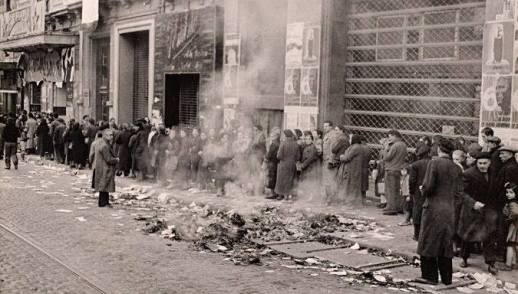
Civilians line up for food in Barcelona in freezing weather
January 21
Today marks the first of four days of successive bombing in Barcelona by Nationalist aircraft, with ten flyovers bringing bombs into the streets. After almost three years of war, Barcelona is weary, despite being far from the front until now. The Nationalists are fast advancing through Catalonia, with little or no resistance.
January 22
The Nationalist counteroffensive in Valsequillo is five days old, and they have taken all 500 square kilometres the Republicans have taken over the month. The Nationalists take the strategic town of Peraleda del Zaucejo, on the Extremadura/Andalucia border. The only other town the Republicans hold falls only three days later. The Republicans have lost almost 6,000 men by this time, for no gain at all.
General Solchaga and General Yagüe’s Nationalist troops reached the Llobregat river, just a few kilometres west of Barcelona, Generals Muñoz Grandes and Garcia Valiño attacked Sabadell and Terrassa, and General Gambara advances to Badalona. Barcelona is now surrounded by the Nationalists and the three lines of defense set up around Barcelona, composed of all men aged 18 -45, with all the city’s industry militarised, cannot save the city. Prime Minister Negrín gets a call from the head of the Republican Army, General Rojo, to tell him that the frontline around Barcelona has been completely shattered.
January 23
The Republican government decides to abandon Barcelona as the capital and heads for Figueres Castle, and most of Barcelona’s political prisoners are released. Much of the population of the city is now fleeing north towards France, and the men on the frontline have either been killed or have retreated from advancing Nationalists. The aircraft overhead are still bombing Barcelona ten times per day.
January 25
One day after General Garcia Valiño’s men capture Manresa, the Nationalist vanguard takes the town of Tibidabo, the highest mountain around Barcelona, which overlooks the entire city. The Nationalists are now on the outskirts of Barcelona and all the defensive lines are gone.
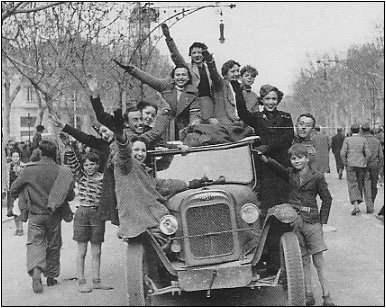
Sadly, some in Barcelona felt like fascism was liberation. Talk about messed up
January 26
Nationalist troops march through the streets of Barcelona, where General Yagüe’s Regulares begin their execution spree. While Barcelona is ravaged, the Catalonia offensive is halted briefly, meaning many civilians who have fled north towards France have no advancing troops at their backs . But the German Condor Legion and and Italian Aviazione Legionaria continue their campaign from the air, bombing towns and roads on the 160 kilometre hike to the French border.
Franco’s fascist troops enter Barcelona
January 28
The town of Granollers, thirty kilometres north of central Barcelona is captured by the Nationalists. Just eight kilometres north of Granollers, the town of La Garriga has 10,000 people, 7,000 of them Madrid and Basque refugees, and now has the remaining Republican troops under General Lister hiding with them. With the Nationalists in Granollers, the men have to leave, while the refugees have nowhere to go but towards France, if they dare.
Refugees head for the border
January 29
The Italians send ten bombers to La Garriaga, and bomb the town over two days, though Republican troops are gone, leaving 13 civilian casualties; one local, five refugees and seven children. Bombing La Garriga’s train station means getting north is much harder for Republicans.
January 31
The French government, who announced they opened the border on January 28, start receiving the first of 400,000 – 500,000 refugees into the country, those who are first to make the walk through the snow. Republican troops are not yet permitted to enter, yet the remaining men are flanking the refugees on their dangerous walk, while the German Condor Legion continues to bomb them from overhead. Once the Nationalists reach the frontier, they plan to close the border, meaning there is nothing but executions and oppression for all remaining Spaniards who opposed the rebel invasion. They have only ten more days to make the freezing, bomb-ridden march towards France, while starved and/or injured and all traumatised.
Republican men head for the border
~~
This is not a detailed analysis, just a highlight (lowlight?) of the month’s events. Things get lost in translation – Feel free to suggest an addition/clarification/correction below. The more the world remembers, the better. All photos and captions are auto-linked to source for credit, and to provide further information.
After occupying Pandols Range on November 2, the Nationalists fighting in the battle of the Ebro finally reach the water’s edge itself. With the Republicans either slaughtered or captured, and the International Brigades withdrawn at the Prime Minister’s command, nothing is stopping the Nationalists crossing into Catalonia.
November 7
The town of Cabra, 70 kilometres southeast of Córdoba, is bombed from the air by the Republicans. Between three bombers, some six tonnes of bombs are dropped in a surprise morning attack. The bombs are dropped on the market and working class areas, with one bomb weighing 200 kilograms landing right in the morning marketplace. The Republicans catch the Nationalists off-guard, who don’t have time to react. The plan is to hit the Italian troops stationed in Cabra, and the pilots think they see military tents, but instead hit the market awnings. Around 109 civilians are killed with another 200 injured in a scathing mistake.
November 10
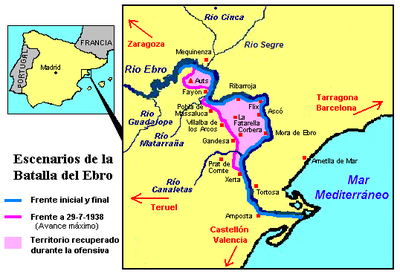
The Nationalists have crossed the Ebro river to take the small town of Móra la Nova, on the east side of the river in Catalonia province. They also have Mount Picossa, the final main strategic point in the Battle of the Ebro. The Republicans have no way to stop the Nationalists now.
November 16
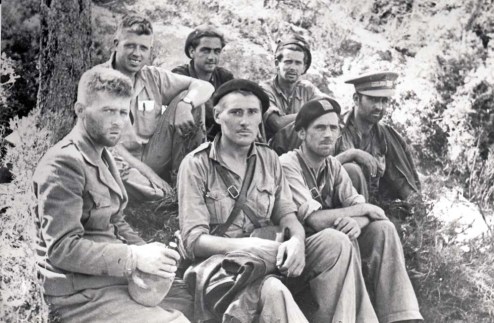
The remaining Nationalist forces cross the Ebro at Flix and the battle is over. The Republican army is now destroyed, losing most of its men and all of its equipment, and the Republican airforce has nothing left to fight Franco’s rebels, losing 150 planes in the fight. Both sides have suffered massive losses over the four-month battle. The estimate of deaths ranges between 50,000 to 100,000 people, with another 20,000 to 30,000 captured. The Nationalists have sacrificed many of their finest officers, while the Republicans lost their experienced men and all their weapons. Even the Nationalists need to repair all of what they had left.
Franco signs a new deal with Germany, who send in new weapons in return for mining contracts, so the Nationalists can regroup and launch an attack on Catalonia. The Republicans have long used an approach of constantly attacking Nationalist positions, rather than planning solid defense, meaning Catalonia and its capital Barcelona have no safety, and the propaganda gained from constant attacks now has no use. The one positive note of the Ebro battles is that since the Nationalists had to turn around troops and weapons to the mountains, saving Valencia from being captured.
Remaining Republican men at the end of the battle
November 25
The Republicans now have no solid army, and the Nationalists are regrouping for a December attack on Catalonia. They need to bring 340,000 men together to cover the front-line from the Pyrenees to the Mediterranean, along the Catalonia border. The Republicans need to bring together 200,000 men to defend the region, though with no weapons, the men will be unarmed. The Soviets agree to send what artillery they can, though the battle is looking to be another slaughter by the Nationalists.
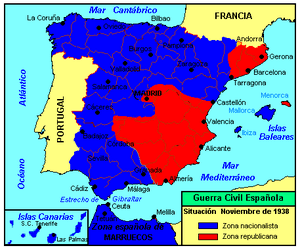
July 1938 has all eyes on Valencia, Catalonia and Aragon, and yet in the south-west, the Mérida pocket is also suffering new battles. Extremadura, the most western area of Spain, was quickly taken by the Nationalists when the war broke out, but the Mérida pocket is the sole area held by Republicans, an area west of Mérida in the La Serena region in Badajoz province. Franco wants the Mérida pocket in his control to settle the entire region. If Republicans could take Mérida, then they could cut the Nationalist zone in Extremadura in half. While the Nationalists had quietly secured the frontline along the Zújar River in June, Franco implements a plan to circle all remaining Republican men and execute the whole lot, whose numbers could be as high as 10,000.
The Battle of the Ebro preparation is well underway. The Republican Ebro Army was formed on May 15 by the Republicans, in response to massive gains made by the Nationalists as they murder their way through the Valencia region. Lieutenant Colonel Juan Modesto took control of both the 5th and 15th Army Corps, which combined the 35th International Division (made of the XI, XIII and XV International Brigades), the 3rd Division (made of the 31st, 33rd and 60th mixed brigades) the 42nd Division (made of the 226th, 227th and 59th brigades), the 15th Army Corps (with the 16th Popular Republican Army Division of the 12th Army Corps) and the 3rd Cavalry Regiment. By mid-July many anti-aircraft weapons arrive along with 11th Division (made of the 1st, 9th and 100th mixed brigades), the 46th Division (made of the 10th, 60th and 101st mixed brigades) and the 45th Division International Division (made with the 12th”Garibaldi”, 14th “Marsellesa” and 139th mixed brigades).
July 13
The Republicans add more to their numbers with the 12th Army Corps, now led by Lieutenant Colonel Etelvino Vega. The 12th Army Corps was then made up of the 16th Division (including the 23rd and 24th mixed brigades) and the 44th Division (including the 140th, 144th and 145th mixed brigades). The 18th Army Corps bring Lieutenant Colonel José del Barrio to lead the 27th Division (including the 122nd “la Bruixa”, the 123rd and 124th mixed brigades), the 60th Division (with the 95th, 84th and 224th mixed brigades) and 43th Division (with the 72nd, 102nd and 130th mixed brigades). At its height, the Republican troops will number 80,000 men.
Republican soldiers at the Ebro, July 1938
July 15
The Nationalist army has been storming regions around the Ebro for months and have many huge battalions in the area. The Army of the North, controlled by General Fidel Davila, a powerful and successful group, are flanked by the 40th, 50th and 105th Divisions of the Moroccan Army Corps under vicious General Yague. Included in the Moroccan Corps are the Legionarios, Regulares, the Carlists and Falaganists and African mercenaries, all groups well-known over the past two years for wild slaughter, torture and rape of troops and civilians. General Rafael García Valiño’s Maestrazgo Army Corps, made of the 1st Navarra Division and the 74th, 84th and 13th Divisions are also very close by, having controlled the northwest Valencia region. The numbers the Nationalists have/can access is 90,000 experienced men.
Legionnaires on the Ebro, July, 1938
July 18
Today marks two years of civil war in Spain. The death tolls is already into the hundreds of thousands, with no spot in the country unaffected. Madrid continues to be held by the Republicans while surrounded by Nationalists, who still cannot get through the front-lines. Catalonia’s uprising with the rights of workers has long dimmed as the war nears their own streets, and the Aragonese anarchist lifestyle has been destroyed. Concentration camps have been set up to take Republicans, if they are not first executed. All major cities, except for capital Valencia, Madrid and Barcelona, rest in Nationalist hands. Europe is looking nervously at Hitler, yet not helping the people of Spain, already suffering Hitler’s power as Franco looks to join Hitler and Mussolini as Europe’s great fascist leaders. Precious few believe in the Republican cause now, which is the one card they have to play in the Battle of the Ebro, as they have the element of surprise on the Nationalist troops.
July 20
South in Extremadura, the Mérida Pocket is going to be closed by the Nationalists. General Saliquet, based in the northern area of the Badajoz region, marches his men south into La Serena, where the Republican front-line is strong. At the same time, General Queipo de Llano has been marching his men northwest towards La Serena. This makes the Republicans embattled at both their major front-lines, and are routinely pounded by gunfire for four days.
La Serena
24 July
The Republican divisions, the VII Army Corps with the 36th and 36th Divisions from Algodar to Zújar, and the VIII Army Corps with the 38th, 63rd and 51st divisions from Zújar to Guadalmellato, are completely overtaken by Nationalist troops. The battle ends with the massive slaughter of troops throughout the Don Benito and Villanueva de la Serena areas, murdering the whole Extramaduran Republican Army. This short battle is the largest slaughter of troops in the region (as civilian slaughter and imprisonment has been wholesale here since the outbreak of war). Nationalist men continue their march through the Mérida pocket of La Serena, eastwards into Toledo province, where the Republican 91st and 109th mixed brigades are trapped on every side. These remaining men are rounded up to be placed in the Castuera concentration camp 45 kilometres south, though most will be executed in the camp. Colonel Ricardo Burillo, leader of the Extremadura Army Corps, survives, and is dismissed after the bloody defeat of around 10,000, while the Nationalists have lost almost no one.
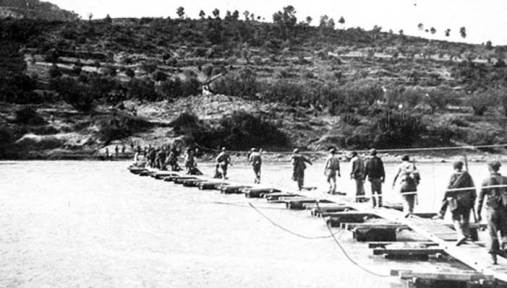
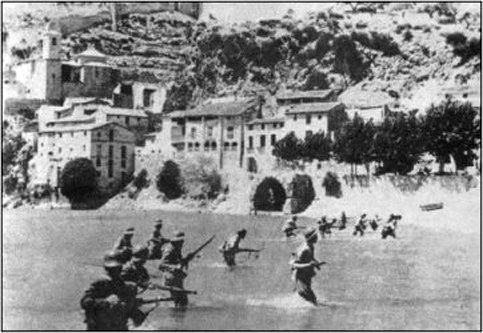
Republicans cross the Ebro
July 25
After a week of planning, the commanders of the 14th Republican Army Corps cross the Ebro river, to watch the Nationalists, taking their positions while other troops prepare river crossings. The Nationalists soon see what is happening, reporting to Franco that the Republicans and their International Brigades are on the bank of the river with rafts and pontoons. Franco is not concerned, aware of how weakened the Republicans have been in the area.
The early hours of July 25 are completely dark with no moon. Between Fayon and Benifallet, a 45 kilometre bend in the river, the commanders again cross the river and kill 50th Division Nationalist guards posted in the area. After fastening assault boats, the first of 90 boats cross, ten men in each boat, under darkness. All following troops then cross on pontoon bridges at daybreak. The Nationalists are totally unprepared for this wide attack, overcome in surprise. The International Brigade attack 40 kilometres south of Benifallet at Amposta, but are overpowered within the first 18 hours of combat, with the few survivors retreating back over the Ebro.
Around 4,000 Nationalist men of the 50th division are imprisoned, while some manage to desert. The Republican 15th Army Corps carry on, and advance three miles north, while the 5th Army Corps manage a huge 21 kilometres east.
July 26
The Republicans have marched 30 kilometres south to Gandesa, and now occupy 800 square kilometres, but cannot hold Gandesa, as the Nationalists’ 13th division have the town fortified. Franco frantically deploys more troops to counter the attacks, with an extra eight divisions, 140 bombers and 100 fighters sent to the Ebro. The Nationalists hold the dams at Tremp and Camarasa, which are opened, flooding the Republican pontoons, which take two days to repair. At the same time the German Condor Legion and Italian Aviazione Legionaria bomb the pontoon bridges, which can only be repaired at night. Due to the planes and the flooding, the Republicans have only got 22 tanks and minimal artillery over the bridges, leaving men exposed and without water and food.
International Brigades cross at Minveret
July 27
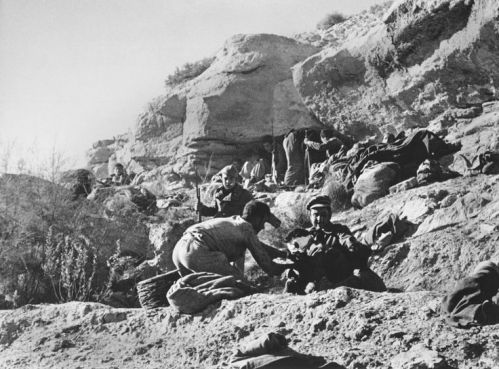
The town of Gandesa is a key target for the Republicans, which is 25 kilometres west of their first river crossing point. Gandesa is surrounded by hilly limestone terrain in the Caballs, Pandols and Fatarella ranges. The limestone hills have little shelter, leaving the men at the mercy of overhead bombers. But they push on, spread out over a 35 kilometre line, eager to take Gandesa, a pivotal town into Catalonia, so men and tanks are forced over the limestone hillsides.
Republicans in the hard terrrain
July 31
The leading Nationalist commanders want to hold their ground at Grandesa, keeping the town in their hands and stopping the Republicans, while also planning to attack them from the north. But Franco is unwilling to listen to this, as he is pleased to have the strength of the Republican army trapped within a 35 kilometre stretch. Regardless of the loss of life, Franco wants the Nationalists to regain all the ground they have lost, rather than holding Republicans in place. Franco wants them back over the Ebro and killed.
The International Brigades, who have been mixed with 15th Army Corps, have regrouped after their failed crossing at Amposta, and plan an attempt to take Hill 481, right outside the town of Gandesa. It will be a risky attack, with no cover from the air bombers. The battle still has four months to run.
British troops at Hill 481
~~
This is not a detailed analysis, just a highlight (lowlight?) of the month’s events. Things get lost in translation – Feel free to suggest an addition/clarification/correction below. The more the world remembers, the better. All photos and captions are auto-linked to source for credit, and to provide further information.













 CAROLINE ANGUS