PART 2: Vengeance in the Valencian Water Q+A

To read part one, click here – PART 1: VENGEANCE IN THE VALENCIAN WATER Q+A

Here we go, part two of the Q+A, time for some of the more specific questions –

6 ) Did you base the characters on real-life people, like with Blood in the Valencian Soil? 

Rather than look at the situations of specific individuals and make a fictional tale based on their lives, this book takes a different vein. This book follows real events (like BITVS) but has all fictional characters. This book is a snapshot of Valencia in 1957 and the characters live in what was reality at the time. I spent countless hours studying photographs and recollections of the city and its way of life at the time. I also studied the 1957 flood over the period of about a year, so I knew all the details I needed. I got to point where I knew the water level of individual streets around the city. I also walked those streets in Valencia, to visualise the scenarios for myself. All of the characters are entirely fictional, and would not want to meet these people in person!

As for the 2010 characters, they are all also fictional, but live in Spain as it was that year. One chapter sees Luna caught up in a protests in Madrid, and I made sure there was a protest in Puerta del Sol in that month, and checked what they protested against and what their signs said. The timeline is accurate, but no one is based on a real person.

Graham Hunt was kind enough to capture this, so it had to go in the book

7 ) What did you research for the book? You talk about research a lot of twitter.

Jaja, my twitter rambling coming back to bite me. Following on my from the last question – I researched a lot. For me, when I sit down to write, I need to be able to envisage the whole scene in my mind before a word can be written. When it’s based in Valencia, imagining somewhere is a piece of cake. But still, I need to know the details are in place before I can start. For example, when writing José in 1957, I needed to know what his Guardia Civil uniform looked like, or what the fashion of the time looked like in Valencia. That meant tracking down photographs in 1957. There is one scene were José has to wear what I imagine as the most ugly brown suit ever, but then in another, the smoothest grey suit you can imagine. I know both of these were on sale because I checked. I don’t spend a great deal of time on clothing unless it’s relevant to the scene, so you don’t feel bombarded with inane tidbits. But when they buy 1957 swimsuits, I checked to see what you could get at Malvarrosa at the time. Beach umbrellas are the right colour, restaurant decor is correct, street names are correct, even the flowers bought at the market are the right type. When Franco arrives, his car is the right kind, the positions are correct, the aides are dressed properly. When it comes to bullfighting, the clothes are correct, the details of a fight are correct, the feeling from the crowd is correct ( I know this because I sat there to get it right). Valencia is the perfect place to use as a location because there is just so much to see, and how much the city has changed is incredible. I have studied the detail of the city from the mid-1800’s until now and the changes are amazing, yet the core, the heart of the city remains the same.

Calle Miguelete at Plaza de la Virgen, both Jose’s 1957 and Luna’s 2010 reality 

8) Are there any storyline pieces you are worried about? Does reaction to the book worry you?

Does it worry me? Only all the time. Writing a book is like walking around naked, you are fully exposed to embarrassment and ridicule. I feel like a running joke – an author with an anxiety disorder. I dream about being teased about typos. After writing a  chapter, I put on a cynical hat and question its believability. With the Luna Montgomery series, I want things to be as realistic as possible. Fortunately, by following real-life scenarios, the possibility of the storyline being over-the-top is nigh impossible. With the flood, it’s all real, as is the babies stolen by the church. None of that needed to be made up. The 2010 storyline gave me more worries. The medical details were something I was careful with – there’s nothing worse than reading/watching something and a character is sick and makes an instant miracle recovery. Anyone who suffered or nursed someone with a serious illness or injury will see right through it. I had to check the detail very carefully. I fight constantly with Luna and Cayetano, to make sure they are believable and full of flaws. Perfection doesn’t exist and neither of them can appear to have the upper hand over the other. They both make mistakes, they both say stupid things, like any couple. I worried, about halfway through, that Luna was being too needy, and then wasn’t being strong enough. At the end, I did worry if all the feminists out there will be disappointed with her life choices, but to me, she does all she needs to do for all around her. She doesn’t have the luxury of making decisions to suit herself. I also worry if Cayetano comes off as arrogant or selfish at times, but have tried to suitably redeem him. You aren’t supposed to like every character all the time anyway.

9 )Why give Luna two children? What’s the point?

There is plenty of point. From the very beginning, I imagined Luna with two sons. Luna is the very first character I ever created, back in 2009 when I was still finding my feet. (You can’t accuse me of not taking my time with the characters. I took 18 months off these characters to work on Canna Medici while I got this series together.) Luna meets Cayetano and their lives are a mess. They meet to uncover murdered relatives, so it’s not a love story. From the very beginning, Cayetano always had María, his wife. That in itself is a nightmare, but to have Luna as a single woman would be too easy, and make her too perfect. I made her a parent because it suits her, she’s the type to cope well with sons. I had to also make her a widow, because that was the only way to make her solo mother, no other scenario worked on Luna and Fabrizio as a couple. I’ve been the child of a solo mother, and know just how amazing they are. To have a male and female lead character makes it easy for them to fall into a relationship, or at least an affair, and by making Luna a widowed solo mother, and Cayetano already married, it gave me far more scope to develop the characters and their interactions. They come from totally different perspectives, and not just because their families sit on opposite sides of the political and religious divide. They cannot understand each other’s situations because they are so bogged down in their own realities. Just when the path seems smooth for a quiet life, I have something to throw in the mix. This isn’t a romance novel (but if you like romance, I have one in the pipeline to come out after my next civil war book, so bear with me!)

10 ) Which of the two books (Blood in the Valencian Soil and Vengeance in the Valencian Water) have you enjoyed writing the most….and why?

That is a really hard choice. BITVS was my baby, I nursed her for quite some before I got the book I wanted. It is centred in the civil war, something that gives me enough inspiration to write 100 books. It is set around a murdered grandfather, something very close to home for me. The issue of relative killed in the civil war and hidden away also hits close to home for me. The story of a kiwi nurse in Spain is something I took the time to understand, follow and genuinely care about. It was great to meet the family of Renee Shadbolt, the real Scarlett Montgomery, and how proud they were of her. Real people in real scenarios flourishing and despairing was what I wanted to create. I will always love BITVS.

one place – three periods in the series

VITVW is totally different. Writing one book and making it my baby seems easy compared to following it up with a suitable sequel. I wanted to continue the series, but at the same time, make a story that can stand on its own. It needed to pack all the punch of the first book, without going over old detail. I can’t remember when I decided to write a Valencia flood novel, but I don’t think it’s been done before (feel free to correct me). It would have been easy to have Luna and Cayetano go back through another civil war story and it probably would have worked, too. But going back to the 1950’s instead of the 1930’s gave the series new life. The third book goes to the 1970’s, so the state of Spain under Franco through the years can be seen in long form. From war in the 30’s, to the heavy-handed rule of the 50’s, to the unstable 70’s, the story of the Beltrán and Morales families can tell a huge story. The present day storyline also gives that chance. BITVS is set in 2009, VITVW in 2010 and then Death in the Valencian Dust in 2013, and Spain changes in this tiny time frame, giving me plenty to work with. As long as Rajoy is in power, enough things will be screwed up, providing plenty of ideas.

I would have to say BITVS is my favourite to write because it was the first in this big project, but VITVW gave me huge satisfaction too, as I feel I have done a really good job with it. I wouldn’t change a thing, and feel my writing style is much better now.

Click here to read the Part 1 with the free book offer Q+A. Part 3 will have all remaining questions, Part 4 is Valencia in photos, and Part 5 is the first chapter, available January 24, the same day as the book release.

Thanks to Graham Hunt for the video, and Juan Antonio Soler Aces for the historical Valencia photos

SPAIN BOOK REVIEW: ‘Franco’s Crypt: Spanish Culture and Memory Since 1936’ by Jeremy Treglown

bandicam 2013-12-05 16-29-18-214

source

An open-minded and clear-eyed reexamination of the cultural artifacts of Franco’s Spain –True, false, or both

Spain’s 1939–75 dictator, Francisco Franco, was a pioneer of water conservation and sustainable energy. Pedro Almodóvar is only the most recent in a line of great antiestablishment film directors who have worked continuously in Spain since the 1930s. As early as 1943, former Republicans and Nationalists were collaborating in Spain to promote the visual arts, irrespective of the artists’ political views.

Censorship can benefit literature. Memory is not the same thing as history.

Inside Spain as well as outside, many believe—wrongly—that under Franco’s dictatorship, nothing truthful or imaginatively worthwhile could be said or written or shown. In his groundbreaking new book, Franco’s Crypt: Spanish Culture and Memory Since 1936, Jeremy Treglown argues that oversimplifications like these of a complicated, ambiguous actuality have contributed to a separate falsehood: that there was and continues to be a national pact to forget the evils for which Franco’s side (and, according to this version, his side alone) was responsible.

The myth that truthfulness was impossible inside Franco’s Spain may explain why foreign narratives (For Whom the Bell Tolls, Homage to Catalonia) have seemed more credible than Spanish ones. Yet La Guerra de España was, as its Spanish name asserts, Spain’s own war, and in recent years the country has begun to make a more public attempt to “reclaim” its modern history. How it is doing so, and the role played in the process by notions of historical memory, are among the subjects of this wide-ranging and challenging book.

Franco’s Crypt reveals that despite state censorship, events of the time were vividly recorded. Treglown looks at what’s actually there—monuments, paintings, public works, novels, movies, video games—and considers, in a captivating narrative, the totality of what it shows. The result is a much-needed reexamination of a history we only thought we knew.

~~~

‘Franco’s Crypt: Spanish Culture and Memory Since 1936’

When opening this book, a reader could easily expect to sit down an examine Franco’s effect on Spanish art during his dictatorship. Instead, this book extends far further, into many aspects of the Franco period, so much so that art ends up being only a fraction of the story.

The first part of Franco’s crypt gives a clear introduction to the Franco period. The book titles refers to Valle de los Caídos, where Franco is buried outside Madrid, and his behemoth is discussed, along with other monuments to the time period. The book talks about Spain’s left and how the crypt is a symbol for all things horrid, while also managing to be a figure for the Spanish right, their religion and their vast power under Franco. The opening of the book delves into the subject of bodies buried in unmarked mass graves throughout Spain, and goes through the reality of digging up such a grave. The section is laced with a feeling of resignation; that after  all this time, whose bodies are they and the reasoning behind digging is uncertain. It is a subject that deserves far more opinions and time placed upon it. 

The author gives a feeling that ‘memory’ is not such a simple beast; rather that the name encompasses many things. This could be certainly true, as memories and history are merely a recollection of the winners in a heated battle. With Spain being divided, by being its own enemy, all ideas, social and cultural norms, politics and attitudes are up for debate.

One chapter is dedicated to dam building in Spain under Franco. The voice of the book pulls back and forward between talking of the need to progress and the results of such ambitious, and sometimes failed, projects as well as the reality of what it did to the poorer people, who saw no benefit of the projects. This back-and-forward feeling in opinions distinguishes itself throughout the book.

What this book does do is lay out all the various elements of life under Franco, and how it is perceived in modern times. There can be no one element which accurately portrays Francoism and its effects, rather embracing that all walks of life, levels of wealth and social standing, and everyday opinion shape what is called ‘history.’ Treglown takes a (well-needed) swipe at the Spanish Biographic Dictionary, done by the Royal Academy of History in 2011. The glaring pieces of detail left out, and the additions and exclusions in this so-called encyclopaedia of Spain’s history is the perfect analogy for how Spain is viewed today.

This book does tell much of arts during Franco’s reign. To say Franco suppressed the arts could be an unfair comment. The book talks of great artists such as Joan Miró, Antoni Tàpies and Antonio Saura. It talks of Spanish art making its way around the world, to be seen by overseas audiences more so than ever before. Writer Camilo José Cela won the Nobel Prize for literature. Filmmakers Pedro Almodóvar and Luis Buñuel were able to produce their films in Spain (though Buñuel, fresh from exile, had his work again banned). The book makes little mention of artists whose arts were not selected for greatness, and why, and a recurring theme throughout the book is that women barely managed to scrape their way into the history books. While Spain had its own share of female painters and writers, it seems fair to say women were not able to make much headway in the art houses of Spain. Treglown touches on the fact a feudal system still persisted among artists; not many artists were working class, no doubt out of the need to earn a living as best they could. While notable exceptions to this class divide are celebrated, all it does is highlight the inequality of the age.

Franco’s Crypt, page 102 – ‘Besides, while in the nineteenth century all the talent painters had to emigrate, in the Franco period they were once again living on the Peninsula. Did the unexpected development occur because of or despite the regime?’

Treglown answers that the regime did neither or both. Franco allowed Spanish artists to speak and their word spread worldwide, thus creating an image of Spain. Whether Franco liked it or not, we will never truly know. The book does not dwell much on drama or performance art, or on poetry, which is a shame.

One area of considerable divided option is the author’s chapters on the transition to democracy in the 1970’s. Opinion (or propaganda) tends to say that the left were hushed up during this period, and that the voices of the people went unheard during this period. Treglown gives examples of media accounts, historical studies and publications and documentaries which spoke out in this period against Franco, and of past crimes. He attempts to show that opinions of leftist Spain did have a voice. However,  the so-called ‘pact of forgetting’ does remain in place, and those guilty were never tried for crimes, so to what effect these limited voices had is questionable. A roll-call of those in power after the transition says a lot of the effect of leftist ideas for change.

The reality of the era is that Franco modernised his country. After war in the 30’s, the violence of the 40’s and the struggling 50’s, Spain did begin to prosper in the 60’s, by becoming a US ally, with all important tourism and through economic growth. Little mention of the early 70’s, with inflation, high increases in the cost of living, and Spaniards returning home in search of work, isn’t touched upon. The book tries to sit on the fence in the opinions of Franco and his regime, in an effort to tell truths otherwise hidden. However, it shows without doubt that Spain lacked any decent authority figures for a long period. Some argue the Catholic right-wingers lost much of their hold on Spain towards the end of Franco’s reign, but a quick look who has influenced Spain since Franco, and at the laws being created in Spain in 2013 by the PP government, suggests an evil seed has been allowed to flourish. Liberalism have have got hold for some time, but the future remains murky for Spain.

Treglown should be praised for putting together a book so laden with information. This is no summer-sun read, but if you want to learn about Spain, understand the country you have moved to, or wish to make sense of a divided nation, be aware that this book is written with a biased prose. I can’t be certain it shows that Franco wasn’t the oppressor he was made out to be, but it shows that despite the regime, creativity and the human spirit continued to fight. I am a unashamed leftie and won’t praise anything Franco achieved, and this book didn’t sit well with me for the entire length.

Buy Franco’s Crypt here

A Wistful Day in Valencia – Lost in a Sea of Familiarity

For me, the day starts with noise. Normally, it’s the sound of one of my young sons singing in the bathroom down the hallway. Or, if I’m lucky and the children have slept in, it’s my 6am alarm, waking me to the sound of Recuerdos de la Alhambra. But I’m not at home today, I’m in Valencia city. The hum of the city is immediately evident; Valencia is never quiet, and in my absence, I had forgotten just how noisy the city can be. Fourth noisiest in Europe, someone once told me. Statistics aside, the place buzzes with life 24 hours a day. I hear it while I lie in bed, the constant whirring of traffic somewhere, of scooters and buses on the street three stories below me. I wonder how long ago the love affair with leaning on the car horn began. The city sighs, breathes and releases a sound that is not unique, yet oddly comforting.

Out of bed and I pull open a window, to look down on Carrer de Sant Vicent Mártir. Two street cleaners are emptying a bin. I’m sure I heard one yell to the other that he didn’t have sex last night because his girlfriend was constipated. You can’t accuse Spaniards of not sharing. Only a few people are walking the streets at 7.30. The air is still cool, but that won’t last, even on this narrow shaded street. The beautiful building across from me is silent; I hope it has life inside somewhere, it deserves life. This street has seen a lot of history. Franco and his troops marched down here when the city was overcome in the war. That plays on this war nerd’s mind.

The apartment has a little patio in the well of the building. I step out in the cool air and privacy and sip my drinking yoghurt. It’s not a favourite thing, but I used to buy it in Spain when I lived here. The cheap price gave me a sense of nostalgia at the Mercadona last night, as did the organic fresh milk from Galicia, and the Valencian oranges. I don’t even eat oranges, can’t stand them. But they are part of the life I used to have in this city, and today is my chance to enjoy that life again, if I can find it. One floor up, a woman is talking to her daughter in French; the smell of cigarette smoke is overwhelming. Time to go for a walk.

Last night’s exuberance is still in my head. I walked the streets and alleys of Valencia old town in the dark – because it’s safe enough to do so – and found myself in a club late at night, with an old friend in tow. Places close earlier than they use to; all-night parties seem to have faded. Maybe the long-suffering residents of the El Carmen got their way with their noise protests, maybe the recession keeps people home more often. Maybe not, there are people everywhere. I had forgotten how many people live in Europe. Too much south Pacific island living? Is there such a thing?

La plaza de goerlich

Plaza del Ayuntamiento 1933 and today

plaza1

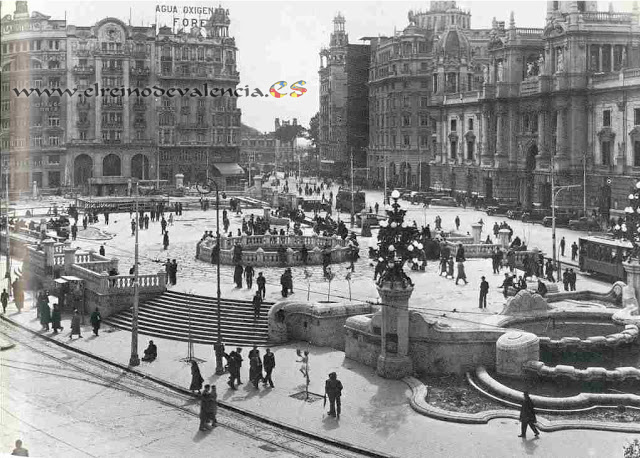
The tourist route can wait, though it will be filled with cruise-ships parties following their guide soon. That’s new. I wander into Plaza del Ayuntamiento, the main square of the city. Two police officers stand at the main entrance, which is still closed. They both smile and nod hello as I walk by; that’s not new. There are a few other tourists out early in the day, but are all at least twenty years older than me. I have learned a lot about Plaza del Ayuntamiento in my absence – it was called Plaza Emilio Castelar during the Second Republic, and Plaza del Caudillo when Franco took over. They tried Plaza del País Valenciano for a while, too. Since I’m in Spain on a civil war research trip, I can stand and imagine the propaganda posters and protesters, plus soldiers from both sides of the battle.

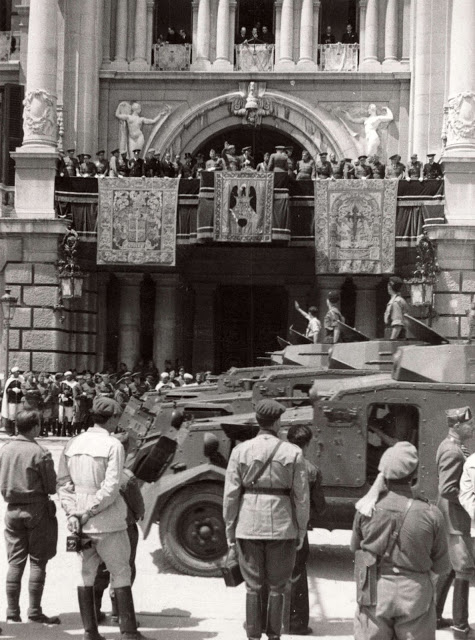
ENTRADA DE FRANCO EN vALENCIA EN 1939

Town Hall balcony 1939 and today 

plaza

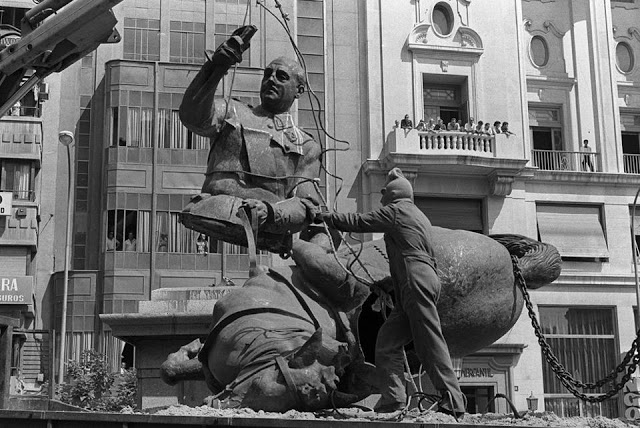
desmontaje estatua de Franco

Franco gets his marching orders

A statue of Franco stood in the square once, to commemorate 25 years of peace under his reign (no comment!). Now, a statue of Francesc de Vinatea stands in its place, a 14th century Valencian hero. The plaza once had a flower market embedded in the centre, underneath a fountain-littered promenade, but that was ripped out in 1961. Now, flower vendors are stalls that dot around the open space. I buy some; pink somethings (I don’t know my flowers!), for no reason than to say hello to the old man who was selling them. The plaza teems with people driving around its exterior, the audible hum of life is in full swing. There are stickers on posts; protests against government cuts to education. Valencia’s voice is coming in to protest later, but I don’t know that yet. My first day in Valencia years ago, as a new citizen to the city, there was a fireworks display in the plaza. I had never seen such a spectacle; Valencia like to burn things with a lot of noise. It was to commemorate an event being staged, the same one that had brought me across the world. The fireworks, which were let off in the centre of the plaza, where I’m standing, were so loud that a glass bus shelter shattered into a gazillion pieces. Nobody batted an eyelid; shit happens. Now, my friends, who shared the moment, aren’t here. We’re spread out across the world again. It changes the feel of the city remarkably.

fireworks

BOOM

I leave the plaza and the older part of this ancient city, and head down the pedestrian Carrer de Ribera. It’s cold in the shade. The stores are still closed, but the cafes are all open, filled with people having breakfast at 9am. Everyone looks so relaxed. I’m glad I brought my pink scarf on holiday; it seems to be part of the fashion. New Zealand may as well be another planet when it comes to clothes; finally my scarf has a home. I’ll need to buy more before I go back.

Carrer de Colon is busy, its one way traffic speeds past as I wait to cross the wide street. A bus stops and many people, mostly women, get off, obviously on their way to work. It’s the Number 19 route, almost at its end. I’ll take that bus at some point, it’s the route I took many times before. One woman is loudly telling another that her period is really bad this morning. There’s that over-sharing again. I cross the street, next to a woman pushing a worn-down stroller. The girl, perhaps three, looks tired. The mother is struggling to push the child on wobbly wheels and suck on her cigarette. I don’t like to tell people how to live their lives, and hate to receive advice, but smoking like that in a child’s face annoys me. I forget I come from a place where smoking is considered strange.

toros

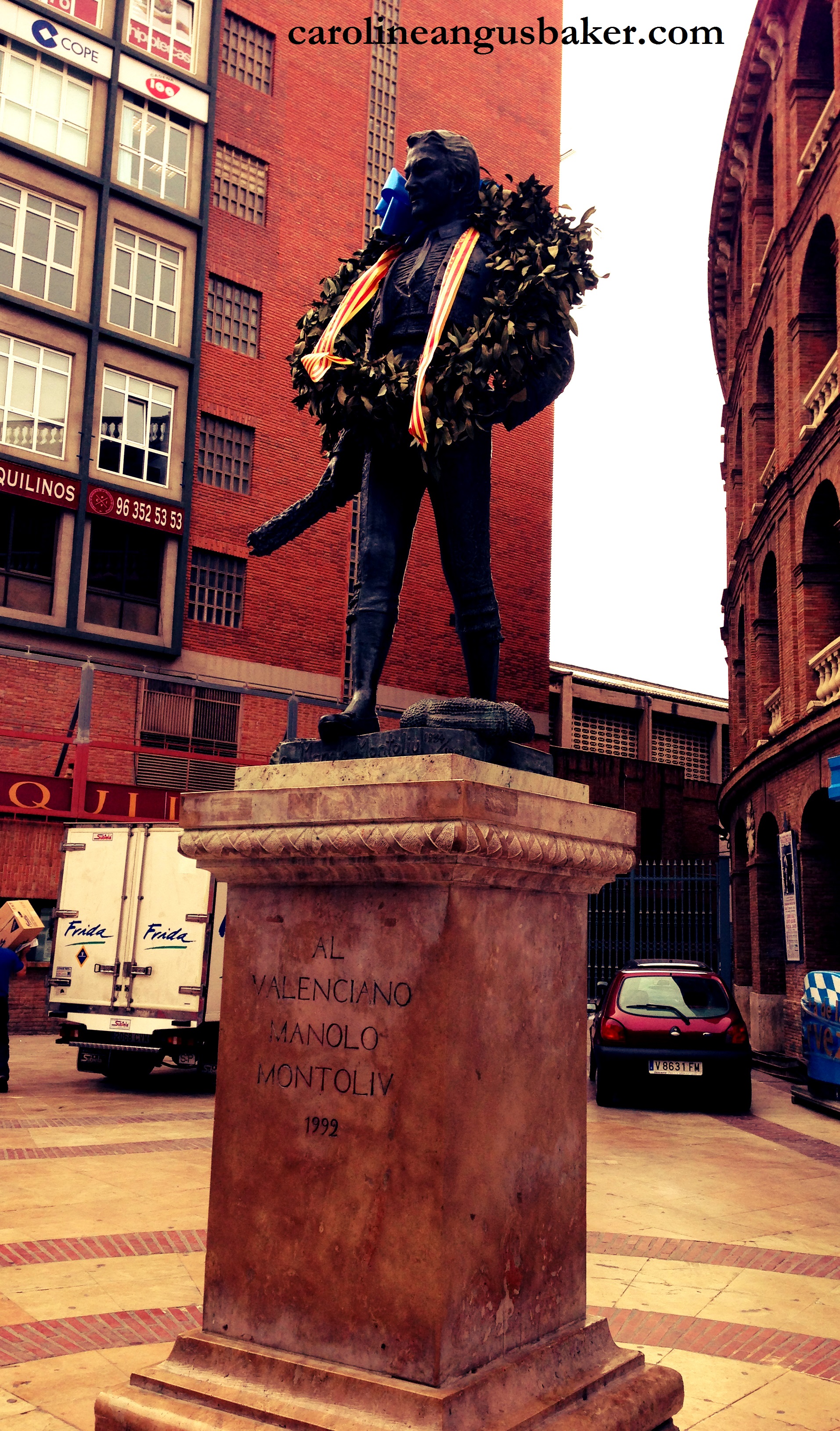
I pass by the bullring, Plaza de Toros de Valencia, which is closed this early, even the ticket booths. Posters are up for the upcoming weekend fight. I must go (it will later disappoint me). The statue of Valencian fighter Manolo Montoliu has had an artificial wreath put around his neck, and it’s covered in ribbons the colour of the Valencian flag. The anniversary of his death has just passed.

Down busy Carrer de Russafa, past a panadería selling the most delicious-looking pastries, and there is a space in the line-up of conjoined buildings. I think of Jason Webster’s novel, A Death in Valencia, when the main character’s apartment block collapses in this suburb. There hasn’t been a building on that site in years. Wasn’t it once a public carparking space? Knowing Valencia, they probably went to build something and found Roman or similar artifacts. The place is good for finds like that.

Down Gran Via del Marques del Turia, a street I’ve wandered many times. You can wander either side of the multi-lane street, or through the middle, in the tree-lined walkway lovingly placed in the centre. The cobbled path is dusty, like Valencia always seems to be. There are many beautiful buildings along here; I had several friends who lived here, in gorgeous apartments. They don’t live here now; they were in San Francisco or New Zealand last I heard. My doctor lived on this street. His office, in his apartment, has a plaque outside his door, and I touch it when I walk past. In very difficult times, it was good to have someone who listened to serious concerns. The old bookstore is still there, still not open for the day. Imagine all the stories hiding inside. The optometrist is still there; a young woman is opening the place as I go by. I wonder if the old couple who worked there have retired yet. I hope they were able to. The traffic is building as I reach the end, at the Pont d’Aragó, the bridge over the Turia across the street. The light says I can cross, but cars stream through their own red light anyway. It was always dangerous crossing here, though I don’t have my quad (yes, quad) stroller with me anymore. The sight made cars stop, but running down a single woman seems to be of no concern, as always. I stood on this bridge late one night, eight months pregnant with my fourth child, knowing I had to move away from Valencia. What a depressing evening.

turia

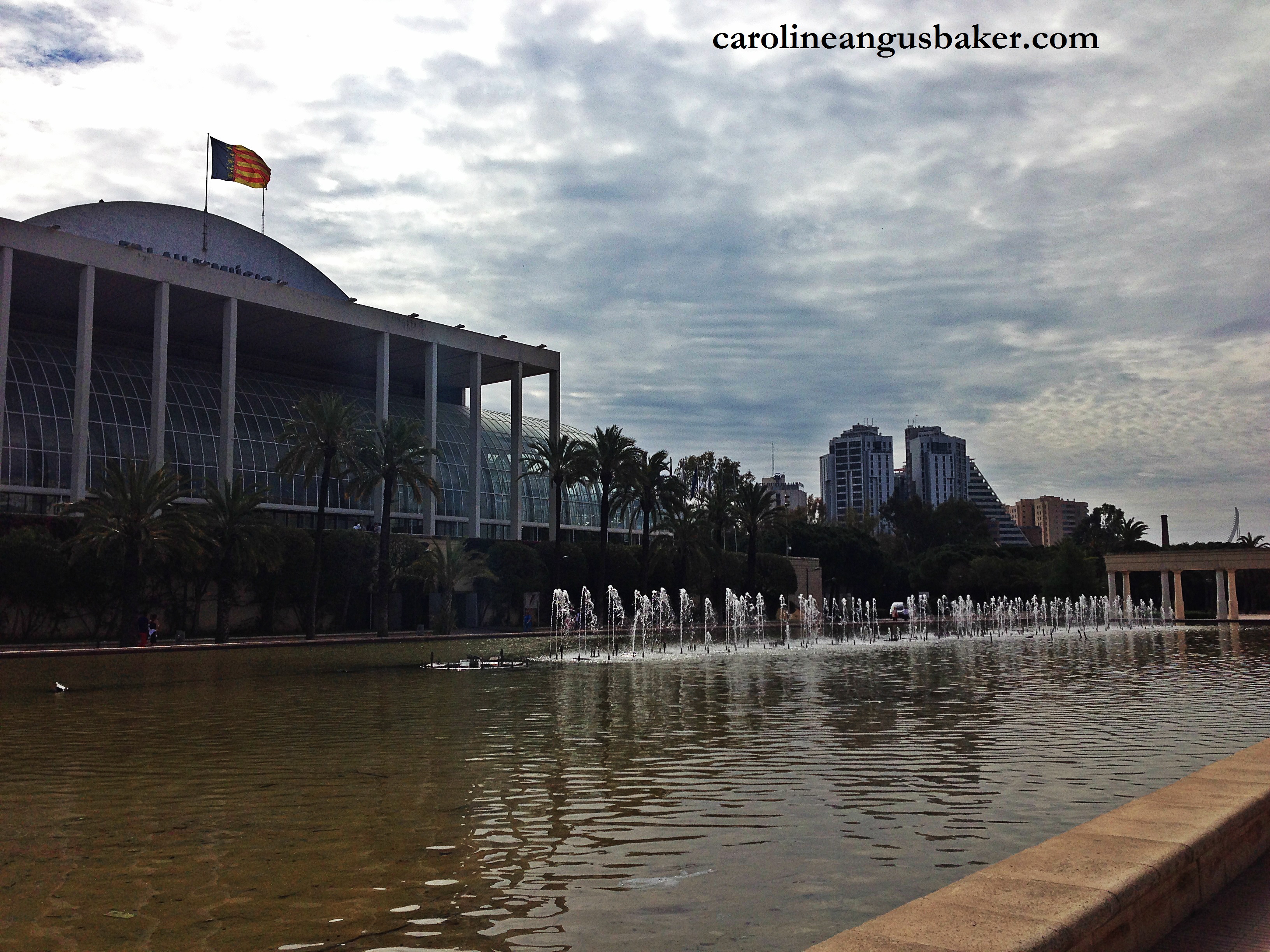
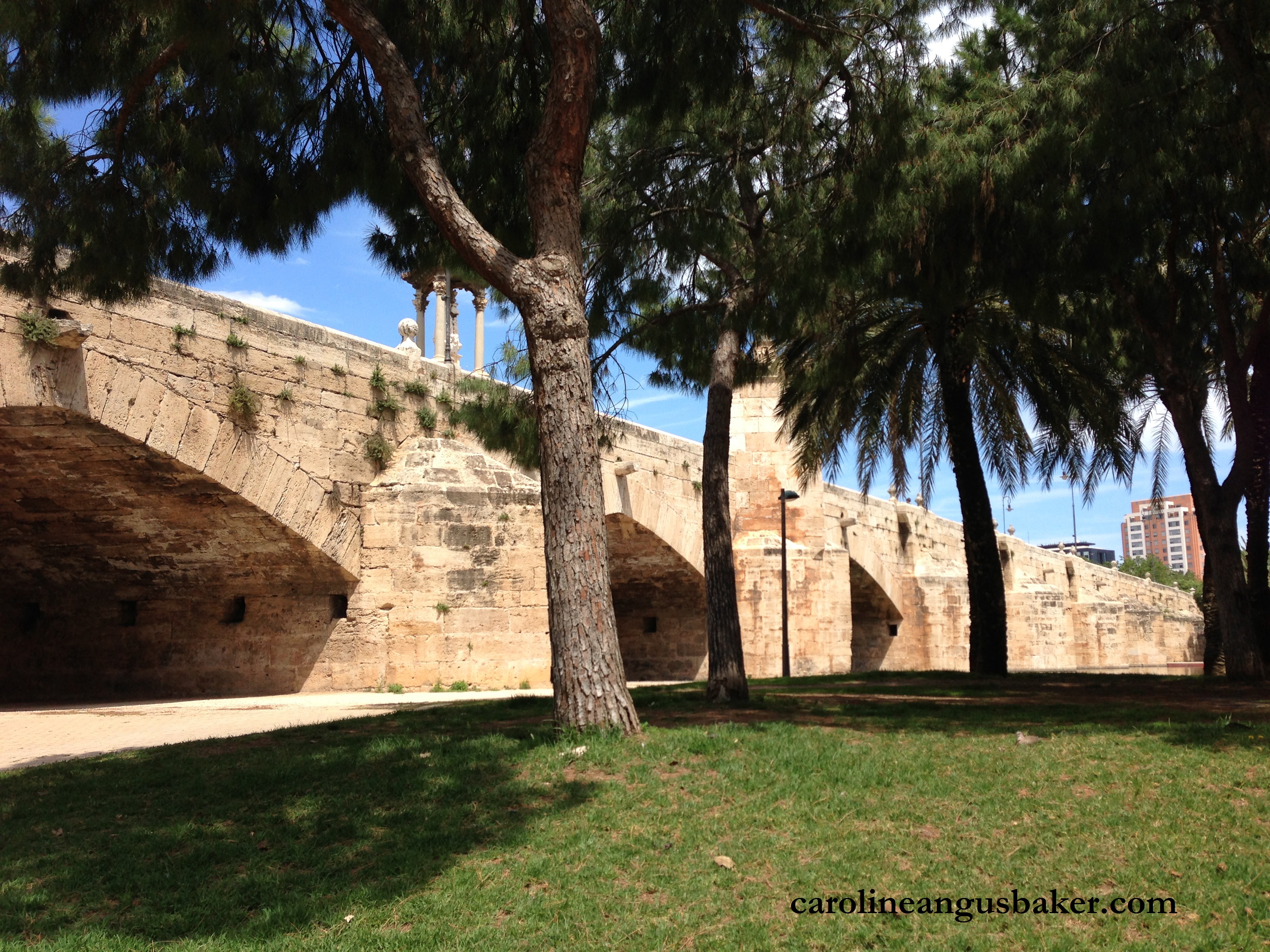
Into the Turia I walk, one of the grandest sights you will ever behold. Bikes drift past as I head along familiar routes. The Chinese guy is still doing tai chi in his usual spot after all these years. Keen runners are out, along with pairs of old women out for a stroll. One tells me that I’m beautiful enough to find a good husband. How generous. One of my favourite spots, the fountain outside the Palau de la Musica, is silent. My children loved running along the edges and watching the water displays. No one is playing now. A young guy is setting up a tripod and he goes out of his way to say hello to me as the sun begins to warm up the city. I remember seeing a friend here, a famous New Zealand sportsman, one hot summer evening as he was riding his wife’s bike, and had a pizza in the front basket. His front wheel wobbled when he waved hello. He’s gone now, runs some kind of hovercraft company these days. Another friend told me to stop running along here, because I was too pregnant; she’s gone now, too. There used to host open-air concerts here at night in the summer, maybe there still are. Sitting under trees with picnic baskets and enjoying noisy Spanish life; I hope the recession didn’t claim them.

Turia

A walk along familiar paths brings back memories, like the bike stand where tourists grab a ride, Gulliver playground, which is amazing, but in all honesty, not that clean and my children were too small to really enjoy it. The concrete mini-golf thing is still there, looking as worn as ever. The cafe with foul-tasting horchata ice-blocks is open, and mothers sit outside with young kids. When we took our kids there with friends, we went around as a group, and collected the rubbish before the children could play. After a while, you accept that as standard practice. I remember learning of a friend’s miscarriage while at the playground, and wondering how could I tell her that her husband had been cheating on her after that? She forgave him, once she found out.

park

The skateboard ramps have even more graffiti and it seems angrier than before. Spanish life has got harder. ‘My’ part of the park, the area around the Arts and Sciences has a huge amount of familiarity, yet feels so different at the same time. On the whole, nothing has changed. The Reina Sofia theatre, the giant eye, could use a wash, but the place is exactly how I remember. I walked along here every day, and after being away so long, coming back is a bizarre experience. There’s no way of explaining what is it like to walk past things that I have missed for so long that I almost felt as if they no longer existed. The playground where my children played is exactly the same; the bushes still rustle oddly, too. The kids always suspected giant rats (not sure who started that rumour. It’s just birds). I sit in a spot under the shade of a tree. I did that one day, with my sons, then aged 23 months and 7 months, and wondered why we were alone. Then I noticed it was 44 degrees, according the temperature gauge on Pont de Montolivet. I had a pain in my stomach and I had a feeling I was pregnant. Four weeks later I had that confirmed, while looking out over the park in my apartment.

Turia

It’s odd to see my part of the city so lifeless. Once, I couldn’t walk down the road without bumping into 30 people I knew, friends to chat with, husbands wheeling pink shopping baskets home for their wives, locals who were amazed at how many sons I had and how close together they were all born. Now, almost no one is about. The woman at the perfume counter I used to visit seems happy to have a customer when I buy a bottle of Prada. The smell is an instant reminder of my old life.

It’s easy to waste hours walking around old haunts, up and down streets, filled with memories. The facade is all the same, but the atmosphere has changed. Valencia moved on without me. Of course it did; I moved on without Valencia. I was only meant to be away three months, not six years. But it’s great to be back. The day is quickly lost by wandering old haunts. I stop by the Disney store; there was a robbery at the nearby Carrefour once. Friends had been there, and dived behind piles of stuffed Disney characters. One guy dived behind his girlfriend. I don’t think the relationship lasted much longer after that. Today, the whole place is quiet.

serranos

Walking among the tourists at Torres de Serranos

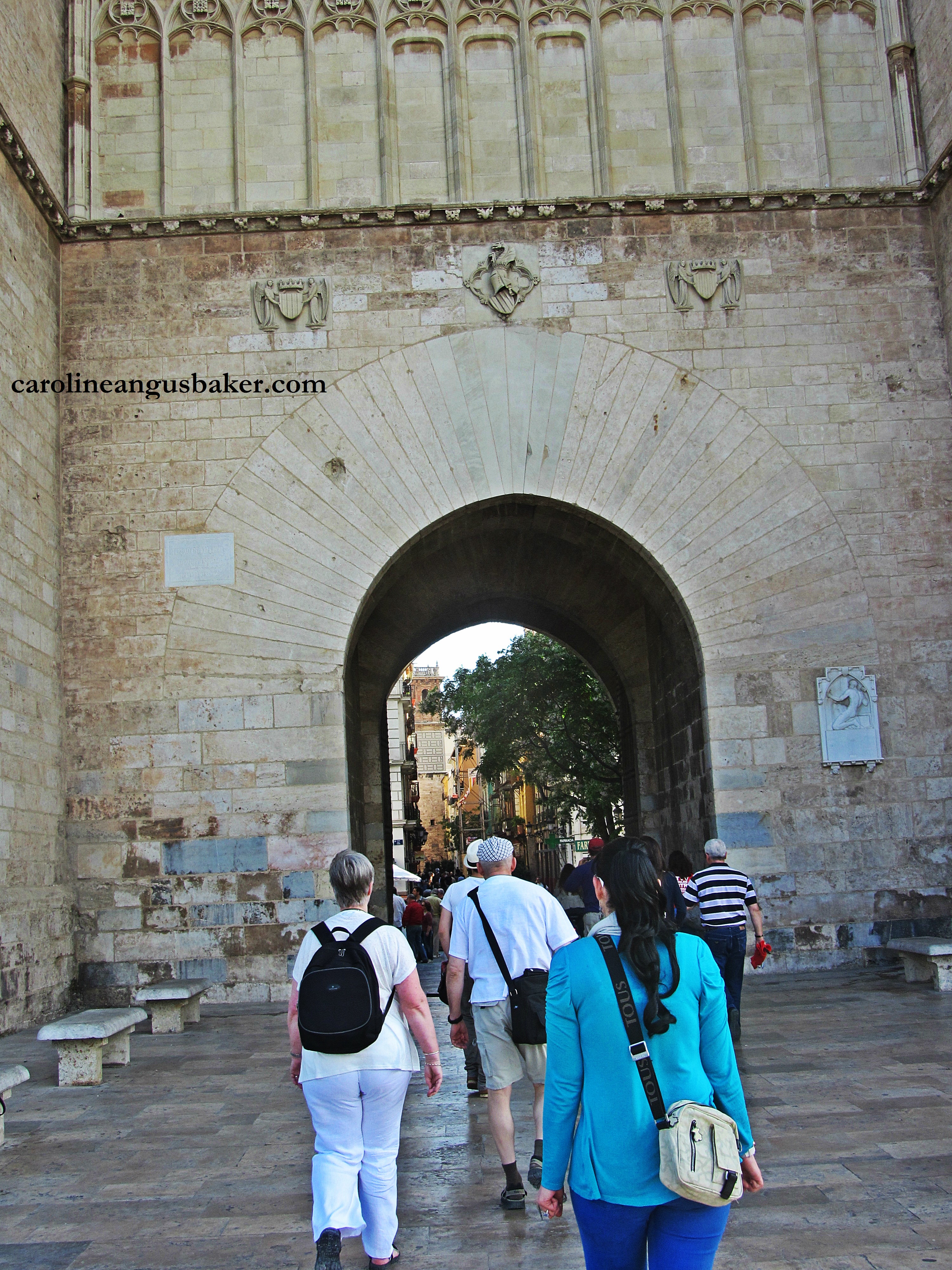
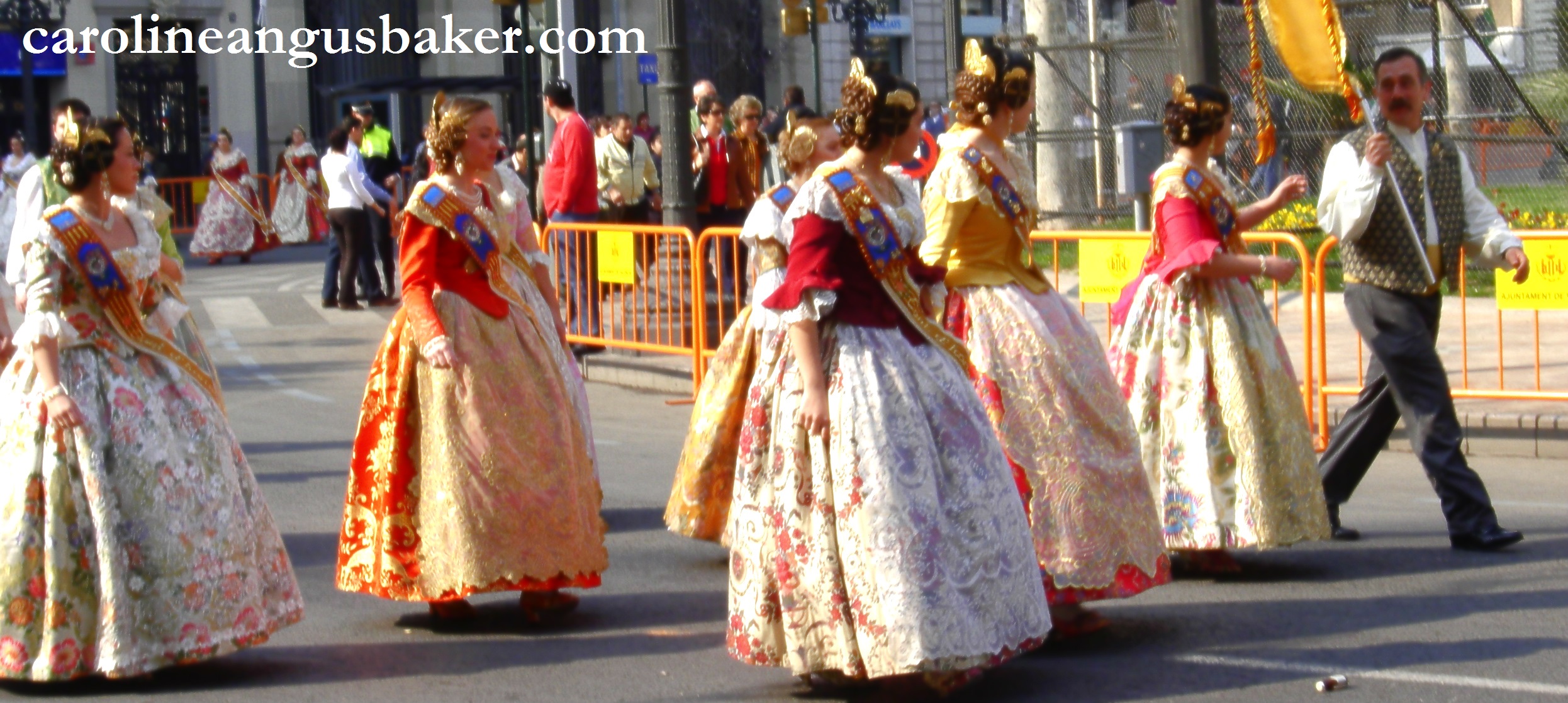
It’s time to walk back through the park, to Torres de Serranos and dive back through the old town. People to see, places to go. I have to play tour guide later, not something I’m sure I can do. The way I know the city can’t really be explained. Plaza de la Virgen is gearing up for a fiesta, but I can’t even remember which one. I’ve seen a few girls in their fallera dresses, so it’s something big. I sit at the fountain, a popular spot, and remembered sitting here with my father, while heavily pregnant with son number 3 of 4. My father has passed away now.

fallera

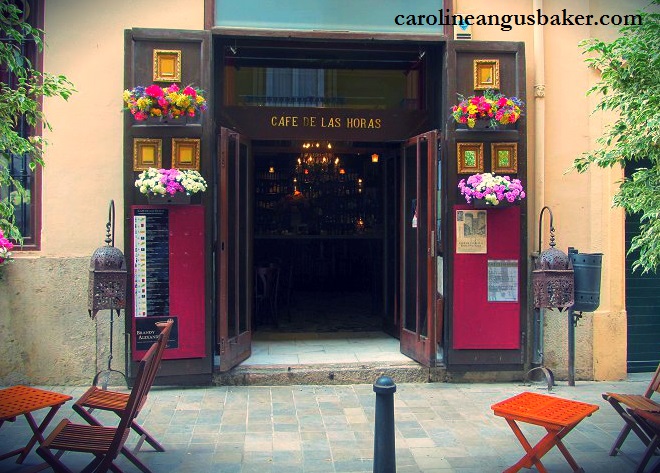
I see familiar spots, places I put in my first Spain novel. New(er) places will be in the next novel. I’ll visit those spots later. The beverages in Cafe le las Horas are as good as ever in the mid-afternoon, as is the decor. I might sit here for a while; little do I know I’ll be wandering busy streets later and getting caught up in a giant-sized anti-government and banking protest. This spot will do nicely while I laugh with a friend. Valencia exists entirely inside the people who are there. 

cafe

All 2013 photos author’s own. Valencia history photos courtesy of Juan Antonio Soler Aces

A LITTLE JAUNT TO SPAIN – REVIEW PART 7: Valle de los Caídos: A trip to Franco’s tomb to see a divided Spain

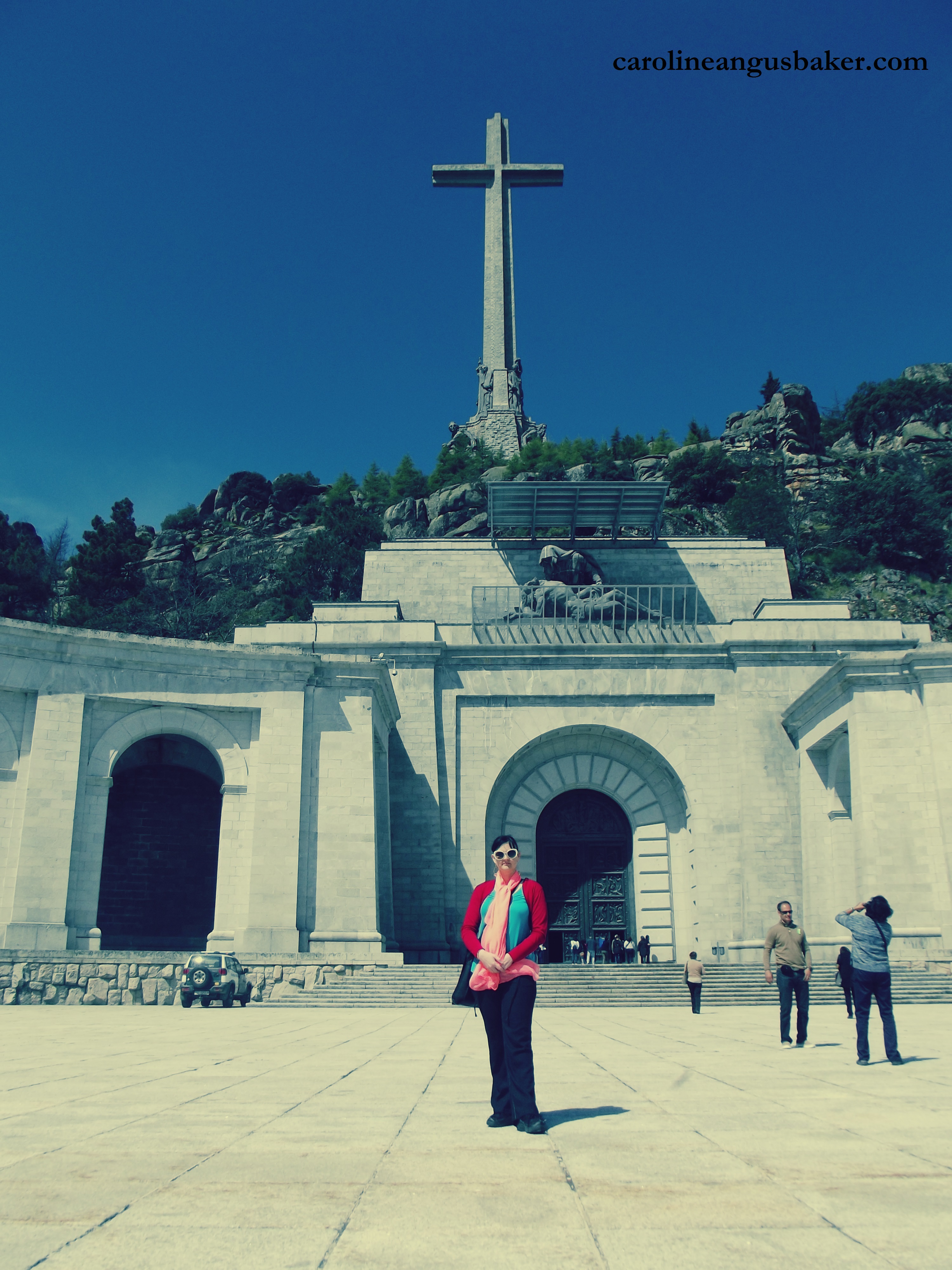
me1

You know how Germans dress in their best every Sunday and go to leave flowers and prayers at Hitler’s grave? Oh wait, they don’t, they opened up about their past, dealt with their issues and moved on as a people decades ago. So why are Spaniards having family picnics near the tomb of fascist dictator Francisco Franco? I packed my best possible neutral opinion and set off into the Madrid forests to find out.

“The moment you move the soil over shallow graves, the agony of Spain will pour out, like fresh blood from a wound. All that pain and hatred is covered by a thin layer. Don’t stir up something you can’t understand” – Blood in the Valencian Soil

I’m no ignorant tourist. I’m aware of the tensions that surround El Valle de los Caídos, the Valley of the Fallen. Some say it shouldn’t be open at all, and for a time when the PSOE was in power, it was closed to the public. It was one of the few places on my trip where I was the only foreigner, trying to quietly pass between families of all ages inside a macabre and eerie Basilica inside a mountain.

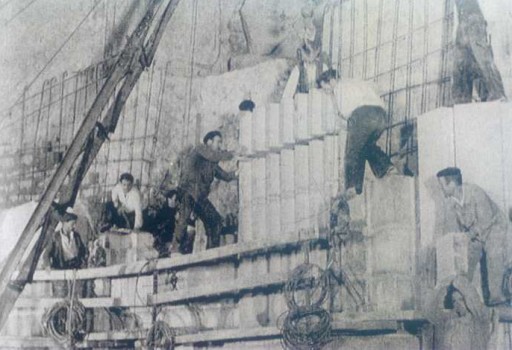
What is Valle de los Caídos?  It is a giant memorial to those killed in the Spanish Civil War, but ended up as a monument to only the Nationalist side, headed by ultra-conservative war winner Franco, who is buried there. Even the history surrounding the place is murky. ‘Official’ records say it was built by approximately 2,600 workers, and a handful of them were Republican (left-wing anti-Franco) prisoners. (Long story short, Republican prisoners were basically anyone the new dictatorship didn’t like. Proof that ever committed any crime, against the public or the State was tough to find, unless being a Republican soldier counts as a crime, and it was back then). It was commissioned in 1940 and finished in 1959, but a more accurate report was of 20,000 Republican prisoners taking part, and the number  killed in the process is unknown, some say dozens. You can get an idea of how touchy this subject really is.

Franco40

Franco inspects the site of Valle de los Caídos in 1940

buildwork

Republican prisoners building the cross

bodies

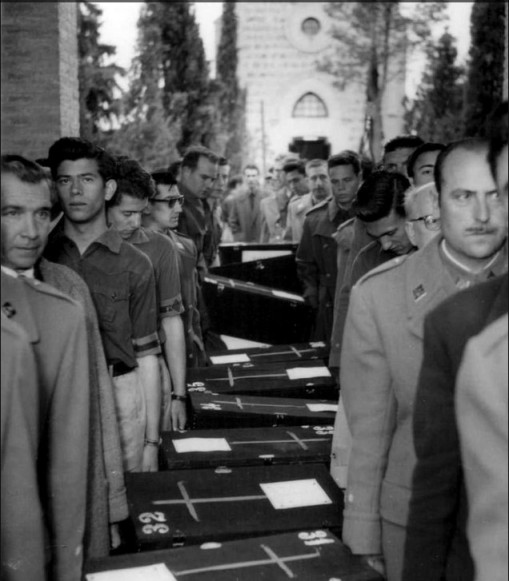
Remains of soldier killed in Toledo arrive to be reburied in 1959

1290096772854

Watching the opening of Valle de los Caídos in 1959

(click to enlarge the photos will launch an amazing slideshow of pics)

Franco created Valle de los Caidos in the Sierra de Guadarrama, the mountains outside Madrid city. Nearby is San Lorenzo de El Escorial, the once summer palace of the royal family (I visited, and the golden tomb is WELL worth the visit – for another post).  The trouble is, Valle de los Caídos was filled with the bodies of killed men, Nationalist (Franco) soldiers and sympathisers. It was a civil war, Spaniard against Spaniard, but those who opposed the rebel army takeover of the Republic were simply forgotten. José Antonio Primo de Rivera, founder of the fascist Falange party is buried there, and Franco was also placed inside a tomb under the basilica in 1975. The exact number of bodies laid to rest inside Valle de los Caídos is unknown, and could be anywhere from 30-35,000. In the last 10 to 15 years, a large number of Republican families and organisations have found the strength and courage to dig up their relatives who were murdered and thrown in mass graves around Spain. However, some have been removed from these graves and placed in Valle de los Caídos without family permission, which only serves to give this place an even more heartbreaking feel.

view1

View while driving up the mountain

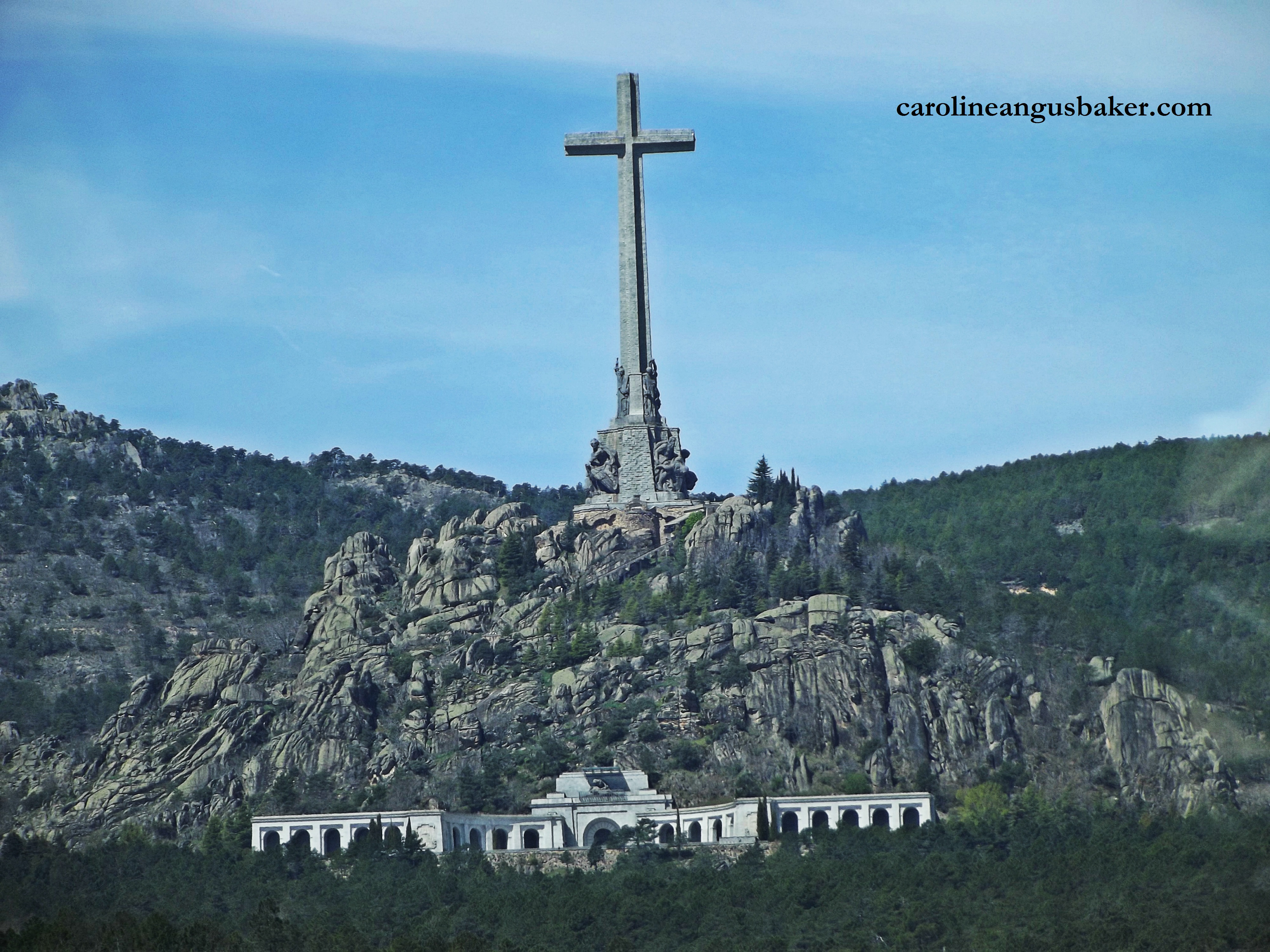
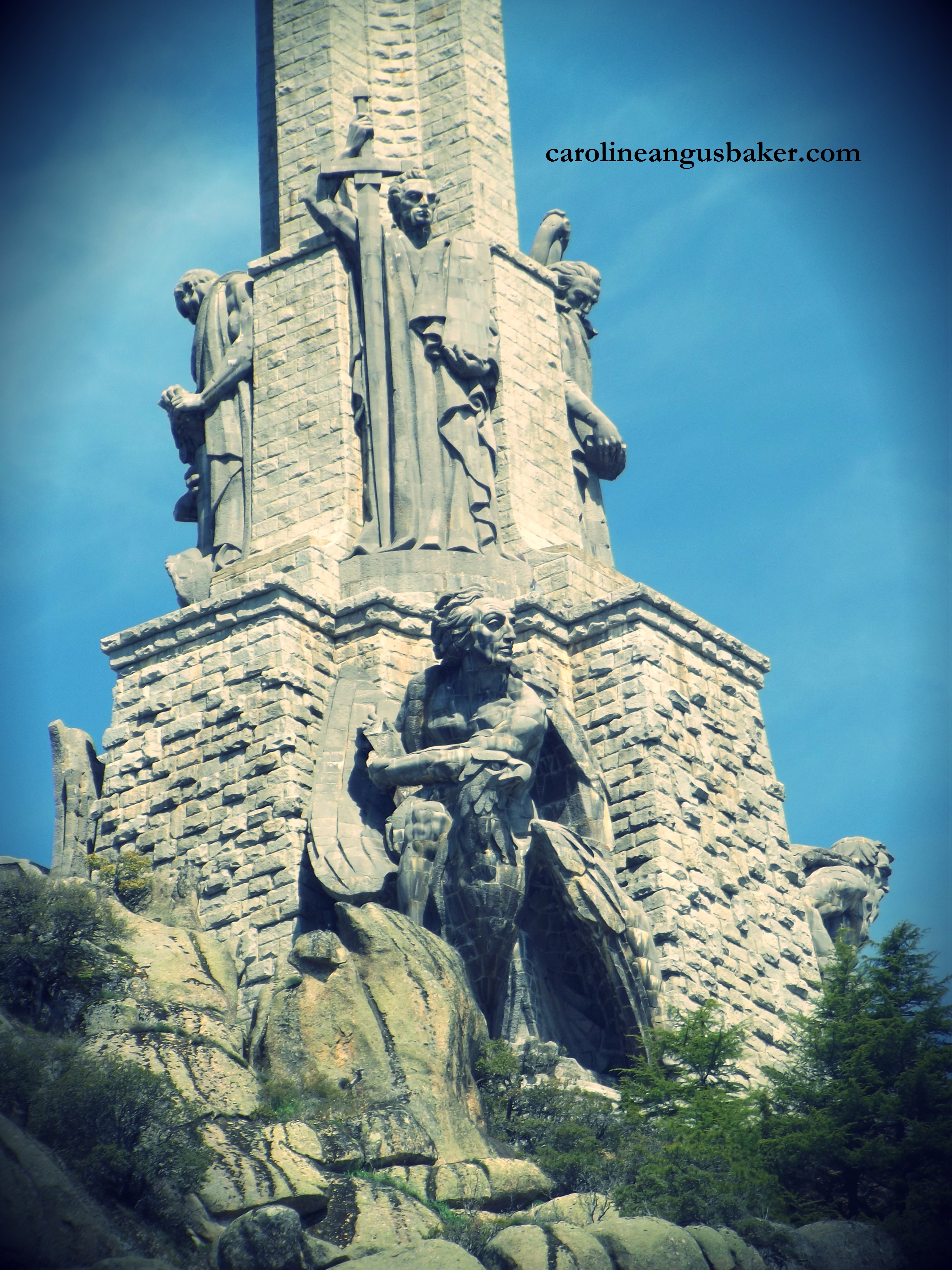
Political views aside, the sight of this location is incredible on its own. You can see it while driving along the motorway, sticking out of the otherwise peaceful mountains the surround the north side of the Madrid province. We went through an innocuous gate off the main road to El Escorial and made our way several kilometers up the mountainside on a bright and beautiful Sunday morning. You constantly catch glimpses of the behemoth through the trees, but until you are standing below the enormous cross  built on the hillside (152 metres, the worlds’ tallest), you cannot grasp the size and scope of the this place.

cross1

cross2

DSCF5120

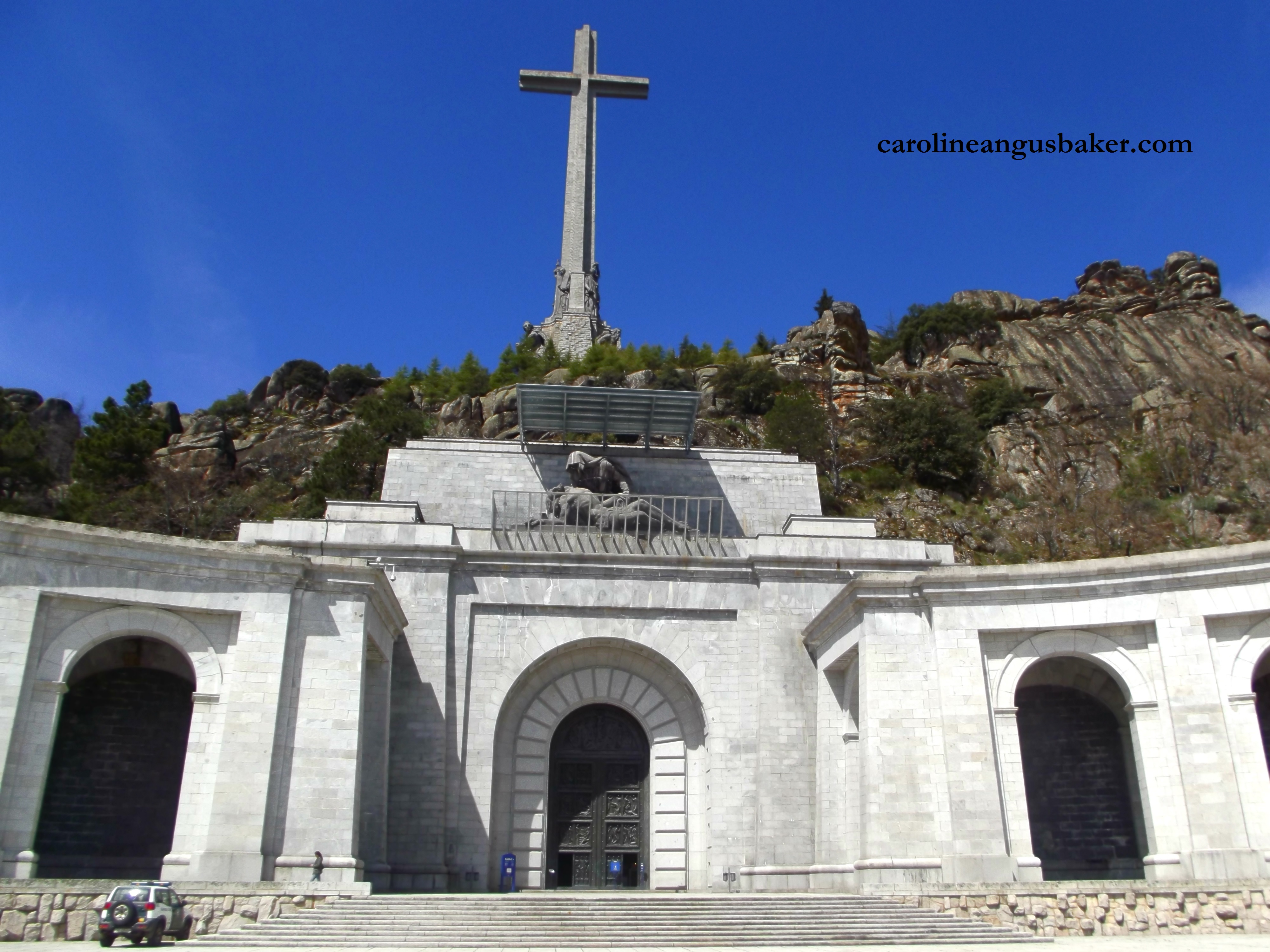
The carpark was filled with cars and buses, and I suspected I was about to turn into another touristed location. Not so! Once at the arch doors to the entrance, the only people in sight were the Guardia Civil. The place itself is situated in a beautiful location and the quality of work done is exquisite. The place could have been built as a place to honour those lost in the war and the healing of a great nation. But given that the crypt is a basilica, and that the church oppressed the Spanish population and the Republican (or left-wing if you prefer) side didn’t support the church, there was never the possibility that the monument could honour both sides of the nation.

outside1

Entrance archway

outside2

View of the Sierra de Guadarrama

outside3

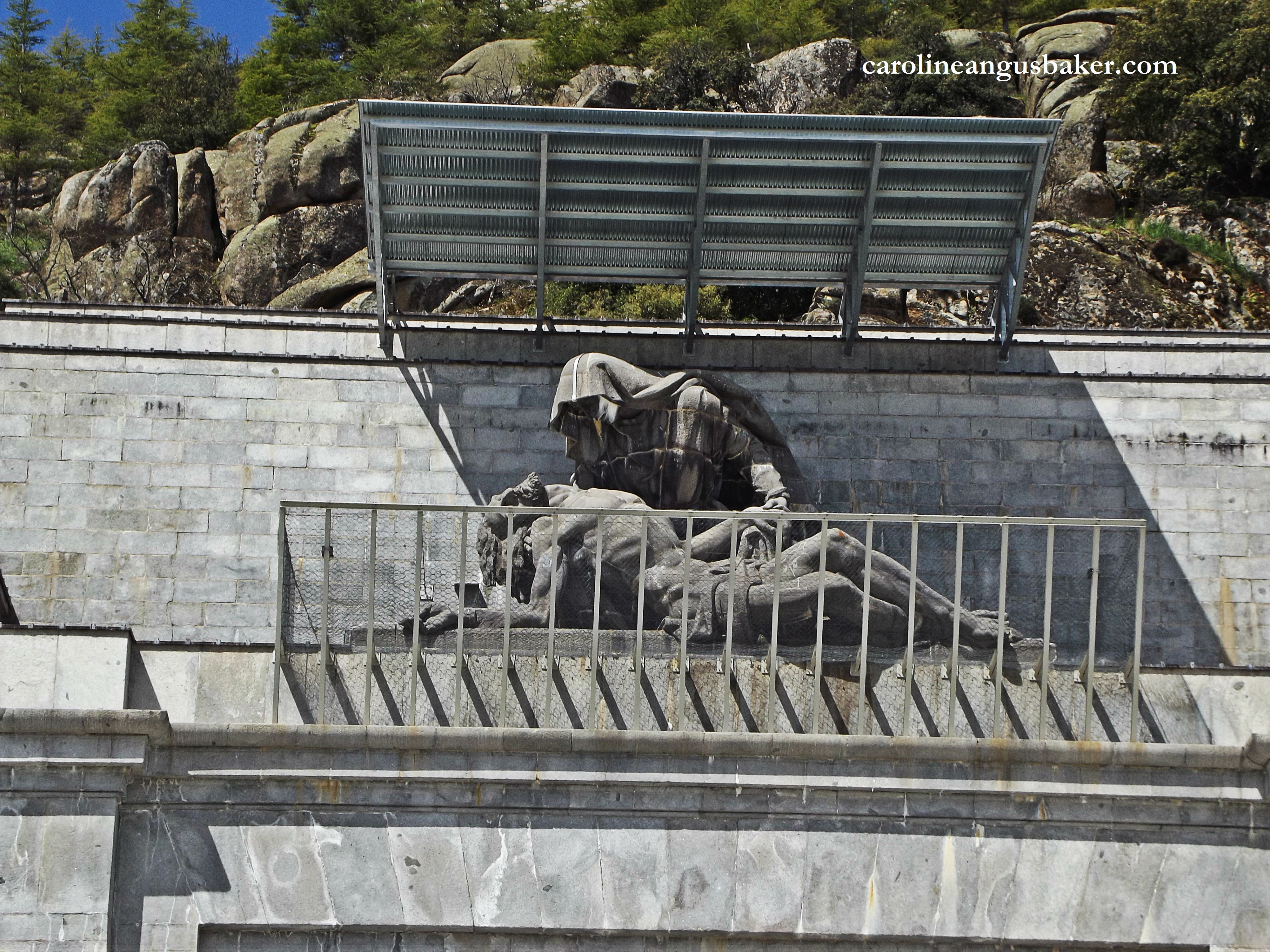
Statue over the entrance – The Pietá

I stepped inside, sadly unsurprised that there is gift shop (After all, what child doesn’t want a gift of a colouring book and pencils from a crypt, or a fan with Franco’s grave printed on it?) I put my camera in my satchel, as photos were forbidden, but I had my iPhone in my pocket, just in case. Then I entered the nave.

nave

Nave

Spain_Valle_Ceiling-1280

Ceiling over the altar

From the moment you go inside, the overwhelming and solemn feel of the cold and dark place takes you over. Giant gloomy and menacing angels brandishing swords bear down on you. The nave is filled with masterpieces of religious painting and tapestries. The attention to detail is second to none. I paused to take in them and the angel statues, but the foreboding sense of the place had already sunk into my bones. Mass was finishing up as I arrived at the altar, and I sat down quietly to listen to children sing in the choir. Children were singing in this place that spoke of death.

angel

Altar angel

Mass ended and the faithful began to wander around the altar, me included. The first thing I noticed was not the menacing  angels, or the elaborate golden Jesus, but the grave of José Antonio Primo de Rivera, which someone had left flowers. Now, can I judge those who come here? No, I can’t. I don’t know why they come. Perhaps their loves ones were buried here,  as Nationalist believers to the Franco cause. It was a civil war and everyone lost one way or another. Can I, or anyone, look down on these people for coming  to pray? No. Whether it’s for a loved one, to feel closer to the history of Spain, or even if they supported Franco, that’s their decision. But what about the people who came to leave flowers on the grave of the founding father of Spain’s fascist party? What was the motivation there? A grieving loved one, or someone with old evil ideas that haven’t been forgotten? It was shiver up the spine stuff.

IMG_1639

Altar

grave

As priests wandered about and nodded hello, I found what I had (kind of) came for – the tomb of Franco placed on the opposite side of the altar below the semi-circle of wooden stalls made for the monks and the choir. There lay flowers on the grave, and this time I saw no reason why anyone would place them there. There are many reasons why people continue to support Franco (and it’s a discussion too long for this post) and I don’t see the merit in any of them. Just to the right lay more floral tributes – dozens to be precise, which had been placed to one side presumably because of the sheer volume. A few people were taking photographs, under the watch of a guard. These people had laid the flowers and wanted to capture the moment, no mistaking their alliances in this case. I asked if I could also take a photo with these people and got permission. Why take it? I don’t know, it’s like watching a car crash, it’s awful but you can’t look away.

I was surprised by the state of the place. Perfection? No. Built into a mountain, they must fight their own war with damp, and you can see that in the granite stonework. Water seeps in here and there, which only gave the place a more unearthly and morbid feel. After all, we were all underground, surrounded by graves…

To the left and right are small rooms, with rows of seats and monuments to Spain’s fallen. People lit candles and families laughed and chatted with priests. What says family day out more than this? I sat in the right room, the entombment, which featured an alabaster Jesus statue. I sat and looked at the wall.  Caídos – Por Dios y Por España. Fallen – For God and For Spain.  All of Spain? Many disagree. Republicans denounce this place, and many here on this random Sunday wore Falange symbols on their lapels.

Placa_Valle_Caidos

Inside the chapel of the emtombment

I will admit it – I silently cried as I sat there, which drew the attention of a priest who thought I needed comfort, and the ‘comforting’ hands of old ladies on my shoulder. Me, the young Catholic attending Mass here? Oh boy, that couldn’t be more untrue.

I headed back through the place, fairly certain I wouldn’t ever be back. I stopped by the gift shop to buy a book on the place, in Spanish, about how the place has reconciled Spain. Hmm. I also grabbed an excellent copy of a collection of civil war photographs. The crypt trinkets and religious adornments could stay where they were. After all, who would wear a Valle de los Caídos t-shirt? Why would you, and for what purpose?

The shining moment came as I left the crypt and stepped out in the sunlight. There stood a group of men, all aged 70 or more, hailing a fascist salute at the cross above the entrance. It was well and truly time to leave.

view

Panoramic view from the main entrance after the fascist saluters said hello and went inside

If there is one thing, it’s that this place is full of emotion. Good emotions? Not all of them. No good ever came from a fascist salute, but it would be too simple to label everyone who visits there, whether they’re crying at Franco’s tomb or having a picnic outside in the sunshine. I am not a religious person and I am not going to tell Catholics how to pray to their God in that Basilica. The books I bought there, their glossy pages gloss over Spain’s history entirely – after all this time, the war and the subsequent dictatorship is not talked about like it should be. Spain shouldn’t have to hide its past. It has been 74 years since the end of the war and yet its presence still lives in Spanish life, whether people say so or not. In 2011, it was decided that moving Franco’s body would be a way of restoring Valle de los Caídos’ image and making it a truly impartial monument to Spain’s fallen, however as the crypt was elevated to Basilica status, the church can decide, and their opinions are not so easy changed.

Entierro-de-Franco-en-el-Valle_54064507265_960_639

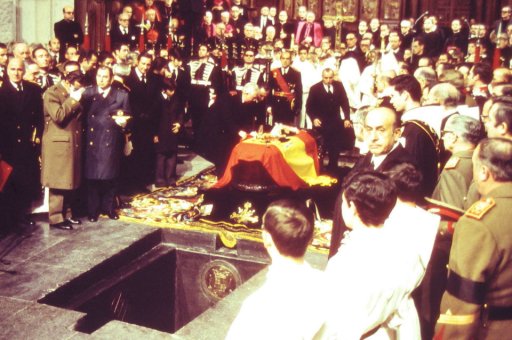
Franco’s burial in 1975  I wonder who the crying  guy is on the left (click to enlarge and view slideshow)

My personal opinion? The place is worth the visit, despite being a pain to get to if you don’t have a car. I travelled alone, and would I want to take my young family there? I’m honestly not sure. It’s not something you will find in the Spain brochures during your Ryanair flight to the beach in Benidorm or Malaga. But if you’re into Spain history, or have a personal or familial connection to the civil war (as have I) you really should visit. Just leave your camera behind and hush your opinions while you’re there. I know what side I stand on, and I took the bus back to Madrid, convinced more than ever of my opinions. But they remain mine. The other people there were very polite, and believe in what they love – that Spain was better under Franco. Nothing I stumble out in Spanish will make the slightest bit of difference. Check out this photo of a wedding over Franco’s tomb though, that was a surprise find. Just goes to show how divided this place can make people.

Photos by abc.es – protesters waved Republican flags and supporters gave out fascist salutes when Valle de los Caídos reopened. The salute seems to be pretty popular

valle-caidos

Want to visit for yourself? – Valle de los Caídos website

Up next, Part 8 of A Little Jaunt to Spain…. Learning to be a tourist in Spain

Click here for past editions of A Little Jaunt to Spain – Spain 2013 in Review

All photos are author’s own, or linked to original sources

A LITTLE JAUNT TO SPAIN – REVIEW PART 6: Bullfighting in Spain – Madrid vs. Valencia

IMG_3616

“Bullfighting is the only art in which the artist is in danger of death and in which the degree of brilliance in the performance is left to the fighter’s honor.”

– Ernest Hemingway, Death in the Afternoon

Hemingway sung of praises and pitfalls in Death in the Afternoon. Generations past flocked to the ring. Protestors now stand outside the bullring and argue, as if they can change the minds of those going inside. Some people screw their faces up at the very notion of watching a bullfight.

The first time I was offered a slice of afternoon death in 2005, I didn’t flinch. I didn’t protest, I didn’t go on the offensive. From a young age I ran around on my nanny’s farm, probably terrifying the animals that we loved, fed and named. I also stood with a straight face the day I saw them slaughtered and turned into steaks, lamb chops or bacon strips. That is how the world works. Every animal you have ever eaten was killed, it lay bleeding out before cut up nicely for city folk to buy in little portions.

However, there is the fact that bullfighting taunts the animal before it meets its (hopefully) swift and bloody end. People who have never been to a bullfight can be very vocal of their opposition. That’s fair enough – I don’t need to watch child porn to know that I am steadfastly against it. Those who support bullfighting say it’s a tradition, part of Spain’s culture. Bullfighting is not considered a sport; rather it appears in the art and culture pages of the Spanish papers. I have studied and followed bullfighting in an attempt to learn more whilst writing the art into the storyline of my Secrets of Spain series. No matter how much you discuss bullfighting, no matter your opinions, an afternoon at the plaza de toros can have an effect.

“Bullfighting is like dancing the tango. It is a collection of human emotions – passion, love, anger, jealousy, happiness… all illuminated distinctly in the performance” – Cayetano Beltrán, Blood in the Valencian Soil

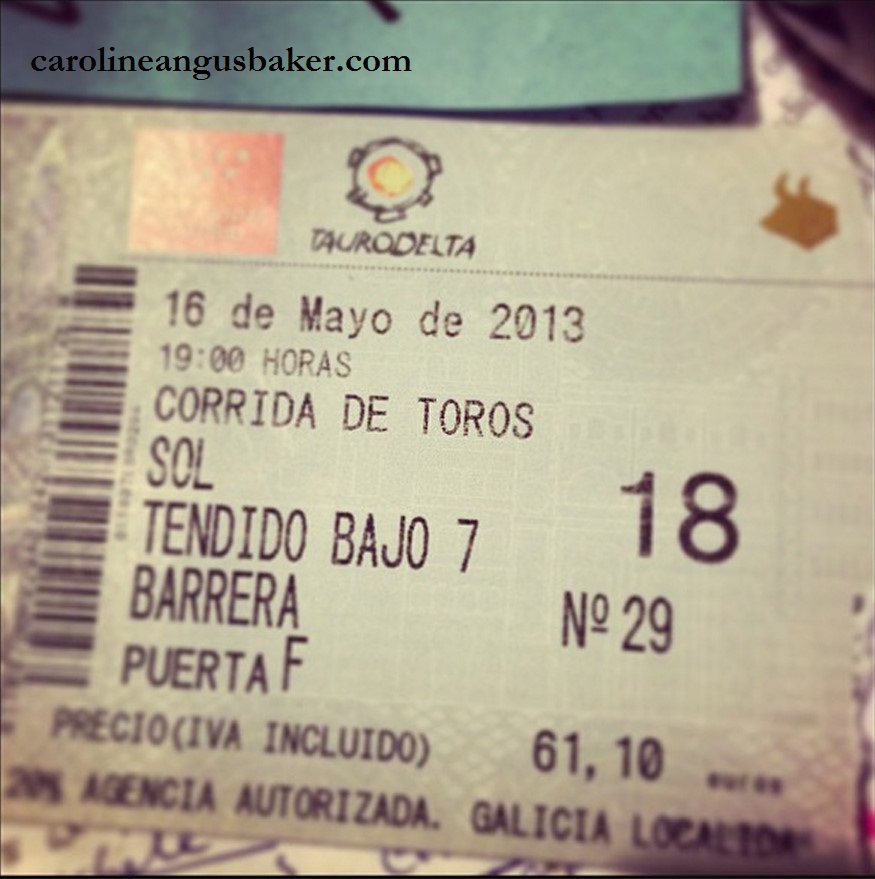
With the storyline of my second novel in the Secrets of Spain series, there are fights in both Valencia and Madrid. As the main character is the top billing at Las Ventas, the Madrid bullring, for San Isidro, a premier fiesta in the city, I decided to coincide my Spanish road-trip with this event. I booked a front row spot four months in advance, and lucky thing, because it was a sell-out. I wanted to look the animal in the eye and see how it feels down against the barrier.

To my surprise (or forgetfulness) there was also a one-off bullfight in Valencia for the Virgen de los Desamparados fiesta. Return to the same ring that I had been given tickets to in 2005? Why not? Suddenly my trip had two bullfights – and they couldn’t have been more different.

IMG_2572

Valencia – the cheap seats

I got a seat right at the very back, very top, very last spot of the bullring. If you’re unsure about bullfighting, then this is the place for you. Up high, looking out over the entire ring, you are wholly disconnected from what is happening on the sand. What else could you expect for €15? In saying that, the enthusiasm from my fellow spectators wasn’t diminished. All men, aged over 60, with fat cigars in their hands found it amusing to help a woman find her seat. Poor hapless girl needs help from a Spanish man. (Hey, okay, enjoy while it lasts, dudes. Lung cancer can’t be far away!)

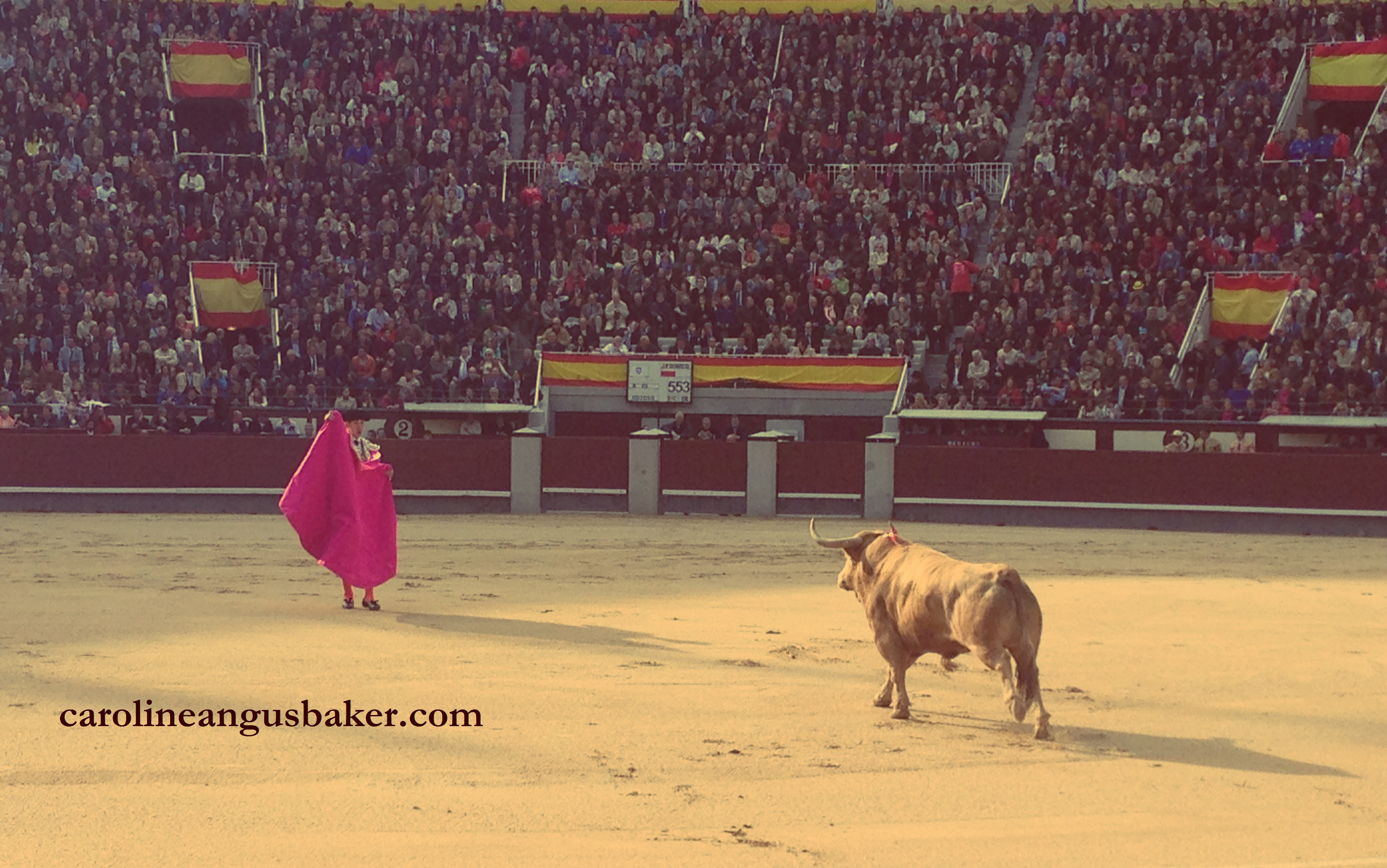
The ring was half empty, but those who had made the trip were keen to see three toreros (or matadors if you’re Anglosaxon), each having two fights. Here’s a very basic rundown of how it works, starting with the pasodoble played with a band headed up by a trumpet.

ring1

Out they come in Madrid

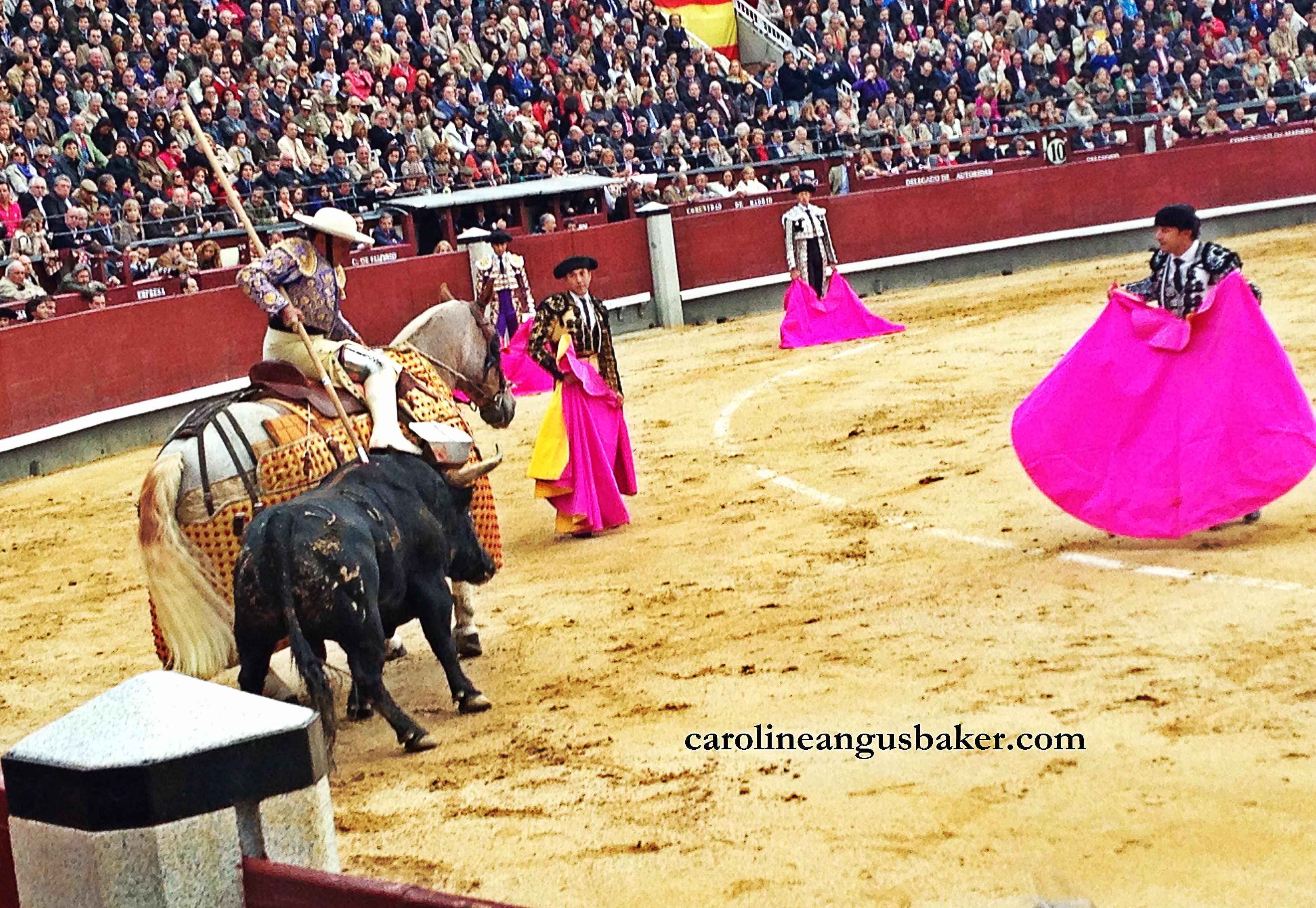
A torero isn’t alone, he has a cuadrilla (entourage, if you will). To start with his three banderilleros (let’s call them pink cape guys in full dress), taunt the bull a little, allowing the torero to get a look at the animal, how it moves, etc. This is a bit of entertainment; the pink cape guys tease the animal, let him run around, get nice and angry. The torero can come in and do what is called the suerte de capote (act of the cape), making passes with the animal. This is the fun thing about bullfighting. When the torero gets it just right, the crowd all let out a ‘ooooh’ at the same time, me included. You don’t need to understand passes (like the veronica, where the torero holds his posture as the bull goes under the cape) to know when it’s done well. It’s like watching a flawless ballet dancer and you can see the gracefulness in the moves. You don’t need to know how to do it to know it’s being done well.  

ring2

Banderilleros in Madrid

Next is the bit I find a little pointless, other than the bloody great point on the end of the lance, that is. In come two picadores (guys with lances on horseback). The horses are very well padded and have their eyes covered. They appear calm, but if you think they are innocent to the situation, I reckon that’s bollocks. Horses are too intuitive for that. Anyway, the bull is suitably pissed off and charges the horses, and the picador jabs his lance into the muscle at the back of the bull’s neck. It’s bloody, meaty and weakens the angry animal.

ring3

Picador gets his lance in the bull in Madrid

Then comes some more taunting, when the three banderilleros attempt to stab multi-coloured banderillas into the neck of the beast. Whether you like bullfighting is irrelevant when assuming that you need to be pretty brave to give it a try, because the bull is mad by this stage and ready to gore you in the guts.

IMG_3547

España coloured banderillas in Madrid

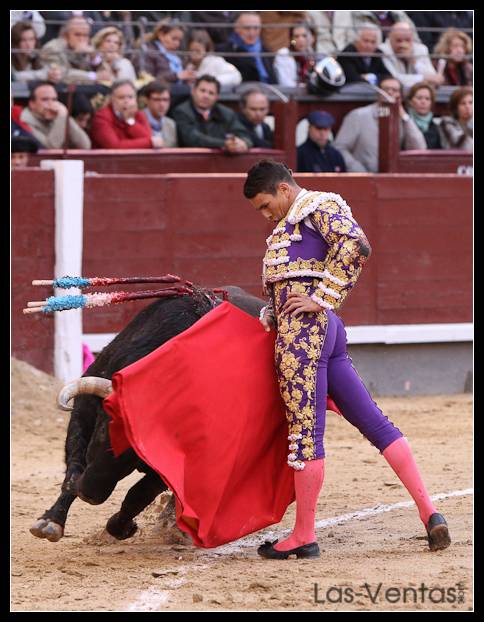
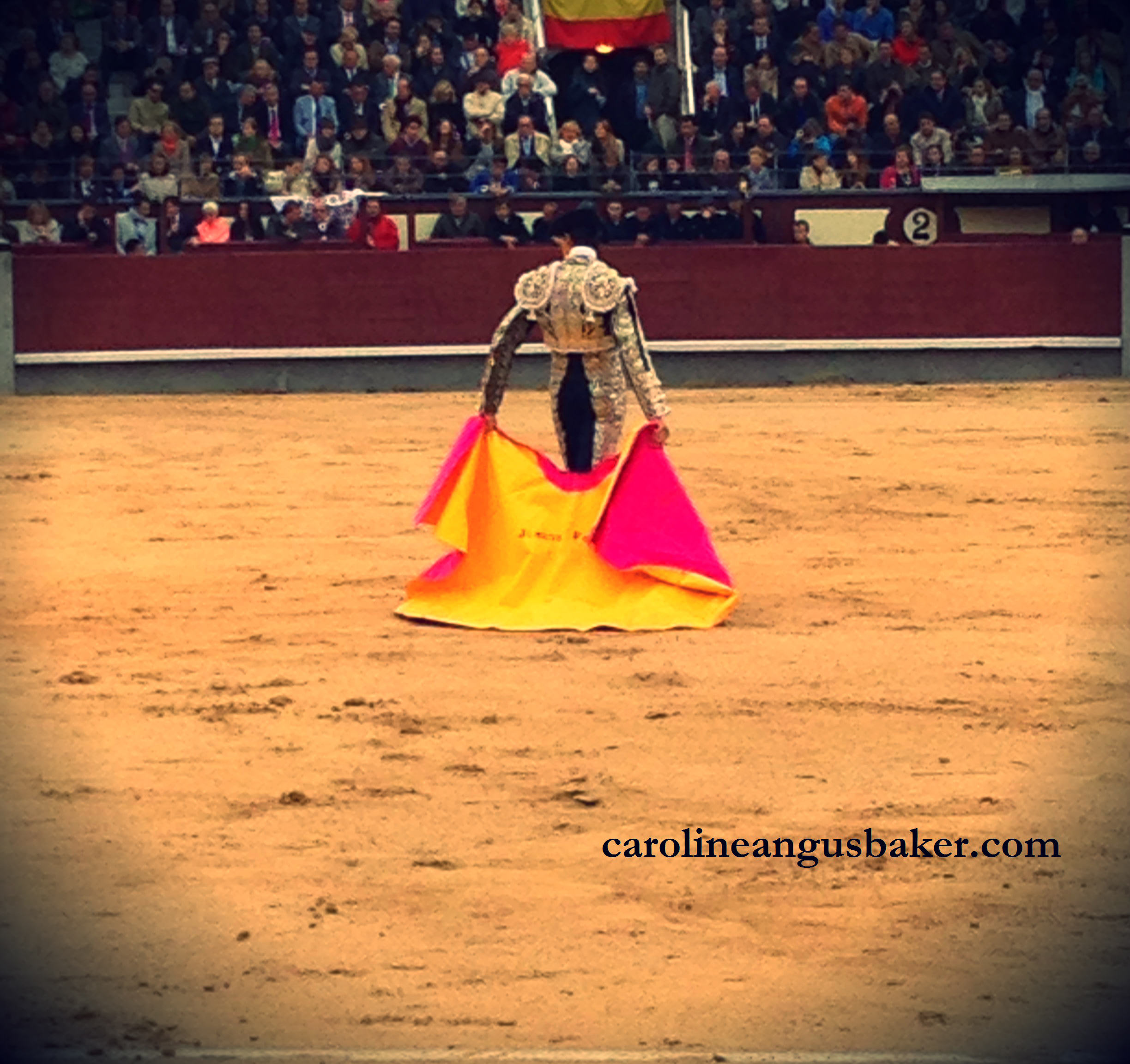
Next is the real action, the tercio de muerte. In comes the torero alone with his red cape and his sword. The torero makes a number of passes with the bull, attracting it with the movement of the cape (bulls are colour-blind) and allowing it to charge past him at close range, the closer the better. (Time for more ‘oooohs and olés’) The graceful movement comes into play and it’s great to see those smooth and precise movements if they get it right.

t2015

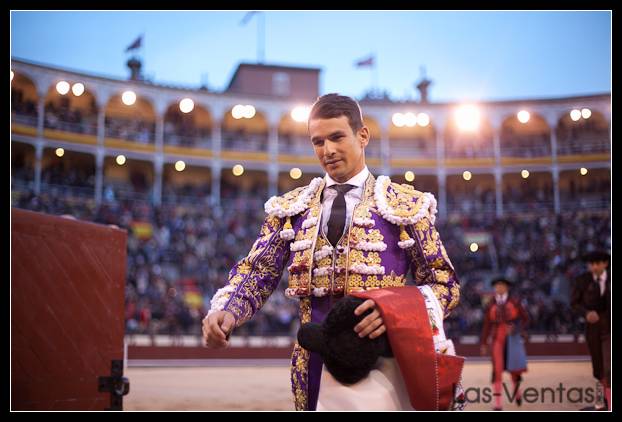
José Maria Manzanares can get it right

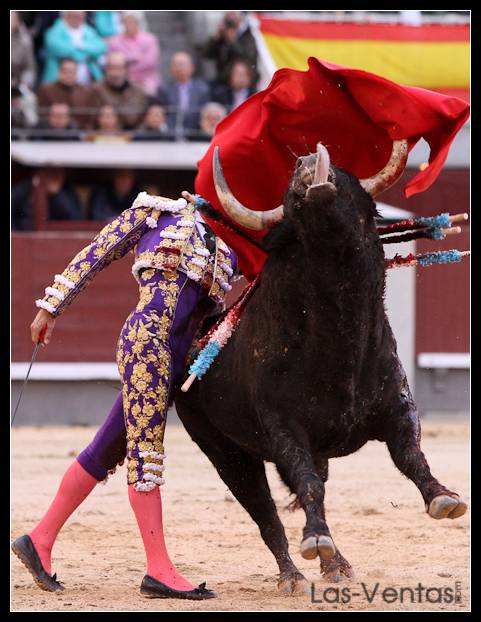
While you’ll be hearing a few “¡oles!” at this point, the crowd need to shut up for sword time. In theory the torero rams his long sword in cleanly (called the  estocada) and the animal falls and dies. The beast has been pieced in the heart, the aorta severed. The whole faena should be done in about 20 minutes.

IMG_2647

The final bull dies in Valencia

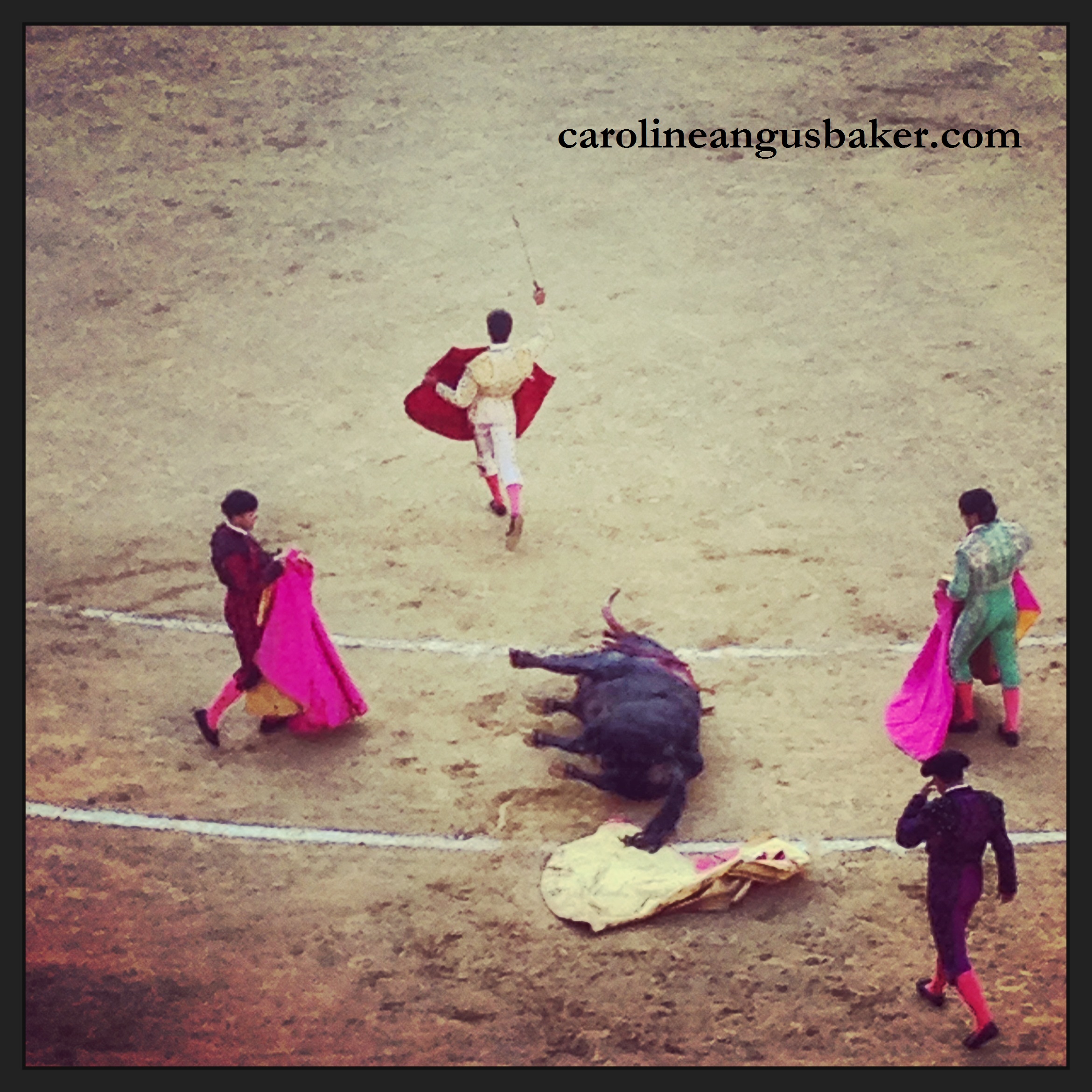
That’s all fine and well, if it works. I watched the full six fights in Valencia, and some were better than others. Unfortunately, the sword didn’t always go in, and it took several, what I would imagine as painful, attempts to sever the heart. All bulls get a puntillero, a dagger, jammed in to make sure they’re really dead. In some fights, the bull had the sword inserted and it stumbled around before dying. That is jeered by the crowd (at the torero, not the bull) and it does highlight the unfairness of the performance. The Valencian crowd (in a half-filled ring) were treated to three reasonable fights, two less than impressive performances, and one I have to admit was well done, with clean passes and a single blow with the sword. That was the only beast that appeared to die right away. In response, the crowd did the customary waving of white handkerchiefs, the indulto, to show their support to have the torero awarded an ear before the check-its-dead-dagger is inserted. Yep, an ear cut from the animal and handed to him in all it’s still warm and bloody glory. At least we got one ‘good’ performance! A torero can be awarded up to two ears and/or a tail.

ring4

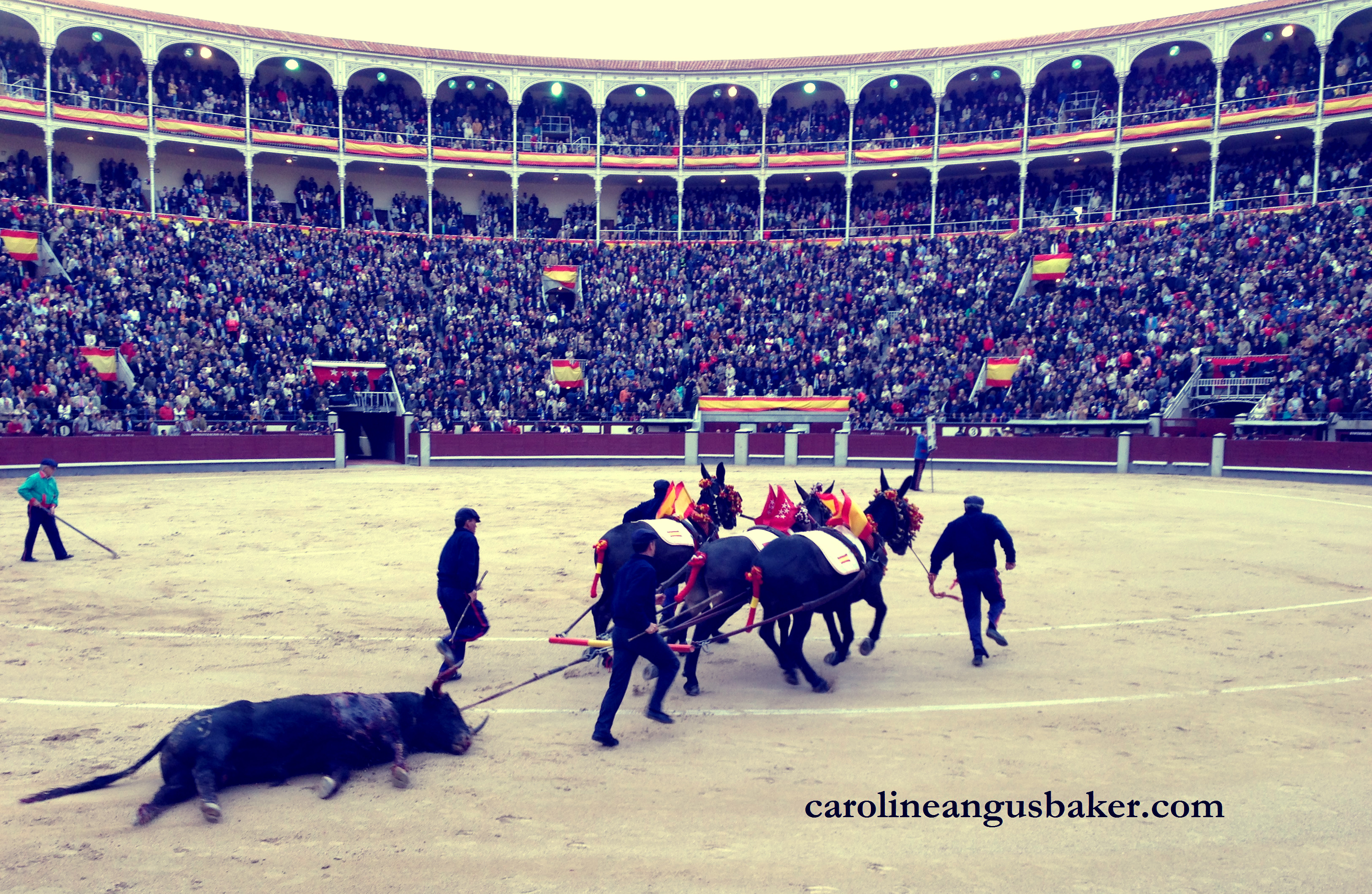
A very dead bull gets removed Madrid. I have picture of it being removed and sliced up, but decided not to post it

~~~

IMG_3802

High times in Madrid

2013-06-20

Onto Madrid and Las Ventas for the sold-out San Isidro fights. Wow, what a difference! Once the toreros all came in, they held one minute’s silence for José Gómez Ortega, or Joselito, who was gored to death in Talavera de la Reina aged 25, in 1920. It was his idea to have a premier ring built in Madrid. One humorous moment came during as entire 25,000 sell-out crowd stood in silence. About halfway through, a lone voice cried out “Viva España!” The crowd erupted into wild cheering and clapping, which appeared to make the Police in front of me a little nervous. It eventually died down and we had to start the silence all over again.

t2010

Time for silence and prayer

Madrid was cold. Cold on a level I don’t care to enjoy in Spain. The uncharacteristic weather certainly made it hard to enjoy my time on my concrete seat, though the barrier directly in front of me did provide some shelter from the wind. I was blessed with a seat in the sun and I needed every drop I could get! The guy next to me had frozen his way through the fights the previous night in the shaded area, but the problem was that the sun was already beginning to fade. However, as the sun sets and the lights come on, the torero’s suit, traje de luces, glitter and sparkle which is rather beautiful all on its own.

t2018

This is how I see it – anyone could sit in the Valencian sunshine and watch from above. Even someone who doesn’t feel happy about animal killing could cope. Sitting in the front row at Las Ventas gives a far more real experience of the situation. The first bull ran out and I sat close enough to be able to see the bull. It seemed genuinely afraid, lost and confused. You imagine the bull to be angry and this beast was not. As the dance of taunting began, I sat shivering (and politely rebuffing all the coats from gentlemen twice my age. Gracias, caballeros, muy amable) and felt really sorry for this bull. Once the horses had come and gone, the lances were removed from the ring. The guys carrying the weapons stopped right in front of me, giving me the chance to see the spears covered in blood and flesh. I wanted up close, and I got it!

ring5

Preparing for a bull in Madrid

Six fights – and none of them spectacular. To be honest, it can get very repetitive very quickly. For those who thoroughly watch the events and can pick subtle differences, I’m sure it felt different, the same way others find yachting boring when I’m into the action. One thing I noticed in Valencia was that after the first round, many people, primarily tourists, got up and left. Las Ventas – not so. In fact, because I entered the ring early (and thanks to the strapping young chap who accompanied me to my spot and asked me out on a date) I had a chance to watch the crowd. Around a third there were women, a big difference to Valencia, and the average age of the crowd was much younger than Valencia (though not in the prime seats).

Not all the bulls seemed as nervous as the first, some charged out and were keen to get their horns caught in the wooden barrier in their quest to catch a torero or two. Still, when up really close, you not only see but can hear the animal panting. Its tongue, which hangs and drips as the animal tires, quivers with every laboured breath. The further through the faena the bull progresses, the more it begins to moan and grunt, something you don’t hear in the cheap seats. At times, the toreros yelled to the bull to get its interest, as it look bored and exhausted. There were moments when the animals were fired up and ready to hurt someone; the risk is certainly there. But often it looked like a tired animal who really couldn’t give a damn.

t2013

This bull wanted some action

“The animals are brave, noble, and majestic. While it would be a disgrace to allow the bull to live at the end of its performance, it dies with consummate gallantry. He bursts through the gate of fear into the ring and is powerful against the torero.” –  Paco Beltrán, Vengeance in the Valencian Water

t2016

Seconds from death as in goes the sword 

I don’t mean to sound critical of any of the fighters I saw in either Valencia or Madrid. I’ve poked bulls with sticks and run through their paddocks as a kid, but I wouldn’t want to jump in that ring! There is not just the wrath of the bull, but also of the audience. When the crowd became tired of the time taken to kill the bull, they didn’t hold back in criticism. When the sword didn’t go in cleanly (and that was a lot in Madrid) the crowd jeered, me among them. The thing I learned above all else is that the true beast is the crowd, who urge for the kill. The bull and the torero are puppets in a game of cultural bloodlust.

t2001

What did I get out of going to bullfights? In the case of Valencia, not a lot. Judging by the crowds, you can tell it’s not a quintessentially Valencian pastime. Many there were tourists (and there’s a lot of those in V-Town these days), and the place was half empty. Luckily, for my efforts, I got to see a good clean death and and ear awarded (if you consider that good).

In the case of visiting Las Ventas, I got a lot for writing. When Cayetano Beltrán steps out onto the sand in Vengenace in the Valencian Water, to face off against the ghosts of Las Ventas, I’m going to know how it feels to be there, at the barrier, watching him. I don’t doubt the men who take on the bulls, they love it and believe in what they’re doing. There are more men wishing to become toreros than in the past thanks to the recession (so they tell me). I don’t wish to sound negative about their talents, performances or desires to maintain this Spanish tradition.

Is the whole process cruel to bulls, even though they were lovingly bred for this exact purpose? Yes. I don’t see the value in killing for entertainment, and I didn’t think I would feel as strongly about that as I do now. While I respect the rights of those who participate and support, I have no need to ever go back. I didn’t expect to have a feeling of disappointment as I left Las Ventas. Will you ever see me at the plaza de toros in the future? Maybe, who knows.  I’ve had my day at the barrier, and I have many feelings and thoughts to savour and translate into novels, but not all of them good.

t2009

Once back in ‘my’ part of Madrid for some quiet (or not-so quiet) vermouths, I discovered that I had missed the protest against Franco and his wartime slaughtering of Republicans. I would have much rather have been in Puerta del Sol, holding a sign with the face of a loved one attached, one of the ‘disappeared’, as that is in my Secrets of Spain series and close to my heart. A little bit of my ancestral blood is somewhere in Spain’s soil, hidden away. At least that’s one thing I can write in the series without the need to go looking for it. Some people are holding up tradition at the bullring, and some are fighting for Spain’s past and future. Either way, Spain may be suffering economically, but its soul is as alive as ever.

IMG_2648

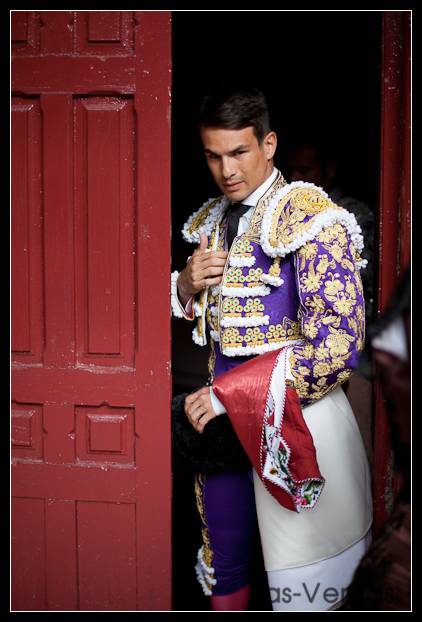
Un beso muy grande y gracias to a very (handsome in purple) helpful and inspirational torero  – José Maria Manzanares

Watch the video replay of Las Ventas 16 May – San Isidro 16.5.13

Visit Las Ventas website – Las Ventas

Up next… A Little Jaunt to Spain – Part 7 – Valle de los Caídos: Spain’s most terrifying location (prepare for some strong opinions now)

Click here for past installments – Spain 2013 in Review series

*all photos author’s own, or courtesy of Las-Ventas.com