
- Extremadura
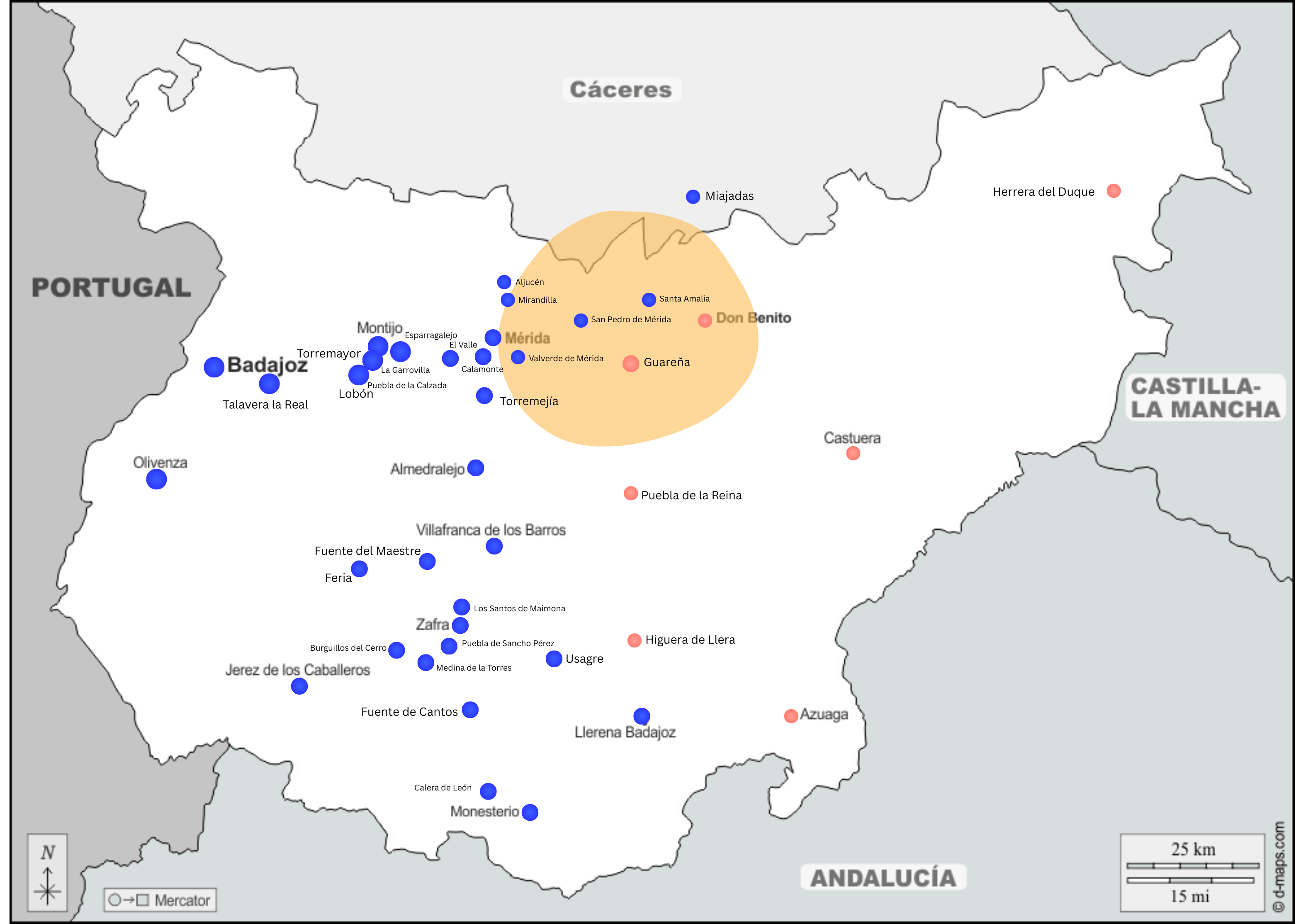
La Nava de Santiago was a rural community of approximately 1,200 inhabitants, lying northeast of Mérida between Aljucén and the Vegas Altas. It remained under Republican control during the first weeks of the war before being occupied on 17 August 1936 as Nationalist forces consolidated control over the countryside surrounding Mérida. No major battle took place, its occupation strengthened Nationalist communications between Mérida and the advancing eastern columns.
Nearby, Santa Amalia was one of the largest settlements in the eastern part of Badajoz Province with 3,400 people. Its location on the road towards Don Benito, Villanueva de la Serena, and Medellín made it strategically important. The town remained under Republican control until 17 August 1936, when Commander Antonio Castejón’s column occupied it following the fall of Badajoz. Republican aircraft attacked the advancing Nationalist forces during the operation, but the town was secured. Santa Amalia became the eastern limit of the Nationalist advance before stronger Republican resistance halted further progress towards Don Benito and the killing of people along the path to Madrid could finally be pushed back as Republicans manged to set up a front line in the area.
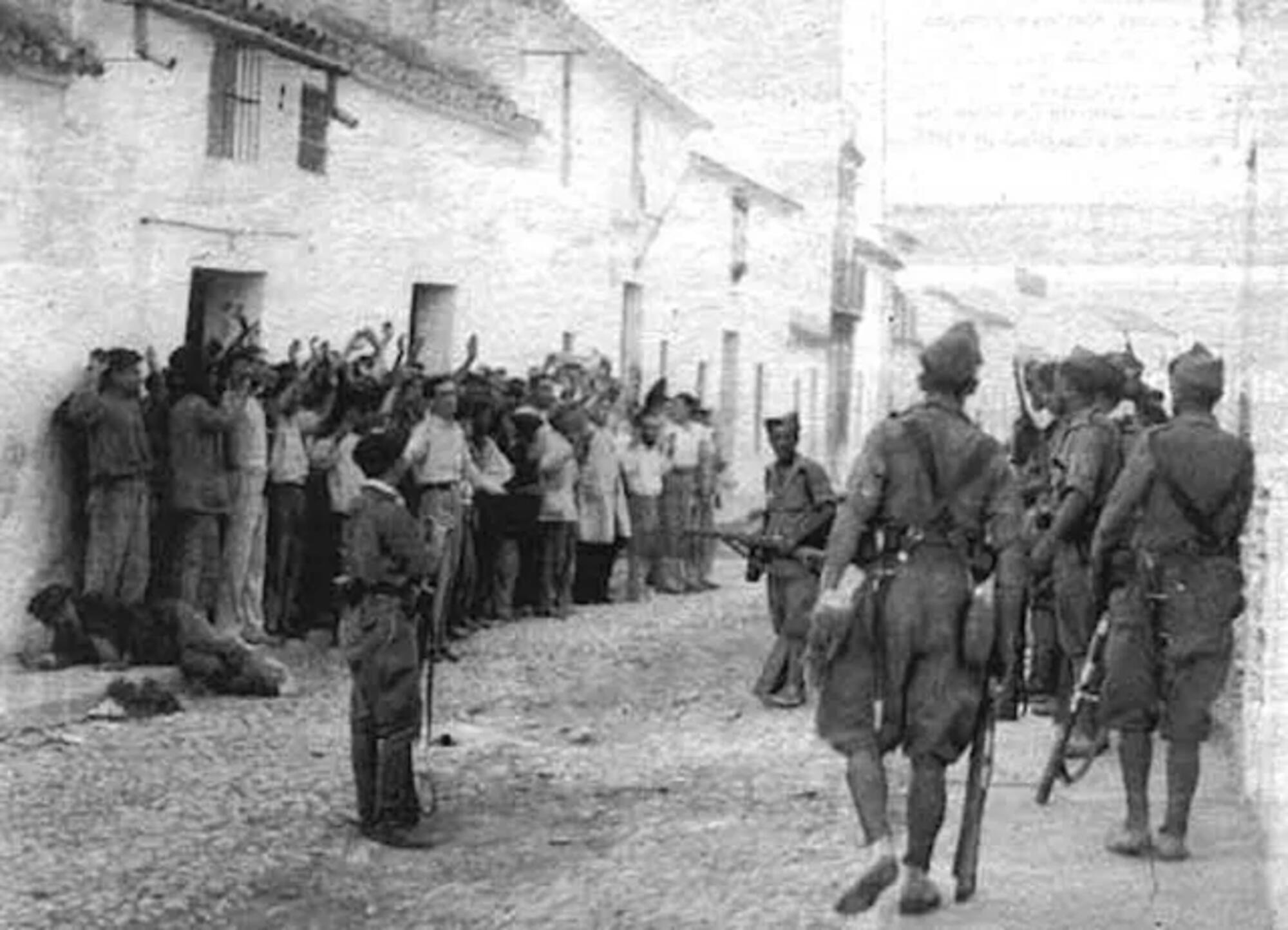
On 17 August 1936, as Commander Antonio Castejón’s column occupied Santa Amalia, Republican aircraft attacked the advancing Nationalist forces. According to the telegrams of Manuel Gómez Cantos, the air raid inflicted significant casualties among the attackers, although the exact number is unknown. Despite the attack, the Nationalists secured the town and continued consolidating their position in the eastern Vegas Altas. The nearby area, such as the Yelves mountain range opposite Santa Amalia, served as a scene of movements and refuge for operational groups during the conflict.
Today the town as two mass grave in the immediate town area, one on the east coroner of the cemetery, which has not been excavated, and another in town among an olive grove of Calle Guardia Civil, where a memorial sits. Neither location has proof of how many locals died. On the outskirts of town, three local family properties also have mass graves.
El Finca Malmedra contains the bodies of Francisco Gómez Rincón (the grandfather of the searching relative) and his brothers Alonso and Sergio Gómez Mojonero all three natives of Almoharín, 30km north of the estate. Information gathered through testimonies indicates that these three relatives participated in the occupation of farms in 1936, before the start of the Spanish Civil War. They were living on the nearby La Vieja and El Moro farms and were expelled by Falangists and the Guardia Civil after the coup. According to informant Pedro Arroyo, Francisco Gómez was arrested on the La Vieja farm, and the brothers Alonso and Sergio were ambushed at a rural crossroads nearby and executed. The mass grave, according to testimonies, is located on the Malmedra farm, near the Santa Amalia crossroads by an iron gate under a tree. The area is now covered with rubble and piles of earth from the construction of the A-5 highway. Another possibility being considered is that the remains of these three family members may be in the mass grave located on the Zambrano estate where the remains of thirty people executed by firing squad are found.
The Finca Zambrano is right beside Finca Malmedra on the Arroyo Molina road. This grave contains the remains of a group of thirty people, though witnesses claim they removed two bodies at an unknown date (likely after Franco’s death). Santiago Parra, son of Ángel Parra, a resident of Miajadas who was murdered during the Spanish Civil War, may be on the private property. Another local, Francisca Novillo, is also looking for relatives. The last investigation was done in 2021, but more is pending further funding. (yes, you can donate! See Association for the Recovery of Historical Memory)

A third private property along the road is Finca La Parrilla. On 13 August 1938, witnesses saw several residents of Santa Amalia with family ties were shot, to the right of an old road that existed at the time, a service road for the Orellana Canal which leads to the La Parrilla property near the Lirio stream. Six test pits were excavated in 2011, one identifying a mass grave with at least eight individuals piled up and intertwined in forced positions. Anthropological analysis showed they were from the Arauces family of Santa Amalia, murdered in the summer of 1938.
In 1936, 30km from Santa Amalia, Manchita had a population of approximately 900 inhabitants. The village remained under Republican control during the opening month of the war before Nationalist forces occupied it on 17 August 1936 as they secured the countryside east of Mérida. Only a small settlement, Manchita formed part of the chain of villages occupied to protect the Nationalists’ eastern flank while the Army of Africa continued its advance towards Madrid. On 17 August, the Army of Africa passed through Trujillo and divided into three self-contained motorised combat groups. Each column combined Legion infantry, Moroccan Regulares, artillery, engineers and its own transport, allowing it to operate independently without waiting for the rest of the army. Rather than concentrating nearly 4,000 men on a single mountain road, Yagüe dispersed his force across several axes through the Villuercas, forcing the Republicans to defend multiple approaches simultaneously.
On 17 August, the leading elements of the Army of Africa reached Trujillo, which had remained under Nationalist control since the military uprising in July. Rather than continuing as a single force, the army divided into separate columns to advance along different routes through the rugged mountains of eastern Extremadura. This reduced pressure on the limited road network, complicated Republican efforts to organise a coherent defence, and allowed the Nationalists to threaten several objectives simultaneously.
Major Heliodoro Rolando de Tella led the northern column through Almaraz, aiming to secure one of the principal crossings over the Tagus River before Republican forces could destroy it or establish strong defensive positions. Further south, the columns commanded by Colonels Antonio Castejón and Carlos Asensio advanced through the Sierra de Guadalupe, where narrow roads, steep valleys and commanding high ground offered the Republicans their best opportunity to delay the advance. Although operating on separate axes, the columns remained mutually supporting, intending to reunite once they had crossed the mountains and entered the Tagus Valley.
The decision to divide the Army of Africa reflected both the geography of the Villuercas and the Nationalists’ operational doctrine. Rather than concentrating every unit on a single road, the columns advanced independently, forcing Republican commanders to disperse their limited forces across multiple approaches. This prevented the defenders from establishing a continuous front and ensured that, even if one route was delayed, the advance towards Madrid could continue on the others.

- Castilleja del Campo, Huelva, Andalucia
The town of Castilleja del Campo in Huelva province was just one of many towns in the area that fell under NAtionalist cntrol n the July uprising. The town had only 700 people, and the events of the civilw ar were not talked of or recorded until the 1980s when people finally felt ready to to speak. The town had been sufferng prior to the war, with violence, hunger, fear, and revenge, suffering old hatreds and or personal vendettas. When the Nationalsist took power in July, a dozen men were executed, other forced to become Falangists, and nine women of the town, aged between 29 to 64 had their heads shaven and forced ot eat bread soaked in castor oil and paraded through the streets as they were renamed after Falangist men.
Everyone in thw town had been sent to the villag doctor’s office, to swear a pact of mutual protection, so that no more locals would die, after had been a murder of a young teenager boy, Manuel Rodríguez Mantero, just before the war, caught between left and right hostilities. Suddenly, men and women were begin killed and mutual protection meant nothing among the group of people who knew everyone and everything about each other.
In the La Zarcita area near the local reservoir, there are two graves of Magdalena García González, aged 19, and her boyfriend buried about 100 metres away. The pair had been taken from town and executed, and Magdalena’s father had found out and gone and buried them where they were found. The family has refused to move the bodies over these past 90 years, and are marked by stone mounds which people anonymous maintain when the Garcia family cannot.
Castilleja del Campo has s tory not often repeated, that a truck load of prisoners was being transferred past the town from nearby Aznalcóllar. The prisoners were tied together in pairs, inlcuidng a mother and her pregnant duaghter. The truck stopped on the road outside town, and all of them were shot. The pregnant woman gave birth convulsively fater death and the Nationalsist kileld the child with their rifle butts. Casteilleja del Campo has only one mass grave itself, and there is no way of knowing if these people were bruied on the roadside or in the grve, thougyh the small towns were movig prisoners between one another, so the mother and duaghter may never be identified.

The largest of the mass graves in the Aznalcóllar area is located inside the Aznalcóllar cemetery, at the southern end, above an old mine entrance. The location was perfect for Nationalists, who could simply thrown bodies in the ventilation shaft, and the local gravedigger claimed there were hundreds of bodies thrown in between 1936 and 1942. He was the same man who planted a tree near the shaft so that no one could build a memorial for the victims. In 1982, the first democratically elected town council placed a plaque in the town, ‘At this site, homage is paid to the people who died under arms in this town during the years 1936 and following. The Aznalcóllar Town Council, with infinite respect, remembers these men and women, with the hope that their sacrifice was not in vain. Aznalcóllar, November 1982.’ It is possible the mother and daughter were returned to the town they came from for burial, rather than in Castilleja del Campo.
- Badajoz, Extremadura
Queipo de Llano’s broadcasts, 17 August 1936
In broadcasts reproduced by La Unión (Seville) on 17 August 1936, General Gonzalo Queipo de Llano portrayed the Badajoz Nationalist offensive as an unstoppable march towards Madrid. Speaking only days after the capture of Badajoz, he announced further advances in Extremadura and Andalucía, claiming that Republican resistance was collapsing across the south-west. He praised the Army of Africa and presented each captured town as evidence that the military rebellion had become irreversible. But it was of little use; the international media had heard of the slaughter of the city, and La Unión, a Seville paper dedicated to publishing right-wing propaganda, had its work cut out to defect from the atrocities that killed 1800-4000 people, almost all civilians.
Much of the nightly broadcast on 17 August was devoted to propaganda. Queipo accused the Republican government of widespread atrocities, corruption and incompetence, frequently describing political opponents in dehumanising terms while claiming that Nationalist forces were restoring order and civilisation. He cited reports of killings, church destruction and attacks on civilians in Republican-held areas as justification for the military campaign, though many of these accounts were impossible to verify. Quiepo’s broadcast over the previous weeks had promoted constant violence, glorified rape, delighting in talking about the sexual violence committed against women and children, and told lies about the babies being murdered by Republican militia, no doubt to cover up for what his own Legion and Moroccan troops were doing around the southern half of Spain. The daily threats and inflammatory rhetoric were already present, but now they are interwoven with lengthy accounts of the advance through Extremadura and an effort to convince listeners that victory was both inevitable and imminent. One of the defining features of the broadcasts was Queipo’s refusal to describe Republicans as a legitimate military opponent. Instead he repeatedly calls them, hordas marxistas, canalla (rats or scoundrels), and criminales.
Queipo repeatedly predicted the imminent collapse of Madrid, dismissed Republican military strength, and warned that those continuing to resist would face severe punishment. He portraysed the Madrid government as incompetent, cowardly and dishonest, claiming they were misleading both the Spanish public and foreign governments. He addressed civilians as well as soldiers, urging Republican supporters to surrender while attempting to convince listeners that further resistance was futile. Alongside military news, he commented on international opinion, criticised foreign reporting that challenged the Nationalist version of events, and insisted that the rebellion was gaining support both within Spain and abroad. Another recurring argument is that the Nationalists are not conquering Spain but ‘liberating’ it from terror. Addressing those still resisting, particularly in mining districts and Republican-held areas, Queipo warned that they will be held accountable and punished if they continue fighting. The broadcasts therefore function as psychological warfare, intended to weaken morale before Nationalist forces even arrive.


You must be logged in to post a comment.