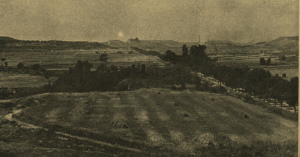
The ‘Highway of Death’ during the last week of September 1936, the road from Estrecho Quinto and Montearagón that led to Barbastro and Lleida, which became the frontline for the next two years, via Ahora, Biblioteca Nacional de Espana
Estrecho Quinto and Montearagón, Huesca, Aragon
By the final week of September 1936, the Nationalist positions at Estrecho Quinto and Montearagón were increasingly isolated. These outposts, held by a mixed garrison of approximately 600 regular infantrymen, Guardia Civil, and Falangist volunteers, were critical to the defence of the region as they controlled the strategic Huesca-Barbastro highway.
.
Republican commanders continued moving reinforcements into the sector to tighten the siege. On 24 September, two centurias from the Del Barrio Column, approximately 130 militiamen, were transferred from the Tardienta sector to take part in operations against the two positions, joining the Negus Column and Guerrilleros Rojos. The POUM-associated Arquer-Grossi Column was also brought into the operation. From 25 September, its main body took positions between Tierz and the Casetas de Quicena, leaving a smaller force at Leciñena. Republican attacks against Huesca continued as the Republican columns consolidated the ground captured earlier in the month.
.
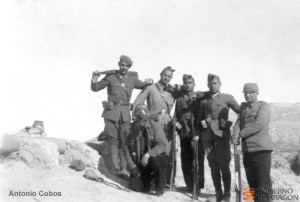
Group of 6 soldiers at Estrecho Quinto, one wearing a gas mask, via Antonio Cobos Berges, Documentos y Archivos de Aragon
.
Cut off from ground reinforcement, the Nationalist garrisons suffered from severe shortages of food and ammunition. Coded Nationalist communications from the isolated positions in the final days of September described an increasingly desperate situation; the defenders requested regular air deliveries of approximately 4,000 cartridges a day, as well as food rations to sustain their 600 men. Recognising their vulnerability, Colonel José Villalba sent a written offer of surrender to the commanders at Estrecho Quinto and Montearagón on 26 September. He guaranteed the lives of their officers and men if they surrendered to the Republican government and handed over their weapons and ammunition. Though the offer was firmly refused, the Nationalist resistance could not be sustained. Because they had rejected Colonel Villalba’s surrender offer on 26 September, the Republican forces, particularly the aggressive anarchist and POUM militia columns, unleashed a final, relentless assault, causing heavy Nationalist casualties during these final days of shelling.
.
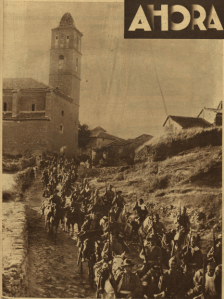
The front cover of Ahora newspaper, 1 October 1936, of the Republican militia taking over the regions, via Ahora, Biblioteca Nacional de Espana
.
Under relentless pressure and with supply lines severed, the 600 Nationalist forces finally abandoned both Estrecho Quinto and Montearagón on 30 September, taking advantage of the rugged terrain and cover, many managed to successfully break through the tightening Republican lines and escape back into the relative safety of the main Nationalist stronghold inside the city of Huesca. Those who were too badly wounded, trapped, or unable to retreat in time were captured by the advancing Republican forces. Given the brutal nature of the early months of the war on the Aragon front, captured combatants (especially Falangist volunteers and Guardia Civil) faced immediate execution or severe imprisonment rather than the peaceful terms Villalba had initially guaranteed.
.
Republican forces immediately moved in to secure the sector, with the POUM’s Arquer-Grossi Column occupying the abandoned lines and heavily fortifying the trenches to seal off Huesca from eastern relief. In the immediate aftermath of the Nationalist withdrawal, the sector underwent a rapid transformation from a desperate battlefield into a heavily fortified, ideologically driven Republican military zone. The Republican forces immediately flooded the area to secure the newly won high ground. It is estimated that between 2,000 and 3,000 Republican militiamen consolidated control over the Estrecho Quinto, Montearagón, and Tierz sectors.
.
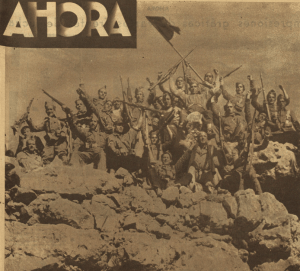
The cover of Ahora newspaper on 3 October 1936, of the victorious Republicans, wich discussed how quickly they needed to act to drive the Nationalists from he area, via Ahora, Biblioteca Nacional de España
The Republicans expected an immediate Nationalist attempt to retake the highway. Under the orders of Colonel José Villalba, the forces immediately brought in engineers and forced labour to overhaul the sector. They transformed the crude, mud-walled Nationalist trenches into a sophisticated, permanent defensive network. They poured concrete to build heavy machine-gun bunkers directly into the hillsides of Estrecho Quinto and around the ancient Montearagón Castle. These positions were so robustly constructed that many of the concrete bunkers and trench lines still stand perfectly preserved today.
.
Many locals had already fled deeper into the Nationalist-held city of Huesca during the heavy artillery shelling of late September. Those who remained in the villages found themselves trapped inside the newly established front-line no man’s land. Because the dominant forces in the area were anti-fascist militias (especially the anarchists and the POUM), the immediate political aftermath for the remaining villagers was the forced collectivisation of agriculture. The vast majority of the rural population consisted of agrarian peasants and small-scale farmers. While some traditionalists and deeply religious locals genuinely had welcomed the Nationalist forces, a significant portion of the peasantry were already politically aligned with left-wing unions. At Montearagón, there had been multiple white flags waved leading up to the retreat and some had attempted to flee the nationalist side. once the Republicans marched into the abandoned Nationalist camps, many local Falangists had attempted to hide among prisoners and the wounded, though had to be identified and removed one by one. A Republican hospital was ready to take the wounded, though Ahora newspaper reported of gangrene setting in with some.
.
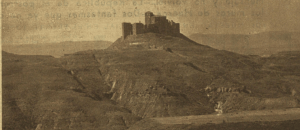
The castle at Montearagón, printed in Ahora 3 October 1936, via Ahora, Biblioteca Nacional de España
Local farms, grain stores, and livestock were instantly seized by militia committees to feed the thousands of front-line fighters. By the time the POUM and anarchist columns actually stormed the positions on 30 September, the villages were mostly ghost towns. Anyone who was genuinely pro-Nationalist, wealthy, or closely tied to the rebel forces had already abandoned their homes weeks prior, fleeing behind the heavy urban defensive walls of Huesca. Anyone suspected of having right-wing sympathies, connections to the Falange, or ties to the Catholic Church was rounded up. Local priests and wealthy landowners who hadn’t escaped to Huesca were frequently imprisoned or summarily executed by the more radical militia elements along the highway or near local cemetery walls, while others were taken to makeshift prisons in the rear guard such as nearby Barbastro or Sariñena.
.
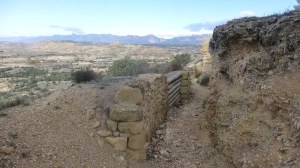
The trenches still in place looking at at Tierz, via Servicio Especial
Near the local cemetery and hiking trail of Tierz, leading up to the Saso de Tierz trenches, historical records note immediate makeshift burials from the late-September clashes.For decades, a large concrete cross stood directly atop the high ridge looking out at Estrecho Quinto. It was originally erected to commemorate the fallen Nationalist defenders who refused the surrender and died during the final breakthrough attempt on 30 September. The ideological plaques have since been removed under modern Spanish memory laws. Republican sympathisers or militia prisoners captured by the Nationalists in the area since the outbreak of war in July had already been sent into the city of Huesca, where they were executed and buried in the massive mass graves located at the Cerro de Las Mártires Cemetery, which remains one of the largest Civil War burial sites in the Huesca province.
.
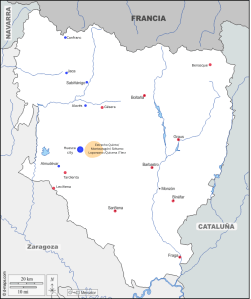
Huesca province by the end of September 1936, which would stay largely like this until 1937, except for Leciñena, which fell into Nationalist hands on 12 October 1936
Bizkaia, Basque Country
The Nationalist advance across Gipuzkoa produced one of the first large refugee movements of the war in northern Spain. By 24 September, a French diplomatic report estimated that 50,000–60,000 refugees were already in Bilbao, a city with a pre-war population of roughly 190,000. The movement continued as the remaining Republican-held towns of Gipuzkoa were lost, and more than 70,000 refugees eventually required organised assistance in Bizkaia. Later records indicate that approximately 35,000 were accommodated in Bilbao itself, including about 15,000 children, 12,000 women and 6,500 older men, with a similar number dispersed through other municipalities.
.
In September 1936, the famous autonomous Basque Government had not yet been sworn in (that happened on 7 October 1936). The Herculean task of managing these 70,000+ refugees fell onto the shoulders of the Junta de Defensa de Vizcaya (Biscay Defence Junta) and its dedicated Department of Social Assistance.
.
Finding somewhere for so many people to sleep required the requisition of buildings throughout the province. Schools, convents, company premises, religious foundations, large private properties and other buildings were converted into collective accommodation. In Busturia, for example, refugees were already being housed in Palacio Arrótegui and private homes by mid-September; premises at Axpe had been requisitioned on 9 September for social-assistance offices, stores and vehicles. Many families had arrived with little more than what they could carry. Food, clothing and medical treatment had to be provided alongside beds. The assistance network developed communal kitchens, collective accommodation and medical services, while requisitioned premises provided additional capacity as the numbers increased. The scale of need can be seen in the later refugee census: almost 90 per cent requested clothing, reflecting how quickly families had left Gipuzkoa and the approaching winter.
.
Bilbao also received a very different group from San Sebastián. On 9 September, political prisoners evacuated before the Nationalist occupation were transported by ship to Bilbao. They entered an already expanding detention system that included conventional prisons and requisitioned merchant ships in the Bilbao estuary. The presence of these right-wing prisoners aboard floating hulls like the Cabo Corona and the Altuna-Mendi became a flashpoint for severe violence. (When Nationalist aircraft bombed Bilbao later that autumn, angry mobs and radicalised militiamen would storm these very prison ships to carry out bloody reprisal executions against the hostages inside, making them some of the most notorious spots of the Terror Rojo in the north).
.
By the end of September, tens of thousands of displaced Gipuzkoans were living among a Bizkaian population of roughly 485,000. Their arrival affected housing, food supplies, hospitals and municipal services throughout the province, while many families still had members fighting or retreating with Republican and Basque units only a short distance to the east. Modern historical reviews by institutions like the Basque Government’s Gogora Institute show that the fall of Gipuzkoa ultimately forced over 100,000 displaced people to seek immediate sanctuary within Republican Bizkaia or cross the border into France by the time the front stabilised, putting severe strain on the province.
.
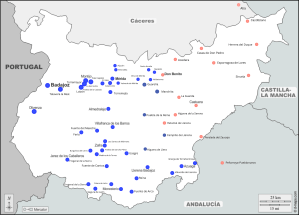
Badajoz province by the end of September 1936, where the frontline would stay for years
Badajoz Province, Extremadura
By the final week of September 1936, the province of Badajoz had become one of the most violently contested territories in southwest Spain. Following the initial summer push by Nationalist forces, the final days of the month saw a systematic consolidation of rebel territory, a brutal wave of political repression in newly occupied towns, and the solidifying of a permanent frontline that would divide Extremadura for months to come.
.
Azuaga
The tightening of the Nationalist grip on the southern sector of the province intensified around 24 and 25 September with the occupation of Azuaga. Immediately following the entry of the rebel troops, a systematic campaign of Nationalist repression began. Local military authorities and Falangist squads initiated a wave of arrests and executions that deliberately targeted Republican municipal officials, prominent trade unionists, local miners, and other left-wing activists who had been unable to escape.
.
The capture of Azuaga was particularly catastrophic due to the massive humanitarian crisis unfolding within the town. Boasting a large pre-war local population of over 17,000 inhabitants, Azuaga’s streets were simultaneously overflowing with 5,000 to 6,000 desperate refugees who had just arrived as part of the tragic Columna de los Ocho Mil—an exodus of rural peasants fleeing Francoist terror from western Badajoz and Seville. Sent explicitly by General Gonzalo Queipo de Llano, two highly trained columns of Africanist troops heavily supported by Falangist volunteers quickly overwhelmed the poorly armed resistance put up by local Republican militias and left-wing miners. Because a Republican committee had governed the town for the previous two months without executing any right-wing detainees, the subsequent Nationalist entry marked a terrifying escalation in violence. The Francoist execution squads launched instantaneous and exceptionally brutal purges, systematically targeting municipal staff, union leaders, and trapped refugees, ultimately tripling the pre-existing wartime death toll in the area within a matter of days.
.
In mid-September 1936, as thousands of rural families from western Badajoz began their desperate 100-kilometre march across enemy territory toward the Republican sanctuary of Azuaga, General Gonzalo Queipo de Llano in Seville was of course following their bid for safety. He explicitly mentioned this massive column of refugees on the airwaves, using it to track their movements for his troops and to mock their attempt to escape. His broadcast updates went hand-in-hand with front-page military reports in the Nationalist newspaper ABC de Sevilla. When his Morrocan columns and Falangist units finally assaulted the sector on 24–25 September, Queipo de Llano logged onto the radio to boast about the victory. In his typical informal, triumphalist tone, he listed Azuaga alongside other newly conquered towns like Utrera, Lora del Río, and Peñaflor. He described the scenes of the takeover on air, boasting about how the town’s inhabitants were hanging white sheets from their balconies in surrender and how local unionists and labourers were raising their hands to capitulate.While he used the radio to broadcast these images of absolute Nationalist dominance, he completely omitted any mention of the mass executions and the grim reality of the burial walls where his squads were systematically tripling the town’s wartime death toll. Azuaga served as a live, psychological scoreboard to show his listeners that the Republican southern flank in Extremadura was completely folding under his command.
.
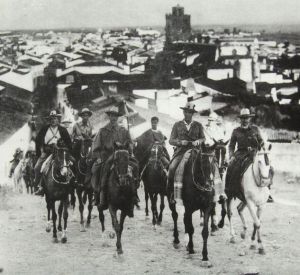
Carlist Requetés from Seville leaving Azuaga, date and author unknown
The number of casualties during the takeover of Azuaga remains one of the most complex questions of the war in Extremadura because the bodies of local residents and fleeing refugees are completely mixed together in mass graves. Decades of historical research by specialists registers two major mass graves in the Azuaga municipality. Because these graves remain completely unexhumed, it is physically impossible to scientifically analyse the remains or separate the local casualties from the outsiders. Also, the thousands of peasants who composed the Column of 8,000 came from distant villages across Seville, Cádiz, Huelva, and western Badajoz. When Franco’s columns caught them in Azuaga, the execution squads did not log their identities. They were buried anonymously in pits as unknowns. The only deaths that were explicitly tracked by local memory groups were prominent Azuaga citizens. These included left-wing town councillors, local police, and recognised heads of the UGT and CNT mining unions whose identities were known to local right-wing informants. The Nationalist columns left a minimum of 6,610 documented victims across just 85 towns in Badajoz province, driven heavily by massacres of mixed refugee-local populations.
.
Granja de Torrehermosa, date and author unknown
Granja de Torrehermosa
As the survivors fled eastward from Azuaga, a localised frontline rapidly established itself between 25 and 30 September in the Granja de Torrehermosa sector. Republican forces successfully checked the Nationalist advance and retained control of Granja de Torrehermosa, while Nationalist forces dug into their positions in Azuaga. In 1936, Granja de Torrehermosa was a medium-sized agricultural town with a pre-war population of roughly 8,500 inhabitants. Like neighbouring Azuaga, it had been governed by a left-wing revolutionary committee since the July military uprising.
.
As the professional Nationalist columns from Seville rapidly pushed through Azuaga on 24 September, total panic gripped the Republican rearguard in Granja de Torrehermosa. Knowing they had to evacuate the town immediately towards Monterrubio de la Serena, extremist militia elements carried out a swift, devastating massacre of right-wing civilian detainees. The primary victims were local conservative landowners, right-wing sympathisers, and members of the Catholic clergy (including several religious figures who had been moved there from Fuenteovejuna). The most notorious event took place on 24 September 1936 at the home of a wealthy local traditionalist family. Militiamen executed 14 members of the Gala and Llera families, ranging from the 78-year-old grandfather, Sebastián de la Gala Ortiz, down to his two-year-old granddaughter, María de las Nieves, alongside two of their maids and the family seamstress’ 11-year-old daughter.
.
The town was officially evacuated by the Republicans on 24 September and occupied by Nationalist troops on 26 September 1936 by a combined tactical column of roughly 600 to 800 men. The entry was part of a broader offensive designed to secure the vital Seville-Mérida railway line and eliminate the concentrations of mining militias in the south. When the Nationalist troops and the Burgos brothers (photographers attached to the Seville columns) entered the town and discovered the bodies of the executed right-wing families, they immediately recognised its value as a psychological weapon. The Nationalist press section took extensive, graphic photographs of the corpses. Historical analyses (including testimonies from survivors like Nationalist pilot Antonio Bahamonde) reveal that the troops intentionally mutilated, rearranged, and defiled the corpses, crushing heads with stones and separating limbs, to artificially amplify the horror of the scene. These altered photographs were published by the Seville edition of ABC and sent to international agencies worldwide as definitive, graphic proof of what they labeled the horrific Red Terror in Extremadura. It was used to justify the brutal executions the Nationalists were simultaneously conducting in places like Azuaga and Guareña.
.
Following the entry on 26 September, the Republican forces managed to check the advance just a few kilometres to the east. This established the permanent frontline outside the town that lasted for over a year and a half. Granja de Torrehermosa remained in Nationalist hands until a desperate, final Republican counter-offensive briefly retook the ruins of the town for a single month in January 1939, right before the war ended.
.
Immediately after occupying the town on 26 September 1936, Nationalist regular troops and Falangist paramilitaries launched immediate paseos against left-wing citizens who had not evacuated. They used the recent Republican massacre of the right-wing Gala-Llera families to justify immediate, bloody revenge against local laborers, unionists, and socialist sympathisers. Once the immediate extrajudicial killings quieted down, the institutional repression took over. Official records from historical database registries track a massive total of 154 documented residents of Granja de Torrehermosa who were systematically processed, condemned, and executed or sent to forced labour camps via Francoist Consejos de Guerra (Military Courts).
.
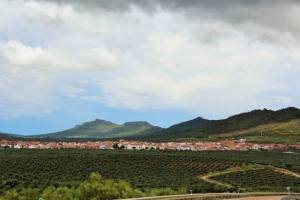
The terrain around Oliva de Mérida today, via Wikimedia Commons
Oliva de Mérida
Further north, a coordinated Nationalist offensive on 29 September dramatically altered the landscape east of Mérida. Rebel columns pushed outward to secure the approaches to the Republican strongholds. In one operation, the 2nd Battalion of the Castilla Regiment captured the town of Oliva de Mérida, successfully extending Nationalist territory eastward and creating a protective buffer zone for the strategic hub of Mérida. The capture of Oliva de Mérida directly determined the geography of the war in Extremadura for the next year and a half. Following the Republican retreat on 29 September, the town became a fixed Nationalist frontline outpost. The new line of fortification was anchored directly opposite the fiercely defended Republican zone of Valle de la Serena. This geographic divide froze in place, shifting the sector into a prolonged stalemate of trench and garrison defence.
.
Using lists provided by local right-wing informants, execution squads conducted immediate paseos, dragging left-leaning town councillors, trade unionists, and agrarian peasants from their homes to be summarily executed along roadsides and cemetery walls. Following the initial wave of executions, the Nationalist authorities institutionalised the repression. Over the subsequent months and years, remaining residents, primarily poor agrarian jornaleros (day labourers) and union members, were subjected to formal military tribunals (Consejos de Guerra). These military trials resulted in a wave of long-term prison terms (ranging from 12 to 30 years) and severe death sentences. Tactically, the fall of Oliva de Mérida successfully transformed a peaceful agricultural village into a heavily fortified Nationalist launch point that successfully choked off Republican communication lines stretching out of the Serena valley.
.
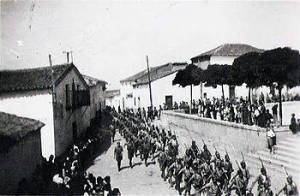
Troops march into Guareña, via Todos las Victimas
Guareña
Simultaneously on 29 September, the 4th Battalion of the Castilla Regiment advanced on Guareña, capturing the town after overcoming Republican resistance. The fall of Guareña established a crucial Nationalist position directly opposite the heavily defended Republican zone around Don Benito and Mengabril. Faced with professional soldiers, the local Republican defence, primarily composed of poorly equipped civilian volunteers, agricultural labourers, and local trade unionists, was unable to hold the outer perimeters of the town. The Castilla Regiment quickly breached the town limits and forced the remaining active loyalist fighters to flee toward the Republican strongholds.
.
The sheer brutality of the subsequent Nationalist takeover was fuelled by a tragic event that occurred just hours before the town fell. As the Nationalist troops closed in, panicking elements within the collapsing Republican rearguard turned on the local right-wing civilians they had detained. When the 4th Battalion of the Castilla Regiment and accompanying Falangist paramilitaries entered the town and discovered the bodies of the right-wingers, the retribution was instant and systematic. A total of 78 right-wing locals, including conservative landowners, town traditionalists, and suspected rebel sympathisers, had been killed inside the town right before the Republican forces retreated. From 29 September onward, Nationalist forces carried out systematic house-to-house searches, leading to widespread arrests. In the immediate aftermath of the takeover, approximately 55 people were killed in paseos, terrorising the remaining local civilian population and cleansing the town of suspected left-wing elements.
.
Following the immediate killings, the Nationalist authorities established formal military tribunals (Consejos de Guerra). Over the coming months, 245 residents of Guareña were put on trial by military judges. Driven heavily by unproven local rumours, denunciations, and a thirst for vengeance, these trials resulted in death sentences and long-term prison terms, gutting a village of only 8,500 people. Tactically, the fall of Guareña successfully established the fixed Nationalist front line for the next year and a half, pinning the town down as a fortified launch point directly facing the Republican-held territory of La Serena.
.
Valdetorres, date unknown, via Disputacion de Badajoz
Valdetorres
On 30 September, Nationalist forces captured the town of Valdetorres, 20km west of Don Benito, to extend Nationalist control further eastward along the banks and approaches of the Guadiana River, a tactical manoeuvre that helped establish a secure front line directly facing the fiercely Republican-held region of La Serena. During the 1930s, Valdetorres was a small, tight-knit agrarian village with a population of approximately 1,400 to 1,500 inhabitants. This was typical for minor farming settlements along the Vegas Altas of the Guadiana River, and was swept up by a single mobile column consisting of roughly 300 to 500 men (usually a single battalion or a few companies of regular infantry, reinforced by a squadron of Falangist cavalry or paramilitaries. These highly mechanised columns moved rapidly along the river roads, clearing small villages one by one.
.
While Valdetorres was not a major destination hub for massive organised exoduses like the Column of 8,000 (which stayed further south near Azuaga), it was swollen by small, scattered groups of displaced families and retreating militiamen fleeing from towns further west like Mérida and Medellín, which had fallen earlier in August. Historical memory groups identify dozens of local victims killed during the initial occupation phase. Because the town was so small, the execution squads relied heavily on local right-wing informants who knew every single resident. Rather than indiscriminate massacres, the repression here was highly surgical, targeting the village blacksmiths, farmworker union organisers, and the members of the local Republican municipal committee. They were dragged out in paseos and buried in roadside ditches along the approaches to the Serena region.
.
By the end of September 1936, the frantic, fluid movements of the summer columns in Badajoz province had finally settled into a new, heavily fortified eastern front line. By the turn of the month, the principal divide separating the two Spains in Extremadura ran along a clearly defined axis: anchoring in the north near Santa Amalia and Medellín, cutting through Guareña directly opposite Mengabril and Don Benito, stretching down through Oliva de Mérida facing Valle de la Serena, running past Retamal and Campillo de Llerena opposite Higuera de la Serena, and finally terminating in the south at the highly contested bottleneck between Azuaga and Granja de Torrehermosa.
In late September 1936, the region of Alía in south east Cáceres on the border with northwest Badajoz and its surrounding rural hamlets represented one of the most fascinating geographic anomalies of the early Spanish Civil War, as the only municipality in the Cáceres province to stay in Republican hands. The main urban hub of the municipality had a peacetime population of roughly 3,500 inhabitants, though the urban nucleus itself was tight, the municipal boundary was vast, spanning 600 square kilometres). Nearby hamlets like La Calera and the mining settlement of Minas de Santa Quiteria had tiny populations, ranging from just 100 to 300 residents each. They were heavily hemmed in by Nationalist-held territory, functioning as a vulnerable peninsula of Republican loyalty. To its immediate west and north lay the rest of Cáceres province, entirely secured by Franco’s forces. The Nationalist provincial power centre was just 15km away at the strategic Monasterio de Guadalupe. Alía was luckily not completely encircled, as they maintained a crucial, narrow lifeline to the southeast, connecting it to the anti-fascist mountainous strongholds of eastern Badajoz province in the La Siberia region) and western Toledo province.
.
.
In August, a highly mobile, fiercely anti-fascist Republican militia force led by Guardia Civil Captain Alberto Uribarri had swept through the region. Known as the Columna Fantasma, Uribarri’s forces flipped Alía back to the loyalist side, driving out right-wing sympathisers and executing local landowners. The Republicans held on by heavily fortifying the rugged peaks of the Sierra de Altamira. In late September, local peasants dug an extensive network of mountain trenches and stone machine-gun nests overlooking the mountain passes. This high-ground advantage made it incredibly costly for local Nationalist garrisons to mount a direct assault with a rotating force of roughly 500 to 1,000 local militiamen, mostly local agricultural workers, miners from nearby Santa Quiteria, and regional columns backed by anarcho-syndicalist and socialist trade unions.
.
By late September 1936, the fighting here had devolved into a tense, bloody war of positions. While Franco’s main army was bypassing this area to push through the Tagus Valley toward Madrid, Alía faced constant, violent skirmishes. Falangist militias from Guadalupe conducted regular guerrilla raids against the Republican mountain lines. Artillery exchanges and sniper fire across the ravines were a daily reality as both sides fought to control the roads leading into Toledo. In late September, these populations were also artificially inflated by hundreds of leftist refugees, landless peasants, and families fleeing the brutal Francoist purges occurring in western Cáceres and Badajoz.
.
Just to the northeast, the key Republican stronghold of Talavera de la Reina fell on 3 September and on 27 September, Nationalist troops ‘liberated’ the Alcázar of Toledo. With the main Nationalist army successfully sweeping east toward Madrid, Alía was left deeper and deeper behind enemy lines. The local population was fully aware that the only reason they had not been crushed yet was because Franco’s columns had bypassed them to focus on the capital. They were essentially living on borrowed time. The economy was in a state of shock. Because the municipality was cut off from its traditional supply lines in Cáceres and western Spain, food shortages began to take hold. The atmosphere was thick with paranoia, as over the summer, local militias had carried out executions of wealthy right-wing residents and landowners. In late September, the remaining population lived in absolute terror of what the Nationalists would do to them if the front lines buckled, a fear that would later prove justified (and post-war become known as the 1942 Alía Massacre). But by the end of September, the population still held out hope of rescue.
.
Meanwhile, in northern Extremadura, Cáceres province had been firmly established as a Nationalist rearguard for most of the war, and remained serving as a staging ground for the Nationalist march on Madrid. By September, the province was undergoing a brutal political consolidation marked by structural repression, economic reversals, and intense militarisation as the Extremadura Front solidified on its borders. With Cáceres safely under Nationalist control, the rebels secured the western flank bordering Portugal, which was sympathetic to the Nationalist cause and allowed supply lines to flow. Except for isolated pocket resistances in the east (such as the town of Alía), Cáceres was effectively the secure Nationalist rear. During this pivotal month, Franco established his temporary military headquarters (Cuartel General) in the city of Cáceres, operating out of the Palacio de los Golfines de Arriba. It was from this base in Cáceres that Franco orchestrated the high-stakes meetings with other top rebel generals that took place nearby in Salamanca.
.
Nationalist authorities, alongside paramilitary Falangists, carried out widespread executions, arrests, and torture. Targets included left-wing politicians, union members, schoolteachers, and peasants who had benefited from pre-war land reforms. Historical research indicates that Francoist repression claimed roughly 2,000 identified victims in the province of Cáceres over the course of the conflict, with a high concentration of extrajudicial killings occurring during these volatile early months of autumn 1936. September 1936 also saw mass displacements as thousands of Extremaduran agricultural workers and families attempted to flee eastward toward Republican-held territory.
.
Cáceres featured some of the highest concentrations of land owned by wealthy Grandee aristocrats in Spain, with the largest landowners controlling nearly 60% of the land. The Second Spanish Republic had previously passed decrees allocating suitable farms to landless peasants to combat rural unemployment. As soon as the Nationalists secured the province, these land reforms were aggressively revoked. In September 1936, land was forcibly seized back from the peasantry and returned to the traditional aristocracy. Peasants who had occupied land were marked as political dissidents, directly feeding into the cycle of executions and imprisonment.
.
In September 1936, violence against women in the Nationalist rearguard of Cáceres province was highly specific, deeply gendered and systemically used to as an instrument of terror. The primary targets for frontline combat and massive firing squads, women in Cáceres faced a double layer of punishment. They were targeted for their political affiliations but also as a means to punish their male relatives and strip away the social and legal liberties women had gained under the Second Spanish Republic. When Republican men (union leaders, land reform advocates, or left-leaning politicians) fled the province or hid in the mountains, Nationalist militias routinely arrested their wives, mothers, or sisters.Women were subjected to torture and psychological coercion to force them to reveal the whereabouts of their male relatives.
.
A cornerstone of the Francoist strategy in early autumn 1936 was exemplarity, making a public example of ‘red’ women to deter the rest of the rural populace. Falangist militias, Civil Guards, and local right-wing groups forcibly shaved the heads of Republican-aligned women. This stripped them of a primary marker of contemporary femininity.Women were force-fed massive doses of castor oil, a powerful laxative, and then paraded through the town square or forced to march back home as they soiled themselves in public view.Humiliated women were frequently forced to perform menial tasks, such as scrubbing local churches or cleaning military barracks under armed guard. Though physical elimination was less frequent for women than for men, it remained a severe threat. According to forensic and historical studies by researchers like Dr Laura Muñoz-Encinar, women accounted for roughly 7% of the victims of extrajudicial executions in Cáceres province during the war. Women were taken from their homes at night by squads, shot along isolated roadsides or cemetery walls (such as the Campo de Tiro de Pistola in Cáceres), and buried in unmarked mass graves.
.
Rape and sexual abuse were systematically deployed as weapons of war. In the rearguard, women seeking the release of imprisoned relatives or attempting to secure food rations were exposed to severe sexual extortion, harassment, and assault by Francoist authorities and camp administrators (something which was happening regularly also in Seville at the time, at all military levels, and no doubt many other locations). But the nature of violence against women in Cáceres contrasted sharply with other parts of Spain due to its unique geopolitical and social positioning in September 1936. While Cáceres fell almost instantly to the July coup, neighbouring Badajoz province remained Republican territory until it was violently conquered by Nationalist troops over August and September 1936.
.
In Badajoz, women faced the immediate, visceral violence of an invading army, including mass rapes by the advancing Moroccan regulares used to terrify the local populations. In Cáceres, the violence against women was less about active combat terror and more about calculated, institutionalised domestic policing designed to enforce absolute submission in an already-conquered zone. In the Republican-controlled areas (like Madrid, Catalonia, or Valencia), women were experiencing unprecedented mobilisation. They served as milicianas, worked in factories, and ran wartime logistics. In Cáceres, the violence explicitly targeted this exact concept of the New Woman (mujer nueva). Nationalist violence was rooted in National Catholicism, which viewed gender equality as a moral disease. Therefore, violence in Cáceres was explicitly aimed at restoring the traditional patriarchal hierarchy, forcing women out of public life and back into strict domestic subservience.
.
In larger urban Nationalist rearguards like Burgos or Salamanca, the repression of women eventually funnelled through formal military tribunals or official state-run prisons. Because Cáceres was highly rural and dominated by vast agricultural estates (latifundios), local landless peasant women had been heavily involved in pre-war agricultural unions and land occupations. Consequently, the violence in rural Cáceres in September 1936 was far more intimate and locally driven. Paramilitary squads and wealthy landowners exacted immediate, informal, and extrajudicial revenge on their immediate neighbours, long before the formal Francoist prison system was fully organised in the province later in the war.
.
The Catholic Church did not merely turn a blind eye to the violence in regions like Cáceres. The ecclesiastical hierarchy actively legitimised and sanctified the Nationalist uprising, viewing the structural repression as a painful but necessary holy cleansing. Under the Second Spanish Republic, secular laws had stripped the Church of its control over education, banned religious orders, and ceased state funding. When the war broke out in July 1936, the Republican zone experienced a fierce wave of anticlerical violence where left-wing radicals systematically burned churches and executed over 6,800 clergy members. Consequently, the Church viewed Francisco Franco as a military dictator and a divine saviour. Franco’s forces protected the clergy where they held control, turning the Nationalists into the only entity capable of securing the Church’s survival. In turn, the Church actively provided the moral framework that justified the violence. Bishops and priests framed the civil war not as a political conflict, but as a Holy Crusade to save Christian civilisation from ‘atheistic communism.’ Because the enemy was viewed as a spiritual threat rather than just a political opponent, violence against them was rationalised. Local clergy frequently preached that physical punishment, suffering, and even execution were forms of redemption for sins committed against God and the traditional social order.
.
In towns across Cáceres, local priests were routinely present at executions. Historical records show that their primary concern was rarely saving the victims’ lives, but rather ensuring that the condemned confessed their sins and received Catholic sacraments before being shot. If a victim confessed, the Church considered their soul saved, rendering the physical execution morally acceptable to the regime. By September 1936, local parish priests in Cáceres were integrated into the state’s intelligence and policing apparatus. Priests routinely completed moral and political evaluation forms (informes de conducta) for local citizens. A negative report from a priest regarding a woman’s pre-war behavior, church attendance, or political alignment was frequently used by Falangist militias to justify arrests, head-shavings, or executions. The specific violence directed at women aligned seamlessly with the Church’s desire to crush the secular modernism of the 1930s. The Second Republic had granted women the right to vote, divorce, and work outside the home. The Church viewed this liberation as an assault on the traditional family. To the clergy, the public degradation of ‘red’ women was a justifiable correction of their perceived immodesty and moral decay. By letting militias humiliate these women publicly, the Church helped enforce a rigid, traditionalist standard that returned women exclusively to the roles of submissive wives and mothers.
.
If a woman was able to escape to a Republican zone, it would certainly make her safer, though not safe as in peace time. Peacetime Spain in the 1930s featured low reported rates of public sexual violence due to massive underreporting. While the Republic’s leadership ideologically opposed and actively prosecuted sexual abuse, the reality on the ground was dictated by the harsh mechanics of total war in 1936. The immediate collapse of the police force, the distribution of thousands of firearms to untrained civilian militias, and the opening of prisons created a volatile environment. This surge in opportunistic rape, looting-adjacent assaults, and the abuse of female prisoners in uncontrolled local detention centres resulted from societal breakdown under military conflict. Much like modern conflicts where command structures explicitly forbid rape but lack the operational capacity to police their frontline fighters, Republican leaders frequently threatened their own men with firing squads for sexual misconduct to preserve revolutionary morality. Sexual violence was a destructive by-product of structural chaos, a hyper-masculinised frontline culture, and a temporary vacuum of judicial authority. It was committed in spite of official state ideology, and suffers from the same lack of reporting that the systemic rape by Nationalists suffered, meaning the true suffering will never be publicly known.


You must be logged in to post a comment.