This Week In Spanish Civil War History – Week 3: 1 -7 August 1936

Week 3: 1 – 7 August 1936

August 1

France changes its mind and doesn’t want to support the Republicans, after being pressured by Britain, who don’t want to intervene in a war. The two governments, along with Italy, Portugal, Germany, and Russia, forge a Non-Intervention Committee and sign an agreement of non-intervention in the civil war. This will become a major error and huge turning point.

Spanish King Alfonso XIII, who has been in exile for five years, begs Mussolini for help and they send more planes and trained pilots to the Nationalist rebels, paid for by a Spanish billionaire known for illegal and dodgy deals. But two planes crash on their way to Morocco to collect troops, making the news, showing Italy has already broken their non-intervention plan. Still, other major countries sit on their hands and refuse to assist.

sa01-09-001The Non-Intervention agreement

August 2

Troops head out of Seville, having secured the city and made it their southern base, marching towards Madrid, over 550 kilometres away. The leaders plan to attack major areas like Badajoz, Toledo and Talavera along the way.

August 3

The shipment of refugee children is already underway, with children being sent to other European countries such and Belgium, France and Britain for their safety.

Nr:185498 9SP-1936-0-0-A1-35 Spanischer B¸rgerkrieg 1936-39. - Ankunft von Fl¸chtlingskindern aus Spanien auf dem Bahnhof von Gent (Belgien).- Foto, 1936. Photo: AKG Berlin Teutonenstr. 22 / D-14129 Berlin Tel. 030-803 40 54 / Fax 030-803 35 99 Bankverbindung Dresdner Bank Berlin BLZ 100 800 00 Konto 462732500 USt.Id DE 136 62841
Children leave for Belgium

August 4

As the war as broken down much authority, the collectivisation of Spain is strengthening, particularly in Catalonia and Aragon. Workers are grouping together and gaining control of land and businesses, mostly under the guidance of the CNT and FAI anarchist organisations. Worker control is being established, training and education is being given, state and church control is being eliminated, all while looking to defeat the rebels.

300px-Milicianas_em_1936_por_Gerda_TaroWomen start training in the militia outside Barcelona

August 6

North of Madrid in the Sierra de Guadarrama, Josep Sunyol i Garriga, the deputy of the Catalonian Republican left party and also the president of the Barcelona Football Club, is murdered by Nationalist troops. Sunyol is a politician, leader and journalist, having founded a left-wing newspaper in the 1920’s. He was captured during fighting and shot, and then dumped in a shallow unmarked grave (and wouldn’t be found for 60 years. This system of taking left-wing sympathisers, from battles or just their homes, murdering them without a word and dumping them in the wilderness is the start of what will result in 100,000 – 200,000 Spaniards ‘disappearing’, many still not found today).

indexJosep Sunyol

Francisco Franco makes his move, and leaves Morocco and flies to Seville, to be on the ground as his troops continue their bloody march towards Madrid, the start of severe killing through Spain’s south and west.

~~

This is not a detailed analysis, just a highlight (lowlight?) of the week’s events. Feel free to suggest an addition/clarification/correction below. All photos are linked to source for credit.

This Week In Spanish Civil War History – Week 2: July 25 – 31 1936


Week 2: 25 – 31 July 1936

July 25

Hitler agrees to support Franco’s bid to take over Spain. Franco needs urgent supplies and Hitler needs a distraction from his plans to dominate Europe.

Reprisal killings are happening in the south, in and around Seville. Numbers of deaths are unknown; anyone suspected of supporting the Republicans is taken away to face a firing squad.

franco_hitler

Franco and Hitler

July 26

German and Italian planes land in Morocco, ready to help the Nationalist cause. With a naval blockade halting the transfer of soldiers from Morocco to the mainland, they can be flown instead.

July 27 

The Nationalists control Seville with reinforcements from Morocco on the German-donated airplanes. Seville is to be a main centre for the rebels to plan their sweep north to capture all of Andalusia in southern Spain.

Aircraft used by the Nationalists drop a bomb on a market in Malaga, killing mainly women and children.

Fighting between Republicans and Nationalists continues in the eastern cities of Valencia and Alicante, which haven’t been captured by either side yet. Both cities are Republican strongholds.

00001d7d_big

Republicans fighting in the streets

July 28

First bulk arrival of German and Italian planes into mainland Spain. Masses of troops arrive, ready to help local military forces, now vastly outnumbering the Republican people.

Savoia-Marchetti_SM.81

German donated aircraft used in Spain

July 29

Northern city of Gijon still fighting for control; military haven’t yet been able to claim the area.

July 30

Fighting still ongoing in Valencia as the large Republican population manage to contain the military in their barracks. Local people in support of the Nationalists are subdued by the worker’s Republican groups. Reports of old grudges between individuals being resolved with shooting, masked as executions due to the rebellion.

July 31

Great Britain bans the sale of weapons to the Republic. Most of Europe foolishly thinks that non-intervention is better than assistance.

400 Nationalist supporters killed by Republican supporters in Toledo as part of reprisal killings.

Reports from all locations of both Republicans and Nationalists being pulled from their homes and murdered, based on the perception of who they support. Reports of mass rape of women prior to being put before firing squads. Republicans are angry and trying to weed out ‘traitors’; Nationalists are killing the educated – doctors, lawyers, teachers, artists, government workers, anyone left-wing, and anyone suspected of voting Popular Front last February. Full-scale massacre has begun.

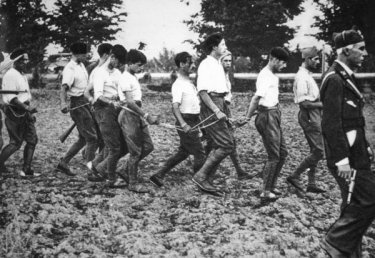
Republican prisoners about to be shot by Nationalist firing squad

Men being marched to firing squads

~~

This is not a detailed analysis, just a highlight (lowlight?) of the week’s events. Feel free to suggestion an addition/clarification/correction below. All photos are linked to source for credit.

This Week In Spanish Civil War History – Week 1: July 17 – 24 1936

Here is the first installment of a new series, a weekly post chronicling the Spanish Civil War, 80 years after the uprising in July 1936. The Spanish Civil War is a complex subject, but if you are new, here is a super simple round-up.

A country with a rocky past, but the more recent Spanish troubles started in 1931, when the monarchy was exiled, creating the Second Spanish Republic. Left-wingers won an election, but as people tried fighting for basics, like fair wages, workers’ rights, women’s rights, education etc, nothing went well, no one agreed, and right-wing conservatives and the church resisted in every which way. Power switched in every direction, but when the Republican left-wing Popular Front took power in February 1936, the military considered an uprising to restore conservative control. Tensions ran high for several months, and when several prominent left and right-wing leaders were murdered in Madrid in July, the match was lit for battle.

The Republicans, the Spanish left, consisted of the Popular Front government, combined with socialists, communists, anarchists, workers’ unions, Marxists, leaders of autonomous Spanish regions like Catalonia and Galicia, and later the International Volunteers. The Spanish right consisted of the military, the Falange fascists, the religious Carlists and the monarchists.

People quickly had to decide which side they were on, though this would have been obvious in most people’s lives already. Within days, thousands were killed for being on the ‘wrong’ side, depending on the consensus of their town or city. What happened next was three years of bloody murder, fighting and executions.

Week 1 – July 17-24 1936

July 17

A military rebellion starts in Morocco, with the Spanish Legion soldiers killing or imprisoning their Generals. Guardia Civil police try to hold back the military in Tetuán and  Larache, resulting in bloody battles. Within a day, Spanish Morocco has fallen to the rebel soldiers. Three Generals – Franco, Mola, and Sanjurjo, all recently demoted within the army, have set up much of the plans. Franco declares a state of war, a call for soldiers to rebel all over mainland Spain and take control of their towns and cities. Anyone who resists gets a bullet.

The Prime Minster, Santiago Casares Quiroga, does nothing to arm the population of Spain, instead spending all day on the phone, ensuring no military barracks decide to rise up in support of the angry Generals.

Armed workers’ militia in July 1936

July 18

Word has spread and the socialists, communists, anarchists and workers’ unions are ready to fight to preserve the Republican government. By dawn, Pamplona, Segovia, Cadiz, Avila, Salamanca and Zaragoza are already overcome by the military, with many deaths. Zaragoza was a stronghold of the anarchists, so it is a huge blow to the Republicans.

The rebel Nationalists already have 1/3 of the country under their control and systemic executions start as other locations rise to protect themselves. Unions offer to help if given weapons, but are refused. Workers strike and start building barricades in the streets.

July 19

By dawn, the prime minister has resigned, and after negotiations, José Giral takes over, giving weapons to the population to defend themselves after formally disbanding the army.

tof-02-035aWeapons handed out to the populace

Seville fights but is defeated by the rebels. Much of southern Spain is invaded and executions begin. Navarre in the north falls to the rebels in a bloody massacre. The city of Burgos has no fighting, totally in support of the military.

Jaén, San Sebastian, Santander and Malaga manage to hold back the rebels. The important cities of Madrid and Barcelona have not yet been taken by the military. Madrid is on a knife-edge as workers are armed, ready to do battle, the assault guards personnel on their side.

General Franco leaves his post in the Canary Islands to take control in Morocco. Barcelona faces battle in the streets, with armed workers and police fighting the large military contingent. The police divisions could not hold the city on their own, and arms are given to the public to help with the siege.

July 20

After two days fighting in the streets, Barcelona is won by the Republican population. In Madrid, workers lay siege to the military barracks, killing many and saving the capital city with people power, as in Barcelona.

condorsMallorca, Coruña, Vigo, Bilbao and Granada are all won by the rebels. Valencia is still in confusion, when the army did not take sides. Fighting begins as workers strike and attack the military barracks.

The rebel military leader, General Sanjurjo, flies from exile in Portugal but is killed when his plane crashes due to plane overloading.

July 21

All chances of ending the rebellion is over, although Seville is the only main city controlled by the military.
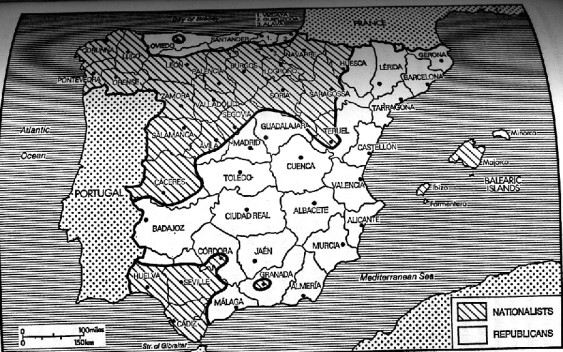
SpanishCivilWar_DivisionOfSpain_193607endAreas controlled by Republicans and nationalists in the early days of the war

The Siege of the Alcázar starts in Toledo, south of Madrid. The Alcázar (castle/fort) is filled with rebels and their hostages as Republicans fight to free the women and children inside and defeat the rebels.

July 22

The People’s Olympiad, (an event held in protest against Germany holding the Olympics) get cancelled with the outbreak of war, with many athletes in the city at the outbreak. Many were trapped in Barcelona as fighting started; some choose to fight.

The navy is loyal to the government and the Republicans. Sailors got word of the uprising and defied and killed most navy officers, saving the navy from the rebels. The air force never intended to turn against the government, but didn’t have much in the way of planes or power anyway.

808-0001-001People’s Olympiad poster

July 23

The Nationalist rebels start their own military government, the Junta de Defensa Nacional, based in right-wing Burgos. General Miguel Cabanellas is their leader.

All areas are suffering from killings and prisoner-takings, regardless of who won the uprising.

July 24

The Durruti Column, led by leader Buenaventura Durruti volunteer to leave safe Barcelona and head to Aragon to start fighting back the rebels. About 3000 workers leave in their first group to begin  a take back of rebel-held areas.

~~

From now on, each weekly round-up will be posted on a Monday. All photos are linked to original sources for photo credit.

This is not an in-depth analysis, merely a weekly highlight (lowlight?) round-up. Comments on any extra details anyone wishes to add are welcome.

The Beginners Guide to the 40th Anniversary of Franco’s Death – ‘History’ Remains Fluid

El Caudillo. The Generalissimo. Supreme patriotic military hero by the Grace of God. Whatever you want to call him, Franco was a short man with a penchant for moustaches and murder. When people think of dictators, they think of Franco’s mate Hitler, or more current dictators such as Mugabe or the North Koreans with bad haircuts. Some would say Franco was a coward in comparison, or more moderate. If you turn from the word dictator and instead to fascism, the dictionary will give you Franco as a definition. Call Franco whatever you like, but November 20 is the day to celebrate his slow and painful death. The day in 1975 when cava and champagne bottles were popping faster than overheated popcorn. That day, Spaniards, at home and in exile, could finally shake off their not-so wonderful leader.

Born in December 1892 in Galicia, Francisco Paulino Hermenegildo Teódulo Franco Bahamonde was one in a long line of relatives in the navy. But instead Franco chose the army in 1907, and worked his way through the ranks through wars in Morocco, and was shot in the stomach in 1916, and lost a testicle (it is rumoured). He continued fighting and winning medals, and by the mid-twenties, he was ranked high enough to be before the King in Madrid. The royal family got run out of the country when the Second Spanish Republic took hold in 1931, but it wasn’t until Franco’s cozy position at the army academy in Zaragoza being extinguished did Franco start getting angry. Posted to the Balearic Islands for a few years, Franco got a taste of killing his own people during the miner’s strike in Asturias in 1934. He crushed innocents defending their rights, and the left and right side of politics only continued to divide as bitterness set into the young Republic. After the 1936 elections, all went to hell, and Franco found himself leading an army from Morocco into Spain to depose the Republican government.

Fast forward through three years of brutal civil war though 1936-1939 (if I explain that in detail, we will be here forever), and Franco’s Nationalist army, backed by fascists, Carlists, monarchists, any right-wing nutball group really, had defeated the Republicans, with the communists, anarchists and general plucky young men and women from Spain and overseas fighting for freedom. After gross atrocities, upwards of 200,000 people were killed. Franco was the leader of Spain, a nation decimated by force and hate. The short, moustached, one-testicled Hitler lover was in control.

Spain was no picnic. So many fled the country, many to France, Mexico, Cuba, Argentina… basically anywhere but Spain. Artists, teachers, bright minds, and those of the left-wing all ran for their lives. Spain skipped the Second World War after basically being in pieces, claiming neutrality, though Franco loved Hitler’s style of hating. While Franco was claiming that Spain had struck gold and all would be well, 200,000 people starved to death in the first half of the 1940’s. The whole decade was spent rounding up people who had supported the Republican side of the civil war, and up to 50,000 were killed, or put in concentration camps, or just ‘disappeared’.

Franco was brutal and bizarre. He could be easily played with wild schemes. But his own plan, being anti-Communist, won him love from the United States. They were allowed to set up military bases, Spain got money and their love for Hitler, Mussolini, etc was swept under the carpet. Spain and its technocrats were keen to move on and make Spain wealthy and prosperous again, though naturally, all spoils only went to the people at the top of the food chain. Spain’s Años de Desarrollo, years of development began through 1961-1973, with Franco promoting tourism, bullfighting, flamenco, everything super-Spanish. Financially, things got much better, but since everyone was doing so poorly, ‘much better’ still wasn’t great. Many Spaniards were still living overseas. Riots broke out at universities, women were still horribly oppressed, with divorce, abortions and birth control illegal. They couldn’t have bank accounts without male oversight, and couldn’t even leave a violent husband, real middle-ages style of living. The church was sticking its evil nose into everything, being gay was illegal, local languages were banned, and nuns loved hitting kids in schools and orphanages.

By 1969, Franco was getting old and handing more power to the lecherous bastards who profited from his reign. It was time to choose an heir. Franco had one daughter (though that has been questioned, given the testicle incident, but never mind), and Franco chose Juan Carlos de Bourbon, grandson to the Spanish King exiled to France in 1931. The young man, dutifully married to a Greek princess, would be modelled and educated in the ways of Francoism – basically being a murderous douche.

Even as Franco was getting super old in the 1970’s, he was still being real bastard, handing down executions just months before his death. Young people were rising up, wanting change in their country, and groups such as ETA wanted their regions’ independence back, as did Catalonia, Galicia, Valencia – basically everyone. In the final months of Franco’s reign, countries were having protests against his execution decisions, Mexico tried to have Spain kicked from the UN, and the Pope wasn’t interested in him anymore, which isn’t cool for a Catholic nation. But on October 1st, Franco have a hate speech from his palace and left in tears. From that moment, his number was up.

Pneumonia, heart attacks and then internal bleeding took hold. Machines kept the old man alive and drugged. Doctors worked day and night for the man who let people be shot by firing squads or starve to death. But after 35 days of pumping life into a frail old man, on November 20, 1975, Franco finally passed away.

The parties started, in Spain and all around the world, where Spaniards had waited for the day. Half a million people went to see his body, just to see the proof for themselves (this figure remains disputed, like all figures during Spain’s 20th century). Spain, which had been lying dormant, could live again. The protege, Juan Carlos, was crowned King, and tossed Francoism aside, opting for democracy. None of that was an easy ride as the road to the Transition began.

The trouble is, those killed during and after the war are still buried in their makeshift graves. Those lecherous wannabes who circled Franco did not lose their place in politics, and among the wealthy and elite. Those who were evil were all given amnesty, to smooth the road for democracy. Justice was never served; Spain’s hard questions remained unanswered for so many. Those who did wrong have grown old, as those who were harmed. The varying levels of independence of Spain’s 17 regions still causes headaches. Does Spain still need to ask questions of its past, or is the future hard enough?

Either way, pop a cork off champagne today, at least to celebrate the freedom Spaniards would have felt on 20 November, 1975.

Read more of what has changed in Spain since Franco’s death, and what is to come – Spaniards aim for a new democracy and end to Franco’s long shadow

Read more about Valle de los Caídos, Franco’s super creepy tomb, where monks will be praying for him today (yes, that’s a thing!)

Read more about Franco’s war, reign, and death in the Secrets of Spain  novel trilogy

Comments on this article are now closed.