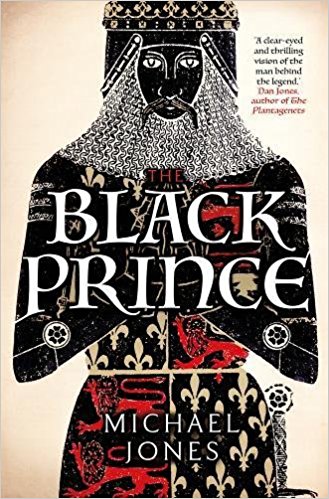
HISTORICAL BOOK REVIEW SERIES: ‘The Black Prince’ by Michael Jones

As a child he was given his own suit of armour; in 1346, at the age of 16, he helped defeat the French at Crécy; and in 1356 he captured the King of France at Poitiers. For the chronicler Jean Froissart, ‘He was the flower of all chivalry’; for the Chandos Herald, who fought with him, he was ‘the embodiment of all valour’. Edward of Woodstock, eldest son and heir of Edward III of England, better known as ‘the Black Prince’, was England’s pre-eminent military leader during the first phase of the Hundred Years War.

Michael Jones uses contemporary chronicles and documentary material, including the Prince’s own letters and those of his closest followers, to tell the tale of an authentic English hero and to paint a memorable portrait of warfare and society in the tumultuous fourteenth century.

cover and blurb via amazon

~~

My area is the 1400s and 1500s, so Edward, The Black Prince, hasn’t really been on my radar. So when I wanted to make a start on this legendary man, I came across this book, which stuck out. With my head already swimming with countless heavy academic books to read, it was a relief to find such an informative but easy to read book.

Edward of Woodstock (cool name) was born in 1330, was an earl while still in medieval nappies, and the first ever English duke, Duke of Cornwall, by age 7. King Edward III would have a slew of healthy sons, somethings all kings would dream of, but Edward was the first, the heir England needed. Young Edward was at his father’s side, and educated 1300s style – jousting, warfare and a touch of chivalry, which was on its way out. As a child, Edward had to attend council meetings and was Prince of Wales by age 13.

But it was the battlefield where Edward would reign, and get that nickname. The Crecy campaign of 1346 in France let Edward get taste for blood, winning the battle by his father’s side. The English had much of Normandy and had Calais, and then went to defend the sea between England and France from the Castilian soon after.

Battles in Aquitaine raged constantly and the Poitiers Campaign ravaged the French in 1356, and now the English had roughly a third of France in their control, making black-clad Edward a formidable soldier who could also be a great leader. Edward also sided with Pedro the Cruel in Spain to attempt victory in the Najera Campaign of 1366 which was a bad move, as Pedro more than lived up to his name, and Edward wasted his time in Aragon.

Edward’s name and reputation suggests a vicious man, cold and ready to use violence, but the author has shown a different man; a man loved by his countrymen, educated and cultured. Edward married his cousin Joan, the Fair Maid of Kent, in 1361, and only just into his thirties, started to suffer an unknown affliction where he began to waste away, possibly of liver or kidney failure, or a number of infections picked up on numerous battlefields. Edward and Joan gained two precious sons, Edward and Richard, only to lose Edward at a young age, leaving waif-like Richard as the heir to the throne.

By 1371, Edward was again fighting to hold onto power in Aquitaine, but needed to return home with illness. He attempted one more battle into France with his father but had to return home again. He spent the remainder of his life suffering until an early death in 1376, aged only 45, his heir Richard only nine.

Edward was buried in Canterbury Cathedral, and wasn’t called The Black Prince until a century and a half later, a result of his black armour and his ability to kill French people in Aquitaine, winning two of three major campaigns England made into France (the other is Agincourt 14515 btw). Edward III would have been devastated at the death of his son, and Richard went on to be a useless king, which caused death and battles among Edward III’s remaining heirs, all of which might have been avoided.

The Black Prince is the king who never was, and I am so glad I chose this book to start with learning more about the royals of the 1300s. You don’t need to be an expert to read this fluid piece of work, well laid out, and solid on the details. Much credit to the author for this book; I am glad to have it in my collection.

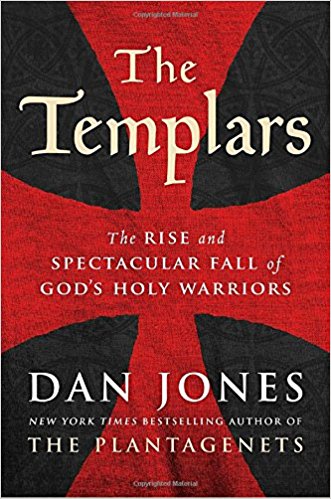
HISTORICAL BOOK REVIEW SERIES: ‘The Templars’ by Dan Jones

Jerusalem 1119. A small group of knights seeking a purpose in the violent aftermath of the First Crusade decides to set up a new order. These are the first Knights of Templar, a band of elite warriors prepared to give their lives to protect Christian pilgrims to the Holy Land. Over the next two hundred years, the Templars would become the most powerful religious order of the medieval world. Their legend has inspired fervent speculation ever since. But who were they really and what actually happened?

In this groundbreaking narrative history, the bestselling author of The Plantagenets tells the true story of the Templars for the first time in a generation, drawing on extensive original sources to build a gripping account of these Christian holy warriors whose heroism and depravity have so often been shrouded in myth. The Templars were protected by the pope and sworn to strict vows of celibacy. They fought the forces of Islam in hand-to-hand combat on the sun-baked hills where Jesus lived and died, finding their nemesis in Saladin, who vowed to drive all Christians from the lands of Islam. They were experts at channeling money across borders. They established the medieval world’s first global bank and waged private wars against anyone who threatened their interests.

Then in 1307 the Templars fell foul of a vindictive King of France, whose lawyers built a meticulous case against them. On Friday October 13, hundreds of brothers were arrested, imprisoned and tortured, and the order was disbanded amid lurid accusations of sexual misconduct and heresy. They were tried by the Pope in secret proceedings and publicly humiliated. But were they heretics or victims of a ruthlessly repressive state? Dan Jones goes back to the sources to bring their dramatic tale, so relevant to our own times, in a book that is at once authoritative and compulsively readable.

cover and blurb via amazon

~~

The thing about the Knights Templar is that you mention them, you get a reply that suggests they are well-known. But if you were to ask the where-when-why etc, you get a blank expression or something a little garbled and fishy. The Knights Templar has built up an aura of men in full amour, wielding swords, holding limitless power and having some sort of personal line to God. Finally, here is a book you can trust.

The cultish-like Templars started in Jerusalem, living rather plain lives, much like Spaniards  before the Moors came to town and made everything better. The Templars took their name from a palace in the centre city named Temple of the Lord. The Templars believed in Christian values, which even today is a sketchy ambition and usually means harming those who don’t agree with you. This is relevant to this tale, as the Templars were a Catholic military unit founded around 1119. From their basic levels in Jerusalem, over the next thirty years, the Templars spread themselves out over Christendom, killing in order to make sure everyone stayed Christian – their appointed version of Christianity. They were, by this time, famous, rich and considered battle warriors against heretics and infidels.

In a time of typically violent crusades between Christians and Muslims, the Templars rose to be seen as heroes. The victory in Jerusalem came in June 1187, winning against a Muslim attack thanks to the fund received from King Henry II, who had paid their church as penance for a huge misdeed. Again in 1191, the Templars rose to defeat the Saracen and their leader Saladin, in name of King Richard I the Lionheart.

The battles fought by the Templars raged throughout 1200’s but by the early 14th century, the Templars had established an iron will, refusing any kind of diplomacy and lack of understanding of values in the areas where they wielded their butchery. The Templars also remained strict to one another, sometimes even serving punishment to each other like eating like a dog for a year.

Jones’ work is accurate and yet reads like a drama as the Templars are turned upon by the French in the 1300’s when the king got heavily indebted to the Templars. Propaganda really got its legs when churches started disparaging the Templars. Their Grand Masters, combat robes, secret ceremonies, the vast wealth all started to slip away, as did their victories in the crusades. They lost Jerusalem by the mid 1200’s, moved on from modern-day Israel and Syria soon after, moved from Cyprus by 1303. Their cells through Europe continued, but when the Pope and the French king wanted them eliminated, the Templars met the fate on Friday 13, 1307, when they were set upon and formally denounced. By 1312, all the cells had been quashed and writs from the Pope wiped the Templars from Christendom.

Jones’ book is a wonderful read and dispels the myths of the Templars as well as giving the reader a clear picture of those murky times during the crusades. As always, Dan Jones has delivered.

HISTORICAL BOOK REVIEW SERIES: ‘The King’s Pearl’ by Melita Thomas

Mary Tudor has always been known as ‘Bloody Mary’, the name given to her by later Protestant chroniclers who vilified her for attempting to re-impose Roman Catholicism in England. Although a more nuanced picture of the first queen regnant has since emerged, she is still stereotyped, depicted as a tragic and lonely figure, personally and politically isolated after the annulment of her parents’ marriage and rescued from obscurity only through the good offices of Katherine Parr.

Although Henry doted on Mary as a child and called her his ‘pearl of the world’, her determination to side with her mother over the annulment both hurt him as a father and damaged perceptions of him as a monarch commanding unhesitating obedience. However, once Mary had finally been pressured into compliance, Henry reverted to being a loving father and Mary played an important role in court life.

As Melita Thomas points out, Mary was a gambler – and not just with cards. Later, she would risk all, including her life, to gain the throne. As a young girl of just seventeen she made the first throw of the dice, defiantly maintaining her claim to be Henry’s legitimate daughter against the determined attempts of Anne Boleyn and the king to break her spirit.

Following the 500th anniversary of Mary’s birth, The King’s Pearl re-examines Mary’s life during the reign of Henry VIII and her complex, dramatic relationship with her father.

cover and blurb via amazon

~~

Called Bloody Mary through the centuries, Queen Mary has never attracted the same level of interest as her little sister Elizabeth I. This book has set out to change the stereotype of Mary, heir to the throne of Henry VIII and her powerful mother, the Queen Katherine. Mary has been seen as a Catholic fanatic, unable to navigate politics with poise or experience, a cruel woman happy to kill Protestants without thought. Mary is seen as married to a Spaniard, which somehow made her an instant tyrant.

In recent times, some authors have tried to make Mary into a more gentle figure; an innocent woman, forced away from her religious mother, determined to turn back time in England, unable to satisfy a husband or make an heir. The King’s Pearl is different again, which makes the book such a nice surprise. Instead, this book looks at Mary from an earlier angle, how her father’s reign impacted on Mary.

Mary’s early life is chronicled in serious detail, before the reality of Henry’s ‘Great Matter’ starts affecting Mary and her life. Mary was a stylish and educated young woman, witty, musical and a skilled horse rider. Mary was not weak or timid, as often portrayed; not constantly alone or at prayer, Mary could hunt or dance, host parties or play games as well as any young woman. She was beautiful and always immaculately dressed. Gone are the dull descriptions that often plagued her mother also, more likely propaganda to portray Elizabeth as superior later in life.

The list of betrothals Mary suffered though makes for bleak reading. Henry never seemed serious in finding a groom for his daughter. Mary was an unchallenged heir for much of her young life, and Henry seemed wary to ever marry her off and make her position as heir more powerful. Mary could defy her father at any time, on any level, and while others were forsaken, Mary was forgiven by Henry, dispelling the notion Henry hated his eldest daughter.

Mary may have had more in common with Elizabeth than either of them would have liked to admit; bright, intelligent girls, separated by their birth and their religion. I feel as if Mary’s reputation suffers due to her sex more than ever – Mary killed less than 300 heretics, her father killed 72,000, yet she is the bloody one? No man would have had a harmed reputation for the killing of 300. Mary rode out and took the throne from Jane Grey, the throne that was rightfully hers, and did her best, in a role she was prepared for, and Mary had her own terms. Only history hasn’t remembered her as well as it should.

This book is a worthy read indeed. Loved it. The author has created an excellent perspective on Queen Mary through facts instead of myth.

HISTORICAL BOOK REVIEW SERIES: ‘Game of Queens’ by Sarah Gristwood

Sixteenth-century Europe saw an explosion of female rule. From Isabella of Castile, and her granddaughter Mary Tudor, to Catherine de Medici, Anne Boleyn, and Elizabeth Tudor, these women wielded enormous power over their territories, shaping the course of European history for over a century. Across boundaries and generations, these royal women were mothers and daughters, mentors and protégées, allies and enemies. For the first time, Europe saw a sisterhood of queens who would not be equaled until modern times.

A fascinating group biography and a thrilling political epic, Game of Queens explores the lives of some of the most beloved (and reviled) queens in history.

cover and blurb via amazon

~~

Sarah Gristwood has written a superb book detailing the lives of incredible queens from England, Spain. France, The Netherlands and Hungary, starting with Isabella of Spain through to Elizabeth I. Without sounding like I am hero-worshipping, this biography is perfection.

Isabella of Spain was unlike any queen before her. She had inherited Castile in her own right, married the king of Aragon and became the warrior leader needed to invade southern Spain and conquer it for the Christians. The example as a female leader set a standard for her daughters, including Katherine, who would go on to be queen of England.

The beauty continues as the book does not solely tell the tales of English queens (though Queen Katherine crushing of the Scots is brilliant, as is Margret Tudor on the Scots side with all her turmoil), other countries and their female leaders are given much page-time. Marguerite of Navarre is detailed, describing the intriguing relationship with her brother Francis I and her own mother, Louise of Savoy. Her diplomatic skills are recognised, along with her role in the Protestant Reformation. Marguerite also tutored Anne Boleyn, noting how Anne’s birth was her downfall, as she knew when to push forward but not when to hold back, not born into a royal role.

Mary of Hungary is a great addition to the book. With her strong noble family, she was a queen in Hungary as well as governor of the Netherlands in her own right. Mary of Guise is displayed as astute in Scotland, and Catherine de Medici’s long life ruling over France is beautifully written. A bastard daughter risen to be a wife of a second son instead became the French queen and was able to steer own family in ruling the nation.

Queenship is regularly overshadowed by kingly pursuits, when history can lavish us with wise, educated women. Religion plays out over every tale, where it could help steer these queens, guide or justify their behaviour and aid them in keeping their kingdoms alive. While the fate of women was always in the hands of male family members, these women took the hand they were dealt and ruled, an example to everyone.

Gristwood’s book is flawless and I would recommend it to absolutely everyone.

HISTORICAL BOOK REVIEW SERIES: ‘The Survival of the Princes of the Tower’ by Matthew Lewis

The murder of the Princes in the Tower is the most famous cold case in British history. Traditionally considered victims of a ruthless uncle, there are other suspects too often and too easily discounted. There may be no definitive answer, but by delving into the context of their disappearance and the characters of the suspects Matthew Lewis examines the motives and opportunities afresh as well as asking a crucial but often overlooked question: what if there was no murder? What if Edward V and his brother Richard, Duke of York survived their uncle’s reign and even that of their brother-in-law Henry VII? There are glimpses of their possible survival and compelling evidence to give weight to those glimpses, which is considered alongside the possibility of their deaths to provide a rounded and complete assessment of the most fascinating mystery in history.

cover and blurb via amazon

~~

Everyone knows the story of the Princes of the Tower, two royal brothers, one ready to be crowned, his brother the ‘spare heir,’ locked in the Tower of London by their uncle, who would instead crown himself King Richard III. The boys would then disappear from the planet completely soon after.

There is a list of suspects of who murdered Edward, aged 12, and Richard aged 9, at the time of their imprisonment. There is no proof the boys were even murdered, but their total disappearance, and Richard III’s short-lived reign a result of that disappearance, leaves little doubt.

King Richard III is the prime suspect – his brother Edward’s sons were to inherit the throne before him. But King Richard and deceased Edward had a brother – George (also deceased). George himself had a son and daughter, and the departed Edward had a slew of daughters with a claim to the crown. If Richard wanted to kill the boys in the Tower to take the throne, he would have had to eliminate all the children – and he harmed none.

Henry Tudor was in France, ready to invade and marry one of Edward’s daughters and claim the throne. This made the royal sisters of the Princes (and George’s children) threats. Yet King Richard never declared that young Edward and Richard had died in the Tower. They disappeared but were never announced as deceased. The fact they were not known as dead meant they remained a threat. They could have fallen ill; they could have been killed by another.

Henry Stafford, the Duke of Buckingham made himself a suspect in the murder by his behaviour. He rebelled against King Richard, with a view to his own as claim, making him a candidate for needing the boys murdered. Buckingham was quashed by Richard’s forces and executed, and making him the ‘murderer’ would have been so easy. But King Richard never publicly blamed Buckingham for the deaths, when he easily could have used him as a scapegoat. It suggests neither killed the princes.

Some claim Margaret Beaufort, Henry Tudor’s mother, had the boys killed so her son could inherit the throne. There is not a shred of evidence to suggest this but the theory persists through fiction and Lewis’ book does discuss the possibility. Henry Tudor married the Princes’ oldest sister, so the odds of him murdering her brothers is slim.

King Richard III’s guilt seems to easy to accept, and the author brings up many details to help clear Richard’s name. The rumours of the Princes’ death are as strong as the survival of the boys. The Princes’ own mother never blamed Richard for the deaths. The books tell of Elizabeth Woodville and her son Thomas Grey under suspicion, a detail I didn’t know until reading this version of the affair. And then there is Perkin Warbeck, the Prince Richard pretender who haunted Henry VII.

Could Edward and Richard have survived? Was there ever a murder of the Princes in the Tower? Or is there are far more interesting version to be told? This book is fantastic and I would recommend it to Tudor fans and newbies alike. As an A+ fan of Richard III, I welcome any book looking to clear his darkened name. Thank you, Matthew Lewis.