This Week in Spanish Civil War History – Week 76: The Battle of Teruel 23 – 31 December 1937

December 23

Franco knows his planned Guadalajara offensive is futile, as Teruel needs all of the manpower in the area, despite anger from the German and Italian allies who want to take Madrid and end the war.

December 25

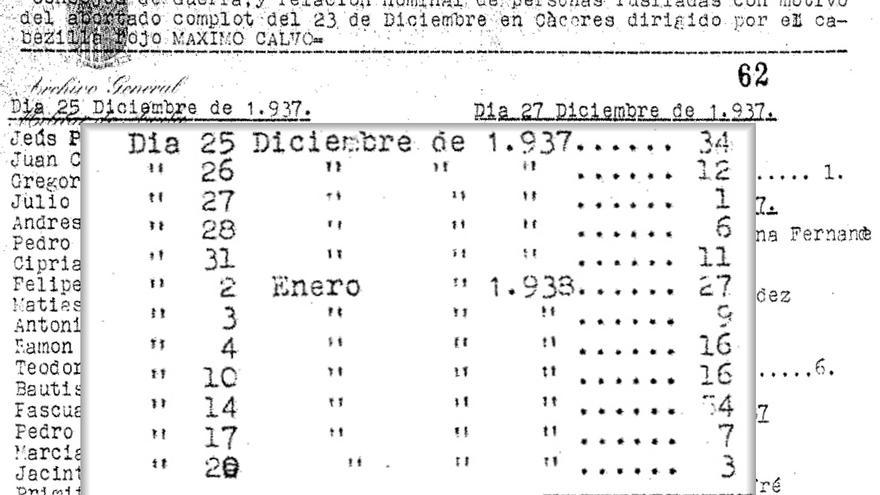
In the small city of Cáceres in the far western region of Extremadura, 34 men are murdered, some taken from the dinner table during quiet Christmas Day meals. A shooting range is set up at the barracks of the 27th Algiers infantry regiment, where sixty Guardia Civil men could kill the chosen victims. Among the victims was the socialist Mayor Antonio Canales and President of the Provincial Council Ramón González Cid. Others were local trade union members, teachers, UGT members and Republican sympathisers, some already under arrest for months. The province had been under Nationalist control since the beginning of the war, but false rumours of an uprising led to the deaths. No plans by Republican or Communist members were planning an uprising, only lies spread by local Nationalist leaders. The story of a fake coup led by Máximo Calvo  was announced by the Falange on December 23, leading to the arrests and execution of the men. It would be the start of one month of scheduled killing around the area, leading to a total 196 dead, including 14 women, all executed for non-existent crimes.

Nationalist Colonel Domingo Rey d’Harcourt has been trying to hold out while reinforcement troops arrive in Teruel. Now two generals, Antonio Aranda and José Enrique Varela have arrived, with fresh  experienced men, and the Condor Legion has arrived to attack Teruel from the air.

December 30

Nationalist men are already making gains, by getting on the La Muela (Teruel Tooth) mountain beside the town. The weather continued to close in on both sides, making defense and attack slow and dangerous.

Frozen tanks seen by Robert Capa

December 31

The Republicans have continued their assault on the four strategic buildings the Nationalist held in the town  -the Convent of Santa Clara and the Seminary of Santa Clara, the Bank of Spain building, and the Civil Governor’s Building. By the time the new year began, all the Nationalists inside the Convent of Santa Clara had been murdered.

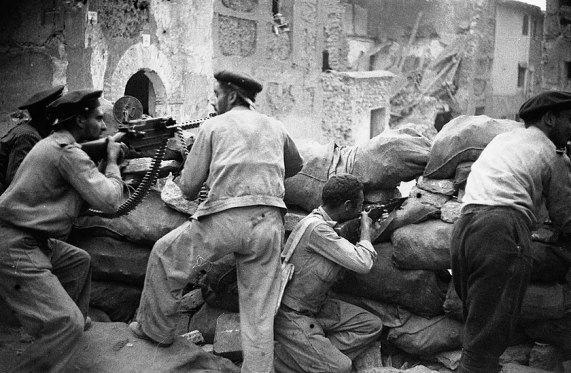
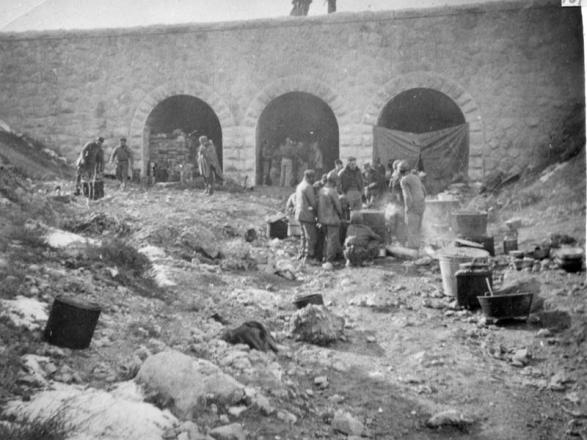
The final day of 1937 saw the start of a vicious four-day blizzard, with frostbite that will claim lives and limbs while the fighting continues. But 1937’s final day also saw the Nationalists hold their position on the Teruel Tooth, and get into Teruel’s bullring and railway station, both at the lowest southern point of the town. With the temperature at minus 18C, machine guns are frozen, and the reinforcement Nationalist troops do not enough warm clothing to make many gains.

~~

This is not a detailed analysis, just a highlight (lowlight?) of the week’s events. Things get lost in translation – Feel free to suggest an addition/clarification/correction below. The more the world remembers, the better. All photos and captions are auto-linked to source for credit, and to provide further information.


DECEMBER SPAIN BOOK REVIEW: ‘Alberto’s Lost Birthday’ by Diana Rosie

A little boy and his grandfather embark on a quest to find the old man’s missing birthday in Diana Rosie’s debut novel, Alberto’s Lost Birthday.

Alberto is an old man. But he doesn’t know how old – he remembers nothing before his arrival at an orphanage during the Spanish civil war.

He rarely thinks about his missing childhood, but when seven-year-old Tino discovers his grandfather has never had a birthday party, never blown out candles on a birthday cake, never received a single birthday present, he’s determined things should change. And so the two set out to find Alberto’s birthday.

Their search for the old man’s memories takes them deep into the heart of Spain – a country that has pledged to forget its painful past. As stories of courage, cruelty and love unfold, Alberto realises that he has lost more than a birthday. He has lost a part of himself. But with his grandson’s help, he might just find it again.

cover and blurb via amazon

~~

I read this whole book in one sitting; that is a testament to how easy it is to read this sweet work of fiction. By the time I was two-thirds through, I was desperate to see how it all played out.

The book bounces around the trip of Alberto and his seven-year-old grandson, Tino. Tino’s father is in the hospital after a horrific burning accident, and Alberto tries to distract the child with the story of how, as an orphan, he doesn’t know his own age or birthday. They head off on a road trip to find out what happened to Alberto as a young boy.

Other chapters are peppered through the book from the point of view of other major players  in Alberto’s early life- the woman who cared for him at the orphanage, the girl who grew up with him, the angry fascist commander who was killing people during the Spanish Civil War, Alberto’s birth mother and father, a young priest and an English International Brigade fighter who finds young Alberto in the forest. Between these point of views and of elderly Alberto on his mission, the heartbreaking story all comes together.

The Spanish Civil War rears its ugly head, showing the misery of growing up a orphan in war-time, the realities for Alberto’s birth parents, the sins of the 1930’s, all mixed with a few moments of bad luck, PTSD and beautiful family ties torn to shreds, comes together to find the true date of Alberto’s birth written in a rather unusual place.

.Alberto’s first ever party is laced with a pain I could see coming but didn’t want to acknowledge, but his search also healed pains for many people left scarred by the battles of the late 1930’s. The book is simple and no fuss, has its quiet moments, but tells a painful tale in a gentle way. I really enjoyed this book and would recommend it to everyone.

HISTORICAL BOOK REVIEW SERIES: ‘Elizabeth’s Rival: The Tumultuous Tale of Lettice Knollys, Countess of Leicester’ by Nicola Tallis

The first biography of Lettice Knollys, one of the most prominent women of the Elizabethan era.

Cousin to Elizabeth I – and very likely also Henry VIII’s illegitimate granddaughter – Lettice Knollys had a life of dizzying highs and pitiful lows. Darling of the court, entangled in a love triangle with Robert Dudley and Elizabeth I, banished from court, plagued by scandals of affairs and murder, embroiled in treason, Lettice would go on to lose a husband and beloved son to the executioner’s axe. Living to the astonishing age of ninety-one, Lettice’s tale gives us a remarkable, personal lens on to the grand sweep of the Tudor Age, with those closest to her often at the heart of the events that defined it.

In the first ever biography of this extraordinary woman, Nicola Tallis’s dramatic narrative takes us through those events, including the religious turmoil, plots and intrigues of Mary, Queen of Scots, attempted coups, and bloody Irish conflicts, among others. Surviving well into the reign of Charles I, Lettice truly was the last of the great Elizabethans.

cover and blurb via amazon

~~

Lettice Knollys is such an interesting person, a life filled with enough drama and excitement that anyone would envy her. One of the few women of the English court not to be named Katherine, Anne, Elizabeth or Mary, Lettice Knollys was the daughter of Catherine Carey, the so-called love child of Henry VIII and Mary Boleyn.

While Catherine Carey wasn’t formally recognised as Henry’s love-child, the odds are high, making Carey the half-sister of Queen Elizabeth, and thus Lettice was Elizabeth’s niece, rather than cousin. The two women looked much alike, and as Lettice was only 10 years younger than her aunt, she was the younger gorgeous redhead. Dressed in clothes of the period, Queen Elizabeth and Lettice look much alike, same hair, face, smile. The author of this book leans closely to the fact that Henry VIII was Lettice’s grandfather, and had she been male, would have been an illegitimate heir to the throne. Lettice was a Tudor, something fast disappearing from the world.

Lettice married well at 17 to Walter Devereux, Viscount Hereford and bore him four surviving children (out of five, pretty good). Lettice was young, happy and known as the most beautiful woman at the English court. Elizabeth, ever-vain, needed to be centre stage and could have been annoyed, but yet she and Lettice were close. Elizabeth had her own love – Robert Dudley, Earl of Leicester, whom she could not marry. This is how two Tudor women became bitter rivals.

Lettice’s husband, now Earl of Essex, shipped out to Ireland at the queen’s behest in 1573, and Lettice started an affair with the queens’ favourite, Dudley. While nothing could be confirmed and most accounts are long-lost, the book tells of how rumours swirled of the affair and Lettice carrying and bearing children while her husband was away. Devereux came home after two and half years away, having heard all about his wife’s behavior. But Devereux left for Ireland again six months later, only to die soon after of dysentery while complaining about women being frail.

Lettice fought hard for an inheritance for herself and her children, and her affair with Dudley continued despite him being Elizabeth’s favourite. Dudley had wanted to marry Elizabeth, but was unable to for many reasons, and so had instead gone to the bed of the younger Tudor model. He married Lettice in secret in 1578, two years after she was widowed, he himself a widower for some 18 years at this point. Just two days later, Lettice sat with the queen at dinner, the secret safe, as it would be for  years, with Lettice and Dudley moving about regularly, usually separated. Lettice lost a  baby in 1580, gave birth to a son in 1581, and lost another in 1582. Their precious only son died in 1584, causing great grief to the pair.

But in 1583, all hell had broken loose. Elizabeth found out her favourite had married Lettice, and was living openly with her in his own home. A bond which had almost certainly begun in childhood was broken; Lettice was banished from Elizabeth’s presence, furious the man she wouldn’t marry had married someone else. Dudley was sent on several trips abroad, before he fell ill, possibly with malaria in September 1588 and he died with Lettice at his side.

Lettice remained out of favour with the queen, living a country life with a new husband, a young soldier named Sir Christopher Blount, former attendant to her late second husband. She struggled with the loss of her eldest son and suffered many financial troubles, and did not see her queen again until 1598, where the meeting remained icy a decade after Dudley’s death. The love triangle between Dudley and the two red-headed Tudor women never healed.

Thanks to the Essex revolt of 1601, Queen Elizabeth beheaded Lettice’s precious remaining son and her new husband , both for treason. She spent much time fighting over inheritances with a bastard son of Robert Dudley, and then lived with her daughters and their children, outliving them. She lived quietly under King James and King Charles, dying at her grandson Robert’s home in December 1634, aged 91, a symbol of  bygone age.

Lettice’s life, born under Henry VIII, a bastard grandchild to the great king, grew up under him, King Edward, Queen Mary, lived through Queen Elizabeth’s reign, then King James and King Charles, is a story of wonder, drama, intrigue, heartache and love. Why there aren’t many books on such an incredible woman is a mystery. Thank you so much to Nicola Tallis for the book I have been waiting for, a perfect read on a riveting subject.

This Week in Spanish Civil War History – Week 75: The Battle of Teruel 15 -23 December 1937

December 15

Enrique Lister’s Republican brigade attacks Teruel in falling snow. Teruel has around 4,000 Nationalists holding the main town, half just civilians. Another 5,000 are in the surrounding area. The Republicans now have almost 100,000 men, half the Army of the Levante and the other the Army of the East. By the end of the day, they have surrounded Teruel, and have the critical location of La Muela, the Teruel Tooth, the highest ridge overlooking the town.
civilian evacuation from Teruel

December 17

The Nationalists, headed by Colonel Domingo Rey d’Harcourt, are struggling to hold their position in the town. The Nationalist men outside the town walls are called in to help keep the Republicans at bay, and the Nationalists have to surrender their attempts to reclaim La Muela.

Republican soldier on duty

December 19

Franco has been planning a major battle at Guadalajara outside Madrid, but now postpones his plan so the Teruel troops can receive back-up. The German and Italian allies are unhappy with this decision, as they wanted to strike a final huge blow and march into Madrid and end the war. Franco now knows he cannot end the war this way and has to win by a war of attrition. Franco is determined that no city or town will fall to the Republicans once captured by Nationalists, and keeping Teruel becomes critical in saving face as well as ground.

Hemingway arrives in Teruel

December 21

Without any aerial bombardment or major artillery, the Republicans march into Teruel, as they simply have more men in the battle. Colonel Domingo Rey d’Harcourt and his remaining men retreat into the southern edge of the town, and hope to hold four main buildings – the Convent of Santa Clara and the Seminary of Santa Clara, the Bank of Spain building, and the Civil Governor’s Building. The Nationalists are down to around 4,000 men after only a week of fighting. The fighting is down to hand to hand combat, men being bayoneted after the building they hide inside is pounded with artillery. Ernest Hemingway  and Herbert Matthews enter Teruel with the Republican troops to report on the fighting, giving the battle a large following.

Republicans outside Teruel

December 23

The Nationalists are still holding their four main locations, but the rest of Teruel is held but the Republicans. Franco decides that a Guadalajara offensive is now impossible. Franco tells Colonel Rey d’Harcourt  to hold out no matter the human cost, as the Guadalajara troops are on their way to Teruel, which will take six days. The weather in Teruel continues to get worse, the depths of winter being awful, even by Teruel’s icy standards. It will be the coldest winter in 40 years, with men sleeping in four feet of snow to hold their position. Frozen guns and frostbite are rife. Franco is sending General Antonio Aranda and General José Enrique Varela, two very vicious and successful leaders, with what will become 100,000 men, enough to match the Republican garrison.

Republicans head into Teruel

~~

This is not a detailed analysis, just a highlight (lowlight?) of the week’s events. Things get lost in translation – Feel free to suggest an addition/clarification/correction below. The more the world remembers, the better. All photos and captions are auto-linked to source for credit, and to provide further information. All pictures in this post ar courtesy of Magnum Photos, taken by Robert Capa.

HISTORICAL BOOK REVIEW SERIES: ‘Joan of Arc and The Great Pity of the Land of France’ by Moya Longstaffe

Joan of Arc’s life and death mark a turning point in the destiny both of France and England and the history of their monarchies. ‘It is a great shame,’ wrote Étienne Pasquier in the late sixteenth century, ‘for no one ever came to the help of France so opportunely and with such success as that girl, and never was the memory of a woman so torn to shreds.’

Biographers have crossed swords furiously about her inspiration, each according to the personal conviction of the writer. As Moya Longstaffe points out: ‘She has been claimed as an icon by zealous combatants of every shade of opinion, clericals, anticlericals, nationalists, republicans, socialists, conspiracy theorists, feminists, yesterday’s communists, today’s Front National, everyone with a need for a figurehead. As George Bernard Shaw said, in the prologue to his play, “The question raised by Joan’s burning is a burning question still.”’

By returning to the original sources and employing her expertise in languages, the author brings La Pucelle alive and does not duck the most difficult question: was she deluded, unbalanced, fraudulent ‒ or indeed a great visionary, to be compared to Catherine of Siena or Francis of Assisi?

cover and blurb via amazon

~~

Everyone has heard of Joan of Arc, the girl dressed as a man, who heard godly voices telling her to run an army. But ask for more, the where, when and why, then the story becomes murkier. So a comprehensive book on Joan is perfect for anyone.

Joan, or Jeanette, was a woman, so naturally has been written in a less than ideal light throughout time. A saint, a lunatic, a heretic, a liar, witch, a leader. Poor Joan has been labelled it all. But who is Joan of Arc?

The book starts off with the detail of the country of Joan’s birth. ‘The Great Pity of the Land of France’ was the phrase, the pity being the sorry state of the country and the suffering of its people. First came civil war between the leaders of Orleans and Burgundy in the early 1400’s, before the English then  invaded France, with the massive battles of Harfleur, Agincourt and Rouen with King Henry V in 1415-1419. France was on its knees – a crazed leader, a dead dauphin, a ragged army and struggles for the people. Battles between France and England through the Hundred Years’ War, ending in 1453, is explained through this book, to give clarity to the life and situation that gave rise to such a heroine.

The book delves into Joan’s early life, the family who raised her, and what made her believe she was called by God to save her country. Joan of Arc was no great-sized warrior. An average girl of average height, her hair cut short like a soldier, the clothes of a soldier. Joan was not the first French woman to ride into battle but none before her had the qualities of young Joan. With God on her side, Joan was a unique figure. She set out from her home in Domrémy, where she had seen visions of  Saint Michael, Saint Catherine, and Saint Margaret from the age of 13. Leaving home at about 16 in 1428, Joan believed she had to drive the English out of France, and bring the King Charles to Reims where he would be crowned. Joan travelled to Vaucouleurs and petitioned an army commander with her tales of divine intervention. Joan told the men of tales of battle at Rouvray days before word spread to the area about the battle, convincing the army of her visions. What began was an extraordinary change in favour for the French army.

Joan was sent to meet with King Charles in 1429, age 17. Joan was sent on a relief mission to Orleans, all in donated armour, to be a message of hope to battling soldiers losing to the English. Some say Joan fought in battles, others say she merely sat in on military meetings and planning. Either way, for a young woman, any involvement is extraordinary for the time. But soon after Joan’s arrival, the French beat back the English, took Reims after other successful battles, and Joan’s family were ennobled. Her presence, her visions, her tales changed the war.

A year on and a truce with England collapsed and Joan was again at war and captured by Burgundy. She jumped from a tower up to 21 metres high to escape and had to be moved to a secure location. Then Joan was put on trial for heresy, a classic move when an enemy wanted to bring someone down. The English and the Burgundians wanted Joan gone. Not only guilty of heresy by claiming to hear saints, Joan was charged with cross-dressing, something only hated after she was caught. As a soldier, Joan was welcome to dress as a man, for necessity. Her male outfit also saved her chastity, and as soon as she was forced into a dress, an English lord attempted to rape her, allowing her back into male clothing.

The religious court lacked honesty or jurisdiction, and the English and Burgundians won out. Joan was found guilty of her charges, the penalty death at the stake. Joan was burned 30 May 1431 in Vieux-Marché in Rouen, and then her charred body was pulled from the ash and burned twice more to ensure her death. Both French King Charles and English boy-King Henry continued to claim hold over France, and the war carried on. It was not until 1452 did poor Joan get a retrial, ending in an innocent verdict in 1456, just as the wars finally ended in France’s favour.

I have to confess I did not know the detail of Joan of Arc’s life, so this book was of great interest. Someone interested in Joan may know all the facts as they are already known, but to me, the book is a treasure trove of detail on a great woman of history. Congratulations to the author for the wide research and careful construction of this great heroine.