Valencia Photos of the Month: Ancient Moorish Tower of Plaça de l’Àngel

While the Romans founded Valentia is 138BC, the Moors took over the city in 714, and the city remained a small area by the riverside. But in the early 11th century, Valencia city was proclaimed the taifa of Valencia, the city kingdom of the area, after the fall of the Caliphate of Cordoba in 1010. Abd al-Aziz ibn Amir took over the city and from the beginning of his reign in 1021, Valencia needed a secure wall around the city, which was expanding quickly with people moving north from al-Andaluz. The stone wall was built with seven gateways, and circular towers for lookout and protection, but only some parts of this great wall still remain. 

440px-Muralla_àrab_València


Between the main gate, Bab al-Qantara, (now the site of Valencia Torres de Serranos gate) and gate number two, the west gate named Bab al-Hanax (my last post HERE shows photos of the remaining wall) was on Calle Salines. (Also between these gates was Portal de la Valldigna, the doorway to the Christian pocket of the city) Between these two gates was the Torre del Angel (Angel tower). El Cid took over the city in 1099, but it wasn’t until 1356 that the new city walls needed to be built, expanding the city when Christian reign took over the city. Only parts of the original towers and slices of the ancient stronghold remained standing as the city doubled in size.

Plaza del Angel, (called Plaça de l’Àngel in Valencian), a tiny square off the main road away from Torre de Serranos, managed to hide and protect one of the Moorish towers for centuries. In 1701, a hotel was built around the Torre de Angel, using the still intact tower as part of its establishment. It appeared in travel guides for the city from 1849. The Parador /Hostal del Angel was featured in an article in 1930, about the family and building (article is below in the slideshow). The hostal actually had its entrance in Plaza Navarro, but was the main building in the tiny Plaza del Angel along its back. Both the Moorish tower and wall were protected inside the hostal.

When the great Valencia flood of 1957 destroyed the hostal, the area was left unattended, until development saw a new apartment building go up in the ruins of the hostal grounds, making Plaza del Angel the small triangular plaza it is today. The hostal grounds became a park, leaving the tower and wall safe from demolition. But the park was neglected and then pulled away, and today the old hostal grounds and surrounding Moorish treasures are fenced off and kept away from a public. Getting a good photo of the Torre de Angel can be quite a challenge. However, the Valencian government committed to preserving the tower and surrounding wall. A quick search finds that the promised works on the Moorish towers in the Barrio del Carmen have not made any progress, missed all restoration details since 2006, and now other agencies are being called in to investigate the delays. So in Valencian terms, this issue probably won’t be sorted for another 100 years. Let’s hope the towers outlast the bureaucracy.

Also saved from the same part for the Moorish wall is another smaller tower technically now called the Calle Mare Vella tower, though this street provides no glimpse of the structure. It sits against 1970’s apartment blocks and can be seen easily from outside the car park area (?!) on Calle Borras and Calle Adoberies.

Plaza del Angel/Plaça de l’Àngel is one of the sites featured in all books in the Secret of Spain book series. Both these books and this site use both the Spanish and Valencian spellings, depending on time period featured, as Valencia was banned under the Franco dictatorship. The plaza itself is labelled in both languages in the city, though newer maps only have Valencian spellings. There are other great Moorish secrets tucked away in Valencia, which I will do in a separate post.

All historical photos via Valencian Historia Grafica and recent photos author’s own, or via Google

Valencia Photos of the Month: Portal de la Valldigna

Portal Valldigna Valencia

Portal Valldigna (Valldigna Gate) is a portal/gateway built in 1400 to separate the Christian and Moorish areas of the city. It is located in the oldest part of Valencia’s old town, in the Barrio del Carmen, in the Ciutat Vella. The gateway never had a door, and simply separated the nearby buildings, and leaned against the ancient Arab wall around the city. The local abbot had his home over the doorway, and gave the Portal Valldigna after the  Monasterio de Santa María de la Valldigna, an amazing monastery built in 1298 outside the city area.

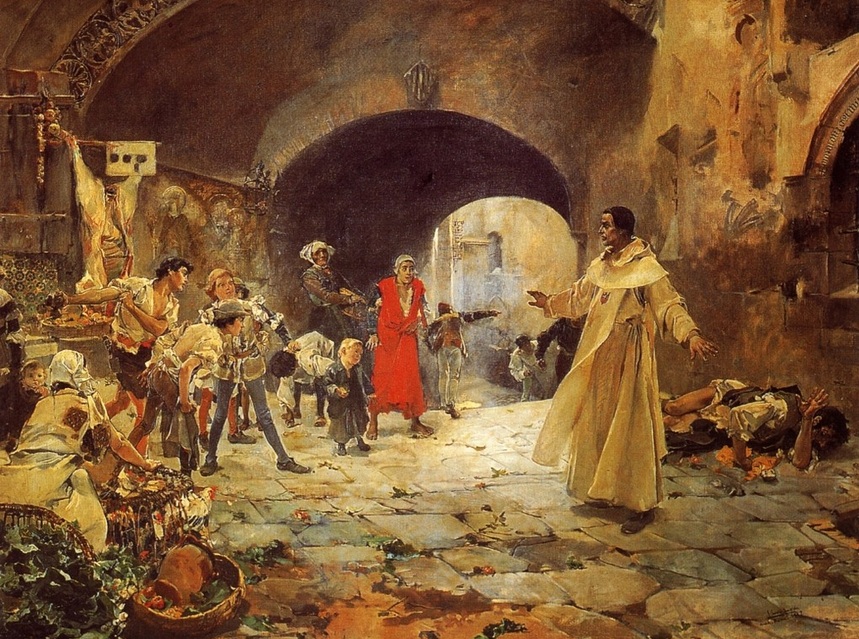
Jofre_sorolla

Father Jofre defending a madman, by Joaquin Sorolla (1887) – Source

The portal, seen here in this painting by one of Valencia’s finest artists, shows the portal in the background as Joan Gilabert Jofré, known as Father Jofré, saves a madman from being stoned in 1409. After spending time seeing how Muslims cared for the mentally ill, Father Jofré went on the start the world’s first mental institution in the world, sanctioned by Pope Benedict XIII and King Martín I of Aragon. It was built nearby and named after Valencia’s patron saint Nuestra Señora de los Desamparados.

In 1474, a book named Obres e trobes en lahors de la Verge María was printed with paintings of the Portal Valldigna, showing an inscription in Valencian, es obres or trobes Davall scrites quals them lahors tracten of the sacratíssima Verge Maria (in praise of the Virgin Mary). In 1589 a new plaque was put above the portal depicts King Jaime II of Aragon at the founding of Valldigna monastery.

Speed forward to the 1940’s and the portal was in a state of disrepair and the city planned to demolish it along with the historical buildings surrounding it. In 1944, the Valencia Director of Fine Arts stepped in to have the Portal Valldigna named a historical monument and saved it from its fate. The portal and above building was fully renovated in 1965, making sure the original Arab and Christian stones were saved. A new plaque was put over the entrance into the ‘old cities’ with the shields of both the city of Valencia and the Valldigna monastery. The Valencia inscription next to it reads : Dona Nostra Son of Bona, Pregueu per nós, Valldigna Portal (Good Women of Our Son, Pray for us, Valldigna Portal).


Today, Portal Valldigna is a good spot to stop by and see a pocket of Valencia’s ancient history, away from the crowds. It is easy to find if you are already visiting some of Valencia’s more well-known sites. If you are new to Valencia, just head up Carrer Concordía off Carrer Serrano, and follow the road right, and you will be on Carrer Portal Valldigna. Or, head down Carrer Cavallers (Calle Caballeros if your map is in Spanish) and head down either tiny Carrer Landrer, or even narrower Carrer Salinas, which, while not the prettiest street in the city, has a section of the ancient Arab wall, just standing alone between two buildings. A landmark often missed by many.

Historical photos by Valencia Historia Grafica

Valencia Photos of the Month: La Lonja

La Lonja de la Seda de Valencia (Silk Exchange, or Silk Llotja in Valencian) is one of Valencia’s greatest marvels. Set in the Plaza Mercado, next to other great buildings (which I’ll have to blog in a separate post due to their awesomeness), the La Lonja is a great representation of Valencia in its golden age. Designed in a Gothic style by Pere Compte, construction started in late 1482,  after 20 homes were demolished to make way for the building. Its Sala de Contractació, (Trading Hall or Hall of Columns), was completed in just fifteen years. However, the complex building, named a UNESCO site in 1996, wasn’t completed in 1548.

Since 1341, Valencia had been trading all major products from the Llotja de l’Oli (Oil Lonja) on a nearby site, but as the city boomed, it was time to upgrade the trading hall. Silk was becoming a major product in Valencia, and the city had big plans. Opting for the style of trading halls in Barcelona, Mallorca and Zaragoza, Valencia set to building La Lonja, comfortable that sales in the market would recover costs due to Valencia being Europe’s biggest port. The Trading Hall was built in the traditional style of a tall building held up columns. La Lonja’s main room is 36m by 21m, with 24 columns holding the spectacular ceiling 17.4m high. Despite other major works going on in Valencia, multiple sculptors and artists were employed to make this vital building a success. The quality and speed of the build cemented La Lonja as the symbol of Valencia’s golden era. The spiral columns were to represent palm trees, and the ceilings painted bright blue with golden stars, and around the building is a latin inspiration – Inclita domus sum annis aedificata quindecim. Gustate et videte concives quoniam bona est negotiatio, quae non agit dolum in lingua, quae jurat proximo et non deficit, quae pecuniam non dedit ad usuram eius. Mercator sic agens divitiis redundabit, et tandem vita fructur aeterna. (A rough translation says that the famous building requires no particular religion or nationality in those who wish to sell their wares. Merchants can enjoy wealth and eternal life). 

At the same time as the Trading Hall build, La Torre was also built, a third higher than the rest of the building. The bottom floor of the tower became a chapel designed by Juan Guas and the second and third floors were for prisons where merchants were held if they missed payments to La Lonja. The glorious staircase leading up to these cells is off-limits, but is beautiful example of the architecture of the building. The tower underwent a good quality restoration by Josep Antoni Aixa Ferrer between 1885 and 1902, to bring the simple roof details more into line with the rest of the building.

Once these aspects were completed in 1498, the Patio de los Naranjos was started. The courtyard was filled with orange and cypress trees, native to the area, with an eight-pointed star fountain, Moroccan style. The courtyard walls are covered with gargoyles, humorously representing figures of the time. The courtyard held many of the city’s most important fiestas and meetings, including royalty and ceremonies. The courtyard is accessed through the beautiful Chambers of Trade doorway.

But the La Lonja needed more beauty. Pere Compte died in 1506, and Joan Corbera carried on his work with an additional building off the courtyard, to be named the  Consulado del Mar (Consulate of the Sea). Started in 1238, the court held meetings on matters relating to maritime trade and commercial matters. They were given a large space within La Lonja and the room beholds a golden detailed ceiling. All of these rooms have been well maintained and all accessible for visitors. The cellars have also been recently restored and can be visited (and would have made great prison cells, not sure why they wasted the good views on the prisoners in the tower!).

The main door to the La Lonja, the portal sins (since the ‘original sins’ are carved around it) is not always accessible. When I first moved to Valencia, it was the main entry to the building, but now the building can be accessed from the back entry only, in Plaza de la Companyia (where you can see the plaque to El Palleter) and only costs a few euros for entry. The exterior is fully covered in gargoyles and carvings representing the kingdom of Valencia, and also has many Renaissance designs over the original Gothic details. Each doorway and window is heavily detailed and designed for a glorious all over effect. La Lonja became known at the Silk Llotja because the product was so essential to the city (around 25,000 people were working at around 3000 looms in Valencia at their height), though all items were traded here along with the silk. Sadly, the bottom fell out of Valencia silk industry in 1800, and the city lost its golden age forever. The building now exists as a tourist attraction after trading ended 30 years ago, but has been kept in perfect condition.

Spain named the building as a Property of National Interest in 1931, survived relatively unscathed in the civil war, and La Lonja became a world heritage site because “the site is of outstanding universal value as it is a wholly exceptional example of a secular building in late Gothic style, which dramatically illustrates the power and wealth of one of the great Mediterranean mercantile cities.” Valencia deserves great praise for maintaining such a priceless gem.

Click on each photo to start slideshow or see year of each shot.

Historical photos via Valencia Historia Grafica

SPAIN BOOK REVIEW: ‘Blood Med (Max Cámara 4)’ by Jason Webster

Blood Med jasonwebster.net

Spain is corrupt and on the brink of collapse. The king is ill, banks are closing, hospitals are in chaos, homes are lost, demonstrators riot and rightwing thugs patrol the street. The tunnels beneath the streets are at once a refuge and a source of anger. And as the blood flows Cámara roars in on his motorbike…

 Cámara is back in Valencia, with his partner Alicia and his anarchist, marijuana-growing grandfather Hilario. In the old police headquarters, the mood is tense, as the chief hunts for cuts – who will go, Cámara or his friend Torres? The two men are flung into action investigating the suicide of an ex- bank clerk and the brutal murder of a young American woman. As the city erupts around them, their case takes them into the heart of the trouble.

Photo and blurb from jasonwebster.net

~~

Blood Med is the fourth in the Max Cámara series by Jason Webster, following on from Or the Bull Kills You, A Death in Valencia and The Anarchist Detective. The story starts in early summer Valencia, where Cámara is back at work as the Chief Inspector at the Policía Nacional, after extended leave. Living with his now-unemployed girlfriend Alicia and his grandfather Hilario, readers are instantly given an insight into Valencia and its current state.

The King of Spain is close to death, throwing a huge cloud of uncertainty over the country already on the brink of collapse. As pro-Republican supporters hit the streets, ready to reclaim the nation from its monarchy and right-wing government, Cámara is assigned the murder of a young American blogger named Amy. Thanks to cutbacks in the Jefatura, the decrepit boss, Maldonado, has pitted Cámara against his friend Torres, each given separate cases to solve. In previous times, the pair have been found working together to solve cases and eat paella, but now their separate performances will decide who keeps his job, and who loses everything.

Enter a new character, Laura Martín, the only member of the sexual violence team. The differences between Laura and Cámara are apparent; she is blunt and a stickler for rules, and for some reason Cámara continues to call her by her first name, unlike other female members in the squad. As they search for Amy’s killer, Laura is convinced Amy’s Valencian husband is the culprit, while Cámara feels there are other avenues to explore. While the unlikely pair work together to find out why an everyday girl was murdered execution-style, they quickly find there is nobody they can trust.

It is not only Cámara’s professional life that highlights the corruption and despair of living in present day Valencia. Uneasiness hangs over Cámara’s happy home with the prospect of lay-offs, Alicia has no work, and they are helping Hilario, a golden character if ever there was one. Cámara’s grandfather had a stroke (in the previous book) and has relocated from Albacete. The trio work with the homeless living in underground tunnels abandoned after money to complete the metro lines (the same which destroyed Cámara’s home in book two) dried up. People are broke and desperate. Jobs are nowhere to be found and suicide is on the rise as people are forced from their homes by the banks. The streets are filled with protesters, labelled terrorists by the ridiculous and inept regional government. The striking misery of the city attacks Cámara personally, when he is forced to hunt down medication he needs for his grandfather, as pharmacies are no longer paid by the government, leaving people powerless to care for themselves. Immigrants are being harassed, the poor have nowhere to turn, and banks are being shut corralito style so the city doesn’t go bankrupt.

Cámara’s life falls in a deep pit of anguish and torment (have tissues handy) when the realities of the cutbacks to essential services touch him in such a way that it’s hard to believe Valencian’s live such difficult lives. Despite the immense pain of living in Valencia’s dark and brutal reality, there are still deaths to be solved. As Cámara tries to find Amy’s killer and help Torres with his similar killing, a storm of evil rears its ugly head in the crevices of the city, bringing the murders and corrupt bastards which have destroyed Valencia into daylight.

The book is far removed from the previous in the series. The first two almost seem light-hearted in comparison, such is the decay of Valencia, and the third gave readers an imperative insight to Cámara’s life and family. The book needs no stretches of the imagination – it shows what a blight corruption has made on Valencia. The lack of medical supplies, the rising factions – left and right, the violent divide between the rich and poor are laid bare, in a way no other writer has even attempted to portray. Max Cámara is the one of the few characters I look forward to reading, and along with the others around him. Cámara’s girlfriend, his grandfather, those whom he works with, or meets under the city, all have strong characteristics that make you love or loathe them. Driving on Cámara’s motorbike through the streets, the feelings of both the characters and the once-noble city can easily be felt. So many books talk of sunshine, the food, the beaches, but here is a book that takes on another reality, along with the serious issues which face the region of Valencia, distinct from the rest of Spain. This book was released the same week as the abdication of King Juan Carlos, followed by the streets filled with people, calling for freedom, an eerie coincidence indeed.

There are parts of this book I didn’t enjoy, though this is no disrespect to the author. The fact that women are treated as disposable, cheap fuck-toys to hurt and kill with indifference is hard to read, but is a part of how men from certain lifestyles and values see women. The evil, vulgar and sickening behaviour of the cretins in this book could well use a trigger warning for readers who feel uncomfortable with such sexual violence, something that won’t leave my mind in a hurry. That said, the book should not be dismissed as something using sexual violence for entertainment, rather the author has wandered into territory which is reality in a world gone mad.  The book is credible in its portrayal of Valencia and its current state, as is the feeling of those who are faced with having to struggle in this environment. Readers will be desperate for the vicious thugs, from the violent right-wing Franco lovers on the street, to the other super-scum, those in Valencian power, to be brought to their knees (and worse!). Sadly, whether everyone gets what they deserve in their interlinked web of corruption, either in real life or the Cámara series, will remain to be seen.

Five stars to Blood Med. May the Max Cámara series have a long and illustrious life. I don’t read crime books very often; this is a series worth an exception. Cámara may be king, but Valencia has become a dark queen thanks to Jason Webster.

Valencia Photos of the Month: Palacio Ripalda

After doing a well-known landmark in the last installment, this week is an iconic Valencian scene that was wiped from the earth in a moment of a politician’s stupidity. Not sure which one? Palacio Ripalda, which would sit on the north side of the Turia over the Pont del Real bridge, had the castle not met its demise.

In 1889, María Josefa de la Peña Paulín, the Countess of Ripalda, commissioned a palace from architect Joaquín María Arnau Miramon, on Paseo de la Alameda, over the river from the central city of Valencia. The design copied French chateaus, unseen in Valencia, and construction was complete in 1891. The castle mimicked the rise and fall of the family who had her built.

The tale starts with the story of  José Joaquín Ramón Sánchez Agulló de Bellmont y Ripalda, Count of Ripalda, a member of a rich ancient family who had owned many properties through the Valencian province. As typical in Spain and its feudal system, the family had a noble title and was super rich for centuries, and lorded over property here, there and everywhere. The family had streets, suburbs, walkways and lands named after them wherever they owned property. The Count was a fine arts lover and was president of the Royal Academy of San Carlos from 1860 until 1868. He also worked for the Real Sociedad Económica de Amigos del País (Royal Economic Society of Friends of the Country).  In 1863 when the International Red Cross was founded in Geneva, Ripalda was Spain’s representative and was also a conservative MP in Valencia. He went to be the president of the Red Cross in Spain, and generally lived a happy, rich lifestyle.

In 1876, Count Ripalda died, his French-Spanish aristocracy wife, Countess Maria Josefa inherited his fortune and property. She set to building the Passatge Ripalda (off Calle San Vicente), an alleyway of shops in a new European style. Apartments were built around the passage, giving it an arcade feel and led out onto Plaza Pelota (now Calle Moratín). She also commissioned a grand hotel, home to Valencia’s first elevator. But the big project came when the Countess decided to build a grand family home on the farmlands on the edge of Valencia city, next to the Jardines del Real (Royal Gardens) and along Paseo de la Alameda, the road against the edge of the river. After multiple drawings and changes with her architect, Joaquín María Arnau Miramón (who also did Passatge Ripalda, and was said to have an ‘intense professional relationship’ with the Countess, make of that what you will), the project went over budget but was completed to the Countess’ whims. The Countess didn’t live long after her castle was completed, but had enough time to fill the place with fine furnishings and artworks, all of which disappeared over time.

The castle belonged to the next Countess, but when Valencia became the capital of Spain during the civil war, Palacio Ripalda became the headquarters for the Ministry of Commerce. The last Countess died not long after the war was over and with no children, the castle was handed to her nephews, not part of the ancient Ripalda lineage. The royal title has since been renewed when relatives were appointed the Countess and Marquess name.

Palacio Ripalda fell into a state of disrepair, and while the outside facade remained in relatively good condition, the interior was said to have suffered, though this is in dispute. As time went on, and Valencia entered its construction boom of the 1960’s, the castle and its gardens started to get in the way of a new era of the city.

In 1967, as the castle sat unoccupied, Valencian mayor Adolfo Rincón de Arellano wanted to demolish and redesign the trade fair grounds next to the castle as the city expanded. It was quickly decided the castle too had to go. Despite complaints from locals and the press weighing in to save the landmark, with the help of politicians and businessmen getting together for their own gain, the castle was swiftly torn down in the name of progress. Legends started to swirl that the castle would be moved to Florida, where the stones had been sent, to rise up again, though it was more fancy than reality. The castle was torn down 100 years after another idiot spot in Valencia’s history – the tearing down the city walls, which would have made Valencia a (even more) unique location. Time obviously doesn’t stop politicians from making bad decisions.

After the demise of the castle, an apartment building was built, called the Pagoda, which isn’t exactly pleasing to the eye (though the apartments inside are nice and simple enough, I suppose). The Monforte gardens remain behind the complex, a little ode to the palace that once belonged to the regal Ripalda family.

Historical photos courtesy of Valencia Historia Grafica