OTD with Thomas Cromwell – 17 August 1529: Cromwell Writes to John Creke in Spain

Parliament of 1523, RCIN 1047414

While this letter does not have a year on the letter itself, Cromwell talks of Parliament, and Parliament only sat twice in the 1520s (mid-1523 and late 1529). The messy handwriting is an honest and casual letter to one of Cromwells closest friends, John Creke, who was in Bilbao, Spain, working as a merchant. Creke regularly wrote long letters despairing at being apart form Cromwell.

THOMAS CROMWELL TO JOHN CREKE, 17 August 1523* (SP 1/28 f. 154)

To my special and entyrelye belouyd Frende John Creke be this youyn Bylbowe in Biscaye.

Master Creke, as heartily as I can, I commend me, and in the same way thank you for your gentle and loving letters to me at various times. I accordingly have not likewise remembered and written, as it has been that I have not had anything to write or which to advertise to you. I assure you if it were in my little power, I could be well contented to favour you as far as any one man living. But at present, I am somewhat intending to remember and remunerate old acquaintances, and to renew our not forgotten various communications. Supposing you desire to know the current news in these parts, it is said that news refreshes the spirit of life.

You shall understand that for a long time, I among others have endured a Parliament which contended the space of 17 whole weeks where we communed of war, peace, strife, contention, debate, murmured grudges, riches, poverty, penury, truth, falsehood, justice, equity, distaste, oppression, magnanimity, accurate force, intemperance, treason, murder, felony, consuls… and also how a common wealth might be edified and continued within our realm. However, in conclusion we have done as our predecessors have done, that is to say, that we left where we began.

You should also know the Duke of Suffolk is furnished with a great army to go with all goodly haste when I know not, when I know I shall advertise you. Our Parliament granted the King’s Highness a right large subsidy, the like whereof was never granted in this realm. All your friends, to my knowledge, be in good health and especially those that you want of: you know what I mean. I think it best to write in parables because I am in doubt. Master Vaughan fares well, and also Master Munkcaster. Master Woodall is merry without a wife and I commend you. So is Nicholas Longmede, who has paid William Wilford. And thus, fare you well as I would do myself. At London, the 17th day of August by your friend to all his possible power

THOMAS CRUMWELL

OTD with Thomas Cromwell 6 February 1530: Wolsey begs Cromwell’s help yet again

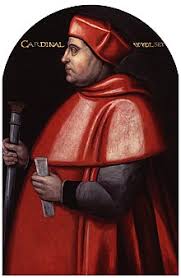
Thomas Wolsey c.1520. NPG32

On 6 February 1530, Cardinal Thomas Wolsey was looking to have his various vague charges of praemunire, and potential treason dropped by the king, after a blisteringly harsh parliament tried to have him convicted, the penalty being execution. Only Thomas Cromwell had spoken out in Wolsey’s defence, which had softened King Henry’s stance, and several others had tried to speak in Cromwell’s name to the king’s praising him and his courage, most notably Sir John Russell and Sir John Gage. Wolsey wrote many begging, pleading, woeful letters to Cromwell though the final months of 1529 and early 1530, begging for help and money, even though Cromwell visited Esher Place regularly, and paid wages and for supplies for the household.

On 6 February 1530, the king was close to caving and forgiving Wolsey for not securing an annulment, and several had gently tried to persuade the king to relent, catching Anne Boleyn’s anger in the process. Two letters from Wolsey survive, both attributed 6 February 1530, begging Cromwell to help him, as Cromwell had not recently visited Esher, due to the death of his wife Elizabeth. Wolsey was more concerned with himself than Cromwell’s retreat to Austin Friars in pain. Here is a portion of both letters, taken from my book of Cromwell letters, with my modern spelling and punctuation. Italics are all mine.

THOMAS WOLSEY TO THOMAS CROMWELL 6 FEBRUARY (Cott. App. XLVIII. 19)

“Mine only comfort, at the reverence of God leave me not now, for if you do I shall not long live in this wretched world. You will not believe how I am altered, for that I have heard nothing from you of your proceedings and expeditions in my matters… I hope you will not allow all your former labours to me to be cast away. I beg you to redub (restore) the matter, continue your accustomable goodness and sent me some comfort… Written this morning with a moste heavy heart, by your assured, Thomas Cromwell, we are miserable and unfortunate.”

  • This second letter is very mutilated and difficult to decipher. Wolsey tries to instruct Cromwell to speak to Secretary Stephen Gardiner and Treasurer William Fitzwilliam, and asks that Henry Norris and John Russell speak to the king on Wolsey’s behalf. He also requests John Arundell to travel to Esher and that Henry Percy was lying to the king about Wolsey. There was also a charge that Wolsey had coins minted with his face rather than the king’s which raised questions of further treason. It was Cromwell you spoke to the king on Wolsey’s behalf that following week, and got Wolsey’s charges all dropped.

THOMAS WOLSEY TO THOAMS CROMWELL 6 FEBRUARY 1530 (Cott. App. XLVIII. 18)

“Mine own good, trusty, and most assured refuge in this, my calamity. I am so encumbered with heaviness and anxiety that I cannot remember everything, but I trust to you to supply what we lack…  that you may be plain to Mr. Treasurer (Fitzwilliam), and specially Mr Steven (Gardiner), who, upon consideration thereof, may be the (person?) with the king in allotting and appointing of my pardon if he listen. No man can do me more good and you … yourself refer that his opinion was that I should have no less then 4,000l (£1.8 million today) yearly to live with, which mine… degree considered is with the lest, I could not forbear putting you in remembrance hereof, remitting the bettering thereof to your wisdom and good handling; and as touching the coin (where Wolsey had his face minted on a series of coins in 1526, which was seen as treason) with the letters and badge in the same, you may for your better knowledge refer to Robert Amadas and other officers (of the mint )… learned how the usage has been (done in this way for centuries)… I would gladly have (lawyer and attendant John) Arundell (here)… (Henry Percy, Earl of) Northumberland’s untrue and wrong information … meant mean betwixt him (and I?) … Mr. Norris, Sir John Russell … my good and ever be greatly to my comfort.”

Wolf Hall 2: The Mirror and the Light – Thomas Cromwell Quick Q+A

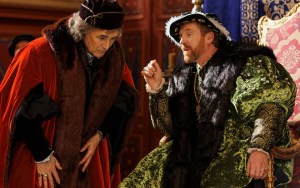
BBC/Nick Briggs

Welcome to part 4 of Wolf Hall 2: The Mirror and the Light facts about moments seen in Thomas Cromwell’s life at court. Today is a quick round-up of questions asked that don’t require a whole post of explanation on their own. So let’s start –

Wolf Hall is Jane Seymour’s home. What is The Mirror and the Light?

On 28 November 1538, Cromwell wrote a letter to Sir Thomas Wyatt (Harl. MSS. 282, f. 217), who was King Henry’s ambassador to Holy Roman Emperor Charles V, and travelling Europe with the Emperor’s court. Wyatt was not a good ambassador, and relations between the countries were started to deteriorate. Cromwell updated Wyatt on Henry Courtenay, Marquess of Exeter and Henry Pole, Lord Montagu, the Catholics traitors,  and asked Wyatt to get the Emperor  to intervene on several subjects were making trouble for London merchants. In the letter, Cromwell wrote of King Henry exercising his right as the supreme head of the church by burning Sacramentarian John Lambert a week earlier:

‘…undoubtedly [Emperor Charles] should have much marvelled at [King Henry’s] most high wisdom and judgement, and reputed him none otherwise, after the same, than in manner of the mirror and light of all other kings and princes in Christendom.’

King Henry is the mirror, and everyone and everything should reflect his brilliance. Henry is the shining light of princely splendour all should look up to. Being out of Henry’s light/favour is like being in the darkness. The letter is extremely flattering of Henry, since it would be read and repeated at the Emperor’s court, and could reveal nothing of reality, only a glowing picture of praise and perfection.

Was Thomas Cromwell the Lord Chancellor of England?

NO. Thomas Cromwell was never the Lord Chancellor. Thomas Wolsey was Lord Chancellor, followed by Thomas More, and then Thomas Audley. Cromwell assumed the role without title between more’s resignation in May 1532, and Audley’s appointment in January 1533, and was not always in a good mood about the position or workload. Audley was a puppet; he would do anything the king wanted, and he was easily intimidated, so Cromwell could yell at Audley whenever he made an error  and Audley would beg and grovel for forgiveness (Audley complained a lot, especially about his yearly salary of 800l or £350,000 today, plus bonuses. Cromwell always told him to shut it because it annoyed the king). Audley and his protégé Richard Rich really ran with Henry’s plan to dissolve monasteries when Cromwell didn’t want to move forward, but other than that, Cromwell had total control and authority over all matters. Audley never intervened in Cromwell’s business, despite technically being higher ranked until 1536. (Lord Chancellor was ranked second in the realm after the archbishops. In 1536, Cromwell became the Vicegerent of England, the new number one in order of precedence, putting Lord Chancellor down to third).

Thomas Cromwell was, in 1539, Lord Cromwell, Baron of Wimbledon the Vicegerent of England, Lord Privy Seal, Vicar-general of England, Knight of the Most Noble Order of the Garter, Principal Secretary, Chancellor of the Exchequer, the first-ever layman Dean of Wells, and Commissioner for the Peace in seven counties, Chancellor and High Steward of Cambridge University, Master of the Jewel House, Clerk of the Hanaper, and Steward of the Duchy of Lancaster, Essex, Hertfordshire and Middlesex, the Receiver of Petitions in the House of Lords, highest ranked man in the House of Lords, Warden and Chief Justice in Eyre, Prebendary of Salisbury, Steward of Westminster Abbey and Savoy Manor, Constable of Hertford Castle, Berkeley Castle and Gloucestershire Castle, Recorder of Bristol, Commissioner for the Subsidy to print the Bible, Lordship of Edmonton, Sainsbury, Hovering and Writtle, and  master of every single powerful man in the country of Ireland. By 1540, Cromwell was also the Earl of Essex and Lord Great Chamberlain. At that point that was basically nothing left for Cromwell to control, other than being the Lord Treasurer, but Norfolk held that role and seemed to live forever.

Sometimes people write Cromwell as Lord Chancellor because it is easier to understand in modern terms. Cromwell was the only person to ever be England’s Vicegerent, and no one person will ever receive that much power again.

Did Cromwell feel guilt over Anne Boleyn?

Certainly not that he ever mentioned where it would be recorded. It would have been insanity to have expressed guilt or sympathy. Archbishop Cranmer wrote to King Henry to make sure he didn’t go down with her, and so the Reformation would be safe without Anne on the throne. Cranmer was frozen out by the king for a while for this, and had his prime lands and manors confiscated, and given to Cromwell after Anne’s death. Mortlake Manor was the traditional home of the Archbishop of Canterbury since its construction 500 years earlier, and Crowmell relatives had worked there as servants. Cromwell then owned the property and made it grander than ever.

Cromwell did say to Ambassador Eustace Chapuys that Anne Boleyn handled herself well through her trial. Everyone knew she was innocent, but no one was stupid enough to say anything. I cover the whole period about Anne’s death in my book on the subject.

Did King Henry actually say he could make Cromwell the king after himself if he wanted at the Privy Council meeting?

No, that was just an imagined scene of the king flexing his power over all the nobles. Likewise, Cromwell and Fitzwilliam never came to blows like that at a meeting. It is another piece of fiction laid out to be reflected in later episodes. I will do a separate post about Cromwell and Fitzwilliam, as their relationship was very interesting.

BBC/Playground Entertainment/Nick Briggs

Did Cromwell spend time with Dorothea Wolsey?

There is no evidence of this; ‘Dorothea’ is a just a plot-point for Cromwell’s guilt. There are letters between Cardinal Wolsey’s three children and Cromwell. Most of the letters come from Thomas Wynter, Wolsey’s eldest son, born 1510 to Joan Larke, was always travelling in Europe, and always looking for money. Cromwell was one of Wynter’s financial babysitters, and felt sorry for Wynter after his father’s death. There are extensive papers showing Wolsey’s favour towards Wynter, and Cromwell got him set up in a comfortable life in the North in the 1530s, and he later became the Dean of Wells.

Dorothy was born in 1513, her mother also Joan Larke. Her surname was Clancey, the name of her adoptive family in Dorset. She was placed in Shaftesbury Abbey for her education and upbringing where many nobles sent their daughters, and just fell under Cromwell’s ban of no one being allowed to take holy orders from age 24 or younger in 1535. Cromwell soon changed the laws, so no one under 20 could enter the church, and Dorothy could technically  become a nun. The rich and well-appointed Shaftesbury Abbey was closed in 1539, and Dorothy Clancey was given a pension. She was never heard from again, and she certainly never met Thomas Cromwell.

Wolsey’s third child was Thomas Minterne (though his mother is uncertain), born in about 1516. Minterne grew up in Sherborne, ten miles from his sister Dorothy. Wolsey sent Minterne to New Oxford College and Cromwell ensured he was made a fellow at only 17 years old in 1533. Cromwell then sent Minterne to study in Europe in 1538, and when he returned to England broke in 1542, King Henry gave Minterne a cozy job at Salisbury Cathedral, which he kept for the next 20 years or so.

(Joan Larke married George Legh and had another four children, and then married Sir George Paulet in 1530, but died giving birth two years later, though her son William survived. Joan must have been quite young when having Wolsey’s children, maximum no more than 20 years old. Joan’s baby William Paulet was cousin of John Paulet, 2nd Marquess of Winchester, who married Elizabeth Cromwell, widow of Gregory Cromwell. These people really never moved around much).

All sources come from The Private Life of Thomas Cromwell and The Letters and Remembrances of Thomas Cromwell. My publisher might come for you if you plagiarise.

FRAILTY OF HUMAN AFFAIRS: Author Q+A – Part 1

How much do you know about Tudor England? Maybe you are an expert; maybe you are new and know no more than Henry VIII and his desire to crop heads (roughly 72,000). Maybe you know Thomas Cromwell was the real genius behind Henry’s reign and changed laws in a way no country has ever known. Maybe you have heard his name a few times, maybe watched Wolf Hall, or get him mixed up with the genocidal Oliver Cromwell of the 1600’s.

Frailty of Human Affairs is set in the years 1529 – 1533, the early years of Cromwell’s rise to control England behind Henry VIII. He was already a wealthy merchant, trader, lawyer and money-lender. He had already served both the royal court for his master,Cardinal Wolsey, and in parliament. But it was 1530’s in which Thomas Cromwell basically picked up England and shook it, changing everything that everyone knew in a way that had never been done, and was never done again. If you are English or in a country invaded and dominated by the English (like here in the antipodes), you can thank Thomas Cromwell that you are not Catholic (unless you want to be, which is your choice now, you do you). Yes, Catholic vs. Protestant reform would have come to England with or without Cromwell’s help, but how it played out would have been very different.

Do you need to understand the difference between Catholic vs. Protestant to read this book?

I have kept it simple because unless you have done religious studies (like me), it can seen as daunting. It did to me at the start. Basically, Catholics pray in church to their priests, bishops archbishops and cardinals. All bow to the Pope in Rome. In Cromwell’s time, prayer had to be done in Latin. The Protestants (literally religious protestors, mostly in Germany) translated the bible from Latin to German and then English, and the translations came out with different rules on how to revere God. These bibles were banned in Cromwell’s time, as they questioned the Church’s real power. These English and German bibles allowed people to understand prayer easier, let them pray where and when they chose, and didn’t expect people to pray a premium in church for their souls to be saved. That’s the over-simplified version, but it’s all you need to start reading.

Why read your Cromwell over another version?

Thomas Cromwell sat in obscurity until around the 1950’s when he was brought back into public knowledge, as the villain behind King Henry VIII and the destruction of Catholic England. In the last decade, much has been written to reinvent Thomas Cromwell as a hero, a smart man who was caught under a despot king. I seek to write neither a hero nor a villain. In a world such as the Tudor court during the 1530’s, every man and woman would have needed to take sides – hero or villain – but I wanted to show that people can be both and neither. Neither Cromwell nor Frescobaldi are in any way perfect, and have intentions of their own as well as serving a king.

Who is Nicóla Frescobaldi in all this?

While Francesco Frescobaldi was the man who found a starving English teenager (Thomas Cromwell) on the streets of Florence, nothing is known about his immediate family. All characters focused around Frescobaldi are purely fictional, including Nicóla and Nicóletta.

Who is Machiavelli?

Niccoló Machiavelli was an Italian writer and diplomat in Florence until his death in 1527. He was at odds with the reigning Medici family, but wrote many books which have been him eternal. ‘The Prince” is his top book, basically the creation of modern political science. Seriously, grab a copy.

Much has been made of who ‘The Prince’ of Niccoló Machiavelli’s book really was. While dedicated to Lorenzo Di Piero De Medici, the book is said to be sometimes based on Cesare Borgia, the infamous son of Pope Alexander VI. The book,  published in handwritten form in 1513, was first published on a printing press in 1532, when Pope Clement VII agreed to its release. Thomas Cromwell and the Protestants were known as fans of the Machiavelli book, though Catholic kings such as Charles V, and French Queens such as Catherine de’ Medici, also endorsed the writing. Who inspired much of the book may in fact be a wide number of people, but Thomas Cromwell and his incredible mind lived in Florence from around 1503 until 1513. Very little is known around this period of his life. Is Cromwell the prince? Frescobaldi believes so.

What is the point of Cromwell’s changes to England?

Henry VIII needs rid of his first wife, who served England for twice as long as his other five wives combined.

Click here to read more on the “Great Matter”

In 1509, King Henry VIII was crowned alongside his new bride, Princess Katherine of Aragon. Katherine had married Henry’s brother, Prince Arthur, in 1501, only for him to die months later. After receiving dispensation from the Pope, the couple married and were crowned in a dual coronation, and would go on to have one daughter and lose another five children at birth.

After having affairs with several well-known mistresses, King Henry set his sights on Anne Boleyn, lady-in-waiting to Queen Katherine, sometime in 1525. By 1527, Henry set his chief advisor, Cardinal Thomas Wolsey, Lord Chancellor of England, to the task of procuring an annulment of his marriage to Katherine, on the grounds that a man could not marry his brother’s widow.

After several failed attempts to persuade Pope Clement VII to agree to an annulment, a decision was made – an ecclesiastic legatine court was to be set up in London. Two cardinals, Cardinal Wolsey and Cardinal Lorenzo Campeggio, a chief confidant of the Pope, would stand in as papal legates (the Pope’s representatives), and through a hearing, decide on whether Henry and Katherine’s marriage was ever lawful in the eyes of God.

The people of England loved Queen Katherine; she had ruled for twenty years, a kind, pious and beautiful Catholic queen all could respect. But Katherine was too old to give Henry what he needed – a son to inherit the English throne. Anne Boleyn was still in her twenties – pretty, sophisticated, intelligent, and young enough to give birth to a male heir.

After being in love with Anne Boleyn for four years, King Henry had become bitter towards his Queen, and also his sixteen-year-old daughter, Princess Mary, whom he considered too unnatural to inherit the throne, as she was female. Anne Boleyn was a mistress who would not share Henry’s bed, and a combination of frustration, longing, and arrogance built in the 38-year-old ruler. Cardinal Wolsey, at Henry’s side for twenty years, and credited with countless successes at home and abroad, and the wealthiest man in England, could not give the King what he wanted, an annulment from Katherine. With the witty Anne Boleyn and her family taking Wolsey’s place at Henry’s side, and the Protestant reformers beginning to eat into England’s Catholic soul, the King could be easily swayed in any direction.

Enter Thomas Cromwell – lawyer and advisor to Thomas Wolsey, a commoner with a smart mind and vivid history throughout Europe, educated in England and Italy, who had ideas on how to create an annulment, and destroy Pope Clement’s power in the process.

By 1529, no one, noble or common, knew what would happen in their realm, and with the anger of the Holy Roman Emperor also weighing upon the annulment issue – the King’s ‘Great Matter” – the threat of war was real, all to gain a male heir for the kingdom. King Henry needed a new queen, and Katherine would never give up her crown.

Why so many characters?

They, with the exception of the Frescobaldi children, Nicóla and Nicóletta, all the characters are real people who served or opposed Henry VIII. There are a lot and they all played a role. There were many more who I have chosen not to showcase, and more will be added in the next books.

England’s royal inner circle by 1529

King Henry VIII

All-powerful, well-educated and athletic ruler of England for twenty years. Aged only 38 years old, a religious, volatile, arrogant man. Father of one legitimate heir, Princess Mary, and a bastard son, Henry Fitzroy, Duke of Richmond and Somerset

Click here for more on Henry VIII

 Queen Katherine

Catholic Spanish princess married to Henry for twenty years – pious, respectable, intelligent, and mother to the only legitimate royal heir, Mary, Princess of Wales

Click here for more on Katherine

Anne Boleyn

High-educated former lady in-waiting to Queen Katherine, daughter to successful courtier Thomas Boleyn

Charles Brandon

Duke of Suffolk, and Henry’s best friend. Married to Henry’s sister Mary, Dowager Queen of France. Member of the Privy Council (advisors to the King on state matters) and the King’s Council (the King’s private advisors)

Thomas Howard

Duke of Norfolk, uncle to Anne Boleyn, close courtier to Henry. Member of the Privy Council and King’s Council

Thomas Boleyn

Lord Rochford and Lord Privy Seal (leader of the Privy Council) and member of the King’s Council. Father to Anne Boleyn, along with popular courtier George Boleyn and the beautiful Mary Boleyn, King Henry’s former mistress

Advisors and courtiers to King Henry

Cardinal Thomas Wolsey

Common-born man risen through the church to become advisor to King Henry, elevated to Cardinal by the Catholic Church, and Lord Chancellor of England, the nation’s most powerful ministerial role

Click here for more on Thomas Wolsey

Thomas Cromwell

Advisor and lawyer to Thomas Wolsey. Member of parliament, wealthy merchant and money-lender. Former soldier, Italian trader and banker and English-trained scholar

Click here for more on Cromwell

Sir Thomas More

Chancellor of the Duchy of Lancaster, respected humanist, author and Catholic theologian. Loyal advisor to King Henry and champion of Dutch writer Erasmus

Thomas Cranmer

Highly educated theologian, humanist and ordained priest, and supporter of Martin Luther. Diplomat to both Spanish court and Holy Roman Emperor on King Henry’s behalf

Archdeacon Stephen Gardiner

Trained in canon (religious) and civil law, and master secretary to Cardinal Wolsey. Well-travelled diplomat, Master of Trinity Hall and expert at Cambridge University

William Warham

Archbishop of Canterbury and leader of the Convocation of Canterbury (religious parliament). Bound to Pope Clement and the Catholic faith

Eustace Chapuys

Imperial Ambassador to England and champion of the cause of Queen Katherine on Charles V’s behalf

Powerful Italian figures in 1529

Pope Clement VII

Pope of Rome and leader of the Catholic faith since 1523. Member of the powerful Florentine Medici dynasty. Imprisoned during the sacking of Rome by Charles V’s soldiers in 1527

Cardinal Lorenzo Campeggio

Powerful and well-travelled cardinal, left in charge of Rome during the Pope’s absences, and Cardinal Legate of England. Representative of Pope Clement abroad

Charles V of Spain

King of Spain, Holy Roman Emperor, King of Italy, King of the Romans, Lord of the Netherlands and Duke of Burgundy, ruler of the German and Austrian states controlled by the Roman Empire. Nephew of Queen Katherine of England

The Medici dynasty

Multi-generational family in control of the Republic of Florence. One of the wealthiest families in Europe, creator of two Popes, including Clement. Ousted from Florence in 1527 during a siege, only to be reinstated with full control and wealth

Nicóla Frescobaldi

Effeminate bastard son to the late Francesco Frescobaldi, a wealthy Florentine merchant and banker. Reclusive favourite courtier of Pope Clement, highly educated man of business and theology

Nicóletta Frescobaldi

Only living daughter of Francesco Frescobaldi. Pre-contracted in marriage to Alessandro de’ Medici

Well known figures in Europe in 1529

Erasmus of Rotterdam

Dutch Renaissance humanist, Catholic priest, social critic, teacher, and theologian. Creator of the Latin New Testament bible based on Greek texts

William Tyndale

Creator of the English language bible, translated from Greek and Hebrew texts. Supporter of Protestant reform. In exile from England and against Henry’s annulment

Martin Luther

German theologian, excommunicated priest and creator of the Protestant Reformation and the German language bible

Niccoló Machiavelli

Recently deceased Florentine diplomat, politician, historian, philosopher, humanist, and writer. Creator of political science

King Francis I of France

Popular young King of France. Well-educated writer and patron to Leonardo da Vinci. Signed the peace treaty at the Field of Cloth of Gold with England

Alessandro de’ Medici

The last senior member of the original Medici generation, illegitimate son of Pope Clement, set to rule Florence. His ‘sister’, Catherine de’ Medici, is set to become a French princess

Stephen Vaughan

English merchant, royal agent and diplomat, and strong supporter of the Protestant Reformation

Popular English courtiers in 1529

Ralph Sadler

Ward and master secretary to Thomas Cromwell

Richard (Williams) Cromwell

Nephew and attendant to Thomas Cromwell

George Cavendish

Writer and faithful attendant to Thomas Wolsey

Edmund Bonner

Faithful friend and chaplain to Thomas Wolsey

Sir Thomas Audley

Barrister and Speaker in the House of Commons

Richard Rich

Popular lawyer and member of parliament

Thomas Wriothesley

Lawyer serving Thomas Cromwell and Stephen Gardiner, clerk of the royal court

Sir Henry Norris                        

Sir Francis Weston

Sir William Brereton                                 

Sir Francis Bryan

Members of the privy chamber of  King Henry

Mark Smeaton

Talented young English composer and musician

Sir Thomas Wyatt

Diplomat, politician, poet, loved friend of Anne Boleyn

Hans Holbein the Younger

Popular German artist, given royal favour for his extraordinary portrait talents

What else do I need to know?

Check out the author Q+A Part 2 on the book for more, or click here to read the first chapter free right now.