Women of the Spanish Civil War: Part 1 – Lucía Sánchez Saornil

cntLucía Sánchez Saornil was born in Madrid on 13 December 1895, and raised in poverty by her father. Sánchez got accepted into the Royal Academy of Fine Arts of San Fernando (Madrid) with her passion for poetry, and by 1919 she had already been published in multiple journals, where she used a pen name. As a man, she was able to write of lesbian themes; at that time, all gay relationships (and anything related) was subject to censorship and prison time, all still illegal in Spain. This lead to Sánchez having to keep her private life very private for her safety. However, she wrote alongside many modern new authors, dedicated to promoting new literary styles, but only as a man.

1933Sánchez worked for the as a phone operator at Telefónica, and in 1931, participated in the union strike arranged by the CNT (anarchist workers union), and ignited her passion for activism. In 1933, Sánchez gained a role with the CNT in Madrid, as their Writing Secretary, and edited their own journal, right until the start of the Spanish Civil War in 1936. Her writing quickly established her as a feminist and addressed the urgent need for better equality in Spain. At that time, gender roles were extremely strict and went unquestioned. Sánchez wrote of how motherhood should not have to define a woman and that women deserved far better treatment. The anarchist movement praised equal rights, but it seemed as all talk and no action, with men who claimed to be anarchists still sexist in the home. Women still were forced into marriage and single women required a chaperone in public. Women still received half the income of men. The working class women were not receiving any benefits promised by the Second Spanish Republic.

In 1935, Sánchez decided to form the Mujeres Libres (Free Women), along with Mercedes Comaposada, a socialist lawyer in Madrid. They argued that social revolution and women’s revolution were the same thing; that women’s issues were everyone’s issues. They started their magazine, and were soon joined by Amparo Poch y Gascon, a doctor who believed in sexual freedom and the abolishment of double standards for women. The women felt that their contribution to the CNT was not being treated equally, and that sexism was rampant. At same time, Soledad Estorach in Barcelona started the Grupo Cultural Feminino, a group committed to equality in unions. In 1936, the groups came together and formed the Agrupacion Mujeres Libres, a group which would grow to 30,000 members.
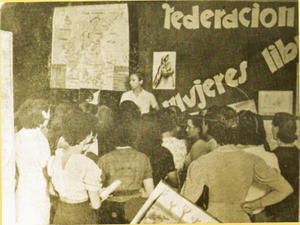
The anarchists believed that women’s equality would be naturally created after the social revolution, when the working classes received better rights. However, the Mujeres Libres believed women’s rights could begin right away, and they created networks of support and reported on sexist issues within their unions. By the start of the Spanish Civil War in 1936, coinciding with the Spanish revolution, Mujeres Libres were already formed and prepared, so that women could participate in war fully, both in the revolution and as militia in battle. Sánchez and her team spread propaganda, radio news, and travelled to rural women to give them support.

In order for women to be free as the Spanish Civil War and revolution progressed, the Mujeres Libres organised schools, women’s only social occasions and a women-only newspaper, so women could feel safe and confident as their political consciousness was educated. Many working class women could not read or write, so Mujeres Libres set up classes for these women to attend, and women were trained as nurses for the ever-increasing wounded from the front. At the same time, they were taught about sexual health and post-natal care, to pass on to as many women as possible. Much had been denied to working class women in the past, and they finally started to receive basic help.
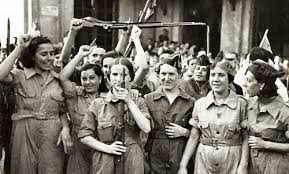
Mujeres Libres did not become part of the CNT or FAI, as they wished to be an independent anarchist group. As men left to fight at the front (along with many women, who are largely forgotten by history), the Mujeres Libres had women work-ready to fill men’s roles. While still stuck in female roles like cooking for the militia and nursing the wounded, women were also being training in shooting by Mujeres Libres. Also formed was daycare for children as women empowered themselves, and the children were educated in the causes their mothers fought to achieve. Mothers, in turn, received information on child care and development, for the better of the whole family. They also published their first Mujeres Libres magazine as the war broke out, being printed until the front reached Barcelona.
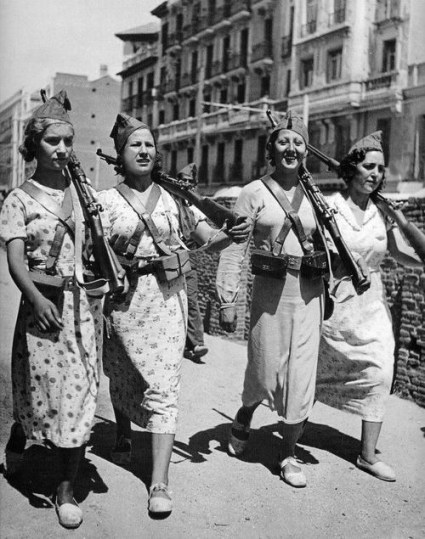
Mujures Libres had much opposition, as feminism does today, believing women cannot be a good mother and a good working woman. Their roles would always be limited to parenting. Many believed that anarchism could not work if women soughtto undermine men, even though one of their aim goals was an egalitarian society with freedom for all. As Mujeres Libres flourished, so did the man tears, who got scared and voiced opposition. To this day, no one has figured out why men are so scared of women.

The revolution broke down ten months after the outbreak of war, and the ability of the Mujeres Libres faltered. The inability to work together got the better of the left-wing factions, and the strength of the Nationalists slowly ate away at freedoms gained for the working class. Fighting and killing became the only activity in all parts of Spain.

Sánchez fled to Valencia and worked as a journal editor for Threshold, and met the love of her life, America Barroso. Sánchez became a member of the SIA (international antifascist union) and worked as their General Secretary, who supplied anarchist aid to the wounded and fleeing during the war. Sánchez and Barroso were forced to flee to France in 1939 as anarchists, but were forced out of there by Nazis in 1941. Sánchez did not have the luxury of anonymity and had to live quietly in Valencia, living with her ‘wife’s’ family, as all same-sex relationships were illegal, and fascism and Catholicism were raining down. Sánchez worked as an editor and Barroso worked at the Argentine consulate, until Sánchez died of cancer in 1960, aged 75.

Sánchez was buried quietly in Valencia with a headstone which reads –

¿Pero es verdad que la esperanza ha muerto? But is it true that hope has died?

~~

This is not a detailed analysis, just a highlight of the Sánchez’s life. Things get lost in translation – Feel free to suggest an addition/clarification/correction below. The more the world remembers, the better. All photos are linked to source for credit

This Week in Spanish Civil War History – Week 29: 29 January – 5 February 1937

February 2

Preparations for the Battle of Jarama, east of Madrid, are complete. The aim is to cross the Jarama river and cut off communications between Madrid and the temporary capital, Valencia, to the east. The Nationalists have 15,000 men ready, along with support of the German Condor Legion, along with tanks and machine guns. The Republicans have 30,000 men including international volunteers and are spread out ready to hold steady.

February 3

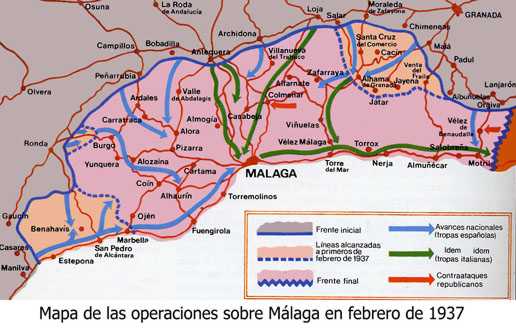
The Army of the South decides it is time to attack the city of Málaga from the west, starting from the already fallen town of Ronda. The Nationalists have 15,000 troops, and the accompanying Italian Blackshirts have another 10,000 men and plenty of supplies. The Republicans holding Málaga have around 12,000 men, only 8,000 armed. None have been trained in battle.

517px-batalla_de_malaga-svg

February 4

The Málaga Republicans are not ready to take on the Italians, who are prepared for armoured warfare, and have tanks ready while the Republicans do not even have enough bullets for their guns. The Italians make a huge gain in territory in one day and many Republicans are killed around the outskirts of the city.

February 5

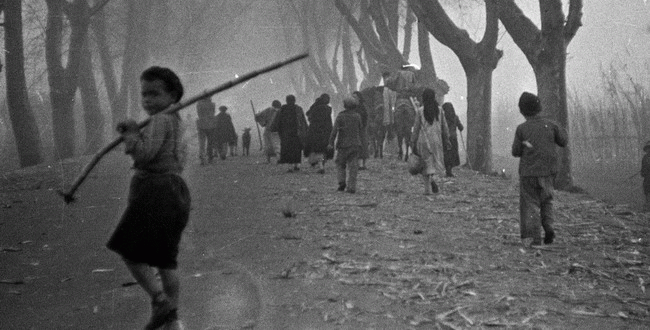
The Republicans have 600 right-wing hostages kept on a ship at the port, and many are killed in revenge for air raids which are unleashed on the city. Republicans have no air defense or planes of their own. No roadblocks have been set up and no trenches have been dug. The CNT and the Communists have been running the area, but have difficulty working together. Colonel Villalba who runs the Republicans, has no ammunition to hand out and no guns to place in strategic locations for defense.  Over the days of fighting, 4,000 innocents will be killed in Málaga. There is no way Málaga can hold off the Nationalists and people prepare to flee, in what shall soon be known as the Málaga-Almería road massacre, where between 3,000-5,000 will die.

NB: A special post on the massacres of Málaga will be posted on February 7.

February 5

The Nationalist offensive begin on the west bank of the Jarama river, catching the Republicans by surprise after heavy rain. The Nationalists have highly trained men who advance with whole brigades in columns, meaning the Republicans simply overwhelmed. While the Nationalists have a good first day, they did not gain the total control as planned, and thus begins the now-infamous battle lasting three bloody weeks. (All daily events will be posted from next week)

~~

This is not a detailed analysis, just a highlight (lowlight?) of the week’s events. Things get lost in translation – Feel free to suggest an addition/clarification/correction below. The more the world remembers, the better. All photos are linked to source for credit.

JANUARY SPAIN BOOK REVIEW: ‘Boadilla’ by Esmond Romilly

In 1936 Esmond Romilly, nephew of Great Britain’s ‘War Chancellor’ Winston Churchill and outspoken pacifist, went to fight with the International Brigades for the democratically elected Spanish government against the insurgent fascist general Francisco Franco. This is the unheroic, unsentimental account he wrote immediately after the fighting, fresh and personal like no other, spiced with dry English humor.

There have been other records of the part played by the British members of the International Brigade at the siege of Madrid. But Mr. Romilly’s is the most full. He is one of the two survivors of the original ten British volunteers attached to the Thaelmann Battalion in the early days of the war. So his book has its place in the annals of the contemporary struggle for liberty. He writes easily and simply. There are occasional breaths of Hemingway, but in the later chapters especially he displays a detached casualness—unusual in so young a writer (Mr. Romilly is nineteen)—that is genuinely dramatic and moving. Without heroics he conveys the feelings of those untrained enthusiasts (the author’s military experience was confined to refusing to join his school O.T.C.) suddenly plunged into a battle fought apparently at random. Caught between a cross-fire, the little group was almost wiped out. Their bodies were never found.

cover art and blurb via amazon and spectator

~~

As mentioned a few weeks in ago in This Week in Spanish Civil War History – Week 25: 1 -7 January 1937, the battles for Corunna Road and the fight to take the town of Boadilla del Monte, just outside Madrid, were chronicled by 19-year-old English volunteer Esmond Romilly.

The book starts off by promising to account the battle of Boadilla in a straight-forward fashion, as that it does. It tells a very simple story of what happened, all written while fresh in the author’s mind in 1937, as he holidays on honeymoon in France. Romilly came from a rich family, married in another rich family, but for a few months in late 1936 and early 1937, he fought to make ‘Madrid the grave of fascism.’ He had little stamina for the war, but he was an excellent example of unprepared men thrown into a poorly planned battle, so typical of volunteers in Spain.

The book starts with a background of all the main characters that Romilly met on the trip – Joe Gough, Harry Audley, Aussie Whateley, Jerry Fontana, Lorimer Birch, Arnold Jeans, Bill Scott, Tom Mann and Martin Messer. It seems in this short time, Romilly got to know these men very well. After the battle to claim Boadilla, he would go home alone.

The early chapters show him working to get by in France as he makes his way south, arriving in Spain by ship at Valencia. The Albacete training bases had been set up by this time. Romilly describes this as playing at soldiers. He had no idea how to use a rifle, couldn’t speak any Spanish and was constantly suffering dysentery. He met many Germans, Latvians and French men, as well as his fellow Englishmen, and the story tells of the usual difficulties marching with supplies and being hot, of the whole thing having a ‘field day’ atmosphere while away from the front. Romilly has given some people assumed names, most those who were German or went to Germany after the war (it was illegal for Germans to aid the Republicans. Those returning home were jailed).

One thing that stood out was Romilly being told by French communist André Marty that the Republicans needed three things to win the war – political unity, military leaders with experience, and discipline. They had none of these.

Romilly uses assumed names for the towns of his initial battles. Battle starts in chapter 5 when out of nowhere, Romilly finds himself under fire, his first reality in the civil war just south of Madrid. As soon as they hit the front at ‘Noreno’, Romilly gets lost under darkness, and ends up walking miles the wrong way, meeting up with others, and eventually making their way to ‘Melilla’ (thought to be Villaconejos. No one know why Romilly changed the town names). Though as dawn air raids strike, the men are lucky to have gotten lost and in the wrong town.

Romilly seems to run around, never really having a clue what is going on, where they are heading or what to do. Dysentery is the one thing everyone shares, and the bitter cold of being up on the plain around Madrid really hits home, with only those prepped by anarchists in Barcelona are ready for it, as the rest of the Thaelmann Battalion have to struggle on.

The battalion team up with the Garibaldi battalion and thrown into fighting in University City on the northern tip of Madrid. Romilly recalls seeing Moorish soldiers shooting into trenches were his comrades were, their bayonets slashing at those trapped but not killed. He details his time fighting in University City very well, saying the night smelled night ‘dead men, crackling flames and drizzle’.

Romilly soon is in Madrid at the Ritz, swirling brandy and bathing again. He gets eight days’ training in the town (now suburb) of Fuencarral north of Madrid, before heading back to Majadahonda, a village (now suburb) west of Madrid. Now the battles for Corunna Road and the surrounding towns are all on, and Romilly is sent to hold the tiny town of Boadilla. Under the air raids and against the well-prepped Nationalists, the whole battle falls into total chaos, of watching close friends die and running away in blind panic. One by one, as they retreat, Romilly’s friends are killed, not by the Moorish soldiers that anticipated, but by uniformed Spaniards.

Romilly is one of only a couple who survived Boadilla. He speaks of meeting English poet John Cornford along the way, another young Englishman, with his head bandaged. Cornford never made it out alive either. The few remaining living foreigners (just over a dozen volunteers from a combined Spanish and volunteer group of 15,000 at Corunna Road battles) made it to El Pardo (just outside Madrid) where they came to grips with the brutal losses.

Romilly was diagnosed with neuralgia, damaging nerves causing excessive pain, and was sent home, where he married Jessica Mitford, and then wrote the fresh accounts of the men left in the mud at Boadilla. Romilly went on to fight in WWII but died in 1941.

This Week in Spanish Civil War History – Week 27: 15 – 22 January 1937

January 15

The third battle of Corunna Road ceases. The Nationalists have convincingly won the first and second waves of battle, and now both sides are exhausted. The XII International Brigades do not have the men or supplies to take back any of the northwest Madrid areas, and the Nationalists can’t get any further with their numbers. Both sides are now exhausted and give up in their plans. The Corunna Road route is still technically open and supplies still have a chance of getting through to Madrid, though now the city will have to rely more on the roads coming from Valencia and Aragon in the east/northeast.

Routes of soldiers prior to the battle: Spanish/Moroccans blue, Italians green, Republicans resistance red

January 17

The Nationalists form a plan to take Malaga on the southern coast. The huge losses at the Battle of Corunna Road have made the Nationalists keen to redirect their offensive, and decide to focus away from Madrid. The Nationalists have had 10,000 fresh troops arrive from Italy to the port of Cádiz, and are sent towards Malaga with their light tanks and armoured cars. Columns of Moroccan troops mixed with Spanish Carlists troops, around 15,000 men,  are sent from Seville and Granada. The Nationalists have four cruisers, the  Canarias, Baleares and Velasco ready to bomb Malaga from the sea, and the German Admiral Graf Spee is brought into the area.

The troops form the new Army of the South, run by Captain Queipo de Llano, who brings in men from the west while Antonio Muñoz Jiménez brings in men from the northeast. The Republicans hold a stretch of coastline around 25 miles long, with the port city of Malaga in the centre. In the first week, the advance of the Nationalist troops is 15 miles into the Republican held area, as the Republicans are poorly armed.

As Nationalist troops march through the Malaga region, the Republicans fail to see the groups of Nationalists are all heading directly for Malaga, so the city is not notified or prepared for the huge coming attack. Malaga is run by around 12,000 anarchist CNT militia, though only 8,000 are armed. There are rumblings between the allied CNT and communist militias, and none of the men in the area have been trained for warfare, though are keen to fight for their home. The Republicans have little ammunition, have no trenches dug, no roadblocks in place and nothing to protect them from the air.

The lack of preparation from the Republicans means the large civilian population of Malaga are now under serious threat, and a massacre is imminent.

Defence at Cerro de los Angeles

January 19

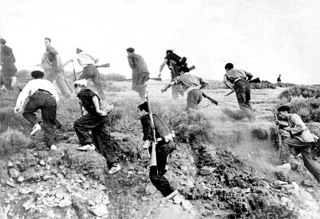
General Enrique Líster based in Madrid is in control of more International Brigades, which are going in numbers and more men are becoming trained, or are now already battle-worn. The Republicans are in short supply of both men and ammunition. General Lister leads a column of International Brigades to try to recapture Cerro de los Angeles, just south Madrid. The Nationalists took the overlooking area of Madrid in November and have been using the hill as an artillery base to shell the city. Lister and his foreign volunteers claim the hill for the Republicans are a day of fighting. Madrid is in need of this respite from constant bombardment.

Republicans atop Cerro de los Angeles, once a religious site


~~

This is not a detailed analysis, just a highlight (lowlight?) of the week’s events. Things get lost in translation – Feel free to suggest an addition/clarification/correction below. The more the world remembers, the better. All photos are linked to source for credit.

This Week in Spanish Civil War History – Week 26: 8 – 15 January 1937

Anarchist supporters in Barcelona

January 8

The Popular Executive Committee of Valencia is dissolved. The Committee is one of eight main groups set up to look after regions (broken into almost smaller 600 collectives) which have been participating in the Spanish Revolution, an anarchist-driven change in way of life for workers of their regions. Aragon was the main driver of this movement, along with neighbouring Catalonia and Valencia regions. Workers unions were collectivised and land is redistributed between workers to create a new, more equal society. At its peak, between five to seven million people were involved in participating in this enormous and ambitious change. Now through three main phases of its operation, the end is coming to much of the programme, which is suffering for a myriad of reasons (this post could go on for months if I get too detailed). The Popular Executive Committee of Valencia, which set laws and rules in the region, is taken over by the Republican government, which can now take control of anarchist popular militias. The militias now have to join the Popular Army and fight officially for the Republicans and fight under the command of professional army officers (anarchist principles are against hierarchy). While the revolution is huge and successful many places, the collapsing of major collectives such as the Popular Executive Committee signals the beginning of the end for the anarchist revolution. (Click on the above or below photos captions to read more about the collectives and revolution)

Examples of anarchist money coupons issues in some collective areas. Other areas did away with money completely

January 9

The second battle for Corunna Road outside Madrid is coming to a close. In one day, the Nationalists take seven miles of the road between Las Rozas and Puerta de Hierro. The Republicans and International Brigades have all been killed, and a handful have managed to flee, leaving the Nationalists to control the critical supply road into Madrid.

The Garabaldi battalion, part of the XII International Brigade

January 10

The XII International Brigades (mostly Spanish volunteers, along with Italian, Franco-Belgian and Albanian volunteers) enter the region from Madrid to start the third Corunna Road battle. The next five days of fighting shall see them fight to recapture the northwest Madrid areas of Majadahonda, Villanueva, Pozuelo and Boadilla, all areas taken during the Corunna Road battles. The heavy fog has dropped on the region again making fighting cold, wet and difficult.

January 11

The Nationalist forces, which have only just finished the battles killing so many Republicans, have lost up to 15,000 men themselves (the same as the Republican side) and take cover in trenches in the under siege Madrid areas, as they are suffering from their casualties and lack of supplies.

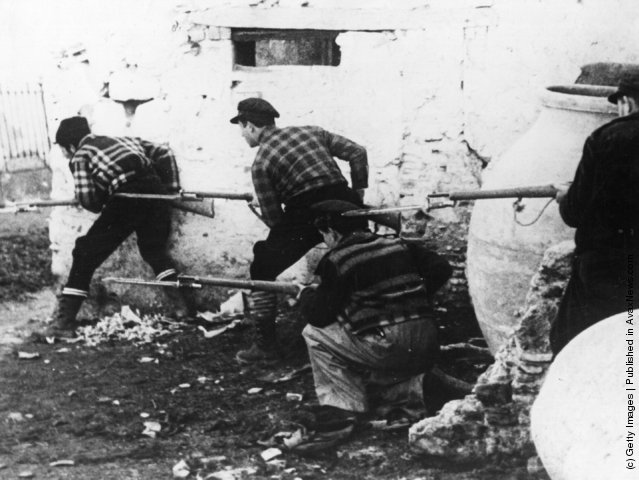
Republican forces lying in ambush in a village near Madrid

January 15

The third battle of Corunna Road ceases. The Nationalists have convincingly won the first and second waves of battle, and now both sides are exhausted. The XII International Brigades do not have the men or supplies to take back any of the northwest Madrid areas, and the Nationalists can’t get any further with their numbers. Both sides are now exhausted and give up in their plans. The Corunna Road route is still technically open and supplies still have a chance of getting through to Madrid, though now the city will have to rely more on the roads coming from Valencia and Aragon in the east/northeast.

~~

This is not a detailed analysis, just a highlight (lowlight?) of the week’s events. Things get lost in translation – Feel free to suggest an addition/clarification/correction below. The more the world remembers, the better. All photos are linked to source for credit.