This Week in Spanish Civil War History – November 1937: The Halfway Point

In a war which lasted almost three full years, November 1937 is the approximate halfway point in the destruction of Spain. Spain was already a deeply divided nation, struggling with multiple inside forces and serious social and economic issues, and while civil war is tragic, Spain had come to a point where it was inevitable. The working class was deeply oppressed and dire need for salvation, which could come from nowhere but within. Franco’s initial coup in July 1936 was thwarted only by the men and women who rose up in haste, without training or preparation, in a  desperate attempt to free themselves and save their country from fascism.

(Before we continue, this is a quick round-up of posts I have done throughout the war, not a detailed breakdown. Ease up on the posts saying I wasn’t specific enough. You have been warned. All links open a new tab so you don’t lose the timeline of the events).

The opening weeks of the war saw Spaniards forced to take sides, to align themselves with the military taking control of their cities and towns, often with the Guardia Civil on their side, or instead arm themselves as best they could and align themselves with the Spanish government, the Republican side, to try to hold off the rebels. Within weeks the battle lines were strong; much of southern Spain was conquered by a marching army of rebels, with massive bloodshed in cities and countryside alike. Madrid, Valencia and Barcelona were firmly Republican and fighting within themselves, while in the north, the Basques, Cantabrians, Asturians and Galicians fought to maintain their autonomy over the rebels. Slaughter occurred in Santander and Asturias as rebels initially overpowered these centres, only to be beaten back again. Much north of Madrid beneath these independent areas backed Franco and the killing continued. Click here to read Weeks 1 and 2:  July 1936

August saw thousands slaughtered in the summer heat. The battle of Badajoz saw up to 4000 killed in days. Cordoba suffered massive fighting and killing as troops stormed the southern city. The famous poet Federico García Lorca was taken and murdered outside Granada. While Madrid continued to defend itself, the nearby town of Talavera de la Reina suffered mass slaughter. Click here to read all of August 1936
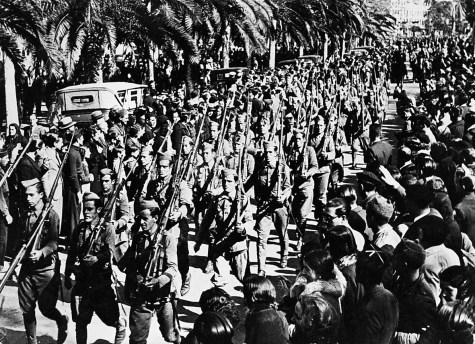
September saw the huge attack on the Alcazar of Toledo, as well as the formation of the International Brigades, all foreign volunteers who decided to flood into Spain in an effort to stop fascism taking hold. Major nations such as England, France and the US decided to say out while Hitler and Mussolini decided to back their fascist mate Franco.

Through October and November the killings continued, the Spanish government collapsed, and the Catalonia and Aragon regions in the northeast began life as anarchist regions, creating their social revolution where control was handed back to the people. The siege of Madrid began as Franco fought to take the capital and end the war, and the Russians provided tanks and equipment to aid the socialist/anarchist/worker unions/communist Republicans. In the north, and Asturias took heavy losses as they were bombed from the air by German planes. After leaving Barcelona, Buenaventura Durruti was killed in Madrid, a huge set-back for the social revolution in the northwest. Also in Madrid,  Falange leader José Antonio Primo de Rivera is executed.
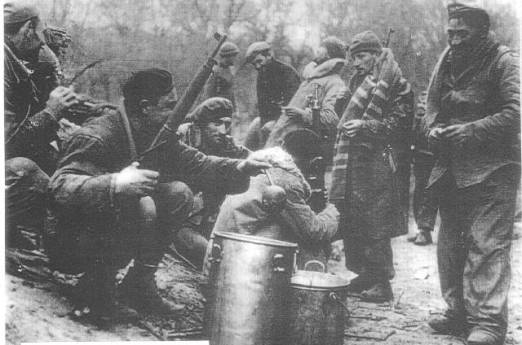
By the time the year ended, Madrid had been heavily bombed but not taken by the rebels, and the International Brigades had set up and integrated (as well as they could) into the Republican troops. The Republicans were not taking much ground but continuing to hold main centres in the east, along with Madrid. Click here to read all about December 1936

January and February held battles fought in heavy fog and rain, including much fighting outside Madrid, and Jarama, just northwest of the capital. Militias in Catalonia and Aragon held fast to their social revolution, while the Basques suffered heavy losses again as they held off the rebels. In Málaga in the south, the city was invaded when they could not defend themselves, sending thousands to flee along to the coast to relatively safe Almeria. Thousands were slaughtered as they walked the perilous road, where refugees were exposed, then bombed and shot as they fled. Click here to read about the Málaga/Almería massacre.

The bloody battles of Jarama and Guadalajara continued through March, and in April, 32,000 children started being shipped from the Basque country overseas in order to save their lives. The rebel army of the north is intensifying its efforts, with the now-infamous bombing of Durango and Guernica.

May saw the intense bombing of the new Republican capital city of Valencia, along with the fighting in the May Day fighting in Barcelona. June was an especially brutal month, with huge frontlines drawn up along the region of Aragon, battles in the Sierra de Guadarrama outside Madrid, Bilbao in the Basque Country was bombed and invaded, and in Barcelona, leader Andreu Nín was kidnapped and murdered in a Madrid prison.

Battles around Madrid, in Boadilla, Sierra de Guadarrama and Brunete saw huge fighting and casualties for both sides as the war reached its first anniversary. Legendary war photographer Gerda Taro was killed outside Brunete, and no nation except Russia comes to the Republicans’ aid as they are slaughtered by the fascists and their Moorish soldiers.

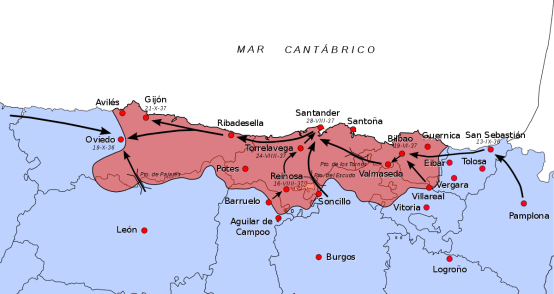
August 1937 focussed on the north. With the Basque region taken by the rebels, they turned east to take Santander in the Cantabria region. By September, the fascists again moved east again to take Gíjon in the Asturias region, with heavy mountainous battles taking place on cliffs that had kept Asturias safe from invaders for centuries. By October, Asturias was defeated by the northern army and could keep going west to claim Galicia, and Valencia is stripped of its title of capital of Spain in favour safer Barcelona. The Republican alliances of multiple militias fell apart, and many are fired from government and imprisoned, political alliances were ruined, and the dislike for the powerful communists pulled the left apart. The social revolution has suffered setbacks, including heavy battles and losses in the Aragon region, and there was breakdown of working class support in Barcelona.

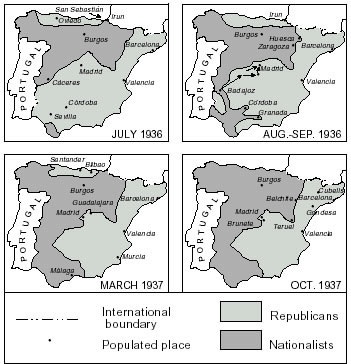
By November 1937, the frontlines have moved little in some time, with the exception of the conquering of the northern regions. Madrid remains in Republican hands, along with the Valencia, Aragon, Catalonia and Almería region in the east. All regions have suffered serious losses, but little ground is gained in seriously bloody battles.The north is now under Franco’s control, along with all the south and the western Extremadura region. The strong left-wing cities of Madrid, Barcelona and Valencia are targets for the well-trained fascist brigades. The month of November saw little of major battles taking place, as both sides are exhausted from the fighting, and small breakouts of fighting yield little results for either side. The new target for the fascists is Teruel, a strong city in the Aragon region, which is about to see one of the war’s biggest fights go down in a particularly brutal winter.
~~

This is not a detailed analysis, just a highlight (lowlight?) of the week’s events. Things get lost in translation – Feel free to suggest an addition/clarification/correction below. The more the world remembers, the better. All photos and captions are auto-linked to source for credit, and to provide further information.

SEPTEMBER SPAIN BOOK REVIEW: ‘The Dead’ by Mark Oldfield

MADRID, 1982.
Comandante Leopoldo Guzmán has decided it is time to disappear. Franco is in his grave and there’s no place in the new order for the one-time head of the dead dictator’s secret police.

But first Guzmán needs money. Luckily, blackmail has always come easily to him – after all, he knows where the bodies are.

And so he should. He buried them.

MADRID, 2010.
Fifteen tangled corpses in a disused mine, three bound skeletons in a sealed cellar – a trail of dead that has led forensic investigator Ana María Galindez to one Comandante Leopoldo Guzmán.

Guzmán himself disappeared decades ago but she fears his toxic legacy lives on. Her investigation has revealed a darkness at the heart of Spain, a conspiracy born amid the corruption and deprivation of Franco’s dictatorship, a conspiracy that after decades in the shadows, is finally ready to bloom.

cover and blurb via amazon

~~

The Dead is a long-awaited book for me – I read The Sentinel and The Exile as soon as they were released, so I pounced on this as well. The Dead is the final in the trilogy of Franco-lover Guzman and the modern-day investigator Ana Maria Galindez, who is literally about to have history come back to bite her.

The Dead moves at such a fast pace you need to make sure you are stable in your seat. You could read The Dead on its own, but I recommend the first two just for the joy. The book lives is in three time periods; 2010, where Galindez is looking for Guzman, whom she has been tracking after forensic evidence put him in the centre of multiple murders and torturing incidents during the Franco regime. The book keeps jumping around, entering 1982, where Guzman runs the Brigada Especial; Franco is dead and the ‘glory’ days of being able to be a vicious fascist is over. Spain is concreting over its past and wants democracy to work. Guzman has one last mission, and wants to end his enemies. What I love is the little flashbacks to 1965, and Inspector Villanuevo who lives in tiny Llanto del Moro. A policeman living under Franco is bound to get caught up in something nasty.

Even with three time periods, the storyline gallops along, the flashbacks filling in details as Galindez tracks Guzman to the bitter ended. The reality of life under Franco and those fragile years post-death swaps out to Spain 2010, not exactly a prosperous time, but at least free. Those who were murdered in Franco’s name, those who are the ‘disappeared’ and the selling of babies all comes back to haunt Spain and Guzman in his final stand.

You all know I love these subjects. My own Spanish trilogy dealt with baby selling, the Brigada Espeical and the ‘disappeared’ from the Spanish Civil War onwards. Only, I like Guzman, even though he was the bad guy. I could never really root for Galindez, the history nerd in me kept referring to the other characters.

In Oldfield’s version, the story is more important than history, so it can appeal to a wide range. The series is neatly tied up and at least some of Spain’s ghost are laid to rest. Reading this made me want to dump all my own work and write another Spanish historical fiction immediately.

Click here to read my reviews of The Sentinel and the Exile

This Week in Spanish Civil War History – Week 61: 10 – 17 September 1937

September 10

Still under the thick fog, the Nationalists take the hill at Biforco, below the El Mazuco Pass, but the mountain of Llabres is still in Republican hands, where they machine gun Nationalist troops and roll down barrels of explosives. The day is marked with the first delivery of hot food for the Republican men. If the Nationalists cannot take this pass, they will be forced to climb much steeper mountains to claim El Mazuco.

on the hills at El Mazuco

September 11.The Nationalists are still stuck in the valley below the El Mazuco pass, and change their plans. They spend two days heading along the mountain range to hike up Pico Turbina,  height of 1315m, a rocky cliff face with 40° slopes.  No tracks have ever been made up Pico Turbina and no mules have ever made the trek. The Nationalist men are forced to carry everything as they scale the cliffs. They are hidden in thick fog and no aircraft can see them overhead.

September 13

Constant bombardment on the northwest edge of El Muzuco has weakened the Republicans at the top, and they have to surrender the Sierra Llabres to the Nationalists. At the top of the village of El Mazuco itself, which has no defenses.

El Mazuco village © José González Fernández.

September 14

Nationalists climbing the Pico Turbina have almost reached the top of the mountain but are attacked by Republicans with hand grenades, aided by the thick fog, which prevents the Nationalists from taking the peak.

Pico Turbina

September 15

El Mazuco village is surrounded by Nationalists so the Republicans retreat back to Meré, six kilometres west along the mountains pass. Pico Turbina is taken by the Nationalists at last and nearby Peñas Blancas peak is also taken, along with the villages of Arenas Arangas.

September 16

The three summits of the Peña Blancas (Peña Blanca, Pico Turbina and El Mazuco) are all now surrounded  by the Nationalists. There are still Republican men at Pico Turbina, not yet ready to surrender. If they can hold the Nationalists on the south side of the Peña Blancas and the El Mazuco pass until winter, then the remainder of the north will be safe from the Nationalists. Casualties are unknown at this point in the wild terrain, but with the Nationalists starting with 33,000 men and the Republicans with only 5,000, the Republican hopes of the Basque, Cantabrian and Asturian men are fading fast.

nearby Arangas

~~

This is not a detailed analysis, just a highlight (lowlight?) of the week’s events. Things get lost in translation – Feel free to suggest an addition/clarification/correction below. The more the world remembers, the better. All photos and captions are auto-linked to source for credit, and to provide further information.

This Week in Spanish Civil War History – Week 60: 3 – 10 September 1937: 80 years since the Battle of Belchite

The ailing Republican battle of Zaragoza is now centred on the bombing of the village of Belchite, which has been surrounded for two days. Around 3800 civilians are trapped in the town along with 7000 Nationalists fighting, determined not to lose the area. All are suffering with the heat of summer and water in the area has been cut off by the Republicans. With troops so spread out over the Zaragoza battle area of 100 kilometres between Belchite and Zuera, exact numbers are not known, but bloody combat continues right around the small town. Much of the Republican artillery for the battle, with T-26 tanks and aircraft support, moves in to cut off the southern end of the Nationalist troops from the northern reinforcements.

September 4

While the bombardment of tiny Belchite continues, Nationalists with the Army of the North continue their trek through the mountains from the Cantabria region into Asturias, and cross the strategic point of the Deva river, with Republicans holding the area quickly having to retreat.

September 5

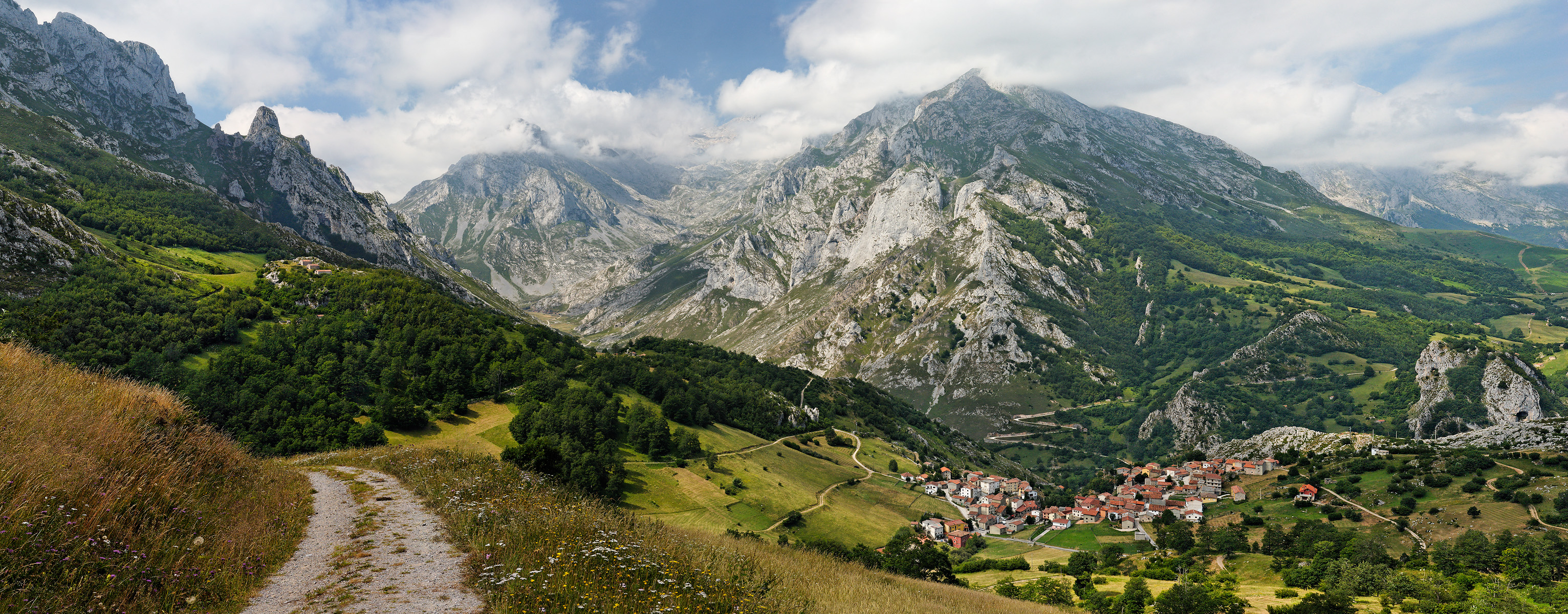
The advancing Nationalists capture the tiny town of Llanes, but the 33,000 troops now have to trek through the limestone cliffs of the Sierra de Cuera. These difficult regions are Asturias’ protection and the Nationalists will have to take the El Mazuco pass in order to advance any further.

El Mazuco mountains

September 6

While the bombardment of Belchite is still ongoing, the 33,000 Nationalists in the north begin the battle of El Mazuco. The Republicans, groups of Basque, Cantabrian and Asturian fighters, have only 5,000 men in the Sierra de Cuera region. El Mazuco is just five kilometres from the ocean, meaning destroyers can also be deployed to help the Nationalists, along with German Condor Legion aircraft. The Republicans, all men weakened from the lost battles of Bilbao and Santander, have no support and no way of gaining reinforcements. Only the steep cliffs will keep the Nationalists at bay.

Republican Libertad

September 7

The Nationalist cruiser Baleares battles the Republican light cruisers Méndez Núñez and Libertad off the coast of Cherchell on the Algerian coast. The Baleares comes across the Republican convoy in the dark, becoming the battle of Cherchell. Republican ships are escorting merchant ships through the dangerous area. The entire convoy flees the area while Libertad and Méndez Núñez try to hold off the larger Baleares. The two Republican ships are separated  during the day while Baleares tries to repair initial damage, but by afternoon, Baleares is hit twice by Libertad. Baleares backs away to be recused by a sister-ship in the sea, while both Nationalist and Italian planes attack the two Republican ships from the air. All ships involved are damaged and the leave the area, with only the Nationalist Baleares suffering serious damage. However, two of the cargo ships which had been travelling with the Republican convoy panicked during the nearby battle and changed course to get to Algeria. One ship runs aground, and one is captured the French and taken into the Cherchell port.

Carpet-bombing is used in the battle of El Mazuco, using both explosive and incendiary bombs throughout the day. The Republicans are trying to hold their post under Commander Higinio Carrocera, just three battalions and 24 machine-guns, and only the terrain holds back the strong Nationalist troops.

Still on September 7

The huge battle of Zaragoza is over. Republicans managed to eat 10 kilometres into the Nationalist areas, but only captured unpatrolled areas and win a few tiny villages. Exact losses on both sides are unknown (running into the thousands) but are worse for the Republicans who have also lost much of their artillery in the process. The battle of Belchite has also now come to an end, with the village completely destroyed. The Republicans and International Brigades take 2,411 prisoners and another 600 Nationalists have been wounded in the fight. After both bombing and hand-to-hand fighting, 3,000 people are dead. Those left behind manage to live in the rubble until a new town is built nearby in 1939, however the ruins will never be touched.

source

September 8

The battle through the El Mazuco mountains continues as thick fog fills in the whole area. The only fighting that can be done is hand-to-hand combat, causes massive casualties and wounds on both sides, and the Nationalists manage to capture a full two kilometres of ground.

September 9

The Republicans battalions defending El Mazuco have to retreat as the Nationalists shell their positions, but the Nationalists cannot take new ground as the men are cut down by machine gun fire from the Republicans in reply, meaning no one makes up any ground.

Area of Cabrales in the El Mazuco pass area

September 10

Still under the thick fog, the Nationalists take the hill at Biforco, below the El Mazuco Pass, but the mountain of Llabres is still in Republican hands, where they machine gun Nationalist troops and roll down barrels of explosives. The day is marked with the first delivery of hot food for the Republican men. If the Nationalists cannot take this pass, they will be forced to climb much steeper mountains to claim El Mazuco.

on the hills at El Mazuco

~~

This is not a detailed analysis, just a highlight (lowlight?) of the week’s events. Things get lost in translation – Feel free to suggest an addition/clarification/correction below. The more the world remembers, the better. All photos and captions are auto-linked to source for credit, and to provide further information.

This Week in Spanish Civil War History – Week 57: 14 – 21 August 1937

August 14

The Nationalists are ready to begin their massive new siege to take the north of Spain. The Army of the North of both sides have been assembled throughout the top half of Spain. General Fidel Dávila has 90,000 troops, 25,000 of them through three Italian divisions. They also have a massive cache of weapons, plus the German Condor Legion aircraft, plus Spanish and Italian planes. Their troops are fresh and the Nationalists are ready after the end of the battle of Brunete at the end of July. The Republicans have 80,000 in the region under General Mariano Gámir Ulíbarri. However, their planes are useless, and morale is low. The Basque soldiers included in the numbers are tired and devastated from a loss of their autonomous region and their capital Bilbao, and are already considering surrendering to Italian troops in order to survive.

 The Nationalist 1st Navarrese Brigade attacks the frontlines between Valdecebollas in the Palencia region and Cuesta Labra in order to block Republican troops south of the Cantabrian mountains. This is in preparation to start capturing Republican territories in the mountain region over the coming week and capture the entire Cantabrian region and Santander city on the coast.

August 15

The Nationalist troops advance through Barruelo up to Peña Rubia, Salcedillo, Matalejos and Reinosilla, all mountainous villages, without resistance, with the exception of the Republicans fighting back at nearby Portillo de Suano.

also August 15

The Servicio de Inteligencia Militar (SIM) is created. Having SIM means that secret police activities are now in the control of the government again, rather than Communist and Soviet hands. Political meetings have now been banned in Barcelona, and the constant fighting is undermining the left-wing groups. Barcelona is the central hub for Republicans mixing, with anarchism, socialism, regionalism, and communism coming together to produce infighting. The Republican war effort is hindered by these internal arguments. Peace has not truly been restored in Barcelona since the outbreak of fighting in May.

August 16

The Nationalists take Portillo de Suano and the industrial factory area outside the town of Reinosa during the day, and take central Reinosa at dusk. Meanwhile, the Navarrese Brigade are advancing, furthering the Nationalists’ control of the region. Italian troops sent from Burgos are heading to Lanchares, 17 kilometres from Reinosa, and also San Miguel de Aguayo, a mountainous 14 kilometres trek north from Lanchares. The Cantabrian area is quickly being swallowed by Nationalist troops with little to no resistance in the sparsely populated regions.

August 17

The Republicans still hold Campoo, just 4 kilometres east of Reinosa, with 22 battalions camped there. However the Nationalists have now encircled them completely.

In Barcelona, the Socialist Party and the Communist Party sign a pact to ally as one group, to bring stability to the Republicans’ effort. The Communist party expected a merger, in line with international Communist groups. The Spanish Republican government does not like the idea of the Communists controlling the Socialist party, but the unity pact agreement leaves the groups independent but formally allied, meaning the Communists do not gain any extra control over the government.

Nationalists outside Reinosa

August 18

Nationalist forces take the town of Santirude as they surge further north through Cantabria, while the Italians claim San Pedro del Romeral and San Miguel de Luena, only 45 kilometres south of Santander itself.

August 19

Cabuérniga, Bárcena de Pie de Concha and Entrambasmestas all fall to the Nationalists.

August 20

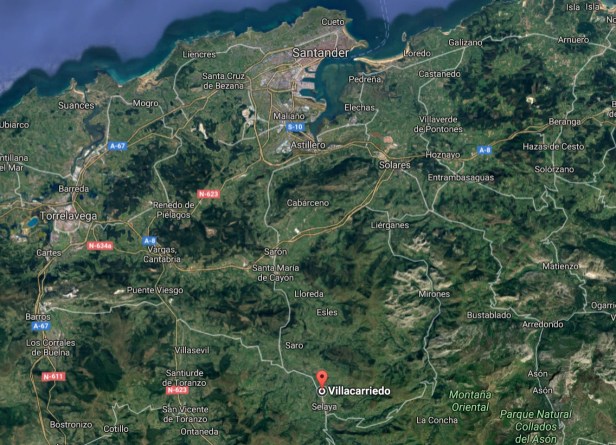
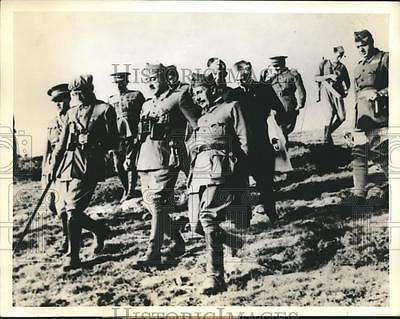
Italian troops claim Villacarriedo and Navarrese forces advance towards Torrelavega and Cabezón de la Sal. Santander is now in sight, just 30 kilometres from Torrelavega. The Nationalists are destroying the northern part of Spain and the Republicans cannot do anything to stop them. The Nationalists have overwhelming support, troops and artillery. The Basque, Cantabrian and Asturian units cannot work together against the speed and power of the Nationalist army. The Basques, having already lost their capital Bilbao, are at the morale limits and begin to mutiny as the Nationalists sweep through Cantabria.

Franco at the Santander front

~~

This is not a detailed analysis, just a highlight (lowlight?) of the week’s events. Things get lost in translation – Feel free to suggest an addition/clarification/correction below. The more the world remembers, the better. All photos and captions are auto-linked to source for credit, and to provide further information.