SPAIN BOOK REVIEW: April – ‘The War That Won’t Die: The Spanish Civil War in Cinema’ by David Archibald

The War That Won't Die

The War That Won’t Die charts the changing nature of cinematic depictions of the Spanish Civil War. In 1936, a significant number of artists, filmmakers and writers – from George Orwell and Pablo Picasso to Joris Ivens and Joan Miró – rallied to support the country’s democratically-elected Republican government. The arts have played an important role in shaping popular understandings of the Spanish Civil War and this book examines the specific role cinema has played in this process. The book’s focus is on fictional feature films produced within Spain and beyond its borders between the 1940s and the early years of the twenty-first century – including Hollywood blockbusters, East European films, the work of the avant garde in Paris and films produced under Franco’s censorial dictatorship.

The book will appeal to scholars and students of Film, Media and Hispanic Studies, but also to historians and, indeed, anyone interested in why the Spanish Civil War remains such a contested political topic.

cover art and blurb via amazon

~~

One could possibly be forgiven for thinking that art and cinema in the 20th century was held back due to the civil war and the Franco regime. That is not close to the truth,  and one medium well capable of expressing Spanish culture was cinema. The War That Won’t Die examines how cinema has been used to shape views over the past 80 years. Fiction films can be seen as imagination, but can also hold many truths, and also lies and propaganda, depending on the eye of the lens-holder.

The book starts out with how cinema was used to portray the civil war through foreign eyes, with films from the United States like ‘For Whom It Bell Tolls’, a love story in war-time, and the East German ‘Five Cartridges’ a battle tale between comrades. While foreign films depict drama and action, the Spanish films were held under the thumb of censors, showing a differing view on how the country and the world needed to see the war. Franco won the war, so he also needed to win history. Films shown to the people of Spain and the outside world needed to depict that the ‘right’ side won the war, while foreign nations continued to produce more romantic accounts of war, as is so often the case.

The latter part of The War That Wont Die focuses on post-Franco films, which were able to give broader accounts, or could dwell on more personal accounts, such as La vieja memoria, a movie which set out to find the ‘truth’ behind the war. Countless hundreds of films have been made in Spain since Franco’s demise, and half attest to the civil war period, all trying to tell the ‘real’ story of the war. The author has pulled together so many films and explained each of their roles in how cinema tries to explain the Spanish Civil War period and how it ‘should’ be portrayed. The War That Wont Die is a well-titled book, with a swathe of cinema to select from, opinions on what happened to Spain can live forever. This book can help a viewer to try to pick truth from fiction – if that is possible with such a subject.

SPAIN BOOK REVIEW: March – ‘Forgotten Places: Barcelona and the Spanish Civil War’ by Nick Lloyd

Nick Lloyd: Forgotten Places

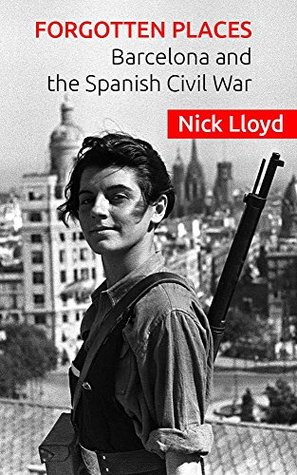
This is a guide to Barcelona in the Spanish Civil War, beginning in the 19th century with the conditions and movements which led to the social revolution of 1936, and ending with the fall of the city on 26 January 1939 when Franco’s tanks drove down the Diagonal and set about destroying everything the Republic and the revolutionaries had built. Stories from the aftermath of the war, the exile and the Franco regime are also included. In addition with dealing with the more obvious issues such as anarchism, the Spanish Republic, Catalonia, George Orwell, the aerial bombing, and the May Days, etc, the book also looks at themes such as the People’s Olympiad, the American Sixth Fleet in the city, Barça, urbanism, Nazis in Barcelona, Robert Capa, the Spanish in the Holocaust, poster art… Intertwined in the text are contemporary quotes and a few personal accounts of people who experienced the war or its aftermath. There are also biographies of figures such as Salvador Seguí, Ramón Mercader, Andreu Nin, Francesc Boix and Lluís Companys. The book is divided into two main sections: a history of the war from the perspective of Barcelona, followed by a guide to related sites which have often been included as an excuse to tell stories or illustrate wider issues. The book ends with an extensive glossary. Nick Lloyd has been running Spanish Civil War tours in Barcelona since 2009.

Cover art and blurb via amazon

~~

It’s no secret that I’m a big fan of Nick Lloyd. I first met Nick in 2013 while I was on book research trip and took his amazing civil war tour of Barcelona.  At that time, Nick was still putting together his Spanish Civil War book to accompany the tour, which has taken thousands of people through the events that took place in the Catalonian capital in the late 30’s. Every city and town in Spain has its own story to tell, but Barcelona’s journey is truly unique, as a city ready to take on a bold new world, one where everyday people were ready to join forces and change their lives and country forever. Everyone has seen the posters of workers uniting, of children bombed by fascist planes, or nuns’ bodies dug up and put on display. But as people shuffle through the iconic areas of Barcelona, most have no idea what happened in the very places in which they stand.

Nick Lloyd has dedicated years to putting his impressive and exclusive tour together, giving everyone the chance to feel and experience the real history of Barcelona’s war story, with stories from the famous, to the international athletes in the city on the fateful day that war got declared, to the workers and union men and women who dared to take on the oppression. From the ambitious beginnings, to the arrival of optimistic international volunteers, to the infighting and breakdown of alliances, to the aerial bombings and street fights, to the eventual demise of the Republic and following executions, Nick takes the reader through the war, just as he could on his tour. Both the details of this ancient city’s struggles and maps, photo and details can take a reader on the journey the author has made his own.

A reader could use this work to learn more about Barcelona, attempt to follow in its footsteps around Barcelona, or use it as a companion on one of Nick’s tours (book your own tour HERE). Forgotten Places is a culmination of work by a man who has dedicated himself to Barcelona’s civil war history, and is unrivalled in his field. This book belongs on the shelf alongside the greats of the genre.

SPAIN BOOK REVIEW: February – ‘Thus Bad Begins’ by Javier Marías

Thus Bad Begins

Award-winning author Javier Marías examines a household living in unhappy the shadow of history, and explores the cruel, tender punishments we exact on those we love

As a young man, Juan de Vere takes a job that will haunt him for the rest of his life. Eduardo Muriel is a famous film director – urbane, discreet, irreproachable – an irresistible idol to a young man. Muriel’s wife Beatriz is a soft, ripe woman who slips through her husband’s home like an unwanted ghost, finding solace in other beds. And on the periphery of all their lives stands Dr Jorge Van Vechten, a shadowy family friend implicated in unsavoury rumours that Muriel cannot bear to pursue himself – rumours he asks Juan to investigate instead. But as Juan draws closer to the truth, he uncovers more questions, ones his employer has not asked and would rather not answer. Why does Muriel hate Beatriz? How did Beatriz meet Van Vechten? And what happened during the war?

As Juan learns more about his employers, he begins to understand the conflicting pulls of desire, power and guilt that govern their lives – and his own. Marias presents a study of the infinitely permeable boundaries between private and public selves, between observer and participant, between the deceptions we suffer from others and those we enact upon ourselves.

cover art and blurb via amazon

~~

As always, it is hard to give a review on the Javier Marías novel, since there is so much to cover. Thus Bad Begins is actually a line from Shakespeare, quite apt since I read it in the spare minutes/seconds I had at the Pop-up Globe. Few authors can tackle the civil war and Franco regime like Marías, his own family victims of the awfulness. The scariest part is that a book doesn’t have to be set too far in the past to show how far the Franco poison spread.

The book tells a story set in 1980 through the eyes of a man named Juan de Vere. Juan is the assistant of a movie director named Eduardo Muriel. Eduardo is married to Beatriz, but the pair are the worst type of couple – one tied to one another, their lives and hearts far apart. Eduardo is sure that the whole damn world and all its issues can be traced back to Francoism, even when it comes to the disaster of his marriage. All of this is told through the eyes of Juan, as if recounting a tale, in the wordy, comma-less style that Marías loves so much. Juan has the not-great position of always being in Eduardo and Beatriz’s home, where he can see how much Eduardo hates his wife, and loves abusing her for an unnamed past crime, a dead child haunting the pair.

Franco has been dead five years and Spain is starting to open up to the world, where people are now free to try new things after years of being trapped in a conservative landscape. Art, culture, drug use, sex, freedom of speech are all going around, but the one thing not quite yet available is divorce, which would eliminate drama from the lives of Juan’s bosses. As part of his rather random assistant job, Eduardo asks Juan to investigate a man named Jorge Van Vechten, a doctor who moves in their social circle. Juan befriends the older Jorge, in an attempt to get him to open up about his shady life under Franco.

The Beginners Guide to the 40th Anniversary of Franco’s Death – ‘History’ Remains Fluid

El Caudillo. The Generalissimo. Supreme patriotic military hero by the Grace of God. Whatever you want to call him, Franco was a short man with a penchant for moustaches and murder. When people think of dictators, they think of Franco’s mate Hitler, or more current dictators such as Mugabe or the North Koreans with bad haircuts. Some would say Franco was a coward in comparison, or more moderate. If you turn from the word dictator and instead to fascism, the dictionary will give you Franco as a definition. Call Franco whatever you like, but November 20 is the day to celebrate his slow and painful death. The day in 1975 when cava and champagne bottles were popping faster than overheated popcorn. That day, Spaniards, at home and in exile, could finally shake off their not-so wonderful leader.

Born in December 1892 in Galicia, Francisco Paulino Hermenegildo Teódulo Franco Bahamonde was one in a long line of relatives in the navy. But instead Franco chose the army in 1907, and worked his way through the ranks through wars in Morocco, and was shot in the stomach in 1916, and lost a testicle (it is rumoured). He continued fighting and winning medals, and by the mid-twenties, he was ranked high enough to be before the King in Madrid. The royal family got run out of the country when the Second Spanish Republic took hold in 1931, but it wasn’t until Franco’s cozy position at the army academy in Zaragoza being extinguished did Franco start getting angry. Posted to the Balearic Islands for a few years, Franco got a taste of killing his own people during the miner’s strike in Asturias in 1934. He crushed innocents defending their rights, and the left and right side of politics only continued to divide as bitterness set into the young Republic. After the 1936 elections, all went to hell, and Franco found himself leading an army from Morocco into Spain to depose the Republican government.

Fast forward through three years of brutal civil war though 1936-1939 (if I explain that in detail, we will be here forever), and Franco’s Nationalist army, backed by fascists, Carlists, monarchists, any right-wing nutball group really, had defeated the Republicans, with the communists, anarchists and general plucky young men and women from Spain and overseas fighting for freedom. After gross atrocities, upwards of 200,000 people were killed. Franco was the leader of Spain, a nation decimated by force and hate. The short, moustached, one-testicled Hitler lover was in control.

Spain was no picnic. So many fled the country, many to France, Mexico, Cuba, Argentina… basically anywhere but Spain. Artists, teachers, bright minds, and those of the left-wing all ran for their lives. Spain skipped the Second World War after basically being in pieces, claiming neutrality, though Franco loved Hitler’s style of hating. While Franco was claiming that Spain had struck gold and all would be well, 200,000 people starved to death in the first half of the 1940’s. The whole decade was spent rounding up people who had supported the Republican side of the civil war, and up to 50,000 were killed, or put in concentration camps, or just ‘disappeared’.

Franco was brutal and bizarre. He could be easily played with wild schemes. But his own plan, being anti-Communist, won him love from the United States. They were allowed to set up military bases, Spain got money and their love for Hitler, Mussolini, etc was swept under the carpet. Spain and its technocrats were keen to move on and make Spain wealthy and prosperous again, though naturally, all spoils only went to the people at the top of the food chain. Spain’s Años de Desarrollo, years of development began through 1961-1973, with Franco promoting tourism, bullfighting, flamenco, everything super-Spanish. Financially, things got much better, but since everyone was doing so poorly, ‘much better’ still wasn’t great. Many Spaniards were still living overseas. Riots broke out at universities, women were still horribly oppressed, with divorce, abortions and birth control illegal. They couldn’t have bank accounts without male oversight, and couldn’t even leave a violent husband, real middle-ages style of living. The church was sticking its evil nose into everything, being gay was illegal, local languages were banned, and nuns loved hitting kids in schools and orphanages.

By 1969, Franco was getting old and handing more power to the lecherous bastards who profited from his reign. It was time to choose an heir. Franco had one daughter (though that has been questioned, given the testicle incident, but never mind), and Franco chose Juan Carlos de Bourbon, grandson to the Spanish King exiled to France in 1931. The young man, dutifully married to a Greek princess, would be modelled and educated in the ways of Francoism – basically being a murderous douche.

Even as Franco was getting super old in the 1970’s, he was still being real bastard, handing down executions just months before his death. Young people were rising up, wanting change in their country, and groups such as ETA wanted their regions’ independence back, as did Catalonia, Galicia, Valencia – basically everyone. In the final months of Franco’s reign, countries were having protests against his execution decisions, Mexico tried to have Spain kicked from the UN, and the Pope wasn’t interested in him anymore, which isn’t cool for a Catholic nation. But on October 1st, Franco have a hate speech from his palace and left in tears. From that moment, his number was up.

Pneumonia, heart attacks and then internal bleeding took hold. Machines kept the old man alive and drugged. Doctors worked day and night for the man who let people be shot by firing squads or starve to death. But after 35 days of pumping life into a frail old man, on November 20, 1975, Franco finally passed away.

The parties started, in Spain and all around the world, where Spaniards had waited for the day. Half a million people went to see his body, just to see the proof for themselves (this figure remains disputed, like all figures during Spain’s 20th century). Spain, which had been lying dormant, could live again. The protege, Juan Carlos, was crowned King, and tossed Francoism aside, opting for democracy. None of that was an easy ride as the road to the Transition began.

The trouble is, those killed during and after the war are still buried in their makeshift graves. Those lecherous wannabes who circled Franco did not lose their place in politics, and among the wealthy and elite. Those who were evil were all given amnesty, to smooth the road for democracy. Justice was never served; Spain’s hard questions remained unanswered for so many. Those who did wrong have grown old, as those who were harmed. The varying levels of independence of Spain’s 17 regions still causes headaches. Does Spain still need to ask questions of its past, or is the future hard enough?

Either way, pop a cork off champagne today, at least to celebrate the freedom Spaniards would have felt on 20 November, 1975.

Read more of what has changed in Spain since Franco’s death, and what is to come – Spaniards aim for a new democracy and end to Franco’s long shadow

Read more about Valle de los Caídos, Franco’s super creepy tomb, where monks will be praying for him today (yes, that’s a thing!)

Read more about Franco’s war, reign, and death in the Secrets of Spain  novel trilogy

Comments on this article are now closed.

SPAIN BOOK REVIEW: A Englishman in Madrid by Eduardo Mendoza

An Englishman in Madrid

Anthony Whitelands, an English art historian, is invited to Madrid to value an aristocrat’s collection. At a welcome lunch he encounters José Antonio Primo de Rivera, founder and leader of the Falange, a nationalist party whose antics are bringing the country ever closer to civil war.

The paintings turn out to be worthless, but before Whitelands can leave for London the duque’s daughter Paquita reveals a secret and genuine treasure, held for years in the cellars of her ancestral home. Afraid that the duque will cash in his wealth to finance the Falange, the Spanish authorities resolve to keep a close eye on the Englishman, who is also being watched by his own embassy.

As Whitelands – ever the fool for a pretty face – vies with Primo de Rivera for Paquita’s affections, he learns of a final interested party: Madrid is crawling with Soviet spies, and Moscow will stop at nothing to secure the hidden prize.

~~

An Englishman in Madrid has been in my reading pile since it was released two years ago. When I posted on Twitter last week about starting to read, I expected (at least those interested in Spain) to scoff that I was last to read it. But it seems not. Perhaps they had the same hesitations that I did – an ageing academic goes abroad and bound to have an unlikely affair with some girl a third of his age. We’ve read that before, more times than we care to remember. Was this book the same? Actually, it was combo I have never read before.

Anthony Whitelands, the ‘hero’ of the story, is fresh from Cambridge university, an art nerd of undetermined age, but with the usual male middle-aged thoughts of life and his career. An ex-wife in the distance, Anthony is busy dispatching with his married lover, Catherine. Perhaps she has made a lucky escape. From the beginning, the police are tracking him, only he is too thick to notice.

Anthony is an art specialist, who loves to compare literally anything – paintings, conversations, people, probably shrubs, to Velazquez (who was a painter in Spain in the 1600’s, if painting isn’t your thing). Anthony is no stranger to Madrid, but in the spring of 1936, shiz is going down all over the place, the prelude to the civil war, which broke out in July that same year. Our hapless character knows all is not well as soon as he arrives, but he is fairly dim, so it takes him a long time to figure out the realities of wandering into an-almost war zone.

The book covers everything, from toffs of the upper class, to the poverty of the times and the social and political realities everyone is facing. The prelude to war is described brilliantly by an author who has taken the time to get things right. Between protests, street killings and strikes, Spain is preparing for implosion and bumbling Anthony has wandered into the eye of the storm.

Our self-confessed art genius finds himself at the beck and call of the Duke of La Igualada, who wants to offload his Spanish art collection, to pay to get his family out of Spain. Selling off the family silver (literal and proverbial) isn’t something particularly legal, but the Duke is a chatty dude, and has Anthony dancing to his tune soon enough. If Anthony’s description is ever written, I have already forgotten it. But he must have been one hell of a looker, because the Duke’s teenage daughters are taken with him in a heartbeat, ready to profess their love before dinner’s first course is even served. Anthony wouldn’t win them over with charm, let’s just say. As an author, I realise how convenient ‘love at first sight’ is for moving a story along, but this group is a crazy set-up, with minimal interactions, yet pounding hearts (real or imagined, anyway). Between the charming Duke, his dim-witted duchess (sticking to stereotype here), the two daughters and the up-and-coming wannabe fascist son, and heir to the money, Anthony accidentally walks into the history books.

The Duke’s paintings are duds, and also a cover-up. Because Paquita, the eldest daughter (with wandering thoughts and as cold as a fish) lures Anthony to see the real treasure – an undiscovered Velazquez in the basement of the palace. Anthony sees his name in lights with the discovery, but knows he simply can’t steal a 300-year-old treasure. He is so blinded by the thought of fame and his never-that-apparent love for the girl he met five minutes ago, Anthony makes mistake after mistake.

The author of this book moves the story on Spain-time, but no matter what others think, this book blows away many similar books written by British authors. I would take on stories with this buffoon-style protagonist before many I’ve read before him. The author wanders into chit-chat about Velazquez so often he is almost holding an art class, and I admit to skipping pages because of it. This is not a criticism, because I admire the author’s research. When it comes to the realities of Spain, Madrid in particular, in that dangerous spring of 1936, the quality is excellent. It can’t be faulted. It is this setting that kept me going.

I like to think I’ve eaten pretty much anything Spain can throw at a stomach, but Anthony, our so-called gent, has weird things like beer and squid in the morning. Um, eww, bit early, my gentleman colleague. He is ethically clueless at times, like giving his passport and wallet to a stranger, who took him to an underage prostitute, whom he bones at her mother’s place. WTH, Anthony? You have no class sometimes. He parties with the hooker and her family, he parties with the Duke (snore-fest), his daughters, and also José Antonio Primo de Rivera, leader of the Falange fascist party, who will eventually align with Franco and be with the rebels (read: baddies of the civil war). The Duke won’t let all-talk, no-action José Antonio marry Paquita, but she loves him while dancing around Anthony (maybe, she doesn’t know herself half the time). She has as little sense as everyone else. Don’t get me started on the little sister, Lilí.

Running with the fascists, the elite, the working class, the police, and hanging with the Prime Minister himself, and pretty much everyone in the mess called Madrid, Anthony nearly gets his head blown off, sees others suffer the fate, and generally can’t figure out who the Communist Russian spy trying to kill him really is. But all because he wants to the art historian who found a Velazquez, he finds himself vying for an item that could invoke an entire civil war.

This book is part art history, part Madrid history teller, part war correspondent, all laced with fictional and not-so fictional characters who make you shake your head (or hope they get theirs blown off). I love the author’s use to detail to set the scene for war, and his use of French-farce type characters lost in world completely screwed in a mess of its own making, makes for something better than the usual old academic/hero and young duchess/whore/idiot that graces these types of books. Sometimes you want Anthony to escape, sometimes you wish someone would just pull the trigger. Will the end satisfy you? Is this book a thriller, a history lesson, or a comedy? The whole lot. Definitely recommended.