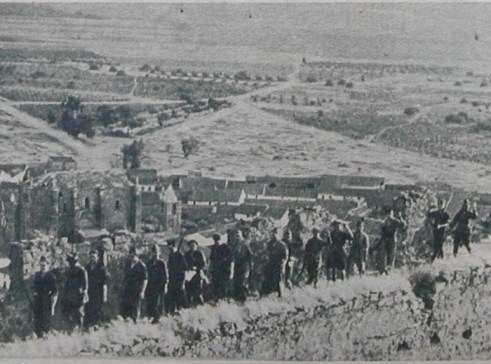
The battle of Monte Pelado, a mountainous area between Almudécar and Huescar, 300 kilometres west of Barcelona, is fought between the Nationalists and Republicans. The battle was significant because the Republicans, the Francisco Ascaso column, are Catalonian anarchists flanked by the Matteotti battalion, a group of Italian fighters who have freshly arrived in Spain to help. The Nationalists have around 500 soldiers on the mountain, a major gun emplacement. A four-hour dawn battle sees the Republicans win, though they suffer huge losses including prominent Italian anarchist Mario Angeloni. Many columns have been marching out of Barcelona since 17 August, now all placed west or southwest of the city, attempting to take control of major locations.
Just 30 kilometres north of of the town of Andújar (near Jaén), in the mountains of the national park, 1,200 right-wing supporters, including Guardia Civil members and women and children, are hiding in the Nuestra Señora de la Cabeza church sanctuary. The town was not initially taken by the Nationalists, and the Falange supporters fled into the hills to hide. They have now been hiding for over a month, surviving on stolen items in the mountains, and are ready to defend themselves in a major siege against the Republicans, which is only days from starting.
A battle begins in Talavera de la Reina, 140 kilometres west of Madrid. The Republicans have been unable to hold back Nationalist troops marching from Seville, and are constantly losing ground. The Nationalists have won hundreds of miles without any fighting, but the Republicans have 10,000 men in Talavera ready to block the troops’ way to Madrid. The battle begins at dawn, with the Nationalists taking the train station and aerodome immediately. Many Republicans panic and flee the town, deserting their fellow fighters and the public. A full attack takes place throughout the day, and while the Nationalists lose 1,000 of their trained soldiers, they win the town, and killed 500 Republicans, and capture another 1,000 to execute or imprison. Now, the capital city of Madrid has nothing to protect it from vicious Colonel Yague and his soldiers.
Two weeks after the Republicans surrounded the island of Mallorca, they have not made much progress in getting to the prime inland heart of the island. The Nationalists have soldiers and equipment, and planes to bomb the Republicans on the coastline. The Republicans retreat in a hurry, leaving behind weapons and equipment and even some of their men.
September 4
Already the Republican government is undergoing changes, and Francisco Largo Caballero replaces José Giral. The new government is made up of six Socialists, four Republicans, two Communists, plus a Republican representative of Catalonia and a Basque nationalist, bringing the two areas into the fold. The anarchists still refuse to join the government, despite fighting alongside them in battle. The CNT now have a solid voice in the government.
~~
This is not a detailed analysis, just a highlight (lowlight?) of the week’s events. Feel free to suggest an addition/clarification/correction below. All photos are linked to source for credit
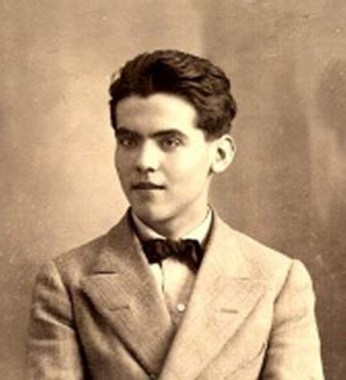
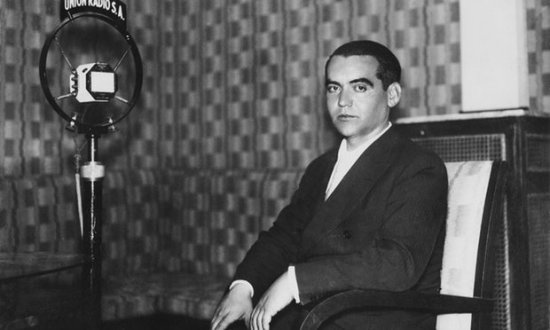
Federico García Lorca, born in June 1898 in the small town of Fuente Vaqueros (near Granada) is a universally known poet and writer. But just as he is recognised for his literary achievements, his name is also well known for what happened on 19 August 1936.
García Lorca grew up with his father, Federico García Rodríguez, a successful farmer, and his mother, teacher Vicenta Lorca Romero, on their farm until moving to Granada in 1909. Six years later he started at the University of Granada, and despite being a gifted musician, he started writing. Just one year later, García Lorca travelled through Spain, and self-published his first book, Impresiones y Paisajes(read my review here) based on the trip in 1918. Through his success, he moved to Madrid a year later to the Residencia de Estudiantes to study at the University of Madrid.
García Lorca studied philosophy and law, but his heart lay in writing. He struck up friendships with Salvador Dalí, Luis Buñuel, Gregorio Martina Sierra and Juan Ramón Jiménez, and published his first work of poetry two years into his studies. More poetry, essays and plays followed, with his most popular poetry Romancero Gitano published in 1928. García Lorca found inspiration in the land and the people of Spain, seeing it through less-than traditional eyes, instead finding beauty in new lights. In 1927 a play opened by Salvador Dalí had García Lorca at his side, to great acclaim, after play failures five years earlier.
The mid-twenties were filled with strong collaboration between García Lorca and Dalí, though Dalí rejected García Lorca’s romantic advances. By 1928, the friendship became strained, and García’s Lorca also broke off his affair with sculpter Emilio Soriano Alarén, which enhanced García Lorca’s depression. The constant stress of being a public figure, and having to hide his true self weighed on him (same-sex relationships were technically legal between 1881- 1928, and then 1932 -1936, but in a deeply Catholic nation it wasn’t considered acceptable). He was being typecast as a gypsy poet, as gypsies were one of his predominant themes in his work. García Lorca wanted to adapt and live his art. Dalí and Luis Buñuel released a film in 1929, without García Lorca’s help, and Dalí married, leaving García Lorca feeling he was being edged out of the group and the depression only grew worse. His family shipped him to the US in 1929 to recuperate from his worries. García Lorca flirted with new styles, though his work would not be published until after his death.
García Lorca returned to Spain after a year and then in 1931 the Second Spanish Republic was born. The young writer was in charge of the Teatro Universitario La Barraca. Thanks to the new government education programme, García Lorca toured rural Spain to bring free art to the public. With little equipment and a tiny stage, the masses got to see García Lorca acting and hear his work performed. Seeing the poor populations of Spain and their reaction to their first (sometimes only ever) art performances drove García Lorca to believe art could change lives with plays about social action. The La Barraca tour created three of Garcia Lorca’s best plays – Blood Wedding, Yerma and The House of Bernarda Alba, all about standing up to the bourgeois.
After taking Blood Wedding to Argentina in 1933, García Lorca was on a roll. He returned home and created Play and Theory of the Duende, and wrote about how art needed to understand death, and reasoning limitations, and then returned to his roots of romance in his poetry (after a love affair with Juan Ramírez de Lucas) with the amazing Sonnets of Dark Love. But La Barraca had their funding cut in 1934 and closed in April 1936. García Lorca kept writing over summers at home in Huerta de San Vicente outside Granada, adding to his works with When Five Years Pass and Diván del Tamarit.
But as everyone knows, García Lorca was living in a deeply troubled world. The Spanish Civil War broke out in July 1936, and García Lorca knew his work on rebelling against the wealthy and his outspoken views on right-wing politics could see him as a target. A spokesman for the people was not going to be welcome anymore. Granada was in turmoil; not one of the cities to be initially overthrown by the rebel Nationalists, but it had martial law imposed. Bombings became frequent and the huge divide between left or right (poor or rich) was so stark that fighting emerged everywhere. García Lorca was not political, but when push came to shove, he supported those with nothing, after years of seeing deprivation in his country and abroad.
García Lorca left his home and stayed with his friend Luis Rosales in central Granada, but nowhere was safe. Lorca’s brother-in-law, Granada Mayor Manuel Fernández-Montesinos was assassinated during fighting on August 18. Hours later, fascist militia turned up at the Rosales’ residence and García Lorca was arrested, no reason given. He had been visited and interrogated weeks earlier, but when a right-wing politician came and got García Lorca alongside armed men, all of García Lorca’s fears came true.
García Lorca was held overnight by armed gunmen, their whereabouts or activities murky. The following morning, García Lorca and three others – Joaquín Arcollas Cabezas, Francisco Galadí Melgar and Dióscoro Galindo González – were driven out to Fuente Grande, the middle of nowhere between the towns of Víznar and Alfacar. After digging their own graves, García Lorca and the others were executed.
While the world was deprived of García Lorca from then on, the why’s and how’s have been debated ever since. He was shot by fascist forces, though his arrest came from CEDA, a conservative Catholic political group. Some think it was part of an elimination process of all who supported Marxism. His murderers spoke of his sexual orientation, leading that to be a theory on his killing, along with some kind of same-sex love and jealousy theory. García Lorca had friends in right and left-wing groups. He supported the left-wing government and had spoken at gatherings supporting the left. He also had communist supporters, yet was arrested in the home of a leading Falange fascist, and regularly met with Falange leader José Antonio Primo de Rivera. Francisco Franco himself ordered an investigation on the execution, but the paperwork has never been found.
Since the undignified death, countless have sought to find García Lorca’s burial place. One early search was by author Gerald Brennan himself, as documented in the wonderful The Face of Spain in 1949. Despite many attempts, García Lorca was never found in the Franco era (1939-1975). The site of the executions was identified in 1969 by a man who said he helped García Lorca dig his grave, but it wasn’t until 1999 that digging by the University of Granada could begin. Nothing was found. García Lorca’s family long denied permission for people to dig up their relative, but relatives of another man also executed continued to push for answers, which the García Lorca family agreed to. DNA samples were taken from all families and in 2009, it was time again to find García Lorca.
After two weeks’ work, samples were taken from a site for testing. No bones were found, and no bullets were uncovered. The grave was very shallow, about 40 cm deep, and could not have been a 70+ year-old grave-site. Three years later, another dig was launched, 500 metres from a first site, which also uncovered nothing. People who claimed to be part of the killings, hired men out killing for the Falange, claimed that García Lorca was a target after writing The House of Bernarda Alba, and the people portrayed in the story wanted him gone.
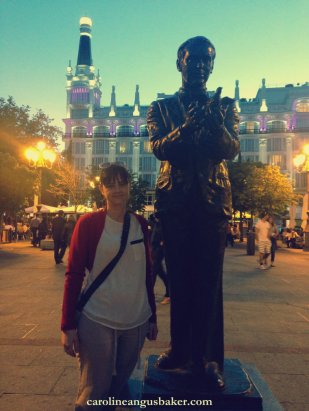
The Barranco de Viznar, a nearby spot of mass civil war graves in the wilderness, has been suggested as a site where García Lorca may lie, killed or moved there during the war. A memorial headstone lies there for García Lorca stating ‘We are all Lorca’. An olive tree at Fuente Grande has a memorial for García Lorca, where flowers are laid every year. All his family homes are now museums in Granada, along with a park named Parque Federico García Lorca. A famous statue of García Lorca stands in Plaza Santa Ana in Madrid, and his niece runs The Lorca Foundation in his honour.
me paying homage to García Lorca’s life in Madrid
García Lorca’s work was banned by Franco until 1953, and then censored for the rest of the Franco era. Since then more work has been published and celebrated, along with new publications from unpublished manuscripts held dear by his family. Searches and theories on his death remain ongoing 80 years later. This month, Argentinian federal judge Maria Servini has agreed to take on the García Lorca case, sequestering paperwork on the killing of the poet, while she is also prosecuting over other civil war deaths. Perhaps one day, Federico García Lorca will be found.
This is not a detailed analysis, instead a simplified report of Lorca’s life and death. Feel free to suggest an addition/clarification/correction below. All photos are linked to source for credit.
The Battle of Badajoz continues, a day after being taken by the Nationalists. The dawn of the day sees thousands murdered in mass executions all over the town.
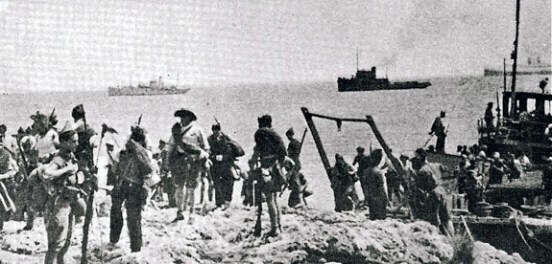
The battle of Mallorca starts. The island is under the control of the Nationalists but Republican forces storm the island from the sea and manage to get 12 kms inland with 8000 militia men. The battle will rage for another month as the Nationalists gain Italian back-up.
Troops on the shore after beginning the battle
August 18
The mayor of Granada, Manuel Fernández Montesinos, is assassinated, a week after taking office. The major city has been without a mayor for months, as the post of considered a death sentence. On the day of his assassinated, his brother-in-law, the famous writer Federico García Lorca, is arrested by Nationalist forces.
August 19
.
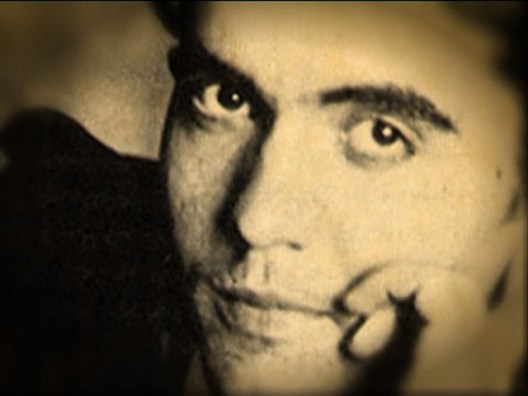
The legendary Federico García Lorca, along with three others, Joaquín Arcollas Cabezas, Francisco Galadí Melgar and Dióscoro Galindo González, are taken out of Granada, to Fuente Grande, between the nearby towns nearby Víznar and Alfacar, and executed. The men were forced to dig their own graves before being shot. Lorca, a man who had friends on both sides of the battle, was reportedly killed for being gay, though all the details have never been fully explained. The bodies have never been found.
NB – there will be a ‘This Week in Spanish Civil War History Extra’ on Lorca on August 19.
Federico García Lorca
August 19
In line with the Non-Intervention Agreement, (which is being ignored by most countries who have signed) Great Britain bans all arms and aircraft sales to Spain. As the Nationalists are being armed by Germany and Italy, this harms only the Republicans, who have to go to Russia for help.
August 20
For several weeks, Republican miltia have been attempting to take back the strategic southern city of Cordoba. On August 20, 3000 troops attack the Cordoba gate 5 kms from central Cordoba, but are beaten in a three-day offensive. This sets off another month of reprisal killings in the area which stabilises the region (as most non-Nationalists are now dead).
.
Gerda Taro with a Republican soldier outside Cordoba
~~
This is not a detailed analysis, just a highlight (lowlight?) of the week’s events. Feel free to suggest an addition/clarification/correction below. All photos are linked to source for credit.
The Battle of Badajoz was one of the first leading battles, and victories, for the right-wing Nationalist rebels in the Spanish Civil War. Won on 14 August 1936, the massacre at Badajoz has long been used as propaganda against the cruel Franco forces.
The war was almost one month old. Areas controlled by Nationalist armies were fractured between north and south, and needed to connect their territories. Badajoz, a town of around 41,000, on the border with Portugal, became a prime target. Nationalist forces set out north from Seville on their way towards central Madrid. By August 10, Colonel Juan Yague (a notorious killer, especially of innocents) and his 2250 troops had taken the town of Mérida, just 60 km east from Badajoz. Yague had orders to take Badajoz to help link their north and south frontiers and have the area next to the Portuguese border under their control.
Badajoz was already flooded by refugees from all directions from killings happening in both towns and in the country. Some rich right-wing landowners were even holding days when they and their friends would go killing peasants while on horseback. Killings and reprisals killings were uncontrolled and widespread. For three days, Badajoz suffered aerial bombing from planes donated to the Nationalist troops from Italy and Germany. The town’s mood was one of impending doom.
Badajoz from the air 1936
After dawn on 14 August, the Nationalists stormed the north gate of the city, Puerta de Los Carros, and the south gate, Puerta de la Trinidad. While the Republicans managed to hold back the soldiers at the south gate, the brutal Moorish troops won at the north gate, breaching the city and overcoming the barracks inside. An ugly battle ensued, with the Nationalists killing with bayonets and knives as they overtook the whole town. Many Republican militia defected to join the Nationalist troops, and many surrendered. Everyone in sight was killed throughout the day, even when surrendering. All the leaders of the town and Republican militia, including the mayor, had left the town early in the day and made it to Portugal, abandoning the people to their deaths.
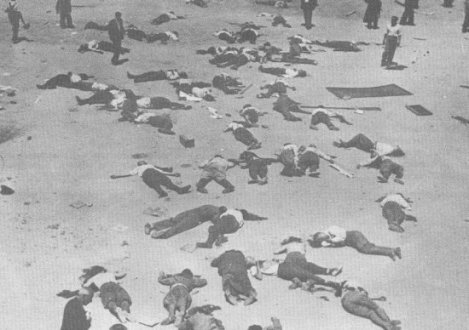
The Nationalist troops took much delight in slaughtering as many people as possible, including unarmed women and children. Their leaders had been promoting the use of rape against women as a weapon from the outbreak of war as well. Anyone who wasn’t immediately killed on sight was rounded up. While many were marched to the local bullring and executed by firing squads, many were simple killed on the street. Estimates of between 1000 and 1800 people were executed on the first day of fighting. In one main street, Calle San Juan, around 300 bodies were left there after execution. Through the night and into the next day, anyone even suspected of being a left-wing sympathiser was taken from their homes and sent to the bullring for execution. Journalists ran censored stories about the massacre, including a Portuguese journalist, who fled home with the story, refusing to ever set foot in Badajoz ever again after witnessing torture and execution.
The true death toll of the Badajoz massacre remains unknown, but estimated somewhere between 1300 and 4000 people. No official death toll was taken. Most were killed by firing squad or machine gun fire in the bullring, to the point where prisoners stood ankle-deep in blood with other bodies as they were murdered. Reports of mutilation were made, though exact behaviour is unknown. It was suggested that some were killed bullfight style, chased around and stabbed in the back and then mutilated. The Moorish troops were well-known for their vicious and sadistic nature. Up to 10% of the town died in this one battle.
An early photo of inside the bullring
The battle of Badajoz gave one of the war’s most famous quotes, when Colonel Yague, who by then had earned his ‘Butcher of Badajoz’ nickname, told an American journalist (with much pride) – “Of course we shot them. What do you expect? Was I supposed to take 4,000 reds with me as my column advanced, racing against time? Was I expected to turn them loose in my rear and let them make Badajoz red again?” While the battle is labelled as fighting during a war, much has been said about reclassifying it genocide or a crime against humanity, which it most certainly was.
Around the Badajoz region, another 2000 people were killed by the marching soldiers, mostly farmers. While the Republicans were labelled ‘reds’, the Nationalists were now known as the ‘white terror’. Sadly this was only the start of a long civil war.
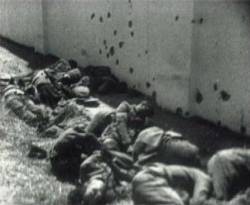
Firing squad against the wall outside the bullring
The leaders of the defense committee and the mayor were found in Portugal and returned home to face execution a short time later. This battle would be far from Badajoz’s only major battle during the war. But this initial massacre linked the north and south elements of the Nationalists, strengthening their advance on the country.
~~
This is not a detailed analysis, instead a simplified report of events in Badajoz. Feel free to suggest an addition/clarification/correction below. All photos are linked to source for credit. Against usual preference, I chose to add the firing squad photos as it is a painfully accurate reflection of the event.
France closes its border with Spain, preventing weapons entering the country, but also cutting off escape for refugees fleeing the violence.
The island of Mallorca has been in rebel Nationalist hands since the outbreak of fighting. Menorca has remained Republican. The islands of Ibiza and Formentera have localised fighting and the Republicans regain control of both islands. They are one of the first places to change hands since the initial outbreak.
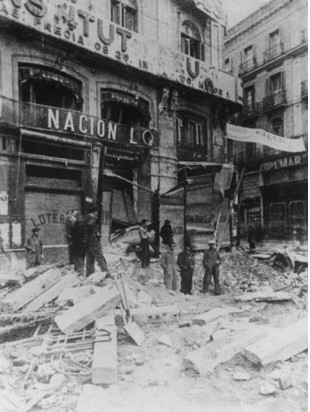
Mallorca damage from bombing
August 9
Church killings continue. Even prior to the outbreak of war, churches have been burned, possessions destroyed and priests and nuns murdered. Republicans are continuing their fight against church oppression, killing priests and nuns in all locations, especially in Catalonia, Valencia and Aragon. A Republican supporter dresses in the Archbishop of Toledo’s clothing for fun, and gets murdered by a drunk Republican soldier, who mistakes him for a priest.
(there are countless photos of church destruction, murder, and of priests/nuns corpses dug up for display available. I am not pro-religion, but I still do not wish to post them here)
August 10
The soldiers, which set off from Seville the previous week, take Merida with bloody killings. The Republicans quickly try to take the city back, but are again defeated. The soldiers are on their way to Madrid, but are meeting resistance. The major location of Badajoz now lies between the Nationalists and Madrid, and is currently in Republican hands.
Nationalists storm Merida
August 12
The Republicans set up checas, investigation commissions, to root out any right-wingers inside their strongholds. Many people suspected are given fake Falangist cards and shot, others denounced by their servants, enemies or debtors. Countless mistakes are made as old grudges we carried out and countless killed. The anarchists do not believe in these commissions and simply shoot enemies, real or perceived. Right-wingers are in hiding, dressed as workers, or hiding in embassies to avoid these killings.
August 14
The town of Badajoz, in the west near Portugal, is captured by marching Nationalists troops. The battle and occupation see 4,000 people killed. The invasion commanded by Juan Yague, unites two major Nationalists areas, increasing their dominance in battle. The battle of Badajoz becomes a representation of the Nationalist power and vicious murdering and raping of Spaniards, and the use of the Moors, the Moroccan troops, is highlighted in the cruel and inhuman attack. The initial attack begins the intense killing in the town over the coming weeks.
(there are many photos of the battle of Badajoz, many of bodies and executions, which I have chosen not to add here)
NB -there will be a separate post to commemorate the battle of Badajoz
~~
This is not a detailed analysis, just a highlight (lowlight?) of the week’s events. Feel free to suggest an addition/clarification/correction below. All photos are linked to source for credit.

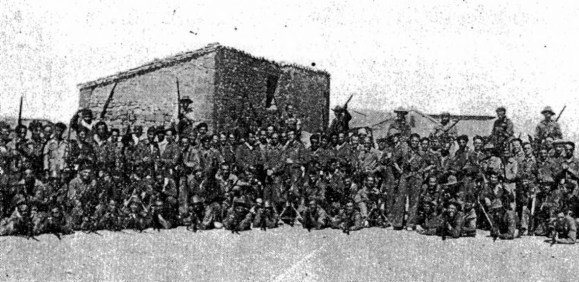 Anarchists and Italian volunteers in Monte Pelado







 CAROLINE ANGUS
