This Week in Spanish Civil War History – Week 14 and 15: 17 – 31 October 1936

Week 14 and 15: 17 – 31 October 1936

Sorry for the delays, as the website was hacked and is only just back online now. Normal service is resumed.

Week 14

October 18

The Republican government creates the ‘Mixed Brigades’. This combines the army units which remained loyal during the initial rebellion, and militia groups of all forms fighting around Spain. This mix is titled the Popular Army, the name coming from the Popular Front party in government. While anarchist groups are not art of the government (yet), their militias are still able to be part of the Popular Army.
.
Week 15

October 24

The first shipment of gold arrives in the Soviet Union; the first shipment of over half the Spanish supply which will be sent to Moscow. It is worth around $35 per ounce, a total of around almost $600 million, though Spain only gets half its worth.

October 27

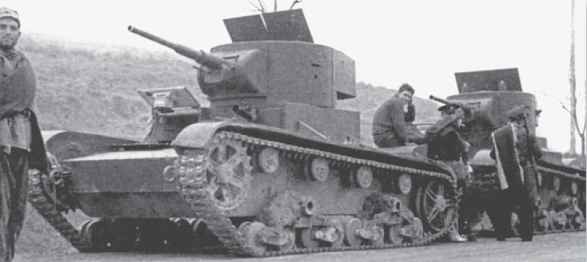
Russian tanks finally get to Madrid to defend the city. T-26 tanks, around 10 tonnes in weight each, are dispatched from Madrid main’s train station and head straight to the front. The Nationalists outside the city already have tanks, supplied by Italy and Germany. The Republicans have been using Molotov cocktails to hold back the Nationalists until now and are in desperate relief to save the city.

.

T-26 tank outside Seseña

October 27

The Nationalist unleash an air raid on Madrid. Six bombs are dropped in Plaza Colón, a major square in the city, heavily populated. A queue of women and children are waiting to get milk and a bomb lands directly on them. A total of 16 are killed, another 60 seriously injured. The air raid comes from a Junker Ju-52 with a German pilot. The bombing is labelled the first bombing in history that served no purpose. It was designed solely to bring terror to 900,000 Madrileños. Madrid has no way to stop planes flying overhead and bombing them as they are becoming surrounded by Nationalists, setting the stage for the coming mammoth siege of Madrid.

October 28

A squadron of Soviet Tupolev ANT-40 planes, named Katiuska bombers, drop bombs over the city of Seville, which has been in Nationalist hands since July. This Republican-supported bombing leads the Germans to send more planes and supplies, and set up the Condor Legion in Spain, to overcome the Soviet forces.

Aftermath of the air raid in prep for the Madrid siege

October 29

The town of Seseña is 30 kilometres (18 miles)  south of Madrid, near destroyed Toledo. The Nationalist army, who have marched and massacred their way north are now ready to take Madrid. The Republicans who hold Seseña attempt to hold their town. The new Mixed Brigades, led by Spanish and Russian colonels, lead their mixed-nation/loyalty troops with newly arrived tanks. However no one has any training, other than one Russian tank expert. The Nationalists have their highly trained Spanish and Moroccan troops and Italian tankettes on their side. The Republicans head south of Seseña to engage with the Nationalists about only gain around 1.5 kilometres (1 mile) before they are attacked.

The Republican were able to destroy 11 Italian tankettes and kill 600 soldiers, losing only eight men and three tanks in the fighting. However numbers were on the Nationalists’ side and they won the battle of Seseña when the Republicans were forced to retreat.

The showdown for the siege of Madrid is ready to begin.

~~

This is not a detailed analysis, just a highlight (lowlight?) of the week’s events. Feel free to suggest an addition/clarification/correction below. All photos are linked to source for credit

This Week in Spanish Civil War History – Week 13: 10 – 17 October 1936

October 12

University of Salamanca’s rector, writer Miguel de Unamuno, gives a speech at their Columbus Day celebration. The western city, in the Nationalist-held area, has many important right-wing audience members, including Franco’s wife. Unamuno speaks out harshly against General Millán Astray, who leads the Spanish Legionaires. While Unamuno had previously said he was a supporter of the Nationalist, he changes his mind and calls Astray inhuman, and an example of the terrible rebel uprising.

Unonumo said – It torments me to think that General Millán Astray could dictate the norms of the psychology of the masses. A cripple, who lacks the spiritual greatness of Cervantes, hopes to find relief by adding to the number of cripples around him.

Astray cried from the crowd – Death to intelligence! Long live death! to the praise of the Nationalist-loving crowd.

Unamuno finished his time on stage by replying – This is the temple of intelligence, and I am its high priest. You are profaning its sacred domain. You will win because you have enough brute force. But you will not convince. In order to convince it is necessary to persuade, and to persuade you will need something that you lack: reason and right in the struggle. I see it is useless to ask you to think of Spain. I have spoken.

Unamuno left the meeting with Franco’s wife Carmen polo, which secured his immediate safety. But he is soon removed from his job and put under house arrest. He will die, humiliated and ruined, two months later.

October 14

The first 500 international volunteers arrive in Albacete, the eastern town set up as the training base for all international volunteers.

October 15

The first ship from the Soviet Union, carrying Republican bought weapons arrives in the port of Cartagena. The weapons are sorely needed as the Nationalist army continues their bloody march towards Madrid.

~~

This is not a detailed analysis, just a highlight (lowlight?) of the week’s events. Feel free to suggest an addition/clarification/correction below. All photos are linked to source for credit

This Week in Spanish Civil War History – Week 12: 3 – 10 October 1936

Week 12: 3 – 10 October 1936

October 3

Franco sets up a new Civil Junta, or civil government, for the areas the rebels have captured, named the National Zone. This is done to try to legitimise the uprising. The Civil Junta is only a facade and has no power or control, as the country is covered in a state of war already. This new group gives Franco no extra power over the German and Italian forces, though their decisions are similar to Franco’s anyway.

October 6

The USSR decides it no longer wants to be part of the Non-Intervention Agreement. As Germany, Italy and Portugal are openly intervening whilst signed to the agreement, the Soviet Union decides it can intervene too, except instead for the Republicans. The Nationalists’ area is supplied with weapons and supplies over the Portuguese border, but as France will not break the agreement, the Republicans have no way of getting supplies.

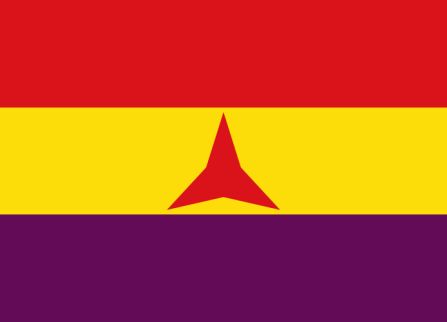
International Brigade flag

October 7

The International Brigade volunteers set up a base in Albacete, in the Valencia region. To men are selected to run the organisation – André Marty, a French Communist, and Palmiro Togliatti, an Italian Communist. Both men are well experienced in running left-leaning groups. Volunteers start arriving, some over the French border. Anarchists control the border and don’t want communist volunteers, but need the manpower. Others make their own way into the country, not contracted or obliged to fight in any way.

October 9

The Spanish Republican government officially forms the Popular Army. As most left-wing groups are militias of workers and/or peasants, these need to be grouped more effectively and have commanders who are sharing information. Also part of the civilian militia joins those army men who remained loyal, along with any Guardia Civil and assault guard men, who are already trained to fight.

The flag three pointed star of the Popular Front

~~

This is not a detailed analysis, just a highlight (lowlight?) of the week’s events. Feel free to suggest an addition/clarification/correction below. All photos are linked to source for credit


This Week In Spanish Civil War History Extra: Siege of the Toledo Alcázar – 21 July – 27 September 1936

1280px-die_gartenlaube_1887_b_085

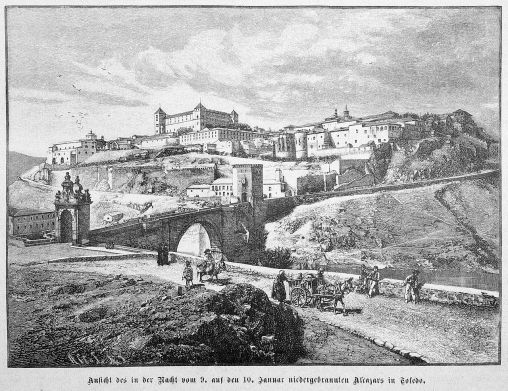
Sketch of the Alcázar above Toledo in 1887

The Alcázar of Toledo was beautifully constructed fortress in the town which was strategically placed on a small hill by a river. First used by the Romans in 59BC, the location ruled over the plains during Roman, Visigoth and Moorish rule. The town was home to Christian, Muslim and Jewish communities living together through the centuries in relative peace. But in 1085 the city fell under Christian rule and the slow decline of the harmony commenced. By 1520, the Alcázar, a palace fortress, was built on the top of the hilltop town by the royal family, and stood until the destruction during the Spanish Civil War in 1936.

The war started on July 17, 1936 when Franco took over the army in Spanish Morocco and staged an uprising. By the morning of the 18th, strict, religious army leader José Moscardó e Ituarte, the military governor of the area, took control of the Guardia Civil police, and decided to lead and control the hilltop town. Toledo had an arms factory, and the Republican government and its followers battled for days to get their hands on the weapons and gain control of their home. Colonel Moscardo was able to fend off the Republicans with his men, and moves were made for Republican reinforcements from Madrid to arrive. By July 20, killings were already occurring on the streets, with both sides attacking and wounding one another, as in all towns and cities in Spain.

t3_3062tq

The grotesque habit of Republicans digging up clergy to show everyone their mortality in Toledo, like everywhere in Spain

Colonel Moscardo had just 800 Guardia Civil officers, around 100 army officers, and the support of 200 right-wing public members. The Guardia Civil had plenty of ammunition to bring to the uprising, but between all these men they only had rifles, a couple of machine guns and a few grenades. Meanwhile, the Republicans in Madrid sent in 8,000 militia men, left-wing supporters banded into groups to save their country, mostly anarchists and workers’ union members. The air force had also sided with the Republicans and were able to fly over Toledo for surveillance and bombing.

Between the call to rise up and claim the city by the rebels on July 17 and the following four days, the Republicans managed to hold off the right-wingers, with only one man arrested as a Republican activist. However, between 100-200 people were taken hostage by the Nationalists, and they including the town’s governor and his family. The hostages and Nationalist families, those belonging to the Guardia Civil men, were put inside the city Alcázar to be safe from the Republicans. This started a siege, with Nationalists trapped in the Alcázar and the Republicans keen to take back their town.
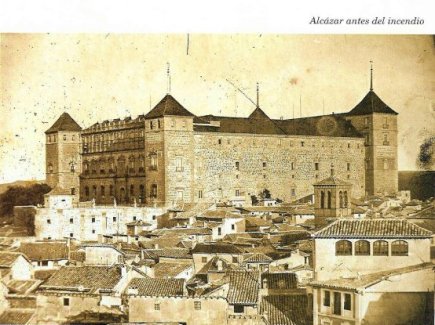
The Alcázar prior to the siege

By July 22, the Republican surge meant the town was in their hands, with the exception of the great Alcázar, which was under bombardment from the air. On July 23, Colonel Moscardo, inside the Alcazar, got a phone call from the Republican leader, Commissar Cabello. They had taken Moscardo’s son hostage, age just 16, and threatened execution. Moscardo told his son to die as a patriot, which young Luis agreed to do. However the Republicans did not yet have the heart to shoot the boy.

For the next three weeks, the Nationalists stayed safe in the Alcázar as the Republicans continued to attack. The insiders only fought when militia fired at the building, or planes dropped bombs from above. Constant bombardment to the strong Alcázar began to weaken the northern side of the fortress. But the constant back and forth of fire, bombs and grenades, meant no one could get close enough to the Alcázar to get inside, not even to the buildings surrounding the building, all of which were still under Nationalist control and huddled together for safety. Sometime in mid-August, Moscardo’s 16-year-old son was shot and killed as the Republican frustrations mounted. Likewise, the hostages inside the Alcázar met an ugly end.

Republicans try to get close to the Alcázar

However, by early September, the northern side of the Alcázar was in collapse, and the Republicans decided to change tactics. In a momentary downing of weapons on September 9, Major Vicente Rojo Lluch, an army man who decided to fight for the Republicans rather than with the army, went to the Alcázar to speak to Colonel Moscardo. Rojo offered Moscardo the chance to surrender and leave the Alcázar but it was refused. Moscardo requested a priest be sent to the Alcázar, as two babies had been born inside the besieged fortress and needed to be baptised. Despite being anti-religion, the Republicans allowed this request.
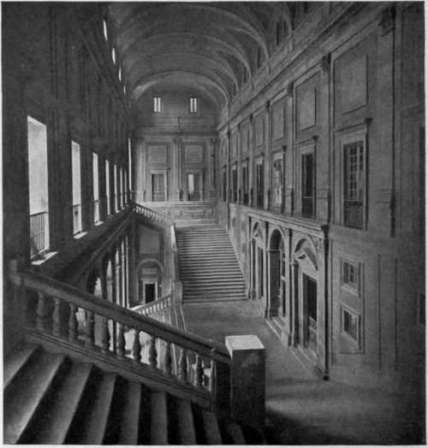
Inside the Alcázar before the bombing

As the priests of Toledo had been killed or fled the town at the outbreak of war, a preacher from Madrid arrive on September 11 and entered the Alcázar to baptise newborns and offer spiritual guidance to the 1000 strong right-wingers, including final absolution in case of death. Again Rojo offered a surrender, but no one would leave the Alcázar; they would rather die than give up. In retaliation, Republicans fired and threw grenades at the Alcázar, destroying all communications with the insiders.

The Chilean ambassador to Spain wanted to help with the negotiations for surrender, but the grenade launch had wiped out all the phones, and at this stage, surrender was no longer an option for the Nationalists.
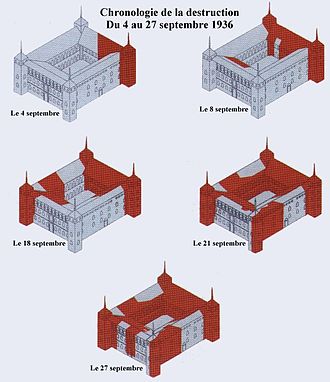
 .

All the while air and ground fire had been sent back and forth, Republicans had been digging tunnels to come up right underneath the Alcázar. By September 18, after a month of digging, the two tunnels were complete and under the southwest tower of the Alcázar. Soon-to-be appointed Spanish prime minister, Francisco Largo Caballero, went into the mines and detonated a huge supply of explosives, which flattened much of the tower. As the dust settled and panic reigned, the Republicans stormed the Alcázar with tanks and armoured cars. Still, they could not get inside the mighty fortress, and constant firing went on for days.

qa7kf

Explosions destroy the exterior

By September 22, all those inside were in the interior courtyard of the Alcázar, and most of the garrison has also left their posts on the exterior of the building for their own safety. Another two days of fighting made no progress for either side.

Just as the siege looked as if it would end with the slaughter of the Nationalists, reinforcements finally arrived in the city.  On September 27, the Republicans, desperate to get inside, had no choice but to abandon their cause and flee to Aranjuez, 44 kilometres north of Toledo. This large withdrawal left few attacking the Alcázar, as they knew of the danger about to arrive.
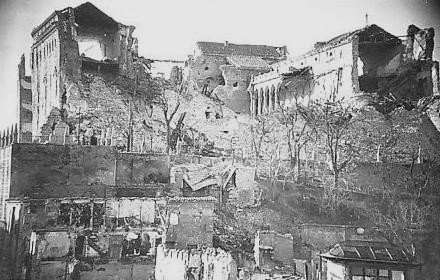
The Alcázar is destroyed into a mess

Nationalist soldiers, consisting of Spanish Legionnaires and Moroccan troops (the Moros), had been marching north from Seville, massacring everyone in their path, their reputations already bloody and horrific. On September 27, all it took was the first 100 soldiers to enter the city and kill everyone still holding out. They also murdered the doctors, nurses and patients in the hospital, all Republicans and their supporters. All those inside the Alcázar were released, only five dead, of natural causes.

For all the killing and the destruction of the nearly 500-year-old Alcázar, Toledo as a location had no strategic value. But the determination of the Nationalists was used a propaganda for those fighting in other areas, and the media took a huge interest in the battle. The arms factory, which was raided early in the war, was the only important location in the area, and was now worthless. The weapons and supplies dropped to help the trapped Nationalists could have been better used in other areas, and even Franco’s advisors were upset Franco even bothered to ‘save’ Toledo at all, when Madrid 55 kilometres north was more important.

Interior of the building after ‘liberation’

Those who escaped after being inside the Alcázar were treated as heroes and used as morale boosters. Much had been made of the Republicans’ mine explosion, with media flocking to see the event. But when the Republicans were forced to flee a week alter, and Franco claimed the town, the Republicans plan to show the world their strength instead showed their terrible loss.
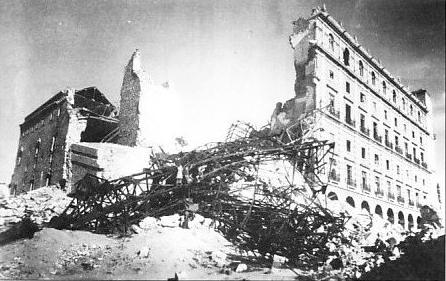
Final destruction

As soon as Moscardo and the others left the Alcázar, the soldiers immediately left Toledo destroyed physically and emotionally, and continued their march north to try to take Madrid. The initial stand-off and attacks on Toledo were all for nothing.
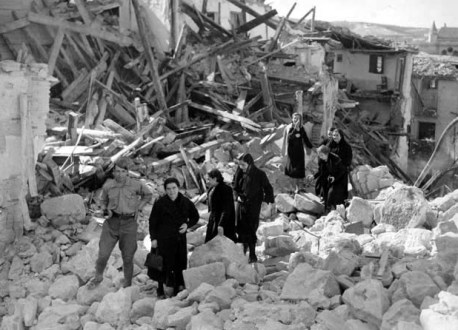
Survivors have to live among their ruined town

The restoration of the Alcázar didn’t begin until well after the war ending in 1939, and today houses the  Biblioteca Autonómica (Castilla-La Mancha Regional Library) the and   Museo del Ejército (Museum of the Army).

The Alcázar today

~~

This is not a detailed analysis, just highlights (lowlights?) of the siege. Feel free to suggest an addition/clarification/correction below. All photos are linked to source for credit.

This Week in Spanish Civil War History – Week 11: 26 September – 2 October 1936

Week 11: 26 September – 2 October 1936

September 26

The Generalitat de Catalunya (government of Catalonia, based out of the capital of Barcelona) increases in size to incorporate more factions fighting for the Republican case. The anarchist CNT-FAI (workers unions) sends ministers, along with the communist POUM (Marxist workers group).

September 27

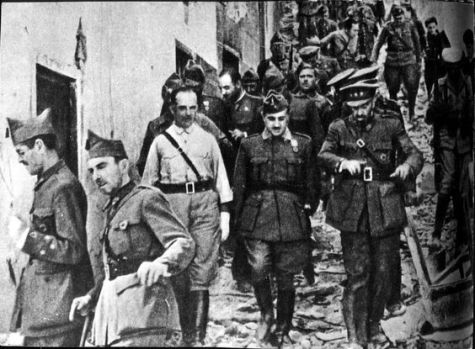
After a siege lasting over two months, Toledo is finally won by the Nationalists. The Legionnaires and Moroccan soldiers (Moros, as they are nicknamed) who have been murdering their way north, reach the city, and 100 men take Toledo, ending the siege on the Alcázar. A group of anarchists set fire to their own buildings and are burned alive so they are not captured and executed. The invading soldiers take the hospital, killing doctors and nurses, as well as the patients. All the Republican hostages that were taken at the start of the siege by Nationalist leader Colonel Moscardo are already found to have been long killed, and all Republicans are either killed or flee the area.

A full ‘This Week In Spanish Civil War History: Extra’ will be published on September 27

9ecc65b2305c11fdfe46f7febc7c831f

Generals Verela, Franco and Moscardo in Toledo after the rebels capture the city

Also…

The Non-intervention Committee is doing a stellar job of not doing nothing to help Spaniards, and doesn’t bother to argue with Portugal over their continued support for the Nationalists. Germany and Italy are also sending weapons and equipment in defiance of the Non-Intervention agreement and the committee doesn’t lift a finger.

September 28

Generalissimo Francisco Franco is named head of the Spanish State by the Junta de Defensa Nacional (Nationalist militarised government) in Burgos, even though Spain has a Prime Minister and government still functioning in Madrid.

39315

Franco: A small man with a heinous attitude and a penchant for massacre (and rumour has it, sporting mangled testicles)

September 29

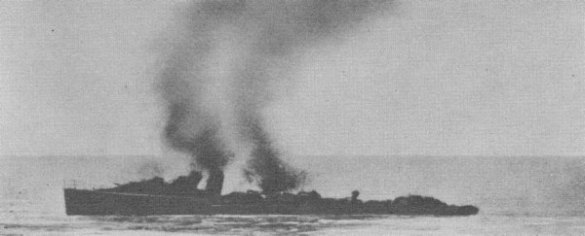
The Battle of Cape Spartel breaks out over control of the Strait of Gibraltar. The navy has been pro-Republican, but Nationalists have held the Galician naval base since the outbreak of war. A Republican ship is sunk and others badly damaged, and just one escapes the battle as the Nationalists also now control this crucial sea passage.

The Almirante Ferrándiz just prior to sinking in battle

September 30

Enrique Pla y Deniel, the Bishop of Salamanca, publishes his famous pastoral letter titled ‘The Two Cities’. He praises the decision of the rebel Nationalists to rise up and start the war. He defends the actions of the rebels and the need to destroy Republicans. He states the war is not a civil war, but a crusade to restore order and crush the ‘heretics’ in government. He also issues a pastoral latter claiming Franco as Spain’s leader, and sends him a telegram to congratulate him for the ‘glorious resurrection of Christian Spain’.

Enrique Pla y Deniel – a bishop with a small mind and a heart filled with hate and control, Catholic style

October 1

The Brigadas Internacionales (International Brigades) are officially formed. It gives a name and organisation to work with the foreign volunteers flocking to Spain to help out. People from 53 nations want to give their help to the Republican cause against the rebels. The group will swell to up to 35,000 fighters, plus 10,000 non-combat roles and up to 5,000 foreign CNT or POUM members. These brave individuals are true heroes, risking their lives for strangers in a strange land, thinking they can save the world from fascism while governments sit idle.

The famous International Brigades become official

Also…

Francisco Franco officially declares himself the Generalissimo in public, and settles into life as the controller of a country out of control. This formally gives him power over the entire Nationalist cause.

And…

The Republican government gives the Basque Country full autonomy, and Jose Antonio Aguirre is elected as leader of Euzkadi a week later. The Basque country is getting little support or outside help, surrounded, and already partly invaded, by the rebels. Autonomy gives them more control over their moves and their own army as they fight to control their region.

Jose Antonio Aguirre – politician, activist, leader

~~

This is not a detailed analysis, just a highlight (lowlight?) of the week’s events. Feel free to suggest an addition/clarification/correction below. All photos are linked to source for credit