HISTORICAL BOOK REVIEW SERIES: ‘The White King: Charles I, Traitor, Murderer, Martyr’ by Leanda de Lisle

From the New York Times bestselling author and master of narrative nonfiction comes the tragic story of Charles I, his warrior queen, Britain’s civil wars and the trial for his life.
Less than forty years after England’s golden age under Elizabeth I, the country was at war with itself. Split between loyalty to the Crown or to Parliament, war raged on English soil. The English Civil War would set family against family, friend against friend, and its casualties were immense–a greater proportion of the population died than in World War I.
At the head of the disintegrating kingdom was King Charles I. In this vivid portrait–informed by previously unseen manuscripts, including royal correspondence between the king and his queen–Leanda de Lisle depicts a man who was principled and brave, but fatally blinkered.
Charles never understood his own subjects or court intrigue. At the heart of the drama were the Janus-faced cousins who befriended and betrayed him–Henry Holland, his peacocking servant whose brother, the New England colonialist Robert Warwick, engineered the king’s fall; and Lucy Carlisle, the magnetic ‘last Boleyn girl’ and faithless favorite of Charles’s maligned and fearless queen.
The tragedy of Charles I was that he fell not as a consequence of vice or wickedness, but of his human flaws and misjudgments. The White King is a story for our times, of populist politicians and religious war, of manipulative media and the reshaping of nations. For Charles it ended on the scaffold, condemned as a traitor and murderer, yet lauded also as a martyr, his reign destined to sow the seeds of democracy in Britain and the New World.

cover and blurb via amazon

~~

I don’t know much about Charles I; he is not in my time period of “expertise”, but since de Lisle is such a good author, I thought it was time to extend my knowledge. A quick internet search of Charles I tells of a somewhat brutal and foolish guy, where things all went wrong around him. But this book doesn’t tell that story. Charles was a man who took his duty as king most seriously, his kingship and his religion were held to the highest of esteem, he cared about his people and honour was his greatest value to maintain.

Charles I was a Protestant man, yet was not harsh on Catholics like rulers before him. It come have been Charles’ lack of will that caused him trouble. His relationship with Archbishop Laud made Charles’ subjects believe he was a Catholic sympathiser, when in fact, his Protestant beliefs were firm in his heart. When the French princess, Henrietta-Marie, a  Catholic, was chosen as queen, these rumours only grew worse.

While the book talks of a man worthy of being king, Charles’ personality did not automatically translate into him being a good leader. He liked to compromise – to the point where he would be on the losing side, but also could be stubborn and refuse to give in when it was in England’s best interest. Charles, ultimately, was a stiff and difficult king, and seemed to want to be seen as a strong leader while still also a protector. Yet it was his stubbornness that would be remembered, as inflexibility caused his people harm.

Married to French Henrietta-Marie, it has been said that Charles was dominated by this woman. Yet that is a combination of male historians and old attitudes assuming any woman with a will and an opinion must be a domineering wench. Henrietta-Marie was a smart woman, trained to be a queen. Perhaps things would have gone differently had Charles listened to his wife more often. The author uses letters which have not been used before, to show what the royal marriage was like, and showed that this prime political match had sense of love to it also. Charles’ mother-in-law was the powerful Marie de Medici, the Dowager Queen of France. Marie was considered the human body of the counter-reformation, a strong Catholic firmly against Protestantism, only to have her daughter marry Charles, leader of Protestant England. Charles and Henrietta-Marie would have had the most fraught and lively marriage one could imagine.

There were figures in Charles’ life which I had never heard of – the Rich brothers. Henry,  1st Earl of Holland, and Robert, 3rd Earl of Warwick, stood in Charles’ way as he looked for the funds to start a war, as decided upon in parliament. Charles needed to protect Protestant needs throughout Europe as the Catholics fought back more than in previous generations. Also rearing its head was Oliver Cromwell’s desire for civil war and to rule in the monarchy’s place. Between the Rich brothers and their cousin named Lucy Percy, Countess of Carlisle, they rose in power as Charles did his fumbling best to save his true religion and his country.

Of course, that genocidal killer, Oliver Cromwell, was doing is best to embrace an England without a monarchy, and after civil wars, poor Charles I was captured and beheaded for high treason in 1649, after 24 years as king. After plenty more fighting, and England spending a decade free of a monarchy, Charles’ son, also Charles, took the throne in his place. How much easier English history would be if Catholic and Protestant factions could just co-exist, even if just within the confines of the royal line!

While I know little about the time period of Charles I, I enjoyed this book, as de Lisle is a wonderful author, creating another book that is fun to read while laced with information you can trust and enjoy. All books by Leanda de Lisle are a must-buy.

HISTORICAL BOOK REVIEW SERIES: ‘Isabella of Castile: Europe’s First Great Queen’ by Giles Tremlett

In 1474, a twenty-three year old woman ascended the throne of Castile, the largest and strongest kingdom in Spain. Ahead of her lay the considerable challenge not only of being a young, female ruler in an overwhelmingly male-dominated world, but also of reforming a major European kingdom that was riddled with crime, corruption, and violent political factionism. Her marriage to Ferdinand of Aragon was crucial to her success, bringing together as it did two kingdoms, but it was a royal partnership in which Isabella more than held her own. Her pivotal reign was long and transformative, uniting Spain and laying the foundations not just of modern Spain, but of the one of the world’s greatest empires.
With authority and flair, acclaimed historian Giles Tremlett relates the story of this legendary, if controversial, first initiate in a small club of great European queens that includes Elizabeth I of England, Russia’s Catherine the Great, and Britain’s Queen Victoria.

cover and blurb via amazon

~~

I love Giles Tremlett’s work so I was greatly looking forward to this book. Isabella of Castile is 600 pages of history, kindly broken up into a timeline of an extraordinary life. Isabella is a well-known figure, and so there are persistent stereotypes of her character, ranging from a vicious religiously-driven invader, to courageous and fierce woman, to powerful and saintly queen.The kingdom of Castile had seen its fair share of powerful queens in its time, with varying results, so when Isabella stepped up to rule, not as a regent wife, but on her own, things were bound to get hectic and history, always written by men, has varied in its narrative.

The book opens with Isabella’s early life in the court of her much older half-brother, Enrique IV. Both Enrique and their father, Juan II, were not great rulers, so Castile was in chaos, and Enrique had ruled the same as his father – weak and easily influenced by others. So, when Enrique died, there was little in the way of support for Isabella, either from royalty, wealthy land-owning grandees or the church to support a female ruler. But Isabella was determined to rule, and rule on her own terms, becoming a fierce leader that would be remembered for all time.

Europe was ready to emerge from the middle ages. Plague was wiping out so many people, so many that the illness was contributing to the feudal system collapsing. Ottoman rulers were conquering and Castile was hoping for Christianity to be their great saviour in a difficult time. The land known as Spain today was filled with Christians, Muslims and Jews, and the notion of a stable mix was a pipe dream.

Even before Isabella was a queen, she was a princess with a plan. There are writings of romance between her and the princely heir of Aragon named Ferdinand, Spain’s other great Christian power. But Isabella married with a pragmatic approach, and relished in the display of her bloodstained bed sheets after the wedding. People hated Enrique and his new rules; Isabella was a traditionalist. While Isabella and Ferdinand were planning their alliance while producing heirs, another Spaniard named Rodrigo Borgia was trying to get onto the papal throne, an ally to Enrique. Spain’s kingdoms were in turmoil on levels often ignored in the story of Isabella’s life.

Isabella politely grieved her awful brother when Enrique died in 1474, and Isabella, in her magnificent walled city of Segovia, was officially made the queen in her own right. It was not long before Ferdinand became king in Aragon. Many thought Ferdinand could not rule his kingdom as well as his wife’s, and she was not capable of doing so alone. Only months after their crownings, war came to the southern areas, which Isabella was able to command on her own. Yet Isabella also found time to bear a son and heir to two kingdoms in 1478. Isabella and Ferdinand had much to control over an enormous area and were making their mark in doing so.

The book delves deep into the southern wars before Isabella and Ferdinand conquered Granada in 1492, exiling the Muslims from Al-Andaluz and creating (approximately) the Spain we know today. Then came the Spanish Inquisition to expel all the Jews, the Muslims who had been forced to convert, and Columbus’ missions to what was the Americas rather than Asia. Isabella gave birth to five children, and suffered the event of the death of her eldest son and heir, Juan, in 1497, meaning Juana (yes, the mad one) was the ruler of Castile, Aragon and Al-Andaluz, now all one nation. Juan’s pregnant wife miscarried the precious child which would have inherited. Isabella had seven children, but one was a stillborn son early on, and another loss of was a twin sister to another daughter who survived. Two of Isabella’s daughters, first Isabella then Maria, married the King of Portugal, and Catherine famously married Arthur Tudor as the century changed. Isabella died of illness in 1504, after enduring a number of years suffering from personal loss.

Isabella was a powerful ruler, understood the limitations of her gender (by their standards), had her name blackened by historians and Italian haters, and was pious yet vicious with her Inquisition. She raged when her husband strayed – frequently – and took no lovers of her own. Isabella’s story is all about power, and she was truly worthy of the opportunity to rule. Thank you to Tremlett for putting all of Isabella’s story together, not just the well-known parts. No part of any book written by this author will disappoint.

NOVEMBER SPAIN BOOK REVIEW: ‘The Moor’s Last Stand’ by Elizabeth Drayson

The Moor’s Last Stand presents the poignant story of Boabdil, the last Muslim king of Granada. Betrayed by his family and undermined by faction and internal conflict, Boabdil was defeated in 1492 by the forces of King Ferdinand and Queen Isabella of the newly united kingdoms of Castile and Aragon. The Christian victory marked the completion of the long Christian reconquest of Spain and ended seven centuries in which Christians, Muslims and Jews had, for the most part, lived peacefually and profitably together. Five centuries after his death, Boabdil continues to be a potent symbol of resistance to the forces of western Christendom, and his image endures in contemporary culture.

Elizabeth Drayson presents a vivid account of Boabdil’s life and times and considers the impact of his defeat then and now.

cover and blurb via amazon

~~

The Moor’s Last Stand focuses on Boadbil, who suffered the great loss of the Alhambra and city of Granada to Ferdinand and Isabella in 1492. While the year is most known for that idiot Columbus stumbling off to find Asia and instead becoming a toxic force in the Americas, what happened to Spain itself is a great tale all on its own.

Much is made of Spain before the period of Ferdinand and Isabella’s ethnic cleansing. It is so often said the Muslims, Jews and Christians were living together in mostly harmony. In Boabdil’s Granada, Christians were slaves, or people tolerated by the free population. People were ‘protected’ by their monarchs, as Isabella believed, and so sought to ‘free her people’, which included Jews, who were owned by her – as she thought, anyway.

Moors (or Saracens as they called themselves) were about 30% of Aragon population, where Ferdinand reigned, used for labour, a commodity to be owned and keep the Christians rich. They ‘converted’ after the expulsion of Boabdil from Spain, and while this conversion was claimed as voluntary, we all know it was not. Christian scholars around Europe considered Spain to be filled with faithless Jews and baptised Moors (their words, not mine), which started the exclusion of the Jews, 300,000 people booted from their homes, many killed over the course of the Spanish Inquisition. While the Inquisition is used mostly in jokes these days, what went on in Spain through forced conversions, the hunting of Muslims and the expulsion of Jews is a subject usually only measured through the success of the Christian successors.

The story of Boabdil is a beautiful book indeed. The Nasrid dynasty is fleshed out by the author. The story tells of Boabdil’s father who took a Christian slave girl as a wife, destroying Boabdil’s mother, and the sons turned from their father, the family all forced to take sides. Boadbil ruled the Muslim south from the Alhambra, and while he was not great in war (captured twice), he did delight on declaring war on his own relatives. This infighting was just a greater force as the Christian ‘conquest’ of Granada in 1492. The moment where Boabdil stopped at the now-named Slope of Tears, the famous words from his mother were uttered – “You do well, my son, to cry like a woman for what you couldn’t defend like a man.” But Boabdil surrendered his city under the terms that Moors would not have to become Christians, and was given the Alpujarra mountains outside Granada, though he was later forced to leave Spain for Africa from the same spot his ancestors came to Spain 700 years earlier.

Naturally, all terms of surrender were broken and the Moors were forced to convert, or were killed or chased away. But, much to Ferdinand and Isabella’s disgust no doubt, the hidden spots of the Islamic rule in Spain still exist today. Spain could have been a powerhouse throughout Europe had the Moors not been turned out. Land would not have been abandoned and barren, art and medicine would not have been forced back in time, the Muslims and Jews not slaughtered and crushed, their cultures and ideas not blacklisted. Thank you to the author for approaching the fight of 1492 from an angle that is easy to read and yet fully explains the other side of the Ferdinand and Isabella conquest.

OCTOBER SPAIN BOOK REVIEW: ‘Petals and Bullets’ by Mark Derby

It was bright moonlight – good bombing light – and once we had to stop and put out our lights as a Fascist aeroplane flew over. They usually come swooping down with guns firing at cars, especially ambulances. Finally we arrived at a town among the hills about 12.30 p.m. Here there is a hospital of about 100 beds in a former convent . . . They expect an attack tonight. – New Zealand nurse Dorothy Morris’s description of her journey to a Republican medical unit of the Spanish Civil War in early 1937

Petals and Bullets is based on the vivid, detailed and evocative letters written by Dorothy Morris to her family in Christchurch, while she was serving in often dangerous circumstances in Spain and other European countries. The letters have been supplemented by wide-ranging research to record a life of outstanding professional dedication, resourcefulness and courage.

Dorothy Aroha Morris (1904–1998) volunteered to serve with Sir George Young’s University Ambulance Unit, and worked at an International Brigades base hospital and as head nurse to a renowned Catalan surgeon. She then headed a Quaker-funded children’s hospital in Murcia, southern Spain. As Franco’s forces advanced, she fled to France and directed Quaker relief services for tens of thousands of Spanish refugees. Nurse Morris spent the Second World War in London munitions factories, as welfare supervisor to their all-female workforces. She then joined the newly formed UN Relief and Rehabilitation Administration, working in the Middle East and Germany with those who had been displaced and made homeless and destitute as a result of the war.

Dorothy Morris’s remarkable and pioneering work in the fields of military medicine for civilian casualties, and large-scale humanitarian relief projects is told in this book for the first time.

cover and blurb via amazon

~~

Spain veined with blood and metals, blue and victorious, proletariat of petals and bullets, alone, alive somnolent, resounding.

The quote from Pablo Neruda starts the book of the life of a woman no one knows, but made a huge difference to the lives of those struggling during the Spanish Civil War. Dorothy Morris was born in Cromwell, New Zealand in 1904, by the mid-thirties was working as a nurse. The book charts her early life in New Zealand, a life filled with change, war and strikes which would have moulded Morris’ plan to live a life of helping others. Gtowing up in Christchurch, Morris left New Zealand for London in 1935, with ideas considered ‘radical’, ready to take on Europe.

Morris spent 1936 in London, helping those who were preparing to leave for Spain as civil war broke out, and helped to raise funds for those in need. But by early 1937, she could stand aside no longer. She applied to go to Spain with Sir George Young, to send ambulances to Málaga in Spain’s south. As they set out for Spain, Franco’s forces destroyed Málaga and the killing reached catastrophic levels. Morris and a small group drove through Europe, managed to get over the border from France, and headed for Valencia. By February 1936, they were all sent to Almería to try save the few refugees that hadn’t been murdered on the roads out of Málaga.

Letters from Morris to her family tell of the horror and desperation in Almería, a small city now filled with traumatised refugees and the threat of Franco’s forces ever-present. Morris was charged with aiding the International Brigades, who were suffering from health problems, horrific injuries and starvation.

Morris was moved to Brunete as the huge battle broke out just a few months after her arrival in Spain. She survived to be moved on to Murcia, to aid starving refugees from Málaga, Cadíz and Seville. She called the place an abyss of misery, a city of just 60,000 which had another 60,000 refugees.

Letters and photos of Morris’ time in Spain are beautifully woven into a story through this book, before detailing how, by February 1939, long after International Brigades had left, Morris had to flee. Sadly, Morris had fallen in love with a Republican doctor, a lover whose name was never revealed. He was sent to the front lines along the Ebro in late 1938, and he disappeared. Morris would never hear from him again.

Morris left Spain via Alicante in February 1939, just before the mass killing of refugees, and went to France, where she would then help the 100,000 men in a refugee camp in Perpignan, and worked to send thousands of Spaniards to Latin America in June 1939.

Morris couldn’t bear to leave the area, and moved to the Pyrenees where she worked helping children in a village name La Coume. Morris served as a nurse throughout the entire WWII, enduring her brothers’ imprisonment in Europe, and was chosen to work for the United Nations from 1944. Morris’ letters tell the story of a strong woman, who truly cared about the plight of the working class, of equality and peace. Dorothy Morris is a woman to inspire everyone after 50 years of caring for the suffering of Europe.

This Week in Spanish Civil War History – November 1937: The Halfway Point

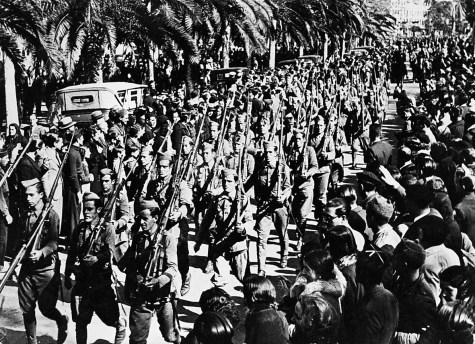
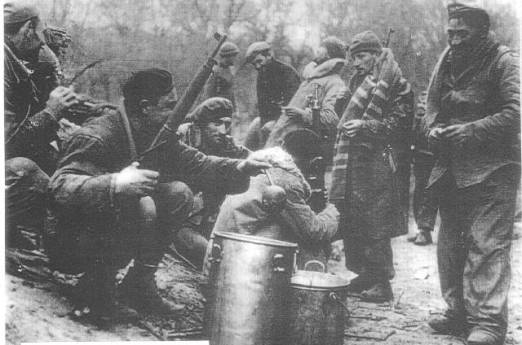
In a war which lasted almost three full years, November 1937 is the approximate halfway point in the destruction of Spain. Spain was already a deeply divided nation, struggling with multiple inside forces and serious social and economic issues, and while civil war is tragic, Spain had come to a point where it was inevitable. The working class was deeply oppressed and dire need for salvation, which could come from nowhere but within. Franco’s initial coup in July 1936 was thwarted only by the men and women who rose up in haste, without training or preparation, in a  desperate attempt to free themselves and save their country from fascism.

(Before we continue, this is a quick round-up of posts I have done throughout the war, not a detailed breakdown. Ease up on the posts saying I wasn’t specific enough. You have been warned. All links open a new tab so you don’t lose the timeline of the events).

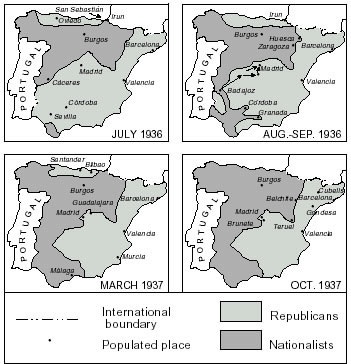
The opening weeks of the war saw Spaniards forced to take sides, to align themselves with the military taking control of their cities and towns, often with the Guardia Civil on their side, or instead arm themselves as best they could and align themselves with the Spanish government, the Republican side, to try to hold off the rebels. Within weeks the battle lines were strong; much of southern Spain was conquered by a marching army of rebels, with massive bloodshed in cities and countryside alike. Madrid, Valencia and Barcelona were firmly Republican and fighting within themselves, while in the north, the Basques, Cantabrians, Asturians and Galicians fought to maintain their autonomy over the rebels. Slaughter occurred in Santander and Asturias as rebels initially overpowered these centres, only to be beaten back again. Much north of Madrid beneath these independent areas backed Franco and the killing continued. Click here to read Weeks 1 and 2:  July 1936

August saw thousands slaughtered in the summer heat. The battle of Badajoz saw up to 4000 killed in days. Cordoba suffered massive fighting and killing as troops stormed the southern city. The famous poet Federico García Lorca was taken and murdered outside Granada. While Madrid continued to defend itself, the nearby town of Talavera de la Reina suffered mass slaughter. Click here to read all of August 1936

September saw the huge attack on the Alcazar of Toledo, as well as the formation of the International Brigades, all foreign volunteers who decided to flood into Spain in an effort to stop fascism taking hold. Major nations such as England, France and the US decided to say out while Hitler and Mussolini decided to back their fascist mate Franco.

Through October and November the killings continued, the Spanish government collapsed, and the Catalonia and Aragon regions in the northeast began life as anarchist regions, creating their social revolution where control was handed back to the people. The siege of Madrid began as Franco fought to take the capital and end the war, and the Russians provided tanks and equipment to aid the socialist/anarchist/worker unions/communist Republicans. In the north, and Asturias took heavy losses as they were bombed from the air by German planes. After leaving Barcelona, Buenaventura Durruti was killed in Madrid, a huge set-back for the social revolution in the northwest. Also in Madrid,  Falange leader José Antonio Primo de Rivera is executed.

By the time the year ended, Madrid had been heavily bombed but not taken by the rebels, and the International Brigades had set up and integrated (as well as they could) into the Republican troops. The Republicans were not taking much ground but continuing to hold main centres in the east, along with Madrid. Click here to read all about December 1936

January and February held battles fought in heavy fog and rain, including much fighting outside Madrid, and Jarama, just northwest of the capital. Militias in Catalonia and Aragon held fast to their social revolution, while the Basques suffered heavy losses again as they held off the rebels. In Málaga in the south, the city was invaded when they could not defend themselves, sending thousands to flee along to the coast to relatively safe Almeria. Thousands were slaughtered as they walked the perilous road, where refugees were exposed, then bombed and shot as they fled. Click here to read about the Málaga/Almería massacre.

The bloody battles of Jarama and Guadalajara continued through March, and in April, 32,000 children started being shipped from the Basque country overseas in order to save their lives. The rebel army of the north is intensifying its efforts, with the now-infamous bombing of Durango and Guernica.

May saw the intense bombing of the new Republican capital city of Valencia, along with the fighting in the May Day fighting in Barcelona. June was an especially brutal month, with huge frontlines drawn up along the region of Aragon, battles in the Sierra de Guadarrama outside Madrid, Bilbao in the Basque Country was bombed and invaded, and in Barcelona, leader Andreu Nín was kidnapped and murdered in a Madrid prison.

Battles around Madrid, in Boadilla, Sierra de Guadarrama and Brunete saw huge fighting and casualties for both sides as the war reached its first anniversary. Legendary war photographer Gerda Taro was killed outside Brunete, and no nation except Russia comes to the Republicans’ aid as they are slaughtered by the fascists and their Moorish soldiers.

August 1937 focussed on the north. With the Basque region taken by the rebels, they turned east to take Santander in the Cantabria region. By September, the fascists again moved east again to take Gíjon in the Asturias region, with heavy mountainous battles taking place on cliffs that had kept Asturias safe from invaders for centuries. By October, Asturias was defeated by the northern army and could keep going west to claim Galicia, and Valencia is stripped of its title of capital of Spain in favour safer Barcelona. The Republican alliances of multiple militias fell apart, and many are fired from government and imprisoned, political alliances were ruined, and the dislike for the powerful communists pulled the left apart. The social revolution has suffered setbacks, including heavy battles and losses in the Aragon region, and there was breakdown of working class support in Barcelona.

By November 1937, the frontlines have moved little in some time, with the exception of the conquering of the northern regions. Madrid remains in Republican hands, along with the Valencia, Aragon, Catalonia and Almería region in the east. All regions have suffered serious losses, but little ground is gained in seriously bloody battles.The north is now under Franco’s control, along with all the south and the western Extremadura region. The strong left-wing cities of Madrid, Barcelona and Valencia are targets for the well-trained fascist brigades. The month of November saw little of major battles taking place, as both sides are exhausted from the fighting, and small breakouts of fighting yield little results for either side. The new target for the fascists is Teruel, a strong city in the Aragon region, which is about to see one of the war’s biggest fights go down in a particularly brutal winter.

~~

This is not a detailed analysis, just a highlight (lowlight?) of the week’s events. Things get lost in translation – Feel free to suggest an addition/clarification/correction below. The more the world remembers, the better. All photos and captions are auto-linked to source for credit, and to provide further information.