SPAIN BOOK REVIEW: ‘Blood Med (Max Cámara 4)’ by Jason Webster

Blood Med jasonwebster.net

Spain is corrupt and on the brink of collapse. The king is ill, banks are closing, hospitals are in chaos, homes are lost, demonstrators riot and rightwing thugs patrol the street. The tunnels beneath the streets are at once a refuge and a source of anger. And as the blood flows Cámara roars in on his motorbike…

 Cámara is back in Valencia, with his partner Alicia and his anarchist, marijuana-growing grandfather Hilario. In the old police headquarters, the mood is tense, as the chief hunts for cuts – who will go, Cámara or his friend Torres? The two men are flung into action investigating the suicide of an ex- bank clerk and the brutal murder of a young American woman. As the city erupts around them, their case takes them into the heart of the trouble.

Photo and blurb from jasonwebster.net

~~

Blood Med is the fourth in the Max Cámara series by Jason Webster, following on from Or the Bull Kills You, A Death in Valencia and The Anarchist Detective. The story starts in early summer Valencia, where Cámara is back at work as the Chief Inspector at the Policía Nacional, after extended leave. Living with his now-unemployed girlfriend Alicia and his grandfather Hilario, readers are instantly given an insight into Valencia and its current state.

The King of Spain is close to death, throwing a huge cloud of uncertainty over the country already on the brink of collapse. As pro-Republican supporters hit the streets, ready to reclaim the nation from its monarchy and right-wing government, Cámara is assigned the murder of a young American blogger named Amy. Thanks to cutbacks in the Jefatura, the decrepit boss, Maldonado, has pitted Cámara against his friend Torres, each given separate cases to solve. In previous times, the pair have been found working together to solve cases and eat paella, but now their separate performances will decide who keeps his job, and who loses everything.

Enter a new character, Laura Martín, the only member of the sexual violence team. The differences between Laura and Cámara are apparent; she is blunt and a stickler for rules, and for some reason Cámara continues to call her by her first name, unlike other female members in the squad. As they search for Amy’s killer, Laura is convinced Amy’s Valencian husband is the culprit, while Cámara feels there are other avenues to explore. While the unlikely pair work together to find out why an everyday girl was murdered execution-style, they quickly find there is nobody they can trust.

It is not only Cámara’s professional life that highlights the corruption and despair of living in present day Valencia. Uneasiness hangs over Cámara’s happy home with the prospect of lay-offs, Alicia has no work, and they are helping Hilario, a golden character if ever there was one. Cámara’s grandfather had a stroke (in the previous book) and has relocated from Albacete. The trio work with the homeless living in underground tunnels abandoned after money to complete the metro lines (the same which destroyed Cámara’s home in book two) dried up. People are broke and desperate. Jobs are nowhere to be found and suicide is on the rise as people are forced from their homes by the banks. The streets are filled with protesters, labelled terrorists by the ridiculous and inept regional government. The striking misery of the city attacks Cámara personally, when he is forced to hunt down medication he needs for his grandfather, as pharmacies are no longer paid by the government, leaving people powerless to care for themselves. Immigrants are being harassed, the poor have nowhere to turn, and banks are being shut corralito style so the city doesn’t go bankrupt.

Cámara’s life falls in a deep pit of anguish and torment (have tissues handy) when the realities of the cutbacks to essential services touch him in such a way that it’s hard to believe Valencian’s live such difficult lives. Despite the immense pain of living in Valencia’s dark and brutal reality, there are still deaths to be solved. As Cámara tries to find Amy’s killer and help Torres with his similar killing, a storm of evil rears its ugly head in the crevices of the city, bringing the murders and corrupt bastards which have destroyed Valencia into daylight.

The book is far removed from the previous in the series. The first two almost seem light-hearted in comparison, such is the decay of Valencia, and the third gave readers an imperative insight to Cámara’s life and family. The book needs no stretches of the imagination – it shows what a blight corruption has made on Valencia. The lack of medical supplies, the rising factions – left and right, the violent divide between the rich and poor are laid bare, in a way no other writer has even attempted to portray. Max Cámara is the one of the few characters I look forward to reading, and along with the others around him. Cámara’s girlfriend, his grandfather, those whom he works with, or meets under the city, all have strong characteristics that make you love or loathe them. Driving on Cámara’s motorbike through the streets, the feelings of both the characters and the once-noble city can easily be felt. So many books talk of sunshine, the food, the beaches, but here is a book that takes on another reality, along with the serious issues which face the region of Valencia, distinct from the rest of Spain. This book was released the same week as the abdication of King Juan Carlos, followed by the streets filled with people, calling for freedom, an eerie coincidence indeed.

There are parts of this book I didn’t enjoy, though this is no disrespect to the author. The fact that women are treated as disposable, cheap fuck-toys to hurt and kill with indifference is hard to read, but is a part of how men from certain lifestyles and values see women. The evil, vulgar and sickening behaviour of the cretins in this book could well use a trigger warning for readers who feel uncomfortable with such sexual violence, something that won’t leave my mind in a hurry. That said, the book should not be dismissed as something using sexual violence for entertainment, rather the author has wandered into territory which is reality in a world gone mad.  The book is credible in its portrayal of Valencia and its current state, as is the feeling of those who are faced with having to struggle in this environment. Readers will be desperate for the vicious thugs, from the violent right-wing Franco lovers on the street, to the other super-scum, those in Valencian power, to be brought to their knees (and worse!). Sadly, whether everyone gets what they deserve in their interlinked web of corruption, either in real life or the Cámara series, will remain to be seen.

Five stars to Blood Med. May the Max Cámara series have a long and illustrious life. I don’t read crime books very often; this is a series worth an exception. Cámara may be king, but Valencia has become a dark queen thanks to Jason Webster.

SPAIN BOOK REVIEW: ‘Soldados de Salamina (Soldiers of Salamis)’ by Javier Cercas

Soldiers of Salamis

In the final moments of the Spanish Civil War, fifty prominent Nationalist prisoners are executed by firing squad. Among them is the writer and fascist Rafael Sanchez Mazas. As the guns fire, he escapes into the forest, and can hear a search party and their dogs hunting him down. The branches move and he finds himself looking into the eyes of a militiaman, and faces death for the second time that day. But the unknown soldier simply turns and walks away. Sanchez Mazas becomes a national hero and the soldier disappears into history. As Cercas sifts the evidence to establish what happened, he realises that the true hero may not be Sanchez Mazas at all, but the soldier who chose not to shoot him. Who was he? Why did he spare him? And might he still be alive?

~

Soldiers of Salamis was first released in Spanish in 2001, just one year after the Association for the Recovery of Historical Memory was founded, set on carrying out the task of excavating bodies left hidden after the Spanish Civil War. The author took on the subject of the war in a time when he felt many of his generation were not talking on the subject, and the 2007 Historical Memory Law, giving the task of digging up the past a mainstream light,  was still far away.  In a time when some voices were still just starting to be heard gain, this book clearly points out that history is merely the opinion of who tells the story, and a hero and villain can be hard to identify when faced with individual tales.

The book is put into three parts. The first tells the story of a journalist, given the same name as the author, who decides to find more about the story of founding fascist Rafael Sánchez Mazas. After an interview with the son of Sánchez Mazas, he writes an article on the man, but decides to find out more. He goes on to find the revealing tale of the night Sánchez Mazas is to be executed in the forest, and the Republican soldier who hunts for him amongst the trees and finds in him cowering the dark, and yet turns away and lets him live. Sánchez Mazas goes on to struggle to survive in the hills outside Girona, and after being taken in by a generous family, he meets three Republican men, who know that they are about to be the losers of the war. Despite their differences (Sánchez Mazas is the highest living member of the fascist party in Spain) they become friends in a brief yet solidifying time in 1939. The tale is written as if the author is retelling what he has heard, giving it a personal approach.

The second part tells the story of Sánchez Mazas, biography style, of an upper class man who shows great talent for writing, but cares little for publishing his poetry. Married to an Italian, he sees value in Italy’s fascism policies and seeks to recreate such ideals in his home nation. After hiding in the Chilean embassy for the first year of the war, he is then taken prisoner on the ship Uruguay until the end of the war, when he is taken to the countryside to be killed by firing squad. There his miraculous escape occurs.

The third book is more fiction, where the journalist Cercas is determined to seek out the Republican solider who let Sánchez Mazas go free. Cercas meets Miralles, a former French Foreign Legion with a history of brave Civil War tales. Miralles never confirms that he indeed was the soldier who chose to set Sánchez Mazes free, despite the journalist being convinced he has found the right man.

Throughout the book, Sánchez Maza’s little green notebook is mentioned, written as he struggles through the forest with his unlikely friends, who are also the enemy. All men went on to live lives of vastly different stature after the event, and the little notebook attempts to give details and validity of the story of Sánchez Mazas, his firing squad escape and battle for survival.

Most Civil War tales tend to be told from the Republican point of view, but the author chose to see it from the Nationalist point of view instead, and makes no assumptions. Never is Sánchez Mazas considered a hero in the book, and neither are opposing soldiers during a time when Spain changed forever. It shows how each individual was their own man, fighting through the turmoil that erupted around them. A moment of a shared gaze between a fleeing fascist and a Republican, who chose not to pull the trigger is the centre, along with the certainty that men are men, never heroes in war.

Rafael Sánchez Mazas seems to be someone not spoken of often, which seems unusual. A founding member of the Falange, he escaped the fate of his collaborator Jose Antonio Primo de Rivera. After spending his pre-war years setting up Falange newspapers and various other publications, and years as a prisoner, he went onto be a minister in Franco’s government, and his sons and grandsons now are also writers. Soldiers of Salamis was translated into English in 2003 and made into a movie in Spain, Soldados de Salamina, the same year. The book was a best-seller in Spain, and I am ashamed to admit it has taken me this long to read the book. It is rare to read a Civil War book which such a lack of prejudice.

Valencia Photos of the Month: Palacio Ripalda

After doing a well-known landmark in the last installment, this week is an iconic Valencian scene that was wiped from the earth in a moment of a politician’s stupidity. Not sure which one? Palacio Ripalda, which would sit on the north side of the Turia over the Pont del Real bridge, had the castle not met its demise.

In 1889, María Josefa de la Peña Paulín, the Countess of Ripalda, commissioned a palace from architect Joaquín María Arnau Miramon, on Paseo de la Alameda, over the river from the central city of Valencia. The design copied French chateaus, unseen in Valencia, and construction was complete in 1891. The castle mimicked the rise and fall of the family who had her built.

The tale starts with the story of  José Joaquín Ramón Sánchez Agulló de Bellmont y Ripalda, Count of Ripalda, a member of a rich ancient family who had owned many properties through the Valencian province. As typical in Spain and its feudal system, the family had a noble title and was super rich for centuries, and lorded over property here, there and everywhere. The family had streets, suburbs, walkways and lands named after them wherever they owned property. The Count was a fine arts lover and was president of the Royal Academy of San Carlos from 1860 until 1868. He also worked for the Real Sociedad Económica de Amigos del País (Royal Economic Society of Friends of the Country).  In 1863 when the International Red Cross was founded in Geneva, Ripalda was Spain’s representative and was also a conservative MP in Valencia. He went to be the president of the Red Cross in Spain, and generally lived a happy, rich lifestyle.

In 1876, Count Ripalda died, his French-Spanish aristocracy wife, Countess Maria Josefa inherited his fortune and property. She set to building the Passatge Ripalda (off Calle San Vicente), an alleyway of shops in a new European style. Apartments were built around the passage, giving it an arcade feel and led out onto Plaza Pelota (now Calle Moratín). She also commissioned a grand hotel, home to Valencia’s first elevator. But the big project came when the Countess decided to build a grand family home on the farmlands on the edge of Valencia city, next to the Jardines del Real (Royal Gardens) and along Paseo de la Alameda, the road against the edge of the river. After multiple drawings and changes with her architect, Joaquín María Arnau Miramón (who also did Passatge Ripalda, and was said to have an ‘intense professional relationship’ with the Countess, make of that what you will), the project went over budget but was completed to the Countess’ whims. The Countess didn’t live long after her castle was completed, but had enough time to fill the place with fine furnishings and artworks, all of which disappeared over time.

The castle belonged to the next Countess, but when Valencia became the capital of Spain during the civil war, Palacio Ripalda became the headquarters for the Ministry of Commerce. The last Countess died not long after the war was over and with no children, the castle was handed to her nephews, not part of the ancient Ripalda lineage. The royal title has since been renewed when relatives were appointed the Countess and Marquess name.

Palacio Ripalda fell into a state of disrepair, and while the outside facade remained in relatively good condition, the interior was said to have suffered, though this is in dispute. As time went on, and Valencia entered its construction boom of the 1960’s, the castle and its gardens started to get in the way of a new era of the city.

In 1967, as the castle sat unoccupied, Valencian mayor Adolfo Rincón de Arellano wanted to demolish and redesign the trade fair grounds next to the castle as the city expanded. It was quickly decided the castle too had to go. Despite complaints from locals and the press weighing in to save the landmark, with the help of politicians and businessmen getting together for their own gain, the castle was swiftly torn down in the name of progress. Legends started to swirl that the castle would be moved to Florida, where the stones had been sent, to rise up again, though it was more fancy than reality. The castle was torn down 100 years after another idiot spot in Valencia’s history – the tearing down the city walls, which would have made Valencia a (even more) unique location. Time obviously doesn’t stop politicians from making bad decisions.

After the demise of the castle, an apartment building was built, called the Pagoda, which isn’t exactly pleasing to the eye (though the apartments inside are nice and simple enough, I suppose). The Monforte gardens remain behind the complex, a little ode to the palace that once belonged to the regal Ripalda family.

Historical photos courtesy of Valencia Historia Grafica 

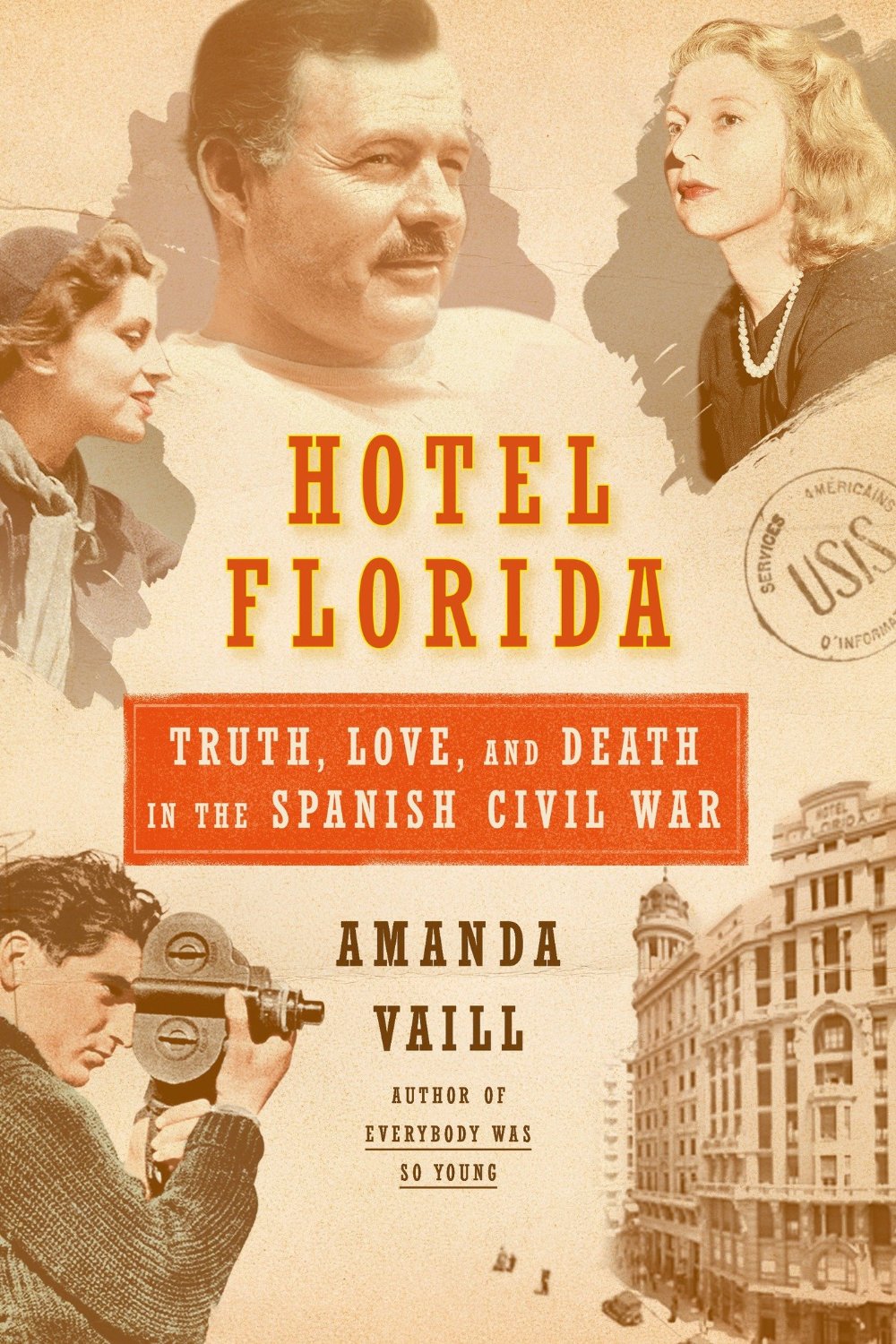
SPAIN BOOK REVIEW: ‘Hotel Florida: Truth, Love, and Death in the Spanish Civil War’ by Amanda Vaill

Hotel Florida

Madrid, 1936. In a city blasted by a civil war that many fear will cross borders and engulf Europe—a conflict one writer will call “the decisive thing of the century”—six people meet and find their lives changed forever. Ernest Hemingway, his career stalled, his marriage sour, hopes that this war will give him fresh material and new romance; Martha Gellhorn, an ambitious novice journalist hungry for love and experience, thinks she will find both with Hemingway in Spain. Robert Capa and Gerda Taro, idealistic young photographers based in Paris, want to capture history in the making and are inventing modern photojournalism in the process. And Arturo Barea, chief of Madrid’s loyalist foreign press office, and Ilsa Kulcsar, his Austrian deputy, are struggling to balance truth-telling with loyalty to their sometimes compromised cause—a struggle that places both of them in peril.
     Hotel Florida traces the tangled wartime destinies of these three couples against the backdrop of a critical moment in history. As Hemingway put it, “You could learn as much at the Hotel Florida in those years as you could anywhere in the world.” From the raw material of unpublished letters and diaries, official documents, and recovered reels of film, Amanda Vaill has created a narrative of love and reinvention that is, finally, a story about truth: finding it out, telling it, and living it—whatever the cost.

~~

I rarely read reviews before I start reading a book, so they don’t influence my opinion while reading. However, Hotel Florida seemed to pop up everywhere just prior to its release, with reviews written by those with advance copies and the like. Once I received my own copy of the book, I already had the opinions of others going around in my head. For once, it’s not a big deal, and the word that seems to be thrown at this book is ‘compelling’. With characters like Hemingway, Capa, Taro and Gellhorn, how could it be anything but compelling? Given that these characters are not new to anyone, how can pre-conceived stereotypes of characters not interfere with reading? There was only one way to find out.

For those without knowledge of the Spanish Civil War, the book starts out with timelines and facts of the who/what/ where/why’s of the conflict. I must confess I skimmed over these since I already knew the details, but this would prove invaluable to those who need to be shown the way through the civil war. They immediately show a reader that the author has gone to a great deal of effort to produce a quality read.

The book has a stellar cast – Ernest Hemingway, (the man who needs no introduction, booze, girls, writing and fighting), Martha Gellhorn (the hardest character to like, known for being lazy and lying), Robert Capa (brilliant but also fluid with the truth), Gerda Taro (young, intelligent, easy to root for, killed in her prime), Arturo Barea (a budding Spanish writer, a character who could have a whole book to himself) and Ilsa Kulcsar (a brave and intelligent Austrian leftist assisting Barea in his pursuits).

These three couples don’t have a large deal of interaction in the books, and the reader gets to jump from the mind of each character chapter by chapter, in a book which moves at a quick pace. The danger faced in Spain as intensely real and would leave a mark on each of these people forever. Hemingway folds into the role he is known for – brash, loud, writing well enough to tell the world what was happening in Spain, but also jealous and petty around other people. Gellhorn wiggles her way into Hemingway’s life, and his marriage, always possessing the air of someone who can’t be trusted, but could be a good writer with more effort. No one could ever suggest going to Spain during the war was an easy task, and these two were changed by their experiences, but at times seemed to be enjoying the war. It was a grand adventure, of front line reporting and loud Madrid parties. Fans of Gellhorn may enjoy her role in this book, though to the less informed reader, she seems like a privileged girl who lives on her whims. Only after her time in Spain did Gellhorn really come into her own, which only served to crush her marriage to Hemingway.

Capa and Taro are an infamous pair, escaping unsafe homelands in Germany and Hungary, changing their names, and setting out to make a massive impact on how the world saw the Spanish Civil War. The iconic moment when Capa (may or not may not – the book doesn’t say) faked the shot of the falling soldier weaves its way into the narrative as the pair photograph the war. It’s been said that Taro was the genius of the pair, but her death was cruel and left a deep wound in Capa, who had found a soul-mate in Taro in more than a romantic sense. The pair makes for reading that would interest even those who don’t know their exploits and photographs.

Arturo Barea is the best character in the book. The Madrileño, who opens the book contemplating how he doesn’t love his wife or mistress, has a quality different to the others. Barea has more faith in the telling the truth and doesn’t enjoy twisting the facts to make reports sound more favourable for the ever losing Republicans. While Hemingway, Gellhorn, Capa and Taro are not fixated on the truth, rather getting published, Barea is left at odds with them all. Barea finds Hemingway and is ilk to be ‘posturing intellectuals’, and Barea better understands what is stake during the conflict. The Spaniard can see the fate of the Republicans as the war unfolds and realises all Spaniards are going to pay and suffer as a result of the fighting. While others can flee, it is Barea’s home that has to live with the realities of war. He engages in an affair with Ilsa Kulcsar, who had come to Spain from Austria in an attempt to aid the Republicans, and Barea divorced his wife to be with Ilsa, which meant he never saw his children again. By the end of the war, Barea and his disdain for the war and those around him made him an outcast, and he and Ilsa had to flee to Paris with little more than the clothes on their backs. They made lives in Britain with their knowledge of Spain, war and languages in what appeared as a life long love affair.

I wasn’t sure what to expect when reading Hotel Florida – fitting all these larger-than-life characters into one book can’t be easy. It is described as ‘a narrative rather than an academic analysis’, which gives the possibility for rich, engaging characters. All the reviews I have read rave about the work, no doubt because of the level of effort Vaill has exuded while writing. While reading, I couldn’t be sure how I felt about the book – the pace made me feel as if I had fact after fact tossed to me, with so many details to absorb as the characters sped along. The book has an ode to Hemingway with some  long sentences – I counted one at 76 words, just as in the style of the big man himself. Being a narrative, I expected to be shown the story rather than to be told the tale, but this did not happen. The story of Hotel Florida is told to the reader; it does not unfold in any way, rather all the details are laid out and presented. Readers do not need to imagine anything, nor put the pieces together, rather everything is laid on the table with sharp sentences. While you cannot doubt the level of devotion Vaill has for her characters, they don’t have personalities, and readers need to rely on the details given out when engaging with these well-known people. Anyone who has edited a book knows the irritation of having to reduce adverbs or fix sentences ending in a preposition, and these basics haven’t been done in this book, but it makes the story more relaxed as a result.

The book ends with forty pages of notes (around 25% of the book on my Kindle), which shows how much effort the author put into this book. The attention to detail is meticulous, and much credit should go to Vaill for her hard work and commitment to perfection. If you are looking for a sweeping tale of wartime Spain this may not be the book for you, but if are looking for a tell-all of famous faces, then you have come to the right place. An added bonus is the cameo roles of powerhouses such as George Orwell, Kim Philby and others who also made their names in Spain in this era. Whether you want war, idealism (foolish or otherwise), love, lust and sex, or celebrity jealousy and pettiness, Vaill has rolled them together in Madrid’s Hotel Florida.

SPAIN BOOK REVIEW: ‘Unlikely Warriors’ by Richard Baxell

When a Nationalist military uprising was launched in Spain in July 1936, the Spanish Republic’s desperate pleas for assistance from the leaders of Britain and France fell on deaf ears. Appalled at the prospect of another European democracy succumbing to fascism, volunteers from across the Continent and beyond flocked to Spain’s aid, many to join the International Brigades.

More than 2,500 of these men and women came from Britain, Ireland and the Commonwealth, and contrary to popular myth theirs was not an army of adventurers, poets and public school idealists. Overwhelmingly they hailed from modest working class backgrounds, leaving behind their livelihoods and their families to fight in a brutal civil war on foreign soil. Some 500 of them never returned home. 

In this inspiring and moving oral history, Richard Baxell weaves together a diverse array of testimony to tell the remarkable story of the Britons who took up arms against General Franco. Drawing on his own extensive interviews with survivors, research in archives across Britain, Spain and Russia, as well as first-hand accounts by writers both famous and unknown, Unlikely Warriors presents a startling new interpretation of the Spanish Civil War and follows a band of ordinary men and women who made an extraordinary choice.

~~

This book caught my eye while I waited in the entry queue at the Museo Nacional Centro de Arte Reina Sofia in Madrid last year. Off to see the Dali exhibit, along with a trip to see Guernica and the civil war exhibition for a second time, I spotted this book in the gift shop as I shivered in the cold. Me – war book – sold.

Talk about finding a gem. Unlikely Warriors is a remarkable accomplishment, with solid five-star reviews for excellent reason. Baxell has taken research to a new level, and used archives and interviews in the UK and the Abraham Lincoln files in New York, and material not yet published. Interviews from the Imperial War Museum in London have been accessed to give a rich account of those who went to Spain to fight the righteous fight. The International Brigades have been fleshed out like never before, along with those who went to fight for various other factions, including those who went to serve Franco’s side.

The book starts off with the realities of life in the UK for those who heard the calling to Spain. While the stereotypes stated that volunteers were ‘radical romantics or middle-class Marxists’, the reality was far different. A large majority were working class, and no doubt imagined they understood the battle that Spaniards faced. However, the upper class, intellectuals and writers were littered among the brave men, from a great range of lifestyles across the class divide. What the International Brigades had was working class men fighting alongside those highly educated, for a common cause, and Baxell has written about these people in a fluid and enjoyable down-to-earth style. The men, the majority Communists, fought under the premise that if Franco won in Spain, Hitler would then go on to victory with his own endeavours. While Britain and France sat idly by, individuals were able to see past self-interest and faced a brutal reality for the common good.

The reality put volunteers at a disadvantage from the start, with many without military training, and provided with exceptionally little. With the International Brigades, just one part of many groups fighting together in an uneasy alliance for the Republican cause, leadership was haphazard, as was any type of planning, along with weapons and gear given. While many volunteers were Communists, those in power among the forces also had to battle against other leaders from other groups. It meant that those on the ground never genuinely formed a coherent group, unlike the united forces under Franco. The massive battles undertaken by British forces, such as Madrid, Ebro, Brunete and Jarama, were bloody affairs littered with an enormous death toll. Just the struggle alone within the medical divisions was horrific as they fought to save the lives of young men, whose cause became increasingly hard to identity. Fighting fascism is a broad notion, to be romanticised as men, gun in hand, throw themselves at the enemy, but Baxell does not subscribe to this notion. The author gives a more realistic and honest account of war, where individuals are convinced of one thing at home, and struggle when faced with the gruesome battles in Spain. Some volunteers were hopelessly inadequate for the war in Spain, due to age or experience, and some were there for the wrong reasons.

Unlikely Warriors doesn’t just cover what happened in Spain. The book explains how these volunteers suffered, and many were lost, but those who survived considered their fight to be one of the greatest moments in their lives. Many went home with little or no regrets. The May Day battles in Barcelona are well covered in the book, explaining how the communist sympathisers fought enemies on all sides. When international volunteers were all ordered out of Spain in late 1938, dreams of these men being able to live in Spain as citizens were not realised until long after Franco’s death. Tales of men held prisoner are told with clarity, showing what many volunteers endured through their time on the peninsula. While British men went home once their battalions got disbanded, they struggled to enlist to serve in WWII and some nationalities were either imprisoned or stripped of their home country citizenship. Their battles did not win the war, just as Europe fell into a state which allowed evil to flourish.

Baxell has created a book where those new to the subject can learn and understand, but at the same time, give more knowledgeable readers a more personal and vulnerable perspective to the battles. Many books on the war can read as stiff or academic, but Baxell has created a marvellous account which humanises but does not romanticise the role of international volunteers in a complex war. The book breaks down the struggles in Spain, to give a realistic account of what life was like for those who sacrificed for a cause which did not succeed in victory. Unlikely Warriors is a must-read for anyone interested in Spain and its recent history.

Richard Baxell is a research associate at the London School of Economics and a trustee of the International Brigade Memorial Trust. Learn more about the author on his website – Richard Baxell

Purchase Unlikely Warriors on Amazon

On Wednesday 30 April, Richard Baxell will be appearing at Offside Librería bookstore in Madrid, giving a presentation on his work from 8pm.

Book covers and blurb via Amazon