This Week in Spanish Civil War History – Week 11: 26 September – 2 October 1936

Week 11: 26 September – 2 October 1936

September 26

The Generalitat de Catalunya (government of Catalonia, based out of the capital of Barcelona) increases in size to incorporate more factions fighting for the Republican case. The anarchist CNT-FAI (workers unions) sends ministers, along with the communist POUM (Marxist workers group).

September 27

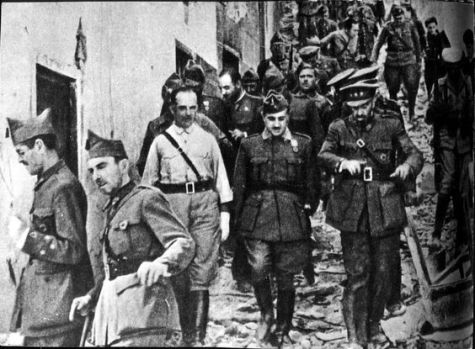
After a siege lasting over two months, Toledo is finally won by the Nationalists. The Legionnaires and Moroccan soldiers (Moros, as they are nicknamed) who have been murdering their way north, reach the city, and 100 men take Toledo, ending the siege on the Alcázar. A group of anarchists set fire to their own buildings and are burned alive so they are not captured and executed. The invading soldiers take the hospital, killing doctors and nurses, as well as the patients. All the Republican hostages that were taken at the start of the siege by Nationalist leader Colonel Moscardo are already found to have been long killed, and all Republicans are either killed or flee the area.

A full ‘This Week In Spanish Civil War History: Extra’ will be published on September 27
9ecc65b2305c11fdfe46f7febc7c831f

Generals Verela, Franco and Moscardo in Toledo after the rebels capture the city

Also…

The Non-intervention Committee is doing a stellar job of not doing nothing to help Spaniards, and doesn’t bother to argue with Portugal over their continued support for the Nationalists. Germany and Italy are also sending weapons and equipment in defiance of the Non-Intervention agreement and the committee doesn’t lift a finger.

September 28

Generalissimo Francisco Franco is named head of the Spanish State by the Junta de Defensa Nacional (Nationalist militarised government) in Burgos, even though Spain has a Prime Minister and government still functioning in Madrid.

39315

Franco: A small man with a heinous attitude and a penchant for massacre (and rumour has it, sporting mangled testicles)

September 29

The Battle of Cape Spartel breaks out over control of the Strait of Gibraltar. The navy has been pro-Republican, but Nationalists have held the Galician naval base since the outbreak of war. A Republican ship is sunk and others badly damaged, and just one escapes the battle as the Nationalists also now control this crucial sea passage.
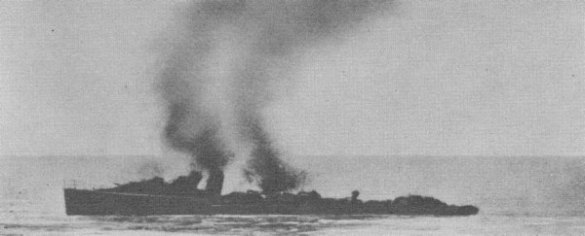
The Almirante Ferrándiz just prior to sinking in battle

September 30

Enrique Pla y Deniel, the Bishop of Salamanca, publishes his famous pastoral letter titled ‘The Two Cities’. He praises the decision of the rebel Nationalists to rise up and start the war. He defends the actions of the rebels and the need to destroy Republicans. He states the war is not a civil war, but a crusade to restore order and crush the ‘heretics’ in government. He also issues a pastoral latter claiming Franco as Spain’s leader, and sends him a telegram to congratulate him for the ‘glorious resurrection of Christian Spain’.

Enrique Pla y Deniel – a bishop with a small mind and a heart filled with hate and control, Catholic style

October 1

The Brigadas Internacionales (International Brigades) are officially formed. It gives a name and organisation to work with the foreign volunteers flocking to Spain to help out. People from 53 nations want to give their help to the Republican cause against the rebels. The group will swell to up to 35,000 fighters, plus 10,000 non-combat roles and up to 5,000 foreign CNT or POUM members. These brave individuals are true heroes, risking their lives for strangers in a strange land, thinking they can save the world from fascism while governments sit idle.

The famous International Brigades become official

Also…

Francisco Franco officially declares himself the Generalissimo in public, and settles into life as the controller of a country out of control. This formally gives him power over the entire Nationalist cause.

And…

The Republican government gives the Basque Country full autonomy, and Jose Antonio Aguirre is elected as leader of Euzkadi a week later. The Basque country is getting little support or outside help, surrounded, and already partly invaded, by the rebels. Autonomy gives them more control over their moves and their own army as they fight to control their region.
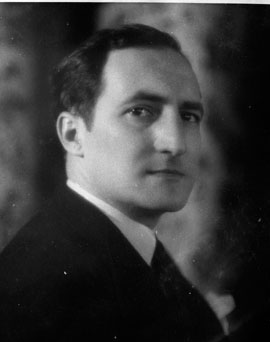
Jose Antonio Aguirre – politician, activist, leader

~~

This is not a detailed analysis, just a highlight (lowlight?) of the week’s events. Feel free to suggest an addition/clarification/correction below. All photos are linked to source for credit

This Week in Spanish Civil War History – Week 10: 19 – 25 September 1936

Week 10: 19 – 25 September 1936

September 19

The island of Mallorca has been in Nationalist hands again since September 12, when the Republicans retreated away from the beaches of Punta Amer and Porto Cristo, after a month of fighting to regain the island. With all Republican militia gone from the Balearic Islands area, Ibiza is captured by the Nationalists with swift action, with no fighting taking place.

September 20

The island of Formentera, the most southern of the Balearics, is taken easily by the Nationalists. All the islands of the Balearics are now in Nationalist control, with the exception of the northern island of  Menorca. The Balearic Islands are small, but a good strategic location for aircraft to be based, for bombing the coastal cities such as Barcelona and Valencia. Italian planes are primarily based there for such activities heading to the mainland.

franco-jong

Franco, September 1936

September 21

The leaders of the Nationalist forces (and boy, are there many) come to an agreement that Francisco Franco will be the ‘supreme commander’ of the rebels. He is stylised the Generalissimo. Naming Franco the leader will have a huge impact on the direction and success of the rebels.

Meanwhile, in Toledo…

Ongoing destruction of the Alcázar

September 21

The bombing of the Alcázar has left it all but destroyed. Communication has been cut off between the Nationalists inside and their support outside, and a retreat is made by outside forces, as there is little left to defend. The ongoing battle is symbolic of the war now, and used in propaganda, and so the Nationalists still refuse to surrender.

September 22

The Republicans continue to attack the building and its rubble, unaware that the garrison inside has abandoned much of the Alcázar.

September 23

A 5am raid on the Alcázar surprises the Nationalist garrison inside with dynamite and grenades. The Nationalists are now all gathered in the interior courtyard of the Alcázar, most of the building collapsed around them. Tanks arrive during the morning to continue pounding away at the Alcázar, but returning Nationalist reserves arrive to fight back the Republicans for yet another day.

September 24

Franco decides, against the advice of his German counsel, to delay his siege on Madrid. Instead, with his troops continuing their march north to the capital, Franco decides to send them to Toledo to save those Nationalists inside the Alcázar. The siege has only a few days left, yet will be a bloody battle, slaughter ending its dramatic fighting. The troops of Spanish Legionnaires and vicious Moroccan soldiers are only a dozen kilometres away now.

NB – there will be a ‘This Week in Spanish Civil War History Extra’ post on the Alcázar on September 27

Damage has made the Alcázar unrecognisable

Also…

September 24

The Nationalist Junta (the National Defense Committee who control and rule over the Nationalist-held areas) decide to annul all the agrarian reforms which have taken place since the February 1936 election, in which the Republican’s Popular Front won. Most agrarian reforms involved the distribution and redistribution of agricultural lands, and rules regarding the rights of rural workers. They’re the people suffering the most, before and during the war, and their rights are once again decimated to nothing.

~~

This is not a detailed analysis, just a highlight (lowlight?) of the week’s events. Feel free to suggest an addition/clarification/correction below. All photos are linked to source for credit

This Week in Spanish Civil War History – Week 9: 12 – 18 September 1936

Week 9: 12 – 18 September 1936

The Nationalists march into San Sebastián

September 13

The Basques surrender San Sebastián as the Nationalists advance after their win at Irún two weeks ago. After the death and destruction of Irún, the people let the Nationalists come in without a single shot fired, but anarchists who are running want to burn the city, as in Irún. The Basques turn on one another to ensure the city isn’t destroyed, and the anarchists are killed. An estimated 30,000 (of a total of 80,000) people flee San Sebastián west towards Bilbao, the Basque Country’s biggest city. The evacuation was planned, but 600 people are murdered by the Nationalists after their victory parade, include the mayor and 17 priests who are loyal to the Basques. The Basque language is also banned.

Also…

The Republican government decide to send some of their national gold reserves to the Soviet Union. The gold will be used as security for future purchase of equipment and materials. While the Republicans need the supplies, they get less than half of the gold’s value in equipment.

September 14

The siege of Santuario de Nuestra Señora de la Cabeza begins in Andújar, near Jaén, in the south. Around 1,200 Nationalist civilians guarded by Guardia Civil members have been in the hilltop Nuestra Señora de la Cabeza church since August, as the town as been held by the Republicans. The Republicans now begin the battle to take the church and capture or kill the Nationalist supporters on the hill. The Nationalist leader wants to surrender, but is overthrown for another commander, who refuses to surrender, starting the siege. Luckily (for the Nationalists) they are dropped supplies from the air so they can hold out on the hilltop, for what is the first day in an eight month battle.

The Nuestra Señora de la Cabeza before the bombings

September 14

Pope Pius XI speaks out against the the Republican Government for their actions, and its ‘satanic hate against God’ (nicely forgetting all the harm the church has done to the people). Despite the war being almost two months old, this outrage only comes after the murder of Josep Samsó of the Santa María de Mataró basilica in Barcelona. After being imprisoned, he was then taken and executed, a fate given to countless priests.

September 16

The Nationalists take the town of Ronda in the south. Ronda had been under the control of Republicans since the war’s outbreak, and many churches destroyed and priests killed. General Verela takes the town and starts the executions. Many flee to Malaga nearby, still under Republican control, and some flee into nearby hills. Rumours of the fleeing Republicans living as bandits in the hills persist for another 15 years.

The Ronda bridge over the El Tajo gorge. Both sides of the war pushed their prisoners from the edge, and the prison cell in the bridge was used for torture

September 18

Continuing on from last week’s failed negotiations in Toledo (see here if you missed it)…

For the past month, Republicans have been digging two tunnels, mining to get under the southwest tower of Toledo’s famous Alcázar, which has 1,000 Nationalists inside, refusing to surrender. The mines are done, and Prime Minister Francisco Largo Caballero detonates an early morning bomb, which destroys the tower completely. As those inside cope with the surprise attack, the Republicans launch a four-pronged attack of the Alcázar in tanks and armoured cars. The Republicans still do not get inside the Alcázar, and continue their attack for another night and day with aerial bombing. The Alcázar is now heavily damaged and the two-month siege will soon come to an end.

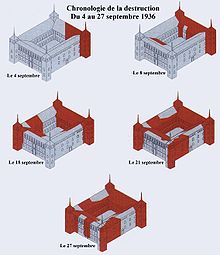
Timeline of the Alcazar destruction

~~

This is not a detailed analysis, just a highlight (lowlight?) of the week’s events. Feel free to suggest an addition/clarification/correction below. All photos are linked to source for credit

This Week In Spanish Civil War History Extra: ‘Falling Soldier’ by Robert Capa – 5 September 1936

“With lively step, breasting the wind, clenching their rifles, they ran down the slope covered with thick stubble. Suddenly their soaring was interrupted, a bullet whistled — a fratricidal bullet — and their blood was drunk by their native soil” – French magazine Vu 23/9/36

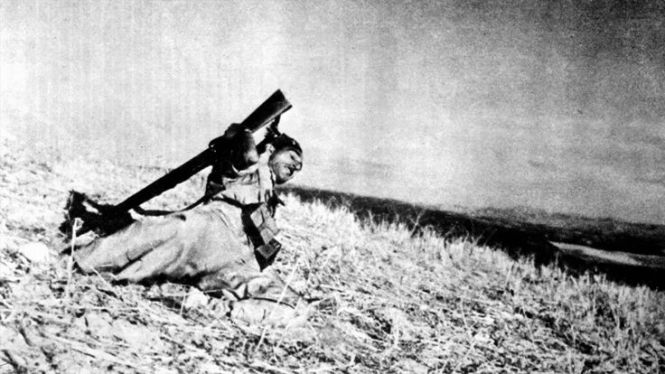
The Falling Soldier, Loyalist Militiaman at the Moment of Death, Cerro Muriano, September 5, 1936

The Falling Soldier is one of the world’s best known war photographs of all time. Taken by Robert Capa on 5 September, 1936, during the battle for Cerro Muriano, a town 20 kilometres north of Córdoba.

The man in the photo is Federico Borrell García, a 24-year-old man from Alcoy/Alcoi in the Valencia region. He had traveled as part of the Columna Alcoiana sent to Córdoba to help them fight off the ever-advancing Nationalist forces. Borrell, nicknamed Taino, was shot at around 5pm at La Loma de las Malagueñas, a hill outside the town of Cerro Muriano, when the column was attacked from behind. He was the only man in the Columna Alcoiana to be killed that day.  The photo is listed to show a man from the Iberian Federation of Libertarian Youth (FIJL), but Borrell, an anarchist, was later identified through the photo by his brother, Everisto.

Falling Soldier shows Borrell at the moment of death. He was shot through the head (some reports say the heart), killing him before he even fell. The photo was one of seven taken in sequence quite by luck (on Capa’s part at least) before Borrell lands on his back, with his rifle still slipping from his hand. At the time, Robert Capa was in a gully/trench on the hill, hidden from the enemy fire, holding his camera high above his head to capture the fighting. Soon after, Falange members from the Nationalists claimed the photo was a fake, but for forty years, the photo was considered one the best war shots of all time (the other great shot, also Capa’s, was of soldiers landing on D-Day).

image-1-in-series-capa_big_pic3

Posing in the gully – Borrell is the man on the left above, and then the man below –

Capa,_Death_of_a_Loyalist_Soldier

These photos, shot six and seven in the sequence, are of another man, the man third of the left in the top photo –  

9b049a5e76ff45a097e66ac93e16250dcapbig

Since 1975, complaints about the photo have raged. Capa, (who died in 1954 when he stood on a landmine in now-Vietnam), was defended by his brother, stating the photo was authentic. Capa’s famous photograph sidekick, Gerda Taro, died during the war in 1937. Many photos in the Spanish Civil War were staged because journalists and photographers couldn’t get to the front lines to see the action. Capa had been forced to stage before, and on this very day, said he had been relaxed with the soldiers during a quiet period before an ambush.

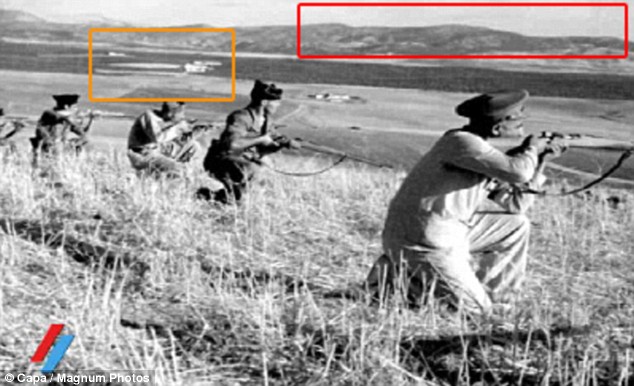
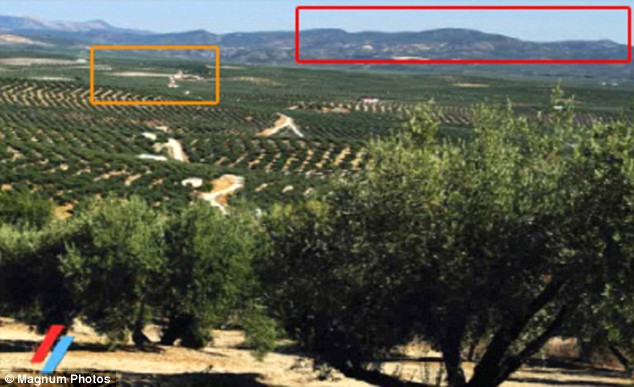
Capa always claimed the photo was taken at La Loma de las Malagueñas outside Cerro Muriano, but naysayers claim it was taken at Espejo, over 50 kilometres south from Cerro Muriano. It is also stated that Borrell is not the man in the photo, despite being identified by his own brother.

In 2009, José Manuel Susperregui Echeveste, a professor from the University of the Basque Country, released Sombras de Fotografía (Shadows of Photography – well worth a look, along with many of his books). The professor studied the backgrounds of Capa’s photograph, and worked with historians in the area of Córdoba to determine the landscape, and it was Espejo, not Cerro Muriano, that was claimed in the shots.

Susperregui’s theory maintains that the Falling Soldier shot was staged, but the others in the sequence are real. Also to back up the professor’s claims, is the fact the Capa gave contradicting statements on the events of the day. Capa is recorded as saying Borrell was shot by a sniper, and another time by machine-gun fire. He also spoke of taking the photo, both in and out of the gully on the hillside.  As the landscape of Espejo hasn’t changed from 1936 to present day, reporters have been out photographing the region in an attempt to find the exact location, with many claiming success.

article-1201116-05C9BC54000005DC-359_634x386 article-1201116-05C9BC54000005DC-656_634x387

1936 ‘Cerro Muriano’ and 2009 Espejo, by Magnum Photos

Others also claim that perhaps Borrell was killed by a sniper while posing for photographs for Capa. Susperregui addressed those rumours as well, claiming there were no snipers in the Córdoba area at the time, a suggestion difficult to verify. The inconsistencies also lead people to suggest the photo was taken by Gerda Taro, not Capa, as has been discovered in Capa’s collection in recent years. Some claim they saw Borrell get shot, others claim Borrell was posing for a photo and was killed, leading Capa to rarely speak about the events.

Capa’s shots in the gully, the theory is some carried on down the hill, some were drawn back, including Borrell when he was shot

It was the Mexican Suitcase discovery in 2009 that then further discredited Falling Soldier. In 2009, a suitcase was found, holding Capa’s negatives from his career, which were sent to Mexico after the war. The photos of Robert Capa, Gerda Taro and David Seymour were all thrown in together. The incredibly talented Gerda Taro died just short of her 27th birthday in 1937, in an accident with a Republican tank. The immense David Seymour, or David Chim, ran Magnum Photos until his death by machine gun during the 1956 Suez War. What the Mexican suitcase showed, that while there were negatives of the sequence of the Falling Soldier, photo number five of seven, the famous shot, was missing.

The Mexican Suitcase tour was a huge success, with the photos in galleries widely seen. Other photos in the sequence were also displayed, including shot five, despite no negative found. The negatives in the suitcase have been analysed, and results show it is Espejo, not Cerro Muriano in the background. Because the sixth and seventh shots show a dead soldier, someone other than Borrell, leads many to say the famous photo was staged. Meanwhile, many others claim it is still completely real, based on the angles, the recollections of Capa, and the details of fighting on September 5, 1936. The photo shows a scene far removed from traditional war shots and different to other staged photos of injured men, meaning there will probably never be a real answer to what killed Borrell, when, where, or if it is really Borrell at all. We will never really know.

Me? I like to believe the photo is real. Why? my own personal sense of whimsy. I would like to believe maybe Gerda Taro took that photo, hence why Robert Capa couldn’t recall the details correctly. Gerda Taro was the first female war photographer, brilliant and daring in her short lifetime. After all, who is Robert Capa? Not an American photographer, rather Endre Friedmann from Hungary, the same way Taro was Gerta Pohorylle from Germany, the pair having to flee their homelands and invent Robert Capa in Paris. Her work was often used under the name Robert Capa. History isn’t fond of powerful women. My theory is total speculation, based on nothing but my own ideas and a love of feminism. Maybe the theory of them all, thinking they were safe, outside the town, were talking and taking photos when a bullet really did strike down Borrell, and no one wanted to talk about it.

Perhaps it is a fake, something that had us all fooled for 80 years. If Falling Soldier isn’t real, it is still a posed shot to display what happened to so many Spaniards, that even now there isn’t an agreed figure on the number of dead. No one who has seen Capa’s collection can doubt his abilities, and is it really that hard to believe that a photo can be taken at that moment when life is taken away?

Either way, rest in peace, Federico Borrell García of Alcoi, Valencia – January 3, 1912 – September 5, 1936

~~

This is not a full detailed analysis, instead a simplified report of Falling Soldier and its authenticity. Feel free to suggest an addition/clarification/correction below. All photos are linked to source for credit.

This Week in Spanish Civil War History – Week 8: 5 – 11 September 1936

 Week 8: 5 – 11 September 1936

If you are new and don’t understand the Basque country, it is an independent region of Spain in the far north. It is (roughly on the above map) the green and two smaller red locations to its left, at top under France. Today it is fully restored to its people.

September 5

The beautiful Basque city of Irún, in Spain’s north, is destroyed in battle. The city is in a pivotal location on the coast, and on the borders of both France and the Spanish region of Navarre. As Navarre is a stronghold for the Carlists on the Nationalist side, the 3,000 Republican fighters need to hold Irún in order to gain supplies from France. Nationalist destroyers and battleships have been bombarding the town for almost a month, and also have planes, tanks and 2,000 well-trained soldiers. German and Italian planes bomb the town, and drop pamphlets, warning the population of mass executions like in the town of Badajoz. Most of the battle takes place on the south side of the city near the Convento de San Marcial, where Republicans fighters, made up of Basque nationalists, miners of Asturias (who are akin to fighting), and communists volunteering from France, are alongside the locals. However they lack training and weapons, with only some guns, dynamite, and eventually reduced to throwing rocks.

Republicans surrender in Irún

Fighting goes on throughout the day, and the Republicans shoot vicious Nationalist Colonel Alfonso Beorlegui Canet in the leg, on the international bridge of Irún (he will die a month later of gangrene). But the Republicans are forced to retreat and abandon their city. Anarchist militia set fire to many key locations in the city as they flee, so they cannot be used by the Nationalists. (This decision would lead to many propaganda scenarios throughout the war, as Nationalists would then destroy a town and say ‘the rojos did it, just like in Irún, despite the fact it was untrue) Many of the population flee either to the safety of France if they can, or retreat further into the Basque country. Nationalist forces can now continue on towards the critical port city of San Sebastian, just 20 kilometres away. The Basque country is already cut off from a rest of Republican Spain and is set to become a guinea pig for German bombers practicing for WWII.

Irún post-siege

September 5 – 6

The battle of Cerro Muriano commences in the province of Cordoba, in Spain’s south. Following the battle in the city of Cordoba in August, outlying areas are now ready to be taken by the Nationalists, with Cerro Muriano just 20 kilometres north of the city. The Columna Miaja, which have up to 3,000 Republican fighters in the region, engage in a 36-hour siege between them and violent Regulares soldiers from Morocco and many Spanish Legion troops. The battle leaves a huge number of men dead in the town. The Republican side is completely eliminated while the Nationalist take the town with few deaths.

The battle of Cerro Muriano includes the moment captured of the iconic ‘Falling Soldier’ photograph by Robert Capa, and will be covered in a ‘This Week in Spanish Civil War History Extra’ post.

Falling soldier by Robert Capa

September 6

Italian aircraft arrive on the island of Mallorca to set up new bases, so they can begin serious bombing campaigns on the mainland, especially targeting Barcelona.

September 8

Portuguese sailors on two navy vessels mutiny against their officers, so they can seize the ships and go to Spain, to help the Republicans. But the mutiny is crushed by men who are loyal to Portuguese dictator António de Oliveira Salazar. The mutiny only strengthens repression against communism and left-wing ideals in Portugal.

September 9

The first Non-Intervention Committee meeting is held in London. The meeting has 23 countries represented, with only Mexico supporting the Republicans. But because the borders are closed and ships patrol the coast, Mexico cannot give the Republican government support or supplies. Larger South American nations such as Chile, Peru, Brazil and Argentina support the Nationalists, and Germany and Italy are part of the committee, yet their dictators continue to aid the Nationalists. Britain and France are sitting on their hands like naughty children, the US is trying to keep clear, but Russia want to help communist interests within the Republic.

Meanwhile, in Toledo…

Destruction of the Alcázar over September

September 9

The battle of the Alcázar in Toledo has been running since July 21, with 1,000 Nationalists  trapped inside (and two-thirds of them too young/old/female to fight), while the Republicans are unable to breach the castle walls. Republican Major Vicente Rojo Lluch, one of the most prodigious military left-wing men in the war, walks blindfolded with a white flag to the Alcázar to negotiate surrender with Nationalist garrison leader, José Moscardó Ituarte, 1st Count of the Alcázar of Toledo. The Alcázar is now badly damaged but not yet fully breached, with two of its corner towers still standing. Moscardó has already sacrificed his teenage son to the Republicans in July (who held him hostage and let him call his father while being threatened with death. His father told him to die like a patriot and the son was killed one month later) and refuses to surrender the Alcázar to the Republicans. However, Major Rojo does allow for a priest (hard to find since Toledo’s have already been murdered or have fled) to go into the Alcázar and baptise two babies born inside during the siege.

The destruction of one of Spain’s most amazing sights

September 11

A priest with left-wing views (and thus, not yet murdered) arrives from Madrid. Vázquez Camarassa goes inside to do the baptisms and give absolution to those in the Alcázar. That night, Major Rojo and Colonel Moscardó meet again, to negotiate the release of the 500 women and children. The women refuse to leave, opting to take up arms and die rather than surrender to the Republicans. Overnight, grenades are thrown at the Alcázar, cutting off all communication with Colonel Moscardó, which would make a surrender negotiation with the Chilean ambassador the next morning impossible.

Nationalist women and children participate in the siege

~~

This is not a detailed analysis, just a highlight (lowlight?) of the week’s events. Feel free to suggest an addition/clarification/correction below. All photos are linked to source for credit