HISTORICAL BOOK REVIEW SERIES: ‘Queens of the Conquest’ by Alison Weir

No automatic alt text available.

In the first volume of an exciting new series, bestselling author Alison Weir brings the dramatic reigns of England’s medieval queens to life.

The lives of England’s medieval queens were packed with incident—love, intrigue, betrayal, adultery, and warfare—but their stories have been largely obscured by centuries of myth and omission. Now esteemed biographer Alison Weir provides a fresh perspective and restores these women to their rightful place in history.

Spanning the years from the Norman conquest in 1066 to the dawn of a new era in 1154, when Henry II succeeded to the throne and Eleanor of Aquitaine, the first Plantagenet queen, was crowned, this epic book brings to vivid life five women, including: Matilda of Flanders, wife of William the Conqueror, the first Norman king; Matilda of Scotland, revered as “the common mother of all England”; and Empress Maud, England’s first female ruler, whose son King Henry II would go on to found the Plantagenet dynasty. More than those who came before or after them, these Norman consorts were recognized as equal sharers in sovereignty. Without the support of their wives, the Norman kings could not have ruled their disparate dominions as effectively.

Drawing from the most reliable contemporary sources, Weir skillfully strips away centuries of romantic lore to share a balanced and authentic take on the importance of these female monarchs. What emerges is a seamless royal saga, an all-encompassing portrait of English medieval queenship, and a sweeping panorama of British history.

cover and blurb via amazon

~~

For far too long, queens have been overshadowed by their kings. Often married, rather than born, into the role, they are considered ‘less than’. While there are many great works now out there about queens, here is a masterpiece of a book of true rulers, ready to lead but ‘betrayed’ by their gender. Queens of the Conquest is, excitingly, the first in a new series, which chronicles war, power, betrayal, tragedy and the odd bright moment.

The first queen in the book is Matilda of Flanders, supporting William the Conqueror as he led the Norman invasion of 1066, and she has a tale just as powerful as any warring king. Instead of simply noting a woman as filled with piety or scandal, Matilda gets a real account of her life. Matilda didn’t want to marry William the Bastard, but with no choice, stood by his side when he became the first king of England.

Their son, Henry I, married Edith of Scotland, and had to change her name to Matilda. Edith/Matilda (or Godiva as she was called by the locals who were putting her down). She was made regent regularly, ran the curia and helped the sick. Edith/Matilda had a grand family lineage in her own right, was well-educated for the time and had a large influnce on articecture.  Her son was killed in a bizarre and stupid accident, meaning she could leave the crown was handed to their daughter, Empress Maude, then renamed Empress Matilda.

Maude/Matilda had married the Holy Roman Emperor, and he died, leaving her to be queen of England in her own right, as her brother was already dead. War raged under Maude/Matilda, but she fought to the very end to hold the throne as hers, not her husband’s/son’s/anyone else related. Naturally, everyone was a real dick about a woman ruling. Maude/Matilda had to marry again, to Geoffrey of Anjou, which was hard because he disliked him; Matilda had to fight wars all over Europe to stay queen. She was a woman who had ruled as queen in Germany and Italy, born to rule, but fought her life away before her son took the English throne to become King Henry II.

Also profiled is Adeliza of Louvain, Henry I’s second wife, whom he had hoped to get a son on, instead of leaving the throne to the incredible Maude/Matilda. Adeliza married Henry soon after his son was killed in the White Ship disaster, a beautiful woman from now-Belgium, a descendant of Charlemagne. Henry I was a huge traveller and Adeliza was always at his side for fifteen years. She gave the king no children, sort-of securing the throne for her stepdaughter Maude/Matilda. Adeliza then went on to marry the royal butler and give him a child.

Also portrayed is Matilda of Boulogne, who married Count Stephen of Mortain. Matilda was niece of the King Baldwin of Jerusalem. When Matilda’s husband heard of Henry I’s death, they rushed to England to take the throne ahead of Empress Maude/Matilda. She was crowned heavily pregnant when the new King Stephen took Maude/Matilda’s place, and was engaged in the battles between these two claimants for eighteen years, sometimes the queen, sometimes deposed, as they battled for control. She helped to found the Knights Templar and negotiated with Maude/Matilda in times of war between them.

None of these women should be forgotten and this book is amazing. If you are into royal history, English history, any kind of history, you should own this book.

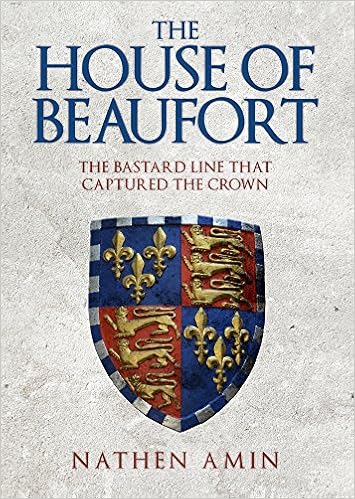
HISTORICAL BOOK REVIEW SERIES: ‘The House of Beaufort’ by Nathen Amin

The Wars of the Roses were a tumultous period in English history, with family fighting family for the greatest prize in the kingdom – the throne of England. But what gave the eventual victor, Henry Tudor, the right to claim the throne? What made his mother the great heiress of medieval England? And how could an illegitimate line come to challenge the English monarchy? Whilst the Houses of York and Lancaster battled directly for the crown, other noble families of England also played integral roles in the war; grand and prestigious names like the Howards, Nevilles and Percys were intimately involved in the conflict but arguably none symbolised the volatile nature of the period quite like the House of Beaufort. The story of the Beauforts, with their rise, fall and rise again, is the story of England during the period, a dramatic century of war, intrigue and scandal. Many books have been written about individual members of the dynasty but never has the whole family been explored as one. This book will uncover the rise of the Beauforts from bastard stock of John of Gaunt, Duke of Lancaster, to respected companions of their cousin Henry V, celebrated victor of Agincourt. The Beauforts fell with the House of Lancaster during the 1460s and 1470s, and their hopes and fortunes came to rest upon the shoulders of a teenage widow named Margaret and her young son, Henry. From her would rise the House of Tudor, the most famous of all England’s royal houses and a dynasty who owed their crown to their forebears, the House of Beaufort. From bastards to princes, the Beauforts are medieval England’s most intriguing family.

cover and blurb via nathenamin.com

~~

One family which doesn’t get enough love are the Beauforts. Nathen Amin has done everyone a favour and produced this wonderful and descriptive book to shed more light on this remarkable line. The story of the Beauforts is one that can last forever. Many families such as the Lancasters, Yorks, Warwicks are often mentioned, when the Beauforts are most important and relevant from the late 1300’s right down to today’s noble families.

Joan Beaufort was the daughter of John of Gaunt, Duke of Lancaster, and his then-mistress Katherine Swynford, remarkable people in their own right.  Joan was the only girl born to this first generation of Beauforts, named illegitimate offspring. Joan married very young and had two daughters, but by her mid-teens, her parents gained a legitimate marriage recognised by the Pope, and Joan herself was already a widow. Joan went on to marry into the Neville family, and produced 14 Beaufort-Neville babies to go with her previous two, and her husband’s eight from his first marriage. Eek!

Nathen Amin has drawn on a countless amount of resources in order to produce such an interesting level of detail, and I found I took so many notes that the whole book was in my notebook. Had the Beauforts not gone on to do so much more, the information on Joan Beaufort could be enough for a book on its own.

Joan’s children went to create the families which ruled England and fueled both sides of the War of the Roses. There was the famous Neville line, including a queen of England and multiple earldoms, including the powerful Warwick family. Joan’s blood flowed through the families of the Dukes of Westmoreland, Somerset and Exeter. Thanks to Joan’s eldest daughter they joined the Mowbray family; another daughter married into the powerful Percy lineage, another into the dynasty of the Staffords, the Dukes of Buckingham. More sons became barons, the family boasted archbishops, and the baby of the family was Cecily, married to the Duke of York, creating two kings, Edward IV and Richard III. That’s just a selection of their greatness!

But nothing destroys families like the quest for power. The 1400’s saw much wealth and success, but also death. By the time Margaret Beaufort (great niece of Joan), who married into the Tudor family, saw her son Henry defeat Richard III for the crown, the Beauforts’ power had spread out like a spiderweb of noble houses.

I am not new to the history of the Beauforts, nor their struggles to take the throne, but I found plenty to enjoy in Amin’s book. If you are new to the subject, this is the number one place to begin. The author has written a book without bias, simply presenting facts written to be entertaining, instead of heavy and academic.

Truth always beats fiction, and while I read this in ebook style, once my hardcover arrives, this book will now sit on my top shelf, where I keep all the books I go back to and reference while I work. History is filled with incredible tales, and Amin’s book brings together so many people that you too could be an expert in no time.

This Week in Spanish Civil War History – Week 61: 10 – 17 September 1937

September 10

Still under the thick fog, the Nationalists take the hill at Biforco, below the El Mazuco Pass, but the mountain of Llabres is still in Republican hands, where they machine gun Nationalist troops and roll down barrels of explosives. The day is marked with the first delivery of hot food for the Republican men. If the Nationalists cannot take this pass, they will be forced to climb much steeper mountains to claim El Mazuco.

on the hills at El Mazuco

September 11.The Nationalists are still stuck in the valley below the El Mazuco pass, and change their plans. They spend two days heading along the mountain range to hike up Pico Turbina,  height of 1315m, a rocky cliff face with 40° slopes.  No tracks have ever been made up Pico Turbina and no mules have ever made the trek. The Nationalist men are forced to carry everything as they scale the cliffs. They are hidden in thick fog and no aircraft can see them overhead.

September 13

Constant bombardment on the northwest edge of El Muzuco has weakened the Republicans at the top, and they have to surrender the Sierra Llabres to the Nationalists. At the top of the village of El Mazuco itself, which has no defenses.

El Mazuco village © José González Fernández.

September 14

Nationalists climbing the Pico Turbina have almost reached the top of the mountain but are attacked by Republicans with hand grenades, aided by the thick fog, which prevents the Nationalists from taking the peak.

Pico Turbina

September 15

El Mazuco village is surrounded by Nationalists so the Republicans retreat back to Meré, six kilometres west along the mountains pass. Pico Turbina is taken by the Nationalists at last and nearby Peñas Blancas peak is also taken, along with the villages of Arenas Arangas.

September 16

The three summits of the Peña Blancas (Peña Blanca, Pico Turbina and El Mazuco) are all now surrounded  by the Nationalists. There are still Republican men at Pico Turbina, not yet ready to surrender. If they can hold the Nationalists on the south side of the Peña Blancas and the El Mazuco pass until winter, then the remainder of the north will be safe from the Nationalists. Casualties are unknown at this point in the wild terrain, but with the Nationalists starting with 33,000 men and the Republicans with only 5,000, the Republican hopes of the Basque, Cantabrian and Asturian men are fading fast.

nearby Arangas

~~

This is not a detailed analysis, just a highlight (lowlight?) of the week’s events. Things get lost in translation – Feel free to suggest an addition/clarification/correction below. The more the world remembers, the better. All photos and captions are auto-linked to source for credit, and to provide further information.

This Week in Spanish Civil War History – Week 60: 3 – 10 September 1937: 80 years since the Battle of Belchite

The ailing Republican battle of Zaragoza is now centred on the bombing of the village of Belchite, which has been surrounded for two days. Around 3800 civilians are trapped in the town along with 7000 Nationalists fighting, determined not to lose the area. All are suffering with the heat of summer and water in the area has been cut off by the Republicans. With troops so spread out over the Zaragoza battle area of 100 kilometres between Belchite and Zuera, exact numbers are not known, but bloody combat continues right around the small town. Much of the Republican artillery for the battle, with T-26 tanks and aircraft support, moves in to cut off the southern end of the Nationalist troops from the northern reinforcements.

September 4

While the bombardment of tiny Belchite continues, Nationalists with the Army of the North continue their trek through the mountains from the Cantabria region into Asturias, and cross the strategic point of the Deva river, with Republicans holding the area quickly having to retreat.

September 5

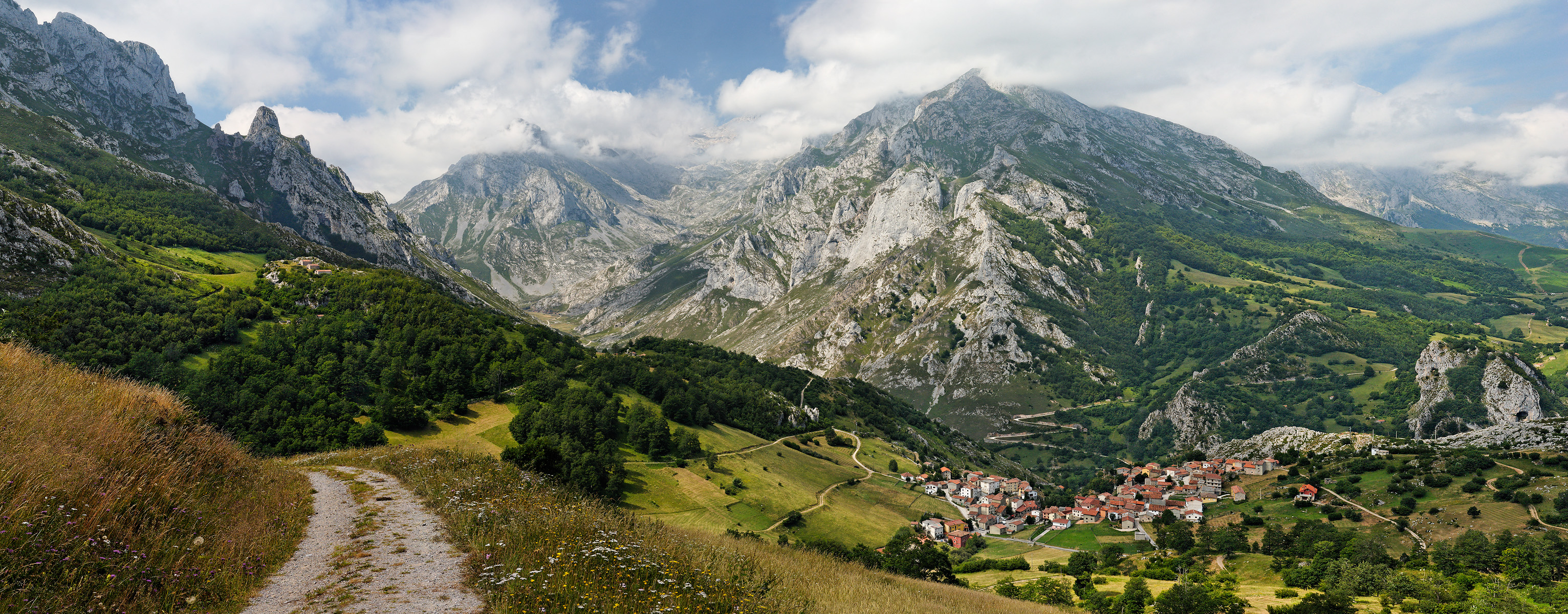
The advancing Nationalists capture the tiny town of Llanes, but the 33,000 troops now have to trek through the limestone cliffs of the Sierra de Cuera. These difficult regions are Asturias’ protection and the Nationalists will have to take the El Mazuco pass in order to advance any further.

El Mazuco mountains

September 6

While the bombardment of Belchite is still ongoing, the 33,000 Nationalists in the north begin the battle of El Mazuco. The Republicans, groups of Basque, Cantabrian and Asturian fighters, have only 5,000 men in the Sierra de Cuera region. El Mazuco is just five kilometres from the ocean, meaning destroyers can also be deployed to help the Nationalists, along with German Condor Legion aircraft. The Republicans, all men weakened from the lost battles of Bilbao and Santander, have no support and no way of gaining reinforcements. Only the steep cliffs will keep the Nationalists at bay.

Republican Libertad

September 7

The Nationalist cruiser Baleares battles the Republican light cruisers Méndez Núñez and Libertad off the coast of Cherchell on the Algerian coast. The Baleares comes across the Republican convoy in the dark, becoming the battle of Cherchell. Republican ships are escorting merchant ships through the dangerous area. The entire convoy flees the area while Libertad and Méndez Núñez try to hold off the larger Baleares. The two Republican ships are separated  during the day while Baleares tries to repair initial damage, but by afternoon, Baleares is hit twice by Libertad. Baleares backs away to be recused by a sister-ship in the sea, while both Nationalist and Italian planes attack the two Republican ships from the air. All ships involved are damaged and the leave the area, with only the Nationalist Baleares suffering serious damage. However, two of the cargo ships which had been travelling with the Republican convoy panicked during the nearby battle and changed course to get to Algeria. One ship runs aground, and one is captured the French and taken into the Cherchell port.

Carpet-bombing is used in the battle of El Mazuco, using both explosive and incendiary bombs throughout the day. The Republicans are trying to hold their post under Commander Higinio Carrocera, just three battalions and 24 machine-guns, and only the terrain holds back the strong Nationalist troops.

Still on September 7

The huge battle of Zaragoza is over. Republicans managed to eat 10 kilometres into the Nationalist areas, but only captured unpatrolled areas and win a few tiny villages. Exact losses on both sides are unknown (running into the thousands) but are worse for the Republicans who have also lost much of their artillery in the process. The battle of Belchite has also now come to an end, with the village completely destroyed. The Republicans and International Brigades take 2,411 prisoners and another 600 Nationalists have been wounded in the fight. After both bombing and hand-to-hand fighting, 3,000 people are dead. Those left behind manage to live in the rubble until a new town is built nearby in 1939, however the ruins will never be touched.

source

September 8

The battle through the El Mazuco mountains continues as thick fog fills in the whole area. The only fighting that can be done is hand-to-hand combat, causes massive casualties and wounds on both sides, and the Nationalists manage to capture a full two kilometres of ground.

September 9

The Republicans battalions defending El Mazuco have to retreat as the Nationalists shell their positions, but the Nationalists cannot take new ground as the men are cut down by machine gun fire from the Republicans in reply, meaning no one makes up any ground.

Area of Cabrales in the El Mazuco pass area

September 10

Still under the thick fog, the Nationalists take the hill at Biforco, below the El Mazuco Pass, but the mountain of Llabres is still in Republican hands, where they machine gun Nationalist troops and roll down barrels of explosives. The day is marked with the first delivery of hot food for the Republican men. If the Nationalists cannot take this pass, they will be forced to climb much steeper mountains to claim El Mazuco.

on the hills at El Mazuco

~~

This is not a detailed analysis, just a highlight (lowlight?) of the week’s events. Things get lost in translation – Feel free to suggest an addition/clarification/correction below. The more the world remembers, the better. All photos and captions are auto-linked to source for credit, and to provide further information.

FRAILTY OF HUMAN AFFAIRS: Author Q+A – Part 1

How much do you know about Tudor England? Maybe you are an expert; maybe you are new and know no more than Henry VIII and his desire to crop heads (roughly 72,000). Maybe you know Thomas Cromwell was the real genius behind Henry’s reign and changed laws in a way no country has ever known. Maybe you have heard his name a few times, maybe watched Wolf Hall, or get him mixed up with the genocidal Oliver Cromwell of the 1600’s.

Frailty of Human Affairs is set in the years 1529 – 1533, the early years of Cromwell’s rise to control England behind Henry VIII. He was already a wealthy merchant, trader, lawyer and money-lender. He had already served both the royal court for his master,Cardinal Wolsey, and in parliament. But it was 1530’s in which Thomas Cromwell basically picked up England and shook it, changing everything that everyone knew in a way that had never been done, and was never done again. If you are English or in a country invaded and dominated by the English (like here in the antipodes), you can thank Thomas Cromwell that you are not Catholic (unless you want to be, which is your choice now, you do you). Yes, Catholic vs. Protestant reform would have come to England with or without Cromwell’s help, but how it played out would have been very different.

Do you need to understand the difference between Catholic vs. Protestant to read this book?

I have kept it simple because unless you have done religious studies (like me), it can seen as daunting. It did to me at the start. Basically, Catholics pray in church to their priests, bishops archbishops and cardinals. All bow to the Pope in Rome. In Cromwell’s time, prayer had to be done in Latin. The Protestants (literally religious protestors, mostly in Germany) translated the bible from Latin to German and then English, and the translations came out with different rules on how to revere God. These bibles were banned in Cromwell’s time, as they questioned the Church’s real power. These English and German bibles allowed people to understand prayer easier, let them pray where and when they chose, and didn’t expect people to pray a premium in church for their souls to be saved. That’s the over-simplified version, but it’s all you need to start reading.

Why read your Cromwell over another version?

Thomas Cromwell sat in obscurity until around the 1950’s when he was brought back into public knowledge, as the villain behind King Henry VIII and the destruction of Catholic England. In the last decade, much has been written to reinvent Thomas Cromwell as a hero, a smart man who was caught under a despot king. I seek to write neither a hero nor a villain. In a world such as the Tudor court during the 1530’s, every man and woman would have needed to take sides – hero or villain – but I wanted to show that people can be both and neither. Neither Cromwell nor Frescobaldi are in any way perfect, and have intentions of their own as well as serving a king.

Who is Nicóla Frescobaldi in all this?

While Francesco Frescobaldi was the man who found a starving English teenager (Thomas Cromwell) on the streets of Florence, nothing is known about his immediate family. All characters focused around Frescobaldi are purely fictional, including Nicóla and Nicóletta.

Who is Machiavelli?

Niccoló Machiavelli was an Italian writer and diplomat in Florence until his death in 1527. He was at odds with the reigning Medici family, but wrote many books which have been him eternal. ‘The Prince” is his top book, basically the creation of modern political science. Seriously, grab a copy.

Much has been made of who ‘The Prince’ of Niccoló Machiavelli’s book really was. While dedicated to Lorenzo Di Piero De Medici, the book is said to be sometimes based on Cesare Borgia, the infamous son of Pope Alexander VI. The book,  published in handwritten form in 1513, was first published on a printing press in 1532, when Pope Clement VII agreed to its release. Thomas Cromwell and the Protestants were known as fans of the Machiavelli book, though Catholic kings such as Charles V, and French Queens such as Catherine de’ Medici, also endorsed the writing. Who inspired much of the book may in fact be a wide number of people, but Thomas Cromwell and his incredible mind lived in Florence from around 1503 until 1513. Very little is known around this period of his life. Is Cromwell the prince? Frescobaldi believes so.

What is the point of Cromwell’s changes to England?

Henry VIII needs rid of his first wife, who served England for twice as long as his other five wives combined.

Click here to read more on the “Great Matter”

In 1509, King Henry VIII was crowned alongside his new bride, Princess Katherine of Aragon. Katherine had married Henry’s brother, Prince Arthur, in 1501, only for him to die months later. After receiving dispensation from the Pope, the couple married and were crowned in a dual coronation, and would go on to have one daughter and lose another five children at birth.

After having affairs with several well-known mistresses, King Henry set his sights on Anne Boleyn, lady-in-waiting to Queen Katherine, sometime in 1525. By 1527, Henry set his chief advisor, Cardinal Thomas Wolsey, Lord Chancellor of England, to the task of procuring an annulment of his marriage to Katherine, on the grounds that a man could not marry his brother’s widow.

After several failed attempts to persuade Pope Clement VII to agree to an annulment, a decision was made – an ecclesiastic legatine court was to be set up in London. Two cardinals, Cardinal Wolsey and Cardinal Lorenzo Campeggio, a chief confidant of the Pope, would stand in as papal legates (the Pope’s representatives), and through a hearing, decide on whether Henry and Katherine’s marriage was ever lawful in the eyes of God.

The people of England loved Queen Katherine; she had ruled for twenty years, a kind, pious and beautiful Catholic queen all could respect. But Katherine was too old to give Henry what he needed – a son to inherit the English throne. Anne Boleyn was still in her twenties – pretty, sophisticated, intelligent, and young enough to give birth to a male heir.

After being in love with Anne Boleyn for four years, King Henry had become bitter towards his Queen, and also his sixteen-year-old daughter, Princess Mary, whom he considered too unnatural to inherit the throne, as she was female. Anne Boleyn was a mistress who would not share Henry’s bed, and a combination of frustration, longing, and arrogance built in the 38-year-old ruler. Cardinal Wolsey, at Henry’s side for twenty years, and credited with countless successes at home and abroad, and the wealthiest man in England, could not give the King what he wanted, an annulment from Katherine. With the witty Anne Boleyn and her family taking Wolsey’s place at Henry’s side, and the Protestant reformers beginning to eat into England’s Catholic soul, the King could be easily swayed in any direction.

Enter Thomas Cromwell – lawyer and advisor to Thomas Wolsey, a commoner with a smart mind and vivid history throughout Europe, educated in England and Italy, who had ideas on how to create an annulment, and destroy Pope Clement’s power in the process.

By 1529, no one, noble or common, knew what would happen in their realm, and with the anger of the Holy Roman Emperor also weighing upon the annulment issue – the King’s ‘Great Matter” – the threat of war was real, all to gain a male heir for the kingdom. King Henry needed a new queen, and Katherine would never give up her crown.

Why so many characters?

They, with the exception of the Frescobaldi children, Nicóla and Nicóletta, all the characters are real people who served or opposed Henry VIII. There are a lot and they all played a role. There were many more who I have chosen not to showcase, and more will be added in the next books.

England’s royal inner circle by 1529

King Henry VIII

All-powerful, well-educated and athletic ruler of England for twenty years. Aged only 38 years old, a religious, volatile, arrogant man. Father of one legitimate heir, Princess Mary, and a bastard son, Henry Fitzroy, Duke of Richmond and Somerset

Click here for more on Henry VIII

 Queen Katherine

Catholic Spanish princess married to Henry for twenty years – pious, respectable, intelligent, and mother to the only legitimate royal heir, Mary, Princess of Wales

Click here for more on Katherine

Anne Boleyn

High-educated former lady in-waiting to Queen Katherine, daughter to successful courtier Thomas Boleyn

Charles Brandon

Duke of Suffolk, and Henry’s best friend. Married to Henry’s sister Mary, Dowager Queen of France. Member of the Privy Council (advisors to the King on state matters) and the King’s Council (the King’s private advisors)

Thomas Howard

Duke of Norfolk, uncle to Anne Boleyn, close courtier to Henry. Member of the Privy Council and King’s Council

Thomas Boleyn

Lord Rochford and Lord Privy Seal (leader of the Privy Council) and member of the King’s Council. Father to Anne Boleyn, along with popular courtier George Boleyn and the beautiful Mary Boleyn, King Henry’s former mistress

Advisors and courtiers to King Henry

Cardinal Thomas Wolsey

Common-born man risen through the church to become advisor to King Henry, elevated to Cardinal by the Catholic Church, and Lord Chancellor of England, the nation’s most powerful ministerial role

Click here for more on Thomas Wolsey

Thomas Cromwell

Advisor and lawyer to Thomas Wolsey. Member of parliament, wealthy merchant and money-lender. Former soldier, Italian trader and banker and English-trained scholar

Click here for more on Cromwell

Sir Thomas More

Chancellor of the Duchy of Lancaster, respected humanist, author and Catholic theologian. Loyal advisor to King Henry and champion of Dutch writer Erasmus

Thomas Cranmer

Highly educated theologian, humanist and ordained priest, and supporter of Martin Luther. Diplomat to both Spanish court and Holy Roman Emperor on King Henry’s behalf

Archdeacon Stephen Gardiner

Trained in canon (religious) and civil law, and master secretary to Cardinal Wolsey. Well-travelled diplomat, Master of Trinity Hall and expert at Cambridge University

William Warham

Archbishop of Canterbury and leader of the Convocation of Canterbury (religious parliament). Bound to Pope Clement and the Catholic faith

Eustace Chapuys

Imperial Ambassador to England and champion of the cause of Queen Katherine on Charles V’s behalf

Powerful Italian figures in 1529

Pope Clement VII

Pope of Rome and leader of the Catholic faith since 1523. Member of the powerful Florentine Medici dynasty. Imprisoned during the sacking of Rome by Charles V’s soldiers in 1527

Cardinal Lorenzo Campeggio

Powerful and well-travelled cardinal, left in charge of Rome during the Pope’s absences, and Cardinal Legate of England. Representative of Pope Clement abroad

Charles V of Spain

King of Spain, Holy Roman Emperor, King of Italy, King of the Romans, Lord of the Netherlands and Duke of Burgundy, ruler of the German and Austrian states controlled by the Roman Empire. Nephew of Queen Katherine of England

The Medici dynasty

Multi-generational family in control of the Republic of Florence. One of the wealthiest families in Europe, creator of two Popes, including Clement. Ousted from Florence in 1527 during a siege, only to be reinstated with full control and wealth

Nicóla Frescobaldi

Effeminate bastard son to the late Francesco Frescobaldi, a wealthy Florentine merchant and banker. Reclusive favourite courtier of Pope Clement, highly educated man of business and theology

Nicóletta Frescobaldi

Only living daughter of Francesco Frescobaldi. Pre-contracted in marriage to Alessandro de’ Medici

Well known figures in Europe in 1529

Erasmus of Rotterdam

Dutch Renaissance humanist, Catholic priest, social critic, teacher, and theologian. Creator of the Latin New Testament bible based on Greek texts

William Tyndale

Creator of the English language bible, translated from Greek and Hebrew texts. Supporter of Protestant reform. In exile from England and against Henry’s annulment

Martin Luther

German theologian, excommunicated priest and creator of the Protestant Reformation and the German language bible

Niccoló Machiavelli

Recently deceased Florentine diplomat, politician, historian, philosopher, humanist, and writer. Creator of political science

King Francis I of France

Popular young King of France. Well-educated writer and patron to Leonardo da Vinci. Signed the peace treaty at the Field of Cloth of Gold with England

Alessandro de’ Medici

The last senior member of the original Medici generation, illegitimate son of Pope Clement, set to rule Florence. His ‘sister’, Catherine de’ Medici, is set to become a French princess

Stephen Vaughan

English merchant, royal agent and diplomat, and strong supporter of the Protestant Reformation

Popular English courtiers in 1529

Ralph Sadler

Ward and master secretary to Thomas Cromwell

Richard (Williams) Cromwell

Nephew and attendant to Thomas Cromwell

George Cavendish

Writer and faithful attendant to Thomas Wolsey

Edmund Bonner

Faithful friend and chaplain to Thomas Wolsey

Sir Thomas Audley

Barrister and Speaker in the House of Commons

Richard Rich

Popular lawyer and member of parliament

Thomas Wriothesley

Lawyer serving Thomas Cromwell and Stephen Gardiner, clerk of the royal court

Sir Henry Norris                        

Sir Francis Weston

Sir William Brereton                                 

Sir Francis Bryan

Members of the privy chamber of  King Henry

Mark Smeaton

Talented young English composer and musician

Sir Thomas Wyatt

Diplomat, politician, poet, loved friend of Anne Boleyn

Hans Holbein the Younger

Popular German artist, given royal favour for his extraordinary portrait talents

What else do I need to know?

Check out the author Q+A Part 2 on the book for more, or click here to read the first chapter free right now.