OTD with Thomas Cromwell – 10 June 1536: Cromwell begs Princess Mary to pledge allegiance to the king

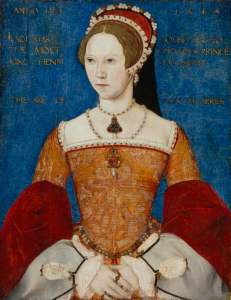
Princess Mary in 1544 by Master John Browne NPG428

In an uncharacteristically rude manner, Cromwell writes to Princess Mary, no doubt under command to the King, and admonishes her for not signing the oath and swearing loyalty to her father. Princess Mary was in grave danger by this time, and Cromwell knew that Mary’s allegiance to Henry was the only thing that would save her. But after years of kind words to Mary, this letter must have arrived at Hunsdon to her great surprise. 

CROMWELL TO THE PRINCESS MARY, 10 June 1536 (MSS Otho. C. x. 273)

I have received your letters, whereby it appears you be in great discomfort, and do desire that I should find the means to speak with you. Your discomfort can be no greater than mine, who upon your letters have spoken so much of your repentance for your wilful obstinacy against the King, and of your humble submission to obey his pleasure and laws in all things without exception or qualification. Knowing how diversely and contrarily you have proceeded at the late being of his Majesty’s Council with you, I am ashamed of what I have said and afraid of what I have done. What the sequel shall be God knows. With your folly you undo yourself, and I say to you, as I have said elsewhere heretofore, it were pity you should not be an example in punishment, if you will make yourself an example in the contempt of God, your natural father and his laws by your only fantasy, contrary to the judgments and determinations of all men that ye must confess do know and love God as well as you. To be plain with you, I think you the most obstinate woman that ever was, and I dare not open my lips to name you unless I have such a ground thereto that it may appear you were mistaken, or at least that you repent your ingratitude and are ready to do your duty. I have therefore sent you a book of articles to subscribe, on receiving which from you again, with a letter declaring that you think in your heart as you have subscribed with your hand, I will venture to speak for your reconciliation. If you do not leave all sinister counsels, which have brought you to the point of undoing, I take leave of you for ever, and desire you to write to me no more, for I will never think you other than the most ungrateful, unnatural, and most obstinate person living, both to God and your most dear and benign father. And I advise you to nothing, but I beseech God never to help me if I know it not so certainly to be your bounden duty, by God’s laws and man’s laws, that I must needs judge that person that shall refuse it not meet to live in a Christian congregation; to the witness whereof I take Christ, whose mercy I refuse if I write anything unto you that I have not professed in my heart and know to be true.

Princess Mary wrote to Cromwell that same day: ‘You will see I have followed your advice and will do so in all things concerning my duty to the King, God and my conscience not offended; for I take you as one of my chief friends next his Grace and the Queen. I desire you, for Christ’s passion, to find means that I be not moved to any further entry in this matter than I have done; for I assure you I have done the utmost my conscience will suffer me, and I neither desire nor intend to do less than I have done.’[1]

 Another letter arrived from Princess Mary on 13 June, saying she had copied the letter Cromwell had ordered her to copy out and send to Henry, and she added, ‘Good Mr. Secretary, I do thank you with all my heart for the great pain and suit you have had for me. I see by your letters that you mislike my exception in my letter to the King. I assure you I did not mean it as you take it, for I do not mistrust that the King’s goodness will move me to do anything which should offend God and my conscience. But that which I did write was only by the reason of continual custom; for I have always used both in writing and speaking to except God in all things, same word for word; and it is unsealed, because I cannot endure to write another copy.’[2]

[1] MSS Otho, C. x. 262 b, 125, 10 Jun 1536

[2] MSS Otho, C. x. 263 b, 13 Jun 1536

OTD with Thomas Cromwell, 14 February 1537: Cromwell sends Princess Mary a Valentine

Princess Mary in 1544 by ‘Master John’, possibly Susanna Horenbout, NPG428

Only three years of Thomas Cromwell’s private bank account records still exist, and February 1537 hid a little piece of gossip. On 22 February, Cromwell’s private clerk made a note:

Lady Mary’s Grace, by Mr. Wriothesley, for by cause My Lord was her Valentine, 15l.

Never again, for any reason, is a Valentine mentioned in Cromwell’s paperwork. Cromwell had sent gifts and money to Princess Mary many times, and despite their extremely divided religious beliefs, they seemed to get along very well. Princess Mary’s letters to Cromwell were usually informal and kind, and they shared many godchildren, Cromwell’s grandson Henry included. Rumours that Cromwell would marry Mary had fallen from the lips of his enemies multiple times, all without basis of proof or merit, and it was used as part of the smear campaign in 1540 (along with Cromwell marrying Princess Margaret Douglas for some random reason).

Was the 15l (around £6,500 today) the gift itself, or did he spend 15l on something? A man could get a nice horse or two for that money. If it had been jewellery, it would have specified, as all of Cromwell’s payments to jewellers gave detail. Did Princess Mary need cheering up, so Cromwell sent her a gift? Her life had much improved by February 1537, reconciled with her father and Queen Jane, and spent Candlemas at Greenwich before moving onto Whitehall. Mary might have known Jane was newly pregnant, which significantly changed Mary’s life. Recently, the Pilgrimage of Grace had been calling for the king to make Mary his heir, or have her take the throne from her father, among many demands. The royal court needed to be seen as a solid unit that trusted one another, and that definitely included Cromwell’s need to be seen as in favour.

Or was the Valentine entry simply a joke? Had Thomas Wriothesley dropped off the gift to Princess Mary on St. Valentine’s Day and made a quip to Cromwell or Avery, who then wrote it in the ledger? or was the gift meant in a more simplistic pagan way, symbolising purification and health, or just the celebration of the start of spring? We have absolutely no way of knowing, but the comment was never crossed out of the ledger. Ledger entries were not always made on the day the bill was paid or money was received, so all detail is lost. But given that Wriothesley turned traitor against his master in 1540, perhaps the comment of Cromwell once sending a Valentine to Princess Mary was mentioned…

Cromwell’s ledgers are printed in full in The Letters and Remembrances of Thomas Cromwell

HENRY VIII’S CHILDREN: Part 1 – The Royal Lockdown of 1517-18

Ahead of the release of Henry VIII’s Children: Legitimate and Illegitimate Sons and Daughters of the Tudor King on 30 May (Pen & Sword Currently have a 30% off special throughout May) , I am doing a 15-part series on some of the smaller, lesser-known details that are covered in the book. These details played out in the background of the defining moments of the lives of each of Henry’s children.

PART 1: The Royal Lockdown of 1517-18

King Henry, in his typically luxurious manner, hosted a banquet at Greenwich on 7 July 1517, to celebrate England’s new League in Defense of the Church, a three-sided treaty with King Charles of Spain and Holy Roman Emperor Maximilian. This treaty specifically excluded France, but also defended the Catholic faith. The festivities of St Thomas’ Day celebrated the alliance; dinners, banquets, jousts, dancing, music, and a buffet thirty feet long, with meals brought out on elephants, panthers, and lions. But, among the glorious celebratory jousts, the worst possible scenario occurred, a huge outbreak of sweating sickness. The international pageant was not over, but ominous news of sudden deaths arrived at the court. While the disease did periodically spring up in England, it is also possible the hundreds of international visitors may have transported the illness. Two of King Henry’s younger privy chamber men, Thomas Baron Clinton, and Lord Grey of Wilton, died suddenly at Richmond.

Windsor Castle, via wikimedia commons

Henry and Katharine fled immediately to Windsor and did not see their eighteen-month-old daughter Princess Mary for months. The last thing they needed was their precious daughter succumbing to the illness, not unlike the illness that killed Prince Arthur fifteen years earlier. The illness spread through England and then Europe, and deaths quickly ran into the thousands. Cardinal Wolsey fell sick with the illness for the fourth time and vowed to take a pilgrimage to Walsingham if he survived. The illness killed noble and common-born subjects with impunity, and with the king away, the locals of London planned more attacks on foreign merchants.

Farnham Castle drawbridge entrance, via wikimedia commons

Henry and Katharine passed the months in seclusion, but those around them kept dying, and they fled to Farnham Castle to allow Windsor to be cleaned. They only returned to Windsor for New Year, where they could be reunited with Princess Mary. Mary stayed on with her parents at Windsor, celebrating her second birthday, and met Venetian ambassador Sebastian Guistanian on 28 February 1518. The sweating sickness was still out of control, but the ambassador touched Mary’s hand, given more deference and respect than Katharine. It was at this meeting that Henry uttered his well-known boast that Mary never cried, and Mary’s first public word. After the meeting, Henry and Katharine, and likely Mary too, left for Woodstock Palace to continue running from the sweat.

Woodstock Palace, via wikimedia commons

While Henry started his first book in isolation, Assertio Septem Sacramentorum, a collection of claims refuting Martin Luther’s works, the quiet time for the royal couple had a better result; Queen Katharine was finally pregnant, likely conceiving in early March 1518. The queen took a private pilgrimage to St Frideswide’s in Oxford, to give an offering to Christ Church cathedral’s relics. Having multiple children gave Henry and Katharine options; if Katharine had a son, England would have an heir, and Queen Claude of France had just given birth to a son. Mary could marry him and be Queen of France.

This time, thanks to the illness and the resulting isolation, Katharine kept her pregnancy quiet, and Princess Mary was returned home to Ditton to remain safe, as even Henry’s bedchamber servants were dying. Katharine did have a few ladies to keep her company during isolation, one being twenty-year-old Bessie Blount. While still in isolation, Princess Mary’s future marriage to infant Francis, Dauphin of France was agreed upon on 30 June 1518, and at once, this upset King Charles of Spain and Emperor Maximilian, the same rulers Henry had painstakingly entertained one year earlier when the banquet unwittingly released the sweating sickness.

Bisham Manor, once attached to Bisham Priory, via wikimedia commons

Around the time of the marriage treaty, the sweating sickness infiltrated Princess Mary’s household, when one of her servants fell desperately ill. Henry ordered Mary’s household to move to Bisham, eleven miles northwest of her home at Ditton, before travelling to The More in Hertfordshire, where the king remained safe with Katharine. By this time, Katharine would have been visibly pregnant, and news of her pregnancy had spread. After time with her parents and staying well, Princess Mary’s household continued to move through summer homes, stopping at Havering, Hatfield, and Tittenhanger, before heading back to Ditton. This period of dodging the sweating sickness gave Mary one of the longest periods of her life when she could stay with both of her parents.

Havering Palace, via wikimedia commons

By September 1518, it was back to business as usual at the royal court, with a lavish banquet in honour of French delegates in London for Mary’s betrothal treaty on 2 October. England was giving away its heir in marriage; it was a massive gamble and the couple needed a son, so France did not take England’s crown when Mary married. As Queen Katharine was due to give birth to the longed-for royal son, King Henry was paired for dancing at the banquet with Bessie Blount.

Queen Katharine’s last child, a baby girl, was stillborn or died just after birth on 10 November 1518. Bessie would give birth to illegitimate Henry Fitzroy nine months after the banquet.

Up next -Part 2: The Birth of Elizabeth Tailboys

HISTORICAL BOOK REVIEW SERIES: ‘Mary: Tudor Princess’ by Tony Riches

From the author of the international best-selling Tudor Trilogy, the true story of the Tudor dynasty continues with the daughter of King Henry VII, sister to King Henry VIII. Mary Tudor watches her elder brother become King of England and wonders what the future holds for her. 

Born into great privilege, Mary has beauty and intelligence beyond her years and is the most marriageable princess in Europe. Henry plans to use her marriage to build a powerful alliance against his enemies. Will she dare risk his anger by marrying for love?

Meticulously researched and based on actual events, this ‘sequel’ follows Mary’s story from book three of the Tudor Trilogy and is set during the reign of King Henry VIII.

~~

I have read Owen, Jasper and Henry, and also Warwick, by this author, so having a woman as a title character is an exciting addition! But it is not about Mary I, but Princess Mary Tudor, Henry VIII’s sister. That’s when I really jumped for the book, as I love both Mary and Margaret, forever eclipsed by their king brother.

The book starts in 1509, and Princess Mary is but 13 years old. Her brother Henry is only five years older but has just been crowned King of England. Henry knows who he shall marry – Katherine of Aragon, widow of Arthur, and now Mary is going to be an equally powerful princess – powerful in that selling her to the highest bidder will help increase Henry’s power.

Mary has, in the past, been written as a fool, a simple girl interested in princes and gowns, no head for politics. What a silly notion, because Mary is the daughter of Henry VII and Elizabeth of York, her sister is Queen of Scots, Arthur was to be king, before Henry took poor Arthur’s place. How could Mary possibly be dim? Here, Mary is educated, confident and a brave young woman at the heart of a very serious political match for her country. Yes, she may break down in private, but her public face is one of total poise, the way only a royal upbringing could provide.

Mary considers Katherine of Aragon a sister when she marries Henry (Mary was very young when Katherine married Arthur). Henry and Mary are close, even though Henry is never an easy man to love, and is often heartless to Katherine. Mary has lost both her parents, and Henry breaks her betrothal to the  Holy Roman Emperor Charles, also just a child, and instead gives Mary in marriage to King Louis of France.

Mary may be a queen, but is also Europe’s most beautiful princess of 18 years when she marries the frail 52-year-old Louis. Mary does as she is bid (and has a child Anne Boleyn in her household, just a little side bonus) and marries the old Frenchman. But first Mary told her brother – I shall marry Louis if  can choose my second husband.

That is where Mary is so grand. Louis kicks the bucket three months in, and kings and dukes are clamouring for Mary less than a week into widowhood. But Mary has her suitor all ready, Charles Brandon, Henry’s best friend and (while the Duke of Suffolk) not at all good enough for her. Secretly married, Mary defies her brother and King, and is banished from court and from his kindness.

Never mind all these details; Mary is written as a woman, a wife, a mother, a sister. She becomes a queen of France (who killed her old husband with too much sex, so they gossiped, eww), then a woman who married for love, then a wife who had to endure infidelity, the births and deaths of children, the heartache she felt for Queen Katherine and the fortunes of all around her. Mary also suffered with her health for her whole life.

Mary was an important princess in the royal history of the time, and is not prone to being frivolous, and so is written as an educated woman. While the Tudor world is filled with politics, law, religion, it is also filled with love, friendship, parties and jousts, colour and excitement, and the book weaves all together.

Did Brandon love Mary back? The book gives hints about such as Mary’s life is followed. Mary’s death is beautiful and tragic, and the process starts over, as Brandon marries a child as a firm alliance just a few months later (he was a lucky man to capture both Princess Mary and Catherine Willoughby!). Mary’s granddaughter Jane would become queen for nine days many years later, and must have had the blood of THIS type of Princess Mary in Jane’s veins.

Thank you, Tony, for a wonderful novel!

~~

About the Author Tony Riches is a full-time author of best-selling historical fiction. He lives in Pembrokeshire, West Wales and is a specialist in the fifteenth century, with a particular interest in the Wars of the Roses and the lives of the early Tudors. For more information about Tony’s other books please visit his website tonyriches.com and his popular blog, The Writing Desk and find him on Goodreads as well as Facebook and Twitter @tonyriches