This Week in Spanish Civil War History – Week 26: 8 – 15 January 1937

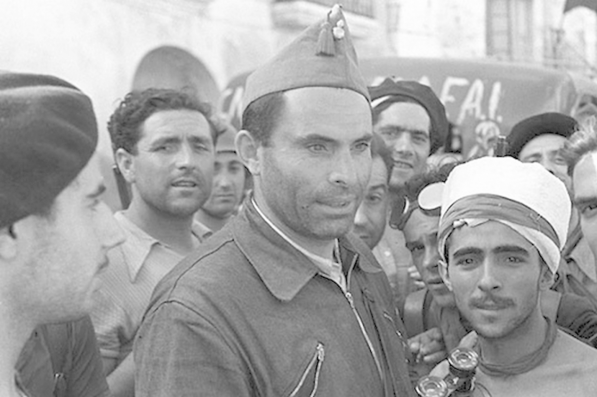
Anarchist supporters in Barcelona

January 8

The Popular Executive Committee of Valencia is dissolved. The Committee is one of eight main groups set up to look after regions (broken into almost smaller 600 collectives) which have been participating in the Spanish Revolution, an anarchist-driven change in way of life for workers of their regions. Aragon was the main driver of this movement, along with neighbouring Catalonia and Valencia regions. Workers unions were collectivised and land is redistributed between workers to create a new, more equal society. At its peak, between five to seven million people were involved in participating in this enormous and ambitious change. Now through three main phases of its operation, the end is coming to much of the programme, which is suffering for a myriad of reasons (this post could go on for months if I get too detailed). The Popular Executive Committee of Valencia, which set laws and rules in the region, is taken over by the Republican government, which can now take control of anarchist popular militias. The militias now have to join the Popular Army and fight officially for the Republicans and fight under the command of professional army officers (anarchist principles are against hierarchy). While the revolution is huge and successful many places, the collapsing of major collectives such as the Popular Executive Committee signals the beginning of the end for the anarchist revolution. (Click on the above or below photos captions to read more about the collectives and revolution)

Examples of anarchist money coupons issues in some collective areas. Other areas did away with money completely

January 9

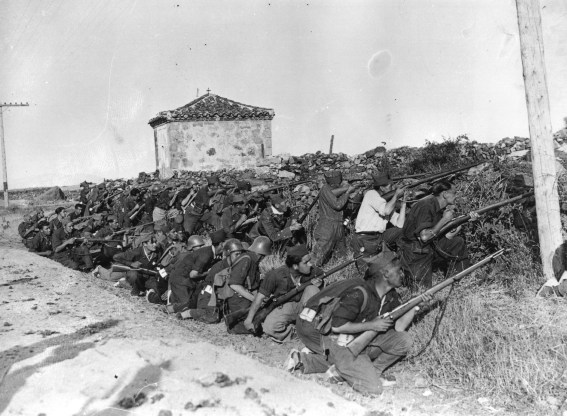
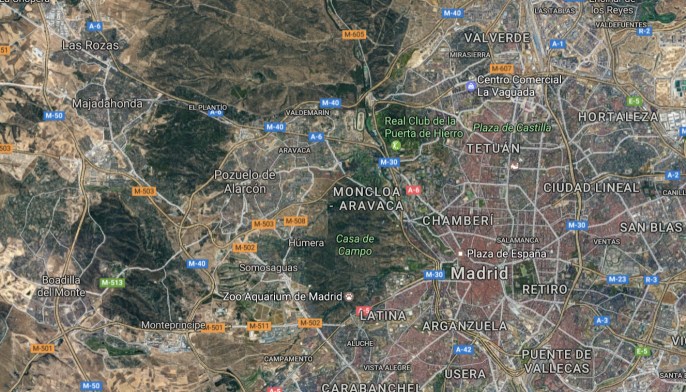
The second battle for Corunna Road outside Madrid is coming to a close. In one day, the Nationalists take seven miles of the road between Las Rozas and Puerta de Hierro. The Republicans and International Brigades have all been killed, and a handful have managed to flee, leaving the Nationalists to control the critical supply road into Madrid.

The Garabaldi battalion, part of the XII International Brigade

January 10

The XII International Brigades (mostly Spanish volunteers, along with Italian, Franco-Belgian and Albanian volunteers) enter the region from Madrid to start the third Corunna Road battle. The next five days of fighting shall see them fight to recapture the northwest Madrid areas of Majadahonda, Villanueva, Pozuelo and Boadilla, all areas taken during the Corunna Road battles. The heavy fog has dropped on the region again making fighting cold, wet and difficult.

January 11

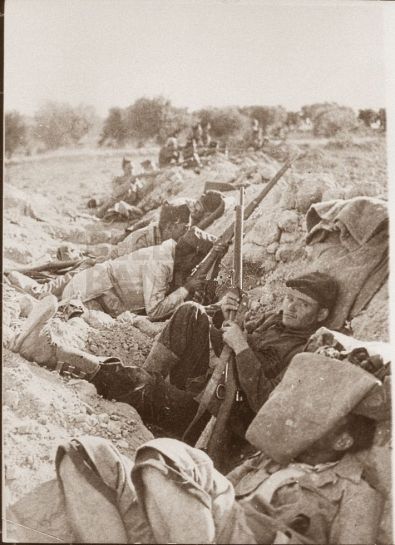
The Nationalist forces, which have only just finished the battles killing so many Republicans, have lost up to 15,000 men themselves (the same as the Republican side) and take cover in trenches in the under siege Madrid areas, as they are suffering from their casualties and lack of supplies.
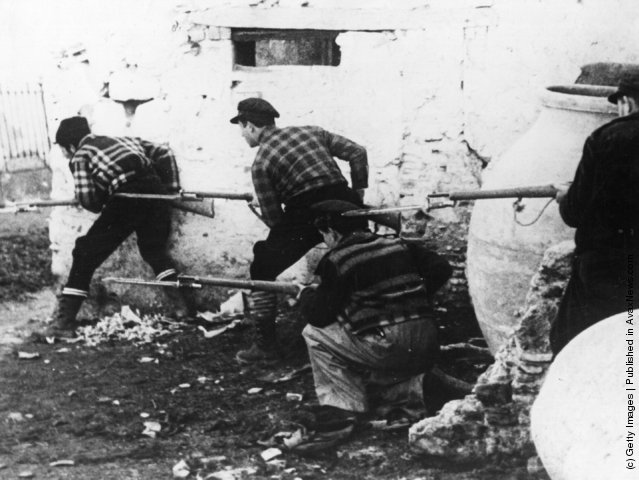
Republican forces lying in ambush in a village near Madrid

January 15

The third battle of Corunna Road ceases. The Nationalists have convincingly won the first and second waves of battle, and now both sides are exhausted. The XII International Brigades do not have the men or supplies to take back any of the northwest Madrid areas, and the Nationalists can’t get any further with their numbers. Both sides are now exhausted and give up in their plans. The Corunna Road route is still technically open and supplies still have a chance of getting through to Madrid, though now the city will have to rely more on the roads coming from Valencia and Aragon in the east/northeast.

~~

This is not a detailed analysis, just a highlight (lowlight?) of the week’s events. Things get lost in translation – Feel free to suggest an addition/clarification/correction below. The more the world remembers, the better. All photos are linked to source for credit.
This Week in Spanish Civil War History – Week 25: 1 -7 January 1937

January 1

By the 25th week of the war, neither side would be able to say their plans had been executed the way they hoped. The Nationalists had hoped to invade, take Madrid and rule the nation within weeks or months. The Republicans came together, multiple factions with similar principles, hoping to oust the fascists. At no stage were they prepared enough to see through their goals. 1937 would see Franco’s plans to take Spain become more established. Franco had much help from Hitler and Mussolini, while the Republicans still had the Soviets on their side, due to the large Communist faction in Spain. But with Republicans made up of many groups and no one clear leader, divisions were one of the main forces at play in the war, with Anarchists and Communists splitting constantly from the Socialists and workers’ militias. As with all wars, the regular people were constant losers.

January 3

The third battle for Corunna Road, just northwest of Madrid city, commences.  General Orgaz Yoldi has gained more Nationalist reinforcements and begins the offensive, known as the Battle of the Fog. The Nationalists retake the town of Boadilla del Monte, as the Republicans are still suffering from their earlier losses. The Republican have five divisions working together, along with the XIV International Brigades, but have little ammunition and have to surrender the town and that portion of the crucial supply route of Corunna Road.

January 4

With surging numbers of Nationalist soldiers coming from the right, the Republicans have to retreat even further away from Boadilla del Monte and also lose the town of Las Rozas, just 11km north of Boadilla del Monte. The weather is at freezing point all day and night and the fog continues to make battle ever more difficult.

The Republicans deploy more units from Pozuelo, ten kilometers west of Madrid city. The Modesto division, a brigade of four units combined, manage to secure the front while other units retreat from advancing Nationalists. The fog continues to thicken, aiding to secure the front for the Republicans and keep the Nationalists at bay, though the strategic towns have been lost. But once the fog lifts, the Republicans know they are in trouble.

Some of the Thaelmann battalion prior to battle

January 5

As the fog lifts, the Nationalists, with 18,000 troops and air support, attack Pozuelo, where many Republican forces are in retreat. The Republicans run out of ammunition, including for the T26 tanks from Russia, which have destroyed 25 German tanks throughout the day. The Republicans have to scatter, without weapons or communication, being split by the attack. Republican General Miaja tries to get the German Thaelmann battalion of the XIV International Brigade back together, along with Lister’s Communist unit, in order to try to regroup. The Nationalists continue to widen their hold over Corunna Road and also take the opportunity to bomb the city of Madrid, mostly by day.

All of the XIV International Brigades are forced far back from Boadilla del Monte and the Nationalists have Corunna Road. They meet up with other Republican groups and are ordered to retake Las Rozas, but they lack the men or firepower to do so. Among the young foreigner volunteers was untrained machine-gunner 17-year-old Esmond Romilly, nephew of Franco-sympathiser Winston Churchill. (It was rumoured that Romilly was Churchill’s own son, Churchill having bedded his wife’s sister. The sisters’ mother was a notorious cheater, and their real father(s) is unknown. Several men are options, one being the grandfather of young Romilly’s wife – meaning the young couple were first cousins. The rich do like to make their own rules, and the family is fascinating/bizarre.)

January 7

The Nationalists bomb Las Rozas from the air, destroying the town and killing almost all the Republicans and International Brigades huddled nearby for safety. The locals of the town have already long fled, hiding in caves in the Hoyo de Manzanares mountains nearby. All but 35 Republicans are killed, those not killed manage to retreat wounded. Those foreigners who survived, such as young Romilly, are sent home with wounds and illness. Romilly went on to write a book named Boadilla, all about the slaughter of  the battle. The Nationalists are in total control of the area, and ready to begin their final push to control all of Corunna road. Both sides have now lost around 15,000 men each.

I’ll will post a review when I get the chance

~~

This is not a detailed analysis, just a highlight (lowlight?) of the week’s events. Things get lost in translation – Feel free to suggest an addition/clarification/correction below. The more the world remembers, the better. All photos are linked to source for credit.

This Week in Spanish Civil War History – Week 19 and 20: 21 November – 5 December 1936

division-of-spain-in-february-1937

Weeks 19 and 20: 21 November – 5 December 1936

“I will destroy Madrid rather than leave it to the Marxists” – Francisco Franco, November 1936

November 21

The Nationalists attack the Model prison and Don Juan barracks. Using bases by the Asilo Santa Cristina Hospital and Dr Rubio Research Institute, they manage to get as far as Parque del Oeste, but are bombed by their German counterparts.

The Commune de Paris column fighting for the Republicans recapture the Hall of Philosophy and Letters Building. Books are used to protect themselves inside. It takes around 350 pages to stop a bullet.

November 22

The ground assault in Madrid has failed and the Nationalists now only have their German pilots to bomb the city constantly, in an effort to weaken the Republican lines.

Carabanchel barricades after the fighting

November 23

Battle of Madrid ends with both sides decimated. Franco pulls back from the outskirts of the city with huge losses and no way into Madrid. The death toll on both sides is unknown after two weeks of killing, though around 2,000 civilians in the city have been killed, and some estimates say a total of 10,000 are dead on both sides. The aerial bombing has been a huge failure; while much of city has suffered serious damage, it hasn’t killed many people and the population are not afraid. The worst aerial bombing of Madrid is now over for the remainder of the war, as Republican supplies increase and pilots gain experience in fighting back. The Nationalists’ plans of storming their way into Madrid and taking the country is over, and now a war will have to rage for another 2.5 years. The Republicans hold the city with  the front line the Manazares River, around the Casa de Campo and Ciudad Universtaria in the north and the Carabanchel suburb in the south.

Madrid is left to clean up

November 27

Operation Ursula, a group a German submarines have been active in the Mediterranean. They had been out in the Atlantic for around a week, but enter the Med on around November 27 to take over patrols done by Italian submarines. They primarily survey Alicante and Cartagena, but have constant trouble identifying any targets coming and going from the ports and have constantly failing torpedos. The submarine operation is a total failure; only one Spanish submarine is sunk, and that was an internal error, though the Germans attempt to claim it as their success. They will sail out of the Mediterranean on December 3.

November 29

The First Battle of the Corunna Road starts, with the Nationalists retreating northwest from Madrid, so try to cut off the city by holding Corunna Road. The Republicans are ready and attack soldiers on the road, and keep the road open for Republican movements.  The fighting lasts for five days as Nationalists try to cut off water and electric supplies from the Sierra de Guadarrama to Madrid. Some 3,000 soldiers under Colonel Varela fight a single Republican brigade and lose, forcing a retreat. They take the small towns of Boadilla del Monte and Villanueva de la Cañada and wait to make another attack on the region.

November 30

The Villarreal Offensive starts, and fighting will last for a month. Basque soldiers, fighting on behalf of the Republicans want to launch an attack Vitoria, in order to pull Nationalist soldiers away from Madrid. The Basques have 4,300 men from the Basque Army and now want to take Villarreal.

The Basques are keen to fight but have little supplies and no aerial back-up. The Nationalists only have 600 men but they have machine guns, plenty of supplies, civilians on their side, and their planes from Burgos have already spotted incoming Basques.

The Basques move into the mountains around Vitoria and surround Villarreal, 3 kilometers from Vitoria. Heavy ground fighting sees 1,000 Basques killed and they do not take Villarreal. The first two weeks of battle sees constant fighting with no outcome, as back-up will not arrive until December 13.

Retreat is a common outcome for both sides at present

*Apologies for the delay, I have been in hospital. Posts will be two-weekly through December.

~~

This is not a detailed analysis, just a highlight (lowlight?) of the week’s events. Things get lost in translation – Feel free to suggest an addition/clarification/correction below. The more the world remembers, the better. All photos are linked to source for credit.

This Week in Spanish Civil War History – Week 18: 14 – 21 November 1936

Week 18: 14 – 21 November 1936

Simplified if you don’t read Spanish –

Numbers are labelled by position of where which column (group) is located on November 16-17. Blue squares are Nationalist, Red are Republicans, and orange are French (and associated supporters) supporting the Republicans. Grey lines – front line. Stars – volunteers in position. Blue arrows – Nationalists making their attack. Spotted blue arrows – aircraft flights, with bombs dropped (blue dots).

November 15

Nationalist soldiers (Morrocan regaulres and Legionaires)  cross the Manzanares River and take over in Ciudad Universitaria (University City). The XIth International Brigade for the Republicans men counter attacks at the ‘Hall of Philosophy and Letters’, however the whole column make it over the river. The Republican factions take the Hall and force the Nationalists to either be killed or run for cover, with over 85% being killed as they flee.

Nationalist soldiers make it as far as  Plaza de la Moncloa inside Madrid, some as far as  Plaza de España in central Madrid before being attacks by the Durruti Column and forced out again. At this point, most bridges over the Manzanares River are now destroyed.  The Nationalists build the ‘pasarela de la puerte’ (passageway of death), a makeshift bridge, which comes under machine gun from the university all day long.

November 17

The Nationalists take the Asilo Santa Cristina Hospital. The Republican Durruti Column attack them, and stretch out to fight in University City and the Casa de Campo. But the  Durruti Column does not have enough supplies and need to retreat back to University City.

November 18

Italy and Germany both recognise Franco as the head of the new Spanish ‘government’. After over a week of battling over Madrid, the leaders all expect Madrid to be taken. Franco is ready to take all the credit but has barely lifted a finger himself in the bloody battle for control.

German aircraft are still bombarding Madrid. This is done to weaken the Republican government into surrendering (though the official government has already gone), and to hurt civilians. The Germans are throwing everything at Madrid in a bid to strengthen their ties to the new Spanish government led by Franco.

The attack north of central Madrid in University City is now three days old and is at breaking point. The Anarchist Durruti Column from Barcelona has been at the front line the whole time, and now their 3,000 strong column is down to only 400 men. The Nationalist side too have lost 1290 men. The University City suburb is largely cut off from central Madrid but neither side have any advantage.

November 19

The Durruti Column launches its dramatic big assault in University City. The Nationalists have taken the hospital and the Buenaventura Durruti men launch an attack.  The Republicans are under prepared and have little supplies; the Nationalists are not used to combat in urban areas. Fighting results in 262 Nationalist killed with no ground gained at all. The Nationalist leaders, Colonel Yague and Colonel Mola are both close to losing faith as they do not want to fight in close quarters, a fight they cannot win.

The Nationalist and Republican/International Brigades fight for control if the Hospital Clínico in the east of the University City. After heaving fighting, the sides fight with grenades and bayonets, one room and floor at a time. Both sides suffer heavy losses.

The outskirts of the city

Buenaventura Durruti is shot while on the front line in the early afternoon in the Casa de Campo.  A bullet pierces his right lung, possibly entering through his back. No one knows (or claims to not know) what actually happened. Which weapon shot him is unknown, and some speculate he was shot by his own side rather than the enemy. The true story will never be definitively uncovered.

NB: There will be a ‘This Week in Spanish Civil War History; Extra’ on Durruti on November 19, including eye-witness accounts of his death and the ‘cover-up’ story.

November 20

Buenaventura Durruti dies at 6 a.m, 16 hours after being shot in the chest. He is aged just 40 and it strikes not just a blow to end his life but also to the end of the propaganda surrounding the Durruti Column, a huge blow to the Anarchists. Durruti dies in the Ritz Hotel, which is now a makeshift hospital, and the bullet is not taken out of his heart. No autopsy is performed.

Buenaventura Durruti – anarchist fighter (and character in my next SCW novel)

November 20

Another 294 Nationalists die while fighting to take Carabanchel and Vertice Basurero to the south of Madrid. Again no gains are made in the urban assault, weakening the entire plan to take Madrid  by force.

José Antonio Primo de Rivera, son of former Spanish dictator Miguel Primo de Rivera is executed in Alicante, two days after being sentenced. Primo de Rivera has been a prisoner there since the start of the war. The Communists holding him decide to try him in a civil court before a Communist governor, as they can no longer wait a decision from the government. He is the leader of the fascist Falange party, and is killed by firing squad at dawn.  Spanish PM Largo Caballero is angered at the Communists for taking their own action, but the Republicans rely so heavily on Soviet supplies and men. The Spanish Communist party is continuing to strengthen and is becoming a state within a state.

NB: There will be a ‘This Week in Spanish Civil War History; Extra’ on Primo de Rivera on November 20.

Jose Antonio Primo de Rivera – Fascist leader

November 21

The Nationalists attack the Model prison and Don Juan barracks. Using bases by the Asilo Santa Cristina Hospital and Dr Rubio Research Institute, they manage to get as far as Parque del Oeste, but are bombed by their German counterparts.

The Commune de Paris column fighting for the Republicans recapture the Hall of Philosophy and Letters Building. Books are used to protect themselves inside. It takes around 350 pages to stop a bullet.

The siege is now days away from its end.

Books as protection seen by Robert Capa

~~

This is not a detailed analysis, just a highlight (lowlight?) of the week’s events. Feel free to suggest an addition/clarification/correction below. All photos are linked to source for credit

This Week in Spanish Civil War History – Week 17: 7 – 14 November 1936

Week 17: 7 – 14 November 1936

(see Week 16: 1 -7 November 1936 for the Madrid lead-up and maps)

Republicans orange, Nationalists blue

November 7

The attack on Madrid begins. All major bridges are attacked by Nationalist troops, most taken easily on the first day of fighting. General Varela attacks from the north, and troops pour into the Casa de Campo and through Ciudad Universitaria. Nationalist troops fight Republican militia in man-to-man combat, and killing occurs one building at a time as Nationalists swarm the city. The death count rockets on both sides. Despite their soldiers’ training and weapons, Colonel Yague sees over 300 of his Legionnaires Moroccan troops killed on day one. Franco expects the Nationalists will have won within a day, unaware the International Brigade troops are one day from arriving from east, along with the Durruti Column anarchists from Barcelona, in time to back up huge number of Spanish militia and hold back the conquering of Madrid.

The start of the massacres in Paracuellos del Jarama, a small area in the north of Madrid. Political prisoners, most soldiers and priests arrested at the outbreak of war, are taken out of the city to be executed. Between November 7 until December 4, the 5,000 prisoners are moved, as the Republicans don’t want hostile Nationalist prisoners inside the city. Some are moved away from the front, but Paracuellos del Jarama is the site of multiple executions. Over the first few days, 1,000 prisoners, all Nationalist sympathisers, will be shot. The death toll will be unknown; many say 2,000-3,000, some up to 12,000.

International Brigades in Casa de Campo

November 8

The major launch on Madrid begins. General Mola attacks with 20,000 soldiers, mostly the Moroccan troops. The Condor Legion from Germany launches air strikes on the city. German officer Wilhelm Von Thoma leads German tanks alongside light amour support from Italy.

The Republicans have more men, and send 12,000 to Carabanchel, but the larger force of 30,000 heads to Casa de Campo. The problem lies in the detail; the Republican men have had little or no training at all, and have only ten rounds per rifle. Only sheer numbers hold off the Nationalists. Small groups of Moroccan regulares soldiers manage to get over the Manzanares River to Model Prison, which is the set target for the onslaught. One of the Republican leaders, General Miaja, took his scared men forward himself to try to force the soldiers back. Radios all over Madrid repeatedly called the classic ‘­­¡No pasarán!’ (they shall not pass!) slogan, calling everyone to help in the fight against the siege.

By evening, the first International Brigade arrives, the XIth battalion, from Albacete in the east. There were small in numbers, but they provided morale and back-up for the fighting Madrileños. The men had not finished their basic training. They were greeted on Gran Via as a Soviet Union battalion, though they were a mix of German, Polish, Italian French and small numbers of other countries.

Telegrams are sent to the War Ministry in Madrid, congratulating Franco on his victory; no Nationalists are in Madrid, and neither side has won anything.

Nationalist soldiers at the front

November 9

The Nationalists focus on taking the southern Carabanchel suburb. The Moroccan soldiers are trained in open-country fighting and not the urban battle they need to fight. Republicans, who work and live in the area, have the home ground advantage, and there are many Nationalist casualties as the Republicans again hold the enemy back.

The XI International brigade, 1,900 men, start their fighting in Casa de Campo alongside Republicans in the evening. Heavy fighting sees 2/3 of the Internationals killed, though the Nationalists do not advance into Madrid. Fighting will last for several days, with both sides suffering losses. The Nationalist no longer see Casa de Campo as a way into Madrid, though this is not just due to international fighting, but their presence is good for propaganda.

The San Fernando bridge, which flanks the left of the Nationalist-held area over the Manzanares River, is retaken by the Republicans.

Air strike damage

November 10

Ciudad Universitaria in the city’s north is under Republican control, though the Nationalists are prepping the take the area. Around 150 Nationalists are killed on the front line around the north of the city, a total of 2,369 casualties since the start of the siege.

The Durruti Column, a group of 3,000 anarchists from Barcelona, arrive in Madrid, ready to help defend Casa de Campo. They had been marching to Zaragoza to recover the city from the Nationalists, but had no success and carried on to Madrid to help. They are led by famous anarchist Buenaventura Durruti.

University City area held by Republicans

November 11

Another 1,000 Nationalist prisoners are killed in the Paracuellos del Jarama reportedly by the Fifth Column, a communist led group of Spanish militiamen, who are well-organised and well-trained, unlike most in the area. The prisoners, all taken from the Model Prison in inner Madrid, are shot and bodies are dumped, in retaliation for the Nationalists attacking the city. The killings are one of the Republicans’ sides most vicious single-acts against civilians.

The arrival of the Durruti column causes some discontent as the placement of the men is up for debate, as the anarchists and Madrid-based militia try to work together. Regardless of any tensions within Madrid, the Nationalists are still held outside Madrid for another day.

Refuge from bombing in the Madrid subway

November 12

The XII International Brigade arrives in Madrid and launches an attack on Cerro de los Ángeles hill, south of Madrid, only just taken by the Nationalists. This is to ensure the Nationalists cannot advance east of Madrid and claim the road to Valencia. The attack fails, but the road to Valencia is still secure. The brigade of Spanish, French, German and Austrian fighters are suffering from lack of training and supplies, and communication trouble, but the 1,500 strong brigade returns to the safety of Madrid, with minimal losses.

The children of Madrid

November 13-14

The battle continues in Carabanchel, and man-to-man fighting continues right in the military hospital, with the Republicans losing many men but still holding the area.

Fighting along the south and west of the city continues, with air strikes on the city combined with close combat fighting. The Nationalists are preparing to take Madrid via the northern Ciudad Universitaria area, as Casa de Campo and Carabanchel manage to hold safely. The International Brigades are basing themselves in the north now to hold the Nationalists back.

Republicans at the front

~~

This is not a detailed analysis, just a highlight (lowlight?) of the week’s events. Feel free to suggest an addition/clarification/correction below. All photos are linked to source for credit