This Week in Spanish Civil War History – Week 6: 22 – 28 August 1936

Week 6: 22 – 28 August 1936

August 22

With Republicans constantly attacking with multiple militias in different areas with different affiliations, the number fighting on their side is still unconfirmed. They have around 90,000 in total, with 33,000 paramilitary, and 7,000 officers, 22 generals and their 50,000 soldiers. Meanwhile, the Nationalists have around 130,000 men – 40,000 soldiers including the Moors from Morocco accompanying 50,000 metro army and Guardia Civil. They are commanded with 17 generals and 10,000 officers. They have 60% of all Guardia Civil guards and only 40% of the assault guards, meaning the Nationalists have far superior trained men, a situation making itself clear in fighting all over the country.

August 24

Italy and Germany join the Non-Intervention agreement officially, which means they can be part of the official blockade of arms and equipment into Spain, and to the Republicans. But because both the Germans an Italians have warships in Spanish waters, they can prevent anyone else from entering Spain and helping the Republicans, while the Nationalist still have them as allies.

August 26

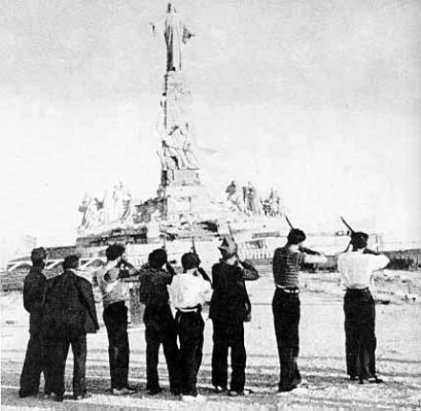
The Catholic Church and the Pope are behind the Nationalist cause, despite their brutal killing. With the Republicans burning churches and killing priests (many priests are ‘second sons’ of wealthy families in their area, making them even more of a target), they are being cited by international media as barbarians. The unsubstantiated claims of nuns being raped has circulated to vilify the Republicans cause, though nothing was ever proven. Meanwhile, Nationalist troops are told via radio announcements that raping women is a perk or bonus and it should be done as often as the chance arises. The soldiers have not needed any encouragement.

SpanishLeftistsShootStatueOfChrist

August 28

The fifth regiment, based out of Madrid, is now at about 6,000 men. Set up by the Antifascist Worker and Peasant Militias (MAOC), the regiment is the only one that is well organised and running efficiently, with the Communist leaders well trained. The fifth regiment is open to people other than Communists and is gaining popularity in Madrid fast, after beating back the Nationalist north of Madrid city earlier in the month.

~~

This is not a detailed analysis, just a highlight (lowlight?) of the week’s events. Feel free to suggest an addition/clarification/correction below. All photos are linked to source for credit

This Week in Spanish Civil War History – Week 5: 15 – 21 August 1936

Week 5: 15 – 21 August 1936

August 15 

The Battle of Badajoz continues, a day after being taken by the Nationalists. The dawn of the day sees thousands murdered in mass executions all over the town.

See The Battle of Badajoz.

August 16

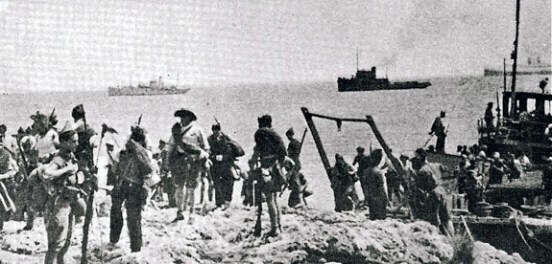
The battle of Mallorca starts. The island is under the control of the Nationalists but Republican forces storm the island from the sea and manage to get 12 kms inland with 8000 militia men. The battle will rage for another month as the Nationalists gain Italian back-up.

Troops on the shore after beginning the battle

August 18

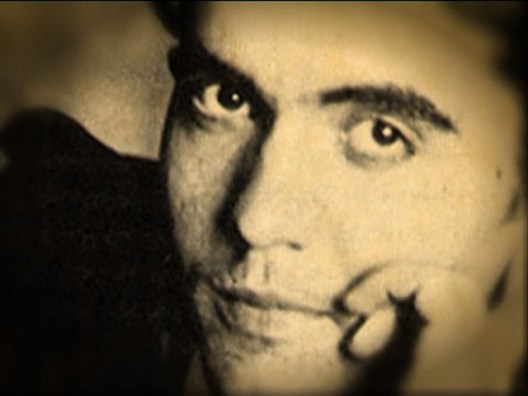
The mayor of Granada, Manuel Fernández Montesinos, is assassinated, a week after taking office. The major city has been without a mayor for months, as the post of considered a death sentence. On the day of his assassinated, his brother-in-law, the famous writer Federico García Lorca, is arrested by Nationalist forces.

 August 19
.

The legendary Federico García Lorca, along with three others, Joaquín Arcollas Cabezas, Francisco Galadí Melgar and Dióscoro Galindo González, are taken out of Granada, to Fuente Grande, between the nearby towns nearby Víznar and Alfacar, and executed.   The men were forced to dig their own graves before being shot. Lorca, a man who had friends on both sides of the battle, was reportedly killed for being gay, though all the details have never been fully explained. The bodies have never been found.

NB – there will be a ‘This Week in Spanish Civil War History Extra’ on Lorca on August 19.

Federico García Lorca

August 19

In line with the Non-Intervention Agreement, (which is being ignored by most countries who have signed) Great Britain bans all arms and aircraft sales to Spain. As the Nationalists are being armed by Germany and Italy, this harms only the Republicans, who have to go to Russia for help.

August 20

For several weeks, Republican miltia have been attempting to take back the strategic southern city of Cordoba. On August 20, 3000 troops attack the Cordoba gate 5 kms from central Cordoba, but are beaten in a three-day offensive. This sets off another month of reprisal killings in the area which stabilises the region (as most non-Nationalists are now dead).
 .

Gerda Taro with a Republican soldier outside Cordoba

~~

This is not a detailed analysis, just a highlight (lowlight?) of the week’s events. Feel free to suggest an addition/clarification/correction below. All photos are linked to source for credit.

This Week in Spanish Civil War History Extra: Battle of Badajoz – 14 August 1936

The Battle of Badajoz was one of the first leading battles, and victories, for the right-wing Nationalist rebels in the Spanish Civil War. Won on 14 August 1936, the massacre at Badajoz has long been used as propaganda against the cruel Franco forces.

Where-is-Badajoz-on-map-SpainThe war was almost one month old. Areas controlled by Nationalist armies were fractured between north and south, and needed to connect their territories. Badajoz, a town of around 41,000, on the border with Portugal, became a prime target. Nationalist forces set out north from Seville on their way towards central Madrid. By August 10, Colonel Juan Yague (a notorious killer, especially of innocents) and his 2250 troops had taken the town of Mérida, just 60 km east from Badajoz. Yague had orders to take Badajoz to help link their north and south frontiers and have the area next to the Portuguese border under their control.

Badajoz was already flooded by refugees from all directions from killings happening in both towns and in the country. Some rich right-wing landowners were even holding days when they and their friends would go killing peasants while on horseback. Killings and reprisals killings were uncontrolled and widespread. For three days, Badajoz suffered aerial bombing from planes donated to the Nationalist troops from Italy and Germany. The town’s mood was one of impending doom.

d98360eac2749741688f3a491ad31773Badajoz from the air 1936

After dawn on 14 August, the Nationalists stormed the north gate of the city, Puerta de Los Carros, and the south gate, Puerta de la Trinidad. While the Republicans managed to hold back the soldiers at the south gate, the brutal Moorish troops won at the north gate, breaching the city and overcoming the barracks inside. An ugly battle ensued, with the Nationalists killing with bayonets and knives as they overtook the whole town. Many Republican militia defected to join the Nationalist troops, and many surrendered. Everyone in sight was killed throughout the day, even when surrendering. All the leaders of the town and Republican militia, including the mayor, had left the town early in the day and made it to Portugal, abandoning the people to their deaths.

The Nationalist troops took much delight in slaughtering as many people as possible, including unarmed women and children. Their leaders had been promoting the use of rape against women as a weapon from the outbreak of war as well. Anyone who wasn’t immediately killed on sight was rounded up. While many were marched to the local bullring and executed by firing squads, many were simple killed on the street. Estimates of between 1000 and 1800 people were executed on the first day of fighting. In one main street, Calle San Juan, around 300 bodies were left there after execution. Through the night and into the next day, anyone even suspected of being a left-wing sympathiser was taken from their homes and sent to the bullring for execution. Journalists ran censored stories about the massacre, including a Portuguese journalist, who fled home with the story, refusing to ever set foot in Badajoz ever again after witnessing torture and execution.

The true death toll of the Badajoz massacre remains unknown, but estimated somewhere between 1300 and 4000 people. No official death toll was taken. Most were killed by firing squad or machine gun fire in the bullring, to the point where prisoners stood ankle-deep in blood with other bodies as they were murdered. Reports of mutilation were made, though exact behaviour is unknown. It was suggested that some were killed bullfight style, chased around and stabbed in the back and then mutilated. The Moorish troops were well-known for their vicious and sadistic nature. Up to 10% of the town died in this one battle.
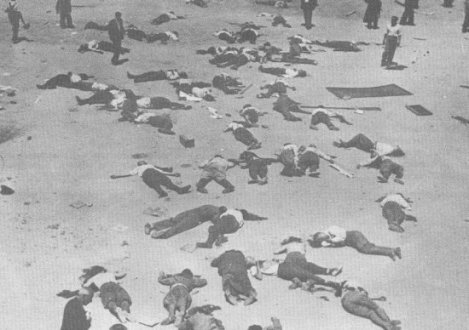
14a1-cuartelmontanaAn early photo of inside the bullring

The battle of Badajoz gave one of the war’s most famous quotes, when Colonel Yague, who by then had earned his ‘Butcher of Badajoz’ nickname, told an American journalist (with much pride) – “Of course we shot them. What do you expect? Was I supposed to take 4,000 reds with me as my column advanced, racing against time? Was I expected to turn them loose in my rear and let them make Badajoz red again?” While the battle is labelled as fighting during a war, much has been said about reclassifying it genocide or a crime against humanity, which it most certainly was.

Around the Badajoz region, another 2000 people were killed by the marching soldiers, mostly farmers. While the Republicans were labelled ‘reds’, the Nationalists were now known as the ‘white terror’. Sadly this was only the start of a long civil war.
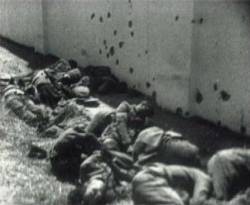
fusilamientos_badajoz_1936Firing squad against the wall outside the bullring

The leaders of the defense committee and the mayor were found in Portugal and returned home to face execution a short time later. This battle would be far from Badajoz’s only major battle during the war. But this initial massacre linked the north and south elements of the Nationalists, strengthening their advance on the country.

~~

This is not a detailed analysis, instead a simplified report of events in Badajoz. Feel free to suggest an addition/clarification/correction below. All photos are linked to source for credit. Against usual preference, I chose to add the firing squad photos as it is a painfully accurate reflection of the event.

This Week In Spanish Civil War History – Week 2: July 25 – 31 1936


Week 2: 25 – 31 July 1936

July 25

Hitler agrees to support Franco’s bid to take over Spain. Franco needs urgent supplies and Hitler needs a distraction from his plans to dominate Europe.

Reprisal killings are happening in the south, in and around Seville. Numbers of deaths are unknown; anyone suspected of supporting the Republicans is taken away to face a firing squad.

franco_hitler

Franco and Hitler

July 26

German and Italian planes land in Morocco, ready to help the Nationalist cause. With a naval blockade halting the transfer of soldiers from Morocco to the mainland, they can be flown instead.

July 27 

The Nationalists control Seville with reinforcements from Morocco on the German-donated airplanes. Seville is to be a main centre for the rebels to plan their sweep north to capture all of Andalusia in southern Spain.

Aircraft used by the Nationalists drop a bomb on a market in Malaga, killing mainly women and children.

Fighting between Republicans and Nationalists continues in the eastern cities of Valencia and Alicante, which haven’t been captured by either side yet. Both cities are Republican strongholds.

00001d7d_big

Republicans fighting in the streets

July 28

First bulk arrival of German and Italian planes into mainland Spain. Masses of troops arrive, ready to help local military forces, now vastly outnumbering the Republican people.

Savoia-Marchetti_SM.81

German donated aircraft used in Spain

July 29

Northern city of Gijon still fighting for control; military haven’t yet been able to claim the area.

July 30

Fighting still ongoing in Valencia as the large Republican population manage to contain the military in their barracks. Local people in support of the Nationalists are subdued by the worker’s Republican groups. Reports of old grudges between individuals being resolved with shooting, masked as executions due to the rebellion.

July 31

Great Britain bans the sale of weapons to the Republic. Most of Europe foolishly thinks that non-intervention is better than assistance.

400 Nationalist supporters killed by Republican supporters in Toledo as part of reprisal killings.

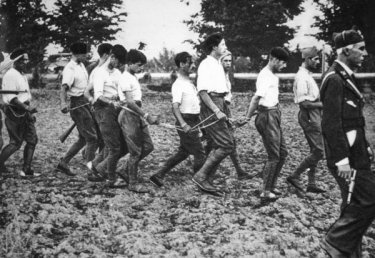
Reports from all locations of both Republicans and Nationalists being pulled from their homes and murdered, based on the perception of who they support. Reports of mass rape of women prior to being put before firing squads. Republicans are angry and trying to weed out ‘traitors’; Nationalists are killing the educated – doctors, lawyers, teachers, artists, government workers, anyone left-wing, and anyone suspected of voting Popular Front last February. Full-scale massacre has begun.

Republican prisoners about to be shot by Nationalist firing squad

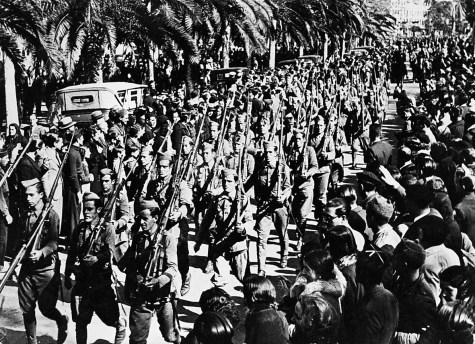
Men being marched to firing squads

~~

This is not a detailed analysis, just a highlight (lowlight?) of the week’s events. Feel free to suggestion an addition/clarification/correction below. All photos are linked to source for credit.