
José Buenaventura Durruti Dumange was born 14 July 1896 in León, northwest Spain, as the second of eight boys born to Anastasia Dumangue, and Santiago Durruti, a railway worker and self-described socialist.
Durruti left school at 14 and started as mechanic on the railway with his father. The pair became members of the UGT, Unión General de Trabajadores (socialist General Workers Union). This quiet start to life changed in August 1917, when the UGT took part in a strike, when the government struck down an agreement between unions and their employers. To stop the general strike, the army was brought in to stop them, killing 70 and harming another 500. Another 2,000 were jailed without being tried for any crime. Young Durruti escaped the fighting, but exiled himself to France for safety, where he found company in fellow anarchists over the border.
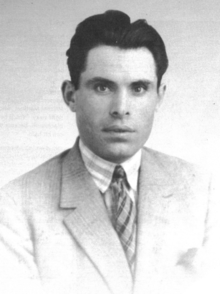
The harsh treatment by the Spanish government on its people changed Durruti forever. He made his way to Paris and worked there as a mechanic for three years, before deciding to return home. He got over the border and onto nearby city San Sebastian on the northern coast. By now he was an anarchist, and set up his own group named Los Justicieros (The Avengers) with well-known local anarchists Suberviola, Ruiz, Aldabatrecu and Marcelino del Campo, and others keen to fight. While Durruti had been in Paris, thousands of workers had been fighting, jailed or killed by the government while defending their rights, and Durruti wanted a high place in helping them all.
On 15 August 1921, San Sebastian had the inauguration of the Gran Kursaal, a beautiful La Belle Époque style building for the city, with casinos, restaurants and a flourish of the cosmopolitan city’s wealth. King Alfonso XIII attended the opening, and Los Justicieros made their first large play – to assassinate the King. The King, a symbol of all workers were oppressed by, was already under fire for losing 10,000 soldiers in Morocco a month earlier, and had suffered assassination attempts before, but Durruti’s plan failed.
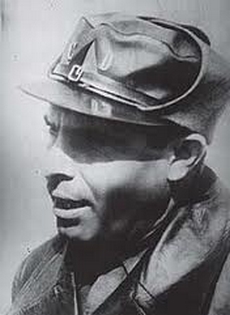 Soon after this failure, Durruti got approached by the leader of the CNT, Confederación Nacional del Trabajo (National Confederation of Labour), a strong anarchist union. Durruti took the offer of going to Barcelona, where workers and CNT members were being jailed, harmed and killed by the government. Members of the Los Justicieros including Durruti moved to Barcelona, where Durruti met Francisco Ascaso and Juan García Oliver, men, along with other prominent anarchists, would become from friends and start the Los Solidarios (Solidarity) group in early 1922. By this time, members of the CNT including their president were being assassinated, thrown in jail, or hurt in armed stand-offs as people tried to defend themselves and their fights against the government.
In 1923, Durruti and Ascaso carried out the assassination of Cardinal Juan Soldevilla y Romero, a man wealthy on gambling and hater of the common man. That year was huge in Spain, with Miguel Primo de Rivera taking power in Spain and launching his dictatorship of the nation. Durruti, Ascaso and their allies retaliated by launching attacks on military barracks both in Barcelona and along the border stations which led into France. Often, these attacks harmed more anarchists than government supporters. With so many unsuccessful attempts to upset the regime, Durruti, Ascaso and Oliver left Spain. They went to Cuba, before travelling South America, robbing banks throughout Argentina and Chile. All Latin American countries have been told of Durruti, and he wasn’t safe anywhere.
 In 1924, Durruti and Ascaso sent to Paris, to again attempt to assassinate King Alfonso XII. Another failed attempt saw both men in jail for a year. Release saw them awaiting extradition to be executed in Argentina, after being convicted in their absence for crimes committed there. But the French anarchists rose up, and the pair were not extradited, but were exiled from France. They fled to Germany, but were denied asylum, and Belgium and Luxembourg offered no help. They fled back to Paris, and lived in secret on the charity of anarchist sympathisers. They moved to the French city of Lyon but were caught by police, so fled illegally to Belgium before making their way back to Germany. Germany again refused asylum and Belgium took them in after a change of heart. Through all this, the USSR were becoming interested in Durruti’s rising status, but the pair refused to take up ‘communist hospitality’ and live in Russia.
Meanwhile in Spain, a secret anarchist meeting in Valencia saw the opening of the FAI, Federación Anarquista Ibérica (Iberian Anarchist Federation) to bring together various militant groups working for the anarchist cause, and become part of the CNT.
It wasn’t until 1931 when the monarchy was overthrown and exiled, and the Republican government won elections did Durruti and Ascaso came home to Spain. Durruti was influential now, and his presence stirred already-forming splits within the anarchist CNT. Arguments about supporting the Republican government formed, splitting the CNT in two, with the leader Angel Pestaña leaving to form a new party and support the government, and loyal CNT/FAI members, including Durruti, to remain loyal to their anarchist principles. Throughout the year, workers were being killed for striking, with hundreds killed in Barcelona, Seville and elsewhere. Durruti and Ascaso kept robbing banks to give money to workers, but change was coming. Durruti married and had a baby on the way, and he needed to step back.
But in January 1932, the Catalonian FAI staged a violent uprising, and the army retaliated by arresting 120 prominent anarchists, Durruti and Ascaso among them. All were immediately deported to Spanish Guinea, Durruti separated from his wife and two-month-old baby. But continuing surges in violence saw the army back down, and all were sent back to mainland Spain three months later. On his return, he tried to play it safe, with what are called his black years. He joined the Textile Workers’ Syndicate in Barcelona and did factory work, but he was constantly hounded by police for his constant work for unions and the anarchist movement.
 By October 1934, Spain was in near collapse. Uprisings by Catalan Nationalists in Barcelona, Madrid and the northern Asturias region saw massive violence. In the Asturias, where workers were well organised, with anarchists, socialists, Stalinists and neo-Trotskyists all working together against their enemy, the Catholic church and the government. The University of Oviedo and the Bishop’s Palace were destroyed, churches we burned, priests shot and nuns raped. Coal miners were striking, and General Franco and his army were sent in to quell drama, killing 1,300 people, mostly the coal miners. Another 3,000 were wounded and another 30,000 jailed, mostly in the Asturias region. The violence saw the rich moving towards fascism to keep themselves safe, while the workers of the country continued to spiral against a system crushing them. The government, now the right-wingers, were looking for blood.
By February 1936, the Republicans returned to power, with full socialist support, but not with the huge anarchist movement, or the smaller communist supporters. Now, the ever increasingly angry fascists, the wealthy and the right-wing religious were ready to pull down the government. Durruti was still in Barcelona, and was forced into hospital in July for hernia surgery, just as war would break out.
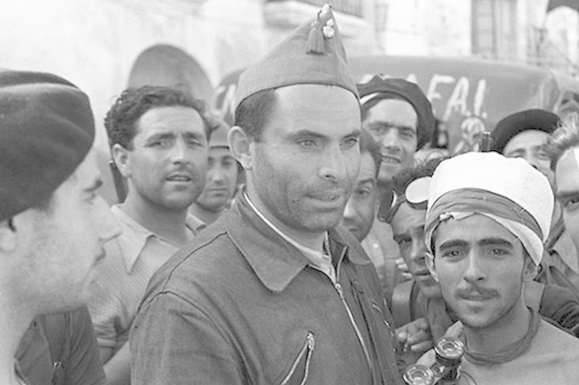 The rich right-wing haters declared a rebellion on July 17, but fighting did not reach Barcelona until the 19th. Durruti, with his wound still open, left hospital and took up arms to squash the army and police seizing the government. Fighting in the streets went on for hours, and the workers, the civilian militia, were winning. At dawn on July 20, Durruti and best friends Ascaso launched an assault on one of the two remaining army barracks not defeated, but Ascaso was shot and killed alongside Durruti as they ran towards the soldiers.
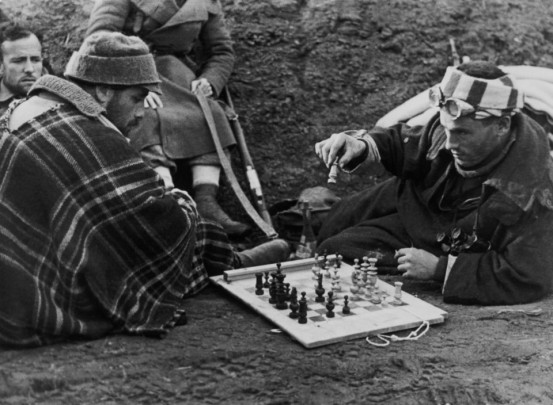
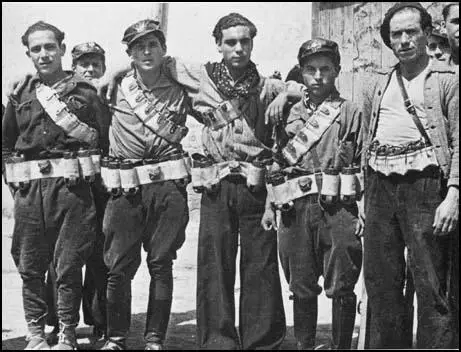
 Durruti Column members
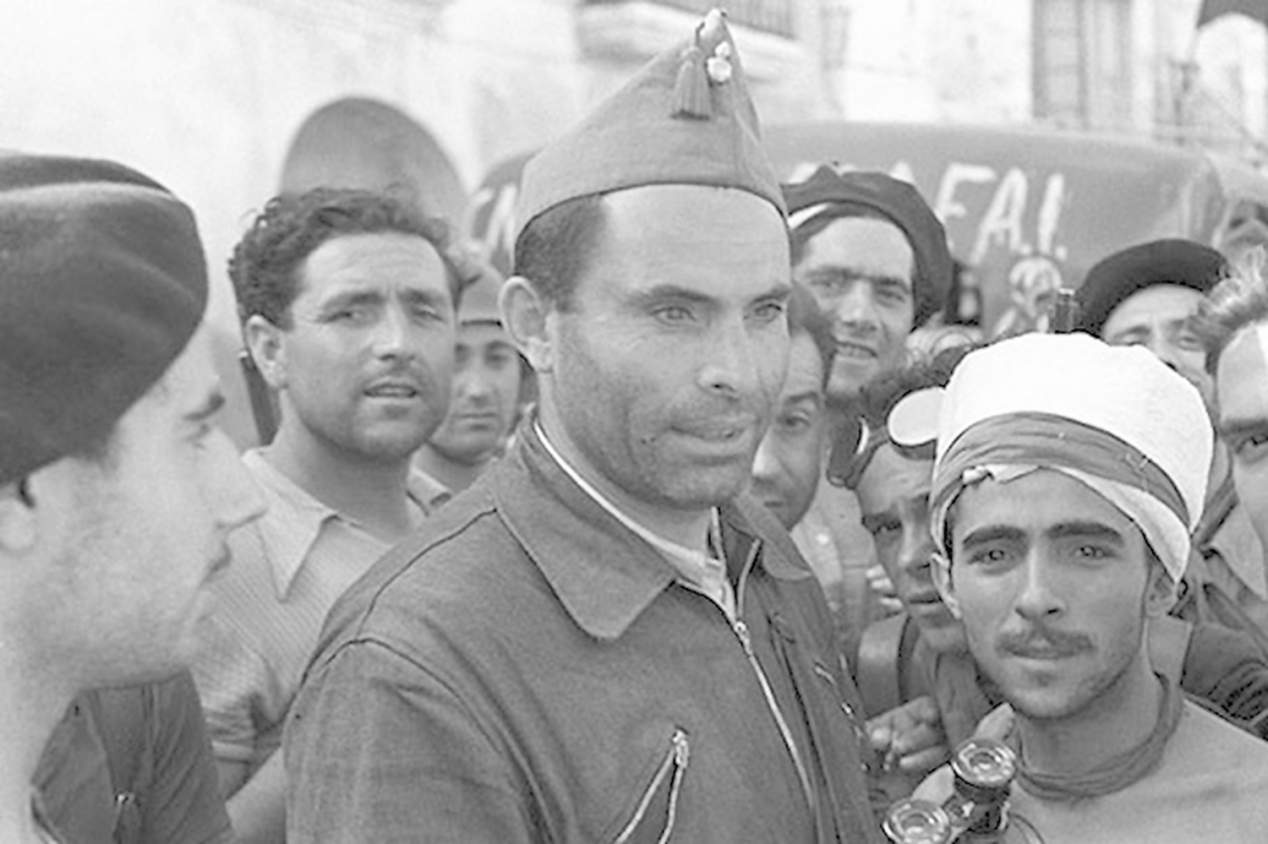
A day later, Durruti along with his other longtime companion Oliver visited the Catalan government leader, still dirty and armed from the attack. They negotiated for the anarchists to join the government and rise up together. The Anti-Fascist Militia’s Committee was formed, bringing together all groups the CNT, the FAI, the UGT, the neo-Trotskyists and a number of Republican groups, taking over as government of Catalonia. Just a week later, teamed with Ascaso’s brother, Durruti and Oliver they formed the ‘Durruti column’ a band of men loyal and ready to take back Spain.
On July 23, Durruti left Barcelona with 1,000 men, ready to save nearby Zaragoza from the army. By the time they marched to Zaragoza, they had between 8,000 and 10,000 men, while other columns worked on saving smaller towns, this large group prepared to save Zaragoza city, though the attack never occurred. By now, as much of Spain was controlled by the fascists and the army, with people being executed by the thousands, but the Aragon and Catalonia regions were in anarchist hands.
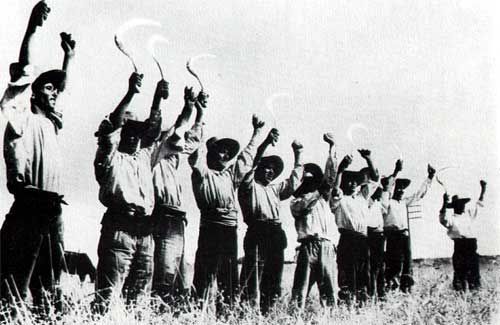
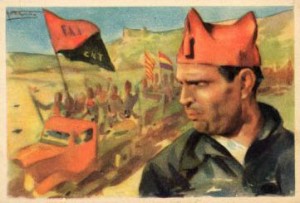
 Popular propoganda poster
The Durruti column set out for Madrid, and the group of around 3,000 marched the 350kms to the capital. They arrived on 12 November, just as International Volunteers also arrived to help fight back the siege on the capital. The Durruti Column fighters battled mostly in the north of the city in the Ciudad Universitaria region. Madrid was under full siege, with German planes bombing at night, soldiers attacking by day in every direction, with no escape.
The tide was starting to turn; the Republicans, their supporters and the volunteers were starting to hold off the army. But on November 19 at around 2pm, Durruti was shot in the chest while in the northern region of Madrid. Little was said about the incident as Durruti was rushed to the Ritz Hotel, now a makeshift hospital and surgical theatre. There was little that could be done, and Durruti died at 6am, November 20. The bullet was not even taken from his heart, where it was lodged. He was only 40.
 The news of Durruti’s death spread fast, and calls for his body to go home to Barcelona and his family were made. No autopsy was performed on his body, so the calibre of the bullet was not recorded. This made it harder to certify what happened.
The story emerged that Durruti was shot by a sniper. His driver said he had stopped his car on Avenida de la Reina Victoria, the area totally destroyed near the Hospital Clinica. He saw some of the militia leaving the front, and ordered them to return. As Durruti returned to the car, bullets came flying from surrounding destroyed buildings. As Durruti tried to get in the car, a sniper’s bullet shot him in the chest.
 Republicans fighting in northern Madrid
This story was relayed over and over, everyone assuming their leader to have died a hero. On November 22, his body arrived back in Barcelona, and half a million people poured in to join the funeral procession. They followed to Montjuïc cemetery where he was laid to rest, and his funeral was the last large gathering of anarchists throughout the rest of the war.

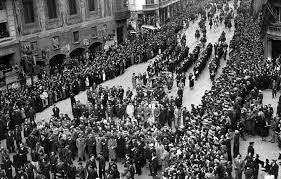 Barcelona funeral
To some, Durruti was a criminal and a bully. To others, he was their salvation against the oppressors. His stories and actions were used for morale and propaganda to help the Republicans cause; this asset now lost. But the story of him dying in a haze of sniper’s bullets continued to circulate, a propaganda story in itself.
But later inquires heard of different stories, from the men who claimed to witness Durruti’s death. Rather than killed by the hiding enemy, the story told was one of simpler disaster. It was said, while planning an attack, one of Durruti’s friends shot him, when a rifle went off by accident. This friendly fire was a common problem due to the poor quality supplies the Republicans fought with. Other rumours suggested Durruti was planning an attack, a sort of suicide mission, and someone shot him to prevent it, though none of that was ever proven. The accidental shooting stayed quiet, the snipers story better to rally the cause.
The Durruti Column was broken up and folded into other groups several months later and while the war did not end until 1 April 1939, the battle to hold Madrid and the Aragon/Catalonia/Valencia regions were the only large success the Republicans had, before eventually falling and suffering another dictatorship for almost 40 years.
 ~~
~~
This is not a detailed analysis, just a highlight of Durruti’s life. Things get lost in translation – Feel free to suggest an addition/clarification/correction below. The more the world remembers, the better. All photos are linked to source for credit.










 CAROLINE ANGUS


