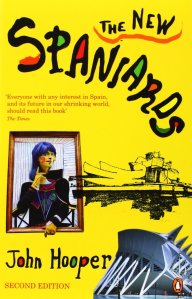
Modern-day Spain is a country changing at bewildering speed. In less than half a century, a predominantly rural society has been transformed into a mainly urban one. A dictatorship has become a democracy. A once-repressed society is being spoken of as a future ‘Sweden of the Mediterranean.’ John Hooper’s outstanding portrayal of the new Spanish society explores the causes behind these changes, from crime to education, gambling to changing sexual mores. This new, up-to-date edition is the essential guide to understanding twenty-first-century Spain: a land of paradox, progress, and social change.
~~~
The New Spaniards is a book which has sat on my to-read shelf for far too long. The second edition of this book got released in 2006, so by the time I pulled it from my shelf, I wondered if its information would be little irrelevant, given the changes to Spain in the past eight years. I could not have been more wrong.
So often mentioned in the same breath as Ghosts of Spain by Giles Tremlett, the book which pulled me from my slumber about Spanish history, The New Spaniards is a must read. The author brings together over 400 pages, creating a solid, credible and easy to read review of Franco and modern life. One chapter in, what immediately becomes clear is the efficient and clean writing style Hopper has; while other books on the subject can feel academic and stiff, the prose is fresh and makes the reader comfortable among a detailed and insightful presentation.
The book starts with a section of the Franco reign, from the years of hunger, the economic boom, the mass migration of Spaniards both abroad and within their own nation, and effects of the reforms made during the dictatorship. The 1970′s, once Franco had gone and democracy set in, is covered with excellent detail, without any confusion on what was undoubtably a dizzying time of change in so many ways. Then-young king Juan Carlos and Prime Minister Adolfo Suárez are well discussed, along with the placement of the young and the old to form a peaceful democracy. The changes made by the Socialist government in the 1980′s are well touched upon, their effect on the economy and the high unemployment rate (easy to identify with today), along with the stark changes in the 1990′s by successive governments.
Chapter 7 – Legacies, Memories and Phantoms – is an engrossing read, whether a reader understands Spain’s 20th century history or not. It explains how Francoism has not survived the passing of years, but a legacy has become ingrained in Spanish life. The pact of forgetting, which did not allow anyone to forgive or heal, is touched upon with honesty, as is Valle de los Caídos outside Madrid. Hooper’s accurate argument is that the omission of the civil war (and its mass graves) in school textbooks, because it is not old enough to be considered history, is an excuse wearing thin.
Part two sweeps in with a section on the churches’ role in Spain, along with the curious and absurd prudery of Franco and the changes to modern time, such with gay marriages. It makes an enlightening read for those less acquainted with subjects such as prostitution, abortion, contraception and gay rights in Spain. Another absorbing chapter is the death of machismo in Spain as women gain rights after being so deeply and cruelly oppressed under Franco. The fact Spanish women are still suffering sexism, like all nations, is also explained, with the all the relevant details to back up the claims. The role of family in Spanish life is given a thorough and honest portrayal, as are the changes in domestic violence and divorce laws which have changed the precious Spanish family for the better.
Part four sheds light on the autonomous regions of Spain, something not well understood by those not living in the country. The Basques, the Catalans and the Galicians are all opened up as Hooper shares their desire for self-governance, with all the information on the remarkably different laws and goals for their regions. (I wanted to wave the flag for the region of Valencia at this point, which has been trapped under their corrupt PP mayor for over 20 years). The book covers the how’s and why’s of the 17 autonomous regions of Spain, their individual paths to freedom, and what lies ahead for these proud places. I learned more about this process, despite having studied it in the past, a testament to the author’s respect for detail.
This book covers so many subjects that it can dizzying when looking back over all that is covered – from Spanish gypsies, to the welfare system, to the ups and down of the education system, housing and the booms and busts suffered, to the legal system, the media, the arts, but Hooper guides readers through every subject with a smooth yet meticulous manner, opening up each of these fundamental subjects. For me, one of the final sections on changing traditions was especially fascinating. Bullfighting is covered in-depth with an unbiased yet accurate voice. I have read much about bullfighting, but it can be hard to find anything written that does not either lean heavily in favour or against the art form. Regardless of your opinions on the subject, any reader can gain from the information shared by the author.
While much as happened politically, socially and economically to Spain since this book was written, it still serves to provide a clean, realistic picture of Spain and why the nation sits in its current form. The book shows how the past has shaped the present, and can also show that what Spain is currently suffering is not unique. Each generation of Spaniard has seen suffering, but also moments of hope in the time since Franco died. If anyone wanted to learn from the past mistakes, the tips to succeed could well lie in the words of John Hooper.
This book got first published in 1986, rewritten in 1995 and revised in 2006, and could be easily overwhelming if it was not so well planned and laid out. I have yet to find a book that captures Spain’s identity as well as The New Spaniards. It should be handed out to each person who arrives in Spain and plans to make a life there.
My only gripe is that my paperback copy has a tiny font! While this has nothing to do with the quality of the author’s work, I had a headache the entire time. I can understand a publisher’s desire to make the text small, with so much to give to a reader, but it was difficult to read. Going to a Kindle version and sizing up the text is needed for everyone with delicate eyes.
Adventures of a Doctor by Eduardo Martínez Alonso seems to be so rare, I can’t find any cover art or a blurb about this book. I managed to purchase a damaged copy from the New Zealand parliamentary library, and when they tossed this book to me for a mere $6 (about €3.60), they obviously didn’t know what a treasure they had. Eduardo Martínez is quite an extraordinary man with a story that seems to have been largely lost. With the market flooded with 1001 Spanish civil war books, it comes as a great surprise that this book doesn’t get more recognition.
The story starts with the author born in Vigo, Galicia in 1903. His father was from Uruguay, and was the consul in Vigo. As a young boy, Martínez travelled to his father’s homeland, along with his family (he was one of eleven children, and talks of his mother constantly having to nurse his siblings). The story tells of life in northern Spain in the era, and exploits with his brothers and attending a boarding school with mixed success. In 1912, Martínez’s father received a post to Glasgow, and the whole family moved north for a new life. Martínez dreamed of working in hotels or on ships, able to meet people and travel far and wide. He became bilingual at a young age, seeing the benefit of speaking Spanish, English, French and more. But it was his father who said he would be a doctor, not a sailor. As each of the eight boys grew and carved out professions (sisters, of course, were to be wives and caregivers), the prophecy of the hard-working consul came true. The family and Martínez recalls the first world war, his school years and an eventual trip back to Uruguay.
As a trained doctor, Martinez moved to Madrid with his grandmother, and speaks of seeing Anna Pavlova dance at Teatro Real, with the King and Queen in attendance. He quickly took up a post at Red Cross Hospital, and met Queen Ena, British wife of King Alfonso XIII, and the Duchess of Lecera, who were delighted to have an English-speaking doctor. News travelled of an English-speaking doctor in favour with the queen, and Martínez was in hot demand. Just eighteen months later, Martinez graduated from San Carlos Medical Facility and while meeting the King and Queen socially and professionally, was appointed the medical adviser to the royal family. This proved to be an amazing and dangerous post.
When the Second Spanish Republic was founded in 1931, Martínez was in the palace in Madrid with the royal family as they were deposed. He tells of sitting casually with Queen and princesses as the monarchy fell. As the family were forced into exile and as Spain underwent revolution, Martínez’s position as a monarchist him an easy target. As civil war came five years later, things changed dramatically. Martínez got his family out of Spain in July 1936, or off to the safety of Vigo, and knew he would be in danger as a former royal family aide. Through his work for the Red Cross, he was ordered by a Communist faction to work as a doctor for the Republican side of the war.
On Saturday morning the shooting started. We sat in a bar and heard the crackling of machine guns, the burst of hand grenades, and I saw smoke arising from many quarters of Madrid. By Monday morning a general strike had been called. Everything was paralysed except murder, arson, and rape. The Spanish civil war had commenced – Pg 70
Martínez talks of watching a church burning as priceless works of art were set alight along with the riches of the churches of Madrid. He saw a priest thrown on the flames but was unable to save his life when he pulled the screaming body from the blaze. Most priests were taken out to Casa del Campo to be shot. Men were burning priests but trying to revive pigeons which fell from bell towers, overcome by smoke. Martínez had an apartment in Madrid, and he hid as many people as he could throughout the war. Nuns and priest were hidden, and forced to serve meals to men who sat and spoke of vicious murders they had committed against the clergy.
Martínez was posted to a town outside Badajoz, Cabeza del Buey, in the south-west, working for the Communists. While running the hospital, a young nurse, Guadalupe, suggested they flee and work for Franco’s troops instead, but Martínez seemed convinced that he would be killed at some stage, regardless of where he was posted, and claimed no political alliances. In Cabeza del Buey, he was forced to attend mass executions of seemingly innocent men, and despair at violent speeches about revolution and vengeance. He performed many surgeries and saved lives in the most atrocious conditions. But with no warning, Martínez was shipped off, with Guadalupe, and sent to Ocaña, just outside Aranjuez, to work in the prison there, and be a prisoner himself. As he had in Cabeza del Buey, Martinez managed to get some nuns freed from prison to work as nurses, and treated patients while living in a cell himself. Between dire conditions and deadly activities, a patient told Martínez that his turn to be executed was near. An in understated manner, Martínez talked of his prison escape to Valencia in March 1937, were he managed to procure a fake passport and get aboard the Maine, a ship bound for Marseilles.
Martínez quickly got himself back in Spain, despite the dangers. He chose to cross the lines and work for the ‘white’ side of Spain, Franco’s rebel army. Red Spain (the Republicans), he felt, thought nothing of him, his work, and long suspected their cause would lose the war, one they never had a chance to win. Posted to Burgos, Valladolid and then San Sebastien, Martínez then found himself working on the front lines as Franco’s army continued to advance into enemy territory. Towns fell one by one as Martínez fought to save lives, but writes in such a humble, unassuming manner. Once in Zaragoza, Martínez worked hard to care for patients at the hospitals, and pioneered the use of closed casts on wounds, a procedure first tried with less success twenty years earlier. Despite the smell offending wealthy female volunteers, Martínez’s experiment helped the lives of many patients otherwise in agony as they recovered. He was then moved on to his own mobile surgical unit in Teruel in 1938.
Martínez was there on the ground when troops stopped in Sarrión, 100kms north-west of Valencia, as the war finally came to its brutal end. On April 1st, 1939, the war was over and declared won by Franco in this small town, and after helping a man and his son to Valencia, Martínez sought out all those who had helped him during the war, and moved back to Madrid. No sooner than Martínez had helped his friends and former nurses, and begged for clemency for some condemned to death by the new regime, the second world war broke out. With some family in Vigo and some Britain, travelling on multiple passports, danger was again faced. As Hitler plowed through Europe, Madrid suffered greatly after the civil war and Martínez went to work at Miranda de Ebro, near Burgos, to help war refugees from all nations. With such a humble attitude, he glossed over his feat to aid refugees out of Spain, saving their lives, until in 1942, when his ferrying of innocents was discovered and he was forced to flee Spain. His time working with British Naval Attaché, Captain Alan Hillgarth is barely touched upon, but should surely serve as an incredible tale of a man saving lives at great risk to his own. This two-year period alone could serve as a story all of its own. Just his dramatic escape would serve as its own story, but the author covers it in a few sentences, and neglects to mention he fled with a new wife. He also failed to mention his first marriage which produced two children, but was annulled after Franco took power in 1939 (His wife was a British woman who went home without him). I only found about either marriage after studying the doctor further myself. There are no clues to whom these women are at any point in the book. His personal life is never touched upon.
Again, Martínez talks little of his involvement with the rest of the world war, after being detained when first arriving in Britain (no idea if his Spanish wife was also detained), but worked as a spy for Britain throughout and barely talks about it. He worked at Queen Mary Hospital after the war and oversaw great new procedural advances, meeting some of Europe’s finest surgeons, but then returned home to Madrid. Life was hard in the beleaguered nation, and he again went to work at Red Cross Hospital, specialising in chest surgery. He then moved on to working as the doctor for the Castellana Hilton, newly opened in 1953. He recounts stories of wealthy Americans, and famous movies stars (unnamed) alike, who came to Madrid for all sorts of reasons. He spoke with frustration at his patients demanding penicillin shots, not wanting to discuss why they need this medication. Many guests, male and female, had a penchant for sleeping around and wanting medicine to atone their sins, either before or just after the liaisons which bore infections. One guest talks of being raped and demanding penicillin, though the story is far from convincing to the doctor. Sexual liberation had come to the foreign guests at the Hilton, and expected Martínez’s penicillin to cover it up. He makes his disdain clear for these patients and the abuse of this groundbreaking medication, and of the myriad of alcoholics he was forced to attend to, when little could really be done for them.
The book is written in the manner of a doctor – no-nonsense, no fussing with detail, just the raw facts given out without prejudice. Martínez is a man with the story worthy of a Hollywood blockbuster, but it wouldn’t be his style. This book was written in 1961, and Martinez lived until 1972. It shows what really stood out to the doctor in his life, because details are excluded, and there are many secret operations he simply never wanted to discuss. He is free and easy with dates – because I know the civil war, I could piece together the timelines of the book, but needed to look up world war details and the opening of the Madrid Hilton, just to give myself an idea of how much time passed between chapters.
Martinez’s daughter, Patricia Martínez De Vicente, has written several books in Spanish about her father, notably La Clave Embassy: La Increíble Historia De Un Médico Español Que Salvó a Miles De Perseguidos Por El Nazismo. The stories not told by her father in his memoir are a whole other side to this man who worked tirelessly for others, and had a strong ability to do good, without any need to be recognised. To read his book is a gift, and I will be also reading his daughter’s books.
*above photo taken just prior to release from the Spanish army, 1939. Photo supplied in the book (page 112)
An open-minded and clear-eyed reexamination of the cultural artifacts of Franco’s Spain –True, false, or both
Spain’s 1939–75 dictator, Francisco Franco, was a pioneer of water conservation and sustainable energy. Pedro Almodóvar is only the most recent in a line of great antiestablishment film directors who have worked continuously in Spain since the 1930s. As early as 1943, former Republicans and Nationalists were collaborating in Spain to promote the visual arts, irrespective of the artists’ political views.
Censorship can benefit literature. Memory is not the same thing as history.
Inside Spain as well as outside, many believe—wrongly—that under Franco’s dictatorship, nothing truthful or imaginatively worthwhile could be said or written or shown. In his groundbreaking new book, Franco’s Crypt: Spanish Culture and Memory Since 1936, Jeremy Treglown argues that oversimplifications like these of a complicated, ambiguous actuality have contributed to a separate falsehood: that there was and continues to be a national pact to forget the evils for which Franco’s side (and, according to this version, his side alone) was responsible.
The myth that truthfulness was impossible inside Franco’s Spain may explain why foreign narratives (For Whom the Bell Tolls, Homage to Catalonia) have seemed more credible than Spanish ones. Yet La Guerra de España was, as its Spanish name asserts, Spain’s own war, and in recent years the country has begun to make a more public attempt to “reclaim” its modern history. How it is doing so, and the role played in the process by notions of historical memory, are among the subjects of this wide-ranging and challenging book.
Franco’s Crypt reveals that despite state censorship, events of the time were vividly recorded. Treglown looks at what’s actually there—monuments, paintings, public works, novels, movies, video games—and considers, in a captivating narrative, the totality of what it shows. The result is a much-needed reexamination of a history we only thought we knew.
~~~
‘Franco’s Crypt: Spanish Culture and Memory Since 1936’
When opening this book, a reader could easily expect to sit down an examine Franco’s effect on Spanish art during his dictatorship. Instead, this book extends far further, into many aspects of the Franco period, so much so that art ends up being only a fraction of the story.
The first part of Franco’s crypt gives a clear introduction to the Franco period. The book titles refers to Valle de los Caídos, where Franco is buried outside Madrid, and his behemoth is discussed, along with other monuments to the time period. The book talks about Spain’s left and how the crypt is a symbol for all things horrid, while also managing to be a figure for the Spanish right, their religion and their vast power under Franco. The opening of the book delves into the subject of bodies buried in unmarked mass graves throughout Spain, and goes through the reality of digging up such a grave. The section is laced with a feeling of resignation; that after all this time, whose bodies are they and the reasoning behind digging is uncertain. It is a subject that deserves far more opinions and time placed upon it.
The author gives a feeling that ‘memory’ is not such a simple beast; rather that the name encompasses many things. This could be certainly true, as memories and history are merely a recollection of the winners in a heated battle. With Spain being divided, by being its own enemy, all ideas, social and cultural norms, politics and attitudes are up for debate.
One chapter is dedicated to dam building in Spain under Franco. The voice of the book pulls back and forward between talking of the need to progress and the results of such ambitious, and sometimes failed, projects as well as the reality of what it did to the poorer people, who saw no benefit of the projects. This back-and-forward feeling in opinions distinguishes itself throughout the book.
What this book does do is lay out all the various elements of life under Franco, and how it is perceived in modern times. There can be no one element which accurately portrays Francoism and its effects, rather embracing that all walks of life, levels of wealth and social standing, and everyday opinion shape what is called ‘history.’ Treglown takes a (well-needed) swipe at the Spanish Biographic Dictionary, done by the Royal Academy of History in 2011. The glaring pieces of detail left out, and the additions and exclusions in this so-called encyclopaedia of Spain’s history is the perfect analogy for how Spain is viewed today.
This book does tell much of arts during Franco’s reign. To say Franco suppressed the arts could be an unfair comment. The book talks of great artists such as Joan Miró, Antoni Tàpies and Antonio Saura. It talks of Spanish art making its way around the world, to be seen by overseas audiences more so than ever before. Writer Camilo José Cela won the Nobel Prize for literature. Filmmakers Pedro Almodóvar and Luis Buñuel were able to produce their films in Spain (though Buñuel, fresh from exile, had his work again banned). The book makes little mention of artists whose arts were not selected for greatness, and why, and a recurring theme throughout the book is that women barely managed to scrape their way into the history books. While Spain had its own share of female painters and writers, it seems fair to say women were not able to make much headway in the art houses of Spain. Treglown touches on the fact a feudal system still persisted among artists; not many artists were working class, no doubt out of the need to earn a living as best they could. While notable exceptions to this class divide are celebrated, all it does is highlight the inequality of the age.
Franco’s Crypt, page 102 – ‘Besides, while in the nineteenth century all the talent painters had to emigrate, in the Franco period they were once again living on the Peninsula. Did the unexpected development occur because of or despite the regime?’
Treglown answers that the regime did neither or both. Franco allowed Spanish artists to speak and their word spread worldwide, thus creating an image of Spain. Whether Franco liked it or not, we will never truly know. The book does not dwell much on drama or performance art, or on poetry, which is a shame.
One area of considerable divided option is the author’s chapters on the transition to democracy in the 1970’s. Opinion (or propaganda) tends to say that the left were hushed up during this period, and that the voices of the people went unheard during this period. Treglown gives examples of media accounts, historical studies and publications and documentaries which spoke out in this period against Franco, and of past crimes. He attempts to show that opinions of leftist Spain did have a voice. However, the so-called ‘pact of forgetting’ does remain in place, and those guilty were never tried for crimes, so to what effect these limited voices had is questionable. A roll-call of those in power after the transition says a lot of the effect of leftist ideas for change.
The reality of the era is that Franco modernised his country. After war in the 30’s, the violence of the 40’s and the struggling 50’s, Spain did begin to prosper in the 60’s, by becoming a US ally, with all important tourism and through economic growth. Little mention of the early 70’s, with inflation, high increases in the cost of living, and Spaniards returning home in search of work, isn’t touched upon. The book tries to sit on the fence in the opinions of Franco and his regime, in an effort to tell truths otherwise hidden. However, it shows without doubt that Spain lacked any decent authority figures for a long period. Some argue the Catholic right-wingers lost much of their hold on Spain towards the end of Franco’s reign, but a quick look who has influenced Spain since Franco, and at the laws being created in Spain in 2013 by the PP government, suggests an evil seed has been allowed to flourish. Liberalism have have got hold for some time, but the future remains murky for Spain.
Treglown should be praised for putting together a book so laden with information. This is no summer-sun read, but if you want to learn about Spain, understand the country you have moved to, or wish to make sense of a divided nation, be aware that this book is written with a biased prose. I can’t be certain it shows that Franco wasn’t the oppressor he was made out to be, but it shows that despite the regime, creativity and the human spirit continued to fight. I am a unashamed leftie and won’t praise anything Franco achieved, and this book didn’t sit well with me for the entire length.
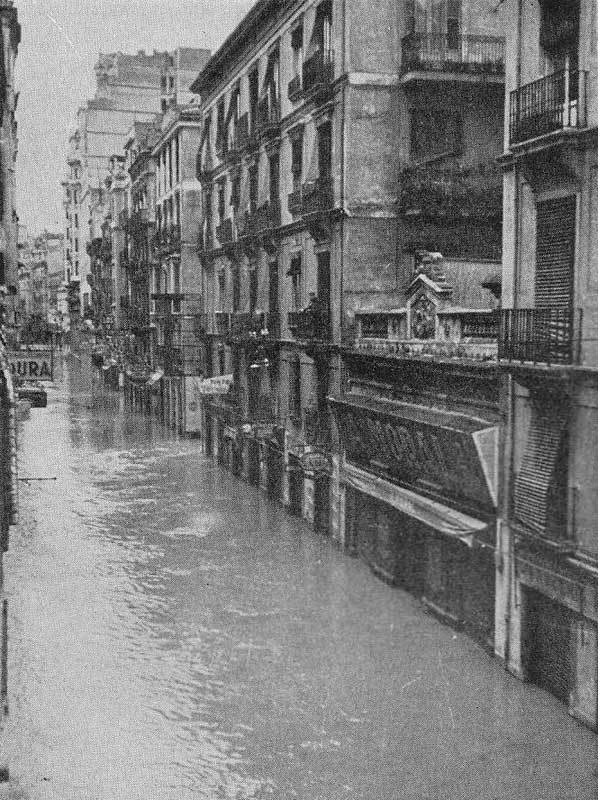
On October 14, 1957, a little known disaster occurred in the Spanish city of Valencia. When I first moved to Valencia in 2005, I heard the story of the Turia (the Valencia river) flooding the city in the 50’s. Now, the city has the beauty of a park in place of the dry riverbed. Years after I first moved to Spain, I decided to research the event in more depth (excuse the pun), and it is the backdrop for my second Secrets of Spain novel, Vengeance in the Valencian Water (out Jan. 2014).
Many people are finding this old post and linking it to stories about climate change after the 2024 Valencia flood. What happened to south Valencia on 29 October 2024 is totally different to what happened in Valencia’s previous 80 floods. Climate change is absolutely a factor in Valencia’s floods, the rainfall was heavier than ever, in a shorter space of time than ever before, and flooded an area not given any consideration around safety of climate effects. Valencia is a flood plain, and that doesn’t mean climate change isn’t real.
In my first book of the series, Blood in Valencian Soil, Cayetano, a bullfighter from Madrid and Luna, a bike mechanic from Valencia, team up to find the burial-place of a murdered Republican soldier and his involvement with an International Brigade nurse, who disappeared from Cuenca in 1939. The second book of the series, while on the search for more civil war mass graves, Cayetano’s Falange member grandfather, José, is forced to tell his story of survival during the Valencian flood which changed his life forever.
The Turia wasn’t always a flowing torrent of water. While there has been recorded flood records since the 1300’s, the riverbed spent most of its time dry, where people would walk to the tiny stream, to wash their clothes. Shack houses sprung up in the riverbed. Sales of animals were held down in the riverbed. It was not a year round flowing river. Serious floods had happened every century the modern city was based against the Turia, the most recent in only 1949 when several dozen people drowned. Even so, they were unprepared for October 1957.
Before you read on, here is the link to a documentary made in 2007 by Valencia University, with radio reports, video footage and eyewitness accounts of the flood. It’s all in Spanish, but if you don’t speak the language, you could just mute the sound and watch the video if you want, you will get the idea. Floods pretty much speak for themselves.
Each October, rain comes to the Valencia region, not so much in the city area, but in the surrounding plains and mountainous area that separates the city from inland Spain (If you’re new to this area, Valencia is both a city and a province of Spain. Just a heads-up). The rainfall surges during this change in autumn, onto land that is very dry after a long year without much rain. On Saturday 12 October, 1957, the heavens opened up over Valencia city, in conjunction to the torrential rains in surrounding villages in the Turia (plains around the city) region. On the morning of Sunday 13 October, Las Provincias newspaper noted that the outlying towns of Lliria, Segorbe, Chelva, Requena and Buñol had received rainfall of 500 millimetres in only two days. The Barranco del Carraixet and Palancia rivers north of the city, and the Magre river to the south, along with the Turia river through than ran Valencia city had all risen, but said there was no reason to worry. The rain began to die down in the city, and by late evening, had stopped completely. What the people of Valencia didn’t know was the immense torrent that was gushing its way down the Turia river towards them.
At around 9.30pm, an emergency call came through from the towns of Pedralba and Vilamarxant, 40 kilometres from Valencia, announcing that both towns had been flooded by a deluge of water as the river swelled beyond breaking point. At 11pm, an alarm sounded in the city, notifying all Guardia Civil and Police to be on alert, as the flood was heading directly towards the populated city.
Just after midnight, with the absence of rain, the river continued to swell, and logs and debris began floating through the city, blocking the bridges that connected the two sides of Valencia. Alarms sounded to alert people, and messengers knocked on doors in the El Carmen and Campanar areas, both the closest barrios on each side of the river’s edge. Radio messages went out with a flurry as police rushed to warn people of impending water. Soon after, the first waves began crashing over the edge of the riverbed, instantly flooding the flat streets on both sides, just as the torrential rains returned. In one hour, the water height pouring against the central city was between one to two metres and rising, cutting people off from any escape in the dark. More than 1000 cubic metes of water per second flowed into the streets, reaching over two metres in some areas. The Manises Dam at the edge of the city rose to seven metres above normal height as the river tripled its width and swallowed up much of the city and surrounding area. All water, power and phone connections were swamped and collapsed under the water. Reports say manhole covers exploded into the air followed by a violent shot of muddy water as the water took the city one street at a time.
(If you don’t speak Spanish – blue: river, green: populated flooded farming areas, purple: city/town flooded, grey: not flooded populated areas. Notice the tiny safe area in the centre of the disaster zone?)
In the centre of the old town lies the Plaza de la Virgen and Plaza de la Reina, where today stands the Valencia cathedral, the Basilica and the archbishops palace just behind them. Along with Calle Micalet, this tiny pocket was once home to a mosque and before that a Roman city. This area is built on the slightest, and almost impossible to see, ridge in the land, resulting in these treasures not getting any water and instead were surrounded. (Coincidentally, in my novel, the main character lives one street over from Calle Micalet in this magical pocket of space, but don’t be fooled into thinking they are all going to be safe – you know I don’t write happy endings!)
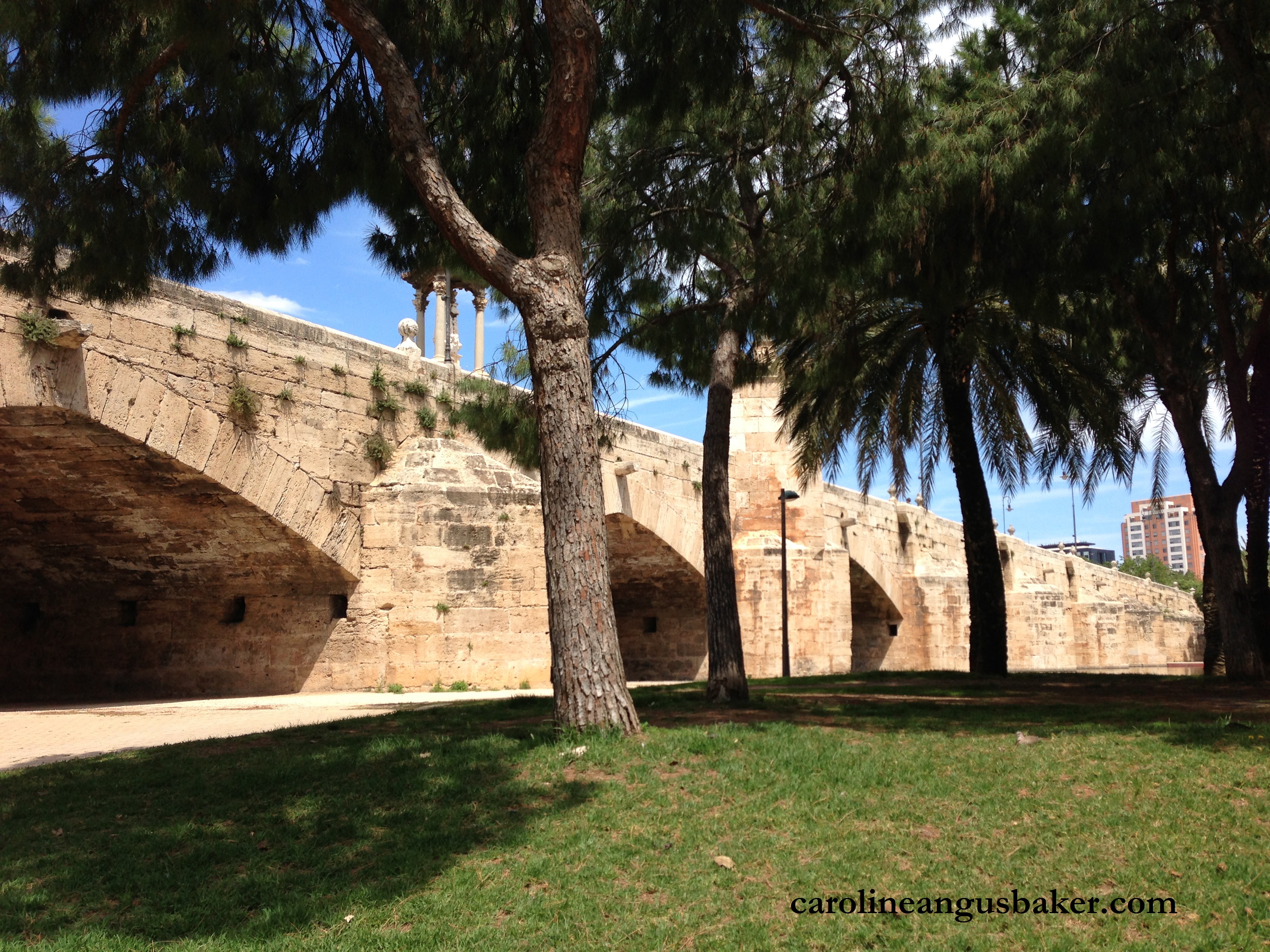
At 4am, the flood reached its peak of approximately 2,700 cubic metres of water per second, but then quickly tapered off. As the sun rose on Monday October 14, the water continued to decrease and the Manises dam was no longer inundated. From the peak of around eight metres above average to only two metres at the dam, Valencians thought the worst was over. A single telephone line to Castellon in the north remained, so emergency services could get word to Madrid, calling for help. All roads and rail lines leading out of the city towards Madrid, Barcelona and Albacete were blocked, damaged or completely swept away. Many of the bridges that crossed the Turia were damaged or destroyed, along with the beautiful stonework that lined the river one day earlier.
As people ventured out into the water and mud-filled streets, the government received a message around midday that things were about to get worse. The towns of Pedralba to Vilamarxant had again been inundated with a second flood, washing away all landmarks. The water took two more hours to reach Valencia city, with 3,500 cubic meters of water per second hitting around 2pm, accompanied by the worst downpour of rain yet seen; around 100 millimetres in just half an hour, enough that people couldn’t even see in front of them. By 3.30pm, the flood reached its peak of around 6,000 cubic metres of water per second, enough to start washing away buildings that had been weakened in the first flood. The river had expanded to cover 2,200 hectares. While Valencia city gave many the luxury of multi-story buildings to find shelter above the water line, which rose between 2-5 metres above street level in places, the more outlying areas by the beach and port, including the towns of Nazaret, El Cabanyal and Malvarrosa at the mouth of the river, were on flat land and single level buildings, resulting in a complete catastrophe and loss of life as the water poured into the sea. Only five bridges, the longest-standing stone ones remained in place, though some were damaged and impassable. The worst had finally passed, and the riverbed emptied out into silence again. The final death toll was recorded as 81, though the actual figure remains unknown.
In the coming days, the army came in by truck and helicopter, bringing up to 500,000 kilos of bread to feed stricken residents. Many needed to be airlifted from rooftops and isolated pockets of dry land as the water receded. Much of the city, port and beach areas were filled with a heavy mud and debris, resulting in a ‘on hands on deck’ response from army and locals alike to clean up. On October 24, dictator Francisco Franco arrived (when much was cleaned already, of course) to survey the damage and have his loyal (oppressed, whatever) subjects cheer for him for coming to the disaster zone. As people lived on bread brought north from Gandia and milk given out by the ladle-load, the long process of rebuilding began. The mud was not completely cleaned away until the end of November.
In June 1958, the outlying port and beach areas suffered a second minor flood, as their drains were still clogged with mud, and the following month ‘Plan Sur’ began, a project to divert the river. The plan had initially been designed over a decade earlier but sidelined due to excessiveness (which is ironic considering the ‘excessiveness’ of everything the Valencian government spends money on). A plan to build an enormous green space in the city was put up against building a huge highway to get people from Madrid to the beach a fraction faster. In 1965 construction began to divert the river south of the city, resulting in water flowing around the city for the first time in 1972. At the same time, land cleared by the flood on the other side of the river from the old town was used to create many new buildings, mostly apartments, giving Valencia a construction boom (that’s a whole other tale). The flood had accidentally given Valencia a whole new chapter in its story, already thousands of years old. (I have never seen any water in the river diversion, other than the tiny part where the sea flows into the river mouth. If you have a photo of the Plan Sur river diversion (any year) with water in it, I would love to see it).
Here is a short clip (in Spanish) made as they designed Plan Sur in the 60’s, with some aerial shots of Valencia if you’re so inclined
In 1976, on his first visit to Valencia as head of State, King Juan Carlos I gifted the dry riverbed to the city, and the highway plan was shelved forever; the 7 kilometre park won its place in Valencia’s history. Construction on the final part of the Turia riverbed park continues today, with most of the park now complete. The ‘top’ of the park has Valencia’s zoo, the Bioparc, and footpaths and bike lanes weave though gardens, streams, sports fields, playgrounds to the other end, home to Valencia’s massive Arts and Sciences complex. The final part, where the old riverbed meets the sea is still to be completed.
While Valencia is an amazing city, the park is the jewel in the crown.
This is a tourism video was taken a few years ago, but shows Valencia from the air, over the park and areas rebuilt after the flood, plus many of the great sights you can read about in my books.
For me, the day starts with noise. Normally, it’s the sound of one of my young sons singing in the bathroom down the hallway. Or, if I’m lucky and the children have slept in, it’s my 6am alarm, waking me to the sound of Recuerdos de la Alhambra. But I’m not at home today, I’m in Valencia city. The hum of the city is immediately evident; Valencia is never quiet, and in my absence, I had forgotten just how noisy the city can be. Fourth noisiest in Europe, someone once told me. Statistics aside, the place buzzes with life 24 hours a day. I hear it while I lie in bed, the constant whirring of traffic somewhere, of scooters and buses on the street three stories below me. I wonder how long ago the love affair with leaning on the car horn began. The city sighs, breathes and releases a sound that is not unique, yet oddly comforting.
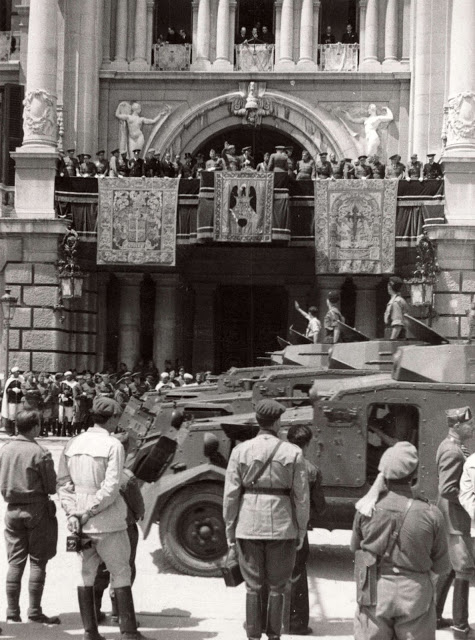
Out of bed and I pull open a window, to look down on Carrer de Sant Vicent Mártir. Two street cleaners are emptying a bin. I’m sure I heard one yell to the other that he didn’t have sex last night because his girlfriend was constipated. You can’t accuse Spaniards of not sharing. Only a few people are walking the streets at 7.30. The air is still cool, but that won’t last, even on this narrow shaded street. The beautiful building across from me is silent; I hope it has life inside somewhere, it deserves life. This street has seen a lot of history. Franco and his troops marched down here when the city was overcome in the war. That plays on this war nerd’s mind.
The apartment has a little patio in the well of the building. I step out in the cool air and privacy and sip my drinking yoghurt. It’s not a favourite thing, but I used to buy it in Spain when I lived here. The cheap price gave me a sense of nostalgia at the Mercadona last night, as did the organic fresh milk from Galicia, and the Valencian oranges. I don’t even eat oranges, can’t stand them. But they are part of the life I used to have in this city, and today is my chance to enjoy that life again, if I can find it. One floor up, a woman is talking to her daughter in French; the smell of cigarette smoke is overwhelming. Time to go for a walk.
Last night’s exuberance is still in my head. I walked the streets and alleys of Valencia old town in the dark – because it’s safe enough to do so – and found myself in a club late at night, with an old friend in tow. Places close earlier than they use to; all-night parties seem to have faded. Maybe the long-suffering residents of the El Carmen got their way with their noise protests, maybe the recession keeps people home more often. Maybe not, there are people everywhere. I had forgotten how many people live in Europe. Too much south Pacific island living? Is there such a thing?
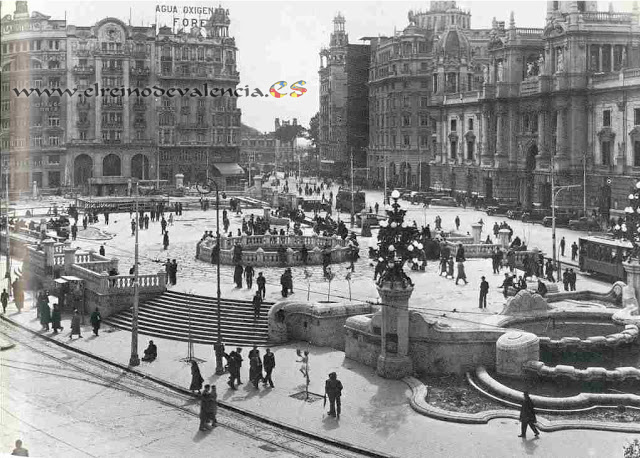
Plaza del Ayuntamiento 1933 and today
The tourist route can wait, though it will be filled with cruise-ships parties following their guide soon. That’s new. I wander into Plaza del Ayuntamiento, the main square of the city. Two police officers stand at the main entrance, which is still closed. They both smile and nod hello as I walk by; that’s not new. There are a few other tourists out early in the day, but are all at least twenty years older than me. I have learned a lot about Plaza del Ayuntamiento in my absence – it was called Plaza Emilio Castelar during the Second Republic, and Plaza del Caudillo when Franco took over. They tried Plaza del País Valenciano for a while, too. Since I’m in Spain on a civil war research trip, I can stand and imagine the propaganda posters and protesters, plus soldiers from both sides of the battle.
Town Hall balcony 1939 and today
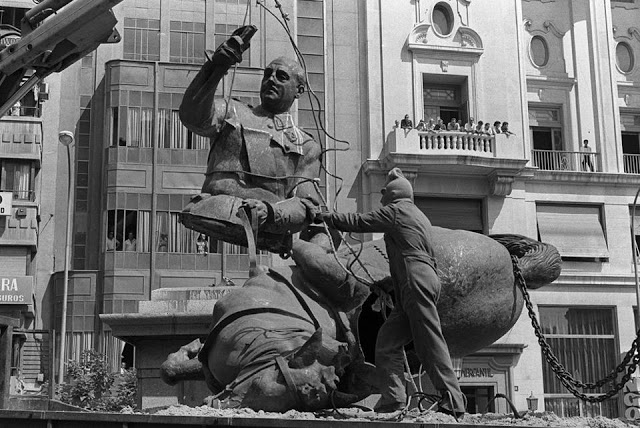
Franco gets his marching orders
A statue of Franco stood in the square once, to commemorate 25 years of peace under his reign (no comment!). Now, a statue of Francesc de Vinatea stands in its place, a 14th century Valencian hero. The plaza once had a flower market embedded in the centre, underneath a fountain-littered promenade, but that was ripped out in 1961. Now, flower vendors are stalls that dot around the open space. I buy some; pink somethings (I don’t know my flowers!), for no reason than to say hello to the old man who was selling them. The plaza teems with people driving around its exterior, the audible hum of life is in full swing. There are stickers on posts; protests against government cuts to education. Valencia’s voice is coming in to protest later, but I don’t know that yet. My first day in Valencia years ago, as a new citizen to the city, there was a fireworks display in the plaza. I had never seen such a spectacle; Valencia like to burn things with a lot of noise. It was to commemorate an event being staged, the same one that had brought me across the world. The fireworks, which were let off in the centre of the plaza, where I’m standing, were so loud that a glass bus shelter shattered into a gazillion pieces. Nobody batted an eyelid; shit happens. Now, my friends, who shared the moment, aren’t here. We’re spread out across the world again. It changes the feel of the city remarkably.
BOOM
I leave the plaza and the older part of this ancient city, and head down the pedestrian Carrer de Ribera. It’s cold in the shade. The stores are still closed, but the cafes are all open, filled with people having breakfast at 9am. Everyone looks so relaxed. I’m glad I brought my pink scarf on holiday; it seems to be part of the fashion. New Zealand may as well be another planet when it comes to clothes; finally my scarf has a home. I’ll need to buy more before I go back.
Carrer de Colon is busy, its one way traffic speeds past as I wait to cross the wide street. A bus stops and many people, mostly women, get off, obviously on their way to work. It’s the Number 19 route, almost at its end. I’ll take that bus at some point, it’s the route I took many times before. One woman is loudly telling another that her period is really bad this morning. There’s that over-sharing again. I cross the street, next to a woman pushing a worn-down stroller. The girl, perhaps three, looks tired. The mother is struggling to push the child on wobbly wheels and suck on her cigarette. I don’t like to tell people how to live their lives, and hate to receive advice, but smoking like that in a child’s face annoys me. I forget I come from a place where smoking is considered strange.
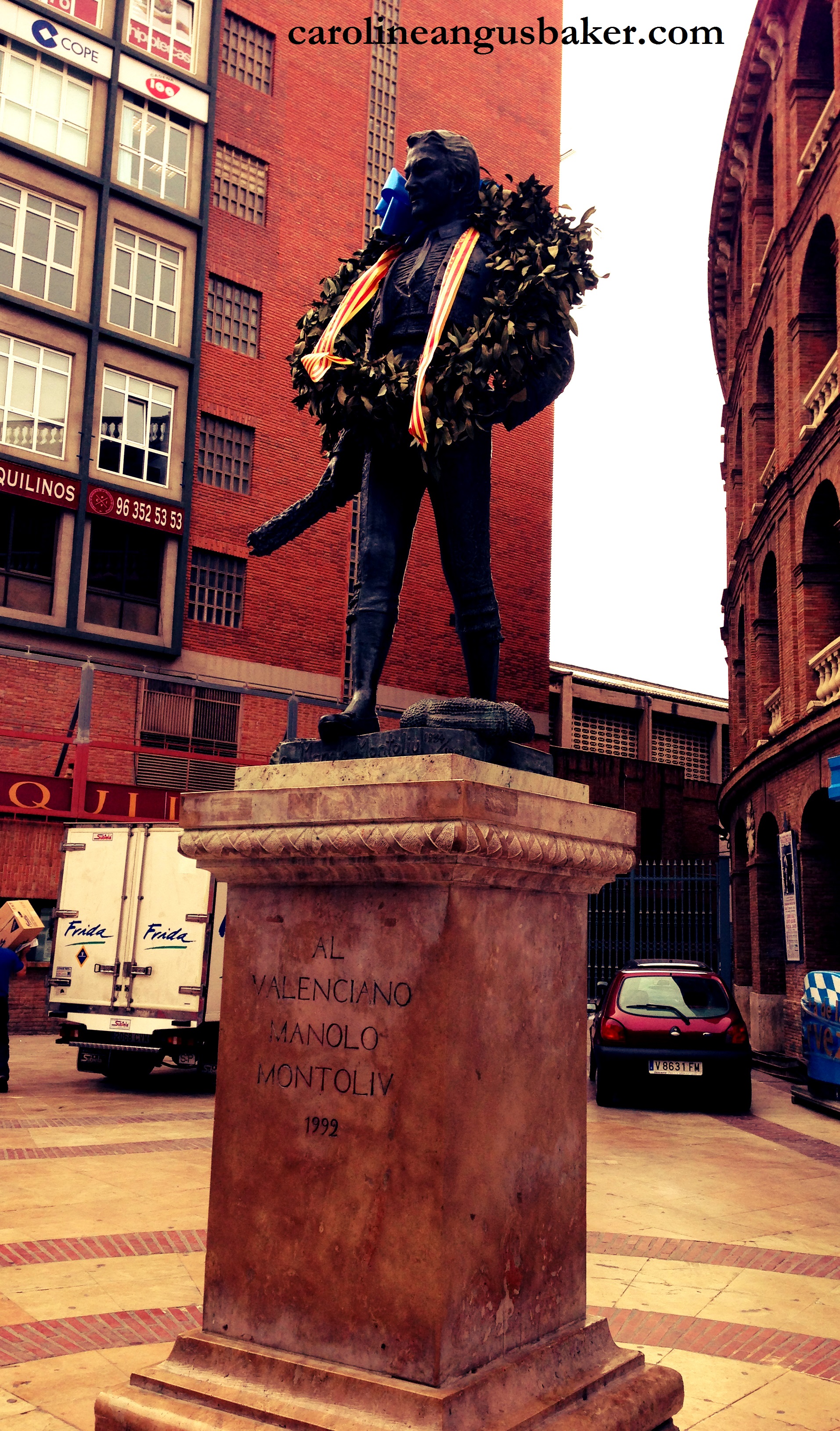
I pass by the bullring, Plaza de Toros de Valencia, which is closed this early, even the ticket booths. Posters are up for the upcoming weekend fight. I must go (it will later disappoint me). The statue of Valencian fighter Manolo Montoliu has had an artificial wreath put around his neck, and it’s covered in ribbons the colour of the Valencian flag. The anniversary of his death has just passed.
Down busy Carrer de Russafa, past a panadería selling the most delicious-looking pastries, and there is a space in the line-up of conjoined buildings. I think of Jason Webster’s novel, A Death in Valencia, when the main character’s apartment block collapses in this suburb. There hasn’t been a building on that site in years. Wasn’t it once a public carparking space? Knowing Valencia, they probably went to build something and found Roman or similar artifacts. The place is good for finds like that.
Down Gran Via del Marques del Turia, a street I’ve wandered many times. You can wander either side of the multi-lane street, or through the middle, in the tree-lined walkway lovingly placed in the centre. The cobbled path is dusty, like Valencia always seems to be. There are many beautiful buildings along here; I had several friends who lived here, in gorgeous apartments. They don’t live here now; they were in San Francisco or New Zealand last I heard. My doctor lived on this street. His office, in his apartment, has a plaque outside his door, and I touch it when I walk past. In very difficult times, it was good to have someone who listened to serious concerns. The old bookstore is still there, still not open for the day. Imagine all the stories hiding inside. The optometrist is still there; a young woman is opening the place as I go by. I wonder if the old couple who worked there have retired yet. I hope they were able to. The traffic is building as I reach the end, at the Pont d’Aragó, the bridge over the Turia across the street. The light says I can cross, but cars stream through their own red light anyway. It was always dangerous crossing here, though I don’t have my quad (yes, quad) stroller with me anymore. The sight made cars stop, but running down a single woman seems to be of no concern, as always. I stood on this bridge late one night, eight months pregnant with my fourth child, knowing I had to move away from Valencia. What a depressing evening.
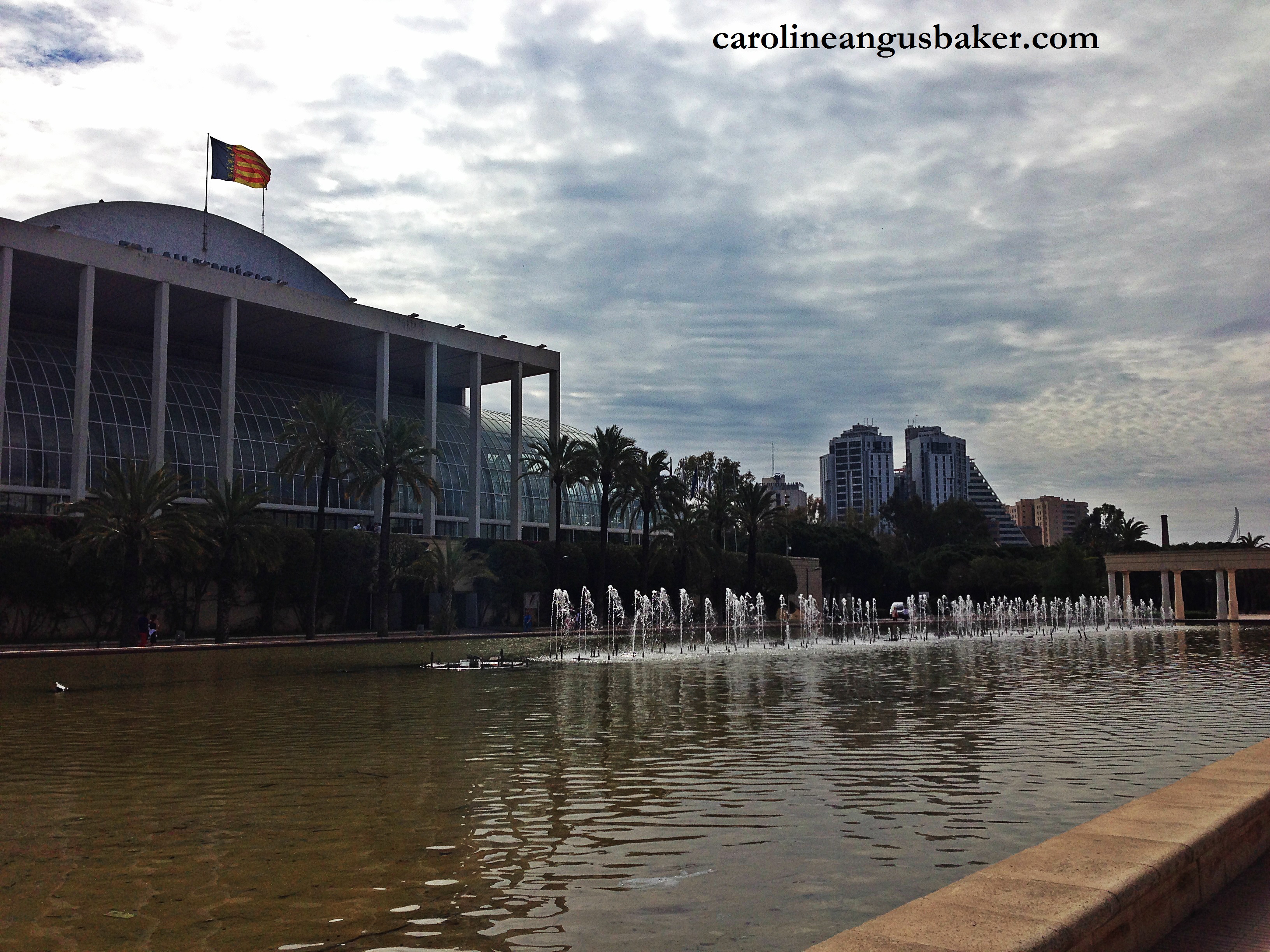
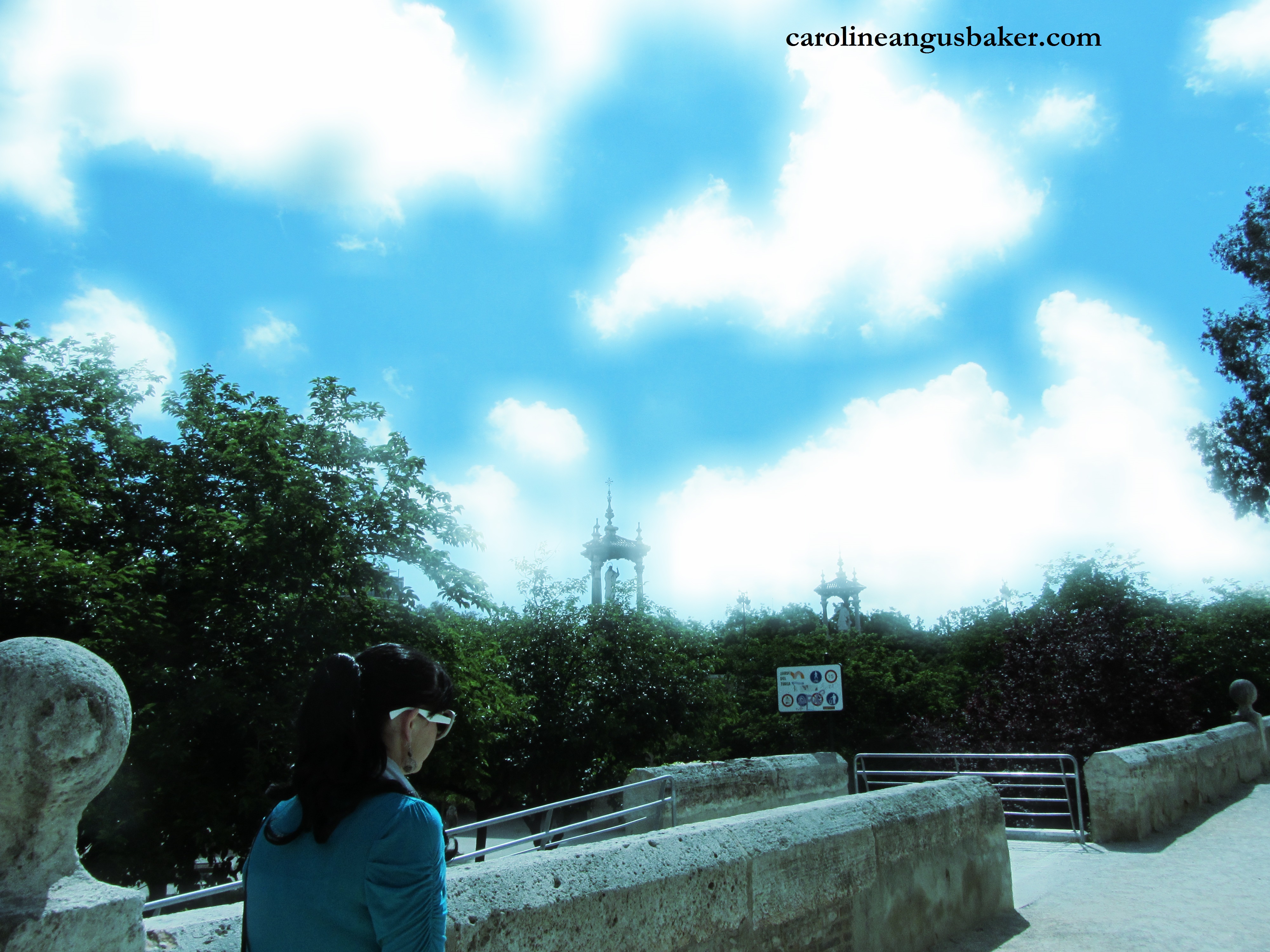
Into the Turia I walk, one of the grandest sights you will ever behold. Bikes drift past as I head along familiar routes. The Chinese guy is still doing tai chi in his usual spot after all these years. Keen runners are out, along with pairs of old women out for a stroll. One tells me that I’m beautiful enough to find a good husband. How generous. One of my favourite spots, the fountain outside the Palau de la Musica, is silent. My children loved running along the edges and watching the water displays. No one is playing now. A young guy is setting up a tripod and he goes out of his way to say hello to me as the sun begins to warm up the city. I remember seeing a friend here, a famous New Zealand sportsman, one hot summer evening as he was riding his wife’s bike, and had a pizza in the front basket. His front wheel wobbled when he waved hello. He’s gone now, runs some kind of hovercraft company these days. Another friend told me to stop running along here, because I was too pregnant; she’s gone now, too. There used to host open-air concerts here at night in the summer, maybe there still are. Sitting under trees with picnic baskets and enjoying noisy Spanish life; I hope the recession didn’t claim them.
A walk along familiar paths brings back memories, like the bike stand where tourists grab a ride, Gulliver playground, which is amazing, but in all honesty, not that clean and my children were too small to really enjoy it. The concrete mini-golf thing is still there, looking as worn as ever. The cafe with foul-tasting horchata ice-blocks is open, and mothers sit outside with young kids. When we took our kids there with friends, we went around as a group, and collected the rubbish before the children could play. After a while, you accept that as standard practice. I remember learning of a friend’s miscarriage while at the playground, and wondering how could I tell her that her husband had been cheating on her after that? She forgave him, once she found out.
The skateboard ramps have even more graffiti and it seems angrier than before. Spanish life has got harder. ‘My’ part of the park, the area around the Arts and Sciences has a huge amount of familiarity, yet feels so different at the same time. On the whole, nothing has changed. The Reina Sofia theatre, the giant eye, could use a wash, but the place is exactly how I remember. I walked along here every day, and after being away so long, coming back is a bizarre experience. There’s no way of explaining what is it like to walk past things that I have missed for so long that I almost felt as if they no longer existed. The playground where my children played is exactly the same; the bushes still rustle oddly, too. The kids always suspected giant rats (not sure who started that rumour. It’s just birds). I sit in a spot under the shade of a tree. I did that one day, with my sons, then aged 23 months and 7 months, and wondered why we were alone. Then I noticed it was 44 degrees, according the temperature gauge on Pont de Montolivet. I had a pain in my stomach and I had a feeling I was pregnant. Four weeks later I had that confirmed, while looking out over the park in my apartment.
It’s odd to see my part of the city so lifeless. Once, I couldn’t walk down the road without bumping into 30 people I knew, friends to chat with, husbands wheeling pink shopping baskets home for their wives, locals who were amazed at how many sons I had and how close together they were all born. Now, almost no one is about. The woman at the perfume counter I used to visit seems happy to have a customer when I buy a bottle of Prada. The smell is an instant reminder of my old life.
It’s easy to waste hours walking around old haunts, up and down streets, filled with memories. The facade is all the same, but the atmosphere has changed. Valencia moved on without me. Of course it did; I moved on without Valencia. I was only meant to be away three months, not six years. But it’s great to be back. The day is quickly lost by wandering old haunts. I stop by the Disney store; there was a robbery at the nearby Carrefour once. Friends had been there, and dived behind piles of stuffed Disney characters. One guy dived behind his girlfriend. I don’t think the relationship lasted much longer after that. Today, the whole place is quiet.
Walking among the tourists at Torres de Serranos
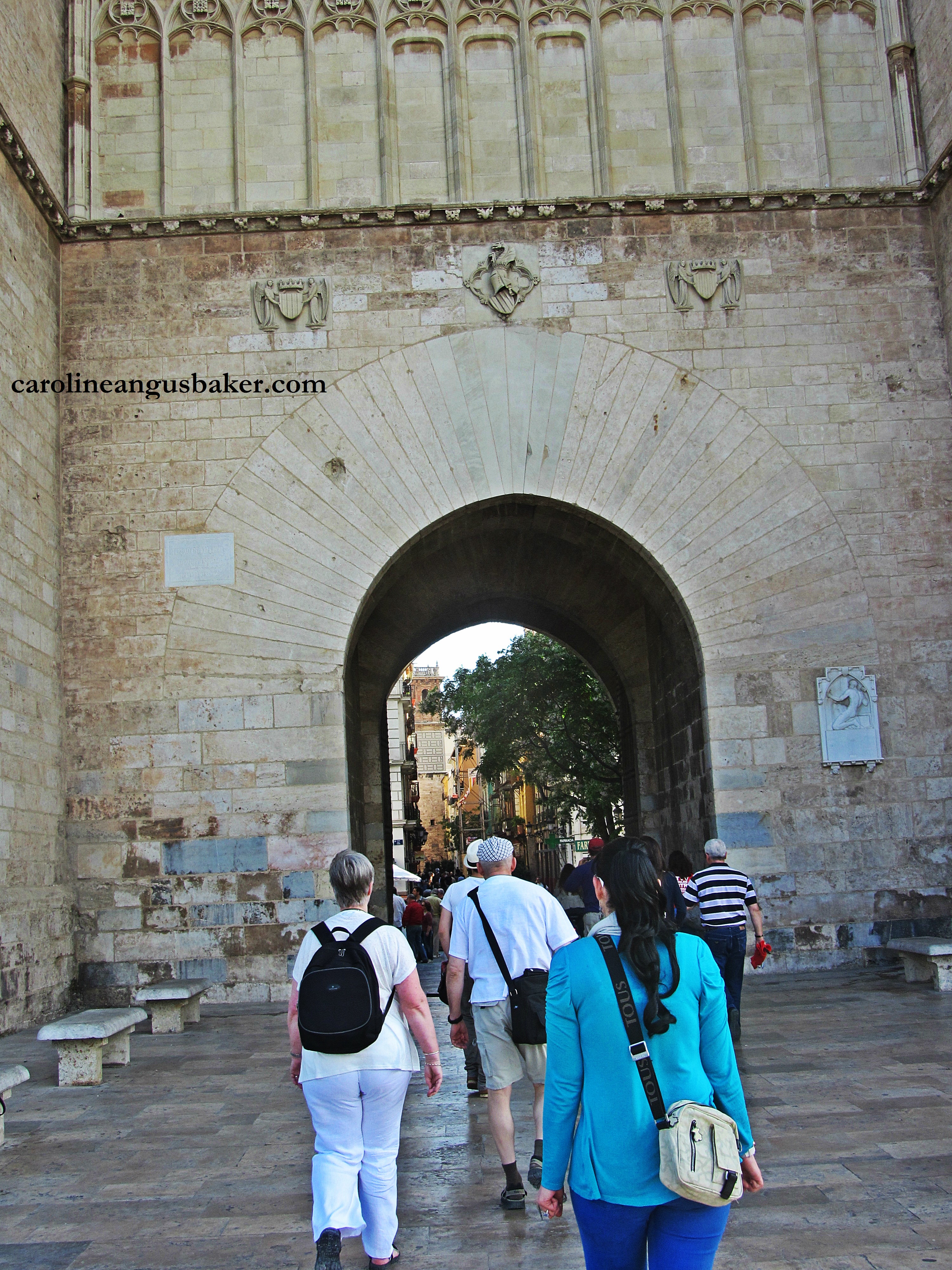
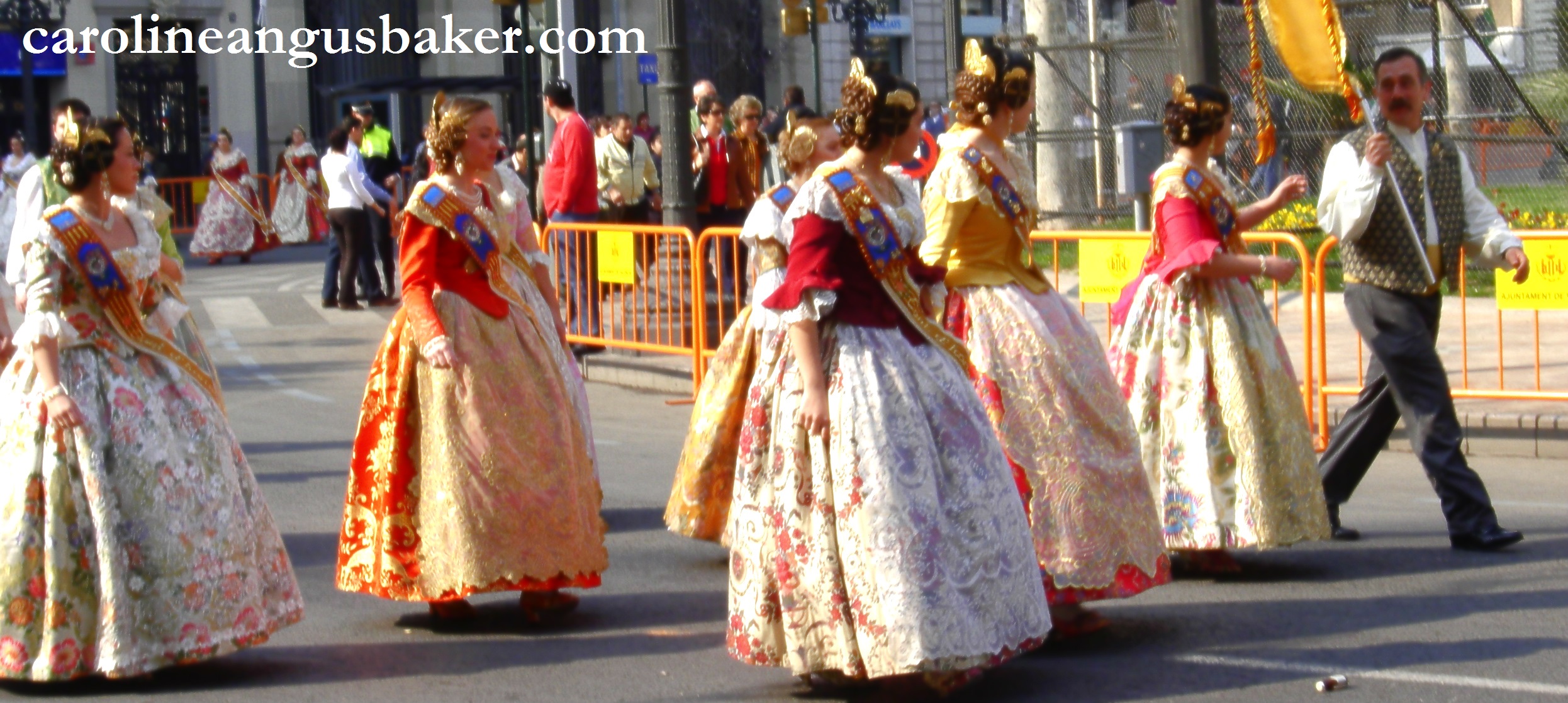
It’s time to walk back through the park, to Torres de Serranos and dive back through the old town. People to see, places to go. I have to play tour guide later, not something I’m sure I can do. The way I know the city can’t really be explained. Plaza de la Virgen is gearing up for a fiesta, but I can’t even remember which one. I’ve seen a few girls in their fallera dresses, so it’s something big. I sit at the fountain, a popular spot, and remembered sitting here with my father, while heavily pregnant with son number 3 of 4. My father has passed away now.
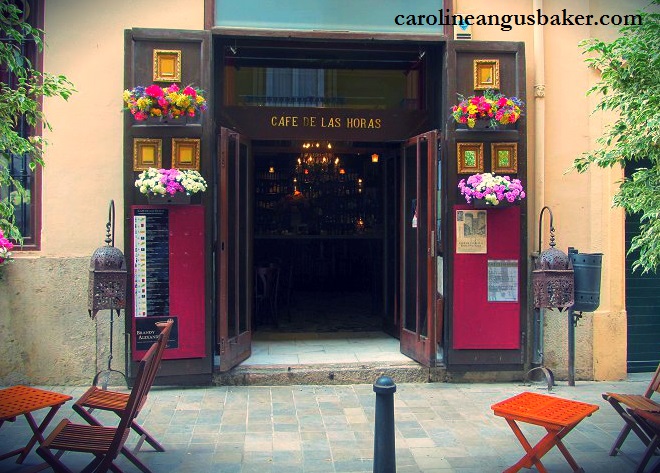
I see familiar spots, places I put in my first Spain novel. New(er) places will be in the next novel. I’ll visit those spots later. The beverages in Cafe le las Horas are as good as ever in the mid-afternoon, as is the decor. I might sit here for a while; little do I know I’ll be wandering busy streets later and getting caught up in a giant-sized anti-government and banking protest. This spot will do nicely while I laugh with a friend. Valencia exists entirely inside the people who are there.








 CAROLINE ANGUS