Had Bishop Stephen Gardiner, ambassador to King Francis in Paris, not kept this letter, there would be no mention from Thomas Cromwell about the case against Anne Boleyn and her co-conspirators in 1536. Cromwell writes to tell Gardiner and his secretary Sir John Wallop about Anne’s crimes and a threat against the King’s life, leaving out all details. Cromwell also promises money to Gardiner, which came from the money collected from the men owed to the king.. Europe needed to know that Anne Boleyn had sinned against the king so much that serious action was taken for the king’s protection. Neither Cromwell nor anyone else believed in the case, and no one else in Europe ever seemed to take the case seriously either, but happily accepted Jane Seymour as queen a few weeks later.
Nothing about the case against Anne survives, none of Cromwell’s handwriting appears anywhere on the topic, except for his signature at the bottom of this letter. Cromwell did not take part in any of the trials or attend anything to do with the king’s new marriage. See Planning the Murder of Anne Boleyn for all the details.
Bishop Stephen Gardiner c.1523, Liechtenstein Museum GE92
THOMAS CROMWELL TO STEPHEN GARDINER AND JOHN WALLOP, 14 May 1536
(Add. MSS. 25,114, f. 160)
To myn Assured Loving friends my lord of Winchestre and S John Wallop knight the King Ambassadors in Fraunce in hast post
After my right hearty commendations, albeit you shall at this time receive no answer to your letters sent by Salisbury, being the same deferred till the arrival of the bailiff of Troyes, yet the king’s highness thought convenient that I should advertise you of a chance, as most detestably and abominably devised, contrived, imagined done and continued, so most happily and graciously by the ordinance of God revelled, manifested, and notoriously known to all men.
Whereof, though you have heard, I doubt not, the rumour, yet I shall express to you some pain of the coming out, and of the king preceding in the same. The queen’s abomination both in incontinent living, and other offences towards the king’s highness was so rank and common, that her ladies of her privy chamber and her chambers could not contain it within their breasts. But detesting the same had so often continuations and conference of it, that at the last it came so plainly to the cares of some of his grace’s council that, with their duty to his Majesty, they could not conceal it from him, but with great fear, as the case enforced declared what they heard to his highness.
Whereupon, in most secret sort, certain persons of the privy chamber and others of her side were examined, in which examinations the matter appeared so evident, that beside that crime, with the accidents, there broke out a certain conspiracy of the king’s death, which extended so far that all we that had the examination of it quaked at the danger his Grace was in, and on our knees gave Him laude and praise that He had preserved him so long from it, and now manifested the most wretched and detestable determination of the same.
Thus, were certain men committed to the Tower for this cause, that is Mark (Smeaton) and (Henry) Norris, and her brother (George). Then was she apprehended, and conveyed to the same place, after her was sent thither for the crimes specified, Sir Francis Weston and William Brereton. And Norris, Weston, Brereton, and Mark be already condemned to death, upon arraignment in Westminster Hall on Friday last. She and her brother shall be arraigned tomorrow and will undoubtedly go the same way.
I write no particularities, the things be so abominable, that I think the like was never heard, and therefore I doubt not but this shall be sufficient for your instruction to declare the truth if you have occasion so to do. Your lordship shall get in 200 pounds (around £120,000 today) of the 300 pounds that were out amongst these men, notwithstanding great suit has been made for the whole, which though the king’s highness might give in this case, yet his Majesty does not forget your service. And the third 100 pounds is bestowed of the vicar of hell (Francis Bryan), upon whom though it be some charge to you, his highness trusts you will think it well bestowed. And thus, fare you most heartily well from the (Chancery of the) Rolls in haste, this 14th of May
Your loving assured friend
THOMAS CRUMWELL
And you, Master Wallop, shall not at this time be forgotten, but the certainty of that you shall have I cannot tell, but in the next letters you shall know it, and I assure you the king’s highness takes both your services in as thankful part as yourself could wish or devise.
Han Holbein’s design for the coronation pageant, Apollo and the Muses on Parnassus. Kupferstichcabinett, Staatliche Museen zu Berlin
FOR THE QUEEN’S CORONATION, 28 April 1533 (Egerton MS. 985, f. 57 b)
This is a list of items prepared for Anne’s coronation. The handwriting belongs to a clerk, as Cromwell took time to prepare for the coronation celebration, as the main items needed were jewels from the Jewel-House and money from the Exchequer, both of which he commanded, and fabric for clothing and decoration was so in demand that supplies ran short, and Cromwell’s connections in the industry kept the cloth coming. Anne’s coronation took place on 1 June, but Cromwell only received the the Convocation of Canterbury’s officially rulings declaring Anne’s marriage to Henry valid a few days before the event. Crowmell had to plan the event in the hope that Thomas Cranmer would be able to push through the ruling that Katharine of Aragon’s marriage to the king was void and that Anne Boleyn could be the queen. The pair worked furiously through May to make everything happen.
For the Quenes coronacion
To appoint the day for the coronation, and to prepare all things for the same.
Letters from the King to be sent to the nobles, lords, knights, ladies, and others to attend, and to those who will be created knights of the Bath, whose names Garter is to have.
Commissions to be made for the Great Steward and Constable.
The day when the Steward shall sit in the White Hall.
All noble men who hold land by service royal to bring in their claims.
The mayor, aldermen, commoners, and crafts(men) of London are to meet the Queen before she comes to the Tower.
The King will meet her at the Tower. A kirtle and mantle (coat) of cloth of gold furred with ermines.
A lace of silk and gold with tassels for the mantle.
A circlet of gold garnished with precious stones.
A litter of timber covered with cloth of gold.
Down pillows covered with cloth of gold, for the litter.
A lady appointed by name to bear her train.
The mayor, aldermen, and crafts(men) of London are to do their service accustomed, and the streets between the Tower and Westminster are to be garnished with tapestry, arras, silk, and the banners, standard, and pennons of crafts to be ready to garnish the barges and stand where the wardens be of each occupation.
The Lords, the High Steward, Constable of England, Garter, the Mayor of London, and the two squires of honour to be in crimson velvet and beket hats.
The tipstaves (court officers) of the marshals in their liveries, to avoid the press of people.
A canopy of gold with valance to be borne by 16 knights.
Two esquires of honour to be appointed to represent the dukes of Normandy and Aquitaine.
A horse of estate, saddled, to be led by the Master of the Queen’s horse.
Six henchmen on palfreys harnessed with cloth of gold.
Two chairs covered with cloth of gold, and ladies of the highest estate to sit in them, clothed in crimson velvet.
Six ladies on palfreys with saddles and harness like those of the henchmen.
Two other chairs richly garnished for the Queen’s ladies.
A great number of ladies and gentlewomen on palfreys dressed according to their estates.
A void to be prepared for the Queen at Westminster.
A kirtle and mantle of purple velvet furred with ermines, with a lace, for the day of the coronation.
A circlet.
A cloth of estate in Westminster Hall.
The procession. A ray (striped) cloth to go from the Hall to Westminster.
A canopy borne by the barons of the Cinque Ports.
Two bishops to go every (either) side of the Queen.
The verge (symbolic rod) of ivory to be borne.
The sceptre.
A rich crown of gold.
Liveries to be given according to the precedents of the Wardrobe.
The archbishop of Canterbury to do as appertains.
The seat royal or pulpit to be dressed with cloth of gold and cushions.
The Queen to be howseled (receive the Eucharist), and after to have secret refection (refreshment) of such meat as she likes best.
A stage to be made, latticed, and covered with rich cloths, for the King and others to see the solemnity.
The mayor, aldermen, and commoners of London, with their crafts, to meet the Queen before she comes to the Tower.
The King to meet her and welcome her at the Tower.
The service to the Queen at dinner, and the ordering of the hall, to be committed to those who have authority.
A stage in Westminster Hall for minstrels and trumpets.
The kings of arms, heralds, and pursuivants to keep their accustomed stage at the right end of the table, and to have a cloth on the table with proper service.
The Treasurer and Comptroller to go on foot, and the three high estates of Constable, Marshal, and Steward, on horseback, their horses trapped.
A stage on the left side of the Hall latticed and garnished for the King.
The surnap (handwashing napkin), and who shall draw it, the marshal to be named.
The void after.
The Mayor to bear the cup of gold. Jousts and tourneys.
To appoint the number of challengers and defenders for the jousts, to go before the Queen from the Tower to Westminster Hall on their steering horses, garnished with bells and devices.
The Lord Steward, Treasurer, and Comptroller must give warning overnight to those who shall do any service.
CROMWELL’S REMEMBRANCES TO THE KING, April 1533 (MSS Titus, B.I. 422)
On the back of a letter listing the King’s demands to the Merchants of the Staple (saying their due bills and new taxes on wool from Calais), Cromwell scribbled down a few more remembrances to discuss directly with King Henry. It’s a a short list with massive implications for the royal family. Cromwell would take some of his busier to-do lists to the king and have Henry sign them, so there could be no debate whether the king was acting on Henry’s instructions or not. A simple method that provided great security.
Remember the judgment to be prepared for the King’s great matter.
Item, for the dispatch of my lord of Norfolk.
Item, the bill for the succession, and to rest upon the same.
For to devise for the coronation, and to see presentiments (possible foreboding feelings) for the same.
Item, to devise for lands for the Queen (Anne)
Item, for the establishment of the Dowager (Queen Katharine)
Henry VIII as Supreme Head of the English church (British Museum 1973 U 219)
Welcome back to a new year, and a new series, On This Day with Thomas Cromwell. The series will feature happenings on different dates in Cromwell’s life, as seen through his surviving correspondence. I will be posting on Instagram, Tiktok, Facebook, and Bluesky, and some of the larger posts will also be added here.
Today we start off with a huge event, when Cromwell submitted to the 1533 parliament The Act of Restraint of Appeals, also known as the Ecclesiastical Appeals Act, Statute in Restraint of Appeals, or ‘An Acte that the Appeles in suche Cases as have ben used to be pursued to the See of Rome shall not be from hensforth had ne used but wythin this Realme’. One 4 February, Cromwell, who by this time was in charge of parliament, placed this act 14th in a list of 16 acts to be passed, all of which reached royal assent on 7 April 1533 (note that the original acts were dated with the Julian calendar, which ended the year 1532 on 31 March, so the acts were all originally labelled as 1532. I only use the Georgian calendar when listing Cromwell’s letters and petitions, as do all legal frameworks).
Queen Katharine of Aragon (Lambeth 26)
Who cared about the The Act of Restraint of Appeals? As it turned out, many powerful people, the most powerful of them all being Katharine of Aragon, Queen of England. Queen Katharine had been on the throne since 1509, and there was no need or desire for her to give up that position, except when King Henry claimed to be in love with Anne Boleyn. Four years on from the messy and inconclusive legatine court annulment hearing before Cardinals Wolsey and Campeggio, Katharine had been petitioning Pope Clement to refuse her husband King Henry an annulment so he could remarry. King Henry was all talk when it came to divorce, but hadn’t really made that many petitions for an annulment, more just attacked those around him, and wrote to many abroad in the hopes of support.
But Thomas Cromwell had not been so idle. In 1532, he wrote the The Supplication Of The Commons Against The Ordinaries, which became known as the Submission of the Clergy. That made Henry VIII the ‘Head of the Church in England as far as the law allowed.’ All clergy had to bow to the king, not the authority of the Pope in Rome. Months later, Archbishop of Canterbury William Warham died, and after sending out the necessary papal papers, Thomas Cranmer was found abroad and brought home to be the new archbishop, just as Cromwell and Henry both wanted. Cranmer had recently been radicalised in Europe, and finally had come to see the ‘benefits’ for a reformed church in England (and not just because he had been dallying with a Swiss girl).
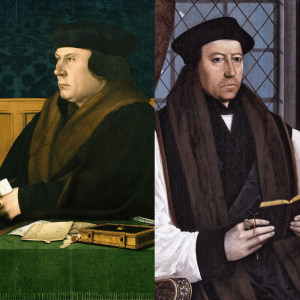
Thomas Cromwell (Frick 1915.1.76) and Thomas Cranmer (NPG 535)
But ultimately, for all the legal paperwork, Pope Clement still existed. The Catholic faith still existed. A law didn’t change people’s opinions or beliefs. A person could, in theory, still go around the new Archbishop Cranmer and write to the Pope and ask for an ecclesiastic ruling. Katharine of Aragon’s petition to save her marriage remained intact. Despite being an ardent supporter of Queen Katharine and her daughter Princess Mary, Thomas Cromwell was the one to do the work, and cut off Katharine’s hopes of saving her marriage and title. It would be treason to go against this law, the penalty being death.
The Act of Restraint of Appeals is the primary legal foundation of the English Reformation. By ensuring no one in England could seek the Pope’s rulings over King Henry, it made the Church of England essentially real, as its own standing faith, overseen by a monarch, who was anointed by God to rule. The petition went to parliament on 4 February 1533, the only major act of the session, neatly squeezed between an act about paving the road from The Strand to Charing Cross in London, and an act against excessively nice clothing (that’s a whole topic on its own). The large roll Cromwell submitted (written in a scribe’s hand) was the first of ten drafts worked on through the session, and included both Cromwell and the king’s handwriting as the statutes were argued, corrected and settled. This meant the king could have the final ruling on subjects like his own divorce, and passed that power to Archbishop Cranmer to formally put it to Convocation and rule the marriage of Henry and Katharine void, clearing the way for pregnant Anne Boleyn to be crowned. The Act of Restraint of Appeals made everything possible for the English Reformation, leaving many dead when they dared to refuse.
The law of only repealed in full by the Statute Law (Repeals) Act 1969, though Northern Ireland was free of the act by 1950.
Here is the text of the completed draft, with modern spelling, punctuation, and italics placed by me, directly from my book of Cromwell’s letters. I have underlined the most important and relevant parts if you would prefer not to slog through this wordy middle-English decree.
THE ACT OF RESTRAINT IN APPEALS, 4 February 1533 (MSS Cleo. E. VI. 185)
‘An Acte that the Appeles in suche Cases as have ben used to be pursued to the See of Rome shall not be from hensforth had ne used but wythin this Realme’
I. An Act that feeds in such cases, as have been used to be pursued to the See of Rome, shall not be from henceforth had nor used but within this realm where, by diverse sundry old authentic histories and chronicles, it is manifestly declared and expressed that this realm of England is an empire, and so has been accepted in the world, governed by one Supreme Head and King having the dignity and royal estate of the imperial Crown of the same, unto whom a body politic, compact of all sorts and degrees of people divided in terms and by names of Spiritualty and Temporality, be bound and owe to bear next to God a natural and humble obedience; he being also instituted and furnished by the goodness and sufferance of Almighty God with plenary, whole, and entire power, pre-eminence, authority, prerogative, and jurisdiction to render and yield justice and final determination to all manner of folk, residents or subjects within this his realm, in all causes, matters, debates, and contentions happening to occur, insurrect, or begin within the limits thereof, without restraint or provocation to any foreign princes or potentates of the world: the body spiritual whereof, having power when any cause of the law divine happened to come in question or of spiritual learning, then it was declared, interpreted, and shown by that part of the said body politic called the Spiritualty, now being usually called the English Church, which always has been reputed and also found of that sort that both for knowledge, integrity, and sufficiency of number, it has been always thought and is also at this hour sufficient and mete for itself, without the intermeddling of any exterior person or persons, to declare and determine all such doubts, and to administer all such offices and duties as to their rooms spiritual does appertain. For the due administration whereof and to keep them from corruption and sinister affection the King’s most noble progenitors, and the ancestors of the nobles of this realm, have sufficiently endowed the said Church both with honour and possessions. And the laws temporal for trial of propriety of lands and goods, and for the conservation of the people of this realm in unity and peace without ravin (plunder) or spoil, was and yet is administered, adjudged, and executed by sundry judges and administers of the other part of the said body politic called the Temporality, and both their authorities and jurisdictions do conjoin together in the due administration of justice the one to help the other. And whereas the King his most noble progenitors, and the Nobility and Commons of this said realm, at diverse and sundry Parliaments as well in the time of King Edward the First, Edward the Third, Richard the Second, Henry the Fourth, and other noble kings of this realm, made sundry ordinances, laws, statutes, and provisions for the entire and sure conservation of the prerogatives, liberties, and preeminence of the said imperial Crown of this realm, and of the jurisdictions spiritual and temporal of the same, to keep it from the annoyance as well of the See of Rome as from the authority of other foreign potentates attempting the diminution or violation thereof as often and from time to time as any such annoyance or attempt might be known or espied. And notwithstanding the said good statutes and ordinances made in the time of the King’s most noble progenitors in preservation of the authority and prerogative of the said imperial Crown as is aforesaid, yet nevertheless since the making of the said good statutes and ordinances diverse and sundry inconveniences and dangers not provided for plainly by the said former acts, statutes, and ordinances have risen and sprung by reason of appeals sued out of this realm to the see of Rome, in causes testamentary causes of matrimony and divorces, right of tithes, oblations and obventions (offerings to God), not only to the great inquietation, vexation, trouble, costs, and charges of the King’s Highness and many of his subjects and residents in this his realm, but also to the great delay, and let to the true and speedy determination of the said causes, for so much as the parties appealing to the said court of Rome most commonly do the same for the delay of justice. And forasmuch as the great distance of way is so far out of this realm, so that the necessary proofs nor the true knowledge of the cause can neither there be so well known nor the witnesses there so well examined as within this realm, so that the parties grieved by means of the said appeals be most times without remedy. In consideration whereof the King’s Highness, his Nobles and Commons, considering the great enormities, dangers, long delays, and hurts that as well to his Highness as to his said nobles, subjects, commons, and residents of this his realm in the said causes testamentary, causes of matrimony and divorces, tithes, oblations, and obventions do daily ensue, does therefore by his royal assent and by the assent of the Lord’s spiritual and temporal and the Commons in this present Parliament assembled and by authority of the same, enact, establish, and ordain that all causes testamentary, causes of matrimony and divorces, rights of tithes, oblations, and obventions, the knowledge whereof by the goodness of princes of this realm and by the laws and customs of the same appertains to the spiritual jurisdiction of this realm already commenced, moved, depending, being, happening, or hereafter coming in contention, debate, or question within this realm or within any the King’s dominions or marches of the same or elsewhere, whether they concern the King our Sovereign Lord, his heirs or successors, or any other subjects or residents within the same of what degree soever they be, shall be from henceforth heard, examined, discussed, clearly finally and definitively adjudged and determined, within the King’s jurisdiction and authority and not elsewhere, in such courts spiritual and temporal of the same as the natures, conditions, and qualities of the causes and matters aforesaid in contention or hereafter happening in contention shall require, without having any respect to any custom, use, or sufferance in hindrance, let, or prejudice of the same or to any other thing used or suffered to the contrary thereof by any other manner person or persons in any manner of ways. Any foreign inhibitions, appeals, sentences, summons, citations, suspensions, interdictions, excommunications, restraints, judgments, or any other process or impediments of what natures, names, qualities, or conditions soever they be, from the See of Rome or any other foreign courts or potentates of the world, or from and out of this realm or any other the King’s dominions or marches of the same to the See of Rome or to any other foreign courts or potentates, to the let or impediment thereof in any wise notwithstanding. And potentates that it shall be lawful to the King our Sovereign Lord and to his heirs and successors, and to all other subjects or residents within this realm or within any the King’s dominions or marches of the same, notwithstanding that hereafter it should happen any excommencement, excommunications, interdictions, citations, or any other censures or foreign process out of any outward parties to be fulminate, provulged (proclaimed), declared, or put in execution within this said realm or in any other place or places for any of the causes before rehearsed, in prejudice, derogation, or contempt of this said Act and the very true meaning and execution thereof, may and shall nevertheless as well pursue, execute, have, and enjoy the meets, profits, benefits, and commodities of all such processes, sentences, judgments,, and determinations, done or hereafter to be done in any of the said courts spiritual or temporal as the cases shall require, within the limits, power, and authority of this the King’s said realm and dominions and marches of the same, and those only and none other to take place and to be firmly observed and obeyed within the same. As also that all spiritual prelates, pastors, ministers, and curates within this realm and the dominions of the same shall and may use, minister, execute, and do, or cause to be used administered, executed, and done, all sacraments, sacramentals, divine services, and all other things within the said realm and dominions unto all the subjects of the same as Catholic and Christian men are owe to do. Any foreign citations, processes, inhibitions, suspensions, interdictions, excommunications, or appeals for or touching any of the causes aforesaid from or to the See of Rome or any other foreign prince or foreign courts to the let or contrary thereof in any ways notwithstanding. And if any of the said spiritual persons, by the occasion of the said fulminations of any of the same interdictions, censures, inhibitions, excommunications, appeals, suspensions, summons, or other foreign citations for the causes before said or for any of them, do at any time hereafter refuse to minister or to cause to be ministered the said sacraments and sacramentals and other divine services in form as is aforesaid, shall for every such time or times that they or any of them do refuse so to do or to cause to be done, have one year’s imprisonment and to make fine and ransom at the King’s pleasure.
II. And it is further enacted that if any person or persons do attempt move, purchase, or procure, from or to the See of Rome or from or to any other foreign court or courts out of this realm, any manner foreign process, inhibitions, appeals, sentences, summons, citations, suspensions, interdictions, excommunications, restraints, or judgments, of what nature, kind, or quality soever they be, or execute any of the same process, or do any act or acts to the let, impediment, hindrance or derogation of any process, sentence, judgment, or determination had, made, done, or hereafter to be had, done, or made in any courts of this realm or the King’s said dominions or marshes of the same for any of the causes aforesaid. . .that then every person or persons so doing, and their fautors (supporters), comforters, abettors, procurers, executors, and counsellors, and every of them being convicted of the same, for every such default shall incur and run in the same pains, penalties, and forfeitures ordained and provided by the statute of provision and praemunire made in the sixteenth year of the reign of King Richard the Second.
III. And furthermore in eschewing the said great enormities, inquietations, delays, charges, and expenses hereafter to be sustained in pursuing of such appeals and foreign process do therefore ordain and enact that in such cases where heretofore any of the King’s subjects or residents have used to pursue, provoke, or procure any appeal to the see of Rome they shall from henceforth take, have, and use their appeals within this realm and not elsewhere, in manner and form as hereafter ensue and not otherwise. That is to say, first from the archdeacon or his official, if the matter or cause be there begun, to the bishop diocesan of the said See, and likewise, if it be commenced before the bishop diocesan or his commissary, from the bishop diocesan or his commissary, within fifteen days next ensuing the judgment or sentence thereof there given, to the archbishop of the province of Canterbury, if it be within his province, and if it be within the province of York then to the archbishop of York; and so likewise to all other archbishops in other the King’s dominions as the case by the order of justice shall require; and there to be definitively and finally ordered, decreed, and adjudged according to justice, without any other appellation or provocation to any other person or persons, court or courts. And if the matter or contention for any of the causes aforesaid be or shall be commenced before the archdeacon of any archbishop or his commissary, then the party grieved shall or may take his appeal, within fifteen days next after judgment or sentence there given, to the Court of the Arches or Audience of the same archbishop or archbishops, and from the said Court of the Arches or Audience, within fifteen days then next ensuing after judgment or sentence there given, to the archbishop of the same province, there to be definitively and finally determined without any other or further process or appeal thereupon to be had or ensued.
IV. And in case any cause, matter, or contention which has, does, shall, or may touch the King, his heirs or successive kings of this realm, that in all and every such case or cases the party grieved shall or may appeal to the spiritual prelates and other abbots and priors of the Upper House assembled and convocated by the King’s writ in the Convocation being or next ensuing within the province or provinces where the same matter of contention is or shall be begun; so that every such appeal be taken by the party grieved within fifteen days next after the judgment or sentence thereupon given or to be given. And this whatsoever be done or shall be done and affirmed, determined, decreed, and adjudged by the foresaid prelates, abbots, and priors of the Upper House of the said Convocation as is aforesaid, appertaining, concerning, or belonging to the King, his heirs or successors, in any of these foresaid causes of appeals, shall stand and be taken for a final decree, sentence, judgment, definition, and determination, and the same matter so determined never after to come in question and debate to be examined in any other court or courts. And if it shall happen any person or persons hereafter to pursue or provoke any appeal contrary to the effect of this Act, or refuse to obey, execute, and observe all things comprised within the same that then every person and persons so doing, refusing, or offending, their procurers, fautors (patrons), advocates, counsellors, and abettors, and every of them, shall incur into the pains, forfeitures, and penalties ordained and provided in the said statute made in the said sixteenth year of King Richard the Second.
Welcome to part 4 of Wolf Hall 2: The Mirror and the Light facts about moments seen in Thomas Cromwell’s life at court. Today is a quick round-up of questions asked that don’t require a whole post of explanation on their own. So let’s start –
Wolf Hall is Jane Seymour’s home. What is The Mirror and the Light?
On 28 November 1538, Cromwell wrote a letter to Sir Thomas Wyatt (Harl. MSS. 282, f. 217), who was King Henry’s ambassador to Holy Roman Emperor Charles V, and travelling Europe with the Emperor’s court. Wyatt was not a good ambassador, and relations between the countries were started to deteriorate. Cromwell updated Wyatt on Henry Courtenay, Marquess of Exeter and Henry Pole, Lord Montagu, the Catholics traitors, and asked Wyatt to get the Emperor to intervene on several subjects were making trouble for London merchants. In the letter, Cromwell wrote of King Henry exercising his right as the supreme head of the church by burning Sacramentarian John Lambert a week earlier:
‘…undoubtedly [Emperor Charles] should have much marvelled at [King Henry’s] most high wisdom and judgement, and reputed him none otherwise, after the same, than in manner of the mirror and light of all other kings and princes in Christendom.’
King Henry is the mirror, and everyone and everything should reflect his brilliance. Henry is the shining light of princely splendour all should look up to. Being out of Henry’s light/favour is like being in the darkness. The letter is extremely flattering of Henry, since it would be read and repeated at the Emperor’s court, and could reveal nothing of reality, only a glowing picture of praise and perfection.
Was Thomas Cromwell the Lord Chancellor of England?
NO. Thomas Cromwell was never the Lord Chancellor. Thomas Wolsey was Lord Chancellor, followed by Thomas More, and then Thomas Audley. Cromwell assumed the role without title between more’s resignation in May 1532, and Audley’s appointment in January 1533, and was not always in a good mood about the position or workload. Audley was a puppet; he would do anything the king wanted, and he was easily intimidated, so Cromwell could yell at Audley whenever he made an error and Audley would beg and grovel for forgiveness (Audley complained a lot, especially about his yearly salary of 800l or £350,000 today, plus bonuses. Cromwell always told him to shut it because it annoyed the king). Audley and his protégé Richard Rich really ran with Henry’s plan to dissolve monasteries when Cromwell didn’t want to move forward, but other than that, Cromwell had total control and authority over all matters. Audley never intervened in Cromwell’s business, despite technically being higher ranked until 1536. (Lord Chancellor was ranked second in the realm after the archbishops. In 1536, Cromwell became the Vicegerent of England, the new number one in order of precedence, putting Lord Chancellor down to third).
Thomas Cromwell was, in 1539, Lord Cromwell, Baron of Wimbledon the Vicegerent of England, Lord Privy Seal, Vicar-general of England, Knight of the Most Noble Order of the Garter, Principal Secretary, Chancellor of the Exchequer, the first-ever layman Dean of Wells, and Commissioner for the Peace in seven counties, Chancellor and High Steward of Cambridge University, Master of the Jewel House, Clerk of the Hanaper, and Steward of the Duchy of Lancaster, Essex, Hertfordshire and Middlesex, the Receiver of Petitions in the House of Lords, highest ranked man in the House of Lords, Warden and Chief Justice in Eyre, Prebendary of Salisbury, Steward of Westminster Abbey and Savoy Manor, Constable of Hertford Castle, Berkeley Castle and Gloucestershire Castle, Recorder of Bristol, Commissioner for the Subsidy to print the Bible, Lordship of Edmonton, Sainsbury, Hovering and Writtle, and master of every single powerful man in the country of Ireland. By 1540, Cromwell was also the Earl of Essex and Lord Great Chamberlain. At that point that was basically nothing left for Cromwell to control, other than being the Lord Treasurer, but Norfolk held that role and seemed to live forever.
Sometimes people write Cromwell as Lord Chancellor because it is easier to understand in modern terms. Cromwell was the only person to ever be England’s Vicegerent, and no one person will ever receive that much power again.
Did Cromwell feel guilt over Anne Boleyn?
Certainly not that he ever mentioned where it would be recorded. It would have been insanity to have expressed guilt or sympathy. Archbishop Cranmer wrote to King Henry to make sure he didn’t go down with her, and so the Reformation would be safe without Anne on the throne. Cranmer was frozen out by the king for a while for this, and had his prime lands and manors confiscated, and given to Cromwell after Anne’s death. Mortlake Manor was the traditional home of the Archbishop of Canterbury since its construction 500 years earlier, and Crowmell relatives had worked there as servants. Cromwell then owned the property and made it grander than ever.
Cromwell did say to Ambassador Eustace Chapuys that Anne Boleyn handled herself well through her trial. Everyone knew she was innocent, but no one was stupid enough to say anything. I cover the whole period about Anne’s death in my book on the subject.
Did King Henry actually say he could make Cromwell the king after himself if he wanted at the Privy Council meeting?
No, that was just an imagined scene of the king flexing his power over all the nobles. Likewise, Cromwell and Fitzwilliam never came to blows like that at a meeting. It is another piece of fiction laid out to be reflected in later episodes. I will do a separate post about Cromwell and Fitzwilliam, as their relationship was very interesting.
BBC/Playground Entertainment/Nick Briggs
Did Cromwell spend time with Dorothea Wolsey?
There is no evidence of this; ‘Dorothea’ is a just a plot-point for Cromwell’s guilt. There are letters between Cardinal Wolsey’s three children and Cromwell. Most of the letters come from Thomas Wynter, Wolsey’s eldest son, born 1510 to Joan Larke, was always travelling in Europe, and always looking for money. Cromwell was one of Wynter’s financial babysitters, and felt sorry for Wynter after his father’s death. There are extensive papers showing Wolsey’s favour towards Wynter, and Cromwell got him set up in a comfortable life in the North in the 1530s, and he later became the Dean of Wells.
Dorothy was born in 1513, her mother also Joan Larke. Her surname was Clancey, the name of her adoptive family in Dorset. She was placed in Shaftesbury Abbey for her education and upbringing where many nobles sent their daughters, and just fell under Cromwell’s ban of no one being allowed to take holy orders from age 24 or younger in 1535. Cromwell soon changed the laws, so no one under 20 could enter the church, and Dorothy could technically become a nun. The rich and well-appointed Shaftesbury Abbey was closed in 1539, and Dorothy Clancey was given a pension. She was never heard from again, and she certainly never met Thomas Cromwell.
Wolsey’s third child was Thomas Minterne (though his mother is uncertain), born in about 1516. Minterne grew up in Sherborne, ten miles from his sister Dorothy. Wolsey sent Minterne to New Oxford College and Cromwell ensured he was made a fellow at only 17 years old in 1533. Cromwell then sent Minterne to study in Europe in 1538, and when he returned to England broke in 1542, King Henry gave Minterne a cozy job at Salisbury Cathedral, which he kept for the next 20 years or so.
(Joan Larke married George Legh and had another four children, and then married Sir George Paulet in 1530, but died giving birth two years later, though her son William survived. Joan must have been quite young when having Wolsey’s children, maximum no more than 20 years old. Joan’s baby William Paulet was cousin of John Paulet, 2nd Marquess of Winchester, who married Elizabeth Cromwell, widow of Gregory Cromwell. These people really never moved around much).
All sources come from The Private Life of Thomas Cromwell and The Letters and Remembrances of Thomas Cromwell. My publisher might come for you if you plagiarise.
Anne Boleyn has mesmerised the English public for centuries. Her tragic execution, orchestrated by her own husband, never ceases to intrigue. How did this courtier’s daughter become the queen of England, and what was it that really tore apart this illustrious marriage, making her the whore of England, an abandoned woman executed on the scaffold? While many stories of Anne Boleyn’s downfall have been told, few have truly traced the origins of her tragic fate.
In Thorns, Lust and Glory, Estelle Paranque takes us back to where it all started- to France, where Anne learned the lessons that would set her on the path to becoming one of England’s most infamous queens. At the court of the French king as a resourceful teenage girl, Anne’s journey to infamy began, and this landmark biography explores the world that shaped her, and how these loyalties would leave her vulnerable, leading to her ruin at the court of Henry VIII.
A fascinating new perspective on Tudor history’s most enduring story, Thorns, Lust and Glory is an unmissable account of a queen on the edge.
¬¬
Thorns, Lust and Glory: The Story of Anne Boleyn offers a fresh and captivating perspective on one of Tudor England’s most enigmatic figures. Anne Boleyn, whose life and tragic death have fascinated historians and the public alike for centuries, is brought to life in this compelling biography that traces her journey from a courtier’s daughter to the queen of England, and ultimately, to the scaffold. Paranque skillfully examines Anne’s early life, particularly her formative years in France, to explore how these experiences shaped the woman who would become Henry VIII’s most controversial wife.
One of the most impressive aspects of Thorns, Lust and Glory is Paranque’s focus on Anne’s time in the French court. This period of Anne’s life is often glossed over in other biographies, but Paranque brings it to the forefront, arguing that it was in France that Anne developed the skills, charm, and political acumen that would later captivate Henry VIII. At the French court, Anne was exposed to a sophisticated culture of courtly love, intellectual debate, and political strategy, all of which she would later use to her advantage in England. Paranque vividly depicts the French court as a place of both opportunity and danger, where Anne honed her abilities but also where she learned the harsh realities of court life—lessons that would both elevate and then doom her.
Paranque’s portrayal of Anne is nuanced and empathetic. Rather than depicting her simply as a victim of Henry VIII’s whims or as a scheming temptress, Paranque presents Anne as a complex and resourceful woman who was deeply influenced by her upbringing and experiences. Anne’s time in France, Paranque suggests, not only gave her the tools to rise to power but also left her with vulnerabilities that would later be exploited by her enemies at the English court. This duality is central to Paranque’s interpretation of Anne’s life, making this biography both a study of her strengths and a poignant exploration of her tragic flaws.
The book also provides a compelling analysis of the forces that led to Anne’s downfall. While many accounts focus on the immediate events leading to her execution—her inability to produce a male heir, the rise of Jane Seymour, and the political machinations of her enemies—Paranque traces the origins of Anne’s fate back to her early alliances and the lessons she learned in France. This approach offers a broader and more complex understanding of why Anne ultimately became the “whore of England” in the eyes of her detractors and why Henry, who had once moved heaven and earth to marry her, so ruthlessly discarded her.







 CAROLINE ANGUS