Portal Valldigna (Valldigna Gate) is a portal/gateway built in 1400 to separate the Christian and Moorish areas of the city. It is located in the oldest part of Valencia’s old town, in the Barrio del Carmen, in the Ciutat Vella. The gateway never had a door, and simply separated the nearby buildings, and leaned against the ancient Arab wall around the city. The local abbot had his home over the doorway, and gave the Portal Valldigna after the Monasterio de Santa María de la Valldigna, an amazing monastery built in 1298 outside the city area.
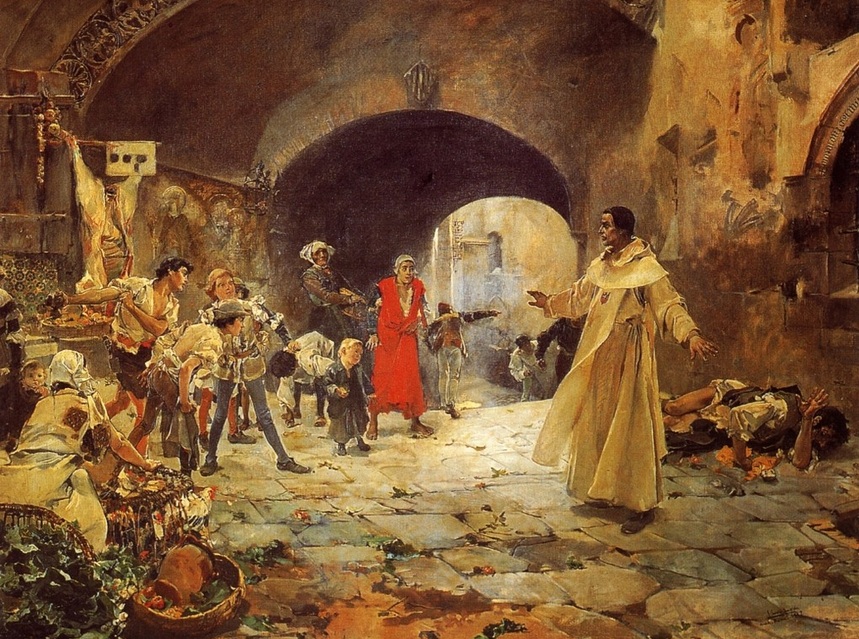
Father Jofre defending a madman, by Joaquin Sorolla (1887) – Source
The portal, seen here in this painting by one of Valencia’s finest artists, shows the portal in the background as Joan Gilabert Jofré, known as Father Jofré, saves a madman from being stoned in 1409. After spending time seeing how Muslims cared for the mentally ill, Father Jofré went on the start the world’s first mental institution in the world, sanctioned by Pope Benedict XIII and King Martín I of Aragon. It was built nearby and named after Valencia’s patron saint Nuestra Señora de los Desamparados.
In 1474, a book named Obres e trobes en lahors de la Verge Maríawas printed with paintings of the Portal Valldigna, showing an inscription in Valencian, es obres or trobes Davall scrites quals them lahors tracten of the sacratíssima Verge Maria (in praise of the Virgin Mary). In 1589 a new plaque was put above the portal depicts King Jaime II of Aragon at the founding of Valldigna monastery.
Speed forward to the 1940’s and the portal was in a state of disrepair and the city planned to demolish it along with the historical buildings surrounding it. In 1944, the Valencia Director of Fine Arts stepped in to have the Portal Valldigna named a historical monument and saved it from its fate. The portal and above building was fully renovated in 1965, making sure the original Arab and Christian stones were saved. A new plaque was put over the entrance into the ‘old cities’ with the shields of both the city of Valencia and the Valldigna monastery. The Valencia inscription next to it reads : Dona Nostra Son of Bona, Pregueu per nós, Valldigna Portal (Good Women of Our Son, Pray for us, Valldigna Portal).
1900
1900’s
1908
1925
1957 floods
1973 fallas
1986
unknown
1993
1995
Portal Valldigna Valencia
Portal Valldigna Valencia
Portal Valldigna Valencia
Portal Valldigna Valencia
Portal Valldigna Valencia
Portal Valldigna Valencia
Today, Portal Valldigna is a good spot to stop by and see a pocket of Valencia’s ancient history, away from the crowds. It is easy to find if you are already visiting some of Valencia’s more well-known sites. If you are new to Valencia, just head up Carrer Concordía off Carrer Serrano, and follow the road right, and you will be on Carrer Portal Valldigna. Or, head down Carrer Cavallers (Calle Caballeros if your map is in Spanish) and head down either tiny Carrer Landrer, or even narrower Carrer Salinas, which, while not the prettiest street in the city, has a section of the ancient Arab wall, just standing alone between two buildings. A landmark often missed by many.
2014 is the 40th anniversary of the bombing of Cafetería Rolando in Madrid. The attack was a significant event in the fight against Francoism and a defining moment in the ETA’s struggle for independence. I first learned about Cafetería Rolando several years ago, and it forms part of my upcoming book, Death in Valencian Dust. In posting this, I do not endorse either side of the ETA struggle, merely recognise the struggle Spain suffered in the 1970’s.
In 1974, to say Spain was at a crossroads would be an understatement. In December 1973, Admiral Luis Carrero Blanco, Spain’s Government President was assassinated by ETA (Basque – Euskadi Ta Askatasuna, Spanish – País Vasco y Libertad, English – Basque Homeland and Freedom), the Basque Country separatist group. For years, ETA had been carrying out attacks and killings around Spain, while other groups started to rise up against the government. In 1974, new Government President Carlos Arias Navarro set up new rules during the spirit of 12 February, keeping in line with Franco’s harsh regime of times past, covering everything from stopping freedom of the press, restriction to the judicial systems, harsh penalties for strikers and protesters, and generally restricting the lives of everyone in the country, everyone outside the búnker, the group of extreme right-wing people surrounding Franco.
The state of the nation deteriorated throughout the year – the church increasingly voiced their opposition to Franco and the regime, the execution of anarchist Catalan Salvador Puig Antich brought people to the streets in protest, the economy slumped, the Communist party mobilised in defense of their sympathisers, workers continued to strike, and universities protested the new draconian laws. Franco himself was seriously ill, and Juan Carlos, his protegé, was taking over all tasks on his behalf. The Portuguese dictatorship collapsed, giving Spaniards more ideas of what they could achieve for themselves. On September 11, 1974, Arias Navarro re-endorsed his changes and announced efforts would double to enforce new laws over the rising tide of anger.
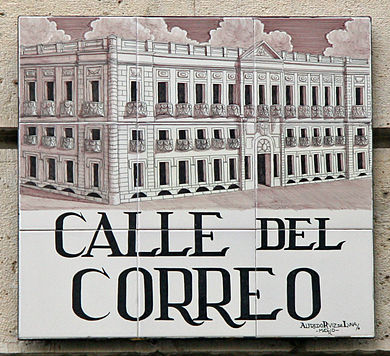
Cafetería Rolando, at 4 Calle del Correos (known as E street), was located in the heart of Madrid, directly off Puerta de Sol. Cafetería Rolando was a large and popular cafe, the local spot for police to visit during their lunch breaks, conveniently located beside the headquarters of the Dirección General de Seguridad (General Directorate of Security) in the famous Real Casa de Correos building. The Dirección General de Seguridad was considered an impenetrable target by ETA and other organisations keen to bring down the regime. Because nearby Cafetería Rolando was so popular with police working nearby, the place became destined for disaster.
Real Casa de Correos (Cafetería Rolando was to the right of this shot) – Source
On September 13, 1974, at 2.35pm, during a busy lunchtime, a bomb exploded at the entrance to the cafe. The bomb, thirty kilos of dynamite filled with nuts for shrapnel, went off as many enjoyed their lunch, and was large enough to cause serious structural damage to the five-storey building. The ceiling of the café collapsed, resulting in several of the hostel guests upstairs falling into the café. The blast was big enough to shatter the windows of the Real Casa de Correos across the tiny street and several cars were obliterated. Another restaurant, a large place with 300 seated guests next door, was also seriously damaged.
Because of the proximity to the security building, police were on the scene immediately, and the process of saving Cafetería Rolando diners began. An attack of this magnitude, on a place frequented by everyday people, hadn’t been undertaken since the Civil War, catching all by surprise. Seventy-one people were pulled alive from the rubble, several children. Most victims made a full recovery, though several were left with scarring and mutilation. In total, twelve people were killed, aged from 20 to 78 years old, including a just-married couple. Several café workers were killed, including one who was pulled alive from the rubble but died before surgery. While the attack was allegedly against the police, and several wounded were police and from Franco’s elite special forces, the rest killed were all civilians. A thirteenth victim, a police officer, died two years later from the attack, unable to survive the injuries he sustained.
The list of the dead only fueled speculation of the bombing. As no police officers were listed among the dead, a theory sprang up that a division of the extreme right themselves planted the bomb. Police earlier that day had been told to avoid the café, but these rumours were never directly admitted. Franco was keen to catch whomever had committed the act, while others, both for and against the government, took the opportunity to criticise the regime, plus Arias Navarro himself, and the búnker, the powerful political families. Everyone had an agenda for establishing blame. The Communist party became a popular target for criticism, initially blamed for the events.
Soon, blame fell on ETA from the Basque Country. They had been killing policemen and guards sporadically since 1968, one just days before the bombing. ETA denied any knowledge of the Cafetería Rolando attack, though throughout Spain, the denial wasn’t taken seriously. Because of the high number of killed and wounded were merely civilians at lunch, both sides of the political fence wanted to see justice done. The assassination of Carrero Blanco less than a year earlier didn’t raise tempers, but the attack on the café brought ETA’s organisation more into the spotlight than ever before.
Famous Basque activist, writer, women rights campaigner and ETA supporter Eva Forest was arrested along with her husband, though her husband was soon released. Forest refused to co-operate and accused the police of ill-treatment during her detainment. It was alleged two Basques, a man and a woman, planted the bomb in Cafetería Rolando, sticking the bomb to the underside of a table, and set off the timer. The identity of those two Basques were never established. It could have been Forest and her husband, playwright Alfonso Sastre, but there was no proof. While many detained in connection to Cafetería Rolando and the Carrero Blanco assassination were released, Forest was kept in prison until 1977, when all political prisoners accused under the Franco regime were given amnesty, to smooth the way for democracy under the new King Juan Carlos. It was rumoured that Forest suffered terribly being in jail, being tortured for all her acts over the years. While Forest admitted to passing on ETA messages and helping with safe houses, she never admitted her part in the Rolando bombing, despite admissions from others in the plot.
Because of the 1977 amnesty, no one was ever held accountable for the Cafetería Rolando bombing, and no one can never be convicted of any crime relating to the incident.
Here we are again, part 4 of the Luminous Colours of Dusk Q+A. here are all your questions about writing –
When did you decide to become a writer?
I’ve had storylines going around in my head for as long as I can remember, but it wasn’t until 2009 when I finished my university studies that I decided to sit down and try fiction. It took about another 18 months before I decided to publish a novel. If you want to do something, just do it!
Where do the your ideas come from?
My warped mind! For my Canna Medici series, the people and their scenarios are all totally fictional. Once I start writing, it all comes to me. For my series based Valencia, there is so much more work to be done – interviews with people in Spain, were in Spain, fought in the war, along with natural disasters, current news events, all come together and work around a group of characters I put together myself. Each type works well, though writing about Spain is important to me, as is its accuracy, and using real timelines of Valencia’s history with fictional characters is so much fun. Whereas with Canna, it’s all made up and my imagination can run wild.
How long does it take you to write a book?
Each of my five published books have taken different times to developed. Night Wants to Forget took 18 months. Violent Daylight was eight months from first word to publication. Luminous Colours of Dusk only took six months in total, but the schedule has been brutal. Blood in the Valencian Soil was a tough one, I spent ten months working on it, tossed the entire lot and wrote something else, then started again and it took a year for the finished product to be released. Vengeance in the Valencian Water took six months of writing time, and another two months to edit. My next two books have eight months each allocated to them.
Do you proofread/edit all your own books or do you get someone to do that for you?
I proofread and edit, and I have also have others do it as well, different people for different series. I can’t thank those people enough for all their help. Being edited can be really hard, so sticking with an editor/proofreader can be tough and you need to trust them. The first person who helped me with Night Wants to Forget was terrible. The book was a disaster. I would like to pretend the first edition doesn’t exist.
Do you think that the cover art is important?
I think so. You can make your own cover art, or get someone on fiverr to whip something up, but first impressions are really important. My personal preference is for a photograph, or a ‘real-life shot, as opposed to a plain cover or designed/drawn covers. For all the books in the Canna Medici series, I had an artist work on the books, so that they followed a theme and had the same fonts and designs used. The artwork was secured by the designer and she took care of everything for me from the United states. The Secrets of Spain series has a simpler design, and all photographic backgrounds are taken from the Valencia area, specific to the storyline. Having them all designed in the same style helps match as a set. Cheap-looking cover art can suggest a poor quality story, so why sell yourself short?
Do you write every day or as and when you can?
I plan my life, my family, my work and then working writing around it all. I aim for 3-4 chapters per week, slipped in where I have free time. If I don’t feel like writing, I just give up. I can skip weeks of writing and then spend two weeks catching up, and the work is always completed. Trying to keep to a strict timeline only stresses me out. With my last book, I fell nearly a month behind, so the next month meant I wrote a chapter nearly every day. It’s not a schedule I would recommend.
Do you aim for a set amount of words/pages per day?
When I write, I write a chapter from start to finish, regardless of how many words it needs to be. My chapters can run from 2,500 to 4,500 words, depending on the book, and I always finish a chapter when I get started. Obviously, some planning is required to achieve this.
For example, Luminous Colours of Dusk is 155,000 words long. That’s not a 200 page chit-chat. Maybe I should write shorter books. I can’t guarantee that I will ever master the art of the 70,000 word book. In fact, I already know I won’t, I have some epic sagas planned.
Do you get a lot of support when writing?
I always have my lovely twitter followers to push me on when things get rough. For my Spanish wiring, the #wabas group, Writers and Bloggers about Spain, are always helpful, with tips, encouragement, promotions, editing, whatever I need, someone can appear and help. I’m a lucky woman.
Do you get writers block?
I usually start with a huge burst of enthusiasm with every book, then get to the middle, worry that I’m not getting to the point fast enough, spin in circles for a month or so, then kill off loads of people and end the story. It’s less writer’s block and more mass confusion about where I’m going. I write a list of what each chapter has to achieve, and then just ignore my own advice. If I just got to work, my problems would probably solve themselves.
What are the highlights and lowlights of writing?
I’m one of those people who don’t like birthdays. They are normal days, but you expect more, and then get let down (at least I do, anyway). Book release day is much the same. There should be excitement, but instead it’s mostly just relief the work is over. It should be a highlight and it isn’t. You may see an increase my use of exclamation points in an attempt to make the day a highlight. Likewise, small moments can make themselves into highlights, like coming up with a plot twists. The day I figured out the plot-twist connection between Luna Montgomery and María Medina in Blood in the Valencian Soil (won’t share – spoiler), I literally jumped for joy in public. Probably looked mental.
Is being edited/ editing other hard?
I sulk after every chapter of edited work comes back o me. Then I see why changes have been made and I move on… to sulk after getting the next email. Editing others can be hard too, because I don’t want to hurt their feelings, but don’t them suffering with typos or mix-ups either. It’s okay to hate editing and/or criticism – just don’t get the two confused.
~~~
Phew, that is all the answers given. Part 5 of the Q&A will be chapter one of Luminous Colours of Dusk, free to read. Also there is a free promo on for Night Wants to Forget and Violent Daylight, go HERE for details.
This was my most popular post from my music blog – Night Wants to Forget, so once I closed the site, I have added this here for future readers 🙂
Tuesday February 14 started in good standing. My alarm went off at 5am and I had Senza Parole in my head. It was going to be a long day. I am an author, and a blogger, and a prolific Il Divo reporter. However, firstly I am a mother of four. For eight years I have been in this starring role and I have never left my children behind for anything. I don’t spend time away from them. So when I decided that I was taking a few nights in Sydney alone to listen to a double helping of Il Divo, it was a big step for me. And them. But mostly me.
Kiwis can fly!
Informed by my four young gentlemen that they were fine in the capable hands of their terrific father, I was left on my own at Auckland airport to board a flight. I hadn’t flown alone since the children were born. And without the tears and the fussing and the excitement they always have on a plane, I remembered again just how much I hate to fly. How awful it is to be in the air. And I had sit next to a woman who complained endlessly about how there is not enough hand luggage space. Her carry-on bag was larger than my suitcase. When I pointed that out she got even more annoying. I would like to thank Sony for the new noise-cancelling headphones I had bought only a few weeks earlier, and the plug that can be put into the on-board entertainment system. Next to her, half a season of Two and Half Men with Ashton Kutcher never seemed more appealing (I met him once, he is nice).
The flight took three hours, as it always does to Sydney, but with an added half an hour circling the airport as well. That was added to the half an hour delay in taking off, and it rapidly looked like I would be late to the diva lunch at midday. Patience is not my strongest virtue, so when I had to wait in my seat at the back of the plane for every passenger to get off, I was getting annoyed. Luckily the sexy Australian man at immigration rushed me through and I had to sprint with my heavy suitcase to catch the train into the city – which I missed. It was hot. Australia is. And humid. And the train wasn’t coming.
Sydney Harbour Bridge
By the time I stepped of the next train at Circular Quay I wasn’t in a great mood. Sure, the view before me was great – the Sydney Harbour bridge and the Opera House right there, but so was rain. Up a hill with my heavy case, and wearing six inch heels, I struggled my way into the Sir Stamford Hotel. I can’t rate it highly enough, but with my frizzy humid-weather hair, panting and red faced, it wasn’t a great way to arrive. My things flung to one side, they shoved me in a taxi to get Square Bar at Rydges a few miles away. My heels couldn’t make that walk, not in the rain for sure.
Sir Stamford on Circular Quay
That was when my mood changed for the trip. Only about 15 minutes late, I strolled in looking a mess and there was the diva group. After years of talking online to these women, it was beyond fantastic to meet in person. You know them instantly! It is a great privilege for this New Zealander (or ‘vowel swallower’ as I was called) to be included in the Aussie divas group. You will not find a better group of women. An afternoon of lunch full of champagne, cake, Divo love and laughs, I was more than ready to see the show. I had not been especially excited to attend, but in the comfort of like-minded ladies, I was ready.
View from the hotel
Back to my hotel, the room was perfect. And the view! The Opera House was only two minutes by foot away, and the buzz and energy of Sydney was hurrying me along to get organised. One of my true loves, Twitter, was on the desk so I could chat with divas everywhere as I got myself organised and into my blue gown, which I had altered only the night before after losing 7kg leading up to the trip. With four Valentine’s Day gift bags in hand, and my clutch purse armed with my camera, I set off. I walked the short distance along the waterfront to the opera house, which was full of people sightseeing and heading out for after work drinks. There I was, in a full length gown, five inch heels, holding my dress up with my purse one hand, gifts in the other, on the uneven cobbles that make up the paths. I quickly lost count how many men asked me if I was free for Valentine’s Day. They must have been desperate! I guess I looked ready for a date?
Out and about at the Opera House
With my ticket, Row A, Seat 27 (centre!) in hand it was time to wait for the Meet and Greet. Again meeting up with divas arriving for the show, we chatted and laughed as the minutes quickly ticked by. Those of us doing the Valentine’s M&G headed off, to meet Ivan, who is the liaison for the M&G for Il Divo. Running almost half an hour late and with 53 people to tick off his list, the poor man was a bit flustered. Chic was kind enough to help him out and take over, to the amusement of Lois and I, who somehow ended up at the front of the queue, the opposite of our plan. One minute I was enjoying some diva banter and telling the security guys that Aussie men are sexy, next I was being guided into a small dressing room by Ivan. It was dimly lit, decorated with a couch and grand piano and against the wall by a dressing table surrounded by lights was – Il Divo!
I stepped forward, careful not stand on my dress, and shook David’s hand, to be greeted with his warm illuminating smile. I was happy to see it, since he isn’t known for his love for M&G meetings. Next was Carlos (YAY!) and I introduced myself, to which he replied “it’s amazing you came all this way to meet me – us.” Sebastien laughed at Carlos as he took my hand and asked me where I was from, and I mentioned New Zealand, and also shook Urs’ hand, also a warm smile from him. Sebastien put his arm around me as I stood between him and Carlos for the photo, which caught me by surprise as we chatted about Auckland. In my desperation to stay composed in the presence of the men I forgot to take my glasses off for the photo! It was an absolutely awful photograph of me – but the guys looked fantastic. As I went to leave Carlos put his arm around me for a moment, which was great! All those Il Divo videos I have made that he has stolen the link for to put on his FB page were worth it. The smell of his favourite Chanel cologne bringing back memories of my memorable 2009 M&G (that is for another time!). All guests were given autographed programme and silver Il Divo picture frame for our M&G photo upon our exit.
Don’t laugh at me! It took a lot of guts to share!
Leaving the gift bags with the lovely Ivan to put in the dressing rooms, I headed out in the backstage cafeteria, where the Il Divo orchestra members, and some of the cast for Turandot that was in the opera theatre next door, were waiting. After more diva chat, and catching up with a couple I sat with at the 2009 tour, we headed to the concert hall with only 10 minutes until the start of the show, and a final chance to chat with divas before were scattered to take our seats. Once in my front row seat, it was obvious all those worries of the stage being very high were all nonsense. I barely had time to talk with the other fans around me and get my camera ready (and tweet my lovely divas the details!) before the lights dimmed.
Sebastien was ready for a big night
The show was nothing like I expected. In 2009 I went to a show and a M&G, and I was starstruck (for lack of a better word). But this was different, it was like seeing four old friends coming out to entertain. The venue was intimate, with everyone able to be encapsulated with the tones of Il Divo. ‘Come What May’ is a perfect song to start with, dramatic and cinematic, setting the tone for the evening very well. Each Divo got their own applause with their first line, before they wandered to the edge of the stage for the big finish. It was that moment when David was only a few feet from me did I notice his earrings and I pointed them out. He nodded with a huge grin and waved. He was rapturous with the reception they were getting and it was only the first song.
What bowtie?
‘Dov’e L’Amore’ was everything I had dreamed of, powerful and dark and intense. I love Carlos in this song especially and he didn’t disappoint. It was quickly followed by ‘Adagio’ where David comes into his own. After those three songs we easily could have gone home happy. By this time, David had plucked off the bowtie, leaving it to hang around his neck. Next was the delicate ‘Nella Fantasia’, my first time I have heard it live, and it was beautifully done. Then it was ‘Don’t Cry For Me Argentina’ and Sebastien stumbled with his first lines. He was right in front of me, and I could see on his face he didn’t know what he was doing as the moment came and he failed. The guys and the audience took it in good humour, before Carlos carried on with his lines. The song is amazing on the album, but much more luscious and theatrical on stage. The playlist deviated from what as initially put out, and ‘Si Tu Me Amas’ rang out. It is one of my all-time favourites, and I was singing (silently) along, and Carlos kept locking eyes with me while he sang, which was a superb treat.
Si Tu Me Amas
A short break in song produced a golden moment. Sebastien pointed out Renee about five or so rows back, sitting with Urs’ wife. He professed his love to her, tears in his eyes. A bunch of dozens of red roses was produced from a staff member on the side of the stage and given to Renee to big applause. The man loves his family and it is so lovely to see. I think every man in the place (and there were many) were nudged by their wives for not giving the same. The group broke into ‘Everytime I Look At You’, and this time I got to sing along with Carlos again. Yay! The pace moved along quickly, passing through the perennial favourites ‘Passera’ and ‘Senza Catene’, which seems to still be a very popular song. Then came the reinvigorated ‘My Way’ to complete the first act. While many say they are sick of the song, they have not seen it live on this tour, because it is a riot. The men left the stage exit left to a thunderous applause.
Their Way
After an interval that flew by, and more tweets sent, the second act was already upon us! ‘Senza Parole’ was presented on stage, and it is a shame it never made the DVD, because it is astounding. The sound is potent and demanding, sucking the audience in with its presence. Sebastien has more of a role in the song than on the CD, and the song is all the better for it. I jumped from my seat for a standing ovation at the end, aware I was alone, but I didn’t care. They then launched into ‘Melanconia’ and it is far more amazing than on the CD. The evocative and compelling song lit up the room, matched by the flames that shoot across the backdrop.
Melanconia
The treats were never-ending. It was time for the Latin medley of ‘La Vida Sin Amor’, ‘Ti Amero’, ‘Have you Really Every Loved A Woman’, and ‘Angelina’, David saying it was four for the price of one. These songs go together so well, and ‘Ti Amero’ has been given an injection and made it much more impressive and now concert-worthy. I got up to dance and Sebastien was directly in front of me, and he and Carlos were impressed, dancing with me and giving me winks and kisses. What I didn’t know was that I was dancing alone in front of the 2000 people there. At least that is better than in Auckland, where the 12000 in the arena saw me being crazy in the front row.
The pace then changed to ‘Mama’, Carlos giving his “I am the single one” speech, but with much less cheese than usual. I won’t say he wasn’t firing that night, but he was more subdued than expected. This was followed by the guys sitting to the left of the stage to perform ‘Hallelujah’, Carlos very deep in thought during this song. Then came the all new ‘Llorando’, which I personally love. I have never cared for Rebekah del Rio, and they don’t need her voice at all. This all came after Sebastien made fun of his own accent and sung some ‘wheels on the bus’. While that is fun, after a while it could become a tedious anecdote later in the tour.
The show then moved on, the guys going to the right of the stage to perform “Ven A Mi’, a real tear-jerker. The song is simultaneously elegant, precise, flowing and passionate. David switched it up and sang ‘Stay With Me’ in the first chorus, and it is a dream come true to have heard it live. The guys then briefly disappeared from moment, Sebastien and Urs coming back out without their jackets, and launched in ‘Regresa A Mi’, which is as beautiful as the day it was released. It was the perfect accompaniment for “Pour Que Tu M’Aimes Encore’, which had the crowd clapping along and received the biggest applause of all, and never fails to please. Again I was singing along and I could to sing while in eye contact with David which was amazing. But then, as always, the show was at an end, David mentioning in Spanish that he hated doing that part. ‘Somewhere’ was the final song, and it is obvious it is a real favourite of the guys themselves, who enjoyed singing every note to perfection. By then the place was all on their feet in applause as the guys dashed off.
Urs strips (a little)
But we knew to wait for more, clapping and cheering until the foursome appeared again at the top of the stairs in the all-black tuxedos for ‘Time To Say Goodbye’. This is another people say they are tired of, but clearly they have not seen Il Divo sing it live. It has a passion and a heartening warmth to it not experienced on the CD. A full standing ovation was of course given again, and I myself was leaning against stage in applause. I thanked Sebastien, who leant down to me, along with Carlos. A dream come true!
Time To Say Goodbye already?
Of course the show needed a full diva debrief, a large group of us all stopping to discuss the show. The Aussie divas are lovers of music and the whole show was well received, not a dull moment for anyone. A had many strangers come to tell me they saw me dancing, and that was when I realised no one had stood up. Never mind! I had the extra enjoyment of going back to my hotel with three lovely divas and we sipped drinks in the bar and discuss life and Il Divo, which was fantastic! Thank you, ladies!
The man I had waited to see
I wasn’t able to get much of a review in or post many pictures in the Australian Il Divo Fan Club on Facebook, it being the small hours before I went to bed as it was. But, unusually for me, I woke up the next day awake and ready for the day. I strolled the botanical garden, seeing the bats in the trees, and went to the New South Wales Art Gallery, and their magnificent Picasso exhibit in town from Paris. A double treat for me! The afternoon was wiled away shopping and sipping coffee, stopping to buy red roses for the show down by the opera house. I bumped into Urs and Tania as I was leaving my hotel to have a wander around the opera house, such a lovely couple. They were heading to the restaurants at Circular Quay for an early dinner. The day couldn’t have been any better for an outdoor meal, the weather was glorious.
New South Wales Art Gallery
I was in a rush to get ready for the second show, pulling my pink dress and getting my long hair tied up. Me and my five inch silver heels again made the trip down the cobbles, with more success, in time to meet the divas again. This time for the M&G, Ivan was on time, and only 18 people were booked in. I asked Ivan if that meant more time with the guys, gaining me a quiet nod. I stood back, chatting with another New Zealand couple, managing to get the illustrious last place for the M&G. I stepped into the lovely room again to gain an ‘oooooooooooh!’ for the guys, raising their arms. “It’s the singer girl!” Sebastien said. Who knew singing through the show would come in handy? I was doing it for myself. “No,” Carlos said stepping forward for a hug, “this is my Caroline.” Night Wants To Forget is well known it seems! I am flattered. I rarely post my opinion on here, I prefer the facts, but I am glad the guys approve of what I have made on screen and in print, Carlos especially. I got about 15 minutes with the guys, chatting about Australia, New Zealand, music (of course!) and Sebastien wanted to know all about my children and why I didn’t bring them all. He told me I am the most amazing mother, and that means a lot to me. And I glad they had got their gift bags the night before and liked the gifts. After Dick took the photo (a FRACTION better than the first night, but still awful), I said goodnight and joined Ivan out in the hallway again, to give him a hug. He could have hurried me and he didn’t Another round of programmes, autograph and picture frame!
Not much better than the first!
I had more time to talk with friends before the show started this time. For the second night the set was the same and the emotions were as heightened as the night before. Again I sung though the songs, getting the chance to sing along with prolonged eye contact with each Divo! I had said I wouldn’t do it if annoyed them, and they dismissed that idea. Seb kept pointing over at me while I was singing. Poor Seb, he seemed to be in pain and was coughing all night. When it came to the wonderful ‘My Way’ again, he offered me the microphone to sing which I did. How could I not? Thank goodness you can’t hear me on the video that Erika made.
The feeling of being with old friends was even more prevalent on the second night, and the whole concert atmosphere was one of relaxation. No one was stupid enough to throw underwear and I am glad for that. Carlos may take it in good humour, but the others hate it, and it does nothing to respect Carlos’ talent. The charmer attitude is a game, the man is totally different to his stage persona. This time, when the Latin medley came around, many more divas got up to dance! Sydney had loosened up! Luckily so had Carlos from tonight before. But it was Sebastien who again stole the limelight with the dance moves, and it was loads of fun for us all. When ‘Pour Que Tu M’Aimes Encore’ came around the crowd were enthralled and engaged, all on their feet at the end. I jumped up myself for ‘Senza Parole’, ‘Melanconia’, ‘Ven A Mi’ and ‘My Way’ as well. ‘Somewhere’ blew everyone away as the finale, as did the encore of ‘Time To Say Goodbye’ again. At the end I got the chance to thank David when he leaned down to me and he replied “you are VERY welcome”. I am sure I saw tears in his eyes. Nearly everyone had tears on this night to remember.
Brothers
With the guys and the divas all farewelled with great reluctance, I headed back to the hotel and managed to upload a few photos and a quick review. I barely had time to post on the forum when Carlos was there having a read too. I love his enthusiasm for our opinions. I never went to bed at all, needing to check out of the hotel at 4am to get to the airport. A fortifying breakfast of strong coffee and bacon and egg toasted roll was essential to soak up the adrenalin, exhaustion and a few cheeky alcoholic beverages that were all oozing from my body. I got on the plane in my special Valentine’s Day IL Divo t-shirt I got, and still with my makeup on from the night before! Talk about a whirlwind trip! After a bumpy three hours I was back in Auckland, to a round of warm happy hugs.
I know many divas have carried on to Melbourne, Hunter Valley, Brisbane and Perth, but my journey had to stop in Sydney because of work back here. But the people I met are what made this trip so special. The Aussie divas are amazing own in their own right, and Il Divo lovers second. I won’t ever forget any part of Il Divo in Sydney. No matter where in the world I will be living for the next tour, Australia will be my choice to see the guys, and the amazing women who love their music.
100 years ago today, on a warm New Zealand Christmas Eve, Trevor James Cunningham was born to his parents Elizabeth and Herbert of 2 Suffolk Street, Newton, Auckland. Several years later, his little sister Lorraine was born, my grandmother. Lorraine lost her beloved brother just before Christmas in 1943, on the battlefields in Italy. They say a person lives as long as the last person who remembers them, so here is the short story of Trevor Cunningham, as written by my late father.
Early history
Trevor James Cunningham – born 24 December 1913 to Herbert Gardiner Cunningham and Elizabeth Wallace Cunningham – registered for war service on 13 November 1940 in Auckland. His medical check showed he was in good general health and described as 5ft 7in tall, weighing 9st 6lb (60kg) with fair hair, grey eyes and a sallow complexion. He also required dental treatment. He was 27 years and 324 days old.
He was the time employed as a truck driver for Shell Oil, single, and declared himself as ‘unable to ride or provide a horse’. At medical check taken on that day, Trevor stated that previous injures had been concussion in 1938 and a broken jaw in 1940. There is no record of how these injuries had occurred.
It was eight months later on 5 July 1941 when Trevor was called to report for training at the Trentham military base. Upon on his enlistment he was allocated his army number of 47638. One of this first tasks was to make a will and he named his mother as his executor, and left a copy with the base records station.
Trevor was assigned to be an Acting Lance Corporal in an Engineering and Ordinance Training Depot. The army often took into account any previous experience a soldier may have had, and Trevor’s occupation as a truck driver was taken advantage of. During his period of service in New Zealand, Trevor was alternated between being a Private, Acting Corporal, and a Driver Mechanic. As a Driver Mechanic he was entitled to one shilling a day extra pay.
In December 1941, he was sent and qualified from the School of Instruction in Trentham. He was then placed in the training role and this continued at Trentham, also having a short period in the hospital from the 18th April until May 1st 1942. There is no record for the reason of his hospitalisation.
During the period from July 1943 until he left for overseas there is no record of him having had any leave or returning home to Auckland.
Crossing the Sangro river
Overseas Posting
When his overseas posting came through he left New Zealand bound for North Africa by way of the Panama Canal. The New Zealand army contributed to the second New Zealand Expeditionary Force. In total around 140,000 NZ personnel served overseas for the allied war effort.
The 2NZEF fought in North Africa and then was became part of the Allied campaign to invaded the Italian mainland, Trevor leaving North Africa on the 20th October 1943. The campaign invasion had begun on the 3rd September 1943 and coincided with the armistice made with the Italians who then re-entered the war on the allied side.
The invasion objectives were to draw German troops from the Russian front and more particularly from France, where an offensive was planned for the following year, and progress through southern Italy was rapid despite stiff resistance, but by the end of October, the allies were a facing the German winter defensive position known as the Gustav line, which stretched from the river Garigliano in the west to Sangro river in the east.
By 4th November the allied force that had fought its way up the Adriatic coast was preparing to attack the Sangro river position. A bridgehead had been established by the 24th November, and after heavy fighting the whole ridge overlooking the river was in allied hands by nightfall on the 30th November.
a dreaded telegram
Wounded in Action
During the fighting in the battle for the Sangro river valley. Trevor was reported as wounded in action on the 25th November 1943. As a battle casualty he was admitted to an army medical base. The following day on 26th he was reported as ‘died of wounds’.
As was custom at this stage of the war, there was no records kept of details of soldiers wounds, or of any medical treatment they received or a cause of death. When a soldier was admitted to the medical station an assessment was done and only those who had a reasonable chance of survival were targeted, and others were made comfortable for further assessment. Most of these would pass away within 24 hours. Records were only maintained if the soldier was to be transferred to another medical facility. In these cases treatment already given was recorded and was forwarded along with the patient. No records of who or why Trevor were ever uncovered, but he was recorded as injured on November 25, indicating a slow painful demise.
little comfort
Final Resting Place
Trevor was taken to the Sangro River War Cemetery where he was buried along with soldiers from the New Zealand Australian armies. His grave with his Name, Rank and Service Number.The grave is marked with the code XV1. E. 20.
He was decorated with the following medals – 1939-45 Star, Africa Star, 8th Army Clasp, Italy Star, 1939-45 War Medal and NZ War Service Medal, all given to his mother on 14 March 1950. the New Zealand Government also paid a War Service gratuity and 200 pounds to Elizabeth Cunningham on 27 May 1946. His gloves and a strand of his hair also arrived home to his mother.
Trevor send this card home to his mother and stepfather, which would have arrived after his death
My father Scott never made it to the Sangro river on his first and only trip to Europe in 2006, but longed to return. Now in his place, I am planning to be the only relative in my little family that has made the journey to find the grave of Trevor Cunnginham. Happy 100th birthday uncle Trevor.




_05b.jpg)




 The smell of his favourite Chanel cologne bringing back memories of my memorable 2009 M&G (that is for another time!). All guests were given autographed programme and silver Il Divo picture frame for our M&G photo upon our exit.




 CAROLINE ANGUS