This Week In Spanish Civil War History Extra: Siege of the Toledo Alcázar – 21 July – 27 September 1936

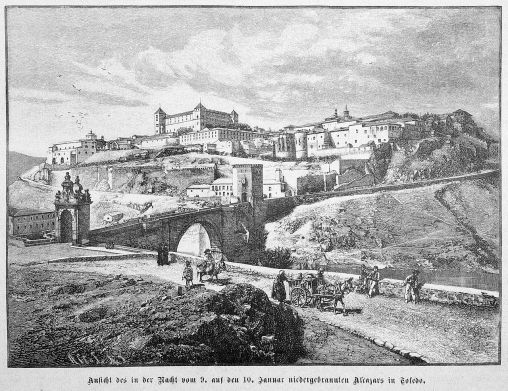
1280px-die_gartenlaube_1887_b_085

Sketch of the Alcázar above Toledo in 1887

The Alcázar of Toledo was beautifully constructed fortress in the town which was strategically placed on a small hill by a river. First used by the Romans in 59BC, the location ruled over the plains during Roman, Visigoth and Moorish rule. The town was home to Christian, Muslim and Jewish communities living together through the centuries in relative peace. But in 1085 the city fell under Christian rule and the slow decline of the harmony commenced. By 1520, the Alcázar, a palace fortress, was built on the top of the hilltop town by the royal family, and stood until the destruction during the Spanish Civil War in 1936.

The war started on July 17, 1936 when Franco took over the army in Spanish Morocco and staged an uprising. By the morning of the 18th, strict, religious army leader José Moscardó e Ituarte, the military governor of the area, took control of the Guardia Civil police, and decided to lead and control the hilltop town. Toledo had an arms factory, and the Republican government and its followers battled for days to get their hands on the weapons and gain control of their home. Colonel Moscardo was able to fend off the Republicans with his men, and moves were made for Republican reinforcements from Madrid to arrive. By July 20, killings were already occurring on the streets, with both sides attacking and wounding one another, as in all towns and cities in Spain.

t3_3062tq

The grotesque habit of Republicans digging up clergy to show everyone their mortality in Toledo, like everywhere in Spain

Colonel Moscardo had just 800 Guardia Civil officers, around 100 army officers, and the support of 200 right-wing public members. The Guardia Civil had plenty of ammunition to bring to the uprising, but between all these men they only had rifles, a couple of machine guns and a few grenades. Meanwhile, the Republicans in Madrid sent in 8,000 militia men, left-wing supporters banded into groups to save their country, mostly anarchists and workers’ union members. The air force had also sided with the Republicans and were able to fly over Toledo for surveillance and bombing.

Between the call to rise up and claim the city by the rebels on July 17 and the following four days, the Republicans managed to hold off the right-wingers, with only one man arrested as a Republican activist. However, between 100-200 people were taken hostage by the Nationalists, and they including the town’s governor and his family. The hostages and Nationalist families, those belonging to the Guardia Civil men, were put inside the city Alcázar to be safe from the Republicans. This started a siege, with Nationalists trapped in the Alcázar and the Republicans keen to take back their town.
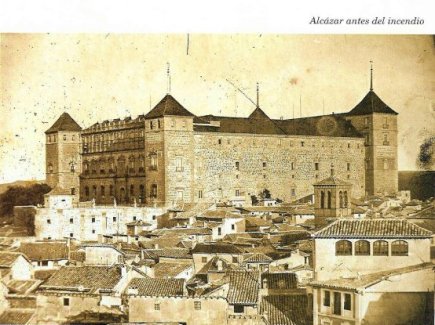
The Alcázar prior to the siege

By July 22, the Republican surge meant the town was in their hands, with the exception of the great Alcázar, which was under bombardment from the air. On July 23, Colonel Moscardo, inside the Alcazar, got a phone call from the Republican leader, Commissar Cabello. They had taken Moscardo’s son hostage, age just 16, and threatened execution. Moscardo told his son to die as a patriot, which young Luis agreed to do. However the Republicans did not yet have the heart to shoot the boy.

For the next three weeks, the Nationalists stayed safe in the Alcázar as the Republicans continued to attack. The insiders only fought when militia fired at the building, or planes dropped bombs from above. Constant bombardment to the strong Alcázar began to weaken the northern side of the fortress. But the constant back and forth of fire, bombs and grenades, meant no one could get close enough to the Alcázar to get inside, not even to the buildings surrounding the building, all of which were still under Nationalist control and huddled together for safety. Sometime in mid-August, Moscardo’s 16-year-old son was shot and killed as the Republican frustrations mounted. Likewise, the hostages inside the Alcázar met an ugly end.

Republicans try to get close to the Alcázar

However, by early September, the northern side of the Alcázar was in collapse, and the Republicans decided to change tactics. In a momentary downing of weapons on September 9, Major Vicente Rojo Lluch, an army man who decided to fight for the Republicans rather than with the army, went to the Alcázar to speak to Colonel Moscardo. Rojo offered Moscardo the chance to surrender and leave the Alcázar but it was refused. Moscardo requested a priest be sent to the Alcázar, as two babies had been born inside the besieged fortress and needed to be baptised. Despite being anti-religion, the Republicans allowed this request.
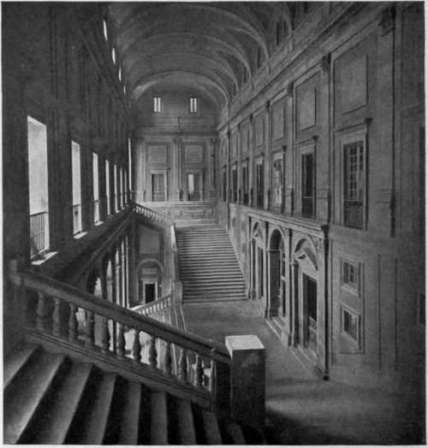
Inside the Alcázar before the bombing

As the priests of Toledo had been killed or fled the town at the outbreak of war, a preacher from Madrid arrive on September 11 and entered the Alcázar to baptise newborns and offer spiritual guidance to the 1000 strong right-wingers, including final absolution in case of death. Again Rojo offered a surrender, but no one would leave the Alcázar; they would rather die than give up. In retaliation, Republicans fired and threw grenades at the Alcázar, destroying all communications with the insiders.

The Chilean ambassador to Spain wanted to help with the negotiations for surrender, but the grenade launch had wiped out all the phones, and at this stage, surrender was no longer an option for the Nationalists.
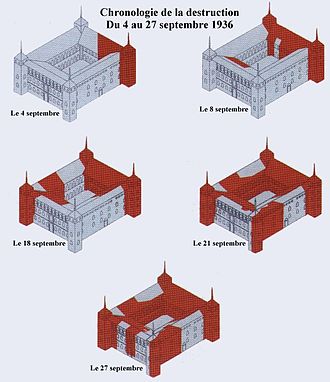
 .

All the while air and ground fire had been sent back and forth, Republicans had been digging tunnels to come up right underneath the Alcázar. By September 18, after a month of digging, the two tunnels were complete and under the southwest tower of the Alcázar. Soon-to-be appointed Spanish prime minister, Francisco Largo Caballero, went into the mines and detonated a huge supply of explosives, which flattened much of the tower. As the dust settled and panic reigned, the Republicans stormed the Alcázar with tanks and armoured cars. Still, they could not get inside the mighty fortress, and constant firing went on for days.

qa7kf

Explosions destroy the exterior

By September 22, all those inside were in the interior courtyard of the Alcázar, and most of the garrison has also left their posts on the exterior of the building for their own safety. Another two days of fighting made no progress for either side.

Just as the siege looked as if it would end with the slaughter of the Nationalists, reinforcements finally arrived in the city.  On September 27, the Republicans, desperate to get inside, had no choice but to abandon their cause and flee to Aranjuez, 44 kilometres north of Toledo. This large withdrawal left few attacking the Alcázar, as they knew of the danger about to arrive.
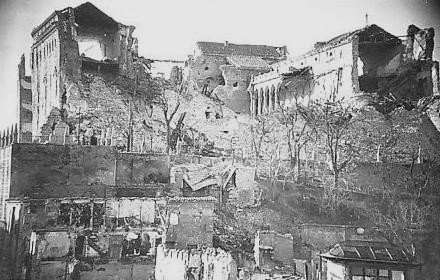
The Alcázar is destroyed into a mess

Nationalist soldiers, consisting of Spanish Legionnaires and Moroccan troops (the Moros), had been marching north from Seville, massacring everyone in their path, their reputations already bloody and horrific. On September 27, all it took was the first 100 soldiers to enter the city and kill everyone still holding out. They also murdered the doctors, nurses and patients in the hospital, all Republicans and their supporters. All those inside the Alcázar were released, only five dead, of natural causes.

For all the killing and the destruction of the nearly 500-year-old Alcázar, Toledo as a location had no strategic value. But the determination of the Nationalists was used a propaganda for those fighting in other areas, and the media took a huge interest in the battle. The arms factory, which was raided early in the war, was the only important location in the area, and was now worthless. The weapons and supplies dropped to help the trapped Nationalists could have been better used in other areas, and even Franco’s advisors were upset Franco even bothered to ‘save’ Toledo at all, when Madrid 55 kilometres north was more important.

Interior of the building after ‘liberation’

Those who escaped after being inside the Alcázar were treated as heroes and used as morale boosters. Much had been made of the Republicans’ mine explosion, with media flocking to see the event. But when the Republicans were forced to flee a week alter, and Franco claimed the town, the Republicans plan to show the world their strength instead showed their terrible loss.
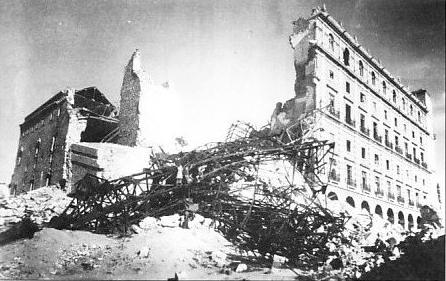
Final destruction

As soon as Moscardo and the others left the Alcázar, the soldiers immediately left Toledo destroyed physically and emotionally, and continued their march north to try to take Madrid. The initial stand-off and attacks on Toledo were all for nothing.
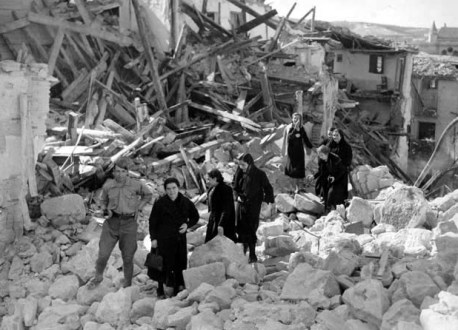
Survivors have to live among their ruined town

The restoration of the Alcázar didn’t begin until well after the war ending in 1939, and today houses the  Biblioteca Autonómica (Castilla-La Mancha Regional Library) the and   Museo del Ejército (Museum of the Army).

The Alcázar today

~~

This is not a detailed analysis, just highlights (lowlights?) of the siege. Feel free to suggest an addition/clarification/correction below. All photos are linked to source for credit.
This Week in Spanish Civil War History – Week 11: 26 September – 2 October 1936

Week 11: 26 September – 2 October 1936

September 26

The Generalitat de Catalunya (government of Catalonia, based out of the capital of Barcelona) increases in size to incorporate more factions fighting for the Republican case. The anarchist CNT-FAI (workers unions) sends ministers, along with the communist POUM (Marxist workers group).

September 27

After a siege lasting over two months, Toledo is finally won by the Nationalists. The Legionnaires and Moroccan soldiers (Moros, as they are nicknamed) who have been murdering their way north, reach the city, and 100 men take Toledo, ending the siege on the Alcázar. A group of anarchists set fire to their own buildings and are burned alive so they are not captured and executed. The invading soldiers take the hospital, killing doctors and nurses, as well as the patients. All the Republican hostages that were taken at the start of the siege by Nationalist leader Colonel Moscardo are already found to have been long killed, and all Republicans are either killed or flee the area.

A full ‘This Week In Spanish Civil War History: Extra’ will be published on September 27

9ecc65b2305c11fdfe46f7febc7c831f

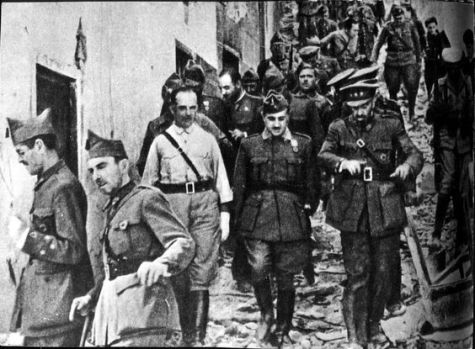
Generals Verela, Franco and Moscardo in Toledo after the rebels capture the city

Also…

The Non-intervention Committee is doing a stellar job of not doing nothing to help Spaniards, and doesn’t bother to argue with Portugal over their continued support for the Nationalists. Germany and Italy are also sending weapons and equipment in defiance of the Non-Intervention agreement and the committee doesn’t lift a finger.

September 28

Generalissimo Francisco Franco is named head of the Spanish State by the Junta de Defensa Nacional (Nationalist militarised government) in Burgos, even though Spain has a Prime Minister and government still functioning in Madrid.

39315

Franco: A small man with a heinous attitude and a penchant for massacre (and rumour has it, sporting mangled testicles)

September 29

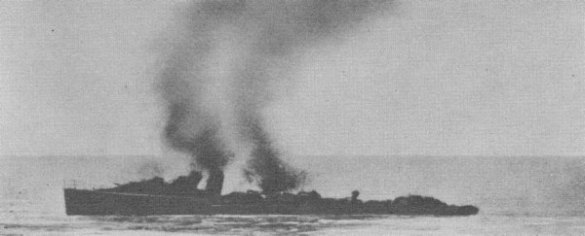
The Battle of Cape Spartel breaks out over control of the Strait of Gibraltar. The navy has been pro-Republican, but Nationalists have held the Galician naval base since the outbreak of war. A Republican ship is sunk and others badly damaged, and just one escapes the battle as the Nationalists also now control this crucial sea passage.

The Almirante Ferrándiz just prior to sinking in battle

September 30

Enrique Pla y Deniel, the Bishop of Salamanca, publishes his famous pastoral letter titled ‘The Two Cities’. He praises the decision of the rebel Nationalists to rise up and start the war. He defends the actions of the rebels and the need to destroy Republicans. He states the war is not a civil war, but a crusade to restore order and crush the ‘heretics’ in government. He also issues a pastoral latter claiming Franco as Spain’s leader, and sends him a telegram to congratulate him for the ‘glorious resurrection of Christian Spain’.

Enrique Pla y Deniel – a bishop with a small mind and a heart filled with hate and control, Catholic style

October 1

The Brigadas Internacionales (International Brigades) are officially formed. It gives a name and organisation to work with the foreign volunteers flocking to Spain to help out. People from 53 nations want to give their help to the Republican cause against the rebels. The group will swell to up to 35,000 fighters, plus 10,000 non-combat roles and up to 5,000 foreign CNT or POUM members. These brave individuals are true heroes, risking their lives for strangers in a strange land, thinking they can save the world from fascism while governments sit idle.

The famous International Brigades become official

Also…

Francisco Franco officially declares himself the Generalissimo in public, and settles into life as the controller of a country out of control. This formally gives him power over the entire Nationalist cause.

And…

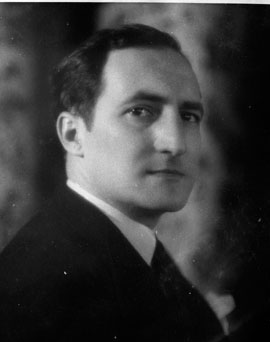
The Republican government gives the Basque Country full autonomy, and Jose Antonio Aguirre is elected as leader of Euzkadi a week later. The Basque country is getting little support or outside help, surrounded, and already partly invaded, by the rebels. Autonomy gives them more control over their moves and their own army as they fight to control their region.

Jose Antonio Aguirre – politician, activist, leader

~~

This is not a detailed analysis, just a highlight (lowlight?) of the week’s events. Feel free to suggest an addition/clarification/correction below. All photos are linked to source for credit

The Beginners Guide to the 40th Anniversary of Franco’s Death – ‘History’ Remains Fluid

El Caudillo. The Generalissimo. Supreme patriotic military hero by the Grace of God. Whatever you want to call him, Franco was a short man with a penchant for moustaches and murder. When people think of dictators, they think of Franco’s mate Hitler, or more current dictators such as Mugabe or the North Koreans with bad haircuts. Some would say Franco was a coward in comparison, or more moderate. If you turn from the word dictator and instead to fascism, the dictionary will give you Franco as a definition. Call Franco whatever you like, but November 20 is the day to celebrate his slow and painful death. The day in 1975 when cava and champagne bottles were popping faster than overheated popcorn. That day, Spaniards, at home and in exile, could finally shake off their not-so wonderful leader.

Born in December 1892 in Galicia, Francisco Paulino Hermenegildo Teódulo Franco Bahamonde was one in a long line of relatives in the navy. But instead Franco chose the army in 1907, and worked his way through the ranks through wars in Morocco, and was shot in the stomach in 1916, and lost a testicle (it is rumoured). He continued fighting and winning medals, and by the mid-twenties, he was ranked high enough to be before the King in Madrid. The royal family got run out of the country when the Second Spanish Republic took hold in 1931, but it wasn’t until Franco’s cozy position at the army academy in Zaragoza being extinguished did Franco start getting angry. Posted to the Balearic Islands for a few years, Franco got a taste of killing his own people during the miner’s strike in Asturias in 1934. He crushed innocents defending their rights, and the left and right side of politics only continued to divide as bitterness set into the young Republic. After the 1936 elections, all went to hell, and Franco found himself leading an army from Morocco into Spain to depose the Republican government.

Fast forward through three years of brutal civil war though 1936-1939 (if I explain that in detail, we will be here forever), and Franco’s Nationalist army, backed by fascists, Carlists, monarchists, any right-wing nutball group really, had defeated the Republicans, with the communists, anarchists and general plucky young men and women from Spain and overseas fighting for freedom. After gross atrocities, upwards of 200,000 people were killed. Franco was the leader of Spain, a nation decimated by force and hate. The short, moustached, one-testicled Hitler lover was in control.

Spain was no picnic. So many fled the country, many to France, Mexico, Cuba, Argentina… basically anywhere but Spain. Artists, teachers, bright minds, and those of the left-wing all ran for their lives. Spain skipped the Second World War after basically being in pieces, claiming neutrality, though Franco loved Hitler’s style of hating. While Franco was claiming that Spain had struck gold and all would be well, 200,000 people starved to death in the first half of the 1940’s. The whole decade was spent rounding up people who had supported the Republican side of the civil war, and up to 50,000 were killed, or put in concentration camps, or just ‘disappeared’.

Franco was brutal and bizarre. He could be easily played with wild schemes. But his own plan, being anti-Communist, won him love from the United States. They were allowed to set up military bases, Spain got money and their love for Hitler, Mussolini, etc was swept under the carpet. Spain and its technocrats were keen to move on and make Spain wealthy and prosperous again, though naturally, all spoils only went to the people at the top of the food chain. Spain’s Años de Desarrollo, years of development began through 1961-1973, with Franco promoting tourism, bullfighting, flamenco, everything super-Spanish. Financially, things got much better, but since everyone was doing so poorly, ‘much better’ still wasn’t great. Many Spaniards were still living overseas. Riots broke out at universities, women were still horribly oppressed, with divorce, abortions and birth control illegal. They couldn’t have bank accounts without male oversight, and couldn’t even leave a violent husband, real middle-ages style of living. The church was sticking its evil nose into everything, being gay was illegal, local languages were banned, and nuns loved hitting kids in schools and orphanages.

By 1969, Franco was getting old and handing more power to the lecherous bastards who profited from his reign. It was time to choose an heir. Franco had one daughter (though that has been questioned, given the testicle incident, but never mind), and Franco chose Juan Carlos de Bourbon, grandson to the Spanish King exiled to France in 1931. The young man, dutifully married to a Greek princess, would be modelled and educated in the ways of Francoism – basically being a murderous douche.

Even as Franco was getting super old in the 1970’s, he was still being real bastard, handing down executions just months before his death. Young people were rising up, wanting change in their country, and groups such as ETA wanted their regions’ independence back, as did Catalonia, Galicia, Valencia – basically everyone. In the final months of Franco’s reign, countries were having protests against his execution decisions, Mexico tried to have Spain kicked from the UN, and the Pope wasn’t interested in him anymore, which isn’t cool for a Catholic nation. But on October 1st, Franco have a hate speech from his palace and left in tears. From that moment, his number was up.

Pneumonia, heart attacks and then internal bleeding took hold. Machines kept the old man alive and drugged. Doctors worked day and night for the man who let people be shot by firing squads or starve to death. But after 35 days of pumping life into a frail old man, on November 20, 1975, Franco finally passed away.

The parties started, in Spain and all around the world, where Spaniards had waited for the day. Half a million people went to see his body, just to see the proof for themselves (this figure remains disputed, like all figures during Spain’s 20th century). Spain, which had been lying dormant, could live again. The protege, Juan Carlos, was crowned King, and tossed Francoism aside, opting for democracy. None of that was an easy ride as the road to the Transition began.

The trouble is, those killed during and after the war are still buried in their makeshift graves. Those lecherous wannabes who circled Franco did not lose their place in politics, and among the wealthy and elite. Those who were evil were all given amnesty, to smooth the road for democracy. Justice was never served; Spain’s hard questions remained unanswered for so many. Those who did wrong have grown old, as those who were harmed. The varying levels of independence of Spain’s 17 regions still causes headaches. Does Spain still need to ask questions of its past, or is the future hard enough?

Either way, pop a cork off champagne today, at least to celebrate the freedom Spaniards would have felt on 20 November, 1975.

Read more of what has changed in Spain since Franco’s death, and what is to come – Spaniards aim for a new democracy and end to Franco’s long shadow

Read more about Valle de los Caídos, Franco’s super creepy tomb, where monks will be praying for him today (yes, that’s a thing!)

Read more about Franco’s war, reign, and death in the Secrets of Spain  novel trilogy

Comments on this article are now closed.

SPAIN BOOK REVIEW: A Englishman in Madrid by Eduardo Mendoza

An Englishman in Madrid

Anthony Whitelands, an English art historian, is invited to Madrid to value an aristocrat’s collection. At a welcome lunch he encounters José Antonio Primo de Rivera, founder and leader of the Falange, a nationalist party whose antics are bringing the country ever closer to civil war.

The paintings turn out to be worthless, but before Whitelands can leave for London the duque’s daughter Paquita reveals a secret and genuine treasure, held for years in the cellars of her ancestral home. Afraid that the duque will cash in his wealth to finance the Falange, the Spanish authorities resolve to keep a close eye on the Englishman, who is also being watched by his own embassy.

As Whitelands – ever the fool for a pretty face – vies with Primo de Rivera for Paquita’s affections, he learns of a final interested party: Madrid is crawling with Soviet spies, and Moscow will stop at nothing to secure the hidden prize.

~~

An Englishman in Madrid has been in my reading pile since it was released two years ago. When I posted on Twitter last week about starting to read, I expected (at least those interested in Spain) to scoff that I was last to read it. But it seems not. Perhaps they had the same hesitations that I did – an ageing academic goes abroad and bound to have an unlikely affair with some girl a third of his age. We’ve read that before, more times than we care to remember. Was this book the same? Actually, it was combo I have never read before.

Anthony Whitelands, the ‘hero’ of the story, is fresh from Cambridge university, an art nerd of undetermined age, but with the usual male middle-aged thoughts of life and his career. An ex-wife in the distance, Anthony is busy dispatching with his married lover, Catherine. Perhaps she has made a lucky escape. From the beginning, the police are tracking him, only he is too thick to notice.

Anthony is an art specialist, who loves to compare literally anything – paintings, conversations, people, probably shrubs, to Velazquez (who was a painter in Spain in the 1600’s, if painting isn’t your thing). Anthony is no stranger to Madrid, but in the spring of 1936, shiz is going down all over the place, the prelude to the civil war, which broke out in July that same year. Our hapless character knows all is not well as soon as he arrives, but he is fairly dim, so it takes him a long time to figure out the realities of wandering into an-almost war zone.

The book covers everything, from toffs of the upper class, to the poverty of the times and the social and political realities everyone is facing. The prelude to war is described brilliantly by an author who has taken the time to get things right. Between protests, street killings and strikes, Spain is preparing for implosion and bumbling Anthony has wandered into the eye of the storm.

Our self-confessed art genius finds himself at the beck and call of the Duke of La Igualada, who wants to offload his Spanish art collection, to pay to get his family out of Spain. Selling off the family silver (literal and proverbial) isn’t something particularly legal, but the Duke is a chatty dude, and has Anthony dancing to his tune soon enough. If Anthony’s description is ever written, I have already forgotten it. But he must have been one hell of a looker, because the Duke’s teenage daughters are taken with him in a heartbeat, ready to profess their love before dinner’s first course is even served. Anthony wouldn’t win them over with charm, let’s just say. As an author, I realise how convenient ‘love at first sight’ is for moving a story along, but this group is a crazy set-up, with minimal interactions, yet pounding hearts (real or imagined, anyway). Between the charming Duke, his dim-witted duchess (sticking to stereotype here), the two daughters and the up-and-coming wannabe fascist son, and heir to the money, Anthony accidentally walks into the history books.

The Duke’s paintings are duds, and also a cover-up. Because Paquita, the eldest daughter (with wandering thoughts and as cold as a fish) lures Anthony to see the real treasure – an undiscovered Velazquez in the basement of the palace. Anthony sees his name in lights with the discovery, but knows he simply can’t steal a 300-year-old treasure. He is so blinded by the thought of fame and his never-that-apparent love for the girl he met five minutes ago, Anthony makes mistake after mistake.

The author of this book moves the story on Spain-time, but no matter what others think, this book blows away many similar books written by British authors. I would take on stories with this buffoon-style protagonist before many I’ve read before him. The author wanders into chit-chat about Velazquez so often he is almost holding an art class, and I admit to skipping pages because of it. This is not a criticism, because I admire the author’s research. When it comes to the realities of Spain, Madrid in particular, in that dangerous spring of 1936, the quality is excellent. It can’t be faulted. It is this setting that kept me going.

I like to think I’ve eaten pretty much anything Spain can throw at a stomach, but Anthony, our so-called gent, has weird things like beer and squid in the morning. Um, eww, bit early, my gentleman colleague. He is ethically clueless at times, like giving his passport and wallet to a stranger, who took him to an underage prostitute, whom he bones at her mother’s place. WTH, Anthony? You have no class sometimes. He parties with the hooker and her family, he parties with the Duke (snore-fest), his daughters, and also José Antonio Primo de Rivera, leader of the Falange fascist party, who will eventually align with Franco and be with the rebels (read: baddies of the civil war). The Duke won’t let all-talk, no-action José Antonio marry Paquita, but she loves him while dancing around Anthony (maybe, she doesn’t know herself half the time). She has as little sense as everyone else. Don’t get me started on the little sister, Lilí.

Running with the fascists, the elite, the working class, the police, and hanging with the Prime Minister himself, and pretty much everyone in the mess called Madrid, Anthony nearly gets his head blown off, sees others suffer the fate, and generally can’t figure out who the Communist Russian spy trying to kill him really is. But all because he wants to the art historian who found a Velazquez, he finds himself vying for an item that could invoke an entire civil war.

This book is part art history, part Madrid history teller, part war correspondent, all laced with fictional and not-so fictional characters who make you shake your head (or hope they get theirs blown off). I love the author’s use to detail to set the scene for war, and his use of French-farce type characters lost in world completely screwed in a mess of its own making, makes for something better than the usual old academic/hero and young duchess/whore/idiot that graces these types of books. Sometimes you want Anthony to escape, sometimes you wish someone would just pull the trigger. Will the end satisfy you? Is this book a thriller, a history lesson, or a comedy? The whole lot. Definitely recommended.

‘Death in the Valencian Dust’ Author Q+A

CLICK HERE TO BUY IN PAPERBACK AND ON KINDLE

Death in the Valencian Dust

Is this it! The final book in the Secrets of Spain trilogy. When I first came up with the idea of Luna Montgomery in October 2009, I really had no idea what would happen. I mucked about with the character for a while, and took a break from her to create Canna Medici, who was ready to be published. But Luna Montgomery and her search for her grandfather in Spain was the very first fiction idea I ever had. Blood in the Valencian Soil (BITVS) was created throughout 2012, released in November that year. Vengeance in the Valencian Water (VITVW) was more of a revelation – I had never intended to write more than one book on Luna, but Valencia’s history deserved more. But Death in the Valencian Dust made its way into my mind and heart before VITVW was even finished.

So, here we are, with the Q+A for this book. I again have lumped together similar questions to cover as many as possible. I will try to avoid as many spoilers as possible. Let’s start in an easy place –

 What is Death in the Valencian Dust (DITVD) all about?

DITVD is unique in the series in that it doesn’t start where the last book left off. BITVS and VITVW were a continuation of one another, but DITVD jumps forward four years to 2014, to give an insight to the lives of Luna Montgomery and Cayetano Beltrán. As the book shows the reader early on, the four years after the events in the last book have been huge for the new Beltrán family, with births, deaths and marriages. But family aside, Spain has changed, even for the wealthy Beltráns. Cayetano is now in his mid-40’s and his bullfighting career is coming to its natural end, much to his reluctance. His whole life is about to change, and those around him are already adjusting to a world where Cayetano Beltrán Morales isn’t having his name cheered by the crowds, or the tabloids following him around Spain. Luna has had her own ambitions pinned back to support Cayetano, but it is not a situation that can continue; Luna is not cut-out for the celebrity Madrileño wife lifestyle. One of the series’ more popular characters, Paco, has been through a huge transition in the four years since we last saw him, and time is running out to solve the mysteries of his family, Luna’s family, and the bodies Luna dug up at Escondrijo.

The alternative storyline is 1975, and Spain’s dictator Franco is close to death. In September that year, eleven men and women are up for execution, and Spain is a real mess, with draconian crackdowns on basic freedoms over the whole populace. Jaime Morales, Cayetano’s uncle, is about to have his perfect life come crashing down when he meets Alzane Mariñelarena, a young woman living in Valencia, where Paco is bullfighting. A chance meeting leads to a difficult friendship which awakens ugly truths, and no one really wants the answers to what Jaime and Alazne learn. Jaime is a sword handler, working for Paco on the bullfighting circuit, and living at Rebelión, a millionaire lifestyle. Alazne is a bastard child and dirt poor. Yet when the reality of Spain’s new laws, and Jaime’s father past, come together, Jaime and Alazne can run together, or die alone.

DITVD is a satisfying conclusion to the story of the Montgomery-Ortega-Beltrán-Morales family history. With luck, readers will have all the answers to the family saga from 1939 until 2015. Every character gets their day in the sun. Cayetano makes huge changes, and Luna needs to decide if she can stand as the leader of the entire family. Luna holds the secrets and fates of everyone in her hands, and has to live the burden, while still trying to live her own life.

Okay, that was really hard to explain. Sorry if I sound vague, but I don’t want to post spoilers!

Where does the book travel in Spain?

Again, Valencia city and Escondrijo in the Valencian mountains, plus Madrid and La Moraleja, the celebrity suburb outside the city. Rebelión, the Morales bull-breeding farm, which is about 50km east of Madrid, gets a lot of story time again. Plus the Beltrán family homes in Cuenca provide another backdrop. There are many other places visited and mentioned – Seville, Hoy de Manzanares and Mallorca all receive bullfights as Cayetano travels the country. Honestly, it is exhausting keeping up with a bullfighter’s schedule!

Why do you write about some as disgusting with bullfighting? Why do you condone cruelty to animals? Why do you promote animal cruelty? How can you justify being a fan of bullfighting? etc,etc,etc…

I have answered this before, and will provide the same answer again…

I have heard it all. I have three things that attract internet trolls – bullfighting, supporting cycling (in NZ) and being a feminist. Bullfighting tends to bring out the animal in people themselves. I have been told I am vile, I am cruel, I don’t deserve to be a parent, I am disgusting, my family deserves to be hurt… the list goes on. Are all these people interesting in the way their meat was raised and processed? Bulls raised on ganaderías and sent to bull fights are treated like kings. Quality healthcare, exercise regimes, carefully controlled diets… none of those things are taken into consideration for the chicken or pork in your fridge. Yes, bulls are taunted and exhausted in the ring, surrounded by the real beast of bullfighting – the crowd – who hungers for the animal to die. Is that degrading? Yes – that is without question. Do I feel sorry for the bulls while they stand disoriented and weakened as they get stabbed to death? Absolutely! The combination of watching the animal die, combined with sitting beside people who love to watch the event is not a nice feeling at all. Am I trying to promote bullfighting? I’m not sure if that is even possible – people can make up their minds about the corrida long before they get there. Many argue on the side of tradition, and I can identify with that. Bullfighting is more than killing an animal. The toreros are fascinating men and their dance with death is something I could write about forever. They are brave, proud and skilled. They have a talent that is frowned upon in the modern age, and stand in the ring to cheat death of its right to claim them, and are both reviled and revered every time they do so. (Numbers of men wanting to be toreros is up, not down as expected). I have great respect for these men, but I have no desire to promote cruelty to animals. I don’t plan on opening minds to both sides of the argument – many minds cannot be opened. The bull is the orchestra, the torero is the conductor. The crowd chants for a kill. I don’t write to glamourise the event – in fact, if you read, you’ll find the books regularly grapple with the subject, and show there is more to a torero than his sword.

Are there new characters added to the series?

All the major characters were seen in the previous books, with their histories opened wider this time. While they may seem new, they have all already been introduced to readers. There are a few minor characters which come and go, but most link to previous encounters.

What did you research for the book? How accurate is the storyline? Are the characters based on real people?

I stress that the characters are fictional, which is true. I have had inspiration from real-life people but I model the characters on no one. The storyline follows real-life events, especially the 1975 storyline. Both BITVS and VITVW both followed real-life, real-time events, and DITVD is exactly the same. The storyline and details of the 1975 executions are all totally accurate; I didn’t have to invent anything. I studied the last weeks and months of Franco’s life, his movements, even his exact words used. The timeline is all accurate; the characters are living in the history I studied. The laws which govern the characters in both 1975 and 2014 are all real, I don’t need to make up anything, Spain provides all the craziness on its own.

I knew much about the last years of the Franco reign, leading up to the dictator’s death. But I dug further and had the whole story mapped out in weeks. I studied the September 26 executions, the who’s, when’s, where’s, and why Franco acted the way he did. I also studied the actions of  (then) Prince Juan Carlos, and also the reactions to the economic and social state of the nation in those final months of 1975. I tried to get as much detail as possible on the death of Franco, his funeral and the coronation of Juan Carlos, which wasn’t hard to come by. All these things are real, with fictional characters reacting to what was real life.

The 2014 storyline is more a world of the character’s making. Cayetano’s sister is on the rise politically, and what she does is a representation of several people in present day Spain. Also, the shaky future of the historical memory association, which Luna gains help from while digging up her family, is also based on truth. To see more abut the association, click on the link at the top of the right hand sidebar.

Was this book hard to write? Was it hard to let go of the series?

No and YES. DITVD wasn’t a hard book to write, because I always knew what would happen, who would live and who would die. I wrote 41 chapters in 43 days. As for finishing the series, while writing, I wasn’t sad to let the characters go, because I was happy with how it ended (more or less). But while editing, it started to hit me that characters I have lived with for years were about to embark on their own lives without me, and it does make me sad. I will never write Luna Montgomery again. I can only hope I have given her a good life. The woman can take anything I can throw at her.

(Potential spoiler alert ) Has Luna recovered from her injuries?

Luna has recovered as much as she ever will. Both Cayetano and Darren hover around her, endlessly concerned. I think it would be unrealistic for Luna to make a full recovery.

Do people really dig up bodies of relatives from the civil war and dictatorship period in Spain?

Yes – look right here Association for the Recovery of Historical Memory for information, photos and ways to support the association.

Why write about Spain?

Give me another country where a family can survive –  civil war, then years of starvation, a brutal dictator’s rule, inequality, home grown terrorists, bleak poverty, then the death of  dictator and new king, emergence of democracy without a war, blinding corruption and now a crippling recession – and all still be alive to tell the tale of the 75-80 years which has passed. Who can have members of a secret police force living happily, while their victims families have to live nearby in silence? Where the nation has endless centuries of strict traditions alongside a modern lifestyle? Add stunning landscapes, vibrant cities, incredible food, energetic people, quirky customs, plus a plethora of vastly different areas, languages and cultures within one nation. Give me all that somewhere else and I may consider writing about that country. (You can’t, Spain became my favourite place ten years ago).

Were there any hard parts to write in DITVD? Did you ever want to quit the series?

Quit the series? Nearly every day! I took an extended break between writing and editing this book, which got me over the finish line with great enthusiasm. Having time away from anything writing or Spain related gave me a real sense of urgency to get back to work when my other jobs died down (see Sorry, Readers, I Ran Away With The Circus). I always wanted the series finished, and finished well, and that is what I have done.

Are you sure the series is over? Will you miss your characters?

Yes, it is finished – for now, at least. Who knows, maybe I’ll revive Luna and Cayetano one day, but I have no immediate plans. I do have a few more books related to the series – stand-alone tales, one with Cayetano Ortega in the 30’s, one based with a young Paco Beltrán in the 40’s, and another one with José Morales in the early 60’s. These three books will have the characters everyone loves, but will be solely based in their respective time periods, and not involve Luna Montgomery in present day.

Why make Cayetano and Luna rich? Is that accurate of everyday Spanish life?

No, not at all, and I debated this at length. I could have made them struggle – and Luna didn’t live a fancy life to begin with, even though she wasn’t poor. I couldn’t resist making Cayetano rich and glamorous. It’s fun! Plus, the money of the family played a role in the storyline. Where Cayetano lives in La Moraleja is the best of the best – check out an example of life in La Moraleja here – Homes in La Moraleja. The home in Rebelión is a pure castle surrounded by bulls and olives. The wealth is part of the lifestyle fought for by the Beltráns.

Do you need to read BITVS and VITVW to understand this new book?

Yes and no. You could get by without them. The 1975 storyline has no relation to the previous books, so you would be fine. I make sure there is enough background in the 2014 storyline to make sure new readers are not lost, but regulars are not bored. I’m careful about that.

The book name suggests death. Should we be worried?

Of course, when did I ever write a book without a disaster or two?

Who is your favourite character of the series?

Eek – that’s tough. I would have to pick Paco Beltrán. That man has seen it all. Paco has an old-world charm about him.

Do you have characters which you hate to write?

No, I understand each of them and their motives. Sometimes I write things, like José explaining the need for rape in women’s prisons, and I hate the man, but he is who he is. I write his words, but they do not follow my personal beliefs. Villains gotta villain, you know?

Do we get a lot of sex in this book?

No, sorry. If you’re looking for sex, I have books with sex, but this one is light on that particular subject.

Is the series suitable for children?

No, no, no. I would say no younger than 16 and even then, depending on the young adult. Be careful with letting children read, the series has sex, and violence, and general grisly behaviour you don’t want children to see. VITVW is high on violence, death and even rape. BITVS has sex but isn’t particularly vicious. DITVD is the least adult of the three, but still, check the books to see if they are in line with what your young adults are ready to see.

What are you going to write now?

My next book is The Invisible Anarchist, based around the Spanish Civil War in Madrid, Barcelona, Valencia and Teruel. I don’t have a release date yet, but the book is already underway. The book has 100% new characters.

Do you have a favourite book of the three in the Secrets of Spain series?

I don’t know if I could play favourites. I loved the story of Luna and her grandfather in BITVS; it was the entire foundation the series was built on, but my writing has vastly improved since the book was released. VITVW was a favourite; the research was meticulous on the subject of the Valencian flood and the church baby-stealing affairs. I’m proud of the work. DITVD tidies up all the loose ends while providing a new mystery as well. Each book plays its role well.

What is your favourite part of DITVD?

Near the end of the book, Cayetano has to make a speech and he talks about his father, Paco. That’s my favourite. It was so easy to write, since I know the characters so well, I can make them recall their childhoods with ease.

Any chance of a free book?

The most asked question! Yes, BITVS and VITVW will be free for four days starting May 7. Check your timezone (midnight PST, 7pm NZT, 9am Spain time) and go onto any Amazon site worldwide to download these two books for free!