This Week In Spanish Civil War History – Week 4: 8 -14 August 1936

Week 4: 8 – 14 August 1936

August 8

France closes its border with Spain, preventing weapons entering the country, but also cutting off escape for refugees fleeing the violence.

The island of Mallorca has been in rebel Nationalist hands since the outbreak of fighting. Menorca has remained Republican. The islands of Ibiza and Formentera have localised fighting and the Republicans regain control of both islands. They are one of the first places to change hands since the initial outbreak.
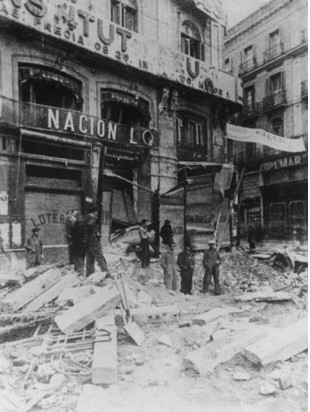
MUS-FAPC2020_500Mallorca damage from bombing

August 9

Church killings continue. Even prior to the outbreak of war, churches have been burned, possessions destroyed and priests and nuns murdered. Republicans are continuing their fight against church oppression, killing priests and nuns in all locations, especially in Catalonia, Valencia and Aragon. A Republican supporter dresses in the Archbishop of Toledo’s clothing for fun, and gets murdered by a drunk Republican soldier, who mistakes him for a priest.

(there are countless photos of church destruction, murder, and of priests/nuns corpses dug up for display available. I am not pro-religion, but I still do not wish to post them here)

August 10

The soldiers, which set off from Seville the previous week, take Merida with bloody killings. The Republicans quickly try to take the city back, but are again defeated. The soldiers are on their way to Madrid, but are meeting resistance. The major location of Badajoz now lies between the Nationalists and Madrid, and is currently in Republican hands.

201419war

Nationalists storm Merida

August 12

The Republicans set up checas, investigation commissions, to root out any right-wingers inside their strongholds. Many people suspected are given fake Falangist cards and shot, others denounced by their servants, enemies or debtors. Countless mistakes are made as old grudges we carried out and countless killed. The anarchists do not believe in these commissions and simply shoot enemies, real or perceived. Right-wingers are in hiding, dressed as workers, or hiding in embassies to avoid these killings.

August 14

The town of Badajoz, in the west near Portugal, is captured by marching Nationalists troops. The battle and occupation see 4,000 people killed. The invasion commanded by Juan Yague, unites two major Nationalists areas, increasing their dominance in battle. The battle of Badajoz becomes a representation of the Nationalist power and vicious murdering and raping of Spaniards, and the use of the Moors, the Moroccan troops, is highlighted in the cruel and inhuman attack. The  initial attack begins the intense killing in  the town over the coming weeks.
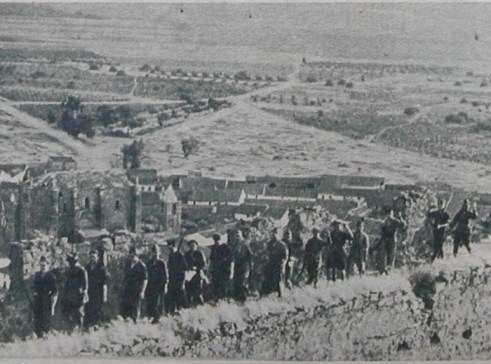
timthumb.php(there are many photos of the battle of Badajoz, many of bodies and executions, which I have chosen not to add here)

 NB -there will be a separate post to commemorate the battle of Badajoz

~~

This is not a detailed analysis, just a highlight (lowlight?) of the week’s events. Feel free to suggest an addition/clarification/correction below. All photos are linked to source for credit.

This Week In Spanish Civil War History – Week 3: 1 -7 August 1936

Week 3: 1 – 7 August 1936

August 1

France changes its mind and doesn’t want to support the Republicans, after being pressured by Britain, who don’t want to intervene in a war. The two governments, along with Italy, Portugal, Germany, and Russia, forge a Non-Intervention Committee and sign an agreement of non-intervention in the civil war. This will become a major error and huge turning point.

Spanish King Alfonso XIII, who has been in exile for five years, begs Mussolini for help and they send more planes and trained pilots to the Nationalist rebels, paid for by a Spanish billionaire known for illegal and dodgy deals. But two planes crash on their way to Morocco to collect troops, making the news, showing Italy has already broken their non-intervention plan. Still, other major countries sit on their hands and refuse to assist.

sa01-09-001The Non-Intervention agreement

August 2

Troops head out of Seville, having secured the city and made it their southern base, marching towards Madrid, over 550 kilometres away. The leaders plan to attack major areas like Badajoz, Toledo and Talavera along the way.

August 3

The shipment of refugee children is already underway, with children being sent to other European countries such and Belgium, France and Britain for their safety.

Nr:185498 9SP-1936-0-0-A1-35 Spanischer B¸rgerkrieg 1936-39. - Ankunft von Fl¸chtlingskindern aus Spanien auf dem Bahnhof von Gent (Belgien).- Foto, 1936. Photo: AKG Berlin Teutonenstr. 22 / D-14129 Berlin Tel. 030-803 40 54 / Fax 030-803 35 99 Bankverbindung Dresdner Bank Berlin BLZ 100 800 00 Konto 462732500 USt.Id DE 136 62841
Children leave for Belgium

August 4

As the war as broken down much authority, the collectivisation of Spain is strengthening, particularly in Catalonia and Aragon. Workers are grouping together and gaining control of land and businesses, mostly under the guidance of the CNT and FAI anarchist organisations. Worker control is being established, training and education is being given, state and church control is being eliminated, all while looking to defeat the rebels.

300px-Milicianas_em_1936_por_Gerda_TaroWomen start training in the militia outside Barcelona

August 6

North of Madrid in the Sierra de Guadarrama, Josep Sunyol i Garriga, the deputy of the Catalonian Republican left party and also the president of the Barcelona Football Club, is murdered by Nationalist troops. Sunyol is a politician, leader and journalist, having founded a left-wing newspaper in the 1920’s. He was captured during fighting and shot, and then dumped in a shallow unmarked grave (and wouldn’t be found for 60 years. This system of taking left-wing sympathisers, from battles or just their homes, murdering them without a word and dumping them in the wilderness is the start of what will result in 100,000 – 200,000 Spaniards ‘disappearing’, many still not found today).

indexJosep Sunyol

Francisco Franco makes his move, and leaves Morocco and flies to Seville, to be on the ground as his troops continue their bloody march towards Madrid, the start of severe killing through Spain’s south and west.

~~

This is not a detailed analysis, just a highlight (lowlight?) of the week’s events. Feel free to suggest an addition/clarification/correction below. All photos are linked to source for credit.