SPAIN BOOK REVIEW: ‘The New Spaniards’ by John Hooper

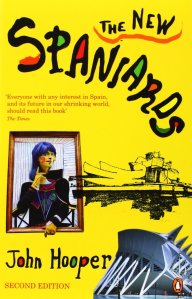
71treumJ37L._SL1355_

Modern-day Spain is a country changing at bewildering speed. In less than half a century, a predominantly rural society has been transformed into a mainly urban one. A dictatorship has become a democracy. A once-repressed society is being spoken of as a future ‘Sweden of the Mediterranean.’ John Hooper’s outstanding portrayal of the new Spanish society explores the causes behind these changes, from crime to education, gambling to changing sexual mores. This new, up-to-date edition is the essential guide to understanding twenty-first-century Spain: a land of paradox, progress, and social change.

~~~

The New Spaniards is a book which has sat on my to-read shelf for far too long. The second edition of this book got released in 2006, so by the time I pulled it from my shelf, I wondered if its information would be little irrelevant, given the changes to Spain in the past eight years. I could not have been more wrong.

So often mentioned in the same breath as Ghosts of Spain by Giles Tremlett, the book which pulled me from my slumber about Spanish history, The New Spaniards is a must read. The author brings together over 400 pages, creating a solid, credible and easy to read review of Franco and modern life. One chapter in, what immediately becomes clear is the efficient and clean writing style Hopper has; while other books on the subject can feel academic and stiff, the prose is fresh and makes the reader comfortable among a detailed and insightful presentation.

The book starts with a section of the Franco reign, from the years of hunger, the economic boom, the mass migration of Spaniards both abroad and within their own nation, and effects of the reforms made during the dictatorship. The 1970′s, once Franco had gone and democracy set in, is covered with excellent detail, without any confusion on what was undoubtably a dizzying time of change in so many ways. Then-young king Juan Carlos and Prime Minister Adolfo Suárez are well discussed, along with the placement of the young and the old to form a peaceful democracy. The changes made by the Socialist government in the 1980′s are well touched upon, their effect on the economy and the high unemployment rate (easy to identify with today), along with the stark changes in the 1990′s by successive governments.

Chapter 7 – Legacies, Memories and Phantoms – is an engrossing read, whether a reader understands Spain’s 20th century history or not. It explains how Francoism has not survived the passing of years, but a legacy has become ingrained in Spanish life. The pact of forgetting, which did not allow anyone to forgive or heal, is touched upon with honesty, as is Valle de los Caídos outside Madrid. Hooper’s accurate argument is that the omission of the civil war (and its mass graves) in school textbooks, because it is not old enough to be considered history, is an excuse wearing thin.

Part two sweeps in with a section on the churches’ role in Spain, along with the curious and absurd prudery of Franco and the changes to modern time, such with gay marriages. It makes an enlightening read for those less acquainted with subjects such as prostitution, abortion, contraception and gay rights in Spain. Another absorbing chapter is the death of machismo in Spain as women gain rights after being so deeply and cruelly oppressed under Franco. The fact Spanish women are still suffering sexism, like all nations, is also explained, with the all the relevant details to back up the claims. The role of family in Spanish life is given a thorough and honest portrayal, as are the changes in domestic violence and divorce laws which have changed the precious Spanish family for the better.

Part four sheds light on the autonomous regions of Spain, something not well understood by those not living in the country. The Basques, the Catalans and the Galicians are all opened up as Hooper shares their desire for self-governance, with all the information on the remarkably different laws and goals for their regions. (I wanted to wave the flag for the region of Valencia at this point, which has been trapped under their corrupt PP mayor for over 20 years). The book covers the how’s and why’s of the 17 autonomous regions of Spain, their individual paths to freedom, and what lies ahead for these proud places. I learned more about this process, despite having studied it in the past, a testament to the author’s respect for detail.

 This book covers so many subjects that it can dizzying when looking back over all that is covered – from Spanish gypsies, to the welfare system, to the ups and down of the education system, housing and the booms and busts suffered, to the legal system, the media, the arts, but Hooper guides readers through every subject with a smooth yet meticulous manner, opening up each of these fundamental subjects. For me, one of the final sections on changing traditions was especially fascinating. Bullfighting is covered in-depth with an unbiased yet accurate voice. I have read much about bullfighting, but it can be hard to find anything written that does not either lean heavily in favour or against the art form. Regardless of your opinions on the subject, any reader can gain from the information shared by the author.

While much as happened politically, socially and economically to Spain since this book was written, it still serves to provide a clean, realistic picture of Spain and why the nation sits in its current form. The book shows how the past has shaped the present, and can also show that what Spain is currently suffering is not unique. Each generation of Spaniard has seen suffering, but also moments of hope in the time since Franco died. If anyone wanted to learn from the past mistakes, the tips to succeed could well lie in the words of John Hooper.

This book got first published in 1986, rewritten in 1995 and revised in 2006, and could be easily overwhelming if it was not so well planned and laid out. I have yet to find a book that captures Spain’s identity as well as The New Spaniards. It should be handed out to each person who arrives in Spain and plans to make a life there.

My only gripe is that my paperback copy has a tiny font! While this has nothing to do with the quality of the author’s work, I had a headache the entire time. I can understand a publisher’s desire to make the text small, with so much to give to a reader, but it was difficult to read. Going to a Kindle version and sizing up the text is needed for everyone with delicate eyes.

SPAIN BOOK REVIEW: ‘Adventures of a Doctor’ by E. Martínez Alonso

Martínez

Adventures of a Doctor by Eduardo Martínez Alonso seems to be so rare, I can’t find any cover art or a blurb about this book. I managed to purchase a damaged copy from the New Zealand parliamentary library, and when they tossed this book to me for a mere $6 (about €3.60), they obviously didn’t know what a treasure they had. Eduardo Martínez is quite an extraordinary man with a story that seems to have been largely lost. With the market flooded with 1001 Spanish civil war books, it comes as a great surprise that this book doesn’t get more recognition.

The story starts with the author born in Vigo, Galicia in 1903. His father was from Uruguay, and was the consul in Vigo. As a young boy, Martínez travelled to his father’s homeland, along with his family (he was one of eleven children, and talks of his mother constantly having to nurse his siblings). The story tells of life in northern Spain in the era, and exploits with his brothers and attending a boarding school with mixed success. In 1912, Martínez’s father received a post to Glasgow, and the whole family moved north for a new life. Martínez dreamed of working in hotels or on ships, able to meet people and travel far and wide. He became bilingual at a young age, seeing the benefit of speaking Spanish, English, French and more. But it was his father who said he would be a doctor, not a sailor. As each of the eight boys grew and carved out professions (sisters, of course, were to be wives and caregivers), the prophecy of the hard-working consul came true. The family and Martínez recalls the first world war, his school years and an eventual trip back to Uruguay.

As a trained doctor, Martinez moved to Madrid with his grandmother, and speaks of seeing Anna Pavlova dance at Teatro Real, with the King and Queen in attendance.  He quickly took up a post at Red Cross Hospital, and met Queen Ena, British wife of King Alfonso XIII, and the Duchess of Lecera, who were delighted to have an English-speaking doctor. News travelled of an English-speaking doctor in favour with the queen, and Martínez was in hot demand. Just eighteen months later, Martinez graduated from San Carlos Medical Facility and while meeting the King and Queen socially and professionally, was appointed the medical adviser to the royal family. This proved to be an amazing and dangerous post.

When the Second Spanish Republic was founded in 1931, Martínez was in the palace in Madrid with the royal family as they were deposed. He tells of sitting casually with Queen and princesses as the monarchy fell. As the family were forced into exile and as Spain underwent revolution, Martínez’s position as a monarchist him an easy target. As civil war came five years later, things changed dramatically. Martínez got his family out of Spain in July 1936, or off to the safety of Vigo, and knew he would be in danger as a former royal family aide. Through his work for the Red Cross, he was ordered by a Communist faction to work as a doctor for the Republican side of the war.

On Saturday morning the shooting started. We sat in a bar and heard the crackling of machine guns, the burst of hand grenades, and I saw smoke arising from many quarters of Madrid. By Monday morning a general strike had been called. Everything was paralysed except murder, arson, and rape. The Spanish civil war had commenced – Pg 70

Martínez talks of watching a church burning as priceless works of art were set alight along with the riches of the churches of Madrid. He saw a priest thrown on the flames but was unable to save his life when he pulled the screaming body from the blaze. Most priests were taken out to Casa del Campo to be shot. Men were burning priests but trying to revive pigeons which fell from bell towers, overcome by smoke. Martínez had an apartment in Madrid, and he hid as many people  as he could throughout the war. Nuns and priest were hidden, and forced to serve meals to men who sat and spoke of vicious murders they had committed against the clergy.

Martínez was posted to a town outside Badajoz, Cabeza del Buey,  in the south-west, working for the Communists. While running the hospital, a young nurse, Guadalupe, suggested they flee and work for Franco’s troops instead, but Martínez seemed convinced that he would be killed at some stage, regardless of where he was posted, and claimed no political alliances. In Cabeza del Buey, he was forced to attend mass executions of seemingly innocent men, and despair at violent speeches about revolution and vengeance. He performed many surgeries and saved lives in the  most atrocious conditions. But with no warning, Martínez was shipped off, with Guadalupe, and sent to Ocaña, just outside Aranjuez, to work in the prison there, and be a prisoner himself. As he had in Cabeza del Buey, Martinez managed to get some nuns freed from prison to work as nurses, and treated patients while living in a cell himself. Between dire conditions and deadly activities, a patient told Martínez that his turn to be executed was near. An in understated manner, Martínez talked of his prison escape to Valencia in March 1937, were he managed to procure a fake passport and get aboard the Maine, a ship bound for Marseilles. 

Martínez quickly got himself back in Spain, despite the dangers. He chose to cross the lines and work for the ‘white’ side of Spain, Franco’s rebel army. Red Spain (the Republicans), he felt, thought nothing of him, his work, and long suspected their cause would lose the war, one they never had a chance to win. Posted to Burgos, Valladolid and then San Sebastien, Martínez  then found himself working on the front lines as Franco’s army continued to advance into enemy territory. Towns fell one by one as Martínez fought to save lives, but writes in such a  humble, unassuming manner. Once in Zaragoza, Martínez worked hard to care for patients at the hospitals, and pioneered the use of closed casts on wounds, a procedure first tried with less success twenty years earlier. Despite the smell offending wealthy female volunteers, Martínez’s experiment helped the lives of many patients otherwise in agony as they recovered. He was then moved on to his own mobile surgical unit in Teruel in 1938.

Martínez was there on the ground when troops stopped in Sarrión, 100kms north-west of Valencia, as the war finally came to its brutal end. On April 1st, 1939, the war was over and declared won by Franco in this small town, and after helping a man and his son to Valencia, Martínez sought out all those who had helped him during the war, and moved back to Madrid. No sooner than Martínez had helped his friends and former nurses, and begged for clemency for some condemned to death by the new regime, the second world war broke out. With some family in Vigo and some Britain, travelling on multiple passports, danger was again faced. As Hitler plowed through Europe, Madrid suffered greatly after the civil war and Martínez went to work at Miranda de Ebro, near Burgos, to help war refugees from all nations. With such a humble attitude, he glossed over his feat to aid refugees out of Spain, saving their lives, until in 1942, when his ferrying of innocents was discovered and he was forced to flee Spain. His time working with British Naval Attaché, Captain Alan Hillgarth is barely touched upon, but should surely serve as an incredible tale of a man saving lives at great risk to his own. This two-year period alone could serve as a story all of its own. Just his dramatic escape would serve as its own story, but the author covers it in a few sentences, and neglects to mention he fled with a new wife. He also failed to mention his first marriage which produced two children, but was annulled after Franco took power in 1939 (His wife was a British woman who went home without him). I only found about either marriage after studying the doctor further myself. There are no clues to whom these women are at any point in the book. His personal life is never touched upon.

Again, Martínez talks little of his involvement with the rest of the world war, after being detained when first arriving in Britain (no idea if his Spanish wife was also detained), but worked as a spy for Britain throughout and barely talks about it. He worked at Queen Mary Hospital after the war and oversaw great new procedural advances, meeting some of Europe’s finest surgeons, but then returned home to Madrid. Life was hard in the beleaguered nation, and he again went to work at Red Cross Hospital, specialising in chest surgery. He then moved on to working as the doctor for the Castellana Hilton, newly opened in 1953. He recounts stories of wealthy Americans, and famous movies stars (unnamed) alike, who came to Madrid for all sorts of reasons. He spoke with frustration at his patients demanding penicillin shots, not wanting to discuss why they need this medication. Many guests, male and female, had a penchant for sleeping around and wanting medicine to atone their sins, either before or just after the liaisons which bore infections. One guest talks of being raped and demanding penicillin, though the story is far from convincing to the doctor. Sexual liberation had come to the foreign guests at the Hilton, and expected Martínez’s penicillin to cover it up. He makes his disdain clear for these patients and the abuse of this groundbreaking medication, and of the myriad of alcoholics he was forced to attend to, when little could really be done for them.

The book is written in the manner of a doctor – no-nonsense, no fussing with detail, just the raw facts given out without prejudice. Martínez is a man with the story worthy of a Hollywood blockbuster, but it wouldn’t be his style. This book was written in 1961, and Martinez lived until 1972. It shows what really stood out to the doctor in his life, because details are excluded, and there are many secret operations he simply never wanted to discuss. He is free and easy with dates – because I know the civil war, I could piece together the timelines of the book, but needed to look up world war details and the opening of the Madrid Hilton, just to give myself an idea of how much time passed between chapters.

Martinez’s daughter, Patricia Martínez De Vicente, has written several books in Spanish about her father, notably La Clave Embassy: La Increíble Historia De Un Médico Español Que Salvó a Miles De Perseguidos Por El Nazismo. The stories not told by her father in his memoir are a whole other side to this man who worked tirelessly for others, and had a strong ability to do good, without any need to be recognised.  To read his book is a gift, and I will be also reading his daughter’s books.

*above photo taken just prior to release from the Spanish army, 1939. Photo supplied in the book (page 112)

Valencia Photos of the Month: Palacio Arzobispal and Calle Barchilla

In 1241, King Jaime set aside an area of land next to the old mosque (where the Valencia cathedral now lies) so the new Archbishop could build his residence. Completed in 1279, and in 1348, the bridge between the palace and the newly completed cathedral was built, passing over tiny but beautiful Calle Barchilla. The building served as the main palace for bishops until the late 1700’s when it underwent a massive renovation, though the chapel was kept in its mostly original state.

In July 1936, the large imposing palace was torched by Republican supporters during the outbreak of the civil war. Like most churches throughout Spain at this time, it was burned to the ground as the oppressed population revolted against its oppressors, with violent results. The palace burned for three days and was left in ruins as Valencia grew to be a Republican stronghold (and later capital city of the Spanish Republic). When the Republicans were defeated in 1939, a plan to rebuild the palace was born. Started in 1941 and finished in 1945, the completed new building was modelled on Sevillian designs. The archway to the cathedral was mostly unscathed and is still original , but the palace is all new after its interior and exterior was totally destroyed in the war attack.

The building has gone from an important symbol of the church, to a symbol of greed burned to the ground, and now sits unassuming behind the grand cathedral and basilica, giving away little secrets about its past.

Historical photos from Juan Antonio Soler Aces and present day by Caroline Angus Baker and Elena Cassals

SPAIN BOOK REVIEW: ‘Winter in Madrid’ by C J Sansom

Winter in Madrid

1940: The Spanish Civil War is over, and Madrid lies ruined, its people starving, while the Germans continue their relentless march through Europe. Britain now stands alone while General Franco considers whether to abandon neutrality and enter the war.

Into this uncertain world comes Harry Brett: a traumatised veteran of Dunkirk turned reluctant spy for the British Secret Service. Sent to gain the confidence of old schoolfriend Sandy Forsyth, now a shady Madrid businessman, Harry finds himself involved in a dangerous game – and surrounded by memories.

Meanwhile Sandy’s girlfriend, ex-Red Cross nurse Barbara Clare, is engaged on a secret mission of her own – to find her former lover Bernie Piper, a passionate Communist in the International Brigades, who vanished on the bloody battlefields of the Jarama.

A vivid and haunting depiction of wartime Spain, Winter in Madrid is an intimate and compelling tale which offers a remarkable sense of history unfolding, and the profound impact of impossible choices.

~~

I must confess that Winter in Madrid is ‘that’ book for me – the one everyone seems to rave about, but I never ended up reading. I got this book five years ago, but after the first two chapters, put it aside, finding its ‘rich British toff’ language to be tiring. Then my father ‘borrowed’ the book, and I only got it back 18 months ago when he passed away. Still, only now could I push on and finally read.

The first forty or so pages set up the story of Harry Brett, a British war veteran invalided out after Dunkirk. Harry is recruited to be a spy in Madrid, thanks to his Spanish fluency and his connections within a public school upbringing (often called private school in most countries. Rich bratty kids). With all of the snobbish upper class language of Downton Abbey, but with none of the poise, Harry is convinced to fly to Madrid in 1940 and spy on an old school mate, who is claiming to have found gold deposits outside Madrid. If Franco has gold, he will rely less on the frugal aid Britain provides, and will be compelled to ditch their neutrality in the Second World War. Hitler is winning, England is looking weary, and newly fascist Spain could be a threat.

That is where we meet the star of the show – Madrid, 1940. The only word to be used is stark in its portrayal, and rightly so. The author has done an unquestionable job in his research of the time. The lives of those in Madrid are intolerable, and the spirits of the proud people are well and truly starving and crushed by the fascist regime. Slightly annoyingly, the book jumps between time periods, of Harry’s days in his snobby school, 1931 where he and friend Bernie first go to Madrid, and the city is down-trodden but on the verge of change, and 1936, when the war starts, and the souls of the working class are surging with hope. I suppose the schoolyard sections are there to show the life of Harry, his interaction with best buddy Bernie, and that of Sandy Forsyth, the rich brat who had gone to bigger things under Franco. The jumps in time period fill in all the blanks, but it means the book leaps about more often than most stories.

Along the way, we meet Barbara Clare, former lover of Communist Bernie, who spurned his upper-crust lifestyle for new ideals, and was listed as missing presumed killed in Jarama 1937. Barbara fell head over heels but Bernie left her in Madrid to fight on the front lines. Three years on, Barbara has moved on to Sandy, who ‘made her’, as he says in the most rapist-like way when he’s angry. Barbara is difficult to love – she had the courage to be in Spain during the war with the Red Cross, but has been reduced to being a borderline alcoholic, chain-smoking rich housewife (without the ring). She sighs her way through concerts with Franco while wearing fur, while most are freezing. She laments on her misery while living in almost paradise-like surroundings while Madrid languishes with hunger. She can’t get over poor  Bernie, who was never a smart guy but had plenty of good intentions. I rather hoped lung cancer would kick in through all Barbara’s cigarettes and waif-like point-of-view.

Harry pushes on, spying on Sandy and Barbara, meeting many nasty characters under the Franco regime. He attends lavish parties hosted by wartime murderers, but walks the streets of the poor as he remembers Bernie. As the web begins to twist around the characters, Harry meets Sofia in the most unusual circumstances. Sofia has had a tough working class life and is the epitome of the locals in the area. Harry spends more time with her, and finally realises he is sleep-walking through life thanks to his rich, snobbish school education. As the push to uncover Sandy’s gold mine continues, Harry and Barbara each keep a variety of secrets which unthreads their fragile minds and pits their survival against evil characters.

Bernie’s point of view tells the story of a British communist stuck in a concentration camp outside the town of Cuenca, and the harsh conditions imposed. Many people fail to realise the existence of Spanish concentration camps under Franco, never photographed and dismantled completely after use. All these characters conspire against each other and those around them, resulting in a massive twist ending where not everyone survives and all the characters are left with blood on their hands.

I know Madrid well and know Cuenca like the back of my hand, and reading about the places in this time period genuinely interests me. If you know little about the Spanish civil war or the Franco regime, this book will give you a realistic insight. The locations and descriptions are exquisite, and the author’s work on detail and political alliances of the time is stunning. But the conversation, the wealthy British language can be hard to take, leaving the conversations feeling stiff and unfulfilled over endless glasses of whiskey. The book lets down its female characters – Barbara is a flake (maybe weighed down by too many bad Madrid coffees?) and Sofia doesn’t get the prime position she deserves. Harry, the main character of the story, is a nice enough guy, though his fate never concerned me. Sandy is a terrific passive aggressive scumbag and Bernie left me so furious that I threw the book down in anger at the end. Not many books have that effect on me!  But rest assured, you will find yourself reading all the way to the end to see what happens to Harry, Bernie, Barbara, Sofia and Sandy. Whether you hope they live, or die in a fire-ball, is up to you.

My rating – 4/5 stars. Madrid is a scene-stealer and a study of eternal struggle, but those inhabiting her are too weak to challenge her dominance.

PART 3: Vengeance in the Valencian Water Q+A

Click here to read Part 1 and Part 2

Here is the final part of the VITVW questions. I have put questions together to answer as many as possible. If yours was missed, let me know in the comments section.

11 ) Did you learn anything new about writing while working on Vengeance in the Valencian Water? Did you enjoy writing this book? Would you change anything about your books?

I learned plenty once again. My last novel release was only five months ago, but I feel like I learned so much about editing in that tiny space of time. I feel like the quality has stepped up another level. Because the time it took to write this book became a mess due to illness, I had to stay on task, and I learned I can write a lot of a short space of time if I make the effort. If I needed to have a chapter done start to finish in a couple of hours, I can do that. Doing 5000 words a day doesn’t feel like a big deal.

I have two individual book series and they are very different to each other, and flipping between the two wasn’t as hard as last time I swapped between them. I finished Violent Daylight and felt ready to finish VITVW once and for all. Now it’s done, I can go and work on Luminous Colours of Dusk without any trouble. Because I feel happy with the product, can I put it to bed and move on without any worries. Swapping between Night Wants to Forget and Blood in the Valencian Soil was harder because the first edition of NWTF never made me happy.

The other thing I learned is that you need to have several proofreaders. Everyone puts their hands up to volunteer to proofread, but then bow out when they see the level of reading involved. It makes perfect sense, since the world is a busy place, so always get a few extra readers, just in case. Big thanks to Sue Sharpe, who volunteered to painstakingly edit the book, and to Mary Mixon who proofread the entire book in a really short space of time. I wouldn’t change a thing!

IMG_3227

Tip to looker thinner than you are on research trips – stand in a giant room filled with fat pillars

12 ) What did you mean when you wrote on Twitter – ‘I hope I don’t sound like a Franco sympathiser in my next book’? Why do you write about Franco? Is it possible to be objective about Franco?

Eek – Franco questions. It instantly remind me of the troll who told me I was liar and Franco is a hero and a genius. That really happened.

If you have read the first book in the series, you won’t be confused about where my political alliances lie – I am an unashamed leftie. Writing a story about a group of anarchists in the Spanish civil war didn’t produce any trouble for me – the desire for freedom,  rights for the working class and equality for women appeal to everything I stand for. Of course, the two families in the series come from different angles – one Republican anarchists and one Nationalists heavily in favour of Franco. In VITVW, the story learns more about the Morales family and their Franco and religious leanings. What I know is that people on either side of the divide believe in their ideals without question, so I wrote a family who believe Franco was a hero. It’s not my personal belief, and there are plenty of lines in the book which go against what I think is true. Remember it’s not the final book in the series, so it will swing back to my beliefs more in the next book. What’s the point of writing the series if I don’t explore both sides? I am not endorsing Franco at all, the book does not even attempt to do that, and I still dislike religion as much as ever.

IMG_3899

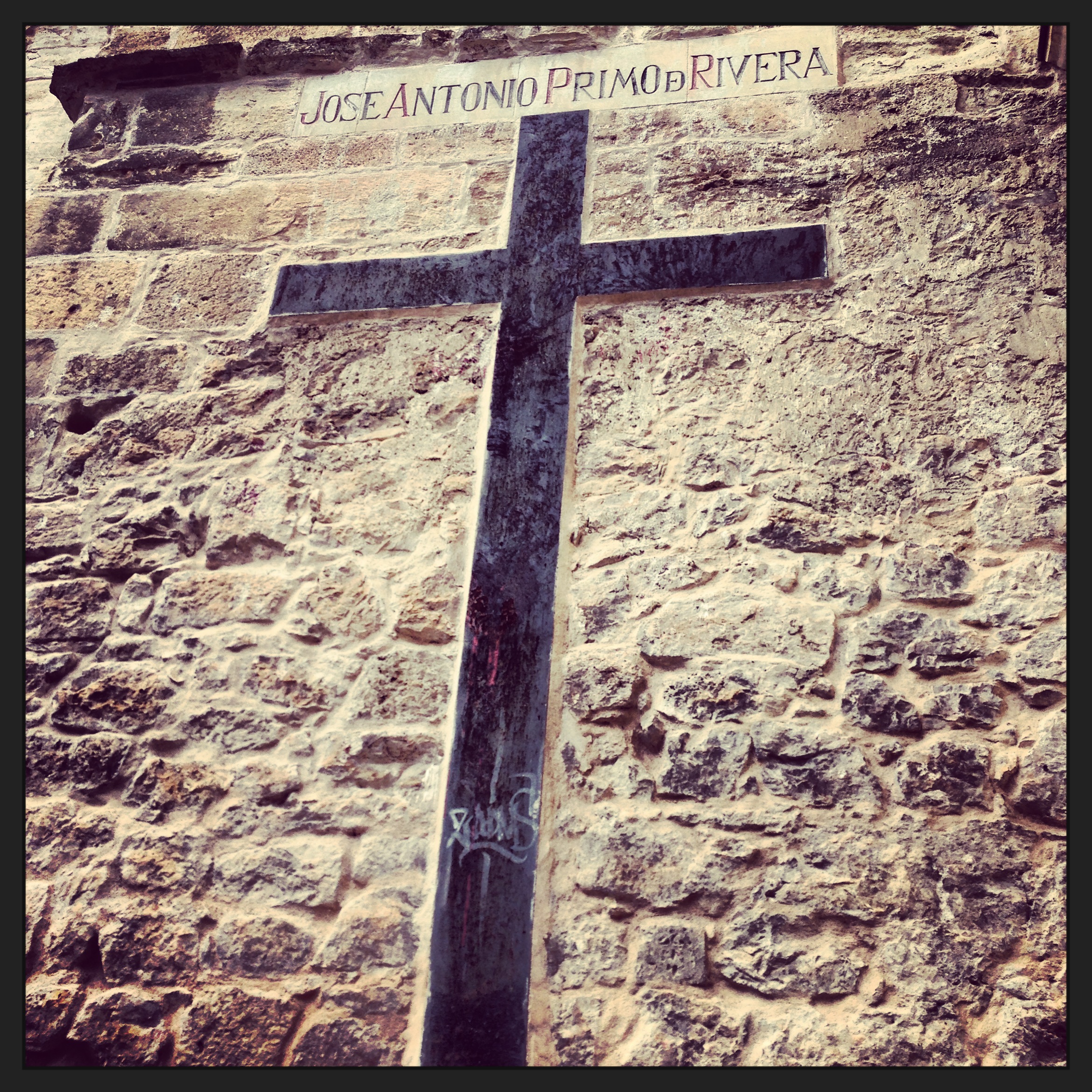
I may take photos of this Falange loving weirdness, but I don’t support it

13 ) Will this book be hard to read if I don’t know anything about the history of Spain? Is this book for Spain lovers? I have never been to Spain, will this book to be complicated?

I hope not! This is not a true story; it’s not a set of facts. VITVW is a novel, first and foremost. While I stuck to reality in terms of the timelines, the people are completely fictional. Are there groups of Franco lovers out there, ready to praise the man? You bet there are (they are called the Spanish government… I’m kidding… but not really…), I spoke to Franco lovers personally. Headlines used in the Valencian papers are close to reality, but the characters are fictional when looking for their stolen babies, and you don’t need to already know the background of the baby stealing process of the Franco era – everything you need to understand in the story is included. Likewise with the 2010 drugs in cycling scandal – everything you need to know to understand it is there.

14) Tell us a few things about you that we don’t know about you. Is your online persona the same as your real-life persona? 

Jaja, my online persona is probably way cooler than real life. In saying that, I am a snappy dresser (I wish) and get into some funny situations. Things you might not know –

I like radishes

I get so seasick that my backyard hammock is even off-limits unless I take my seasickness pills

My homemade salad dressing is made with condensed milk

I scuff the toes of every pair of shoes I own

I climbed onto a railway line when a train hit a car (first on the scene) when I was only 13. Only two of the six car occupants survived. It was as bad as you could imagine. Only two years later I dealt with my step-brother’s body being fished from a river.

I’ve never understood why some women say they feel threatened by other women. I’ve never felt threatened. Am I the threatening one?

I once cried at a Spanish supermarket

My parents both got terminal cancer in their 50’s, which taught me to never hold back – dreams, words, goals; there is no extra time, now is the time to get out there

When I was 17, I carried around a Volvo Ocean Race magazine everywhere I went – I ended up getting work on sails for a team

As a child, I was pulled from classes to take part in a special writing course. The teacher said I had terrific storyline ideas, but I would never be smart enough to write a book

My best friend is my brother who sadly lives in Australia (upside – epic holidays together)

I feel like the last stay-at-home mother left in New Zealand

p51

I was a show-off in 1982 (and a natural blonde! Shh…)

15 ) What else are you writing?

The inevitable question. I will go back to finishing Luminous Colours of Dusk, the third and possibly last book in the Canna Medici series. I’m not sure I could live without Canna! Another book high on the agenda is my novel based in Barcelona, about the glory and demise of the Republican ideals in the civil war. The pressure to get historical detail correct is massive, and the book is a challenge. I do little bouts of writing and researching at a time, rather than taking on the project full-time, because I’m just not ready. I will have to return to Barcelona for a second research trip in the near future. Of course there with be the third novel in the Luna Montgomery series, Death in the Valencian Dust, which will take a lot of work. I also have a book about cheating on someone with cancer, a book about being a pioneer moving to New Zealand in the late 1800’s, and an Australian gold rush story to flesh out. Those six should keep me busy for the rest of the decade, and I’m sure more will come to mind.

Upcoming cover art

Up next is Part 4 of VITVW, photos and locations used in the book. Part 5 will have the first chapter free to read on January 2014, book release day.

Click here to read more  –

PART 1: VENGEANCE IN THE VALENCIAN WATER Q+A

PART 2: VENGEANCE IN THE VALENCIAN WATER Q+A

Since the Blood in the Valencian Soil giveaway went so well, I might sneak in another one before Vengeance in the Valencian Water is released.