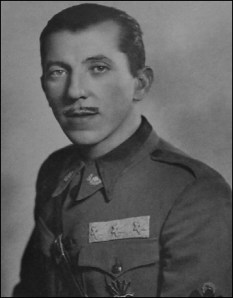
Adventures of a Doctor by Eduardo Martínez Alonso seems to be so rare, I can’t find any cover art or a blurb about this book. I managed to purchase a damaged copy from the New Zealand parliamentary library, and when they tossed this book to me for a mere $6 (about €3.60), they obviously didn’t know what a treasure they had. Eduardo Martínez is quite an extraordinary man with a story that seems to have been largely lost. With the market flooded with 1001 Spanish civil war books, it comes as a great surprise that this book doesn’t get more recognition.
The story starts with the author born in Vigo, Galicia in 1903. His father was from Uruguay, and was the consul in Vigo. As a young boy, Martínez travelled to his father’s homeland, along with his family (he was one of eleven children, and talks of his mother constantly having to nurse his siblings). The story tells of life in northern Spain in the era, and exploits with his brothers and attending a boarding school with mixed success. In 1912, Martínez’s father received a post to Glasgow, and the whole family moved north for a new life. Martínez dreamed of working in hotels or on ships, able to meet people and travel far and wide. He became bilingual at a young age, seeing the benefit of speaking Spanish, English, French and more. But it was his father who said he would be a doctor, not a sailor. As each of the eight boys grew and carved out professions (sisters, of course, were to be wives and caregivers), the prophecy of the hard-working consul came true. The family and Martínez recalls the first world war, his school years and an eventual trip back to Uruguay.
As a trained doctor, Martinez moved to Madrid with his grandmother, and speaks of seeing Anna Pavlova dance at Teatro Real, with the King and Queen in attendance. He quickly took up a post at Red Cross Hospital, and met Queen Ena, British wife of King Alfonso XIII, and the Duchess of Lecera, who were delighted to have an English-speaking doctor. News travelled of an English-speaking doctor in favour with the queen, and Martínez was in hot demand. Just eighteen months later, Martinez graduated from San Carlos Medical Facility and while meeting the King and Queen socially and professionally, was appointed the medical adviser to the royal family. This proved to be an amazing and dangerous post.
When the Second Spanish Republic was founded in 1931, Martínez was in the palace in Madrid with the royal family as they were deposed. He tells of sitting casually with Queen and princesses as the monarchy fell. As the family were forced into exile and as Spain underwent revolution, Martínez’s position as a monarchist him an easy target. As civil war came five years later, things changed dramatically. Martínez got his family out of Spain in July 1936, or off to the safety of Vigo, and knew he would be in danger as a former royal family aide. Through his work for the Red Cross, he was ordered by a Communist faction to work as a doctor for the Republican side of the war.
On Saturday morning the shooting started. We sat in a bar and heard the crackling of machine guns, the burst of hand grenades, and I saw smoke arising from many quarters of Madrid. By Monday morning a general strike had been called. Everything was paralysed except murder, arson, and rape. The Spanish civil war had commenced – Pg 70
Martínez talks of watching a church burning as priceless works of art were set alight along with the riches of the churches of Madrid. He saw a priest thrown on the flames but was unable to save his life when he pulled the screaming body from the blaze. Most priests were taken out to Casa del Campo to be shot. Men were burning priests but trying to revive pigeons which fell from bell towers, overcome by smoke. Martínez had an apartment in Madrid, and he hid as many people as he could throughout the war. Nuns and priest were hidden, and forced to serve meals to men who sat and spoke of vicious murders they had committed against the clergy.
Martínez was posted to a town outside Badajoz, Cabeza del Buey, in the south-west, working for the Communists. While running the hospital, a young nurse, Guadalupe, suggested they flee and work for Franco’s troops instead, but Martínez seemed convinced that he would be killed at some stage, regardless of where he was posted, and claimed no political alliances. In Cabeza del Buey, he was forced to attend mass executions of seemingly innocent men, and despair at violent speeches about revolution and vengeance. He performed many surgeries and saved lives in the most atrocious conditions. But with no warning, Martínez was shipped off, with Guadalupe, and sent to Ocaña, just outside Aranjuez, to work in the prison there, and be a prisoner himself. As he had in Cabeza del Buey, Martinez managed to get some nuns freed from prison to work as nurses, and treated patients while living in a cell himself. Between dire conditions and deadly activities, a patient told Martínez that his turn to be executed was near. An in understated manner, Martínez talked of his prison escape to Valencia in March 1937, were he managed to procure a fake passport and get aboard the Maine, a ship bound for Marseilles.
Martínez quickly got himself back in Spain, despite the dangers. He chose to cross the lines and work for the ‘white’ side of Spain, Franco’s rebel army. Red Spain (the Republicans), he felt, thought nothing of him, his work, and long suspected their cause would lose the war, one they never had a chance to win. Posted to Burgos, Valladolid and then San Sebastien, Martínez then found himself working on the front lines as Franco’s army continued to advance into enemy territory. Towns fell one by one as Martínez fought to save lives, but writes in such a humble, unassuming manner. Once in Zaragoza, Martínez worked hard to care for patients at the hospitals, and pioneered the use of closed casts on wounds, a procedure first tried with less success twenty years earlier. Despite the smell offending wealthy female volunteers, Martínez’s experiment helped the lives of many patients otherwise in agony as they recovered. He was then moved on to his own mobile surgical unit in Teruel in 1938.
Martínez was there on the ground when troops stopped in Sarrión, 100kms north-west of Valencia, as the war finally came to its brutal end. On April 1st, 1939, the war was over and declared won by Franco in this small town, and after helping a man and his son to Valencia, Martínez sought out all those who had helped him during the war, and moved back to Madrid. No sooner than Martínez had helped his friends and former nurses, and begged for clemency for some condemned to death by the new regime, the second world war broke out. With some family in Vigo and some Britain, travelling on multiple passports, danger was again faced. As Hitler plowed through Europe, Madrid suffered greatly after the civil war and Martínez went to work at Miranda de Ebro, near Burgos, to help war refugees from all nations. With such a humble attitude, he glossed over his feat to aid refugees out of Spain, saving their lives, until in 1942, when his ferrying of innocents was discovered and he was forced to flee Spain. His time working with British Naval Attaché, Captain Alan Hillgarth is barely touched upon, but should surely serve as an incredible tale of a man saving lives at great risk to his own. This two-year period alone could serve as a story all of its own. Just his dramatic escape would serve as its own story, but the author covers it in a few sentences, and neglects to mention he fled with a new wife. He also failed to mention his first marriage which produced two children, but was annulled after Franco took power in 1939 (His wife was a British woman who went home without him). I only found about either marriage after studying the doctor further myself. There are no clues to whom these women are at any point in the book. His personal life is never touched upon.
Again, Martínez talks little of his involvement with the rest of the world war, after being detained when first arriving in Britain (no idea if his Spanish wife was also detained), but worked as a spy for Britain throughout and barely talks about it. He worked at Queen Mary Hospital after the war and oversaw great new procedural advances, meeting some of Europe’s finest surgeons, but then returned home to Madrid. Life was hard in the beleaguered nation, and he again went to work at Red Cross Hospital, specialising in chest surgery. He then moved on to working as the doctor for the Castellana Hilton, newly opened in 1953. He recounts stories of wealthy Americans, and famous movies stars (unnamed) alike, who came to Madrid for all sorts of reasons. He spoke with frustration at his patients demanding penicillin shots, not wanting to discuss why they need this medication. Many guests, male and female, had a penchant for sleeping around and wanting medicine to atone their sins, either before or just after the liaisons which bore infections. One guest talks of being raped and demanding penicillin, though the story is far from convincing to the doctor. Sexual liberation had come to the foreign guests at the Hilton, and expected Martínez’s penicillin to cover it up. He makes his disdain clear for these patients and the abuse of this groundbreaking medication, and of the myriad of alcoholics he was forced to attend to, when little could really be done for them.
The book is written in the manner of a doctor – no-nonsense, no fussing with detail, just the raw facts given out without prejudice. Martínez is a man with the story worthy of a Hollywood blockbuster, but it wouldn’t be his style. This book was written in 1961, and Martinez lived until 1972. It shows what really stood out to the doctor in his life, because details are excluded, and there are many secret operations he simply never wanted to discuss. He is free and easy with dates – because I know the civil war, I could piece together the timelines of the book, but needed to look up world war details and the opening of the Madrid Hilton, just to give myself an idea of how much time passed between chapters.
Martinez’s daughter, Patricia Martínez De Vicente, has written several books in Spanish about her father, notably La Clave Embassy: La Increíble Historia De Un Médico Español Que Salvó a Miles De Perseguidos Por El Nazismo. The stories not told by her father in his memoir are a whole other side to this man who worked tirelessly for others, and had a strong ability to do good, without any need to be recognised. To read his book is a gift, and I will be also reading his daughter’s books.
*above photo taken just prior to release from the Spanish army, 1939. Photo supplied in the book (page 112)


 CAROLINE ANGUS