Part 1: Vengeance in the Valencian Water Q+A (plus a FREE book)

Valencia, Spain: October 1957 – After a long hot summer, Guardia Civil officers José Morales Ruiz and Fermín Belasco Ibarra have had enough of their lives. Sick of dealing with lowlifes and those left powerless under Franco’s ruthless dictatorship, the friends devise a  complex system of stealing babies, to be sent away to paying families. But as the October rains fall, the dry Valencian streets fill with muddy water, and only greed and self-preservation will survive…

It’s 2010, and Luna Montgomery is busier than ever. With the mystery of her murdered grandfather solved, she reluctantly prepares to be the bride in Spain’s ‘wedding of the year’. But four more bodies lie hidden at Escondrijo, Luna’s farm in the Valencian mountains. Her fiancé, bullfighter Cayetano Beltrán Morales, is not eager to have his name brought up in a post-civil war burial excavation. When Cayetano’s grandfather José, an evil Franco supporter, starts to push his ideals on Luna, her decision to join the Beltrán family comes under scrutiny.

The Tour de France is fast approaching, and Luna’s position as a bike mechanic on Valencia’s new cycling team begins to come under pressure. When an ‘accident’ occurs at Escondrijo, lives hang in the balance as more of Spain’s ghosts come to life and tell the story of a flood in 1957…

It’s that time again. With time ticking away until Vengeance in the Valencian Water is released on January 24, it’s time I got onto answering some of your questions! I have merged some questions together, to answer as many as possible, but will post in a few parts. Let’s jump right in.

book covers

1 ) What is Vengeance in the Valencian Water all about?

VITVW is the second in the Luna Montgomery ‘Secrets of Spain’ series, which continues right where Blood in the Valencian Soil left off. VITVW follows the same vein – two different time periods, with their own themes that are bound together by similar circumstances. VITVW is centred in Valencia 1957, with a Guardia Civil officer, José Morales and his battle against the struggles of Franco Spain. Common in this time period was the horrendous baby-stealing practices in hospitals, where the church would steal babies from mothers at birth and sell them, with the law on their side. José gets caught up in this vicious circle, only to find his real adversary is the Valencia flood of October 14 the same year. The story runs alongside the 2010 storyline of Cayetano Beltrán, José’s grandson, and his life with Luna Montgomery, which is under pressure. With the financial crisis weighing down Cayetano’s career as a bullfighter and the impending bankruptcy of his grandfather’s huge business, life is increasingly difficult. Luna is still struggling after the recession claimed her job in the first novel, and just as she finds some stability, her late husband’s alleged drug cheating as a professional cyclist rears its head. The long-awaited trial of a Spanish doctor caught doping Tour de France riders leaves Luna to face a legacy she never wanted to be part of. Luna continues pushing to dig up unidentified Spanish civil war bodies, the common clash in Luna and Cayetano’s relationship in BITVS. All the themes in both 1957 and 2010 interlink as ‘coincidence versus fate’ is again explored.

DSCF5338

Pretending to be researching in Segovia

2 ) How long did it take to write Vengeance in the Valencian Water?

I started writing in February ’13, with the intention of having the bulk of the storyline completed before my research trip in May. That failed dismally but while in Spain, I learned so many things. Once back from Spain I was busy with Violent Daylight‘s August release and the story went on hold. I didn’t get back to VITVW until October and finished at the end of November. The book dragged out longer than ever planned, and many ‘real-life’ things got in the way. I had the background for the book, with the research on the Valencian flood, the baby black market and the drugs in cycling done a year in advance, so when it came time to flesh out the book, there was no delay. Going to Spain to learn more about bullfighting and the reality of the recession in Spain really helped with the final touches. Because this book had swirled in my mind for so long, the writing was the final piece of the puzzle, rather than just writing and seeing where the book led, as I have done in the past.
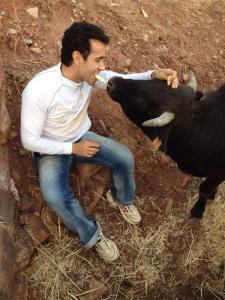
BXR-AKQIAAEkSOK

wonderful photo by @v_puerto

3 ) How can you justify being a fan of bullfighting? Bullfighting is grotesque, so why do you condone animal cruelty? 

I have heard it all. I have three things that attract internet trolls – bullfighting, supporting cycling (in NZ) and being a feminist. Bullfighting tends to bring out the animal in people themselves. I have been told I am vile, I am cruel, I don’t deserve to be a parent, I am disgusting, my family deserves to be hurt… the list goes on. Are all these people interesting in the way their meat was raised and processed? Bulls raised on ganaderías and sent to bull fights are treated like kings. Quality healthcare, exercise regimes, carefully controlled diets… none of those things are taken into consideration for the chicken or pork in your fridge. Yes, bulls are taunted and exhausted in the ring, surrounded by the real beast of bullfighting – the crowd – who hungers for the animal to die. Is that degrading? Yes – that is without question. Do I feel sorry for the bulls while they stand disoriented and weakened as they get stabbed to death? Absolutely! The combination of watching the animal die, combined with sitting beside people who love to watch the event is not a nice feeling at all. Am I trying to promote bullfighting? I’m not sure if that is even possible – people can make up their minds about the corrida long before they get there. Many argue on the side of tradition, and I can identify with that. Bullfighting is more than killing an animal. The toreros are fascinating men and their dance with death is something I could write about forever. They are brave, proud and skilled. They have a talent that is frowned upon in the modern age, and stand in the ring to cheat death of its right to claim them, and are both reviled and revered every time they do so. (Numbers of men wanting to be toreros is up, not down as expected). I have great respect for these men, but I have no desire to promote cruelty to animals. I don’t plan on opening minds to both sides of the argument – many minds cannot be opened. The bull is the orchestra, the torero is the conductor. The crowd chants for a kill. I don’t write to glamourise the event – in fact, if you read, you’ll find the books regularly grapple with the subject, and show there is more to a torero than his sword.

4 ) Do you need to read Blood in the Valencian Soil before you read Vengeance in the Valencian Water?

A tricky one. Yes and no. Book one tells the story of a lonely bullfighter and a grieving bike mechanic teaming up to unearth a civil war grave, running parallel to the 1939 storyline of their grandparents trying to flee Valencia at the end of the civil war. The story tells of how Luna and Cayetano meet and how unorthodox they are as a team. However, book two tells the story of them battling through the trials of 2010 Spain, alongside unearthing an all-new grave. The story does stand alone, and the book should give you enough of background that you don’t feel like you’ve been denied any detail. But they are designed to run together, with VITVW starting off just a month after BITVS ended.

5 ) Why have alternate storylines? Isn’t that complicated?

I’ve never had anyone tell me that alternate storylines is complicated. I personally feel that VITVW is even easier to follow than BITVS with the different time periods. The series tells the story of Spanish families throughout the civil war and Franco time period. BITVS is a snapshot of life in 1939, VITVW tells of 1957 Valencian life, and the third book (out 2015) tells the story of 1976 Spain, as the country comes to terms with Franco’s recent death. These times are pitted alongside modern Spain and the very real struggles that the nation is facing. Given the laws that the current Spanish government passes, there is no need to imagine fantastical fiction; reality continues to inspire in depressing ways.

Portal de la Valldigna ’57/’13 – Different and yet the same (photo courtesy of Juan Antonio Soler Aces)

I will be back with part two of the book Q+A in a few days, so if your question hasn’t been answered, have no fear! In the meantime –

For 48 hours only – Blood in the Valencian Soil is free on Kindle/Kindle App. Catch up for free before Vengeance in the Valencian Water is released!

(promotion runs from midnight January 9 until midnight January 11 PST)

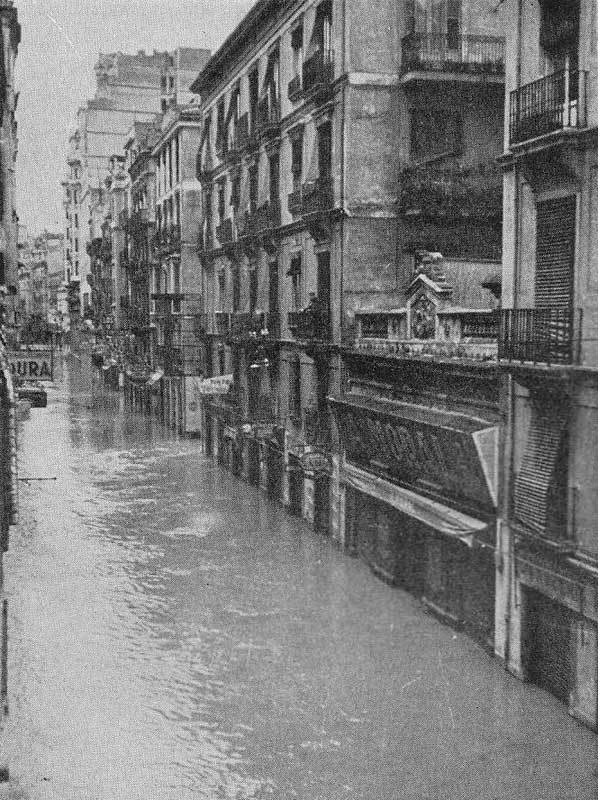
‘LA RIUÁ’ October 14, 1957: The Flood That Changed Valencia Forever

On October 14, 1957, a little known disaster occurred in the Spanish city of Valencia. When I first moved to Valencia in 2005, I heard the story of the Turia (the Valencia river) flooding the city in the 50’s. Now, the city has the beauty of a park in place of the dry riverbed. Years after I first moved to Spain, I decided to research the event  in more depth (excuse the pun), and it is the backdrop for my second Secrets of Spain novel, Vengeance in the Valencian Water (out Jan. 2014).

Many people are finding this old post and linking it to stories about climate change after the 2024 Valencia flood. What happened to south Valencia on 29 October 2024 is totally different to what happened in Valencia’s previous 80 floods. Climate change is absolutely a factor in Valencia’s floods, the rainfall was heavier than ever, in a shorter space of time than ever before, and flooded an area not given any consideration around safety of climate effects. Valencia is a flood plain, and that doesn’t mean climate change isn’t real. 

In my first book of the series, Blood in Valencian Soil, Cayetano, a bullfighter from Madrid and Luna, a bike mechanic from Valencia, team up to find the burial-place of a murdered Republican soldier and his involvement with an International Brigade nurse, who disappeared from Cuenca in 1939.  The second book of the series, while on the search for more civil war mass graves,  Cayetano’s Falange member grandfather, José, is forced to tell his story of survival  during the Valencian flood which changed his life forever.

city map

The Turia wasn’t always a flowing torrent of water. While there has been recorded flood records since the 1300’s, the riverbed spent most of its time dry, where people would walk to the tiny stream, to wash their clothes. Shack houses sprung up in the riverbed. Sales of animals were held down in the riverbed. It was not a year round flowing river. Serious floods had happened every century the modern city was based against the Turia, the most recent in only 1949 when several dozen people drowned. Even so, they were unprepared for October 1957.

Before you read on, here is the link to a documentary made in 2007 by Valencia University, with radio reports, video footage and eyewitness accounts of the flood. It’s all in Spanish, but if you don’t speak the language, you could just mute the sound and watch the video if you want, you will get the idea. Floods pretty much speak for themselves.

Each October, rain comes to the Valencia region, not so much in the city area, but in the surrounding plains and mountainous area that separates the city from inland Spain (If you’re new to this area, Valencia is both a city and a province of Spain. Just a heads-up). The rainfall surges during this change in autumn, onto land that is very dry after a long year without much rain. On Saturday 12 October, 1957, the heavens opened up over Valencia city, in conjunction to the torrential rains in surrounding villages in the Turia (plains around the city) region. On the morning of Sunday 13 October, Las Provincias newspaper noted that the outlying towns of Lliria, Segorbe, Chelva, Requena and Buñol had received rainfall of 500 millimetres in only two days. The Barranco del Carraixet and Palancia rivers north of the city, and the Magre river to the south, along with the Turia river through than ran Valencia city had all risen, but said there was no reason to worry. The rain began to die down in the city, and by late evening, had stopped completely. What the people of Valencia didn’t know was the immense torrent that was gushing its way down the Turia river towards them.

At around 9.30pm, an emergency call came through from the towns of Pedralba and Vilamarxant, 40 kilometres from Valencia, announcing that both towns had been flooded by a deluge of water as the river swelled beyond breaking point. At 11pm, an alarm sounded in the city, notifying all Guardia Civil and Police to be on alert, as the flood was heading directly towards the populated city.

Just after midnight, with the absence of rain, the river continued to swell, and logs and debris began floating through the city, blocking the bridges that connected the two sides of Valencia. Alarms sounded to alert people, and messengers knocked on doors in the El Carmen and Campanar areas, both the closest barrios on each side of the river’s edge. Radio messages went out with a flurry as police rushed to warn people of impending water. Soon after, the first waves began crashing over the edge of the riverbed, instantly flooding the flat streets on both sides, just as the torrential rains returned. In one hour, the water height pouring against the central city was between one to two metres and rising, cutting people off from any escape in the dark. More than 1000 cubic metes of water per second flowed into the streets, reaching over two metres in some areas. The Manises Dam at the edge of the city rose to seven metres above normal height as the river tripled its width and swallowed up much of  the city and surrounding area. All water, power and phone connections were swamped and collapsed under the water. Reports say manhole covers exploded into the air followed by a violent shot of muddy water  as the water took the city one street at a time.

ciudadinundada-1

(If you don’t speak Spanish – blue: river, green: populated flooded farming areas, purple: city/town flooded, grey: not flooded populated areas. Notice the tiny safe area in the centre of the disaster zone?)

In the centre of the old town lies the Plaza de la Virgen and Plaza de la Reina, where today stands the Valencia cathedral,  the Basilica and the archbishops palace just behind them. Along with  Calle Micalet, this tiny pocket was once home to a mosque and before that a Roman city. This area is built on the slightest, and almost impossible to see, ridge in the land, resulting in these treasures not getting any water and instead were surrounded. (Coincidentally, in my novel, the main character lives one street over from Calle Micalet in this magical pocket of space, but don’t be fooled into thinking they are all going to be safe – you know I don’t write happy endings!)

At 4am, the flood reached its peak of approximately 2,700 cubic metres of water per second, but then quickly tapered off. As the sun rose on Monday October 14, the water continued to decrease and the Manises dam was no longer inundated. From the peak of around eight metres above average to only two metres at the dam, Valencians thought the worst was over. A single telephone line to Castellon in the north remained, so emergency services could get word to Madrid, calling for help. All roads and rail lines leading out of the city towards Madrid, Barcelona and Albacete were blocked, damaged or completely swept away. Many of the bridges that crossed the Turia were damaged or destroyed, along with the beautiful stonework  that lined the river one day earlier.

riada10

As people ventured out into the water and mud-filled streets, the government received a message around midday that things were about to get worse. The towns of Pedralba to Vilamarxant had again been inundated with a second flood, washing away all  landmarks. The water took two more hours to reach Valencia city, with 3,500 cubic meters of water per second hitting around 2pm, accompanied by the worst downpour of rain yet seen; around 100 millimetres in just half an hour, enough that people couldn’t even see in front of them. By 3.30pm, the flood reached its peak of around 6,000 cubic metres of water per second, enough to start washing away  buildings that had been weakened in the first flood. The river had expanded to cover 2,200 hectares. While Valencia city gave many the luxury of multi-story buildings to find shelter above the water line, which rose between 2-5 metres above street level in places, the more outlying areas by the beach and port, including the towns of Nazaret, El Cabanyal and Malvarrosa at the mouth of the river, were on flat land and single level buildings, resulting in a complete catastrophe and loss of life as the water poured into the sea. Only five bridges, the longest-standing stone ones remained in place, though some were damaged and impassable. The worst had finally passed, and the riverbed emptied out into silence again. The final death toll was recorded as 81, though the actual figure remains unknown.

riada07

In the coming days, the army came in by truck and helicopter, bringing up to 500,000 kilos of bread to feed stricken residents. Many needed to be airlifted from rooftops and isolated pockets of dry land as the water receded. Much of the city, port and beach areas were filled with a heavy mud and debris, resulting in a ‘on hands on deck’ response from army and locals alike to clean up. On October 24, dictator Francisco Franco arrived (when much was cleaned already, of course) to survey the damage and have his loyal (oppressed, whatever) subjects cheer for him for coming to the disaster zone. As people lived on bread brought north from Gandia and milk given out by the ladle-load, the long process of rebuilding began. The mud was not completely cleaned away until the end of November.

In June 1958, the outlying port and beach areas suffered a second minor flood, as their drains were still clogged with mud, and the following month ‘Plan Sur’ began, a project to divert the river. The plan had initially been designed over a decade earlier but sidelined due to excessiveness (which is ironic considering the ‘excessiveness’ of everything the Valencian government spends money on). A plan to build an enormous green space in the city was put up against building a huge highway to get people from Madrid to the beach a fraction faster. In 1965 construction began to divert the river south of the city, resulting in  water  flowing around the city for the first time in 1972. At the same time, land cleared by the flood on the other side of the river from the old town was used to create many new buildings, mostly apartments, giving Valencia a construction boom (that’s a whole other tale). The flood had accidentally given Valencia a whole new chapter in its story, already thousands of years old. (I have never seen any water in the river diversion, other than the tiny part where the sea flows into the river mouth. If you have a photo of the Plan Sur river diversion (any  year) with water in it, I would love to see it).

Here is a short clip (in Spanish) made as they designed Plan Sur in the 60’s, with some aerial shots of Valencia if you’re so inclined

In 1976, on his first visit to Valencia as head of State, King Juan Carlos I gifted the dry riverbed to the city, and the highway plan was shelved forever; the 7 kilometre park won its place in Valencia’s history. Construction on the final part of the Turia riverbed park continues today, with most of the park now complete. The ‘top’ of the park has Valencia’s zoo, the Bioparc, and footpaths and bike lanes weave though gardens, streams, sports fields, playgrounds to the other end, home to Valencia’s massive Arts and Sciences complex. The final part, where the old riverbed meets the sea is still to be completed.

While Valencia is an amazing city, the park is the jewel in the crown.

This is a tourism video was taken a few years ago, but shows Valencia from the air, over the park and areas rebuilt after the flood, plus many of the great sights you can read about in my books.

riada1

All photos in 1957 are courtesy of Juan Antonio Soler Aces and 2013 photos are author’s own. 

A LITTLE JAUNT TO SPAIN – REVIEW PART 9: Thunderstorms, Jesus and Ghosts in Cuenca

IMG_3670

You will long know by now that Cuenca is one of the central locations on my novel, Blood in the Valencian Soil. What you may not know is that when I wrote the novel, I worked purely on information given to me when researching the real characters that inspired their fictional counterparts in the book. While I know the outlying areas around the town, I never made it to the small hilltop town the entire time I lived in Spain. So, once the book was finished, I decided that while on my trip to gain information for my second Spanish novel, it was time to visit Cuenca in the flesh.

Name a town anywhere in Valencia province and I can almost certainly say I’ve been there. The mountainous region north of Valencia city is one of my favorite places. I have also spread out north-west of the city into the Aragon region many times, but Cuenca was last on the list of places to visit.

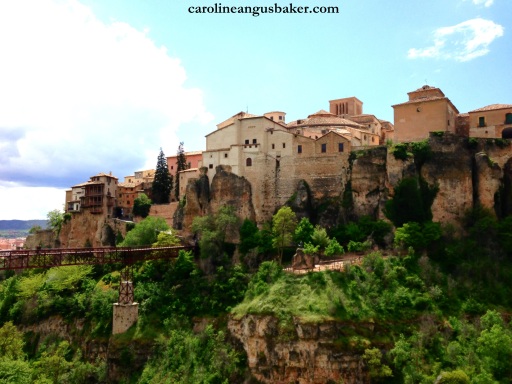
Whilst the town of Uclés was the ‘real-life’ town that my 1939 book characters worked in during the war, I moved the story to Cuenca for the later war storyline, and the town did not disappoint. The views of Cuenca are well-known, the cliffs, the hanging houses, the parador, but the place largely gets ignored during the lists of places to visit in Spain. Personally, the (albeit oddly shaped) triangle that runs from Valencia to Barcelona to Madrid is my favourite part of Spain, and it lies mostly untouched by tourism.

Don’t worry, I’m not going to launch into a high-and-mighty speech about the ‘real Spain’. What Cuenca does offer is an opportunity to have a day trip to a town where there are no set rules on what you should experience.

IMG_3237

The trip started well enough, out of Valencia. I was torn by leaving my  favourite city; while I could easily stay in the place forever, heading for Cuenca was 200 kms closer to getting back to Madrid and on a flight home, which I am not ashamed to say I was missing. The A-3, while a quick route inland, does mean you miss little opportunities to explore the Valencia region more, but I was not the driver (I hate driving); instead I settled for a familiar sights along a familiar road (my ill-fated trip to Teruel had the exact same problem).

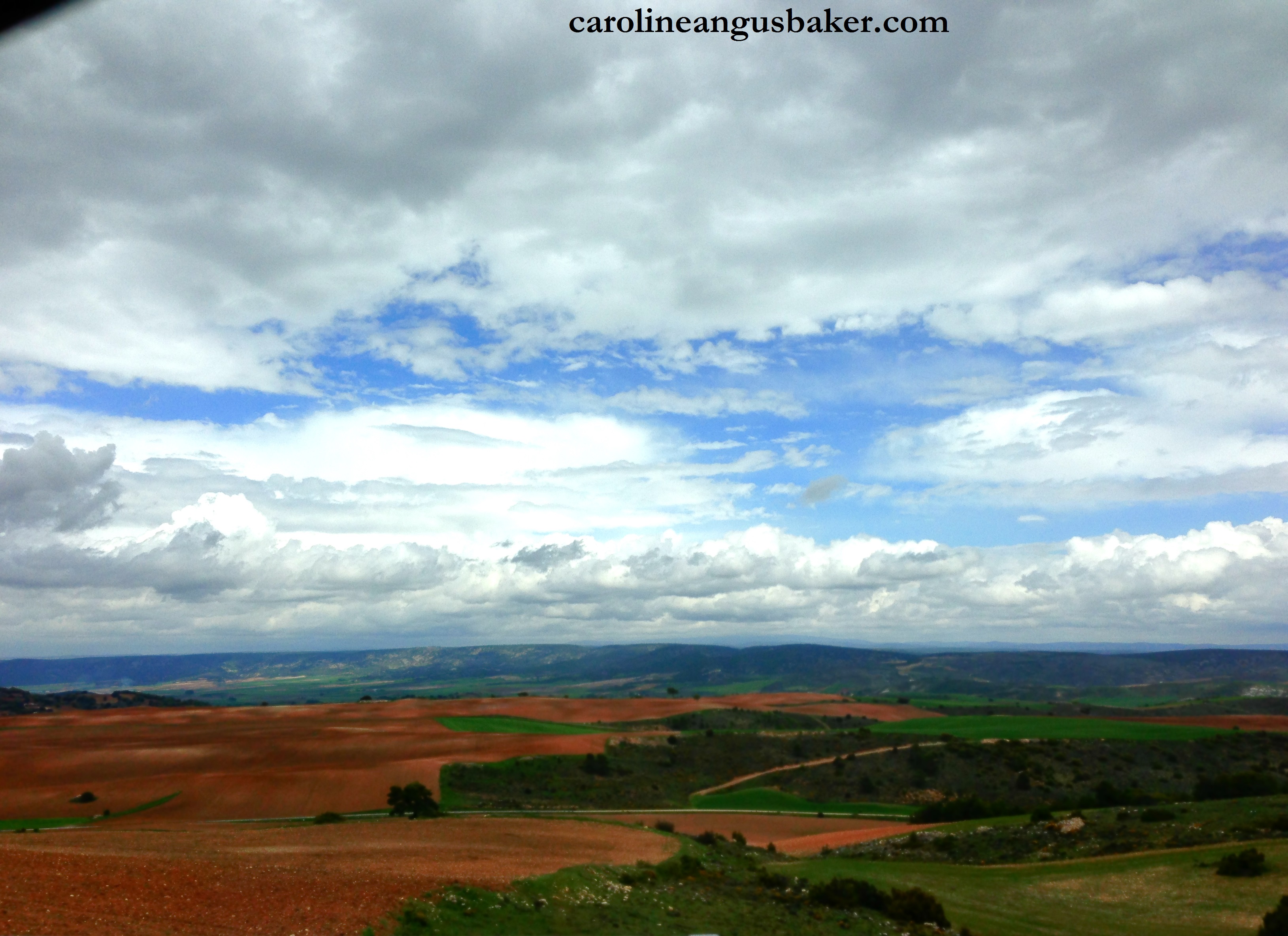
We headed up the N-320, and Spain’s quiet interior peace settled in. It doesn’t take long to leave the world behind and head through small villages. For me, just seeing little places and knowing their wartime history was a great experience, though I had no one to share any of the information with. To be honest, I did wish I had taken the train, which I had in my original plans, but never mind.

country

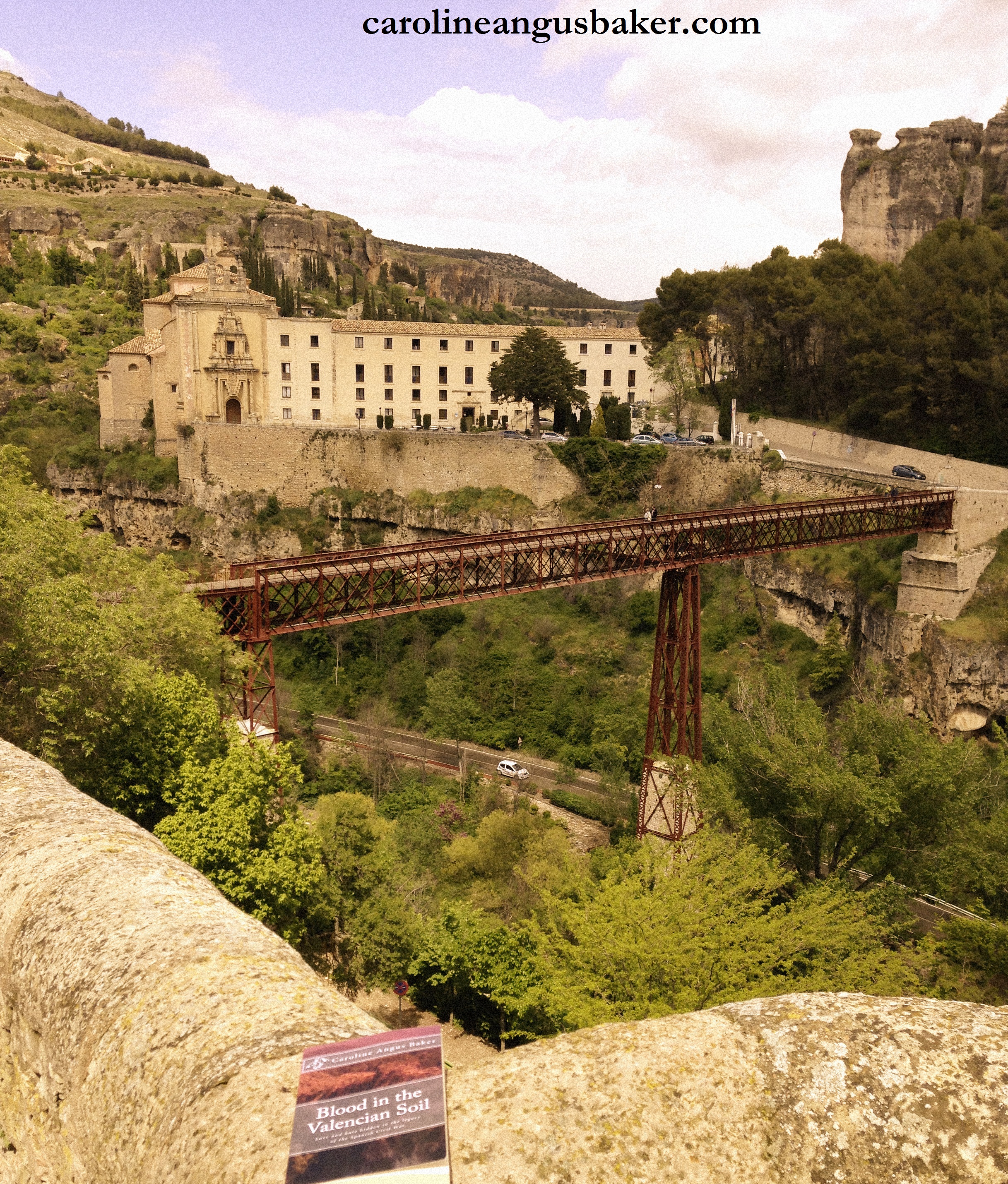
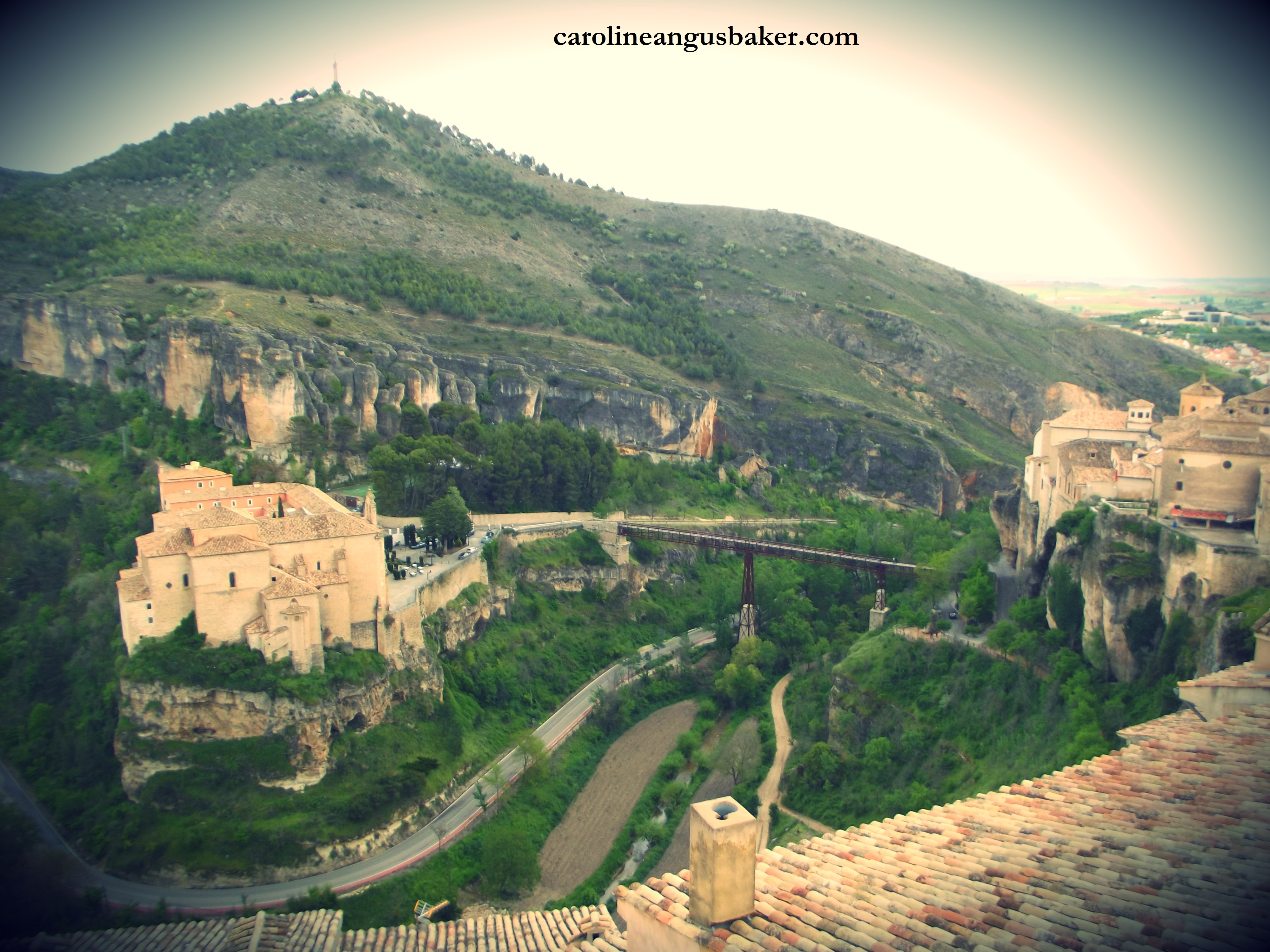
We arrived in Cuenca at about 2pm, and quickly bypassed the new town, filled with your standard Spanish locales, since obviously the locals require these businesses for work and life’s daily needs. My car-ride companion had a desire to get through the area as fast as possible, complaining of its ugliness. We arrived at the parador, the former Convento de San Pablo, one of Cuenca’s most enduring sights. As it is a location in my novel, I was determined to stay there, despite the fact a single night cost me more than three nights in a classy Madrid hotel on the same trip.

luna view 1939 book

View of the parador

I applaud anyone who has the desire to take care of a historic building and those at the parador have done just that. With a quiet, well maintained yet basic courtyard in the building, and hallways that give you the chance to feel the soul of the place. With a room on the second floor, I felt lazy taking the elevator, despite carrying my bag, and opted for the stairs for the rest of the stay, since the elevator is slow and filled with tourists not quite as agile as me.

IMG_3795

Main hallway

The room – I paid for a view, hence the slight increase in price and the view did not disappoint for a moment. Located above the main entrance, the room gave an instant view across the bridge over the gorge and over the old town dangling over the precipice of silent cliffs. A huge thunderstorm hung over the town, reminding me to stay inside for a little while. After an irritating car trip, I didn’t particularly want to hang out in a dated and poorly decorated room with terrible wifi, but the pouring squall slashing its way over the town was best viewed from the behind the windows.

view

I left my dark depressing room and headed down the hallway to a charming area where seating was laid out, with a view over the interior courtyard of the building. I met a charming man named Jesús, on holiday with his parents from Madrid. He said the town has become a popular place for visitors from the capital over the past few years, but as we sat together, all that passed us was a Japanese family eager to do some sightseeing. The silence of the building made us wonder if the nuns were still running the place! Jesús was the only person my age (ie. 30’s) I saw there. Maybe the price puts younger travelers off; Jesús had just got a new job and wanted to treat his parents because he hadn’t had a job for over a year.

I bid farewell to the flirty Jesús and headed outside into the frail sunshine, amazed (though not surprised) by the cool temperatures of the mountainous area. Still free of my car-ride buddy, I started a walk down to the base of the Huécar gorge, and I was entirely alone the whole time. Not a soul walked by and as I wandered around the base of the town, and back up, popping out on the side of the old town, skipping the gorge walk bridge entirely.

Cuenca1

San Pablo bridge all to myself

After the frenetic tourist-ridden locations like Barcelona, to stand alone in this picturesque area is a real chance to breathe. I took about 1001 photos of the area, which could easy take up your whole day. With my handy copy of BITVS in tow, I got to see the areas that has been so accurately described through photos and friends while working on the book.

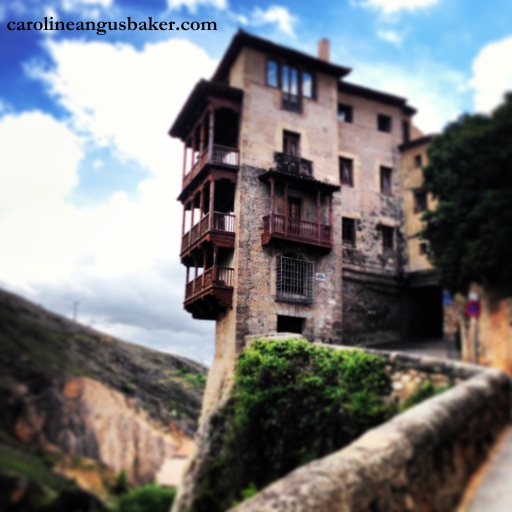
Past the Casas Colgadas, the Hanging Houses (which houses the Museum of Spanish Abstract Art), I wandered in the Barrio San Martín, a labyrinth series of streets, portrayed regularly in my book. More photos and some glorious time to be alone, something I wanted more of, I got to see the places in my book, which made me immensely happy. I didn’t pass a soul in the area, and walking along the steep and easily confusing area, it would be easy to think you have gone back in time. The silence is stunning and the town speaks to you instead.

san martin

Legit street in Barrio San Martín

luna

House used as inspiration in BITVS

Onwards to Plaza Mayor, the heart of the old town. After popping out onto the square by luck rather than planning, it was interesting to see a main plaza with almost no people. For all the talk of the place being a tourist area these days, there wasn’t a tourist to be seen, and not many locals either.  I went straight in the direction of the cathedral, another pivotal location in my novel, and will also feature in subsequent books.

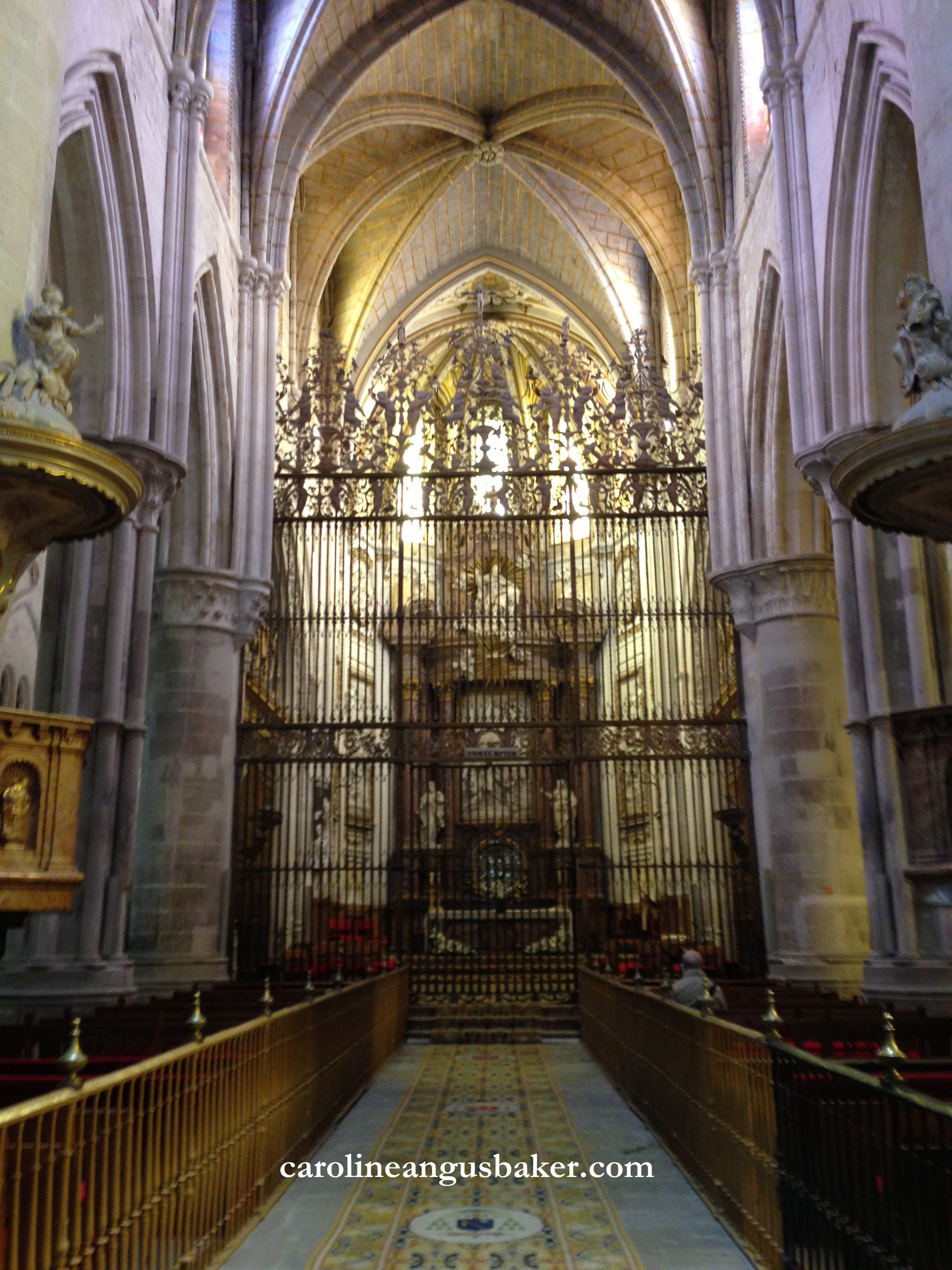
The interior of the church doesn’t disappoint. The solemn religious works sit in an air of silent and cold (almost as cold as Segovia’s frigid cathedral) peace. I sat at the altar for a while, the first time I had taken a break on my whole trip (or so it felt), to soak in the moment. It may sound crazy, or juvenile even, but being in Cuenca made my own book come to life for me, more so than Valencia and Madrid. I could imagine Cayetano Beltrán praying in the same seat, with Luna Montgomery watching in silence, wondering what the hell she was doing there with the bullfighter.

cuenca cathedral

Cuenca cathedral 

IMG_3369

With the intention of walking up Calle San Pedro, the ‘main’ road leaving up out of Plaza Mayor (try watching a bus go up there with a car coming down the other side – impressive skills and nerves), I instead peeled off along tiny and intriguing little alleyways, in search of my Cuenca (mine, as in ‘in the book’ Cuenca). The lack of people and noise makes it easy to develop your own opinion of the town and indeed imagine yourself in a novel.

IMG_3954

I reached the 18th century San Pedro church. Though basic, it’s home to a bell tower,  is a must-climb. The few hundred stairs are an easy climb and the views once up there are amazing. The climb is a real highlight (see what I did there?)

a

Parador view from bell tower

jucar

View of Júcar gorge from bell tower

IMG_3841

odd bit of artwork looking to old town from Júcar gorge

For me, I felt exceedingly lonely in Cuenca. I missed my family, who weren’t on this research trip with me. Without them, the majority of sights seemed hollow. Cuenca is a sight best seen with someone you love (or at least like!). I wandered back to Plaza Mayor, and grabbed a map from a nice young guy named Carlos at visitor information. I prided my lack of maps on my trip, but it was quite handy for a quick walk up and down stairs on the hillside to view the Júcar gorge on the other side of the old town, and then I was officially tired of the whole area. My enthusiasm had gone. I went back to the parador, this time over the San Pablo bridge, and took a break.

weird

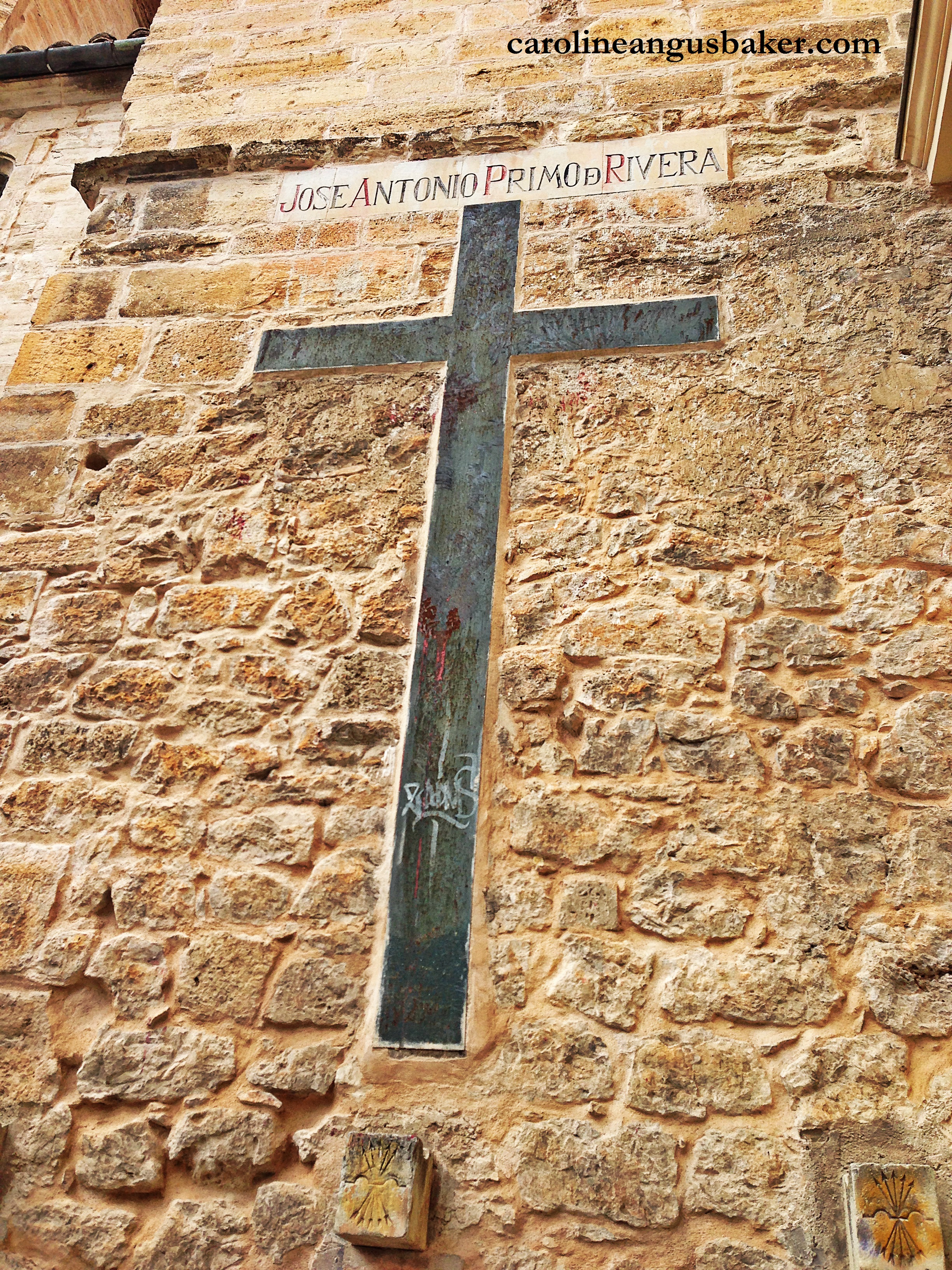
Creepy homage to Jose Antonio Primo de Rivera, see the little Falangist symbols beneath? I nearly fell over when I saw this on the cathedral wall near the entrance to the Archbishop’s palace. Odd in 2013.

Surely evening could be interesting. With exhaustion ruining the trip, my car-ride buddy suggested a drink at the restaurant in the parador. Before even poking my head in, she said that everyone looked too old and boring (note from me – if you are in your 50’s, I’ll happily share a drink with you). Instead, we headed over the gorge and into the old town, to a random little in Plaza Mayor bar where I spent my evening mulling over several white wines from Cuenca – all of which I would recommend. The barman brought so many tapas over that dinner wasn’t required!

IMG_3939

The walk home at about 1am was a highlight, I’m not one for heading out late at night, but walking the pitch dark and silent alleyways, suitably spirited with wine and relatively lost makes you feel like someone is creeping up behind you, or that you’ve stumbled into a Jason Webster novel. The cliffs lit up at night is a sight to behold, even if my iphone couldn’t capture them very well, as is crossing the bridge in the dark.

A rough attempt at sleep on a bed so hard I thought it had been built from nearby rock, I got up at 4am and went for a walk on my own, to the amusement of hotel staff. I did this on almost every night of my trip and it’s interesting what you can see and hear when out when no one else is stirring. I crossed the bridge in the freezing air, and heard what I think were owls, the sound echoing through the gorge like an eery cry. It took little imagination to feel like it was 1913 or even 1713. I sat between some trees on a lonely bench and felt very alone, which felt strangely liberating. The oddest thing, and I don’t believe in ghosts et al, but I felt very watched. I walked down under the bridge and walked the lonely road that arches through the waterless gorge. The sun had began to ease its way through the darkness as I headed back along the path to the hotel. A solitary figure stood on a driveway at one of the basic houses in the gorge, an old woman, who placed a hand on my shoulder as I passed her with a hello. ‘Women are always busy here, even when the men sleep’ she said and then simply turned away. I felt like I had found Spain, there that moment in the dark gorge, the wild Spain I had been looking for, one filled with a presence that was intangible.

After the fear of loneliness and darkness combined with bitter temperatures chased me back into the hard bed for an hour or so.  The creepy quiet night walk was worth staying in the town, otherwise I would recommend Cuenca as day trip rather than an overnight.

bridge

one last look

I checked out of the parador as soon my car-ride buddy was ready to leave and we headed for Madrid, just 165 kms away. I felt great for having seen Cuenca, but more than ready to catch up with friends in Madrid.

road

legit two-way street!

Must see and do –

Covento de San Pablo, even if only from the outside, just to see the view of the town staring back

The San Pablo bridge, were you must add your pledge of love to

Plaza Mayor, were tourists don’t exist

The bell tower at Iglesia San Pedro

The narrow streets of Barrio San Martín, and stop in any almost medieval-looking bar you can find

The view over Júcar gorge tends to get forgotten in postcard snaps but it just as beautiful and wild, and has a long nature walk in and around

The Cathedral, even if you just take in the facade

The alleys that lean against the edge of the Huécar gorge, try Ronda Julián Romero for a quiet alley walk

The wilds that surround the area. The landscape makes you want to cry, especially this civil war nerd

Drink the wine, eat the snacks. Nobody ever regretted that

The not-so great – 

Unless you are planning to take on the wilds around Cuenca, I would recommend taking the train. Cuenca is an easy place to get to by public transport and having a car was a pain in the ass, and I didn’t even drive it! Plus you meet fun people on trains, unlike in tedious car trips, especially if you can’t stop along the way. Plus I don’t like being yelled at for not knowing where to go/park in locations I’ve never been to, or haven’t been to in years

The parador – iconic, yes; but worth the costs? Neither Jesús or I were convinced of that. With other options available, do your homework first. If you’re determined to stay there (as was I), you should. I got the chance to visit the restaurant for breakfast (included in room cost) which served a buffet of both Spanish and English choices. Any day with churros is a good one. The rooms are not that nice or big, so be careful who you room with. Prince Felipe stayed there on his honeymoon, but I’m guessing he had more fun things to do and had well-chosen his companion! The cost of the bar/restaurant has been debated as over-priced, but I saw plenty of unusually pricey menus in windows while out on my walk. But, not every place is attempting you rip you off.

Spain is not hot all year around, despite what some think. Cuenca is located in a gorgeous but unforgiving landscape, so take a jacket unless its August.

Don’t expect Cuenca to be lively and exciting like a city. You might be disappointed. The place met all my expectations, but if you want to meet a sexy 19-year-old man-boy in an old town bar to engage in a fling with, you might be pushing your luck (What?! Some people like to judge people on looks and dream of Spanish interludes. Not me, but some people, it’s how romance novels are born). Likewise, if you’re not interested in war history, don’t travel with me!

The same generic Made in China souvenirs are available, like with anywhere. I did manage to buy a heavy stone model of the hanging houses, which was made locally.

Want to go but don’t know where to start? Take a look at the Spanish Thyme Traveller, who have just added Cuenca to their list of already well-planned holidays. Here is their latest blog post, all about a trip to Cuenca – A Visit to Cuenca Spain

IMG_3442

people declare their love on the San Pablo bridge so I did just that!

A Wistful Day in Valencia – Lost in a Sea of Familiarity

For me, the day starts with noise. Normally, it’s the sound of one of my young sons singing in the bathroom down the hallway. Or, if I’m lucky and the children have slept in, it’s my 6am alarm, waking me to the sound of Recuerdos de la Alhambra. But I’m not at home today, I’m in Valencia city. The hum of the city is immediately evident; Valencia is never quiet, and in my absence, I had forgotten just how noisy the city can be. Fourth noisiest in Europe, someone once told me. Statistics aside, the place buzzes with life 24 hours a day. I hear it while I lie in bed, the constant whirring of traffic somewhere, of scooters and buses on the street three stories below me. I wonder how long ago the love affair with leaning on the car horn began. The city sighs, breathes and releases a sound that is not unique, yet oddly comforting.

Out of bed and I pull open a window, to look down on Carrer de Sant Vicent Mártir. Two street cleaners are emptying a bin. I’m sure I heard one yell to the other that he didn’t have sex last night because his girlfriend was constipated. You can’t accuse Spaniards of not sharing. Only a few people are walking the streets at 7.30. The air is still cool, but that won’t last, even on this narrow shaded street. The beautiful building across from me is silent; I hope it has life inside somewhere, it deserves life. This street has seen a lot of history. Franco and his troops marched down here when the city was overcome in the war. That plays on this war nerd’s mind.

The apartment has a little patio in the well of the building. I step out in the cool air and privacy and sip my drinking yoghurt. It’s not a favourite thing, but I used to buy it in Spain when I lived here. The cheap price gave me a sense of nostalgia at the Mercadona last night, as did the organic fresh milk from Galicia, and the Valencian oranges. I don’t even eat oranges, can’t stand them. But they are part of the life I used to have in this city, and today is my chance to enjoy that life again, if I can find it. One floor up, a woman is talking to her daughter in French; the smell of cigarette smoke is overwhelming. Time to go for a walk.

Last night’s exuberance is still in my head. I walked the streets and alleys of Valencia old town in the dark – because it’s safe enough to do so – and found myself in a club late at night, with an old friend in tow. Places close earlier than they use to; all-night parties seem to have faded. Maybe the long-suffering residents of the El Carmen got their way with their noise protests, maybe the recession keeps people home more often. Maybe not, there are people everywhere. I had forgotten how many people live in Europe. Too much south Pacific island living? Is there such a thing?

La plaza de goerlich

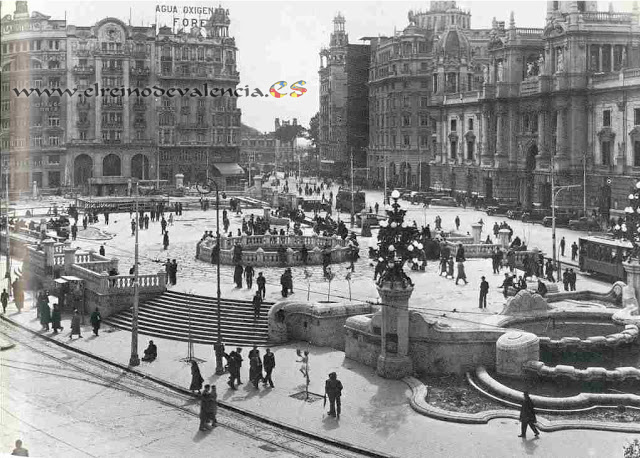
Plaza del Ayuntamiento 1933 and today

plaza1

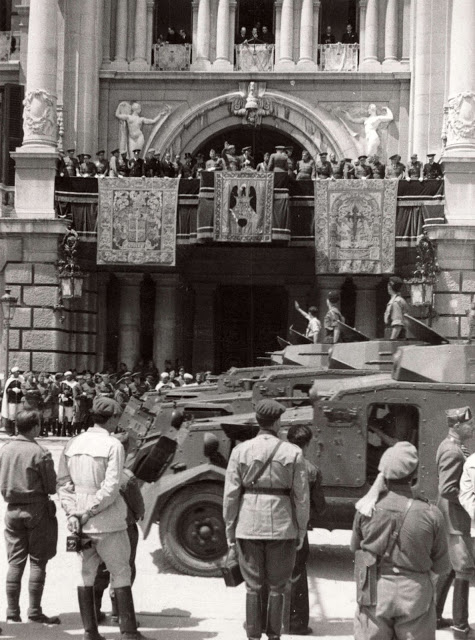
The tourist route can wait, though it will be filled with cruise-ships parties following their guide soon. That’s new. I wander into Plaza del Ayuntamiento, the main square of the city. Two police officers stand at the main entrance, which is still closed. They both smile and nod hello as I walk by; that’s not new. There are a few other tourists out early in the day, but are all at least twenty years older than me. I have learned a lot about Plaza del Ayuntamiento in my absence – it was called Plaza Emilio Castelar during the Second Republic, and Plaza del Caudillo when Franco took over. They tried Plaza del País Valenciano for a while, too. Since I’m in Spain on a civil war research trip, I can stand and imagine the propaganda posters and protesters, plus soldiers from both sides of the battle.

ENTRADA DE FRANCO EN vALENCIA EN 1939

Town Hall balcony 1939 and today 

plaza

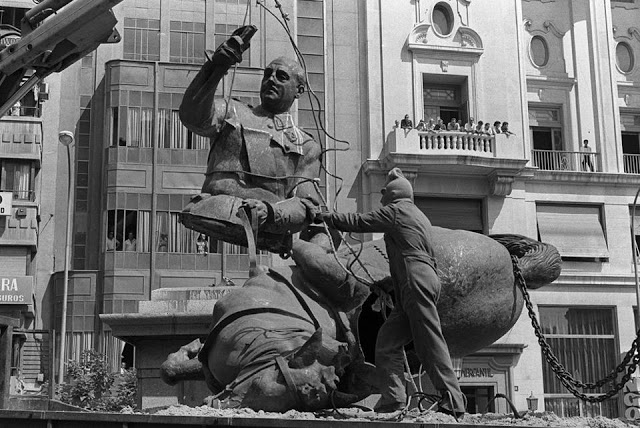
desmontaje estatua de Franco

Franco gets his marching orders

A statue of Franco stood in the square once, to commemorate 25 years of peace under his reign (no comment!). Now, a statue of Francesc de Vinatea stands in its place, a 14th century Valencian hero. The plaza once had a flower market embedded in the centre, underneath a fountain-littered promenade, but that was ripped out in 1961. Now, flower vendors are stalls that dot around the open space. I buy some; pink somethings (I don’t know my flowers!), for no reason than to say hello to the old man who was selling them. The plaza teems with people driving around its exterior, the audible hum of life is in full swing. There are stickers on posts; protests against government cuts to education. Valencia’s voice is coming in to protest later, but I don’t know that yet. My first day in Valencia years ago, as a new citizen to the city, there was a fireworks display in the plaza. I had never seen such a spectacle; Valencia like to burn things with a lot of noise. It was to commemorate an event being staged, the same one that had brought me across the world. The fireworks, which were let off in the centre of the plaza, where I’m standing, were so loud that a glass bus shelter shattered into a gazillion pieces. Nobody batted an eyelid; shit happens. Now, my friends, who shared the moment, aren’t here. We’re spread out across the world again. It changes the feel of the city remarkably.

fireworks

BOOM

I leave the plaza and the older part of this ancient city, and head down the pedestrian Carrer de Ribera. It’s cold in the shade. The stores are still closed, but the cafes are all open, filled with people having breakfast at 9am. Everyone looks so relaxed. I’m glad I brought my pink scarf on holiday; it seems to be part of the fashion. New Zealand may as well be another planet when it comes to clothes; finally my scarf has a home. I’ll need to buy more before I go back.

Carrer de Colon is busy, its one way traffic speeds past as I wait to cross the wide street. A bus stops and many people, mostly women, get off, obviously on their way to work. It’s the Number 19 route, almost at its end. I’ll take that bus at some point, it’s the route I took many times before. One woman is loudly telling another that her period is really bad this morning. There’s that over-sharing again. I cross the street, next to a woman pushing a worn-down stroller. The girl, perhaps three, looks tired. The mother is struggling to push the child on wobbly wheels and suck on her cigarette. I don’t like to tell people how to live their lives, and hate to receive advice, but smoking like that in a child’s face annoys me. I forget I come from a place where smoking is considered strange.

toros

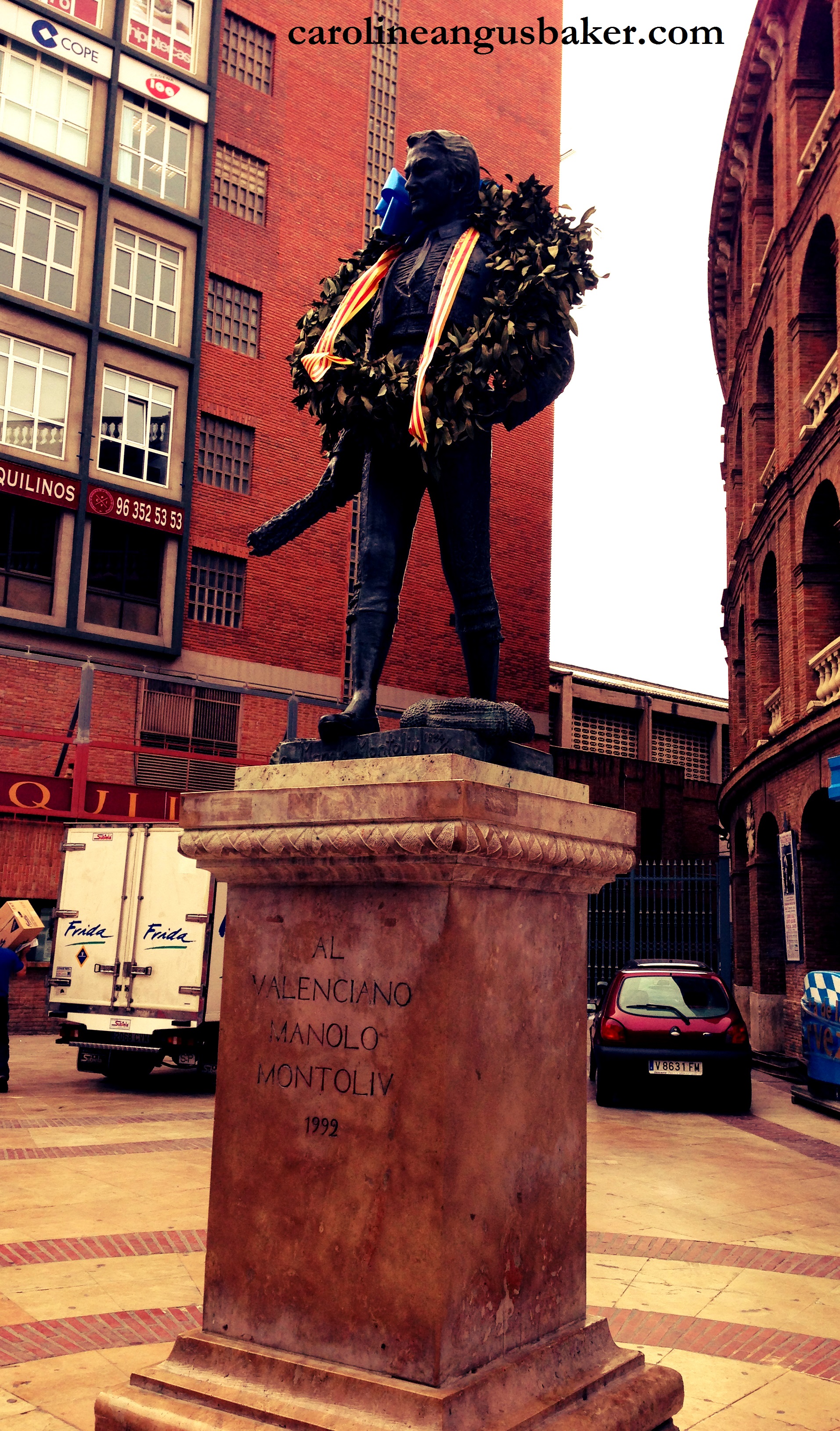
I pass by the bullring, Plaza de Toros de Valencia, which is closed this early, even the ticket booths. Posters are up for the upcoming weekend fight. I must go (it will later disappoint me). The statue of Valencian fighter Manolo Montoliu has had an artificial wreath put around his neck, and it’s covered in ribbons the colour of the Valencian flag. The anniversary of his death has just passed.

Down busy Carrer de Russafa, past a panadería selling the most delicious-looking pastries, and there is a space in the line-up of conjoined buildings. I think of Jason Webster’s novel, A Death in Valencia, when the main character’s apartment block collapses in this suburb. There hasn’t been a building on that site in years. Wasn’t it once a public carparking space? Knowing Valencia, they probably went to build something and found Roman or similar artifacts. The place is good for finds like that.

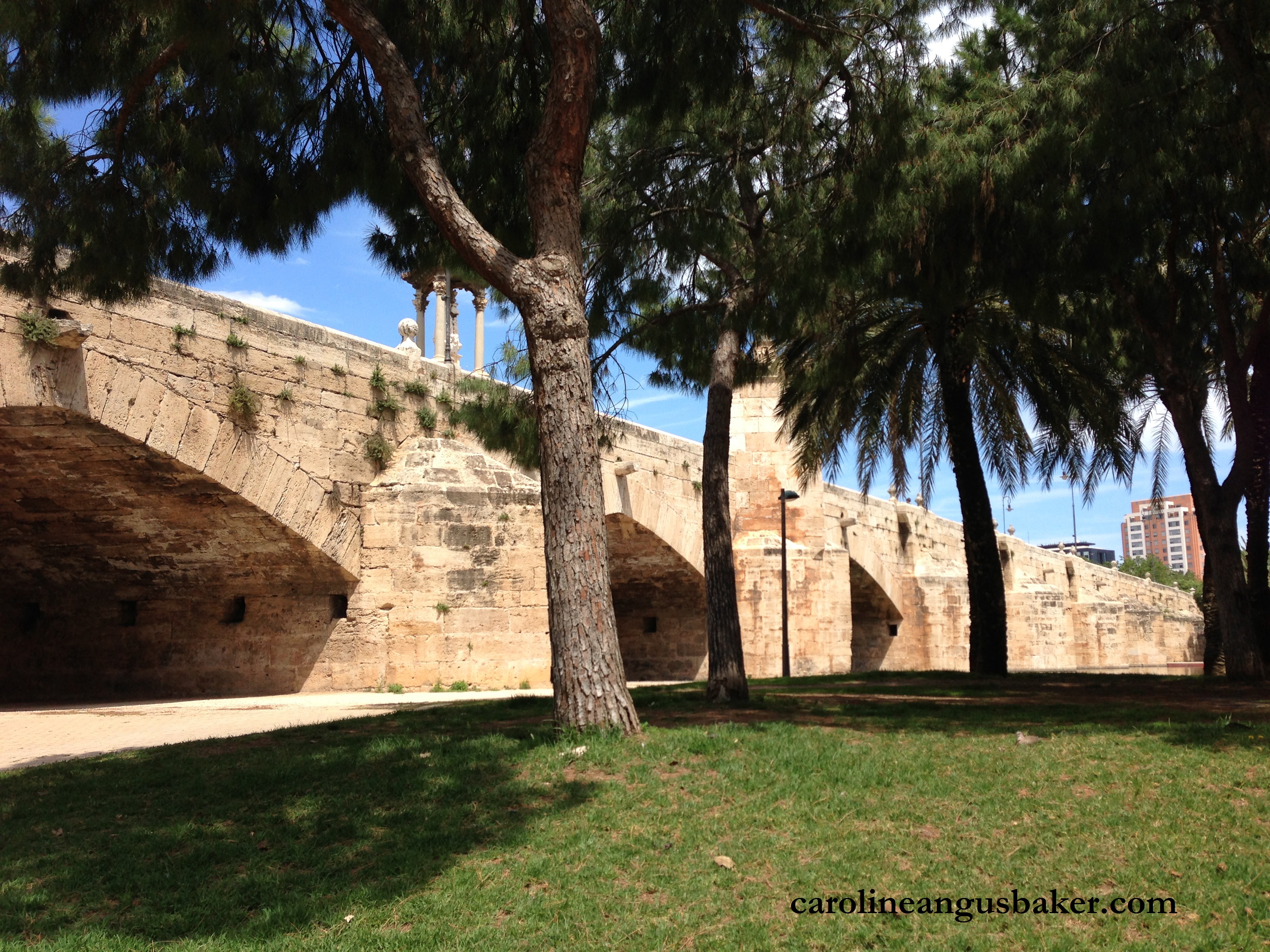
Down Gran Via del Marques del Turia, a street I’ve wandered many times. You can wander either side of the multi-lane street, or through the middle, in the tree-lined walkway lovingly placed in the centre. The cobbled path is dusty, like Valencia always seems to be. There are many beautiful buildings along here; I had several friends who lived here, in gorgeous apartments. They don’t live here now; they were in San Francisco or New Zealand last I heard. My doctor lived on this street. His office, in his apartment, has a plaque outside his door, and I touch it when I walk past. In very difficult times, it was good to have someone who listened to serious concerns. The old bookstore is still there, still not open for the day. Imagine all the stories hiding inside. The optometrist is still there; a young woman is opening the place as I go by. I wonder if the old couple who worked there have retired yet. I hope they were able to. The traffic is building as I reach the end, at the Pont d’Aragó, the bridge over the Turia across the street. The light says I can cross, but cars stream through their own red light anyway. It was always dangerous crossing here, though I don’t have my quad (yes, quad) stroller with me anymore. The sight made cars stop, but running down a single woman seems to be of no concern, as always. I stood on this bridge late one night, eight months pregnant with my fourth child, knowing I had to move away from Valencia. What a depressing evening.

turia

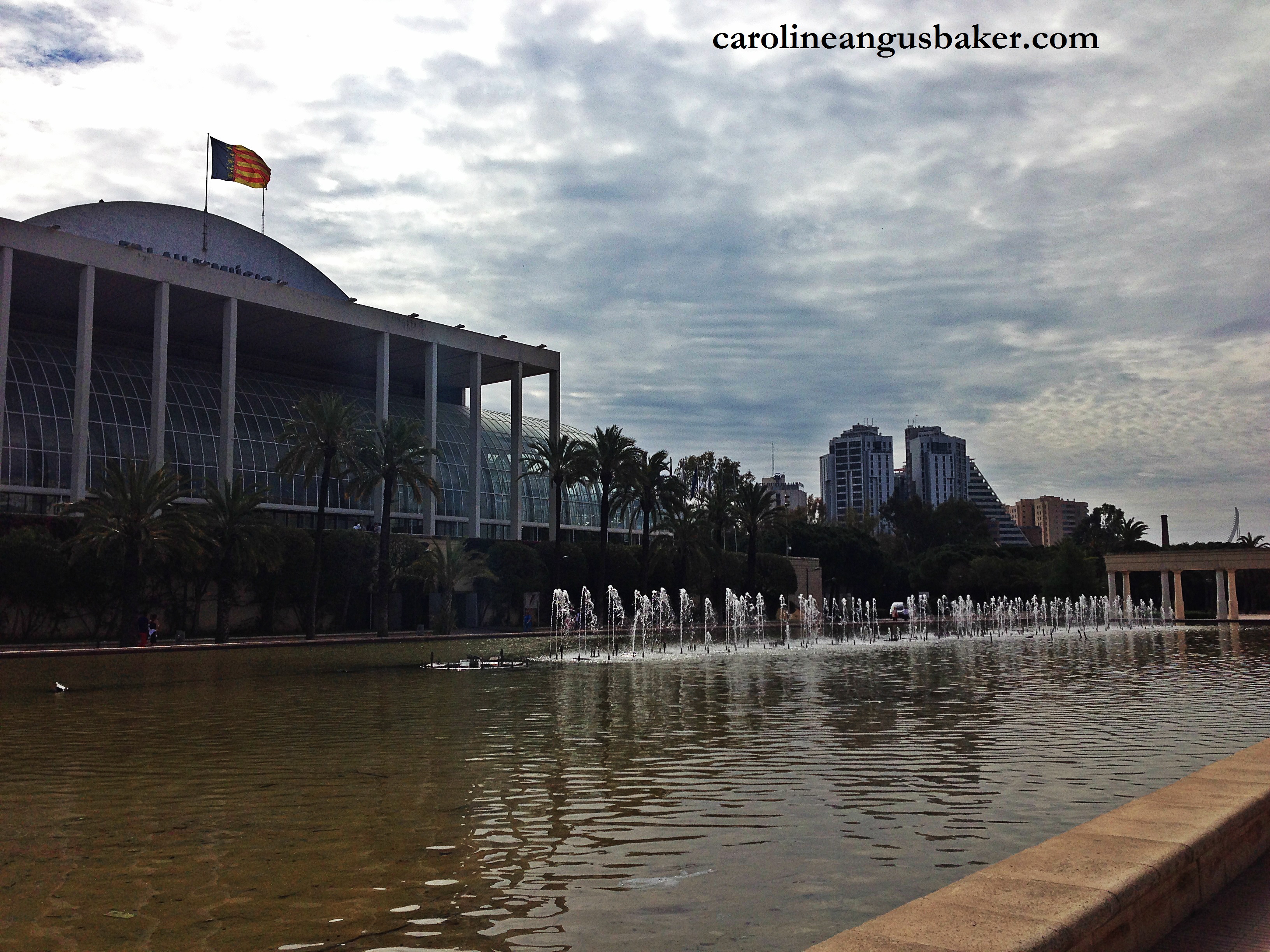
Into the Turia I walk, one of the grandest sights you will ever behold. Bikes drift past as I head along familiar routes. The Chinese guy is still doing tai chi in his usual spot after all these years. Keen runners are out, along with pairs of old women out for a stroll. One tells me that I’m beautiful enough to find a good husband. How generous. One of my favourite spots, the fountain outside the Palau de la Musica, is silent. My children loved running along the edges and watching the water displays. No one is playing now. A young guy is setting up a tripod and he goes out of his way to say hello to me as the sun begins to warm up the city. I remember seeing a friend here, a famous New Zealand sportsman, one hot summer evening as he was riding his wife’s bike, and had a pizza in the front basket. His front wheel wobbled when he waved hello. He’s gone now, runs some kind of hovercraft company these days. Another friend told me to stop running along here, because I was too pregnant; she’s gone now, too. There used to host open-air concerts here at night in the summer, maybe there still are. Sitting under trees with picnic baskets and enjoying noisy Spanish life; I hope the recession didn’t claim them.

Turia

A walk along familiar paths brings back memories, like the bike stand where tourists grab a ride, Gulliver playground, which is amazing, but in all honesty, not that clean and my children were too small to really enjoy it. The concrete mini-golf thing is still there, looking as worn as ever. The cafe with foul-tasting horchata ice-blocks is open, and mothers sit outside with young kids. When we took our kids there with friends, we went around as a group, and collected the rubbish before the children could play. After a while, you accept that as standard practice. I remember learning of a friend’s miscarriage while at the playground, and wondering how could I tell her that her husband had been cheating on her after that? She forgave him, once she found out.

park

The skateboard ramps have even more graffiti and it seems angrier than before. Spanish life has got harder. ‘My’ part of the park, the area around the Arts and Sciences has a huge amount of familiarity, yet feels so different at the same time. On the whole, nothing has changed. The Reina Sofia theatre, the giant eye, could use a wash, but the place is exactly how I remember. I walked along here every day, and after being away so long, coming back is a bizarre experience. There’s no way of explaining what is it like to walk past things that I have missed for so long that I almost felt as if they no longer existed. The playground where my children played is exactly the same; the bushes still rustle oddly, too. The kids always suspected giant rats (not sure who started that rumour. It’s just birds). I sit in a spot under the shade of a tree. I did that one day, with my sons, then aged 23 months and 7 months, and wondered why we were alone. Then I noticed it was 44 degrees, according the temperature gauge on Pont de Montolivet. I had a pain in my stomach and I had a feeling I was pregnant. Four weeks later I had that confirmed, while looking out over the park in my apartment.

Turia

It’s odd to see my part of the city so lifeless. Once, I couldn’t walk down the road without bumping into 30 people I knew, friends to chat with, husbands wheeling pink shopping baskets home for their wives, locals who were amazed at how many sons I had and how close together they were all born. Now, almost no one is about. The woman at the perfume counter I used to visit seems happy to have a customer when I buy a bottle of Prada. The smell is an instant reminder of my old life.

It’s easy to waste hours walking around old haunts, up and down streets, filled with memories. The facade is all the same, but the atmosphere has changed. Valencia moved on without me. Of course it did; I moved on without Valencia. I was only meant to be away three months, not six years. But it’s great to be back. The day is quickly lost by wandering old haunts. I stop by the Disney store; there was a robbery at the nearby Carrefour once. Friends had been there, and dived behind piles of stuffed Disney characters. One guy dived behind his girlfriend. I don’t think the relationship lasted much longer after that. Today, the whole place is quiet.

serranos

Walking among the tourists at Torres de Serranos

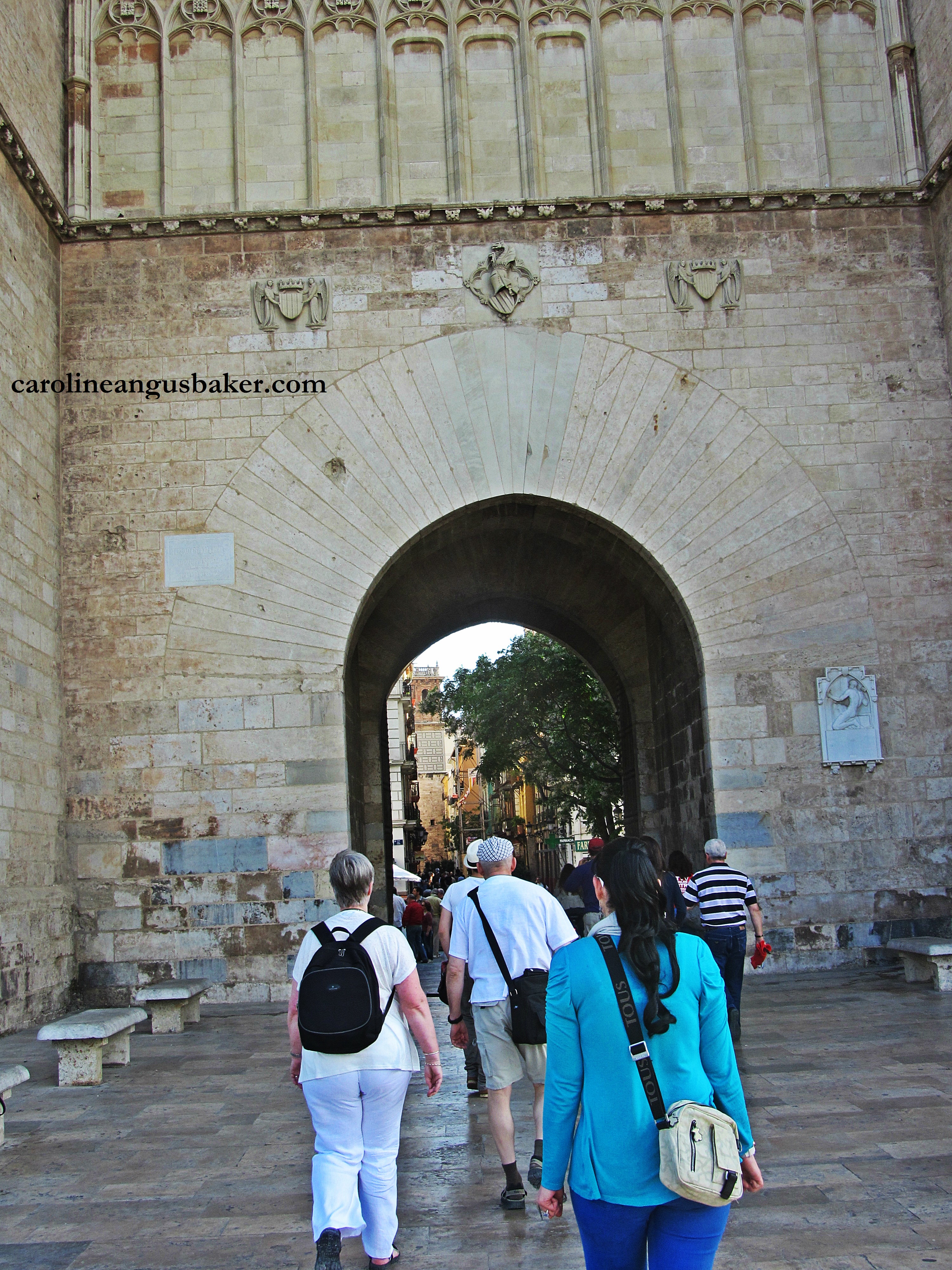
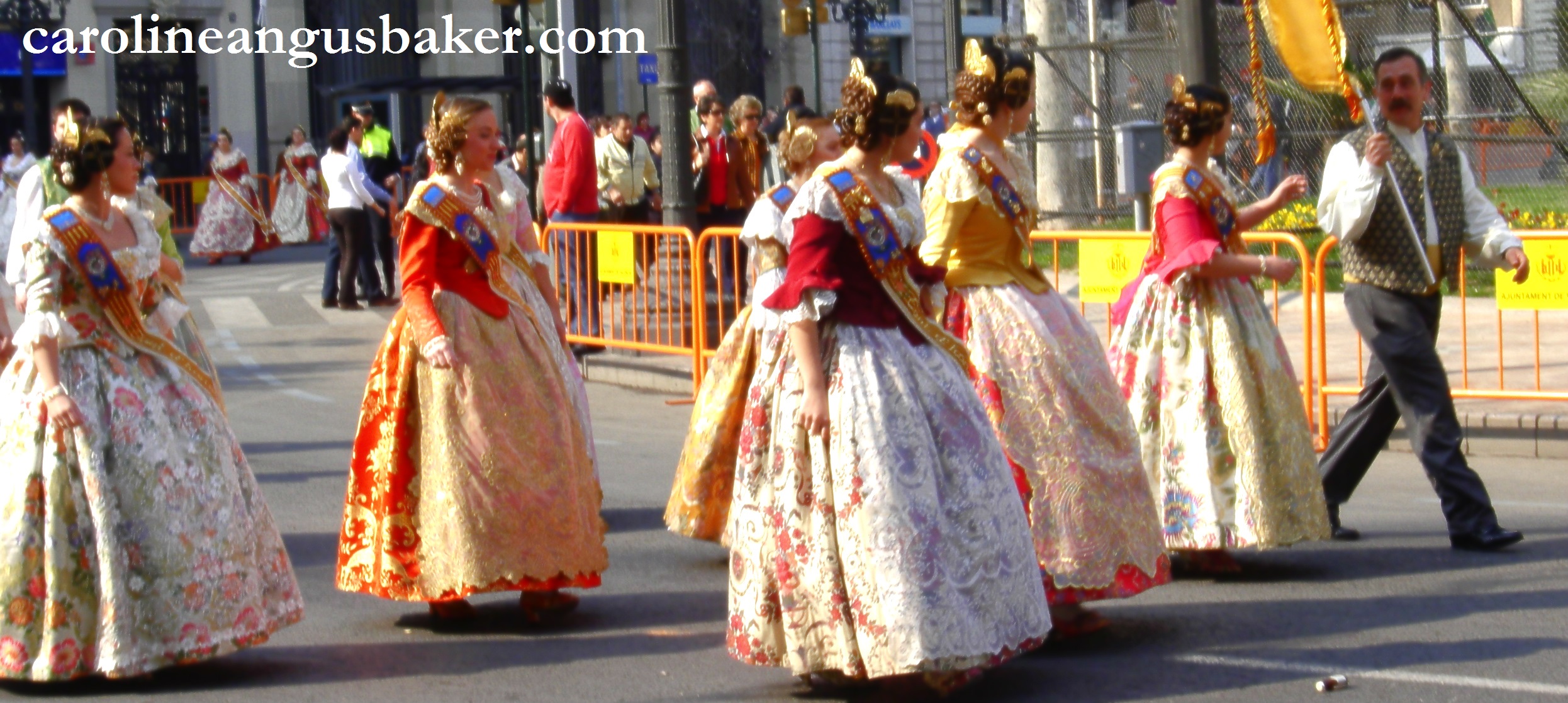
It’s time to walk back through the park, to Torres de Serranos and dive back through the old town. People to see, places to go. I have to play tour guide later, not something I’m sure I can do. The way I know the city can’t really be explained. Plaza de la Virgen is gearing up for a fiesta, but I can’t even remember which one. I’ve seen a few girls in their fallera dresses, so it’s something big. I sit at the fountain, a popular spot, and remembered sitting here with my father, while heavily pregnant with son number 3 of 4. My father has passed away now.

fallera

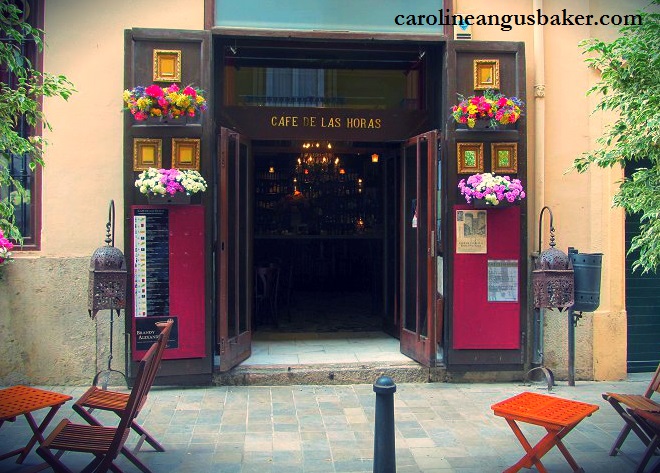
I see familiar spots, places I put in my first Spain novel. New(er) places will be in the next novel. I’ll visit those spots later. The beverages in Cafe le las Horas are as good as ever in the mid-afternoon, as is the decor. I might sit here for a while; little do I know I’ll be wandering busy streets later and getting caught up in a giant-sized anti-government and banking protest. This spot will do nicely while I laugh with a friend. Valencia exists entirely inside the people who are there. 

cafe

All 2013 photos author’s own. Valencia history photos courtesy of Juan Antonio Soler Aces

A LITTLE JAUNT TO SPAIN – REVIEW PART 7: Valle de los Caídos: A trip to Franco’s tomb to see a divided Spain

me1

You know how Germans dress in their best every Sunday and go to leave flowers and prayers at Hitler’s grave? Oh wait, they don’t, they opened up about their past, dealt with their issues and moved on as a people decades ago. So why are Spaniards having family picnics near the tomb of fascist dictator Francisco Franco? I packed my best possible neutral opinion and set off into the Madrid forests to find out.

“The moment you move the soil over shallow graves, the agony of Spain will pour out, like fresh blood from a wound. All that pain and hatred is covered by a thin layer. Don’t stir up something you can’t understand” – Blood in the Valencian Soil

I’m no ignorant tourist. I’m aware of the tensions that surround El Valle de los Caídos, the Valley of the Fallen. Some say it shouldn’t be open at all, and for a time when the PSOE was in power, it was closed to the public. It was one of the few places on my trip where I was the only foreigner, trying to quietly pass between families of all ages inside a macabre and eerie Basilica inside a mountain.

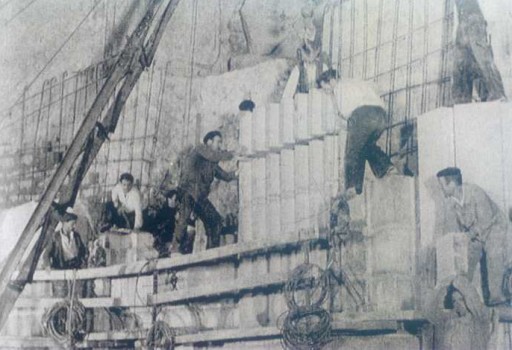
What is Valle de los Caídos?  It is a giant memorial to those killed in the Spanish Civil War, but ended up as a monument to only the Nationalist side, headed by ultra-conservative war winner Franco, who is buried there. Even the history surrounding the place is murky. ‘Official’ records say it was built by approximately 2,600 workers, and a handful of them were Republican (left-wing anti-Franco) prisoners. (Long story short, Republican prisoners were basically anyone the new dictatorship didn’t like. Proof that ever committed any crime, against the public or the State was tough to find, unless being a Republican soldier counts as a crime, and it was back then). It was commissioned in 1940 and finished in 1959, but a more accurate report was of 20,000 Republican prisoners taking part, and the number  killed in the process is unknown, some say dozens. You can get an idea of how touchy this subject really is.

Franco40

Franco inspects the site of Valle de los Caídos in 1940

buildwork

Republican prisoners building the cross

bodies

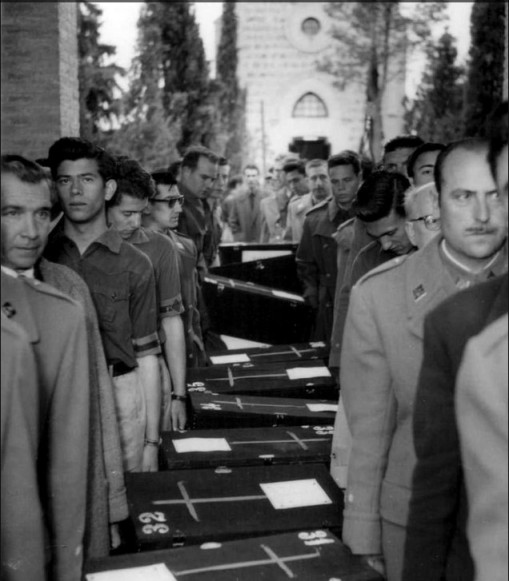
Remains of soldier killed in Toledo arrive to be reburied in 1959

1290096772854

Watching the opening of Valle de los Caídos in 1959

(click to enlarge the photos will launch an amazing slideshow of pics)

Franco created Valle de los Caidos in the Sierra de Guadarrama, the mountains outside Madrid city. Nearby is San Lorenzo de El Escorial, the once summer palace of the royal family (I visited, and the golden tomb is WELL worth the visit – for another post).  The trouble is, Valle de los Caídos was filled with the bodies of killed men, Nationalist (Franco) soldiers and sympathisers. It was a civil war, Spaniard against Spaniard, but those who opposed the rebel army takeover of the Republic were simply forgotten. José Antonio Primo de Rivera, founder of the fascist Falange party is buried there, and Franco was also placed inside a tomb under the basilica in 1975. The exact number of bodies laid to rest inside Valle de los Caídos is unknown, and could be anywhere from 30-35,000. In the last 10 to 15 years, a large number of Republican families and organisations have found the strength and courage to dig up their relatives who were murdered and thrown in mass graves around Spain. However, some have been removed from these graves and placed in Valle de los Caídos without family permission, which only serves to give this place an even more heartbreaking feel.

view1

View while driving up the mountain

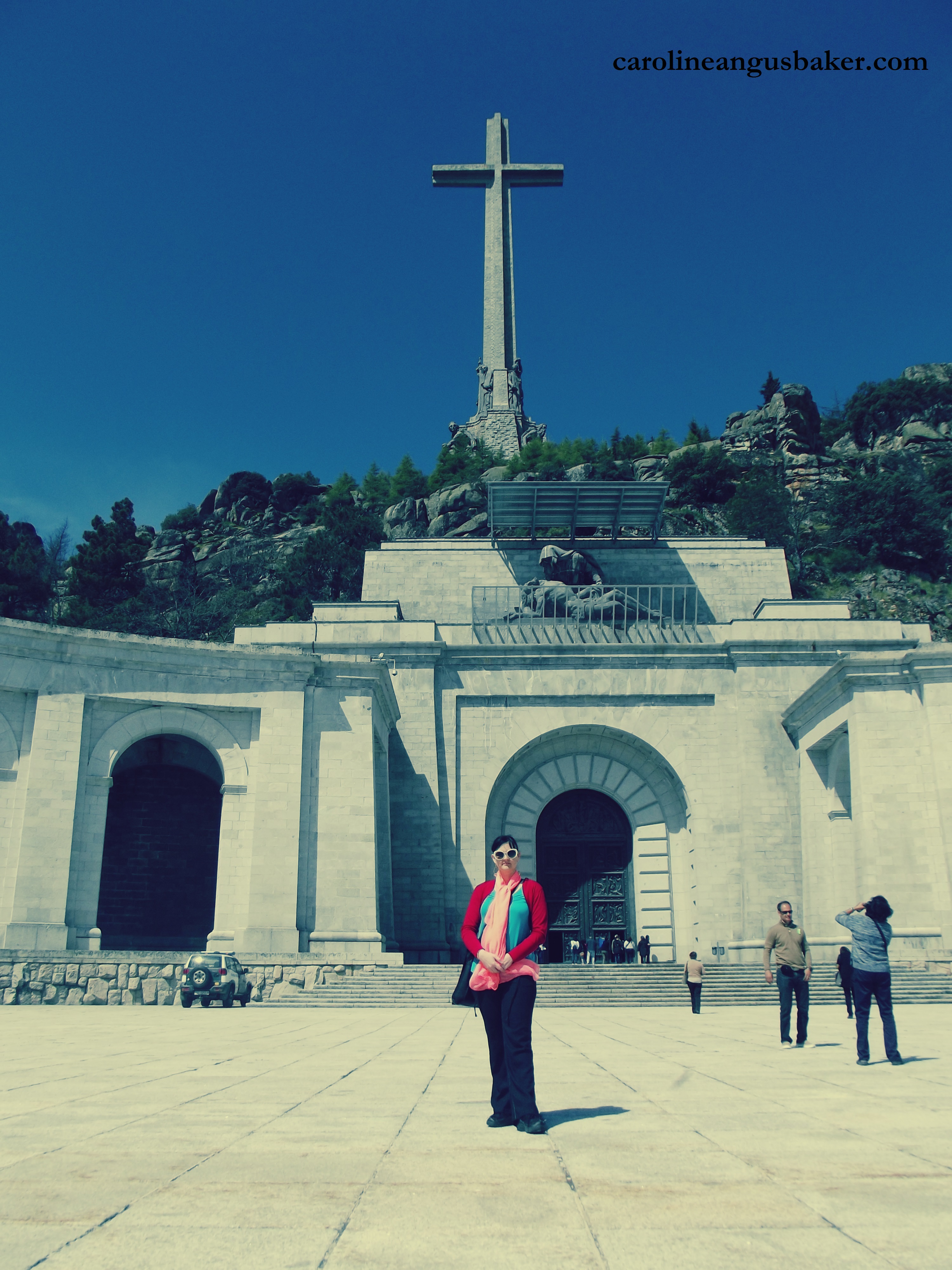
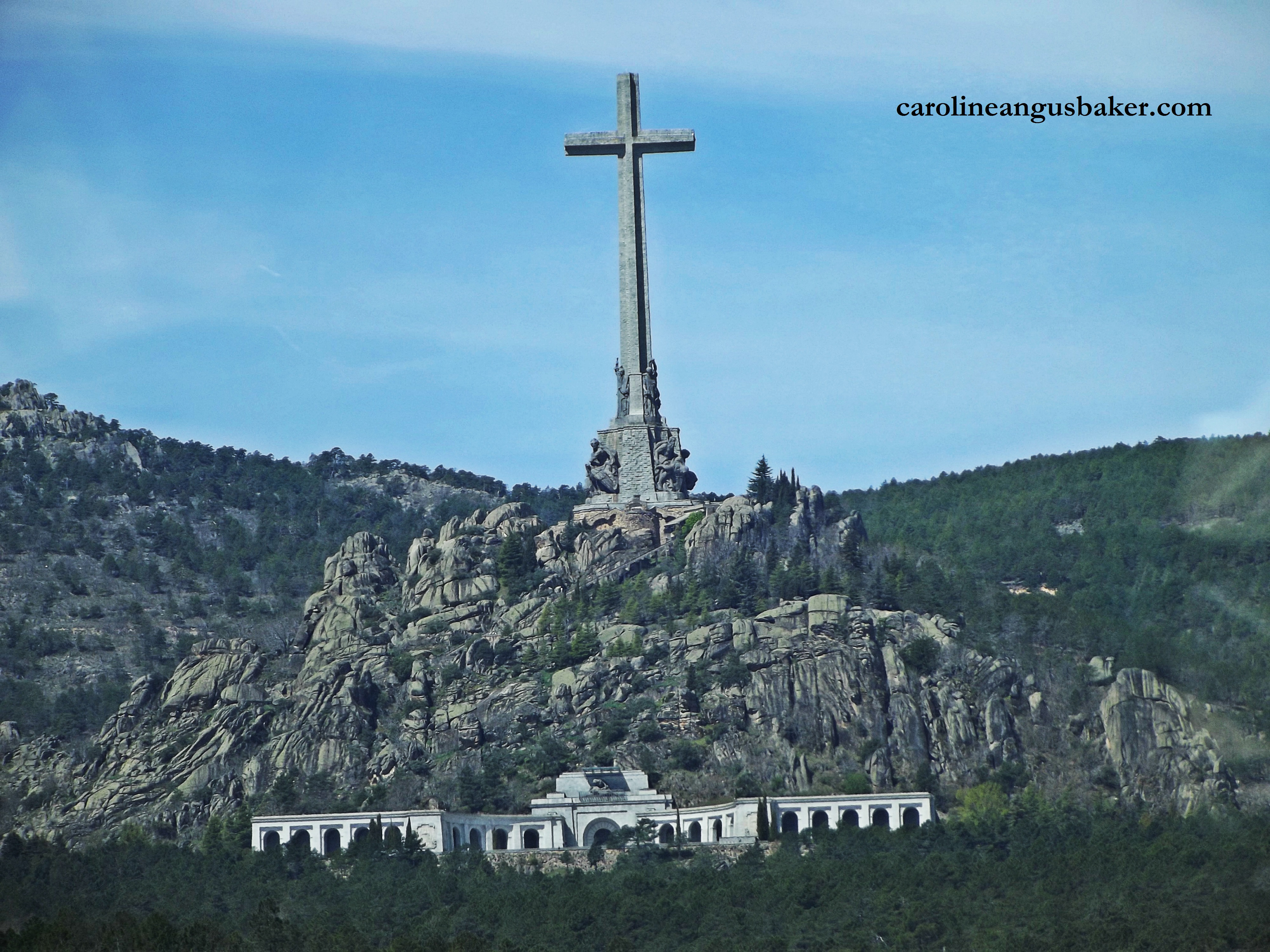
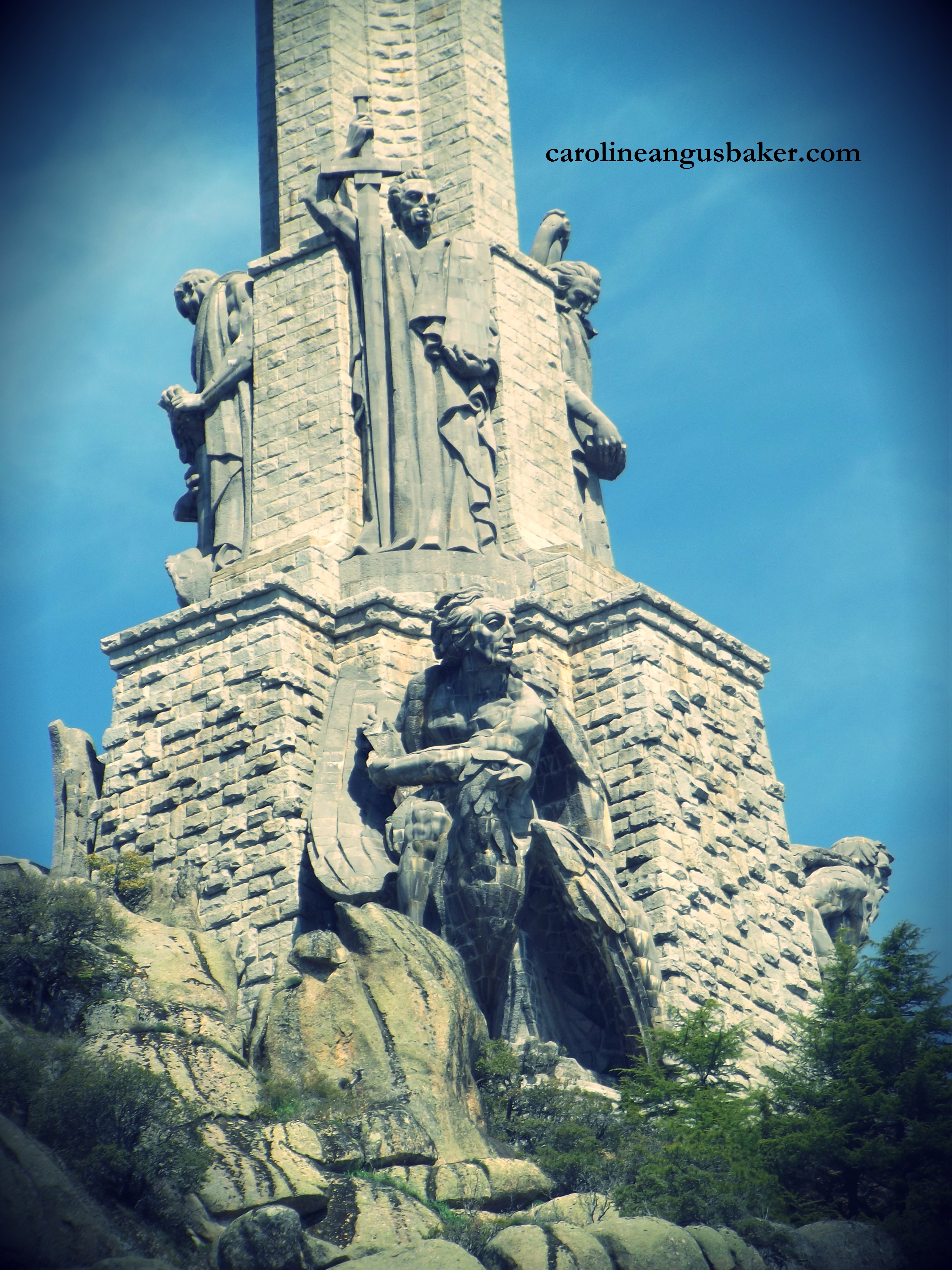
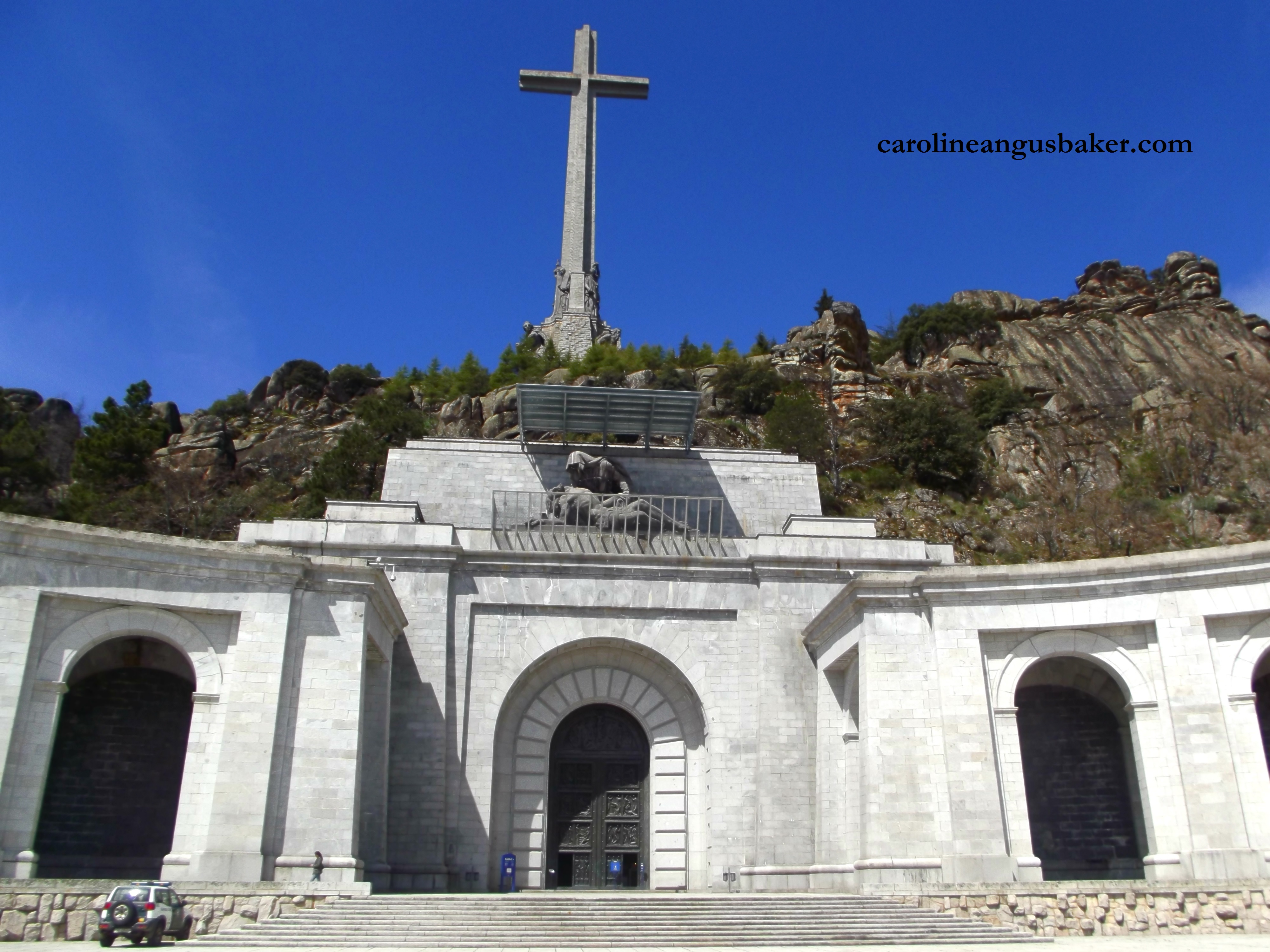
Political views aside, the sight of this location is incredible on its own. You can see it while driving along the motorway, sticking out of the otherwise peaceful mountains the surround the north side of the Madrid province. We went through an innocuous gate off the main road to El Escorial and made our way several kilometers up the mountainside on a bright and beautiful Sunday morning. You constantly catch glimpses of the behemoth through the trees, but until you are standing below the enormous cross  built on the hillside (152 metres, the worlds’ tallest), you cannot grasp the size and scope of the this place.

cross1

cross2

DSCF5120

The carpark was filled with cars and buses, and I suspected I was about to turn into another touristed location. Not so! Once at the arch doors to the entrance, the only people in sight were the Guardia Civil. The place itself is situated in a beautiful location and the quality of work done is exquisite. The place could have been built as a place to honour those lost in the war and the healing of a great nation. But given that the crypt is a basilica, and that the church oppressed the Spanish population and the Republican (or left-wing if you prefer) side didn’t support the church, there was never the possibility that the monument could honour both sides of the nation.

outside1

Entrance archway

outside2

View of the Sierra de Guadarrama

outside3

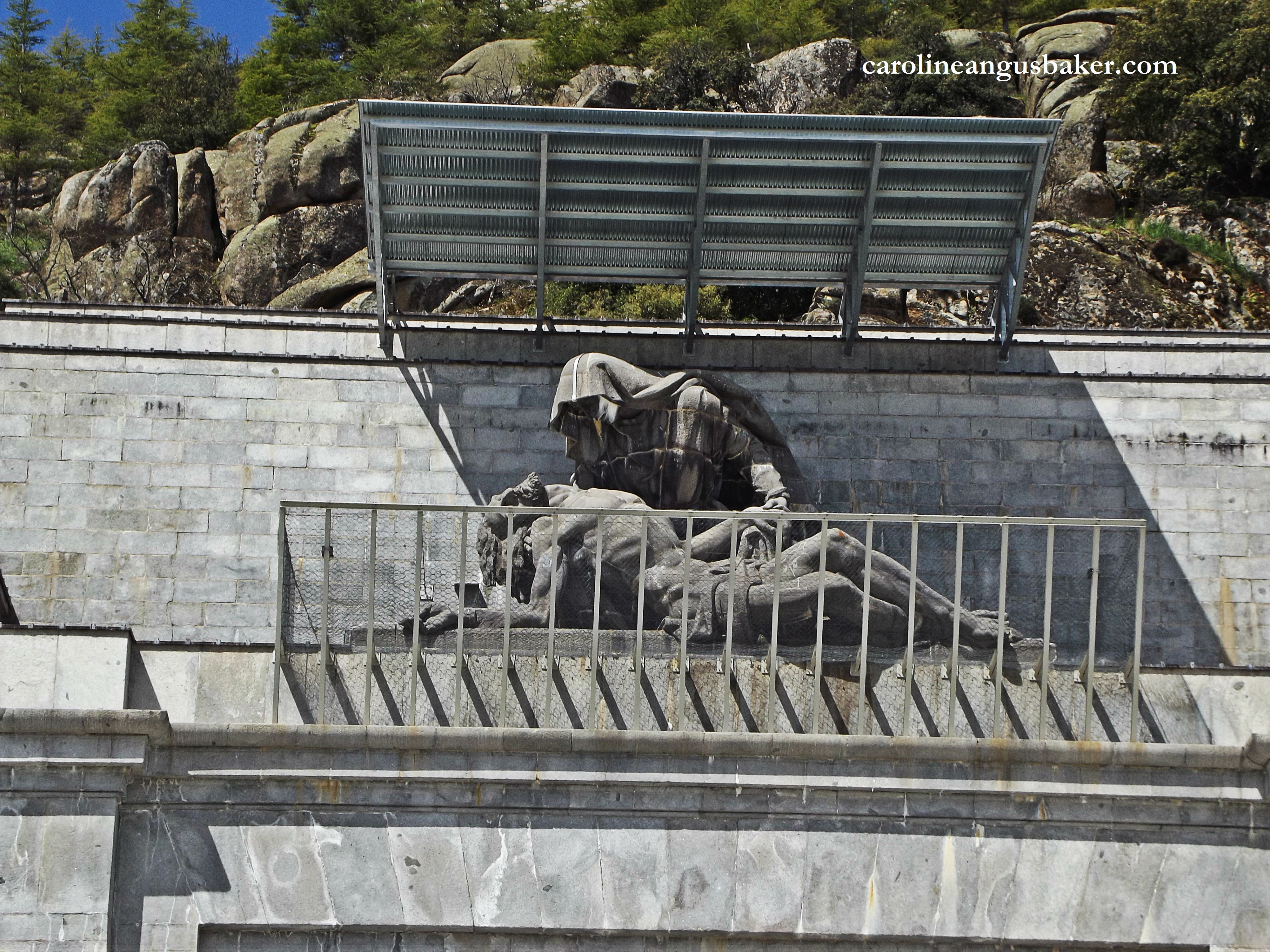
Statue over the entrance – The Pietá

I stepped inside, sadly unsurprised that there is gift shop (After all, what child doesn’t want a gift of a colouring book and pencils from a crypt, or a fan with Franco’s grave printed on it?) I put my camera in my satchel, as photos were forbidden, but I had my iPhone in my pocket, just in case. Then I entered the nave.

nave

Nave

Spain_Valle_Ceiling-1280

Ceiling over the altar

From the moment you go inside, the overwhelming and solemn feel of the cold and dark place takes you over. Giant gloomy and menacing angels brandishing swords bear down on you. The nave is filled with masterpieces of religious painting and tapestries. The attention to detail is second to none. I paused to take in them and the angel statues, but the foreboding sense of the place had already sunk into my bones. Mass was finishing up as I arrived at the altar, and I sat down quietly to listen to children sing in the choir. Children were singing in this place that spoke of death.

angel

Altar angel

Mass ended and the faithful began to wander around the altar, me included. The first thing I noticed was not the menacing  angels, or the elaborate golden Jesus, but the grave of José Antonio Primo de Rivera, which someone had left flowers. Now, can I judge those who come here? No, I can’t. I don’t know why they come. Perhaps their loves ones were buried here,  as Nationalist believers to the Franco cause. It was a civil war and everyone lost one way or another. Can I, or anyone, look down on these people for coming  to pray? No. Whether it’s for a loved one, to feel closer to the history of Spain, or even if they supported Franco, that’s their decision. But what about the people who came to leave flowers on the grave of the founding father of Spain’s fascist party? What was the motivation there? A grieving loved one, or someone with old evil ideas that haven’t been forgotten? It was shiver up the spine stuff.

IMG_1639

Altar

grave

As priests wandered about and nodded hello, I found what I had (kind of) came for – the tomb of Franco placed on the opposite side of the altar below the semi-circle of wooden stalls made for the monks and the choir. There lay flowers on the grave, and this time I saw no reason why anyone would place them there. There are many reasons why people continue to support Franco (and it’s a discussion too long for this post) and I don’t see the merit in any of them. Just to the right lay more floral tributes – dozens to be precise, which had been placed to one side presumably because of the sheer volume. A few people were taking photographs, under the watch of a guard. These people had laid the flowers and wanted to capture the moment, no mistaking their alliances in this case. I asked if I could also take a photo with these people and got permission. Why take it? I don’t know, it’s like watching a car crash, it’s awful but you can’t look away.

I was surprised by the state of the place. Perfection? No. Built into a mountain, they must fight their own war with damp, and you can see that in the granite stonework. Water seeps in here and there, which only gave the place a more unearthly and morbid feel. After all, we were all underground, surrounded by graves…

To the left and right are small rooms, with rows of seats and monuments to Spain’s fallen. People lit candles and families laughed and chatted with priests. What says family day out more than this? I sat in the right room, the entombment, which featured an alabaster Jesus statue. I sat and looked at the wall.  Caídos – Por Dios y Por España. Fallen – For God and For Spain.  All of Spain? Many disagree. Republicans denounce this place, and many here on this random Sunday wore Falange symbols on their lapels.

Placa_Valle_Caidos

Inside the chapel of the emtombment

I will admit it – I silently cried as I sat there, which drew the attention of a priest who thought I needed comfort, and the ‘comforting’ hands of old ladies on my shoulder. Me, the young Catholic attending Mass here? Oh boy, that couldn’t be more untrue.

I headed back through the place, fairly certain I wouldn’t ever be back. I stopped by the gift shop to buy a book on the place, in Spanish, about how the place has reconciled Spain. Hmm. I also grabbed an excellent copy of a collection of civil war photographs. The crypt trinkets and religious adornments could stay where they were. After all, who would wear a Valle de los Caídos t-shirt? Why would you, and for what purpose?

The shining moment came as I left the crypt and stepped out in the sunlight. There stood a group of men, all aged 70 or more, hailing a fascist salute at the cross above the entrance. It was well and truly time to leave.

view

Panoramic view from the main entrance after the fascist saluters said hello and went inside

If there is one thing, it’s that this place is full of emotion. Good emotions? Not all of them. No good ever came from a fascist salute, but it would be too simple to label everyone who visits there, whether they’re crying at Franco’s tomb or having a picnic outside in the sunshine. I am not a religious person and I am not going to tell Catholics how to pray to their God in that Basilica. The books I bought there, their glossy pages gloss over Spain’s history entirely – after all this time, the war and the subsequent dictatorship is not talked about like it should be. Spain shouldn’t have to hide its past. It has been 74 years since the end of the war and yet its presence still lives in Spanish life, whether people say so or not. In 2011, it was decided that moving Franco’s body would be a way of restoring Valle de los Caídos’ image and making it a truly impartial monument to Spain’s fallen, however as the crypt was elevated to Basilica status, the church can decide, and their opinions are not so easy changed.

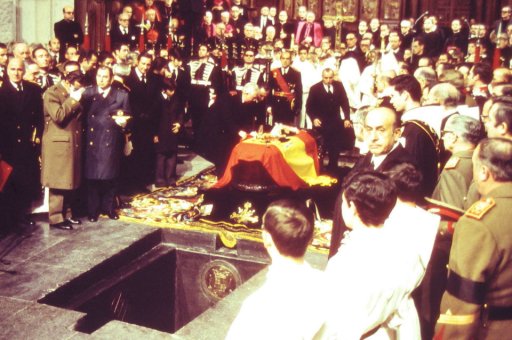
Entierro-de-Franco-en-el-Valle_54064507265_960_639

Franco’s burial in 1975  I wonder who the crying  guy is on the left (click to enlarge and view slideshow)

My personal opinion? The place is worth the visit, despite being a pain to get to if you don’t have a car. I travelled alone, and would I want to take my young family there? I’m honestly not sure. It’s not something you will find in the Spain brochures during your Ryanair flight to the beach in Benidorm or Malaga. But if you’re into Spain history, or have a personal or familial connection to the civil war (as have I) you really should visit. Just leave your camera behind and hush your opinions while you’re there. I know what side I stand on, and I took the bus back to Madrid, convinced more than ever of my opinions. But they remain mine. The other people there were very polite, and believe in what they love – that Spain was better under Franco. Nothing I stumble out in Spanish will make the slightest bit of difference. Check out this photo of a wedding over Franco’s tomb though, that was a surprise find. Just goes to show how divided this place can make people.

Photos by abc.es – protesters waved Republican flags and supporters gave out fascist salutes when Valle de los Caídos reopened. The salute seems to be pretty popular

valle-caidos

Want to visit for yourself? – Valle de los Caídos website

Up next, Part 8 of A Little Jaunt to Spain…. Learning to be a tourist in Spain

Click here for past editions of A Little Jaunt to Spain – Spain 2013 in Review

All photos are author’s own, or linked to original sources