Valencia Photos of the Month: Palacio Ripalda

After doing a well-known landmark in the last installment, this week is an iconic Valencian scene that was wiped from the earth in a moment of a politician’s stupidity. Not sure which one? Palacio Ripalda, which would sit on the north side of the Turia over the Pont del Real bridge, had the castle not met its demise.

In 1889, María Josefa de la Peña Paulín, the Countess of Ripalda, commissioned a palace from architect Joaquín María Arnau Miramon, on Paseo de la Alameda, over the river from the central city of Valencia. The design copied French chateaus, unseen in Valencia, and construction was complete in 1891. The castle mimicked the rise and fall of the family who had her built.

The tale starts with the story of  José Joaquín Ramón Sánchez Agulló de Bellmont y Ripalda, Count of Ripalda, a member of a rich ancient family who had owned many properties through the Valencian province. As typical in Spain and its feudal system, the family had a noble title and was super rich for centuries, and lorded over property here, there and everywhere. The family had streets, suburbs, walkways and lands named after them wherever they owned property. The Count was a fine arts lover and was president of the Royal Academy of San Carlos from 1860 until 1868. He also worked for the Real Sociedad Económica de Amigos del País (Royal Economic Society of Friends of the Country).  In 1863 when the International Red Cross was founded in Geneva, Ripalda was Spain’s representative and was also a conservative MP in Valencia. He went to be the president of the Red Cross in Spain, and generally lived a happy, rich lifestyle.

In 1876, Count Ripalda died, his French-Spanish aristocracy wife, Countess Maria Josefa inherited his fortune and property. She set to building the Passatge Ripalda (off Calle San Vicente), an alleyway of shops in a new European style. Apartments were built around the passage, giving it an arcade feel and led out onto Plaza Pelota (now Calle Moratín). She also commissioned a grand hotel, home to Valencia’s first elevator. But the big project came when the Countess decided to build a grand family home on the farmlands on the edge of Valencia city, next to the Jardines del Real (Royal Gardens) and along Paseo de la Alameda, the road against the edge of the river. After multiple drawings and changes with her architect, Joaquín María Arnau Miramón (who also did Passatge Ripalda, and was said to have an ‘intense professional relationship’ with the Countess, make of that what you will), the project went over budget but was completed to the Countess’ whims. The Countess didn’t live long after her castle was completed, but had enough time to fill the place with fine furnishings and artworks, all of which disappeared over time.

The castle belonged to the next Countess, but when Valencia became the capital of Spain during the civil war, Palacio Ripalda became the headquarters for the Ministry of Commerce. The last Countess died not long after the war was over and with no children, the castle was handed to her nephews, not part of the ancient Ripalda lineage. The royal title has since been renewed when relatives were appointed the Countess and Marquess name.

Palacio Ripalda fell into a state of disrepair, and while the outside facade remained in relatively good condition, the interior was said to have suffered, though this is in dispute. As time went on, and Valencia entered its construction boom of the 1960’s, the castle and its gardens started to get in the way of a new era of the city.

In 1967, as the castle sat unoccupied, Valencian mayor Adolfo Rincón de Arellano wanted to demolish and redesign the trade fair grounds next to the castle as the city expanded. It was quickly decided the castle too had to go. Despite complaints from locals and the press weighing in to save the landmark, with the help of politicians and businessmen getting together for their own gain, the castle was swiftly torn down in the name of progress. Legends started to swirl that the castle would be moved to Florida, where the stones had been sent, to rise up again, though it was more fancy than reality. The castle was torn down 100 years after another idiot spot in Valencia’s history – the tearing down the city walls, which would have made Valencia a (even more) unique location. Time obviously doesn’t stop politicians from making bad decisions.

After the demise of the castle, an apartment building was built, called the Pagoda, which isn’t exactly pleasing to the eye (though the apartments inside are nice and simple enough, I suppose). The Monforte gardens remain behind the complex, a little ode to the palace that once belonged to the regal Ripalda family.

Historical photos courtesy of Valencia Historia Grafica 
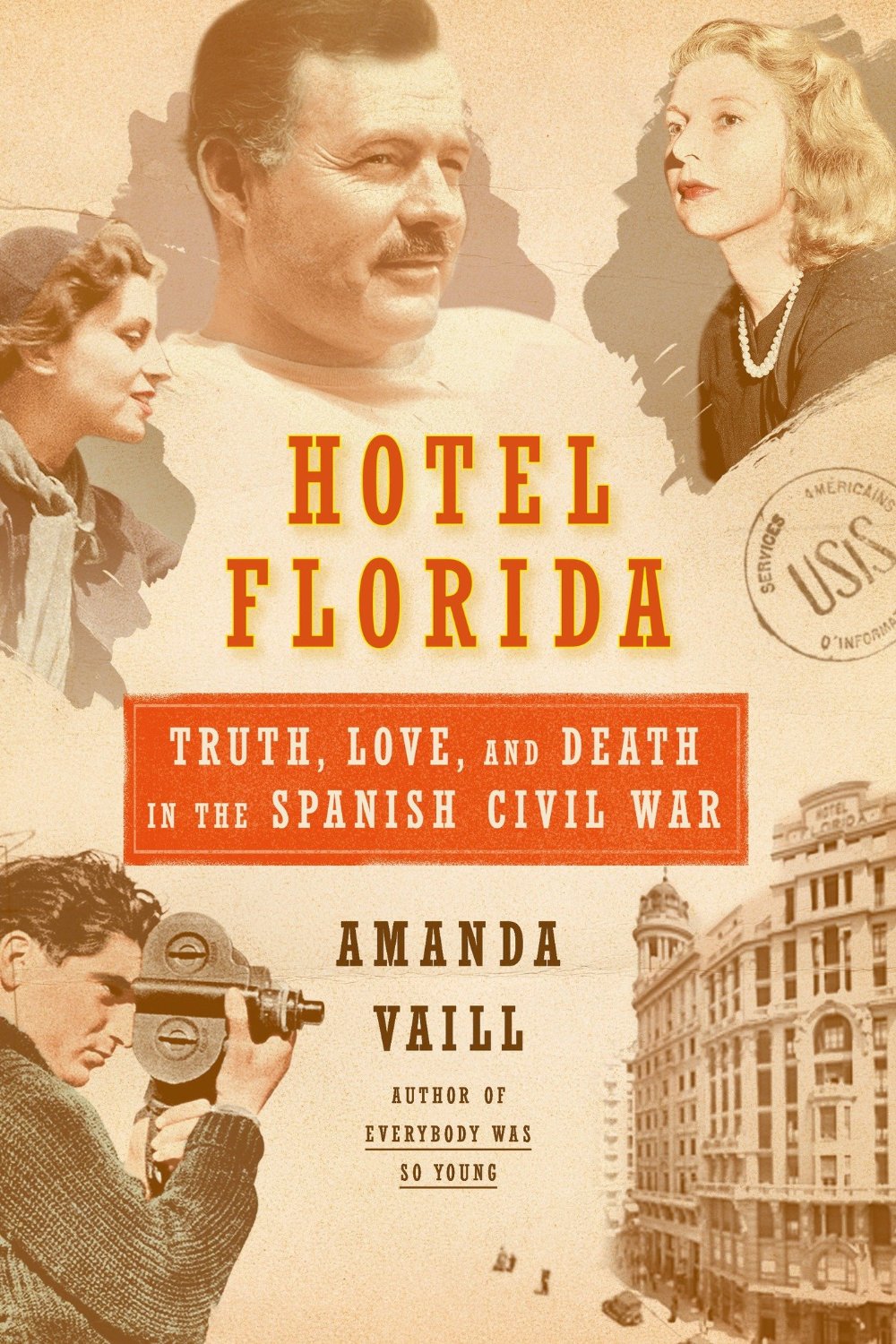
SPAIN BOOK REVIEW: ‘Hotel Florida: Truth, Love, and Death in the Spanish Civil War’ by Amanda Vaill

Hotel Florida

Madrid, 1936. In a city blasted by a civil war that many fear will cross borders and engulf Europe—a conflict one writer will call “the decisive thing of the century”—six people meet and find their lives changed forever. Ernest Hemingway, his career stalled, his marriage sour, hopes that this war will give him fresh material and new romance; Martha Gellhorn, an ambitious novice journalist hungry for love and experience, thinks she will find both with Hemingway in Spain. Robert Capa and Gerda Taro, idealistic young photographers based in Paris, want to capture history in the making and are inventing modern photojournalism in the process. And Arturo Barea, chief of Madrid’s loyalist foreign press office, and Ilsa Kulcsar, his Austrian deputy, are struggling to balance truth-telling with loyalty to their sometimes compromised cause—a struggle that places both of them in peril.
     Hotel Florida traces the tangled wartime destinies of these three couples against the backdrop of a critical moment in history. As Hemingway put it, “You could learn as much at the Hotel Florida in those years as you could anywhere in the world.” From the raw material of unpublished letters and diaries, official documents, and recovered reels of film, Amanda Vaill has created a narrative of love and reinvention that is, finally, a story about truth: finding it out, telling it, and living it—whatever the cost.

~~

I rarely read reviews before I start reading a book, so they don’t influence my opinion while reading. However, Hotel Florida seemed to pop up everywhere just prior to its release, with reviews written by those with advance copies and the like. Once I received my own copy of the book, I already had the opinions of others going around in my head. For once, it’s not a big deal, and the word that seems to be thrown at this book is ‘compelling’. With characters like Hemingway, Capa, Taro and Gellhorn, how could it be anything but compelling? Given that these characters are not new to anyone, how can pre-conceived stereotypes of characters not interfere with reading? There was only one way to find out.

For those without knowledge of the Spanish Civil War, the book starts out with timelines and facts of the who/what/ where/why’s of the conflict. I must confess I skimmed over these since I already knew the details, but this would prove invaluable to those who need to be shown the way through the civil war. They immediately show a reader that the author has gone to a great deal of effort to produce a quality read.

The book has a stellar cast – Ernest Hemingway, (the man who needs no introduction, booze, girls, writing and fighting), Martha Gellhorn (the hardest character to like, known for being lazy and lying), Robert Capa (brilliant but also fluid with the truth), Gerda Taro (young, intelligent, easy to root for, killed in her prime), Arturo Barea (a budding Spanish writer, a character who could have a whole book to himself) and Ilsa Kulcsar (a brave and intelligent Austrian leftist assisting Barea in his pursuits).

These three couples don’t have a large deal of interaction in the books, and the reader gets to jump from the mind of each character chapter by chapter, in a book which moves at a quick pace. The danger faced in Spain as intensely real and would leave a mark on each of these people forever. Hemingway folds into the role he is known for – brash, loud, writing well enough to tell the world what was happening in Spain, but also jealous and petty around other people. Gellhorn wiggles her way into Hemingway’s life, and his marriage, always possessing the air of someone who can’t be trusted, but could be a good writer with more effort. No one could ever suggest going to Spain during the war was an easy task, and these two were changed by their experiences, but at times seemed to be enjoying the war. It was a grand adventure, of front line reporting and loud Madrid parties. Fans of Gellhorn may enjoy her role in this book, though to the less informed reader, she seems like a privileged girl who lives on her whims. Only after her time in Spain did Gellhorn really come into her own, which only served to crush her marriage to Hemingway.

Capa and Taro are an infamous pair, escaping unsafe homelands in Germany and Hungary, changing their names, and setting out to make a massive impact on how the world saw the Spanish Civil War. The iconic moment when Capa (may or not may not – the book doesn’t say) faked the shot of the falling soldier weaves its way into the narrative as the pair photograph the war. It’s been said that Taro was the genius of the pair, but her death was cruel and left a deep wound in Capa, who had found a soul-mate in Taro in more than a romantic sense. The pair makes for reading that would interest even those who don’t know their exploits and photographs.

Arturo Barea is the best character in the book. The Madrileño, who opens the book contemplating how he doesn’t love his wife or mistress, has a quality different to the others. Barea has more faith in the telling the truth and doesn’t enjoy twisting the facts to make reports sound more favourable for the ever losing Republicans. While Hemingway, Gellhorn, Capa and Taro are not fixated on the truth, rather getting published, Barea is left at odds with them all. Barea finds Hemingway and is ilk to be ‘posturing intellectuals’, and Barea better understands what is stake during the conflict. The Spaniard can see the fate of the Republicans as the war unfolds and realises all Spaniards are going to pay and suffer as a result of the fighting. While others can flee, it is Barea’s home that has to live with the realities of war. He engages in an affair with Ilsa Kulcsar, who had come to Spain from Austria in an attempt to aid the Republicans, and Barea divorced his wife to be with Ilsa, which meant he never saw his children again. By the end of the war, Barea and his disdain for the war and those around him made him an outcast, and he and Ilsa had to flee to Paris with little more than the clothes on their backs. They made lives in Britain with their knowledge of Spain, war and languages in what appeared as a life long love affair.

I wasn’t sure what to expect when reading Hotel Florida – fitting all these larger-than-life characters into one book can’t be easy. It is described as ‘a narrative rather than an academic analysis’, which gives the possibility for rich, engaging characters. All the reviews I have read rave about the work, no doubt because of the level of effort Vaill has exuded while writing. While reading, I couldn’t be sure how I felt about the book – the pace made me feel as if I had fact after fact tossed to me, with so many details to absorb as the characters sped along. The book has an ode to Hemingway with some  long sentences – I counted one at 76 words, just as in the style of the big man himself. Being a narrative, I expected to be shown the story rather than to be told the tale, but this did not happen. The story of Hotel Florida is told to the reader; it does not unfold in any way, rather all the details are laid out and presented. Readers do not need to imagine anything, nor put the pieces together, rather everything is laid on the table with sharp sentences. While you cannot doubt the level of devotion Vaill has for her characters, they don’t have personalities, and readers need to rely on the details given out when engaging with these well-known people. Anyone who has edited a book knows the irritation of having to reduce adverbs or fix sentences ending in a preposition, and these basics haven’t been done in this book, but it makes the story more relaxed as a result.

The book ends with forty pages of notes (around 25% of the book on my Kindle), which shows how much effort the author put into this book. The attention to detail is meticulous, and much credit should go to Vaill for her hard work and commitment to perfection. If you are looking for a sweeping tale of wartime Spain this may not be the book for you, but if are looking for a tell-all of famous faces, then you have come to the right place. An added bonus is the cameo roles of powerhouses such as George Orwell, Kim Philby and others who also made their names in Spain in this era. Whether you want war, idealism (foolish or otherwise), love, lust and sex, or celebrity jealousy and pettiness, Vaill has rolled them together in Madrid’s Hotel Florida.