Thomas and Elizabeth Cromwell may not have had their own children in the early period of their marriage (just as Cromwell’s sisters did not), but they did take on a ward, young Ralph Sadler. Cromwell met Henry Sadler from Hackney, who worked with Morgan Williams for Thomas Grey, 2nd Marquess of Dorset. In 1517, Sadler’s wife Margaret died, leaving him with three young boys, Ralph, John, and infant Nicholas. Ralph, aged between seven to ten years old, went into Cromwell’s household and simply never left, becoming a son to Cromwell in all but name. Cromwell and Henry Sadler remained friends throughout their lives, the pair dying
just months apart, with Cromwell happy to aid the entire Sadler family. Ralph Sadler was Cromwell ward until 1527, when he started work as a clerk, first appearing in the paperwork on a murder case Cromwell was overseeing, the death of Isabella Watson and her unborn baby.
Following the downfall of his patron and surrogate father, in 1540, Sadler managed to maintain his position at court, proving himself indispensable through his administrative expertise and diplomatic abilities. As co-Master Secretary to the king (with Thomas Wriothesley) since April 1540, Sadler came to grief alongside Sir Thomas Wyatt in early 1541, when the pair were arrested on the king’s orders on very undefined terms. The king was still in a period of mourning Cromwell and yet suspicious of Cromwellians at court. The exact ‘crimes’ that Sadler and Wyatt committed go largely unrecorded. Sadler was given the chance to speak with Henry, and he managed to smooth-talk his way out of prison and remained in the privy chamber and Privy Council (Wyatt was sent to trial for speaking undefined slander and found innocent months later when Henry calmed down).
But Thomas Wriothesley, the great traitor, constantly bullied Ralph in his shared role as secretary. Sadler stayed out of Wriothesley’s way, and was one of the men tasked with overseeing the interrogation and execution of Queen Katheryn Howard in late 1541 and early 1542, alongside Thomas Cranmer. Sadler was removed as co-secretary in 1543 and given a figurehead role in the king’s wardrobe so he could remain close to the king, but his official position was to be a diplomat and advisor. Sadler did his best to make moves against Stephen Gardiner and the Duke of Norfolk throughout the rest of Henry’s reign in revenge for their behaviour against Cromwell. Both men continued to stir up trouble throughout the 1540s, and both men were committed to the Tower for all of King Edward’s reign.
Sadler came to grief in 1545, when his wife Lady Ellen’s first husband Matthew Barre reappeared, not dead after all, but the king had parliament ratify Sadler’s marriage and legitimise his children Thomas, Edward, Henry, Anne, Mary, Jane, and Dorothy through the Legitimation of Sir Ralph Sadler’s Children Act 1545(37 Hen. 8. c. 30). The couple remained married for another 25 years until Ellen’s death.
After Cromwell’s execution, Sadler continued in the service of Henry VIII, who valued his experience in Scottish diplomacy. In the 1540s, he was sent as an ambassador to Scotland, where he worked to secure the Treaty of Greenwich (1543), which sought to unite England and Scotland through the marriage of Henry’s son, Edward VI, to Mary, Queen of Scots. The treaty ultimately failed due to Scottish resistance, leading to a period of military conflict known as the Rough Wooing. Sadler played a role in advising English commanders during this war, reflecting his continued importance in Henry’s foreign policy.
Henry VIII’s death in 1547 did not diminish Sadler’s influence. Under the rule of the young Edward VI, he remained active in government, supporting the Lord Protector, Edward Seymour, Duke of Somerset. He was involved in England’s ongoing military campaigns in Scotland, notably at the Battle of Pinkie Cleugh (1547). Sadler also took on key administrative roles, such as serving as Treasurer of the Army.
Following Somerset’s fall in 1549, Sadler’s career became more precarious. He briefly aligned with John Dudley, Duke of Northumberland, who took control of the government. However, when Mary I became queen in 1553, Sadler withdrew from public affairs due to his Protestant sympathies. Unlike many others associated with Edward VI’s Protestant government, he avoided execution, though he spent much of Mary’s reign in relative obscurity.
Sadler’s fortunes revived with Elizabeth I’s accession in 1558. As a Protestant, he was well-suited to serve the new queen. His deep knowledge of Scottish affairs made him invaluable during the tense negotiations between England and Scotland in the 1560s. He was again appointed as an ambassador to Scotland in 1559–1560, playing a role in securing the Treaty of Edinburgh (1560), which ended French influence in Scotland and helped establish Protestant control under James Stewart, Earl of Moray.
In the later years of Elizabeth’s reign, Sadler was tasked with overseeing the imprisonment of Mary, Queen of Scots. Though he had previously advocated diplomacy with Scotland, he recognised Mary as a potential threat to Elizabeth. In 1584, he was given the difficult role of Mary’s jailer at Tutbury Castle, though he treated her with kindness.
Sadler remained an esteemed elder statesman until his death in 1587, and he died as the richest commoner in England. His long career was marked by adaptability and discretion, allowing him to serve Tudor monarchs across a volatile period of English history. Unlike many of his contemporaries, he managed to navigate the shifting tides of court politics without suffering disgrace or execution.
The Life and Letters of Ralph Sadler will be published in 2026
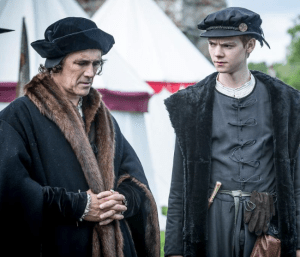
Norfolk and Gardiner – BBC/Playground Entertainment/Nick Briggs
Welcome to another installment of the details behind Wolf Hall 2: The Mirror and the Light. Thomas Cromwell’s fall from grace has long been seen as a sudden act – one minute he is being made the Earl of Essex, next he is dead, all because King Henry thought Anna of Cleves was ugly. None of that is true, and The Mirror and the Light shows the pivotal moment where Cromwell’s fall began, a full year before his death. However, the truth of the event is very different to what is shown onscreen.
In The Mirror and the Light episode 4, we see Cromwell at a banquet dinner held at Lambeth Palace by Archbishop Cranmer. All of the Privy Council attend, and Bishop Stephen Gardiner decides to stir up trouble by discussing the murder of Cardinal Bainbridge, talking of how he was poisoned by a priest, but instead veers into fantasy land and suggests Cromwell was the killer. Cromwell lashes out at Norfolk, who is off on another tangent complaining about how Cromwell isn’t good enough to be a nobleman, and conspires against everyone. This scene is a good show of research on Cromwell’s life, but bears no resemblance to the truth.
In 1514, Thomas Cromwell went to Rome, one of several trips he took during the decade, working on behalf of a private legal client to argue the Stratford Langthorne tithe dispute. Having seen the ‘factions and manners’ of the Italians for years, and able to speak fluent Italian and Latin, Cromwell was perfect for the job. In Rome, Cromwell stayed at the English Hospice, San Tommaso di Canterbury. The English Hospice at via Monserrato 45 (now The Venerable English College), sat a block from the Tiber river, and a two-mile walk to the Apostolic Palace. The hostel had been catering to English pilgrims to Rome for almost 200 years, and after renovation and reorganisation by King Henry VII, became an important hub for English diplomats visiting the city.
On his May stay, Cromwell met Lancelot Collins, nephew to the hospice’s master Cardinal Christopher Bainbridge, Archbishop of York, and resident English cardinal in Rome. This meeting between Cromwell and Collins would spark another genuine lifelong friendship, with Collins considered one of the kindest and most generous men in England by even cynical men. Collins valued his friendship with Cromwell for over twenty years, even when, in later life, it would threaten his safety. But Cromwell had already left Rome by 14 July 1514 when Cardinal Bainbridge was poisoned by Rinaldo de Modena, one of Bainbridge’s chaplains, and rumoured lover who had suffered a beating from the cardinal. When interrogated, Modena confessed to planning the murder with Silvester de Gigli of Lucca, Bishop of Worcester and English ambassador in Rome, however, Modena was soon murdered in prison. Bainbridge’s executors, Richard Pace and John Clerk, wanted Gigli arrested for his part in the death, but Gigli swore that Modena was insane, and no charges were brought in Rome or in England. Either way, Gigli was not charged and he died himself a few years later. Absolutely nothing in the case had anything to do with Cromwell or Wolsey.
Back to 1539, on 2 July, King Henry, already off on progress, commanded Archbishop Cranmer to host a banquet at Lambeth Palace, with both sides of the religious divide ordered to attend, as everyone remained in London. Henry did not attend, but Cromwell, starting to return to health after three full months, could attend his first public occasion. The banquet would go down in infamy. As a man freshly recovered from a torturous illness, Cromwell was far from the calculating, charming man he portrayed at court. Cranmer’s secretary Ralph Morice recorded the evening, which formed the basis of John Foxe’s later book detailing the event. Cromwell and Cranmer were warmest friends and allies, two leaders of the Reformation in England. Morice recalled a rarely recorded argument between the pair. Cromwell muttered to Cranmer:
‘you were born at a happy hour, for do or say what you, the King will always take it well at your hand. And I must needs confess that in some things I have complained of you unto His Majesty, but all in vain, for he will never give credit against you, whatsoever is laid to your charge, but let me or any other of the Council be complained of, his Grace will most seriously chide and fall out with us.’
Whether this uncommon, disrespectful, and candid complaint came before or after the main fireworks is unknown, as Cromwell again made a scene, publicly fighting with the ever-present, ever-meddling, Duke of Norfolk. Norfolk gave a speech about King Henry’s love for Cranmer, and compared Cranmer to Wolsey, calling Wolsey ‘a churlish prelate … who could never abide a nobleman … you know well enough Lord Crumwell, for he was your master …’ Morice then put down his quill, unwilling to record the awful things Norfolk insinuated about Wolsey and Cromwell. Cromwell, only just out of his sickbed, and already surrounded by enemies and a tense meeting of religious views, stood up to defend Wolsey. Cromwell told the room he did not regret his time with Wolsey, well-paid and well-provided for during their six-year friendship. Cromwell then roundly turned against Norfolk, giving him a caustic sixteenth-century dressing down, among other things, saying:
‘I was never so far in love with (Wolsey) as to have waited upon him in Rome if he had been chosen Pope, as I understand (Norfolk) would have done’.
The exchange does not sound hostile now, but it implied Norfolk was prepared to serve the Catholic faith and the Pope over his king, which would be treason. Norfolk bellowed a denial to the claim. Cromwell, through a lack of manners and a vast memory, told everyone Norfolk received 50,000 florins to transport Wolsey to Rome in 1523 when Wolsey was in place to become the Pope. The florins were proof of Norfolk’s plan to go to Rome with Wolsey. While Cranmer and others at the banquet diffused the screaming match, which was unquestionably complemented by bountiful wine and strong egos, the match had been lit between the men. Neither needed to wear the mask of courtesy again, as the peers of the realm had seen and heard all. Cromwell did not know it, but this banquet was the beginning of his ultimate downfall. The illness he suffered that caused him to miss the parliamentary session and the passing of the Six Articles would cause Cromwell to make numerous mistakes
All sources come from The Private Life of Thomas Cromwell. My publisher might come for you if you plagiarise.
Welcome to a new series about the fact and fiction of the newest series of Wolf Hall, The Mirror and the Light. Here is the real story of the marriage of Elizabeth Seymour and Gregory Cromwell.
By now you will have seen (as in the picture above) of the marriage of of Queen Jane’s sister Elizabeth Seymour to Gregory Cromwell. In the show, the character’s name is Bess Oughtred, and given the number of Elizabeths in the period, giving her a common nickname is helpful if you don’t know one Elizabeth from another.
Elizabeth Seymour had a hard early life. The eighth of the ten Seymour children, Elizabeth was married at just 12 years of age to Sir Anthony Ughtred, then aged 52. Why her father John Seymour thought this a good idea remains a mystery. By 1530, John and Margery Seymour had lost two of their children to illness, but their three surviving sons, Edward, Thomas and Henry, had been sent to court. The younger two were put in backroom middling roles, while Edward Seymour was already circling the higher privy chambers as an attendant. But Edward’s wife Catherine had given him two sons whose parentage was dubious to say the least, so marriage prospects may have been a concern for the unmarried Seymour girls. Jane Seymour was already at court too, a lady for Queen Katharine of Aragon. Elizabeth and Dorothy Seymour were only children in 1530. Dorothy Seymour was married off at 13 in 1533, fortunately to someone only a few years older than herself, and began a state of regular pregnancy. Jane Seymour remained unmarried at court. Middle sister Elizabeth was the most unlucky of all.
The marriage of Elizabeth Seymour and Sir Anthony Ughtred surely raised eyebrows, given the bride was 40 years her husband’s junior. Even King Henry wasn’t that lecherous. Anthony Ughtred had a similar military background to Elizabeth’s father, so they were likely friends or at least court acquaintances of similar rank. After losing his first wife without children, Anthony Ughtred acquired Elizabeth Seymour, and she was styled as Lady Ughtred, and joined Anne Boleyn’s court around the same time Jane Seymour was transferred there in 1533. In late 1533, aged 14, Elizabeth gave birth to her son, Henry Ughtred (given the two-year gap between marriage and pregnancy, Ughtred may have not touched his child bride for a couple of years. We can only hope). Anthony Ughtred was the Captain and Governor of Jersey, and Elizabeth and baby Henry lived with him at Mont Orgueil Castle in Jersey, instead of returning to the royal court.
By early 1534, Elizabeth was already pregnant again, but illness came to Jersey, and Sir Anthony Ughtred died in October 1534, aged approximately 56. Elizabeth left her baby son Henry in Jersey and returned to mainland England to serve at court until she needed to retire to give birth to Margery in early 1535, at one of her late husband’s estates in Hexby, Yorkshire, 150 miles north of London. Her son Henry was moved north, and Elizabeth went back to court, leaving the children as head of the household.
Given that by age 16, Elizabeth was a widow with two children, and her sister Jane had been at the royal court without such misery, whether they were close can’t really be measured. But both sisters had to endure the fall of Anne Boleyn, and the rise of their own family, after their father died in late 1535 (his death is mislabelled 1536), and Jane Seymour caught the king’s eye. Elizabeth became one of her sister’s ladies at court, but life was not suddenly simple. In 1537, Elizabeth was 19, had two children to feed, and no money of her own. Hexby Manor, her late husband’s Yorkshire estate, was no glorious money-maker. No official grant of the lands had passed the estate from father to son after Anthony Ughtred’s death. Elizabeth needed to make a bold move. She was young, rumoured beautiful, and the pregnant queen’s sister, but that wasn’t enough to raise children.
Portrait probably of Elizabeth Seymour, c1542 by Hans Holbein
Lady Elizabeth Ughtred sent a letter from York on 18 March 1537 to Lord Cromwell. She explained that her husband had left her with next to nothing, leaving her as a ‘poor woman alone’ and begged to be granted an abbey once it was dissolved, somewhere to live with her children. It’s wild to think that despite being the queen’s sister, Elizabeth had nothing. Given that her late husband had been in service to King Henry and Cromwell, she wrote:
‘I am the bolder to sue herein, and will sue to no other. When I was last at Court you promised me your favour. In Master Ughtred’s days I was in a poor house of my own, but since then I have been driven to be a sojourner, for my living is not sufficient to entertain my friends.’
Elizabeth was resorting to moving between friends’ homes with her children to keep them alive. It is not surprising Cromwell promised to help her at court, he always helped widows and orphans, and paying favour to the queen’s sister would be an obvious courtesy at court. Cromwell likely went to speak with her brother Edward Seymour, Lord Beauchamp. The pair regularly gambled together and Cromwell had lost 45l (£19,000 today) to him just weeks before the letter arrived. Elizabeth soon returned to the London area, likely without her children. Baby Margery goes completely unmentioned in records, except for a note about her marriage up in Yorkshire. Henry Ughtred doesn’t feature anywhere until the 1560s either, so he was likely also north in Yorkshire.
A deal was struck between Thomas Cromwell and Edward Seymour, that Elizabeth would marry Gregory Cromwell, who was approximately 17 at the time. By 1 June, preparations for the wedding were underway as Cromwell ordered a wedding cape and dagger for his son, worth £4,000 today. There was no mistaking who the groom would be at the wedding. Cromwell held a glorious party at Mortlake Manor, the grand castle-like on the Thames usually reserved for the Archbishop of Canterbury (confiscated from Cranmer in 1536 for supporting Anne Boleyn, and given to Cromwell as a gift), Mortlake was to be Gregory and Elizabeth’s home for the time being, lavish, fully staffed, great location, and safe from passing illnesses. Cromwell order a porpoise for the dinner, minstrels to entertain, new uniforms for the staff, and various costs for both Lady Elizabeth and her brother, Sir Edward Seymour, who brought along artichokes, and even Princess Mary sent a gift of quinces. The wine alone at Mortlake for this one party would cost £170,000 today. It may have even been the wedding itself, given Mortlake had a chapel, though the news of the marriage wasn’t made public until 3 August, so that is the generally accepted date of the occasion.
If this June 1537 event was only an engagement party to seal the betrothal, Elizabeth must have felt very pleased with her position, as by the 3 August date, she was already pregnant. Henry Cromwell was born in March 1538, likely at Cromwell’s home Great Place in Stepney, and Princess Mary was his godmother. Cromwell held enormous parties at Hampton Court though February and March 1538 with the king, spent the equivalent of £20,000 today to make sure Elizabeth gave birth in comfort, for her son was the first cousin of baby Prince Edward. Cromwell spent twice as much on outfits, choreographers, horses and and performers at Hampton Court to celebrate in style with the king.
Cromwell soon took on Lewes Priory in Sussex to have it rebuilt as a manor home for his son and daughter-in-law, who got pregnant again almost immediately after giving birth. But by mid-June 1538, Gregory Cromwell was sent to be punished by Bishop Richard Sampson of nearby Chichester for a sexual crime. The Bishop wrote to Richard Cromwell about Gregory’s punishment and told him:
‘the young man has been with me this morning and scornfully refused this penance. Wherefore, I advertise you of it, praying you to weigh it as a matter that touches much the honesty of your friend. For surely if there be any business for it, I will advertise the King’s Majesty of the whole. And I doubt not but when my Lord Privy Seal shall hear the truth, he will assist me in it’.
Sampson was amid having his Chichester cathedral dissolved and its relics stripped, including the shrine of St Richard. Given Sampson needed to give out punishment to Gregory Cromwell, and Richard knew of the situation by the time this letter was written, suggests only two crimes; heresy or sexual assault. Eighteen-year-old Gregory had been
left to enjoy the high life since childhood, given everything without having to earn it, so it is not reasonable to think he may have made an off-hand comment that could have been insulting or even sound heretical to the Catholic bishop. But Gregory was no scholar, no politician like his father, and never showed any interest in religion. Also, that a heretical comment could receive a small punishment but provoke his father in such a wild manner is at odds with reality, leaving only sexual crimes. The church tended to turn a blind eye to (men’s) adultery, equally seduction or coercion without consent. Whatever Gregory did, Sampson said it would affect Gregory’s ‘honesty’, which in turn would harm the ‘reputation’ of Elizabeth, sister to late Queen Jane. Whatever sexual assault Gregory committed (and it cannot have been against Elizabeth), it was enough to potentially make a scandal of the Cromwell family. Given that sexual crimes are rarely punished even today, particularly by the Catholic church, Gregory must have done something especially heinous.
Cromwell had nurtured his only son, given him the world, gained him a noble bride, and had just finished spending countless thousands on Lewes Priory. Suddenly, the young Cromwell household needed to be broken up, Gregory whisked out of Sussex entirely. Sir John Gage nearby offered to lease the Lewes lands so Cromwell could get out at once, and now Cromwell was the largest landowner in Kent, he had somewhere to hide his useless son. Gregory was shipped up to Mortlake Manor, probably at Edward’s Seymour’s nearby home, and a letter from Elizabeth Cromwell arrived, stating she would stay half a mile from Mortlake Manor. Elizabeth wrote, ‘this letter from you is more pleasure to me than any earthly good, for my trust is now only in you … your humble daughter-in-law’. Cromwell needed to pay for Gregory at Mortlake for Christmas and pay servants to attend Elizabeth, who was six months pregnant while she cared for ten-month-old Henry.
The young couple had reconciled by May 1539 when Edward Cromwell was born at their new home at Leeds Castle, and Thomas Cromwell was born around May 1540, Katherine Cromwell a year later, and then Frances Cromwell in 1542, named after Richard Cromwell’s wife who had recently passed away.
So while The Mirror and Light shows Bess Oughtred looking to marry a man close to the king, it was probably lucky she didn’t, though the early years as Lady Cromwell were not happy ones either. She continued to sign her name Elizabeth Ughtred until 1540 when Gregory was made a baron, but she was safe from her brother-in-law King Henry after writing him a groveling letter, disavowing her father-in-law when he was executed. When Gregory Cromwell died in 1551, Elizabeth married Sir William Paulet, Earl of Wiltshire, and after her death in 1568, Her eldest son, Henry Ughtred, married his stepsister Elizabeth Paulet.
The eldest son of the couple , Henry Cromwell, carried on the family name as part of a string of quiet Cromwell MPs who eventually gained power in Ireland. Edward Cromwell died of illness around the same time his father Gregory died. The third son of Gregory and Elizabeth Cromwell, Thomas Cromwell, went on to be an archivist in parliament and created the first ever English-Italian dictionary, continuing his grandfather’s love of the country and language, and remained close to Ralph Sadler, while Katherine and Frances Cromwell married politicians and lived quiet lives. None of these children are ancestors of genocidal maniac Oliver Cromwell; he was the great-great-grandson of their cousin, Richard Cromwell.
All sources come from The Private Life of Thomas Cromwell. My publisher might come for you if you plagiarise.



 CAROLINE ANGUS