
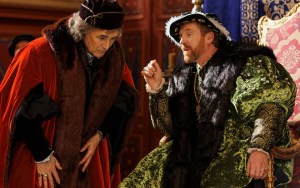
Welcome to part 4 of Wolf Hall 2: The Mirror and the Light facts about moments seen in Thomas Cromwell’s life at court. Today is a quick round-up of questions asked that don’t require a whole post of explanation on their own. So let’s start –
Wolf Hall is Jane Seymour’s home. What is The Mirror and the Light?
On 28 November 1538, Cromwell wrote a letter to Sir Thomas Wyatt (Harl. MSS. 282, f. 217), who was King Henry’s ambassador to Holy Roman Emperor Charles V, and travelling Europe with the Emperor’s court. Wyatt was not a good ambassador, and relations between the countries were started to deteriorate. Cromwell updated Wyatt on Henry Courtenay, Marquess of Exeter and Henry Pole, Lord Montagu, the Catholics traitors, and asked Wyatt to get the Emperor to intervene on several subjects were making trouble for London merchants. In the letter, Cromwell wrote of King Henry exercising his right as the supreme head of the church by burning Sacramentarian John Lambert a week earlier:
‘…undoubtedly [Emperor Charles] should have much marvelled at [King Henry’s] most high wisdom and judgement, and reputed him none otherwise, after the same, than in manner of the mirror and light of all other kings and princes in Christendom.’
King Henry is the mirror, and everyone and everything should reflect his brilliance. Henry is the shining light of princely splendour all should look up to. Being out of Henry’s light/favour is like being in the darkness. The letter is extremely flattering of Henry, since it would be read and repeated at the Emperor’s court, and could reveal nothing of reality, only a glowing picture of praise and perfection.
Was Thomas Cromwell the Lord Chancellor of England?
NO. Thomas Cromwell was never the Lord Chancellor. Thomas Wolsey was Lord Chancellor, followed by Thomas More, and then Thomas Audley. Cromwell assumed the role without title between more’s resignation in May 1532, and Audley’s appointment in January 1533, and was not always in a good mood about the position or workload. Audley was a puppet; he would do anything the king wanted, and he was easily intimidated, so Cromwell could yell at Audley whenever he made an error and Audley would beg and grovel for forgiveness (Audley complained a lot, especially about his yearly salary of 800l or £350,000 today, plus bonuses. Cromwell always told him to shut it because it annoyed the king). Audley and his protégé Richard Rich really ran with Henry’s plan to dissolve monasteries when Cromwell didn’t want to move forward, but other than that, Cromwell had total control and authority over all matters. Audley never intervened in Cromwell’s business, despite technically being higher ranked until 1536. (Lord Chancellor was ranked second in the realm after the archbishops. In 1536, Cromwell became the Vicegerent of England, the new number one in order of precedence, putting Lord Chancellor down to third).
Thomas Cromwell was, in 1539, Lord Cromwell, Baron of Wimbledon the Vicegerent of England, Lord Privy Seal, Vicar-general of England, Knight of the Most Noble Order of the Garter, Principal Secretary, Chancellor of the Exchequer, the first-ever layman Dean of Wells, and Commissioner for the Peace in seven counties, Chancellor and High Steward of Cambridge University, Master of the Jewel House, Clerk of the Hanaper, and Steward of the Duchy of Lancaster, Essex, Hertfordshire and Middlesex, the Receiver of Petitions in the House of Lords, highest ranked man in the House of Lords, Warden and Chief Justice in Eyre, Prebendary of Salisbury, Steward of Westminster Abbey and Savoy Manor, Constable of Hertford Castle, Berkeley Castle and Gloucestershire Castle, Recorder of Bristol, Commissioner for the Subsidy to print the Bible, Lordship of Edmonton, Sainsbury, Hovering and Writtle, and master of every single powerful man in the country of Ireland. By 1540, Cromwell was also the Earl of Essex and Lord Great Chamberlain. At that point that was basically nothing left for Cromwell to control, other than being the Lord Treasurer, but Norfolk held that role and seemed to live forever.
Sometimes people write Cromwell as Lord Chancellor because it is easier to understand in modern terms. Cromwell was the only person to ever be England’s Vicegerent, and no one person will ever receive that much power again.
Did Cromwell feel guilt over Anne Boleyn?
Certainly not that he ever mentioned where it would be recorded. It would have been insanity to have expressed guilt or sympathy. Archbishop Cranmer wrote to King Henry to make sure he didn’t go down with her, and so the Reformation would be safe without Anne on the throne. Cranmer was frozen out by the king for a while for this, and had his prime lands and manors confiscated, and given to Cromwell after Anne’s death. Mortlake Manor was the traditional home of the Archbishop of Canterbury since its construction 500 years earlier, and Crowmell relatives had worked there as servants. Cromwell then owned the property and made it grander than ever.
Cromwell did say to Ambassador Eustace Chapuys that Anne Boleyn handled herself well through her trial. Everyone knew she was innocent, but no one was stupid enough to say anything. I cover the whole period about Anne’s death in my book on the subject.
Did King Henry actually say he could make Cromwell the king after himself if he wanted at the Privy Council meeting?
No, that was just an imagined scene of the king flexing his power over all the nobles. Likewise, Cromwell and Fitzwilliam never came to blows like that at a meeting. It is another piece of fiction laid out to be reflected in later episodes. I will do a separate post about Cromwell and Fitzwilliam, as their relationship was very interesting.

Did Cromwell spend time with Dorothea Wolsey?
There is no evidence of this; ‘Dorothea’ is a just a plot-point for Cromwell’s guilt. There are letters between Cardinal Wolsey’s three children and Cromwell. Most of the letters come from Thomas Wynter, Wolsey’s eldest son, born 1510 to Joan Larke, was always travelling in Europe, and always looking for money. Cromwell was one of Wynter’s financial babysitters, and felt sorry for Wynter after his father’s death. There are extensive papers showing Wolsey’s favour towards Wynter, and Cromwell got him set up in a comfortable life in the North in the 1530s, and he later became the Dean of Wells.
Dorothy was born in 1513, her mother also Joan Larke. Her surname was Clancey, the name of her adoptive family in Dorset. She was placed in Shaftesbury Abbey for her education and upbringing where many nobles sent their daughters, and just fell under Cromwell’s ban of no one being allowed to take holy orders from age 24 or younger in 1535. Cromwell soon changed the laws, so no one under 20 could enter the church, and Dorothy could technically become a nun. The rich and well-appointed Shaftesbury Abbey was closed in 1539, and Dorothy Clancey was given a pension. She was never heard from again, and she certainly never met Thomas Cromwell.
Wolsey’s third child was Thomas Minterne (though his mother is uncertain), born in about 1516. Minterne grew up in Sherborne, ten miles from his sister Dorothy. Wolsey sent Minterne to New Oxford College and Cromwell ensured he was made a fellow at only 17 years old in 1533. Cromwell then sent Minterne to study in Europe in 1538, and when he returned to England broke in 1542, King Henry gave Minterne a cozy job at Salisbury Cathedral, which he kept for the next 20 years or so.
(Joan Larke married George Legh and had another four children, and then married Sir George Paulet in 1530, but died giving birth two years later, though her son William survived. Joan must have been quite young when having Wolsey’s children, maximum no more than 20 years old. Joan’s baby William Paulet was cousin of John Paulet, 2nd Marquess of Winchester, who married Elizabeth Cromwell, widow of Gregory Cromwell. These people really never moved around much).
All sources come from The Private Life of Thomas Cromwell and The Letters and Remembrances of Thomas Cromwell. My publisher might come for you if you plagiarise.
 CAROLINE ANGUS