

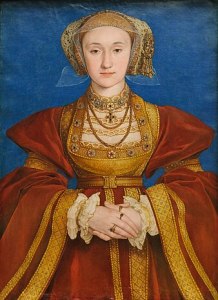
In episode 5 of The Mirror and the Light, it is all coming part for Thomas Cromwell. After finally finding a woman willing to marry King Henry, Anne of Cleves is delayed as she gets to England, and is not stunned into undying love when she sees her sub-par new husband. Henry’s ego is hurt, and the year is off to a bad start.
In reality, Henry not liking Anna of Cleves was borne out of fear, not Anna’s appearance. Her brother was Wilhelm of Cleves, who had just declared war against Emperor Charles over the German duchy of Guelders. By marrying Anna, Henry was essentially making himself an ally against the Emperor in war. Trade with the Low Countries had already been halted, and Cromwell had traded Eustace Chapuys for Thomas Wriothesley, Stephen Vaughan and Edward Kerne, who were held hostage by the Emperor’s sister, Queen Mary of the Netherlands. Marrying and sleeping with Anna meant preparing to go to war against Emperor Charles, and after Anna had not been particularly chatty or enamoured with Henry, he was livid at having married the beautiful, young duchess. Henry was trying to make the best of it, Anna was well-liked by everyone but her husband, and Cromwell was busy infuriating the Duke of Norfolk by closing Thetford Priory, where the Howard ancestors were all buried.
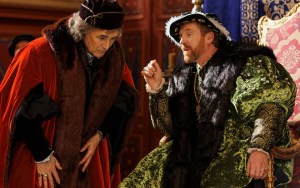
The English bible was out and it was the law to preach the reformed religion in England. Henry, Cromwell and Cranmer all graced the cover of the new bible. But getting everyone to obey the reforms was near impossible. In March 1540, Bishop Stephen Gardiner had been preaching the old doctrine at St Paul’s. Days later, Cromwell’s old friend Robert Barnes did the same, preaching the reformed doctrine. King Henry heard of these outbursts and ordered Gardiner and Barnes to appear before him to explain themselves. It was not simply two men forced to explain themselves, as the king was ‘scandalised’ by their words. It was Gardiner’s words against Cromwell’s words, Barnes simply the mouthpiece. Henry, unhappy with his German marriage, could turn his anger against the Reformation instead of its real target, bringing Cromwell and Gardiner’s long-running feud to its bitter end. Everyone needed to be silent to appease the king’s current mood, so Barnes recanted his words in late March, and Cromwell made a concession; he invited Stephen Gardiner to dinner at Austin Friars.
If the Lambeth Palace banquet with the Duke of Norfolk was a flashpoint in Cromwell’s fortune, the Austin Friars dinner party would go one step further. What should have been two men finding a truce, instead turned into a bitter dispute, free of the civility of court. Rumours were already flying; people believed Cromwell would lose the Vice-Gerent and Lord Privy Seal positions. With Henry turning from the Reformation due to his marital bed problems with Queen Anna, Cromwell needed to defend all he had done, just as Gardiner felt he needed to defend the papacy.
A withering and acrimonious shouting match ensued at Austin Friars, with Cromwell screaming at Gardiner, ‘if the King would turn (from the Reformation), yet I would not turn! And if the King did turn, and all his people, I would fight in the field in my person, with my sword in my hand, against him and all others’. Cromwell, holding a knife (claimed Gardiner), added, ‘if this dagger was not thrust into my heart in battle, and if I would not die in that quarrel against them all, and I live one year or two, it shall not be in the King’s power to resist me’.
Cromwell had made a huge mistake, not unlike several inappropriate outbursts over recent months. A man who could have his enemies cornered before they realised the hunt had begun, suddenly began making missteps for no apparent reason. Cromwell was discussing a theological battle, not an actual war, and if he had a knife, it would have been no more than a dinner knife. The lack of actual danger to Henry must have been apparent, as Gardiner kept this treasonous argument quiet, and Cromwell needed to get ahead of him. Cromwell surrendered the position of Secretary of State to the king, a job he held in an official capacity for six years. Secretary Cromwell was no more. The position that gave so much power beside the throne slipped away, but only just. The position would be divided between two people, a plan used regularly in the future, separating the immense power of the position. Ralph Sadler and Thomas Wriothesley were both given the job.
For a moment, things seemed to calm again but French Ambassador Marillac thought Cromwell was in trouble; Gardiner had not said anything, but Marillac, either listening to bad sources or simply sharing lies, wrote to King Francis, ‘Cromwell is tottering’. Marillac could not have been more wrong. On 17 April, King Henry astounded Cromwell and his friends and foes, telling him that he would become the 16th Earl of Essex (1st Earl, sixth creation), accompanied with a list of lands and manors five pages long. Henry Bouchier, whose family had held the Essex titles for eighty years, broke his neck after coming off his horse a month earlier, a sudden opportunity for Cromwell to be elevated. One day after this shock announcement, Cromwell was again bestowed with glory: the title of Lord Great Chamberlain, head of the royal household. The Earls of Oxford had held the role for the past 400 years, but John De Vere had died at home just a week after Henry Bouchier, leaving a vacancy at court.
But Gardiner had these words, spoken in anger at Austin Friars, coupled with the Duke of Norfolk’s French plan to remove Cromwell, were lying in wait, as the final traitor was about to reveal himself.



 CAROLINE ANGUS