SPAIN BOOK REVIEW: ‘The Ambulance Man and the Spanish Civil War’ by Paul Read

Paul Read


The Ambulance Man and the Spanish Civil War is the first book in the Forgotten Stories from Spain series by Paul Read, giving readers a chance to learn tales of the ‘bravery, humanity and vision’ which existed in 1930’s Spain. But never fear – there is no need to have a great understanding of the time period, as this book caters to both seasoned and new readers of the subject. The book leaps into the time period with a prologue outlining Spain during the war for anyone in need of background details.

This book is the story of Canadian Norman Bethune, a man passionate about public healthcare and social justice. Around 1600 Canadians joined the fight in Spain as volunteers during the war. Bethune started his time in Madrid, noted for both his work, and his fondness of women, drinking and criticism of the regimes operating during that time. Like George Orwell in Barcelona, Bethune became ‘known’ to the Communists and their strict rules, only to have this backfire against him later on in his tour of duty.

The Andalucian city of Malaga, deep in southern Spain, was suffering heavily. The ancient city had a massive disparity in land and wealth, and looked forward to revolution in 1931 at the start of the Second Spanish Republic, but had become tired of waiting for change when war broke out in 1936. But by February 1937, Franco and his troops, with help from the Italians, were advancing fast on the poor city with little way of defending itself. The people had two choices – run or die. People decided to walk the 200km to Almeria and potential safety – not an easy feat with children, elderly, no food or supplies, and carrying everything dear to them.

Along the road, the ‘Carretera de la Muerte’, or Highway of Death, there was only one hope against the bombing, shooters and endless sun. Norman Bethune was the only soul keen enough to do something about the people and their desperate need for help. While thousands died, Bethune had a simple yet brave plan to help the people of Malaga. The book tells of the plan and of what greeted everyone in Almeria, and of Bethune’s escape from Spain after his daring plot. The book also goes on to tell the stories of Bethune’s time in China, and who does and doesn’t remember his work today.

The author uses a fast, smooth, no-nonsense style to recall this forgotten tale, peppering the story with important details, and uses interviews with survivors, and information on how a large percentage of Spain doesn’t know their own history. This book is an easy read, giving people a short yet important insight to a man whose bravery still needs to be shared. The Ambulance Man and the Spanish Civil War is a terrific opening for the Forgotten Stories from Spain series for anyone to enjoy.

Next week I will review the second book in the series Forgotten Stories from Spain: 1984 and the Spanish Civil War

You can find more about Paul Read on his fantastic website – Speaking of Spain

Valencia Photos of the Month: Ancient Moorish Tower of Plaça de l’Àngel

While the Romans founded Valentia is 138BC, the Moors took over the city in 714, and the city remained a small area by the riverside. But in the early 11th century, Valencia city was proclaimed the taifa of Valencia, the city kingdom of the area, after the fall of the Caliphate of Cordoba in 1010. Abd al-Aziz ibn Amir took over the city and from the beginning of his reign in 1021, Valencia needed a secure wall around the city, which was expanding quickly with people moving north from al-Andaluz. The stone wall was built with seven gateways, and circular towers for lookout and protection, but only some parts of this great wall still remain. 

440px-Muralla_àrab_València


Between the main gate, Bab al-Qantara, (now the site of Valencia Torres de Serranos gate) and gate number two, the west gate named Bab al-Hanax (my last post HERE shows photos of the remaining wall) was on Calle Salines. (Also between these gates was Portal de la Valldigna, the doorway to the Christian pocket of the city) Between these two gates was the Torre del Angel (Angel tower). El Cid took over the city in 1099, but it wasn’t until 1356 that the new city walls needed to be built, expanding the city when Christian reign took over the city. Only parts of the original towers and slices of the ancient stronghold remained standing as the city doubled in size.

Plaza del Angel, (called Plaça de l’Àngel in Valencian), a tiny square off the main road away from Torre de Serranos, managed to hide and protect one of the Moorish towers for centuries. In 1701, a hotel was built around the Torre de Angel, using the still intact tower as part of its establishment. It appeared in travel guides for the city from 1849. The Parador /Hostal del Angel was featured in an article in 1930, about the family and building (article is below in the slideshow). The hostal actually had its entrance in Plaza Navarro, but was the main building in the tiny Plaza del Angel along its back. Both the Moorish tower and wall were protected inside the hostal.

When the great Valencia flood of 1957 destroyed the hostal, the area was left unattended, until development saw a new apartment building go up in the ruins of the hostal grounds, making Plaza del Angel the small triangular plaza it is today. The hostal grounds became a park, leaving the tower and wall safe from demolition. But the park was neglected and then pulled away, and today the old hostal grounds and surrounding Moorish treasures are fenced off and kept away from a public. Getting a good photo of the Torre de Angel can be quite a challenge. However, the Valencian government committed to preserving the tower and surrounding wall. A quick search finds that the promised works on the Moorish towers in the Barrio del Carmen have not made any progress, missed all restoration details since 2006, and now other agencies are being called in to investigate the delays. So in Valencian terms, this issue probably won’t be sorted for another 100 years. Let’s hope the towers outlast the bureaucracy.

Also saved from the same part for the Moorish wall is another smaller tower technically now called the Calle Mare Vella tower, though this street provides no glimpse of the structure. It sits against 1970’s apartment blocks and can be seen easily from outside the car park area (?!) on Calle Borras and Calle Adoberies.

Plaza del Angel/Plaça de l’Àngel is one of the sites featured in all books in the Secret of Spain book series. Both these books and this site use both the Spanish and Valencian spellings, depending on time period featured, as Valencia was banned under the Franco dictatorship. The plaza itself is labelled in both languages in the city, though newer maps only have Valencian spellings. There are other great Moorish secrets tucked away in Valencia, which I will do in a separate post.

All historical photos via Valencian Historia Grafica and recent photos author’s own, or via Google

Valencia Photos of the Month: Portal de la Valldigna

Portal Valldigna Valencia

Portal Valldigna (Valldigna Gate) is a portal/gateway built in 1400 to separate the Christian and Moorish areas of the city. It is located in the oldest part of Valencia’s old town, in the Barrio del Carmen, in the Ciutat Vella. The gateway never had a door, and simply separated the nearby buildings, and leaned against the ancient Arab wall around the city. The local abbot had his home over the doorway, and gave the Portal Valldigna after the  Monasterio de Santa María de la Valldigna, an amazing monastery built in 1298 outside the city area.

Jofre_sorolla

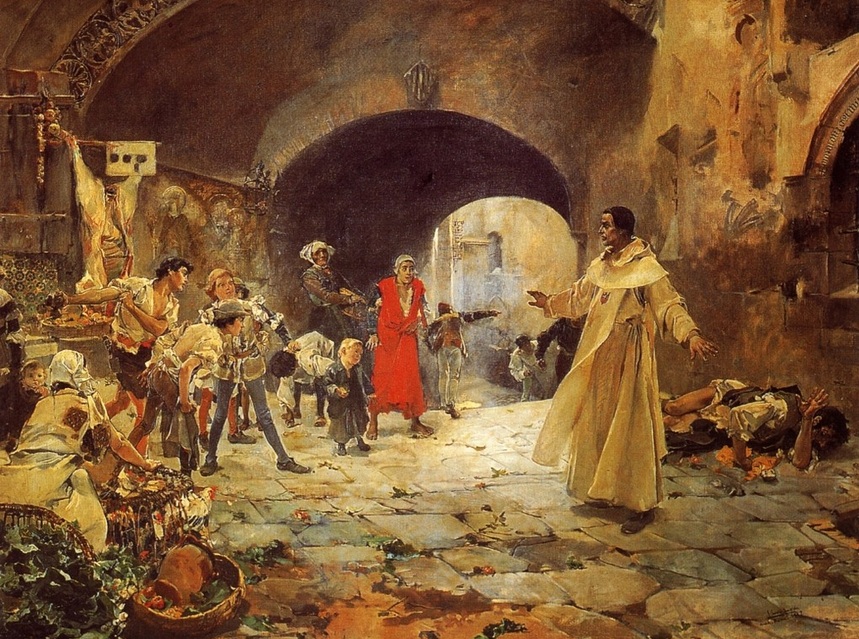
Father Jofre defending a madman, by Joaquin Sorolla (1887) – Source

The portal, seen here in this painting by one of Valencia’s finest artists, shows the portal in the background as Joan Gilabert Jofré, known as Father Jofré, saves a madman from being stoned in 1409. After spending time seeing how Muslims cared for the mentally ill, Father Jofré went on the start the world’s first mental institution in the world, sanctioned by Pope Benedict XIII and King Martín I of Aragon. It was built nearby and named after Valencia’s patron saint Nuestra Señora de los Desamparados.

In 1474, a book named Obres e trobes en lahors de la Verge María was printed with paintings of the Portal Valldigna, showing an inscription in Valencian, es obres or trobes Davall scrites quals them lahors tracten of the sacratíssima Verge Maria (in praise of the Virgin Mary). In 1589 a new plaque was put above the portal depicts King Jaime II of Aragon at the founding of Valldigna monastery.

Speed forward to the 1940’s and the portal was in a state of disrepair and the city planned to demolish it along with the historical buildings surrounding it. In 1944, the Valencia Director of Fine Arts stepped in to have the Portal Valldigna named a historical monument and saved it from its fate. The portal and above building was fully renovated in 1965, making sure the original Arab and Christian stones were saved. A new plaque was put over the entrance into the ‘old cities’ with the shields of both the city of Valencia and the Valldigna monastery. The Valencia inscription next to it reads : Dona Nostra Son of Bona, Pregueu per nós, Valldigna Portal (Good Women of Our Son, Pray for us, Valldigna Portal).


Today, Portal Valldigna is a good spot to stop by and see a pocket of Valencia’s ancient history, away from the crowds. It is easy to find if you are already visiting some of Valencia’s more well-known sites. If you are new to Valencia, just head up Carrer Concordía off Carrer Serrano, and follow the road right, and you will be on Carrer Portal Valldigna. Or, head down Carrer Cavallers (Calle Caballeros if your map is in Spanish) and head down either tiny Carrer Landrer, or even narrower Carrer Salinas, which, while not the prettiest street in the city, has a section of the ancient Arab wall, just standing alone between two buildings. A landmark often missed by many.

Historical photos by Valencia Historia Grafica

SPAIN BOOK REVIEW: ‘Into the Arena’ by Alexander Fiske-Harrison

IntoTheArena

Alexander Fiske-Harrison spent a season studying and travelling with the matadors and breeders of famous “fighting bulls” of Spain (and France and Portugal. ) He ran with the bulls in Pamplona and found himself invited to join his new friends in the ring with 500lb training cows. This developed into a personal quest to understand the bullfight at its deepest levels, and he entered into months of damaging and dangerous training with one of the greatest matadors of all, Eduardo Dávila Miura, to prepare himself to experience the bullfight in its true essence: that of man against bull in a life or death struggle from which only one can emerge alive.

cover and blurb via amazon

~~

Every time I write something regarding bullfighting, I get plenty of hate mail, regardless of the content. Just the mere word ‘bullfighting’ sends people into a spin. There are those who constantly come on here and say I deserve to endure genital mutilation for my writing (which only makes you as grotesque as how you view bullfighting, so STFU). I find it interesting that no one who comes to my site to hound me has ever actually asked my personal view on bullfighting, and logic of abusers seems so ridiculous. When I wrote about rape or spousal abuse, no one asked me if I endorsed those subjects, so for that reason, I have decided to leave comments closed on this new post. Putting up with harassment is not a sign of strength. I shall not be passive, and I shall not be attacked either.

Into the Arena by Alexander Fiske-Harrison is a book I read a few years ago, but never reviewed. I decided to read it again recently, while doing some bullfighting research. I have been reminded how much I enjoyed this account on the subject.

It is argued that bullfighting, when done well, is a work of art, and a sin when done poorly. These two differences are a beautiful reflection of the arguments for and against the battle of death. The author shows how, after first seeing fights in 2000, until his full-fledged love affair with the art form years later, the only way to truly understand bullfighting is to be emerged in the world of the toreros. Bullfighting in the 21st century has triple the number of fights of the so-called golden-age of fighting in the 1930’s. Bullfighters earn enormous sums like football stars, marry beautiful girls and appear on magazine covers. Between the fights, the endorsements, and the celebrity caper, there is an industry worth over €2 billion a year. It would be easy to be swept away by the glamour aspect.

Fiske-Harrison is staunch defender of bullfighting. Some could say it could be a case of being caught in the bright lights of the toreros. Instead, the author turns to some of the greatest names of the current era – Cayetano Rivera Ordóñez, a celebrity wherever he goes, and who speaks of the death in his life as part of a weekly routine.  José Tomás, ‘The Phenomenon’, some say the greatest performer of the age – who performs with great skill and nearly dies in the process. A horrific goring in Mexico shows the lengths the man will go to for what he believes is greatness. Then there is Juan José Padilla, known famously for being the torero who had his eye gored from his face. One famous fight shows Padilla fighting in the same event as Tomás, and nearly gets gravely injured due to vanity, wishing to be the most beloved of the night. Padilla is the epitome of those who live for the skill and thrill.

But this book doesn’t seek to raise the profiles or talk up the participants. This book also addresses the moral conundrum of the event. The hate of bullfighting can be as strong as the love, and the book does its best to counter some of the arguments – that the bulls are treated more humanely than your standard animal raised to become a steak (which I would agree with). Many who argue against bullfighting think little of the grotesque nature of the death of their dinner (or, like me, find steak-eating appalling). The book also discusses the economic and ecological benefits of bullfighting. While these arguments do have their merit, those opposed to the spectacle would no doubt be able to dismiss the claims.

Bullfighting is Spain’s ‘feast of art and danger’. That is mostly certainly true. The book takes a turn as Fiske-Harrison attempts to get into the ring himself, to learn the moves and nature of the animals. You can hate bullfighting all you like, but rarely does anyone have the courage to face one of these strong and aggressive animals. The animals are bred specifically for their speed and aggressive behaviour, and are fast learners. There will also be bulls who do not show the enthusiasm for death that the crowd would want (I’ve seen scared and disinterested bulls in the ring myself). The toreros have a great affinity for the graceful animals, but they must be killed. In the end, the audience is the beast while the man and animal square off for entertainment.

The world of bullfighting is a mixture of death and machismo – two things that can seem extremely unappealing. The author manages to sneak in and out of the world with great fluidity, makes up his own mind based on research and personal effort, and doesn’t waver from his personal opinion. While some see bullfighting as men with inflated egos killing animals to show off for a crowd, where the death of animals is both cruel and pointless, Fiske-Harrison attempts to portray the world of culture, tradition, respect and of bullfighting’s essence – the struggle of life and death. This is a great book told through one man’s perspective, but whether you enjoy the read may depend on your position on the subject.

Because the subject is so decisive, I will continue to both read and write about it, from both sides of the argument.  However, I’m not sure there is any piece of work that will ever sway a reader from their opinion. Some may get caught up the glamour and popularity, and many can respect the animals, but can readers endorse the kill? Who knows. You need to look past the kill to see the men and culture behind it, an action not everyone wants to try.

13 September 1974: The Bombing of Cafetería Rolando

2014 is the 40th anniversary of the bombing of Cafetería Rolando in Madrid. The attack was a significant event in the fight against Francoism and a defining moment in the ETA’s struggle for independence. I first learned about Cafetería Rolando several years ago, and it forms part of my upcoming book, Death in Valencian Dust. In posting this, I do not endorse either side of the ETA struggle, merely recognise the struggle Spain suffered in the 1970’s.

In 1974, to say Spain was at a crossroads would be an understatement. In December 1973, Admiral Luis Carrero Blanco, Spain’s Government President was assassinated by ETA (Basque – Euskadi Ta Askatasuna, Spanish – País Vasco y Libertad, English – Basque Homeland and Freedom), the Basque Country separatist group. For years, ETA had been carrying out attacks and killings around Spain, while other groups started to rise up against the government. In 1974, new Government President Carlos Arias Navarro set up new rules during the spirit of 12 February, keeping in line with Franco’s harsh regime of times past, covering everything from stopping freedom of the press, restriction to the judicial systems, harsh penalties for strikers and protesters, and generally restricting the lives of everyone in the country, everyone outside the búnker, the group of extreme right-wing people surrounding Franco.

The state of the nation deteriorated throughout the year – the church increasingly voiced their opposition to Franco and the regime, the execution of anarchist Catalan Salvador Puig Antich brought people to the streets in protest, the economy slumped, the Communist party mobilised in defense of their sympathisers, workers continued to strike, and universities protested the new draconian laws. Franco himself was seriously ill, and Juan Carlos, his protegé, was taking over all tasks on his behalf. The Portuguese dictatorship collapsed, giving Spaniards more ideas of what they could achieve for themselves. On September 11, 1974, Arias Navarro re-endorsed his changes and announced efforts would double to enforce new laws over the rising tide of anger.

Cafetería Rolando, at 4 Calle del Correos (known as E street), was located in the heart of Madrid, directly off Puerta de Sol. Cafetería Rolando was a large and popular cafe, the local spot for police to visit during their lunch breaks, conveniently located beside the headquarters of the Dirección General de Seguridad (General Directorate of Security) in the famous Real Casa de Correos building. The Dirección General de Seguridad was considered an impenetrable target by ETA and other organisations keen to bring down the regime. Because nearby Cafetería Rolando was so popular with police working nearby, the place became destined for disaster.

 Real Casa de Correos (Cafetería Rolando was to the right of this shot) – Source

On September 13, 1974, at 2.35pm, during a busy lunchtime, a bomb exploded at the entrance to the cafe. The bomb, thirty kilos of dynamite filled with nuts for shrapnel, went off as many enjoyed their lunch, and was large enough to cause serious structural damage to the five-storey building. The ceiling of the café collapsed, resulting in several of the hostel guests upstairs falling into the café. The blast was big enough to shatter the windows of the Real Casa de Correos across the tiny street and several cars were obliterated. Another restaurant, a large place with 300 seated guests next door, was also seriously damaged.

Because of the proximity to the security building, police were on the scene immediately, and the process of saving Cafetería Rolando diners began. An attack of this magnitude, on a place frequented by everyday people, hadn’t been undertaken since the Civil War, catching all by surprise. Seventy-one people were pulled alive from the rubble, several children. Most victims made a full recovery, though several were left with scarring and mutilation. In total, twelve people were killed, aged from 20 to 78 years old, including a just-married couple. Several café workers were killed, including one who was pulled alive from the rubble but died before surgery. While the attack was allegedly against the police, and several wounded were police and from Franco’s elite special forces, the rest killed were all civilians. A thirteenth victim, a police officer, died two years later from the attack, unable to survive the injuries he sustained.

Source

The list of the dead only fueled speculation of the bombing. As no police officers were listed among the dead, a theory sprang up that a division of the extreme right themselves planted the bomb. Police earlier that day had been told to avoid the café, but these rumours were never directly admitted. Franco was keen to catch whomever had committed the act, while others, both for and against the government, took the opportunity to criticise the regime, plus Arias Navarro himself, and the búnker, the powerful political families. Everyone had an agenda for establishing blame. The Communist party became a popular target for criticism, initially blamed for the events.

Soon, blame fell on ETA from the Basque Country. They had been killing policemen and guards sporadically since 1968, one just days before the bombing. ETA denied any knowledge of the Cafetería Rolando attack, though throughout Spain, the denial wasn’t taken seriously. Because of the high number of killed and wounded were merely civilians at lunch, both sides of the political fence wanted to see justice done. The assassination of Carrero Blanco less than a year earlier didn’t raise tempers, but the attack on the café brought ETA’s organisation more into the spotlight than ever before.

Famous Basque activist, writer, women rights campaigner and ETA supporter Eva Forest was arrested along with her husband, though her husband was soon released. Forest refused to co-operate and accused the police of ill-treatment during her detainment. It was alleged two Basques, a man and a woman, planted the bomb in Cafetería Rolando, sticking the bomb to the underside of a table, and set off the timer. The identity of those two Basques were never established. It could have been Forest and her husband, playwright Alfonso Sastre, but there was no proof. While many detained in connection to Cafetería Rolando and the Carrero Blanco assassination were released, Forest was kept in prison until 1977, when all political prisoners accused under the Franco regime were given amnesty, to smooth the way for democracy under the new King Juan Carlos. It was rumoured that Forest suffered terribly being in jail, being tortured for all her acts over the years. While Forest admitted to passing on ETA messages and helping with safe houses, she never admitted her part in the Rolando bombing, despite admissions from others in the plot. 

Because of the 1977 amnesty, no one was ever held accountable for the Cafetería Rolando bombing, and no one can never be convicted of any crime relating to the incident.

Calle del Correo today – Source

Victims of Cafetería Rolando 13 September 1974

Antonio Alonso Palacín, mechanic, and his new wife, María Jesús Arcos Tirado, telephone operator aged 28

Francisca Baeza Alarcón, teacher aged 45

Baldomero Barral Fernández, baker aged 24, and his wife María Josefina Pérez Martínez, mother of two aged 21

Antonio Lobo Aguado, railway worker aged 55

Luis Martínez Marín, businessman aged 78

Concepción Pérez Paino, Dirección General de Seguridad admin worker aged 65

María Ángeles Rey Martínez, student aged 20

Gerardo García Pérez, married father of three

Francisco Gómez Vaquero, Cafetería Rolando chef aged 31 

Manuel Llanos Gancedo, waiter at Cafetería Rolando aged 26

Félix Ayuso Pinel, police inspector aged 46. Pinel didn’t die until 1977.
CalledelCorreo(Madrid)

Source

 Here is a link to the news footage of the bombing in 1974 – Atentado etarra en la calle madrileña del Correo (1974)