OTD with Thomas Cromwell – 10 June 1536: Cromwell begs Princess Mary to pledge allegiance to the king

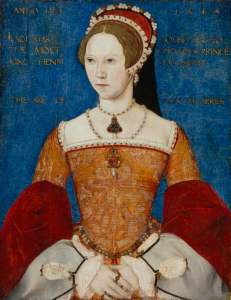
Princess Mary in 1544 by Master John Browne NPG428

In an uncharacteristically rude manner, Cromwell writes to Princess Mary, no doubt under command to the King, and admonishes her for not signing the oath and swearing loyalty to her father. Princess Mary was in grave danger by this time, and Cromwell knew that Mary’s allegiance to Henry was the only thing that would save her. But after years of kind words to Mary, this letter must have arrived at Hunsdon to her great surprise. 

CROMWELL TO THE PRINCESS MARY, 10 June 1536 (MSS Otho. C. x. 273)

I have received your letters, whereby it appears you be in great discomfort, and do desire that I should find the means to speak with you. Your discomfort can be no greater than mine, who upon your letters have spoken so much of your repentance for your wilful obstinacy against the King, and of your humble submission to obey his pleasure and laws in all things without exception or qualification. Knowing how diversely and contrarily you have proceeded at the late being of his Majesty’s Council with you, I am ashamed of what I have said and afraid of what I have done. What the sequel shall be God knows. With your folly you undo yourself, and I say to you, as I have said elsewhere heretofore, it were pity you should not be an example in punishment, if you will make yourself an example in the contempt of God, your natural father and his laws by your only fantasy, contrary to the judgments and determinations of all men that ye must confess do know and love God as well as you. To be plain with you, I think you the most obstinate woman that ever was, and I dare not open my lips to name you unless I have such a ground thereto that it may appear you were mistaken, or at least that you repent your ingratitude and are ready to do your duty. I have therefore sent you a book of articles to subscribe, on receiving which from you again, with a letter declaring that you think in your heart as you have subscribed with your hand, I will venture to speak for your reconciliation. If you do not leave all sinister counsels, which have brought you to the point of undoing, I take leave of you for ever, and desire you to write to me no more, for I will never think you other than the most ungrateful, unnatural, and most obstinate person living, both to God and your most dear and benign father. And I advise you to nothing, but I beseech God never to help me if I know it not so certainly to be your bounden duty, by God’s laws and man’s laws, that I must needs judge that person that shall refuse it not meet to live in a Christian congregation; to the witness whereof I take Christ, whose mercy I refuse if I write anything unto you that I have not professed in my heart and know to be true.

Princess Mary wrote to Cromwell that same day: ‘You will see I have followed your advice and will do so in all things concerning my duty to the King, God and my conscience not offended; for I take you as one of my chief friends next his Grace and the Queen. I desire you, for Christ’s passion, to find means that I be not moved to any further entry in this matter than I have done; for I assure you I have done the utmost my conscience will suffer me, and I neither desire nor intend to do less than I have done.’[1]

 Another letter arrived from Princess Mary on 13 June, saying she had copied the letter Cromwell had ordered her to copy out and send to Henry, and she added, ‘Good Mr. Secretary, I do thank you with all my heart for the great pain and suit you have had for me. I see by your letters that you mislike my exception in my letter to the King. I assure you I did not mean it as you take it, for I do not mistrust that the King’s goodness will move me to do anything which should offend God and my conscience. But that which I did write was only by the reason of continual custom; for I have always used both in writing and speaking to except God in all things, same word for word; and it is unsealed, because I cannot endure to write another copy.’[2]

[1] MSS Otho, C. x. 262 b, 125, 10 Jun 1536

[2] MSS Otho, C. x. 263 b, 13 Jun 1536

HISTORICAL BOOK REVIEW SERIES: ‘Mary: Tudor Princess’ by Tony Riches

From the author of the international best-selling Tudor Trilogy, the true story of the Tudor dynasty continues with the daughter of King Henry VII, sister to King Henry VIII. Mary Tudor watches her elder brother become King of England and wonders what the future holds for her. 

Born into great privilege, Mary has beauty and intelligence beyond her years and is the most marriageable princess in Europe. Henry plans to use her marriage to build a powerful alliance against his enemies. Will she dare risk his anger by marrying for love?

Meticulously researched and based on actual events, this ‘sequel’ follows Mary’s story from book three of the Tudor Trilogy and is set during the reign of King Henry VIII.

~~

I have read Owen, Jasper and Henry, and also Warwick, by this author, so having a woman as a title character is an exciting addition! But it is not about Mary I, but Princess Mary Tudor, Henry VIII’s sister. That’s when I really jumped for the book, as I love both Mary and Margaret, forever eclipsed by their king brother.

The book starts in 1509, and Princess Mary is but 13 years old. Her brother Henry is only five years older but has just been crowned King of England. Henry knows who he shall marry – Katherine of Aragon, widow of Arthur, and now Mary is going to be an equally powerful princess – powerful in that selling her to the highest bidder will help increase Henry’s power.

Mary has, in the past, been written as a fool, a simple girl interested in princes and gowns, no head for politics. What a silly notion, because Mary is the daughter of Henry VII and Elizabeth of York, her sister is Queen of Scots, Arthur was to be king, before Henry took poor Arthur’s place. How could Mary possibly be dim? Here, Mary is educated, confident and a brave young woman at the heart of a very serious political match for her country. Yes, she may break down in private, but her public face is one of total poise, the way only a royal upbringing could provide.

Mary considers Katherine of Aragon a sister when she marries Henry (Mary was very young when Katherine married Arthur). Henry and Mary are close, even though Henry is never an easy man to love, and is often heartless to Katherine. Mary has lost both her parents, and Henry breaks her betrothal to the  Holy Roman Emperor Charles, also just a child, and instead gives Mary in marriage to King Louis of France.

Mary may be a queen, but is also Europe’s most beautiful princess of 18 years when she marries the frail 52-year-old Louis. Mary does as she is bid (and has a child Anne Boleyn in her household, just a little side bonus) and marries the old Frenchman. But first Mary told her brother – I shall marry Louis if  can choose my second husband.

That is where Mary is so grand. Louis kicks the bucket three months in, and kings and dukes are clamouring for Mary less than a week into widowhood. But Mary has her suitor all ready, Charles Brandon, Henry’s best friend and (while the Duke of Suffolk) not at all good enough for her. Secretly married, Mary defies her brother and King, and is banished from court and from his kindness.

Never mind all these details; Mary is written as a woman, a wife, a mother, a sister. She becomes a queen of France (who killed her old husband with too much sex, so they gossiped, eww), then a woman who married for love, then a wife who had to endure infidelity, the births and deaths of children, the heartache she felt for Queen Katherine and the fortunes of all around her. Mary also suffered with her health for her whole life.

Mary was an important princess in the royal history of the time, and is not prone to being frivolous, and so is written as an educated woman. While the Tudor world is filled with politics, law, religion, it is also filled with love, friendship, parties and jousts, colour and excitement, and the book weaves all together.

Did Brandon love Mary back? The book gives hints about such as Mary’s life is followed. Mary’s death is beautiful and tragic, and the process starts over, as Brandon marries a child as a firm alliance just a few months later (he was a lucky man to capture both Princess Mary and Catherine Willoughby!). Mary’s granddaughter Jane would become queen for nine days many years later, and must have had the blood of THIS type of Princess Mary in Jane’s veins.

Thank you, Tony, for a wonderful novel!

~~

About the Author Tony Riches is a full-time author of best-selling historical fiction. He lives in Pembrokeshire, West Wales and is a specialist in the fifteenth century, with a particular interest in the Wars of the Roses and the lives of the early Tudors. For more information about Tony’s other books please visit his website tonyriches.com and his popular blog, The Writing Desk and find him on Goodreads as well as Facebook and Twitter @tonyriches

HISTORICAL BOOK REVIEW SERIES: ‘The King’s Pearl’ by Melita Thomas

Mary Tudor has always been known as ‘Bloody Mary’, the name given to her by later Protestant chroniclers who vilified her for attempting to re-impose Roman Catholicism in England. Although a more nuanced picture of the first queen regnant has since emerged, she is still stereotyped, depicted as a tragic and lonely figure, personally and politically isolated after the annulment of her parents’ marriage and rescued from obscurity only through the good offices of Katherine Parr.

Although Henry doted on Mary as a child and called her his ‘pearl of the world’, her determination to side with her mother over the annulment both hurt him as a father and damaged perceptions of him as a monarch commanding unhesitating obedience. However, once Mary had finally been pressured into compliance, Henry reverted to being a loving father and Mary played an important role in court life.

As Melita Thomas points out, Mary was a gambler – and not just with cards. Later, she would risk all, including her life, to gain the throne. As a young girl of just seventeen she made the first throw of the dice, defiantly maintaining her claim to be Henry’s legitimate daughter against the determined attempts of Anne Boleyn and the king to break her spirit.

Following the 500th anniversary of Mary’s birth, The King’s Pearl re-examines Mary’s life during the reign of Henry VIII and her complex, dramatic relationship with her father.

cover and blurb via amazon

~~

Called Bloody Mary through the centuries, Queen Mary has never attracted the same level of interest as her little sister Elizabeth I. This book has set out to change the stereotype of Mary, heir to the throne of Henry VIII and her powerful mother, the Queen Katherine. Mary has been seen as a Catholic fanatic, unable to navigate politics with poise or experience, a cruel woman happy to kill Protestants without thought. Mary is seen as married to a Spaniard, which somehow made her an instant tyrant.

In recent times, some authors have tried to make Mary into a more gentle figure; an innocent woman, forced away from her religious mother, determined to turn back time in England, unable to satisfy a husband or make an heir. The King’s Pearl is different again, which makes the book such a nice surprise. Instead, this book looks at Mary from an earlier angle, how her father’s reign impacted on Mary.

Mary’s early life is chronicled in serious detail, before the reality of Henry’s ‘Great Matter’ starts affecting Mary and her life. Mary was a stylish and educated young woman, witty, musical and a skilled horse rider. Mary was not weak or timid, as often portrayed; not constantly alone or at prayer, Mary could hunt or dance, host parties or play games as well as any young woman. She was beautiful and always immaculately dressed. Gone are the dull descriptions that often plagued her mother also, more likely propaganda to portray Elizabeth as superior later in life.

The list of betrothals Mary suffered though makes for bleak reading. Henry never seemed serious in finding a groom for his daughter. Mary was an unchallenged heir for much of her young life, and Henry seemed wary to ever marry her off and make her position as heir more powerful. Mary could defy her father at any time, on any level, and while others were forsaken, Mary was forgiven by Henry, dispelling the notion Henry hated his eldest daughter.

Mary may have had more in common with Elizabeth than either of them would have liked to admit; bright, intelligent girls, separated by their birth and their religion. I feel as if Mary’s reputation suffers due to her sex more than ever – Mary killed less than 300 heretics, her father killed 72,000, yet she is the bloody one? No man would have had a harmed reputation for the killing of 300. Mary rode out and took the throne from Jane Grey, the throne that was rightfully hers, and did her best, in a role she was prepared for, and Mary had her own terms. Only history hasn’t remembered her as well as it should.

This book is a worthy read indeed. Loved it. The author has created an excellent perspective on Queen Mary through facts instead of myth.