
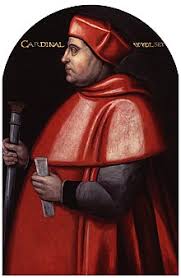
On 6 February 1530, Cardinal Thomas Wolsey was looking to have his various vague charges of praemunire, and potential treason dropped by the king, after a blisteringly harsh parliament tried to have him convicted, the penalty being execution. Only Thomas Cromwell had spoken out in Wolsey’s defence, which had softened King Henry’s stance, and several others had tried to speak in Cromwell’s name to the king’s praising him and his courage, most notably Sir John Russell and Sir John Gage. Wolsey wrote many begging, pleading, woeful letters to Cromwell though the final months of 1529 and early 1530, begging for help and money, even though Cromwell visited Esher Place regularly, and paid wages and for supplies for the household.
On 6 February 1530, the king was close to caving and forgiving Wolsey for not securing an annulment, and several had gently tried to persuade the king to relent, catching Anne Boleyn’s anger in the process. Two letters from Wolsey survive, both attributed 6 February 1530, begging Cromwell to help him, as Cromwell had not recently visited Esher, due to the death of his wife Elizabeth. Wolsey was more concerned with himself than Cromwell’s retreat to Austin Friars in pain. Here is a portion of both letters, taken from my book of Cromwell letters, with my modern spelling and punctuation. Italics are all mine.
THOMAS WOLSEY TO THOMAS CROMWELL 6 FEBRUARY (Cott. App. XLVIII. 19)
“Mine only comfort, at the reverence of God leave me not now, for if you do I shall not long live in this wretched world. You will not believe how I am altered, for that I have heard nothing from you of your proceedings and expeditions in my matters… I hope you will not allow all your former labours to me to be cast away. I beg you to redub (restore) the matter, continue your accustomable goodness and sent me some comfort… Written this morning with a moste heavy heart, by your assured, Thomas Cromwell, we are miserable and unfortunate.”
- This second letter is very mutilated and difficult to decipher. Wolsey tries to instruct Cromwell to speak to Secretary Stephen Gardiner and Treasurer William Fitzwilliam, and asks that Henry Norris and John Russell speak to the king on Wolsey’s behalf. He also requests John Arundell to travel to Esher and that Henry Percy was lying to the king about Wolsey. There was also a charge that Wolsey had coins minted with his face rather than the king’s which raised questions of further treason. It was Cromwell you spoke to the king on Wolsey’s behalf that following week, and got Wolsey’s charges all dropped.
THOMAS WOLSEY TO THOAMS CROMWELL 6 FEBRUARY 1530 (Cott. App. XLVIII. 18)
“Mine own good, trusty, and most assured refuge in this, my calamity. I am so encumbered with heaviness and anxiety that I cannot remember everything, but I trust to you to supply what we lack… that you may be plain to Mr. Treasurer (Fitzwilliam), and specially Mr Steven (Gardiner), who, upon consideration thereof, may be the (person?) with the king in allotting and appointing of my pardon if he listen. No man can do me more good and you … yourself refer that his opinion was that I should have no less then 4,000l (£1.8 million today) yearly to live with, which mine… degree considered is with the lest, I could not forbear putting you in remembrance hereof, remitting the bettering thereof to your wisdom and good handling; and as touching the coin (where Wolsey had his face minted on a series of coins in 1526, which was seen as treason) with the letters and badge in the same, you may for your better knowledge refer to Robert Amadas and other officers (of the mint )… learned how the usage has been (done in this way for centuries)… I would gladly have (lawyer and attendant John) Arundell (here)… (Henry Percy, Earl of) Northumberland’s untrue and wrong information … meant mean betwixt him (and I?) … Mr. Norris, Sir John Russell … my good and ever be greatly to my comfort.”
 CAROLINE ANGUS