Han Holbein’s design for the coronation pageant, Apollo and the Muses on Parnassus. Kupferstichcabinett, Staatliche Museen zu Berlin
FOR THE QUEEN’S CORONATION, 28 April 1533 (Egerton MS. 985, f. 57 b)
This is a list of items prepared for Anne’s coronation. The handwriting belongs to a clerk, as Cromwell took time to prepare for the coronation celebration, as the main items needed were jewels from the Jewel-House and money from the Exchequer, both of which he commanded, and fabric for clothing and decoration was so in demand that supplies ran short, and Cromwell’s connections in the industry kept the cloth coming. Anne’s coronation took place on 1 June, but Cromwell only received the the Convocation of Canterbury’s officially rulings declaring Anne’s marriage to Henry valid a few days before the event. Crowmell had to plan the event in the hope that Thomas Cranmer would be able to push through the ruling that Katharine of Aragon’s marriage to the king was void and that Anne Boleyn could be the queen. The pair worked furiously through May to make everything happen.
For the Quenes coronacion
To appoint the day for the coronation, and to prepare all things for the same.
Letters from the King to be sent to the nobles, lords, knights, ladies, and others to attend, and to those who will be created knights of the Bath, whose names Garter is to have.
Commissions to be made for the Great Steward and Constable.
The day when the Steward shall sit in the White Hall.
All noble men who hold land by service royal to bring in their claims.
The mayor, aldermen, commoners, and crafts(men) of London are to meet the Queen before she comes to the Tower.
The King will meet her at the Tower. A kirtle and mantle (coat) of cloth of gold furred with ermines.
A lace of silk and gold with tassels for the mantle.
A circlet of gold garnished with precious stones.
A litter of timber covered with cloth of gold.
Down pillows covered with cloth of gold, for the litter.
A lady appointed by name to bear her train.
The mayor, aldermen, and crafts(men) of London are to do their service accustomed, and the streets between the Tower and Westminster are to be garnished with tapestry, arras, silk, and the banners, standard, and pennons of crafts to be ready to garnish the barges and stand where the wardens be of each occupation.
The Lords, the High Steward, Constable of England, Garter, the Mayor of London, and the two squires of honour to be in crimson velvet and beket hats.
The tipstaves (court officers) of the marshals in their liveries, to avoid the press of people.
A canopy of gold with valance to be borne by 16 knights.
Two esquires of honour to be appointed to represent the dukes of Normandy and Aquitaine.
A horse of estate, saddled, to be led by the Master of the Queen’s horse.
Six henchmen on palfreys harnessed with cloth of gold.
Two chairs covered with cloth of gold, and ladies of the highest estate to sit in them, clothed in crimson velvet.
Six ladies on palfreys with saddles and harness like those of the henchmen.
Two other chairs richly garnished for the Queen’s ladies.
A great number of ladies and gentlewomen on palfreys dressed according to their estates.
A void to be prepared for the Queen at Westminster.
A kirtle and mantle of purple velvet furred with ermines, with a lace, for the day of the coronation.
A circlet.
A cloth of estate in Westminster Hall.
The procession. A ray (striped) cloth to go from the Hall to Westminster.
A canopy borne by the barons of the Cinque Ports.
Two bishops to go every (either) side of the Queen.
The verge (symbolic rod) of ivory to be borne.
The sceptre.
A rich crown of gold.
Liveries to be given according to the precedents of the Wardrobe.
The archbishop of Canterbury to do as appertains.
The seat royal or pulpit to be dressed with cloth of gold and cushions.
The Queen to be howseled (receive the Eucharist), and after to have secret refection (refreshment) of such meat as she likes best.
A stage to be made, latticed, and covered with rich cloths, for the King and others to see the solemnity.
The mayor, aldermen, and commoners of London, with their crafts, to meet the Queen before she comes to the Tower.
The King to meet her and welcome her at the Tower.
The service to the Queen at dinner, and the ordering of the hall, to be committed to those who have authority.
A stage in Westminster Hall for minstrels and trumpets.
The kings of arms, heralds, and pursuivants to keep their accustomed stage at the right end of the table, and to have a cloth on the table with proper service.
The Treasurer and Comptroller to go on foot, and the three high estates of Constable, Marshal, and Steward, on horseback, their horses trapped.
A stage on the left side of the Hall latticed and garnished for the King.
The surnap (handwashing napkin), and who shall draw it, the marshal to be named.
The void after.
The Mayor to bear the cup of gold. Jousts and tourneys.
To appoint the number of challengers and defenders for the jousts, to go before the Queen from the Tower to Westminster Hall on their steering horses, garnished with bells and devices.
The Lord Steward, Treasurer, and Comptroller must give warning overnight to those who shall do any service.
CROMWELL’S REMEMBRANCES TO THE KING, April 1533 (MSS Titus, B.I. 422)
On the back of a letter listing the King’s demands to the Merchants of the Staple (saying their due bills and new taxes on wool from Calais), Cromwell scribbled down a few more remembrances to discuss directly with King Henry. It’s a a short list with massive implications for the royal family. Cromwell would take some of his busier to-do lists to the king and have Henry sign them, so there could be no debate whether the king was acting on Henry’s instructions or not. A simple method that provided great security.
Remember the judgment to be prepared for the King’s great matter.
Item, for the dispatch of my lord of Norfolk.
Item, the bill for the succession, and to rest upon the same.
For to devise for the coronation, and to see presentiments (possible foreboding feelings) for the same.
Item, to devise for lands for the Queen (Anne)
Item, for the establishment of the Dowager (Queen Katharine)
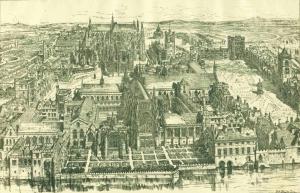
Westminster in the Tudor period. H J Brewer, The Builder magazine, 1884
THE SUPPLICATION OF THE COMMONS AGAINST THE ORDINARIES, April 1532 (Wilkins, III. 750)
The Supplication of the Commons Against the Ordinaries was one of Cromwell’s 1532 masterstrokes. The papers were grievances against the Ordinaries, as abuse was rife within the Church, along with issues surrounding the way they ignored their own laws and unfairly punished lay people for similar behaviour. It is unknown when the Supplication was first drafted; Cromwell may have had his papers drawn up years in advance, given all he had seen over the past few years.[2] The supplication passed in the Commons in January and formally put to King Henry in March.
By the end of April, the King received the Answer of the Ordinaries after it passed through Convocation, who naturally argued against what Cromwell had written. The Church held an enormous amount of power in England, making their own laws and passing their own sentences on laypeople, who did not have the education to argue their case, nor the money to bribe church officials in return for safety. Stripping the Ordinaries of their powers would hand much control back to the King and help a lot of innocent people.[3] In 1533, Cromwell set to work in moving the jurisdiction of laws from the church to the crown, something we take for granted today.
‘A boke ayenst the clergy for takyng excessyve Fees’
To the King our Sovereign Lord
In most humble ways shown unto your excellent highness and most prudent wisdom, your faithful, loving and most humble and obedient subjects, The Commons in this your present Parliament, assembled that where of late as well, through new fantastical and erroneous opinions grown by occasion of frantic, seditious and overthwartly framed books compiled, imprinted, published and made in the English tongue, contrary and against the very true Catholic and Christian Faith, and also by the unreasonable and extreme rigour indiscrete and uncharitable behaviour and dealing of diverse ordinaries. The Commissaries and Substitutes which have heretofore had the examination in and upon the said errors and heretical opinions. Much discord, variance and debate has risen and more and more daily is like to increase and ensue amongst the universal sort of your said subjects, as well as spiritual and temporal, either against others in most uncharitable manners, to the great inquietation, vexation and breech of your peace within this your most Catholic realm. The special particular grieves whereof which most principally concerned your said Commons and lay subjects, and which are as they undoubtedly suppose the very chief foundations, occasions and causes that daily fosters, nourishes and maintains the said seditions, factions, deadly hatred and most uncharitable partakings, either part and sort of your said subjects, spiritual and temporal, against the other hereafter followingly do ensue.
First, where the prelates and spiritual Ordinaries of this your most excellent realm of England and the clergy of the same, have in their convocations, heretofore made and caused to be made, and also daily do, make diverse and many factions of laws, constitutions and ordinances without your knowledge or most royal assent, and without the assent and consent of any your lay subjects, unto the which laws your said lay subjects have not only heretofore and daily be bounden constrained to obey, as well in their bodies, goods and possessions, but also been compelled daily to incur into the censures of the same, and been continually put to importable charges and expenses against all equal right and good conscience. And yet your said humble subjects nor their predecessors could ever be privy to the said laws, nor any of the said laws have been declared unto them in the English tongue or otherwise published. By knowledge whereof, they might have extued (avoided) the dangers, censures, and penalties of the same. Which laws so made your said most humble and obedient subjects under the support of your Majesty are supposed to be not only to the diminution and derogation of your imperial jurisdiction and prerogative royal, but also to the great prejudice, inquietation and damage of all your said subjects. And also, where now of late there has been devised by the most Reverend father in God William, Archbishop of Canterbury, that in the courts which he calls His Courts of the Arches and Audience, shall be but only ten proctors at his deputation, which be sworn to prefer and promote the only jurisdiction and preferment of the said courts. By reason whereof, if any of your lay subjects shoulder have any lawful cause against the Judge of the said Courts or against any doctor or proctor of the same, or any of their friends or adherents, they cannot may in any wise have indifferent counsel. And also all the causes depending in any of the said courts may, by the confederacy of the said few proctors, be in such wise tracked and delayed, as your subjects suing in the same shall be put to importable charges, costs and expenses. And in case that any matters there being preferred should touch your Crown Regal Jurisdiction and prerogative royal, yet the same shall not be disclosed by any of the said proctors for fear of loss of their offices. Wherefore, your said most obedient subjects under the protection of your majesty suppose that your highness should have the nomination of some convenient number of proctors to be always attendant in the said courts of the arches and audience there to be sworn as well to the preferment of your jurisdiction and prerogative royal, as to the expedition of all the causes of your lay subjects repairing and suing to the same.
And where also many of your said most humble and obedient subjects and specially those that be of the poorest sort within this your realm, been daily convened and called before the said spiritual Ordinaries, their Commissaries and Substitutes and Officials sometimes at the pleasure of the said Ordinaries and Substitutes, for malice without any cause and sometimes at the only promotion and accusement of their false summoners and apparitors being very light and indiscrete persons, without any lawful cause of accusation or credible fame proved against them, and without any presentment in the visitation been inquieted, disturbed vexed, troubled and put to excessive and importable charges for them to bear, and many times be suspended and excommunicated for small and light causes, upon the only certificate of the proctors of the adversaries made under a feigned seal, which every proctor has in his keeping, whereas the party suspended and excommunicated many times never had any warning and yet when he shall be absolved if it be out of the court he shall be compelled to pay to his own proctor 20 pence, and to the proctor which is against him another 20 pence, and 20 pence to the scribe besides a pricey reward that the Judge shall have to the great impoverishing of your said poor lay subjects.
Also, your said most humble and obedient subjects find them grieved with the great and excessive fees taken in the said spiritual courts and in especially in the said Courts of the Arches, and audience where they take; for every citation 2 shillings 6 pence; for every inhibition 6 shillings 8 pence; for every proxy 16 pence, for every certificate 16 pence; for every libel 3 shillings 4 pence; for every answer to any libel 3 shillings 4 pence; for every act, even if it be but two words to the Register 4 pence; for every personal citation or decree 3 shillings 4 pence; for every sentence or judgement to the Judge 26 shillings 8 pence; for every testimonial upon any such sentence or judgement 26 shillings 8 pence; for every significate 12 shillings; for every commission to examine witnesses 12 shillings. Which is thought to be importable to be borne by your said subjects and very necessary to be reformed.
Furthermore, where the said spiritual Ordinaries many times purposely to revenge their inward grieves and displeasures and to put their said laws in execution their Commissaries and Substitutes sometimes for their own pleasures, sometimes by the sinister procurement of other spiritual persons use, to make out process against diverse of your said subjects and thereby compel them to appear before themselves to answer at a certain day and place to such articles as by them shall be of office before themselves. Then, purposed and that secretly and not in open places, and forthwith upon their appearance without cause or any declaration, then made or showed commit and send them to ward, where they remain without bail or mainprise (non-custodial bail) sometimes half a year, and sometimes a whole year and more. Nor they may in any ways know either the cause of their imprisonment or any name of their accuser, and finally their great costs, charges and expenses therein, when all is examined and nothing can be proved against them, but they clearly innocent for any fault or crime that can be laid onto them in that part, been set again at large without any recompense or amends in that behalf to be towards them adjudged.
And also, if percase upon the said process and appearance any party be upon the said matter, cause or examination brought forth and named either as party or witness, and then upon the proffe (pre-trial evidence) and trial thereof not able to prove and verify his said accusation or testimony against the party so accused to be true, then the person so causelessly accused is clearly for the more part without any remedy for his charges and wrongful vexation to be in that part towards him adjudged and recovered.
Also, upon the examination of the said accusation, if heresy be ordinarily laid onto the charge of the party so accused, then the said Ordinaries or their ministers use to put to them such subtle interrogatories concerning the high mysteries of our faith as are able quickly to trap a simple unlearned, or yet a well-witted lay man without learning, and bring them by such sinister introduction, some to his own confusion. And forthwith, if there any chance heresy to be, by such subtle policy by him confessed in words, and yet never committed nor thought in deed, then put they without further favour the said person either to make his purgation, and so thereby to lose his honesty and credence for ever, or else as some simple silly soul precisely standing to the clear testimony of his own well-known conscience rather than to confess his innocent truth to abide thextreme examynacion of deth by the Fyer the extremity in that behalf and so is utterly destroyed.
And if by fortune the said party so accused is to deny the said accusation and so put his adversary to prove the false same untruly forged and imagined against him, then for the more part such witnesses as been brought forth for the same be they but two in number, never so sore defamed of little truth or credence, adversaries or enemies to the party yet they shall be allowed and enabled only by discretion of the said Ordinaries, their Commissaries and Substitutes, and there upon sufficient cause to proceed to judgement to deliver the party so accused either to the secular hands and so to be burned after abjuration without remedy, and before if he submit himself to compel him when best happens, to make his purgation and bear a(n emblem of a) fagotte to his extreme shame and utter undoing.
In consideration whereof, most gracious Sovereign Lord, and forasmuch as there is at this present time and by a few years past has been outrageous violence on the one part and much default and lack of payment, and sufferance, charity and good will on the other part, a marvelous disorder of the godly quiet, peace and tranquility that this your realm heretofore ever hitherto has been in, thorough your politic wisdom in most honourable fame and Catholic faith inviolably preserved. It may therefore, most benign Sovereign lord, like your excellent goodness for the tender and universally indifferent zeal, benign love, and favour that your highness bears toward both the said parties, the said articles if they shall be, by your most clear and perfect judgement, thought any instruments or causes of the said variance and disorder, or those and all other occasions whatsoever accompanied by your highness, to make towards the said factions deeply and weightily, after your accustomed eyes and manner searched, weighed and considered graciously, to provide all violence on both sides utterly and clearly set a part some such necessary and behofull (discerning) remedies as may effectually reconcile and bring in perpetual unity your said subjects, spiritual and temporal. And for the establishing thereof to make and ordain on both sides such straight laws against the breakers, transgressors and offenders as shall be too heavy, dangerous, and weighty for them, or any of them, to bear, suffer and sustain. Whereunto, your said Commons, most humbly, heartily, and entirely, beseech your grace as the only head Sovereign, Lord Protector and Defender of both the said parties, in whom and by whom the only and sole redress, reformation and remedy herein absolutely rests and remains. By occasion whereof, all your said Commons, in their conscience surely accompt) that besides the marvellous, fervent love that your highness shall thereby gain and engender in their hearts towards your Grace, you shall do the most princely feat, and show the most honourable and charitable president and mirror that ever a Sovereign lord did upon his subjects and with that, merit and deserve of our merciful lord’s eternal bliss, whose goodness grant your Grace in most godly, princely and honourable estate, long to reign, prosper and continue as the Sovereign lord over all your said most humble and most obedient subjects.
And Where also. the said prelates and Ordinaries daily do permit and suffer the parsons, vicars curates, parish priests and other spiritual persons having cure of soul within this your realm, ministering unto your said loving subjects to exact and take of your humble and obedient subjects, diverse sums of money for the Sacraments and sacramentals of holy church, as the holy sacrament of the altar, baptism, matrimony, confession, burials, weddings, churchings, and such other sometimes denying the same without they first being paid the said sums of money and to take for the ministration of the same of your said subjects divers and certain sums of money alleging the same to be their duties. Which sacraments and sacramentals your said most humble and obedient subjects, under the protection of your highness, do suppose and think ought to be in most reverent charitable and goodly wise freely ministered unto them at all times, requisite without denial or any manner some or exaction of any manner sums of money or other duty or contribution to be asked demanded or required for the same to be demanded or asked for the same. And also, where in the spiritual courts of the said Prelates and Ordinaries been limited and appointed for many Judges, Scribes, Apparitors, Summoners, Appraisers, and other ministers for the approbation of testaments, which coveting so much their own private lucres (immoral profits) and satisfaction of the appetites of the said Prelates and Ordinaries, that when any of your said loving subjects do repair to any of the said Courts for the probate of any testaments they do in such ways extorte and make long delays or excessively take of them so large fees and rewards for the same, as is importable for them to bear directly against all justice law, equity and good conscience.
And also where most gracious Sovereign, the Judges Constituted and appointed by the said spiritual Ordinaries in their said Courts to here and determine causes there, do in likewise daily take many great and excessive fees and rewards of your said poor subjects having any cause or matier depending before them as is aforesaid And over that when any Judgement or sentence by the said Judge shall be given before them will also have great sums of money for the same. So that nothing is or can be obtained in any of the said Courts without money.
Wherefore, Your said most humble and obedient subjects do therefore, under your gracious correction and support, suppose it were very necessary that the said Ordinaries in the deputation of such Judges should be bound to appoint and assign such discreet, gracious and honest persons having sufficient learning, wit, discretion and understanding and also being indeed with such spiritual promotions stipend and salary as they, being Judges in their said courts, might and may minister to every person repairing to the same Justice without taking any manner, fee or reward for any manner sentence or judgement to be given before them, and also, whereas diverse spiritual persons being presented as well by your highness and by other patrons within this your realm to any diverse benefices or other spiritual promotion. The said Ordinaries and there ministers do not only take of them for their Letters of Institution and Induction, many great and excessive large sums of money and rewards, but also do pact and covenant with the same, taking sure bonds for their indemnity to answer to the said Ordinaries the first fruits of the said benefices after their Institution, so as they being ones presented or promoted as is aforesaid been by the said Ordinaries very extremely uncharitably handled, to their no little hindrance and impoverishment, which your said subjects suppose not only to be against all laws right and good conscience, but also to be simony (benefice for profit) and contrary to the laws of God.
And also, whereas the said spiritual Ordinaries do daily confer and give sundry benefices unto certain young folks, calling them their nephews or kinsfolk, being in their minority and within age not apt nor able to serve the cure of any such benefice. Whereby, the said ordinaries do keep and detain the fruits and profits of the same benefices in their own hands and thereby accumulate to themselves right great and large sums of money and yearly profits to the most pernicious example of all your said lay subjects and so the curates and other promotions given unto such infants been only given but employed to enrich the enriching of the said Ordinaries and the poor silly souls of your people and subjects which should be taught in the parishes given as aforesaid for lack of good curates do perish without doctrine or any good teaching.
And also where a great number of holy days which now at this present time, with very small devotion be solemnised, and kept throughout this your realm, upon the which many great abominable and execrable vices, idle and wanton sports been used and exercised, which holy days, if it may stand with your gracious pleasure, and special such as fall in the harvest might, by your majesty, by the advice of your most honourable council, prelates and Ordinaries be made fewer in number, and those that shall hereafter be ordained to stand and continue might and may be the more devoutly, religiously and reverently observed to the lord of almighty God and to the increase of your high honour and fame.
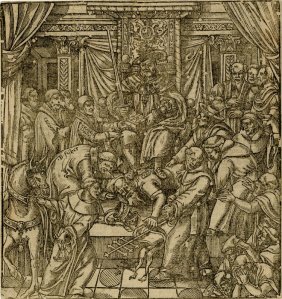
Henry VIII as Supreme Head of the English church (British Museum 1973 U 219)
Welcome back to a new year, and a new series, On This Day with Thomas Cromwell. The series will feature happenings on different dates in Cromwell’s life, as seen through his surviving correspondence. I will be posting on Instagram, Tiktok, Facebook, and Bluesky, and some of the larger posts will also be added here.
Today we start off with a huge event, when Cromwell submitted to the 1533 parliament The Act of Restraint of Appeals, also known as the Ecclesiastical Appeals Act, Statute in Restraint of Appeals, or ‘An Acte that the Appeles in suche Cases as have ben used to be pursued to the See of Rome shall not be from hensforth had ne used but wythin this Realme’. One 4 February, Cromwell, who by this time was in charge of parliament, placed this act 14th in a list of 16 acts to be passed, all of which reached royal assent on 7 April 1533 (note that the original acts were dated with the Julian calendar, which ended the year 1532 on 31 March, so the acts were all originally labelled as 1532. I only use the Georgian calendar when listing Cromwell’s letters and petitions, as do all legal frameworks).
Queen Katharine of Aragon (Lambeth 26)
Who cared about the The Act of Restraint of Appeals? As it turned out, many powerful people, the most powerful of them all being Katharine of Aragon, Queen of England. Queen Katharine had been on the throne since 1509, and there was no need or desire for her to give up that position, except when King Henry claimed to be in love with Anne Boleyn. Four years on from the messy and inconclusive legatine court annulment hearing before Cardinals Wolsey and Campeggio, Katharine had been petitioning Pope Clement to refuse her husband King Henry an annulment so he could remarry. King Henry was all talk when it came to divorce, but hadn’t really made that many petitions for an annulment, more just attacked those around him, and wrote to many abroad in the hopes of support.
But Thomas Cromwell had not been so idle. In 1532, he wrote the The Supplication Of The Commons Against The Ordinaries, which became known as the Submission of the Clergy. That made Henry VIII the ‘Head of the Church in England as far as the law allowed.’ All clergy had to bow to the king, not the authority of the Pope in Rome. Months later, Archbishop of Canterbury William Warham died, and after sending out the necessary papal papers, Thomas Cranmer was found abroad and brought home to be the new archbishop, just as Cromwell and Henry both wanted. Cranmer had recently been radicalised in Europe, and finally had come to see the ‘benefits’ for a reformed church in England (and not just because he had been dallying with a Swiss girl).
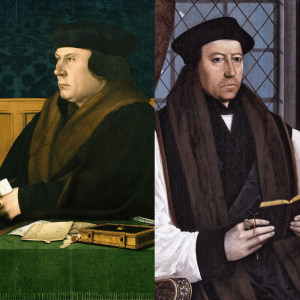
Thomas Cromwell (Frick 1915.1.76) and Thomas Cranmer (NPG 535)
But ultimately, for all the legal paperwork, Pope Clement still existed. The Catholic faith still existed. A law didn’t change people’s opinions or beliefs. A person could, in theory, still go around the new Archbishop Cranmer and write to the Pope and ask for an ecclesiastic ruling. Katharine of Aragon’s petition to save her marriage remained intact. Despite being an ardent supporter of Queen Katharine and her daughter Princess Mary, Thomas Cromwell was the one to do the work, and cut off Katharine’s hopes of saving her marriage and title. It would be treason to go against this law, the penalty being death.
The Act of Restraint of Appeals is the primary legal foundation of the English Reformation. By ensuring no one in England could seek the Pope’s rulings over King Henry, it made the Church of England essentially real, as its own standing faith, overseen by a monarch, who was anointed by God to rule. The petition went to parliament on 4 February 1533, the only major act of the session, neatly squeezed between an act about paving the road from The Strand to Charing Cross in London, and an act against excessively nice clothing (that’s a whole topic on its own). The large roll Cromwell submitted (written in a scribe’s hand) was the first of ten drafts worked on through the session, and included both Cromwell and the king’s handwriting as the statutes were argued, corrected and settled. This meant the king could have the final ruling on subjects like his own divorce, and passed that power to Archbishop Cranmer to formally put it to Convocation and rule the marriage of Henry and Katharine void, clearing the way for pregnant Anne Boleyn to be crowned. The Act of Restraint of Appeals made everything possible for the English Reformation, leaving many dead when they dared to refuse.
The law of only repealed in full by the Statute Law (Repeals) Act 1969, though Northern Ireland was free of the act by 1950.
Here is the text of the completed draft, with modern spelling, punctuation, and italics placed by me, directly from my book of Cromwell’s letters. I have underlined the most important and relevant parts if you would prefer not to slog through this wordy middle-English decree.
THE ACT OF RESTRAINT IN APPEALS, 4 February 1533 (MSS Cleo. E. VI. 185)
‘An Acte that the Appeles in suche Cases as have ben used to be pursued to the See of Rome shall not be from hensforth had ne used but wythin this Realme’
I. An Act that feeds in such cases, as have been used to be pursued to the See of Rome, shall not be from henceforth had nor used but within this realm where, by diverse sundry old authentic histories and chronicles, it is manifestly declared and expressed that this realm of England is an empire, and so has been accepted in the world, governed by one Supreme Head and King having the dignity and royal estate of the imperial Crown of the same, unto whom a body politic, compact of all sorts and degrees of people divided in terms and by names of Spiritualty and Temporality, be bound and owe to bear next to God a natural and humble obedience; he being also instituted and furnished by the goodness and sufferance of Almighty God with plenary, whole, and entire power, pre-eminence, authority, prerogative, and jurisdiction to render and yield justice and final determination to all manner of folk, residents or subjects within this his realm, in all causes, matters, debates, and contentions happening to occur, insurrect, or begin within the limits thereof, without restraint or provocation to any foreign princes or potentates of the world: the body spiritual whereof, having power when any cause of the law divine happened to come in question or of spiritual learning, then it was declared, interpreted, and shown by that part of the said body politic called the Spiritualty, now being usually called the English Church, which always has been reputed and also found of that sort that both for knowledge, integrity, and sufficiency of number, it has been always thought and is also at this hour sufficient and mete for itself, without the intermeddling of any exterior person or persons, to declare and determine all such doubts, and to administer all such offices and duties as to their rooms spiritual does appertain. For the due administration whereof and to keep them from corruption and sinister affection the King’s most noble progenitors, and the ancestors of the nobles of this realm, have sufficiently endowed the said Church both with honour and possessions. And the laws temporal for trial of propriety of lands and goods, and for the conservation of the people of this realm in unity and peace without ravin (plunder) or spoil, was and yet is administered, adjudged, and executed by sundry judges and administers of the other part of the said body politic called the Temporality, and both their authorities and jurisdictions do conjoin together in the due administration of justice the one to help the other. And whereas the King his most noble progenitors, and the Nobility and Commons of this said realm, at diverse and sundry Parliaments as well in the time of King Edward the First, Edward the Third, Richard the Second, Henry the Fourth, and other noble kings of this realm, made sundry ordinances, laws, statutes, and provisions for the entire and sure conservation of the prerogatives, liberties, and preeminence of the said imperial Crown of this realm, and of the jurisdictions spiritual and temporal of the same, to keep it from the annoyance as well of the See of Rome as from the authority of other foreign potentates attempting the diminution or violation thereof as often and from time to time as any such annoyance or attempt might be known or espied. And notwithstanding the said good statutes and ordinances made in the time of the King’s most noble progenitors in preservation of the authority and prerogative of the said imperial Crown as is aforesaid, yet nevertheless since the making of the said good statutes and ordinances diverse and sundry inconveniences and dangers not provided for plainly by the said former acts, statutes, and ordinances have risen and sprung by reason of appeals sued out of this realm to the see of Rome, in causes testamentary causes of matrimony and divorces, right of tithes, oblations and obventions (offerings to God), not only to the great inquietation, vexation, trouble, costs, and charges of the King’s Highness and many of his subjects and residents in this his realm, but also to the great delay, and let to the true and speedy determination of the said causes, for so much as the parties appealing to the said court of Rome most commonly do the same for the delay of justice. And forasmuch as the great distance of way is so far out of this realm, so that the necessary proofs nor the true knowledge of the cause can neither there be so well known nor the witnesses there so well examined as within this realm, so that the parties grieved by means of the said appeals be most times without remedy. In consideration whereof the King’s Highness, his Nobles and Commons, considering the great enormities, dangers, long delays, and hurts that as well to his Highness as to his said nobles, subjects, commons, and residents of this his realm in the said causes testamentary, causes of matrimony and divorces, tithes, oblations, and obventions do daily ensue, does therefore by his royal assent and by the assent of the Lord’s spiritual and temporal and the Commons in this present Parliament assembled and by authority of the same, enact, establish, and ordain that all causes testamentary, causes of matrimony and divorces, rights of tithes, oblations, and obventions, the knowledge whereof by the goodness of princes of this realm and by the laws and customs of the same appertains to the spiritual jurisdiction of this realm already commenced, moved, depending, being, happening, or hereafter coming in contention, debate, or question within this realm or within any the King’s dominions or marches of the same or elsewhere, whether they concern the King our Sovereign Lord, his heirs or successors, or any other subjects or residents within the same of what degree soever they be, shall be from henceforth heard, examined, discussed, clearly finally and definitively adjudged and determined, within the King’s jurisdiction and authority and not elsewhere, in such courts spiritual and temporal of the same as the natures, conditions, and qualities of the causes and matters aforesaid in contention or hereafter happening in contention shall require, without having any respect to any custom, use, or sufferance in hindrance, let, or prejudice of the same or to any other thing used or suffered to the contrary thereof by any other manner person or persons in any manner of ways. Any foreign inhibitions, appeals, sentences, summons, citations, suspensions, interdictions, excommunications, restraints, judgments, or any other process or impediments of what natures, names, qualities, or conditions soever they be, from the See of Rome or any other foreign courts or potentates of the world, or from and out of this realm or any other the King’s dominions or marches of the same to the See of Rome or to any other foreign courts or potentates, to the let or impediment thereof in any wise notwithstanding. And potentates that it shall be lawful to the King our Sovereign Lord and to his heirs and successors, and to all other subjects or residents within this realm or within any the King’s dominions or marches of the same, notwithstanding that hereafter it should happen any excommencement, excommunications, interdictions, citations, or any other censures or foreign process out of any outward parties to be fulminate, provulged (proclaimed), declared, or put in execution within this said realm or in any other place or places for any of the causes before rehearsed, in prejudice, derogation, or contempt of this said Act and the very true meaning and execution thereof, may and shall nevertheless as well pursue, execute, have, and enjoy the meets, profits, benefits, and commodities of all such processes, sentences, judgments,, and determinations, done or hereafter to be done in any of the said courts spiritual or temporal as the cases shall require, within the limits, power, and authority of this the King’s said realm and dominions and marches of the same, and those only and none other to take place and to be firmly observed and obeyed within the same. As also that all spiritual prelates, pastors, ministers, and curates within this realm and the dominions of the same shall and may use, minister, execute, and do, or cause to be used administered, executed, and done, all sacraments, sacramentals, divine services, and all other things within the said realm and dominions unto all the subjects of the same as Catholic and Christian men are owe to do. Any foreign citations, processes, inhibitions, suspensions, interdictions, excommunications, or appeals for or touching any of the causes aforesaid from or to the See of Rome or any other foreign prince or foreign courts to the let or contrary thereof in any ways notwithstanding. And if any of the said spiritual persons, by the occasion of the said fulminations of any of the same interdictions, censures, inhibitions, excommunications, appeals, suspensions, summons, or other foreign citations for the causes before said or for any of them, do at any time hereafter refuse to minister or to cause to be ministered the said sacraments and sacramentals and other divine services in form as is aforesaid, shall for every such time or times that they or any of them do refuse so to do or to cause to be done, have one year’s imprisonment and to make fine and ransom at the King’s pleasure.
II. And it is further enacted that if any person or persons do attempt move, purchase, or procure, from or to the See of Rome or from or to any other foreign court or courts out of this realm, any manner foreign process, inhibitions, appeals, sentences, summons, citations, suspensions, interdictions, excommunications, restraints, or judgments, of what nature, kind, or quality soever they be, or execute any of the same process, or do any act or acts to the let, impediment, hindrance or derogation of any process, sentence, judgment, or determination had, made, done, or hereafter to be had, done, or made in any courts of this realm or the King’s said dominions or marshes of the same for any of the causes aforesaid. . .that then every person or persons so doing, and their fautors (supporters), comforters, abettors, procurers, executors, and counsellors, and every of them being convicted of the same, for every such default shall incur and run in the same pains, penalties, and forfeitures ordained and provided by the statute of provision and praemunire made in the sixteenth year of the reign of King Richard the Second.
III. And furthermore in eschewing the said great enormities, inquietations, delays, charges, and expenses hereafter to be sustained in pursuing of such appeals and foreign process do therefore ordain and enact that in such cases where heretofore any of the King’s subjects or residents have used to pursue, provoke, or procure any appeal to the see of Rome they shall from henceforth take, have, and use their appeals within this realm and not elsewhere, in manner and form as hereafter ensue and not otherwise. That is to say, first from the archdeacon or his official, if the matter or cause be there begun, to the bishop diocesan of the said See, and likewise, if it be commenced before the bishop diocesan or his commissary, from the bishop diocesan or his commissary, within fifteen days next ensuing the judgment or sentence thereof there given, to the archbishop of the province of Canterbury, if it be within his province, and if it be within the province of York then to the archbishop of York; and so likewise to all other archbishops in other the King’s dominions as the case by the order of justice shall require; and there to be definitively and finally ordered, decreed, and adjudged according to justice, without any other appellation or provocation to any other person or persons, court or courts. And if the matter or contention for any of the causes aforesaid be or shall be commenced before the archdeacon of any archbishop or his commissary, then the party grieved shall or may take his appeal, within fifteen days next after judgment or sentence there given, to the Court of the Arches or Audience of the same archbishop or archbishops, and from the said Court of the Arches or Audience, within fifteen days then next ensuing after judgment or sentence there given, to the archbishop of the same province, there to be definitively and finally determined without any other or further process or appeal thereupon to be had or ensued.
IV. And in case any cause, matter, or contention which has, does, shall, or may touch the King, his heirs or successive kings of this realm, that in all and every such case or cases the party grieved shall or may appeal to the spiritual prelates and other abbots and priors of the Upper House assembled and convocated by the King’s writ in the Convocation being or next ensuing within the province or provinces where the same matter of contention is or shall be begun; so that every such appeal be taken by the party grieved within fifteen days next after the judgment or sentence thereupon given or to be given. And this whatsoever be done or shall be done and affirmed, determined, decreed, and adjudged by the foresaid prelates, abbots, and priors of the Upper House of the said Convocation as is aforesaid, appertaining, concerning, or belonging to the King, his heirs or successors, in any of these foresaid causes of appeals, shall stand and be taken for a final decree, sentence, judgment, definition, and determination, and the same matter so determined never after to come in question and debate to be examined in any other court or courts. And if it shall happen any person or persons hereafter to pursue or provoke any appeal contrary to the effect of this Act, or refuse to obey, execute, and observe all things comprised within the same that then every person and persons so doing, refusing, or offending, their procurers, fautors (patrons), advocates, counsellors, and abettors, and every of them, shall incur into the pains, forfeitures, and penalties ordained and provided in the said statute made in the said sixteenth year of King Richard the Second.
Final page of Cromwell’s letter, held by Robert Gascoyne-Cecil, 7th Marquess of Salisbury, at Hatfield House.
Watching Wolf Hall 2, The Mirror and the Light, you would be forgiven for wondering why Cromwell wrote to King Henry and begged for mercy. Being cruel was in Henry’s nature. When Cromwell’s letter arrived to the king, he had his secretary Ralph Sadler read it aloud three times. Henry was feeling the weight of his mistake in arresting Cromwell by 9 July when work was piling up and Cromwell was no longer there as an intermediary between the king and all those who needed something. Cromwell had been attainted and the writ had gone through parliament. Henry couldn’t set a legal precedent and overrule an attainder. But contrary to belief, Henry did grant Cromwell mercy, by having him beheaded as an earl, not hanged or burned like a commoner.
The letter written by Cromwell to King Henry on 30 June 1540 served primarily to recall the finer points of Henry’s marriage to Anne of Cleves (note: Cromwell was not speaking the full truth, rather the agreed set of lies needed to create the Henry-Anna annulment). Cromwell had been interrogated the day prior by Norfolk, Audley and Fitzwilliam, with Wriothesley writing out a series of questions and answers to be signed by Cromwell and sent to Henry directly. Also on 29 June, the House of Lords passed the final draft of Cromwell’s Act of Attainder, meaning he had been declared guilty of treason on the false evidence provided primarily by Norfolk, Gardiner, Fitzwilliam and Wriothesley. The initial draft had gone through parliament ten days earlier, passing unanimously, likewise the final draft on 29 June (not that anyone actually had any choice but to vote in favour). Cromwell would have received this information at his interrogation, and being the man who wrote the Treasons Act 1534, knew that the punishment was hanging, drawing and quartering (though even Henry commuted it beheading much of the time).
This long letter survives in two forms, as a heavily mutilated draft (British Museum Oth. C. x f.247), and a finished copy (Hatfield House, Cecil Papers, 124-7) , both written on the same date. Below is a modern copy (using modern punctuation, as Cromwell loved extremely long sentences) from my book of Cromwell correspondence. I have added footnotes for the names mentioned, in case you get people mixed up. On The Mirror and the Light, Cromwell is called Lord Chancellor, which is not true, he was Vicegerent and Lord Privy Seal.
A very good replica of the letter from The Mirror and the Light
To the king, my most gracious Sovereign lord, his Royal Majesty.
Most merciful king and most gracious sovereign lord, may it please the same to be advertised that the last time it pleased your benign goodness, to send unto me the right honourable Lord Chancellor,[1] the Right Honourable Duke of Norfolk,[2] and the Lord Admiral[3] to examine, and also to declare to me, diverse things from your Majesty, amongst the which, one special thing they moved and thereupon charged me as I would answer, before God at the dreadful day of Judgement and also upon the extreme danger and damnation of my soul and conscience, to say what I knew in the marriage and concerning the marriage between your highness and the queen, to the which I answered as I knew, declaring to them the particulars as nigh as I then could call to remembrance, which when they had heard, they, in your Majesty’s name, and upon like charge as they had given me, before commanded me to write to your highness the truth as much as I knew in that matter, which now I do, and the very truth as God shall save me, to the uttermost of my knowledge.
First, after your Majesty heard of the lady Anne of Cleves’ arrival at Dover and that her journeys were appointed towards Greenwich, and that she should be at Rochester on New Year’s Eve at night, your highness declared to me that you would privily visit her at Rochester upon New Year’s Day, adding these words “to nourish love,” which accordingly your Grace did upon New Year’s Day as is abovesaid. And the next day being Friday, your Grace returned to Greenwich where I spoke with your Grace and demanded of your Majesty how you liked the lady Anne. Your highness answered, as I thought heavily and not pleasantly, “nothing so well as she was spoken of.” Saying further that if your highness had known as much before as you then knew, she should not have come within this realm, saying as by way of lamentation what remedy, unto the which I answered and said I knew none but was very sorry. Therefore, and so God knows, I thought it a hard beginning, the next day after the receipt of the said lady and her entry made into Greenwich and after your highness had brought her to her chamber, I then waited upon your highness in your privy chamber, and being there, your Grace called me to you, saying to me these words, or the like, “my lord, is it not as I told you, say what they will, she is nothing so fair as she has been reported, howbeit, she is well and seemly.” Whereunto I answered, saying, “by my faith, Sir, you say truth,” adding thereunto that yet I thought she had a queenly manner, and nevertheless was sorry that your Grace was no better content, and thereupon your Grace commanded me to call together your Council, which were these by name: the Archbishop of Canterbury,[4] the Dukes of Norfolk and Suffolk,[5] my lord Admiral, my lord of Durham[6] and myself, to common of those matters, and to know what commission the Agents of Cleves had brought as well, touching the performance of the covenants sent before from hence to Doctor Wootton[7] to have been concluded in Cleves, as also in the declaration how the matters stood for the covenants of marriage between the Duke of Lorraine’s son[8] and the said lady Anne. Whereupon, Olisleger[9] and Hoghestein[10] were called and the matters purposed, whereby it plainly appeared that they were much astounded and abashed and desired that they might make answer in the next morning, which was Sunday. Upon Sunday in the morning, your said Councillors and they met early, and there again it was proposed unto them, as well touching the omission for the performance of the treaty and articles sent to Master Wootton, and also touching the contracts and covenants of marriage between the Duke of Lorraine’s son and the lady Anne, and what terms they stood in. To the which things so proposed, they answered as men much perplexed that as touching the commission they had none to treat concerning the articles sent to Mr. Wootton, and as to the contract and covenant of marriage they could say nothing but that a revocation was made, and that they were but spouseless, and finally after much reasoning they offered themselves to remain prisoners until such time as they should have sent unto them from Cleves, the first articles ratified under the Duke,[11] their Master’s, signature and seal, and also the copy of the revocation made between the Duke of Lorraine’s son and the lady Anne. Upon the which answers, I was sent to your highness by my lords of your said Council to declare to your highness what answer they had made, and came to your highness by the privy way into your privy chamber and declared to the same all the circumstances, where your Grace was very much displeased, saying I am not well handled, insomuch that I might well perceive that your highness was fully determined not to have gone through with the marriage at that time, saying unto me these word or the like, in effect that, “if it were not that she is come so far into my realm, and the great preparations that my states and people have made for her, and for fear of making of a ruffle in the world, that is to mean to drive her brother into the hands of the Emperor and French king’s hands, being now together, I would never have nor marry her,” so that I might well perceive your Grace was neither content with the person nor yet content with the preceding of the Agents. And after dinner, the said Sunday, your Grace sent for all your said Councillors, and in repeating how your highness was handled as well as touching the said articles and also the said matter of the Duke of Lorraine’s son, it might, and I doubt not, did appear to them how loathe your highness was to have married at that time. And thereupon and upon the considerations aforesaid, your Grace thought that it should be well done that she should make a protestation before your said Councillors, and notaries to be present, that she was free from all contracts which was done accordingly. Thereupon, I repairing to your highness, declaring how that she had made her protestation, whereunto your Grace answered in effect the words, or much like, “there is none other remedy but that I must need against my will, put my neck in the yoke,” and so I departed, leaving your highness in a study or pensiveness. And yet your Grace determined the next morning to go through, and in the morning which was Monday, your Majesty, preparing yourself towards the ceremony, there was some question who should lead here to church and it was appointed that the Earl of Essex[12] desist, and an earl that came with her should lead her to church, and thereupon one came to your highness and said unto you that the Earl of Essex was not yet come, whereupon your Grace appointed me to be the one that should lead here. And so I went unto her chamber to the intent to have done your commandment, and shortly after I came into the chamber, the Earl of Essex had come, whereupon I repaired back again in to your Grace’s privy chamber and showed your highness how he had come, and thereupon your Majesty advanced towards the gallery out of your privy chamber, and your Grace, being in and about the middle of your chamber of presence, called me unto you, saying the words or the like in sentence, “my lord, if it were not to satisfy the world and my realm, I would not do that I must do this day for no earthly thing.” And there, with one brought your Grace’s word that she was coming, and thereupon your Grace repaired into the gallery towards the closet and there paused her coming, being nothing content that she so long tarried as I judged then, and so consequently she came, and your Grace afterwards proceeded to the ceremony, and then being finished travelled the day, as appertained, and the night after the custom. And in the morning on Tuesday, I repairing to your Majesty in to your privy chamber, finding your Grace not so pleasant as I trusted to have done, I was so bold to ask your Grace how you liked the queen, whereunto your Grace soberly answered, saying that I was not all men, surely my lord as you know I liked her before not well but now I like her much worse. For to quote your highness; “I have felt her belly and her breasts and thereby as I can judge she should be not a maid, which struck me so to the heart when I felt them that I had neither will nor courage to proceed any further in other matters,” saying, “I have left her as good a maid as I found her,” which me thought then you spoke displeasantly, which I was very sorry to hear. Your highness also, after Candlemas, and before Shrovetide, once or twice said that you were in the same case with her as you were before and that your heart could never consent to meddle with her carnally. Notwithstanding, your highness alleged that you, for the most part, used to lie with her nightly or every second night, and yet your Majesty ever said that she was as good a maid for you as ever her mother bore her, for anything that you had ministered to her. Your highness showed me also in Lent last passed, at such time as your Grace had some communication with her of my lady Mary how that she began to wax stubborn and wilful, ever lamenting your fate and ever verifying that you had never any carnal knowledge with her, and also after Easter your Grace likewise at diverse times. In the Whitsun week. in your Grace’s privy chamber at Greenwich, exceedingly lamented your fate and that your greatest grief was that you should surely never have any more children for the comfort of this realm if you should so continue, assuring me that before God you thought she was never your lawfully wife, at which time your Grace knows what answer I made, which was that I would for my part do my uttermost to comfort and deliver your Grace of your affliction, and how sorry I was, both to see and hear your Grace. God knows your Grace diverse times since Whitsuntide declared the like to me, ever alleging one thing, and also saying that you had as much done to much the consent of your heart and mind as ever did man, and that you took God to witness, but ever you said the obstacle could never out of your mind, and gracious prince, after that you had first seen her at Rochester, I never thought in my heart that you were or would be contented with that marriage, and Sir, I know now in what case I stand in, which is only in the mercy of God and your Grace, if I have not to the uttermost of my remembrance said the truth and the whole truth in this matter, God never help me. I am sure as I think there is no man living in this your realm that knew more in this then I did, your highness only except, and I am sure my lord Admiral, calling to his remembrance, can show your highness and be my witness to what I said unto him after your Grace came from Rochester, and also after your Grace’s marriage, and also now of late since Whitsuntide, and I doubt not but many and diverse of my lords of your Council, both before your manage and since, have right well perceived that your Majesty has not been well pleased with your marriage, and as I shall answer to God I never thought your Grace content after you had once seen her at Rochester, and this is all that I know.
Most gracious and most merciful sovereign lord, beseeching almighty God, whoever in all your causes has ever counselled perceived, opened, maintained, relieved and defended your highness so he now will save to counsel you, preserve you, maintain you, remedy you, relieve and defend you as may be most to your honour, wealth prosperity, health and comfort of your heart’s desires. For the which, and for the long life and prosperous reign of your most royal Majesty, I shall, during my life and while I am here, pray to almighty God that He of his most abundant goodness, will help aid and comfort you, and after your continuance of Nestor’s[13] years, that that most noble Imp, the prince’s grace, your most dear son, may succeed you to reign long, prosperously and felicitously to God’s pleasure, beseeching most humbly, your Grace to pardon this, my rude writing, and to consider that I am a most woeful prisoner, ready to take the death when it shall please God and your Majesty. Yet the frail flesh incites me continually to call to your Grace for mercy and pardon for my offences and in this, Christ save, preserve, and keep you. Written the Tower, this Wednesday the last of June, with the heavy heart and trembling hand of your highness’ most heavy and most miserable prisoner and poor slave.
Most gracious prince, I cry for mercye, mercye, mercye
Welcome back to Wolf Hall 2: The Mirror and the Light true details about scenes in the latest episode, where Cromwell is arrested as a traitor to England.
In reality, in May 1540, King Henry was up to his usual tricks; hating on his own wife, romancing another lady (well, child) at court, and messing with religion just enough to upset literally everyone at home and abroad. In an inopportune turn of events, just as Cromwell’s chance to turn on the Catholic bishops had arrived, the king called Cromwell to court on 6 June, where Henry confessed his impotency with Queen Anna. Henry confessed this only to Cromwell and friend-turned-foe William Fitzwilliam. Cromwell had listened to Henry complain of his marriage to Anna multiple times over Easter, and again through Whitsun week in mid-May, but confirmation of the lack of consummation and Henry’s suggestion of annulment could not wait any longer, no matter Cromwell’s opinion. The alliance between England and Germany was non-existent, and the Emperor and France were not looking to go against England. Henry had no reason to hold on to a woman he did not like, no matter how much Anna was liked by others, or how suitable and well-chosen she was for England. King Henry had also been sneaking out of court to spend time with Lady Kathryn Howard at Stephen Gardiner’s Winchester Palace.
Cromwell travelled home to Austin Friars, where Thomas Wriothesley met him; Cromwell appeared exhausted and worn out by events. In Wriothesley’s own words, he asked Cromwell, ‘what one thing rested in his head which troubled him’. Cromwell, believing his home would afford him privacy, told Wriothesley the king’s marriage remained unconsummated. Wriothesley pushed the belief they could solve Henry’s issue, or ‘they should all smart for it’, but Cromwell replied it was a ‘great matter’. Wriothesley kept pushing his master, and Cromwell replied again it was a great matter, but stopped himself from revealing impotence. Still, the damage was done.
While Cromwell was at home feeling despondent and disillusioned, Stephen Gardiner prepared his attack. Since returning to England, he had reconnected with Thomas Wriothesley. Wriothesley claimed to be utterly loyal to Cromwell since late 1535 but was no such thing. Given how many people openly detested Wriothesley, it came as no surprise he would easily swap to old allegiances. Another Cromwell man, Edmund Bonner, who had bonded with Gardiner over their shared disastrous times as French ambassadors, turned against Cromwell, though, like Wriothesley, there appears to be no incident which caused a shift. Bonner’s position was likely his religious beliefs; Wriothesley was likely greedy. Wriothesley knew who else was close to the king and was happy to turn against Cromwell; William Fitzwilliam and his brother Anthony Browne, Master of the Horse. Both men were on the Privy Council and the king would readily listen to their opinions. With Wriothesley fresh appointed co-secretary to the king, and Fitzwilliam the only other person aware of the impotence besides Cromwell, Gardiner could easily collude with these men to destroy the new Earl of Essex.
Thomas Wriothesley, who had been just another man in Wolsey’s household, plucked to work alongside Stephen Gardiner, and then taken into the Cromwell household as one of his own, was only too eager to betray his noble master. Thomas Cromwell had overseen the grandest changes of Henry VIII’s reign. He destroyed the Catholic hold over England and ended the monasteries in favour of reformist colleges. He found the way to bring down Queen Katherine of Aragon. He beheaded Anne Boleyn so Henry could bat his eyelashes at Jane Seymour. Cromwell created the Church of England and made King Henry the supreme leader, ended paying taxes to Rome, and saw off threats from the Pope and Emperor Charles. Cromwell had engineered the execution of countless men, clergy and laity, when they did not agree with the king’s current mood, regardless of their innocence or guilt. He ensured the beheadings of noblemen who died for the king’s ever-grasping power and enriched Henry in a way not thought possible. Cromwell spent years in the background, learning, studying, and working with his legal skills while other courtiers fluttered around the king and whatever woman had Henry’s fancy. The English Bible was a reality because of all the endless work by Cromwell and Cranmer, two great men of learning trying to help the people of England, Wales, and Ireland. Cromwell endured years of taunts as a man walking around like Wolsey’s ghost behind the king, suspected of being a heretic for his learning, and was openly called a traitor for trying to advance the king’s desires. King Henry heard all these taunts, and defended Cromwell, even when 40,000 rebels called for Cromwell’s head. For over half of Cromwell’s time at court, he gained almost no personal advantage to himself, despite the enormous upheavals he created.
Yet one whisper of almost-impotence to Wriothesley at Austin Friars was enough for King Henry to forget every single one of Cromwell’s good deeds in His Highness’ name and sign an arrest warrant. Only Ambassador Marillac’s letters remain on the detail of the arrest of Thomas Lord Crumwell. On 10 June, it was recorded Cromwell arrived late to a Privy Council meeting after a morning in parliament. There was no reason for Cromwell to be late, it is more likely the Council was summoned slightly early without his knowledge. Among those in the Council were those close to Cromwell’s heart; Ralph Sadler, Thomas Cranmer, Thomas Audley, John Gage and John Russell. There were men there who had made Cromwell godfather to their children, the Duke of Suffolk, Edward Seymour, and Robert Radcliffe. Many enemies were present; Stephen Gardiner, the Duke of Norfolk, William Fitzwilliam, and traitor Wriothesley. Men who were like brothers or sons to Cromwell could only sit and watch as the nightmare unfolded. Sir William Kingston from the Tower was there with four guards to arrest Cromwell on arrival. Still dressed formally for parliament, wearing his Garter ribbons, collar of St George and his sable fur robes, Cromwell never got to say a word, nor realised anything was untoward before Kingston announced the arrest.
Shocked, Cromwell ripped his black cap from his head and threw it on the table and cried, ‘I am no traitor! Is this the reward for good service done unto His Majesty the King? I put it to your consciences; am I a traitor as your accusations imply? Well, no matter, for I renounce all pardons or grace needed, for I never offended the King, and it matters only if the King himself thinks me a traitor, and he would never have me linger long!’ The words were not dissimilar to Wolsey’s eleven years earlier.
Fitzwilliam untied Cromwell’s garter from his leg while Norfolk took Cromwell’s golden collar. The intention was clear; an attainted man could not be a member of the Garter. This was not a spur-of-the-moment plan; Norfolk had spoken to King Francis in Paris of the plan to destroy Cromwell back in February. Cromwell was taken from a water gate at Whitehall to the Tower with relative anonymity and housed in the Queen’s apartments, just as Anne Boleyn had been four years earlier.
Wriothesley began the Council’s letters for around England and Europe, sharing the news before anyone at court or parliament even knew the arrest occurred. In London, news of the arrest spread when Sir Thomas Cheyney (uncle of wife Jane Wriothesley) arrived at Austin Friars to confiscate the entire property. Cheyney had two dozen archers at his back for the occasion, despite the fact there would be no resistance at the surprise invasion. At the time, Mercy Prior still lived at the property, as did John and Joan Williamson and their children. The Williams and Wellyfed siblings likely had rooms at the house, as did loyal personal servants like Thomas Thacker. All would now be homeless, unable to access any of their belongings. All the servants, falconers, gardeners, dog handlers, stable hands for Cromwell’s 100 horses, would be left in limbo. The private items belonging to Gregory, his lost mother and sisters, and Cardinal Wolsey would be taken for their value. Cromwell’s daughter, Jane Cromwell, was hopefully away at Leeds Castle at the time of the arrest, though poor Gregory would have been in London for parliament and was likely staying at Austin Friars. Cheyney’s men knew what they wanted, and what they needed to find. Cromwell had 7,000l (almost £3,000,000 today) in coin on the property, plus silver plate and jewels all through the house. Rooms were decimated, from the linens, to bejewelled church relics in storage, to the vast armoury, whose inventory boasted 400 pikes, 272 handguns, 459 hooked halberds, 759 bows and armour for at least 600 men. Cromwell had shown Ambassador Castillion the armoury and boasted of his power; now it could look like a plan to destroy Henry.
Thomas Wriothesley was the King’s new secretary, and only because Cromwell had given him the role. Without Cromwell, Wriothesley had nothing, and yet had chosen to slither back to Gardiner and topple Cromwell for his own ends. Stephen Gardiner and Thomas Howard Duke of Norfolk had been dripping poison in the king’s ears for years about Cromwell, but one inferred comment about the king’s penis was enough for Henry to arrest his finest minister.
Wriothesley is portrayed as a quiet attendant with a hideous spotted fur over his shoulder in The Mirror and the Light, but in reality was a middling man of no special talent, who happened to fail upwards at the right moment, like so many around him. He went on to achieve little other than be the man to torture Anne Askew at the Tower, be sidelined by Edward IV, and then died alone, away from court. He lied about his allegiances and religious views at every turn, and yet history tends of forget all his bad deeds.
All sources come from The Private Life of Thomas Cromwell. My publisher might come for you if you plagiarise.





 CAROLINE ANGUS