Wolf Hall 2: The Mirror and the Light – Thomas Cromwell Quick Q+A

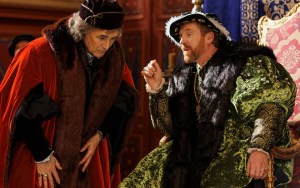
BBC/Nick Briggs

Welcome to part 4 of Wolf Hall 2: The Mirror and the Light facts about moments seen in Thomas Cromwell’s life at court. Today is a quick round-up of questions asked that don’t require a whole post of explanation on their own. So let’s start –

Wolf Hall is Jane Seymour’s home. What is The Mirror and the Light?

On 28 November 1538, Cromwell wrote a letter to Sir Thomas Wyatt (Harl. MSS. 282, f. 217), who was King Henry’s ambassador to Holy Roman Emperor Charles V, and travelling Europe with the Emperor’s court. Wyatt was not a good ambassador, and relations between the countries were started to deteriorate. Cromwell updated Wyatt on Henry Courtenay, Marquess of Exeter and Henry Pole, Lord Montagu, the Catholics traitors,  and asked Wyatt to get the Emperor  to intervene on several subjects were making trouble for London merchants. In the letter, Cromwell wrote of King Henry exercising his right as the supreme head of the church by burning Sacramentarian John Lambert a week earlier:

‘…undoubtedly [Emperor Charles] should have much marvelled at [King Henry’s] most high wisdom and judgement, and reputed him none otherwise, after the same, than in manner of the mirror and light of all other kings and princes in Christendom.’

King Henry is the mirror, and everyone and everything should reflect his brilliance. Henry is the shining light of princely splendour all should look up to. Being out of Henry’s light/favour is like being in the darkness. The letter is extremely flattering of Henry, since it would be read and repeated at the Emperor’s court, and could reveal nothing of reality, only a glowing picture of praise and perfection.

Was Thomas Cromwell the Lord Chancellor of England?

NO. Thomas Cromwell was never the Lord Chancellor. Thomas Wolsey was Lord Chancellor, followed by Thomas More, and then Thomas Audley. Cromwell assumed the role without title between more’s resignation in May 1532, and Audley’s appointment in January 1533, and was not always in a good mood about the position or workload. Audley was a puppet; he would do anything the king wanted, and he was easily intimidated, so Cromwell could yell at Audley whenever he made an error  and Audley would beg and grovel for forgiveness (Audley complained a lot, especially about his yearly salary of 800l or £350,000 today, plus bonuses. Cromwell always told him to shut it because it annoyed the king). Audley and his protégé Richard Rich really ran with Henry’s plan to dissolve monasteries when Cromwell didn’t want to move forward, but other than that, Cromwell had total control and authority over all matters. Audley never intervened in Cromwell’s business, despite technically being higher ranked until 1536. (Lord Chancellor was ranked second in the realm after the archbishops. In 1536, Cromwell became the Vicegerent of England, the new number one in order of precedence, putting Lord Chancellor down to third).

Thomas Cromwell was, in 1539, Lord Cromwell, Baron of Wimbledon the Vicegerent of England, Lord Privy Seal, Vicar-general of England, Knight of the Most Noble Order of the Garter, Principal Secretary, Chancellor of the Exchequer, the first-ever layman Dean of Wells, and Commissioner for the Peace in seven counties, Chancellor and High Steward of Cambridge University, Master of the Jewel House, Clerk of the Hanaper, and Steward of the Duchy of Lancaster, Essex, Hertfordshire and Middlesex, the Receiver of Petitions in the House of Lords, highest ranked man in the House of Lords, Warden and Chief Justice in Eyre, Prebendary of Salisbury, Steward of Westminster Abbey and Savoy Manor, Constable of Hertford Castle, Berkeley Castle and Gloucestershire Castle, Recorder of Bristol, Commissioner for the Subsidy to print the Bible, Lordship of Edmonton, Sainsbury, Hovering and Writtle, and  master of every single powerful man in the country of Ireland. By 1540, Cromwell was also the Earl of Essex and Lord Great Chamberlain. At that point that was basically nothing left for Cromwell to control, other than being the Lord Treasurer, but Norfolk held that role and seemed to live forever.

Sometimes people write Cromwell as Lord Chancellor because it is easier to understand in modern terms. Cromwell was the only person to ever be England’s Vicegerent, and no one person will ever receive that much power again.

Did Cromwell feel guilt over Anne Boleyn?

Certainly not that he ever mentioned where it would be recorded. It would have been insanity to have expressed guilt or sympathy. Archbishop Cranmer wrote to King Henry to make sure he didn’t go down with her, and so the Reformation would be safe without Anne on the throne. Cranmer was frozen out by the king for a while for this, and had his prime lands and manors confiscated, and given to Cromwell after Anne’s death. Mortlake Manor was the traditional home of the Archbishop of Canterbury since its construction 500 years earlier, and Crowmell relatives had worked there as servants. Cromwell then owned the property and made it grander than ever.

Cromwell did say to Ambassador Eustace Chapuys that Anne Boleyn handled herself well through her trial. Everyone knew she was innocent, but no one was stupid enough to say anything. I cover the whole period about Anne’s death in my book on the subject.

Did King Henry actually say he could make Cromwell the king after himself if he wanted at the Privy Council meeting?

No, that was just an imagined scene of the king flexing his power over all the nobles. Likewise, Cromwell and Fitzwilliam never came to blows like that at a meeting. It is another piece of fiction laid out to be reflected in later episodes. I will do a separate post about Cromwell and Fitzwilliam, as their relationship was very interesting.

BBC/Playground Entertainment/Nick Briggs

Did Cromwell spend time with Dorothea Wolsey?

There is no evidence of this; ‘Dorothea’ is a just a plot-point for Cromwell’s guilt. There are letters between Cardinal Wolsey’s three children and Cromwell. Most of the letters come from Thomas Wynter, Wolsey’s eldest son, born 1510 to Joan Larke, was always travelling in Europe, and always looking for money. Cromwell was one of Wynter’s financial babysitters, and felt sorry for Wynter after his father’s death. There are extensive papers showing Wolsey’s favour towards Wynter, and Cromwell got him set up in a comfortable life in the North in the 1530s, and he later became the Dean of Wells.

Dorothy was born in 1513, her mother also Joan Larke. Her surname was Clancey, the name of her adoptive family in Dorset. She was placed in Shaftesbury Abbey for her education and upbringing where many nobles sent their daughters, and just fell under Cromwell’s ban of no one being allowed to take holy orders from age 24 or younger in 1535. Cromwell soon changed the laws, so no one under 20 could enter the church, and Dorothy could technically  become a nun. The rich and well-appointed Shaftesbury Abbey was closed in 1539, and Dorothy Clancey was given a pension. She was never heard from again, and she certainly never met Thomas Cromwell.

Wolsey’s third child was Thomas Minterne (though his mother is uncertain), born in about 1516. Minterne grew up in Sherborne, ten miles from his sister Dorothy. Wolsey sent Minterne to New Oxford College and Cromwell ensured he was made a fellow at only 17 years old in 1533. Cromwell then sent Minterne to study in Europe in 1538, and when he returned to England broke in 1542, King Henry gave Minterne a cozy job at Salisbury Cathedral, which he kept for the next 20 years or so.

(Joan Larke married George Legh and had another four children, and then married Sir George Paulet in 1530, but died giving birth two years later, though her son William survived. Joan must have been quite young when having Wolsey’s children, maximum no more than 20 years old. Joan’s baby William Paulet was cousin of John Paulet, 2nd Marquess of Winchester, who married Elizabeth Cromwell, widow of Gregory Cromwell. These people really never moved around much).

All sources come from The Private Life of Thomas Cromwell and The Letters and Remembrances of Thomas Cromwell. My publisher might come for you if you plagiarise.

HISTORICAL BOOK REVIEW SERIES: ‘Pustules, Pestilence and Pain: Tudor Treatments and Ailments of Henry VIII’ by Seamus O’Caellaigh

Henry VIII lived for 55 years and had many health issues, particularly towards the end of his reign.

In Pustules, Pestilence, and Pain, historian Seamus O’Caellaigh has delved deep into the documents of Henry’s reign to select some authentic treatments that Henry’s physicians compounded and prescribed to one suffering from those ailments.

Packed with glorious full-colour photos of the illnesses and treatments Henry VIII used, alongside primary source documents, this book is a treat for the eyes and is full of information for those with a love of all things Tudor. Each illness and accident has been given its own section in chronological order, including first-hand accounts, descriptions of the treatments and photographic recreations of the treatment and ingredients.

cover and blurb via amazon

~~

The title doesn’t exactly make someone dash to the store for this book, but to miss out would be a real shame. O’Caellaigh has dived into a complex subject and combined it with a visually stunning piece of work to create a detailed life story of Henry and his illnesses, a book which came in very handy for me personally, as well as a great read.

Much is known of Henry’s health, combined with letters written by his doctors and those who were close to the king. Henry’s health changed dramatically throughout his life and had a stark impact on the relationship he had with his wives. Because of this behaviour with these queens, the Tudors have become infamous.

Anyone who has looked for info on Henry’s health will know there is much out there, and not all of it accurate. The author has tried to use primary sources, a great challenge for the time period, as doctors did not keep records as they now do. But through sheer determination it seems, O’Caellaigh has tracked down Henry’s prescription book as well as handwritten records from the Royal British Library. This is combined with letters in the court at the time, and the author has had to push through the accounts to separate truth from rumour.

One original and lucky bonus in this book is the photographs. As Henry was a handsome man, then a huge man, physical appearance would have been important in Tudor times. So this book has been dressed accordingly, with lavish photos of Tudor medicine and history. The photos are a welcome addition to the book.

While there are numerous books that look at Henry’s wives and the destruction of the church, this book looks at Henry from a unique angle, and also catalogues the changes and advancements made during Henry’s life. As Henry’s health and recovery from injuries made such a  difference to his reign, to makes sense to write a book on the details of how people survived during this period. I got a copy of this book not expecting a long read, and yet, to my delight, found it to be fascinating and well-researched. I am extremely pleased to have this book in my digital library and will definitely go back to it time and again.


HISTORICAL BOOK REVIEW SERIES: ‘The Raven’s Widow: A Novel of Jane Boleyn’ by Adrienne Dillard

The river was as calm as I had ever seen it. Ordinarily, the tide would have been wild by this time of year, and woe unto any man unfortunate enough to fall into the fierce currents of the Thames. Tonight the tides were still, and the surface of the water appeared glassy. When I peered down into the dark depths, I saw my tired, drawn face wavering in the reflection. I quickly turned away as I fought back a wave of nausea, frightened by the anguish I saw etched there.

“Only a few moments more my lady, the Tower is just ahead.”


Jane Parker never dreamed that her marriage into the Boleyn family would raise her star to such dizzying heights. Before long, she finds herself as trusted servant and confidante to her sister-in-law, Anne Boleyn; King Henry VIII’s second queen. On a gorgeous spring day, that golden era is cut short by the swing of a sword. Jane is unmoored by the tragic death of her husband, George, and her loss sets her on a reckless path that leads to her own imprisonment in the Tower of London. Surrounded by the remnants of her former life, Jane must come to terms with her actions. In the Tower, she will face up to who she really is and how everything went so wrong.

cover and blurb via amazon

~~

No one with the name Boleyn has fared well through history or fiction, and Jane Boleyn is definitely no exception. In recent times, Jane has been pained as a snitch, a mean, meddling and jealous woman, one who helped get her husband beheaded. Here, Dillard sets out to paint a very different woman.

Jane Parker was born in around 1505 to Henry Parker, Baron Morley and Alice St John (so through her mother’s family, a distant relative of King Henry). By 1520 Jane was in service to Queen Katherine, and considered an attractive woman for her time. By 1525, marriage had been arranged to George Boleyn, brother of two women, Anne and Mary Boleyn, whom also served Queen Katherine. As the Boleyn family were of little consequence at the time, little is recorded about the marriage, or Jane herself. It seems they had a loving marriage, though no children were ever born to the pair. Here, possible miscarriages and losses are added to the book to gain a different insight with artistic licence.

After Mary Boleyn’s time as the king mistress ended, it was Anne’s turn to fall prey to Henry, whom loved her deeply right through the 1520’s, and it was then that the Boleyns rose in the court and public eye. By 1533, Anne was queen of England, and Jane was in her service, now Viscountess Rochford. No part of Jane’s life could have prepared her for such circumstances. Jane is written as caring, emotional, irrational but interesting through the trials of being the queen’s sister-in-law, through the eyes of a courtier not often chosen as a main protagonist.

History remembers Jane as the one who told Cromwell that Anne and George were committing incest to gain a child to claim as King Henry’s. But Jane n reality was a woman married to a man who was a womaniser (though is portrayed as kinder and more chaste in this book), and, when George lost his head, she had to plead and bow to regain favour.

In this book, as in life, Jane is a character who manages to survive, to serve Anne of Cleves and then Katherine Howard as queens, before Jane too loses her head for helping Queen Katherine set up dates with her secret lover in 1542. The twist in this book is how Jane is not written as the scheming bitch who happily served her husband and sister-in-law to the axe so she could continue to survive. Also, Jane’s breakdown right before death is also given a fresh look. A book for those who are on the look out for something new.

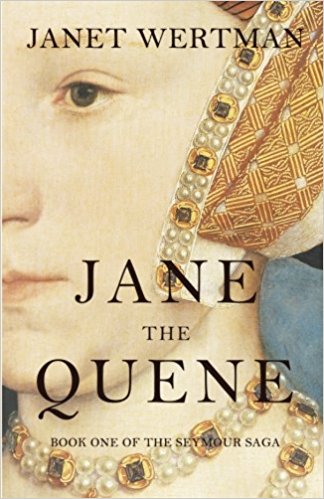
HISTORICAL BOOK REVIEW SERIES: ‘Jane the Quene’ by Janet Wertman

All Jane Seymour wants is a husband; but when she catches the eye of a volatile king, she is pulled deep into the Tudor court’s realm of plot and intrigue….

England. 1535. Jane Seymour is 27 years old and increasingly desperate for the marriage that will provide her a real place in the world. She gets the perfect opportunity to shine when the court visits Wolf Hall, the Seymour ancestral manor. With new poise born from this event, it seems certain that her efficiency and diligence will shine through and finally attract a suitor.

Meanwhile, King Henry VIII is 45 and increasingly desperate for a son to secure his legacy. He left his first wife, a princess of Spain, changing his country’s religion in the process, to marry Anne Boleyn — but she too has failed to deliver the promised heir. As Henry begins to fear he is cursed, Jane Seymour’s honesty and innocence conjure redemption. Thomas Cromwell, an ambitious clerk who has built a career on strategically satisfying the King’s desires, sees in Jane the perfect vehicle to calm the political unrest that threatens the country: he engineers the plot that ends with Jane becoming the King’s third wife.Jane believes herself virtuous and her actions justified, but early miscarriages shake her confidence and hopes.

How can a woman who has done nothing wrong herself deal with the guilt of how she unseated her predecessor?

~~

Jane’s story begins in 1525, where at age 18 is still unmarried and becomes a maid of honour for mighty Katherine of Aragon. Jane is a quiet girl, keen to be part of the court instead of being a lowly spinster at home. But Jane’s tuition at court is placed in the hands of two other maids to the queen – Anne and Mary Boleyn. They are distant cousins to Jane, but quiet Jane finds the pair to be disingenuous – Mary is already the king’s mistress, and rumours swirl of Anne’s virtue also. Jane, who sees herself as fair and perfect, considers her cousins to be intimidating and foolish, and they care not for the company of boring Jane. Years pass and Jane works in the court, slowly rising in favour until poor Katherine is ousted.
 .
 But then Jane’s cousin Anne Boleyn is finally elevated from mistress to Henry’s side as queen. Jane is still unwed, a seemingly boring woman in the company of Queen Anne, who sees nothing in her lady. But trouble soon comes when Anne gives birth to a daughter for Henry.
 .
Jane isn’t the only Seymour at court; her young sister Elizabeth found a husband quickly and the Seymours decide to swap out Jane for another sister, Dorothy. Quiet Jane needs a plan; she goes home to Wolf Hall, where the king plans to stay on summer progress, to host the royal party, and in return her brother will find her a decent husband.
 But while everyone thinks they know Jane Seymour, quiet Jane is a totally new woman. Only she can interest Henry; not brash like Anne Boleyn, but no weakling as her family assumes. Jane has a plan all of her own. Jane goes into training; she will be no whore, and she will be no Anne Boleyn either. Jane wants better for herself and she is no pawn any longer. Jane is ready to stand up, and play her part at court, all to claim what she wants – the crown itself.
 .
Jane is always written as the boring queen and I enjoyed reading a book where she was anything but. Jane plays the games at court well, ready to scheme her way onto the throne, rather than being shoved on by her brother. Her brother Edward is a likable man, a product of his time, and young brother Thomas is a cad, as history suggests. Everyone knows of Edward’s second wife Anne, the bitchy sidekick of her husband. This time, Anne is a kinder woman, while my book-husband Thomas Cromwell is a man who can work with anyone, always ready to come out on top. Cromwell’s POV is used a little too, which was a bonus for me.
 .
 It was fun to read Jane’s perspective, who is sometimes seen as appearing from nowhere to take a king, when she was instead in the background, understanding court politics. And this book is the first in a series, so make room on your shelf!

HISTORICAL BOOK REVIEW SERIES: ‘Young and Damned and Fair: The Life of Catherine Howard, Fifth Wife of King Henry VIII’ by Gareth Russell

Written with an exciting combination of narrative flair and historical authority, this interpretation of the tragic life of Catherine Howard, fifth wife of Henry VIII, breaks new ground in our understanding of the very young woman who became queen at a time of unprecedented social and political tension and whose terrible errors in judgment quickly led her to the executioner’s block.

On the morning of July 28, 1540, as King Henry’s VIII’s former confidante Thomas Cromwell was being led to his execution, a teenager named Catherine Howard began her reign as queen of a country simmering with rebellion and terrifying uncertainty. Sixteen months later, the king’s fifth wife would follow her cousin Anne Boleyn to the scaffold, having been convicted of adultery and high treason.

The broad outlines of Catherine’s career might be familiar, but her story up until now has been incomplete. Unlike previous accounts of her life, which portray her as a naïve victim of an ambitious family, this compelling and authoritative biography will shed new light on Catherine Howard’s rise and downfall by reexamining her motives and showing her in her context, a milieu that goes beyond her family and the influential men of the court to include the aristocrats and, most critically, the servants who surrounded her and who, in the end, conspired against her. By illuminating Catherine’s entwined upstairs/downstairs worlds as well as societal tensions beyond the palace walls, the author offers a fascinating portrayal of court life in the sixteenth century and a fresh analysis of the forces beyond Catherine’s control that led to her execution—from diplomatic pressure and international politics to the long-festering resentments against the queen’s household at court.

Including a forgotten text of Catherine’s confession in her own words, color illustrations, family tree, map, and extensive notes, Young and Damned and Fair changes our understanding of one of history’s most famous women while telling the compelling and very human story of complex individuals attempting to survive in a dangerous age.

cover and blurb via amazon

~~

I have to admit that I am no fan of Catherine Howard. By the time that Henry married Catherine, he was fat, demented and most importantly (to me), had turned against my book-husband Thomas Cromwell. So I read little about wife number five. The whole Catherine Howard incident is just one big hot mess, and one of the main indicators of how far Henry had already fallen.

King Henry had spent twenty years on the throne as a golden king, praised by all in word and art, so to cement a legacy, but Henry’s third decade showed signs of decay. By the time that Henry had denied Anne of Cleves because of his erectile issues, it was little Catherine Howard who had accidentally wandered into view, as a teenage attendant to Anne. Anne of Cleves was an educated, travelled woman and Henry was more in need of a child who had no thoughts or opinions and could be manipulated by a man who would make a better grandfather than lover.

The English court expected women to be virgins, perfect and untouched in every way. Yet men roamed freely, unguarded in their desires, as if their meddling had no effect on virginity. Catherine Howard was a simple girl, raised away from family and without anyone really caring for her. Catherine makes the perfect victim to be targeted by an old weirdo.

Russell’s book tells the story about how court life would have been in Catherine’s time; the late 1530’s were an awful time all round, with Henry’s leg increasingly pressing upon his sanity, the country in revolt, and Anne of Cleves getting the blame for Henry’s lack of male…. well… just, ew.

Catherine was a victim of her own lifestyle, one she never chose. Without a decent education or people to confide in, she fell for charms of young men liked a pretty face. A sweet girl told whispers of love is easy prey for older men. By the time Catherine was sent to court to wait on the new Queen Anne, she had already become a victim of her own existence.

Henry, a fat, old man with a desire to feel special and young again, laid eyes on a girl, not a seductress or whore as claimed, but an innocent girl who was whisked away in the glamour of being courted by the most powerful man in the land. Henry had been married to Catherine’s cousin, Anne Boleyn, and yet Catherine had not been shown a caution around the king, and soon was caught up with a man who never loved her, rather loved the idea of her instead.

Catherine, covered in gowns and jewels, played the role of token on the king’s arm, only to fall in love – with someone else. A man who worked in Henry’s chamber, a man known to be a disgusting human being in his own right, was happy to let Catherine’s feelings run away with her, thinking she could have romance in her life while playing concubine to an ailing fat man.

Catherine’s life ended far too soon, scared, alone and never believed in her words and deeds. A young girl who wanted, needed, to be loved, was instead used and abused by everyone, a minor detail in a long story of depravity that was the end of Henry’s reign. It is nice to read about the life and facts of Catherine, instead of whore narratives.