HENRY VIII’S CHILDREN: Part 3 – The Carey Children

Ahead of the release of Henry VIII’s Children: Legitimate and Illegitimate Sons and Daughters of the Tudor King on 30 May (Pen & Sword Currently have a 30% off special throughout May), I am doing a 15-part series on some of the smaller, lesser-known details that are covered in the book. These details played out in the background of the defining moments of the lives of each of Henry’s children. Here is a snippet of the story of Mary Boleyn’s children.

PART 3 – THE CAREY CHILDREN


Of the handful of illegitimate children ascribed to King Henry’s name, Catherine Carey holds the greatest claim. Yet even then, the story of her parentage is as flimsy as the evidence for King Henry’s involvement with Catherine’s mother. Mary Boleyn is well-known as a mistress to the king; a tale so often told it gives rise to its own common myths and tropes. Mary returned home from her time in France and was married to William Carey in February 1520. Many theories on how King Henry and then embarked on an affair with Mary are based entirely on hearsay and fiction. 

Lady Mary Boleyn, also known as Lady Carey, via wikimedia commons

What is certain is by early 1524, Mary Boleyn gave birth to Catherine. But Mary was married, and naturally, baby Catherine was attributed to William Carey, and despite later slander, no one at the time suspected auburn-haired Catherine to be the king’s daughter. Catherine Carey’s birth came at a time when King Henry was increasingly anxious about the royal succession, and the birth of auburn-haired Henry Carey, likely in early 1526, only made things more complicated.

Catherine and her brother Henry likely lived with their parents during their early years; William Carey was granted the borough of Buckingham in February 1526, in a specific entail that stipulated the land could only be inherited by all ‘lawfully begotten’ heirs. By this time, Mary and King Henry had likely given up any potential relationship. Life for young Catherine Carey was like any of the period, until the sweating sickness outbreak, when William Carey suddenly died on 22 June 1528. Catherine probably stayed with her mother Mary after Carey’s death, while Henry Carey went to live in Anne Boleyn’s care, now she was the Boleyn in the king’s affections.

Despite the Boleyn family’s standing, Catherine Carey’s early life is a mystery. Young when her aunt was queen, her movements and life go unrecorded, though when her mother Mary married Sir William Stafford and fell pregnant in 1534, Catherine likely lived either in Calais, where soldier Stafford was stationed, or at the various estates in Staffordshire owned by Stafford’s noble father. Mary and her new husband were quiet during the execution of Anne Boleyn, but in late 1539, Thomas Cromwell invited Mary and young Catherine to court to meet Anna of Cleves. Catherine was given a place in Anna of Cleves’ household at court, as short-lived as it would be. Catherine used the time wisely; by 26 April 1540, sixteen-year-old Catherine married Francis Knollys, who had been drafted into the gentlemen-pensioners with Catherine’s father. 

Catherine transferred to new Queen Katheryn Howard’s household in late 1540, only to leave and embark on a family Henry VIII could have only dreamed of – sixteen children born over twenty-two years. After her marriage, an act of parliament ensured Francis Knollys’ lands were jointly in Catherine’s name, and soon after, Mary Knollys was born. A year later came Henry Knollys, followed Lettice, William, and Edward by 1547, who lived between their estates at Rotherfield Greys in Oxfordshire and Reading in Berkshire when not in London.

Being married to a staunch Protestant, Catherine was well-placed when Edward VI took the throne. Francis Knollys did well, being knighted in 1547 for his work against Scotland, aided William Cecil in religious changes, and by the time King Edward died in 1553, was already well-endowed with lands and estates. These came in useful, as Robert, Richard, Elizabeth, Maud, Thomas, and Francis the younger were been born to Catherine during King Edward’s reign, many with the rich auburn hair of the Tudors. But darker times soon befell Catherine when Queen Mary took the throne, leaving Protestants like herself at Mary’s mercy. Princess Elizabeth penned a sad goodbye to Catherine just before she, Francis, and their children left England for the safety of Germany during Mary’s reign.

Catherine and Francis Knollys needed to relocate to Frankfurt, and this period of instability gave Catherine a break from childbirth; she had given birth every year since she had married, so unless unfortunate miscarriages occurred, she was likely apart from her husband at times, before giving birth to Anne in 1555. Catherine then joined Francis in Germany, taking only five of her children, forced to leave the rest behind, probably at Rotherfield Greys.

Catherine Carey, Lady Knollys, via wikimedia commons

Catherine’s husband Francis did well among the Protestants in Germany,  before returning to England on the death of Queen Mary in November 1558. The following month, Catherine moved into Queen Elizabeth’s household as Chief Lady of the Bedchamber, the most senior lady-in-waiting. Francis was admitted to the Privy Council as Queen Elizabeth took power. As soon as Catherine was safe back in England with her husband at court, the yearly pregnancies returned, with daughters born in successive years, Catherine, Cecily, Margaret, and then Dudley Knollys, though Dudley did not survive long after birth. Thankfully, Catherine was never again recorded as pregnant, though her remaining surviving portrait shows her pregnant, likely with Dudley. Their comfortable and favoured lives continued in relative peace throughout the 1560s with Catherine as head of Elizabeth’s chamber, but she fell ill and died on 15 January 1569 at Hampton Court Palace.

Henry Carey, born on 4 March 1526, had a similarly obscure upbringing as his sister Catherine. He likely lived with his family until his father’s death in 1528 and became a ward of Anne Boleyn, who placed him in a Cistercian monastery to be educated. He did benefit from the tutoring of French scholar Nicholas Bourbon in 1535, but other than that, his life goes unrecorded. Despite the pedigree the Carey household had through their Beaufort/Spencer lineage (William Carey’s aunt was Countess of Northumberland), it seems as if the Carey family quickly forgot Henry and his sister Catherine after William Carey’s death. These details only fuel speculation about their true parentage. As all monasteries were closed by 1540, Henry Carey could have been placed in any number of households, possibly even Princess Elizabeth’s. He was not forgotten; his sister was a noblewoman, and in 1545, he married Anne Morgan, granddaughter of Blanche Milbourne, Lady Troy, one of Princess Elizabeth’s early governesses. His wife’s aunt, Blanche Parry, also spent time serving Princess Elizabeth.

Henry Carey, Baron Hunsdon, via wikimedia commons

Henry Carey was selected for parliament in 1547 under King Edward and again in 1554-5 under Queen Mary, suggesting he had moderate religious views and obeyed the constantly changing religious rules. As soon as Elizabeth became queen in November 1558, she knighted her cousin Henry Carey and made him a baron after her coronation a few months later. Elizabeth gave Carey her manor at Hunsdon, which had been a home belonging to Queen Mary only months earlier, and where Elizabeth (and possibly Henry Carey himself) spent much time growing up. Carey also gained lands in multiple locations, a pension, a court role, and became a Knight of the Garter. They clearly knew each other very well.

 Decade after decade, Carey served his queen, including facing off against rebellions and possible invasions of England. His wife Anne gave him thirteen children, with illegitimate children also born to Carey through the years. But Henry Carey fell ill in July 1596 and died at Somerset House on The Strand in London. Queen Elizabeth offered Henry Carey the earldom of Ormond on his deathbed, a title once belonging to their shared grandfather Thomas Boleyn, but Carey declined.

The families of Catherine and Henry Carey ensured the family line with dozens of children. Whether they secretly carried on Henry VIII’s bloodline, while his legitimate children could not, is entirely a matter of conjecture. Even if the rumours were untrue, the Carey children and grandchildren had strikingly similar looks to Queen Elizabeth, so perhaps it was the Boleyn genes that prevailed over the Tudors. After all, it is not a descendant of Henry VIII who sits on the English throne today, but a descendant of Mary Boleyn, in King Charles III. 

HENRY VIII’S CHILDREN: Part 1 – The Royal Lockdown of 1517-18

Ahead of the release of Henry VIII’s Children: Legitimate and Illegitimate Sons and Daughters of the Tudor King on 30 May (Pen & Sword Currently have a 30% off special throughout May) , I am doing a 15-part series on some of the smaller, lesser-known details that are covered in the book. These details played out in the background of the defining moments of the lives of each of Henry’s children.

PART 1: The Royal Lockdown of 1517-18

King Henry, in his typically luxurious manner, hosted a banquet at Greenwich on 7 July 1517, to celebrate England’s new League in Defense of the Church, a three-sided treaty with King Charles of Spain and Holy Roman Emperor Maximilian. This treaty specifically excluded France, but also defended the Catholic faith. The festivities of St Thomas’ Day celebrated the alliance; dinners, banquets, jousts, dancing, music, and a buffet thirty feet long, with meals brought out on elephants, panthers, and lions. But, among the glorious celebratory jousts, the worst possible scenario occurred, a huge outbreak of sweating sickness. The international pageant was not over, but ominous news of sudden deaths arrived at the court. While the disease did periodically spring up in England, it is also possible the hundreds of international visitors may have transported the illness. Two of King Henry’s younger privy chamber men, Thomas Baron Clinton, and Lord Grey of Wilton, died suddenly at Richmond.

Windsor Castle, via wikimedia commons

Henry and Katharine fled immediately to Windsor and did not see their eighteen-month-old daughter Princess Mary for months. The last thing they needed was their precious daughter succumbing to the illness, not unlike the illness that killed Prince Arthur fifteen years earlier. The illness spread through England and then Europe, and deaths quickly ran into the thousands. Cardinal Wolsey fell sick with the illness for the fourth time and vowed to take a pilgrimage to Walsingham if he survived. The illness killed noble and common-born subjects with impunity, and with the king away, the locals of London planned more attacks on foreign merchants.

Farnham Castle drawbridge entrance, via wikimedia commons

Henry and Katharine passed the months in seclusion, but those around them kept dying, and they fled to Farnham Castle to allow Windsor to be cleaned. They only returned to Windsor for New Year, where they could be reunited with Princess Mary. Mary stayed on with her parents at Windsor, celebrating her second birthday, and met Venetian ambassador Sebastian Guistanian on 28 February 1518. The sweating sickness was still out of control, but the ambassador touched Mary’s hand, given more deference and respect than Katharine. It was at this meeting that Henry uttered his well-known boast that Mary never cried, and Mary’s first public word. After the meeting, Henry and Katharine, and likely Mary too, left for Woodstock Palace to continue running from the sweat.

Woodstock Palace, via wikimedia commons

While Henry started his first book in isolation, Assertio Septem Sacramentorum, a collection of claims refuting Martin Luther’s works, the quiet time for the royal couple had a better result; Queen Katharine was finally pregnant, likely conceiving in early March 1518. The queen took a private pilgrimage to St Frideswide’s in Oxford, to give an offering to Christ Church cathedral’s relics. Having multiple children gave Henry and Katharine options; if Katharine had a son, England would have an heir, and Queen Claude of France had just given birth to a son. Mary could marry him and be Queen of France.

This time, thanks to the illness and the resulting isolation, Katharine kept her pregnancy quiet, and Princess Mary was returned home to Ditton to remain safe, as even Henry’s bedchamber servants were dying. Katharine did have a few ladies to keep her company during isolation, one being twenty-year-old Bessie Blount. While still in isolation, Princess Mary’s future marriage to infant Francis, Dauphin of France was agreed upon on 30 June 1518, and at once, this upset King Charles of Spain and Emperor Maximilian, the same rulers Henry had painstakingly entertained one year earlier when the banquet unwittingly released the sweating sickness.

Bisham Manor, once attached to Bisham Priory, via wikimedia commons

Around the time of the marriage treaty, the sweating sickness infiltrated Princess Mary’s household, when one of her servants fell desperately ill. Henry ordered Mary’s household to move to Bisham, eleven miles northwest of her home at Ditton, before travelling to The More in Hertfordshire, where the king remained safe with Katharine. By this time, Katharine would have been visibly pregnant, and news of her pregnancy had spread. After time with her parents and staying well, Princess Mary’s household continued to move through summer homes, stopping at Havering, Hatfield, and Tittenhanger, before heading back to Ditton. This period of dodging the sweating sickness gave Mary one of the longest periods of her life when she could stay with both of her parents.

Havering Palace, via wikimedia commons

By September 1518, it was back to business as usual at the royal court, with a lavish banquet in honour of French delegates in London for Mary’s betrothal treaty on 2 October. England was giving away its heir in marriage; it was a massive gamble and the couple needed a son, so France did not take England’s crown when Mary married. As Queen Katharine was due to give birth to the longed-for royal son, King Henry was paired for dancing at the banquet with Bessie Blount.

Queen Katharine’s last child, a baby girl, was stillborn or died just after birth on 10 November 1518. Bessie would give birth to illegitimate Henry Fitzroy nine months after the banquet.

Up next -Part 2: The Birth of Elizabeth Tailboys

HISTORICAL BOOK REVIEW SERIES: ‘The House of Grey’ by Melita Thomas

The Grey family was one of medieval England’s most important dynasties. They were were on intimate terms with the monarchs and interwoven with royalty by marriage. They served the kings of England as sheriffs, barons and military leaders. In Henry IV’s reign the rivalry between Owain Glyndwr and Lord Grey of Rhuthun was behind the Welsh bid to throw off English dominance. His successor Edmund Grey played a decisive role at the Battle of Northampton when he changed allegiance from Lancaster to York. He was rewarded with the disputed lands and the earldom of Kent. By contrast his cousin, Sir John Grey, died at the second battle of St Albans, leaving a widow, Elizabeth née Woodville, and two young sons, Thomas and Richard. Astonishingly, the widowed Elizabeth caught the eye of Edward IV and was catapulted to the throne as his wife. This gave her sons an important role after Edward s death. The Greys were considered rapacious, even by the standards of the time and the competing power grabs of the Greys with Richard, Duke of Gloucester led to Richard Greys summary execution when Gloucester became king. His brother, Thomas, vowed revenge and joined Henry Tudor in exile.

When Thomas Grey’s niece, Elizabeth of York, became queen, the family returned to court, but Henry VII was wary enough of Thomas to imprison him for short time. Thomas married the greatest heiress in England, Cicely Bonville, their numerous children gained positions in the court of their cousin, Henry VIII, and his daughter, Mary. The 2nd Marquis was probably taught by Cardinal Wolsey but was a vigorous supporter of Henry VIII s divorce from Katharine of Aragon. But his son’s reckless involvement in Wyatt s rebellion ended in his own execution and that of his daughter, Lady Jane Grey, the ‘Nine Days Queen’. Weaving the lives of these men and women from a single family, often different allegiances, into a single narrative, provides a vivid picture of the English mediaeval and Tudor court, reflecting how the personal was always political as individual relationships and rivalries for land, power and money drove national events.

cover and text via Amberley Publishing

~~

I jumped with joy when Amberley kindly sent me a copy of this book. Thomas Cromwell was beloved by the Greys, and they are a big theme in my next Cromwell novel out next year. The Grey family has not been given enough of the spotlight, and yet they are always there, close beside the better-known members of the royal court, ready for their time to shine.

While the Grey family began in the late 1100s, it was Lord Reginald Grey of Rhuthun who rose to prominence under Henry IV, and is famous for his battles with the Welsh, and being held hostage due to failed plans. His son, Edmund Grey fought during the Wars of the Roses, splitting from his family, who supported the Lancasterians, and supported the Yorkist cause instead. His son John Grey continued to fight for the Lancastrian cause, but was killed at the Battle of St Albans in 1461, leaving his wife Elizabeth Woodville a young widow with two sons, Thomas and Richard. When she secretly remarried to King Edward IV, the Grey family became full Yorkist supporters. It is these sons Thomas and Richard the world already knows. As with many noble houses of the time period, divided loyalties were a major problem when making the wrong choice could mean death.

Richard, younger of the brothers, did well from his mother’s remarrriage, elevated at the royal court, and half-brother to the heir to the throne. But when Edward IV died in 1483, Richard Grey was executed beside his uncle Anthony Woodville, on Richard of Gloucester’s (Richard III’s) orders, aged only about 26. These killings sparked an already deeply divided power battle between the newly widowed queen and Richard III, her brother-in-law.

Elder brother Thomas Grey was a loyal Yorkist, and the Marquess of Dorset, and watched Richard III be crowned in London as his brother died, and soon after heard of the disappearance of the Princes of the Tower, his two young half-brothers. Thomas joined the Duke of Buckingham’s rebellion against Richard III, but when that rapidly failed, Thomas changed loyalties fled to Brittany to join Henry Tudor, who pledged to marry Thomas’ half sister Elizabeth of York, and rule England. Thomas was ready to invade England alongside Henry Tudor in 1485, only to hear that his mother had come to terms with Richard III, and he tried to desert the Lancastrian cause. Instead, he was captured by the French and held in Paris while the Battle of Bosworth saw Henry Tudor crowned Henry VII and step-uncle Richard III slain. Thomas was only released when Henry was on the throne and the new king could pay his French supporters.

Thomas Grey never recovered his influence in England after flipping between York and Lancaster, and was imprisoned during the Lambert Simnel uprising and the Battle of Stoke Field. Despite being the new queen’s brother, the cloud of treason hung over Thomas, and he enjoyed little favour until his death in 1501, aged only about 48. But Thomas had 14 children, including his heir and namesake, the 2nd Marquess of Dorset.

While his father suffered for his divided loyalties, the young Thomas Grey did well as the ward of Henry VII, only encountering trouble towards the end of the king’s life, when suspicion of treason was rife. But with the accession of Henry VIII, Thomas Grey sat comfortably for another twenty years as one of the few Marquess’ in England, until the King’s Great Matter started to divide the royal court. Grey, along with his brothers and their wives, were loyal to the king, and their Queen Katherine. The Grey family were again forced to take sides and divide their loyalties between Henry and Katherine, to their great disadvantage. But the Grey family, from Dowager Cecily Grey downwards, had the love and friendship of Thomas Cromwell, who gave them money, patronage and preference in the royal court. Thomas Grey died in 1530, leaving behind his  siblings, and also four sons and four daughters, among them Henry and Elizabeth.

While Elizabeth would go on to marry a friend of Cromwell’s, Lord Chancellor Thomas Audley, and live a happy life, Henry Grey was not the smartest man. (His grandmother Cecily asked Thomas Cromwell to watch out for him at court, guide him, possibly godfather his children, etc.) Henry married Frances Brandon, daughter to Charles Brandon and Henry VIII’s sister Mary, Queen of France; quite the coup. (Cromwell continued to favour the Grey family,and the Dudleys due to their connection in marriage to the Greys). Henry and Frances had the famous Grey three daughters – Jane, Katherine and Mary. Henry rose to the title of Duke of Suffolk after the death of his brother-in-law in 1551 (rather than earning a title), but it was Frances Brandon who was the brains of the pair, and their daughters, Jane especially, became the heirs of King Edward VI. Henry Grey saw his daughter Jane become queen for nine days in 1553, only for he and poor Jane to be overthrown, and beheaded a year after their imprisonment. After 150+ years serving high in the royal court, constant divided loyalties saw the Grey family finally slip from favour.

The story of the Grey family at court is one of huge ups and downs from family upheavals all the way up to executions from kings and queens. The Greys were an integral part of the royal court alongside Henry IV, Henry V, Henry VI, Edward IV, Richard III (and the cause of Edward V), Henry VII, Henry VIII, Edward VI, Queen Mary I, and Grey family members still had claims to the throne during the reign of Queen Elizabeth I and succession of King James VI/I.  The story of this family takes place in a tumultuous time, and I greatly enjoyed reading this book.  As someone who prefers the players in the shadows to the stars of the royal court, the tale of the Grey family shows a new side to old tales in history. I truly love having this book in my library.

See also ‘The King’s Pearl’ by Melita Thomas

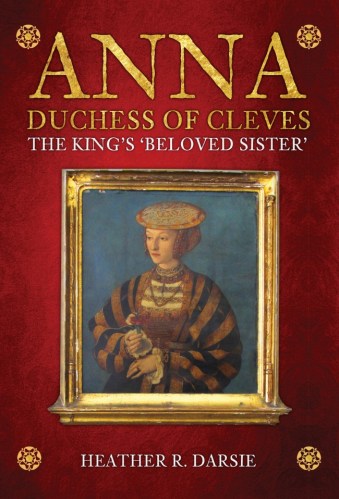
HISTORICAL BOOK REVIEW SERIES: “Anna, Duchess of Cleves” by Heather R. Darsie

Anna was the ‘last woman standing’ of Henry VIII’s wives ‒ and the only one buried in Westminster Abbey. How did she manage it?

Anna, Duchess of Cleves: The King’s ‘Beloved Sister’ looks at Anna from a new perspective, as a woman from the Holy Roman Empire and not as a woman living almost by accident in England. Starting with what Anna’s life as a child and young woman was like, the author describes the climate of the Cleves court, and the achievements of Anna’s siblings. It looks at the political issues on the Continent that transformed Anna’s native land of Cleves ‒ notably the court of Anna’s brother-in-law, and its influence on Lutheranism ‒ and Anna’s blighted marriage. Finally, Heather Darsie explores ways in which Anna influenced her step-daughters Elizabeth and Mary, and the evidence of their good relationships with her.

Was the Duchess Anna in fact a political refugee, supported by Henry VIII? Was she a role model for Elizabeth I? Why was the marriage doomed from the outset? By returning to the primary sources and visiting archives and museums all over Europe (the author is fluent in German, and proficient in French and Spanish) a very different figure emerges to the ‘Flanders Mare’.

Cover and blurb via Amberley

~~

There is a piece of fiction out right now, which suggests that Henry VIII was right, Anna of Cleves was no virgin. I will not be reviewing that work, as I only publish five-star reviews, and leave the rest in privacy. Instead, I am here to show you THE book on Anna of Cleves, a piece of written beauty.

Anna of Cleves starts out with a look at Anna’s childhood, her family, its history, and life in Germany at the time. The book has researched German life and child-rearing for those in Anna’s rich position. No music, dancing and sewing days for Anna – girls were taught by women to learn finance, in order to run a home worth of a duchy. Yes, Anna could sew, with her fine embroidery and needlework on clothing, but could also read, write, understand money and German customs, values and politics. While all that is great, Anna learnt a German way of life, and the German language, one of her original problems in England.

The book tells us of Anna’s early life, rather than only focusing on her once she was purchased as a queen. The Cleves Court was an intriguing place, with a wholly different look at politics and customs of the time period. Without giving away spoilers, the stark difference between Germany and England shows just how much Anna had to go through upon her marriage and carefully negotiated life.

Germany, of course, was in the process of the Reformation, leaning Protestant, just how my personal beloved Thomas Cromwell wanted for England. Between the changes of Germany and the power still held by the Holy Roman Empire at the time, Anna marrying into England would have massive repercussions, and as someone who had to write the death of Thomas Cromwell, the book was an immense eye-opener on how Anna of Cleves’ marriage brought down England’s greatest minister of all time.  The situation was never as simple as Henry thinking Anna was ugly. No spoilers, but damn!!!

Anna of Cleves is an extraordinary woman. She managed to survive an annulment from Henry after only a few months (and didn’t have to sleep with him), and became the king’s ‘sister.’ Anna made friends with the grandest of women in England, Henry’s daughters Lady Mary and Lady Elizabeth, and also the exciting Catherine Willoughby, Duchess of Suffolk. Anna managed all this in England, living a longer life than any other Henry wife, but never had to let go of who she was.  It has been a long time since I found a book with so much new information; we just needed to wait for Darsie to deliver such brilliance. History has relegated Anna to a role of being the ugly foreign wife Cromwell brought to England. A woman so repulsive Henry became impotent (though, come on, none of us ever believed that was her fault). A woman married for an alliance not wanted or needed, and disposed of for a pretty teenager. Anna was beautiful, educated, kind, clever and resourceful. Thank you for this wonderful book!

HISTORICAL BOOK REVIEW SERIES: ‘Mary: Tudor Princess’ by Tony Riches

From the author of the international best-selling Tudor Trilogy, the true story of the Tudor dynasty continues with the daughter of King Henry VII, sister to King Henry VIII. Mary Tudor watches her elder brother become King of England and wonders what the future holds for her. 

Born into great privilege, Mary has beauty and intelligence beyond her years and is the most marriageable princess in Europe. Henry plans to use her marriage to build a powerful alliance against his enemies. Will she dare risk his anger by marrying for love?

Meticulously researched and based on actual events, this ‘sequel’ follows Mary’s story from book three of the Tudor Trilogy and is set during the reign of King Henry VIII.

~~

I have read Owen, Jasper and Henry, and also Warwick, by this author, so having a woman as a title character is an exciting addition! But it is not about Mary I, but Princess Mary Tudor, Henry VIII’s sister. That’s when I really jumped for the book, as I love both Mary and Margaret, forever eclipsed by their king brother.

The book starts in 1509, and Princess Mary is but 13 years old. Her brother Henry is only five years older but has just been crowned King of England. Henry knows who he shall marry – Katherine of Aragon, widow of Arthur, and now Mary is going to be an equally powerful princess – powerful in that selling her to the highest bidder will help increase Henry’s power.

Mary has, in the past, been written as a fool, a simple girl interested in princes and gowns, no head for politics. What a silly notion, because Mary is the daughter of Henry VII and Elizabeth of York, her sister is Queen of Scots, Arthur was to be king, before Henry took poor Arthur’s place. How could Mary possibly be dim? Here, Mary is educated, confident and a brave young woman at the heart of a very serious political match for her country. Yes, she may break down in private, but her public face is one of total poise, the way only a royal upbringing could provide.

Mary considers Katherine of Aragon a sister when she marries Henry (Mary was very young when Katherine married Arthur). Henry and Mary are close, even though Henry is never an easy man to love, and is often heartless to Katherine. Mary has lost both her parents, and Henry breaks her betrothal to the  Holy Roman Emperor Charles, also just a child, and instead gives Mary in marriage to King Louis of France.

Mary may be a queen, but is also Europe’s most beautiful princess of 18 years when she marries the frail 52-year-old Louis. Mary does as she is bid (and has a child Anne Boleyn in her household, just a little side bonus) and marries the old Frenchman. But first Mary told her brother – I shall marry Louis if  can choose my second husband.

That is where Mary is so grand. Louis kicks the bucket three months in, and kings and dukes are clamouring for Mary less than a week into widowhood. But Mary has her suitor all ready, Charles Brandon, Henry’s best friend and (while the Duke of Suffolk) not at all good enough for her. Secretly married, Mary defies her brother and King, and is banished from court and from his kindness.

Never mind all these details; Mary is written as a woman, a wife, a mother, a sister. She becomes a queen of France (who killed her old husband with too much sex, so they gossiped, eww), then a woman who married for love, then a wife who had to endure infidelity, the births and deaths of children, the heartache she felt for Queen Katherine and the fortunes of all around her. Mary also suffered with her health for her whole life.

Mary was an important princess in the royal history of the time, and is not prone to being frivolous, and so is written as an educated woman. While the Tudor world is filled with politics, law, religion, it is also filled with love, friendship, parties and jousts, colour and excitement, and the book weaves all together.

Did Brandon love Mary back? The book gives hints about such as Mary’s life is followed. Mary’s death is beautiful and tragic, and the process starts over, as Brandon marries a child as a firm alliance just a few months later (he was a lucky man to capture both Princess Mary and Catherine Willoughby!). Mary’s granddaughter Jane would become queen for nine days many years later, and must have had the blood of THIS type of Princess Mary in Jane’s veins.

Thank you, Tony, for a wonderful novel!

~~

About the Author Tony Riches is a full-time author of best-selling historical fiction. He lives in Pembrokeshire, West Wales and is a specialist in the fifteenth century, with a particular interest in the Wars of the Roses and the lives of the early Tudors. For more information about Tony’s other books please visit his website tonyriches.com and his popular blog, The Writing Desk and find him on Goodreads as well as Facebook and Twitter @tonyriches