
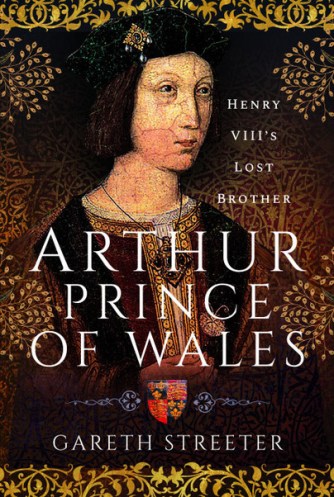
For too long, Arthur Tudor has been remembered only for what he never became. The boy who died prematurely and paved the way for the revolutionary reign of his younger brother, Henry VIII.
Yet, during his short life, Arthur was at the centre of one of the most tumultuous periods of England’s history. At the time of his birth, he represented his father’s hopes for a dynasty and England’s greatest chance of peace. As he grew, he witnessed feuds, survived rebellion and became the focal point of an international alliance.
From the threat of pretenders to West Country rebellions, the dramatic twists and turns of early Tudor England preoccupied Arthur’s thoughts. At a young age, he was dispatched to the Welsh border, becoming a figure head for a robust regional government. While never old enough to exercise full power in his dominion, he emerged as a figure of influence, beseeched by petitioners and consulted by courtiers. While the extent of his personal influence can only be guessed at, the sources that survive reveal a determined prince that came tantalisingly close to forging his future.
Finally, after years of negotiation, delay and frustration, the prince finally came face to face with his Spanish bride, Katharine of Aragon. The young couple had shared a destiny since the cradle. Securing the hand of this prestigious pride for his son had been a centre piece of Henry VII’s foreign policy. Yet, despite being 14 years in the making, the couple were to enjoy just five months together before Arthur succumbed to a mysterious illness.
Arthur’s death at the age of 15 was not just a personal tragedy for his parents. It changed the course of the future and deprived England of one of the most educated and cultivated princes in their history. Arthur would never wear the crown of England. But few Princes of Wales had been better prepared to rule.
‘Arthur, Prince of Wales: Henry VIII’s lost brother’ shows that Arthur Tudor was more than a prince who died. He was a boy that really lived.
—
In Arthur, Prince of Wales Gareth Streeter meticulously reconstructs the life and legacy of one of Tudor England’s questioned royal figures. What sort of king would Arthur have been? It is an interesting question, but the fifteen years Arthur spent alive are often forgotten in the wonders of what could have been. Drawing on historical sources and archival material, this book offers a portrait of Prince Arthur’s life, his childhood, upbringing, and education, and his lasting impact on English history.
Streeter begins by tracing Arthur’s early years, from his birth in 1486 as the first son of King Henry VII and Elizabeth of York, to his education and training as the heir to the English throne. Through vivid storytelling and insightful analysis, the author explores the challenges and expectations that accompanied Arthur’s position as the future king, painting a picture of the royal court and the political intrigues of the time.
One of the book’s most compelling aspects is its exploration of Arthur’s marriage to Katharine of Aragon, a union intended to forge an alliance between England and Spain. Streeter delves into the complexities of their relationship, from their initial meeting to their wedding and wedding night(s), offering insights into the dynamics of their marriage and the role it played in shaping the course of English history.
Arthur, Prince of Wales provides a detailed account of Arthur’s brief reign as Prince of Wales, a period marked by hope and anticipation for the future of the Tudor dynasty. The author examines Arthur’s efforts to establish himself as a future ruler, as well as the challenges his father faced in asserting his authority in a kingdom still recovering from years of civil war and instability.
Tragically, Arthur’s reign was cut short by his untimely death in 1502, just months after his marriage to Katharine. The author explores the circumstances surrounding Arthur’s demise, including the various theories and rumours which have surrounded his death for centuries, and the realities his death brought to Katharine, his parents, and England.
Arthur, Prince of Wales is a patiently researched biography that offers a different perspective on one of England’s most intriguing royal figures. The narrative style makes this book a must-read for anyone interested in the Tudor era and the individuals who shaped it.
Available from Pen & Sword here
 In 1474, a twenty-three year old woman ascended the throne of Castile, the largest and strongest kingdom in Spain. Ahead of her lay the considerable challenge not only of being a young, female ruler in an overwhelmingly male-dominated world, but also of reforming a major European kingdom that was riddled with crime, corruption, and violent political factionism. Her marriage to Ferdinand of Aragon was crucial to her success, bringing together as it did two kingdoms, but it was a royal partnership in which Isabella more than held her own. Her pivotal reign was long and transformative, uniting Spain and laying the foundations not just of modern Spain, but of the one of the world’s greatest empires.
 CAROLINE ANGUS