PART 2: Vengeance in the Valencian Water Q+A

To read part one, click here – PART 1: VENGEANCE IN THE VALENCIAN WATER Q+A

Here we go, part two of the Q+A, time for some of the more specific questions –

6 ) Did you base the characters on real-life people, like with Blood in the Valencian Soil? 

Rather than look at the situations of specific individuals and make a fictional tale based on their lives, this book takes a different vein. This book follows real events (like BITVS) but has all fictional characters. This book is a snapshot of Valencia in 1957 and the characters live in what was reality at the time. I spent countless hours studying photographs and recollections of the city and its way of life at the time. I also studied the 1957 flood over the period of about a year, so I knew all the details I needed. I got to point where I knew the water level of individual streets around the city. I also walked those streets in Valencia, to visualise the scenarios for myself. All of the characters are entirely fictional, and would not want to meet these people in person!

As for the 2010 characters, they are all also fictional, but live in Spain as it was that year. One chapter sees Luna caught up in a protests in Madrid, and I made sure there was a protest in Puerta del Sol in that month, and checked what they protested against and what their signs said. The timeline is accurate, but no one is based on a real person.

Graham Hunt was kind enough to capture this, so it had to go in the book

7 ) What did you research for the book? You talk about research a lot of twitter.

Jaja, my twitter rambling coming back to bite me. Following on my from the last question – I researched a lot. For me, when I sit down to write, I need to be able to envisage the whole scene in my mind before a word can be written. When it’s based in Valencia, imagining somewhere is a piece of cake. But still, I need to know the details are in place before I can start. For example, when writing José in 1957, I needed to know what his Guardia Civil uniform looked like, or what the fashion of the time looked like in Valencia. That meant tracking down photographs in 1957. There is one scene were José has to wear what I imagine as the most ugly brown suit ever, but then in another, the smoothest grey suit you can imagine. I know both of these were on sale because I checked. I don’t spend a great deal of time on clothing unless it’s relevant to the scene, so you don’t feel bombarded with inane tidbits. But when they buy 1957 swimsuits, I checked to see what you could get at Malvarrosa at the time. Beach umbrellas are the right colour, restaurant decor is correct, street names are correct, even the flowers bought at the market are the right type. When Franco arrives, his car is the right kind, the positions are correct, the aides are dressed properly. When it comes to bullfighting, the clothes are correct, the details of a fight are correct, the feeling from the crowd is correct ( I know this because I sat there to get it right). Valencia is the perfect place to use as a location because there is just so much to see, and how much the city has changed is incredible. I have studied the detail of the city from the mid-1800’s until now and the changes are amazing, yet the core, the heart of the city remains the same.

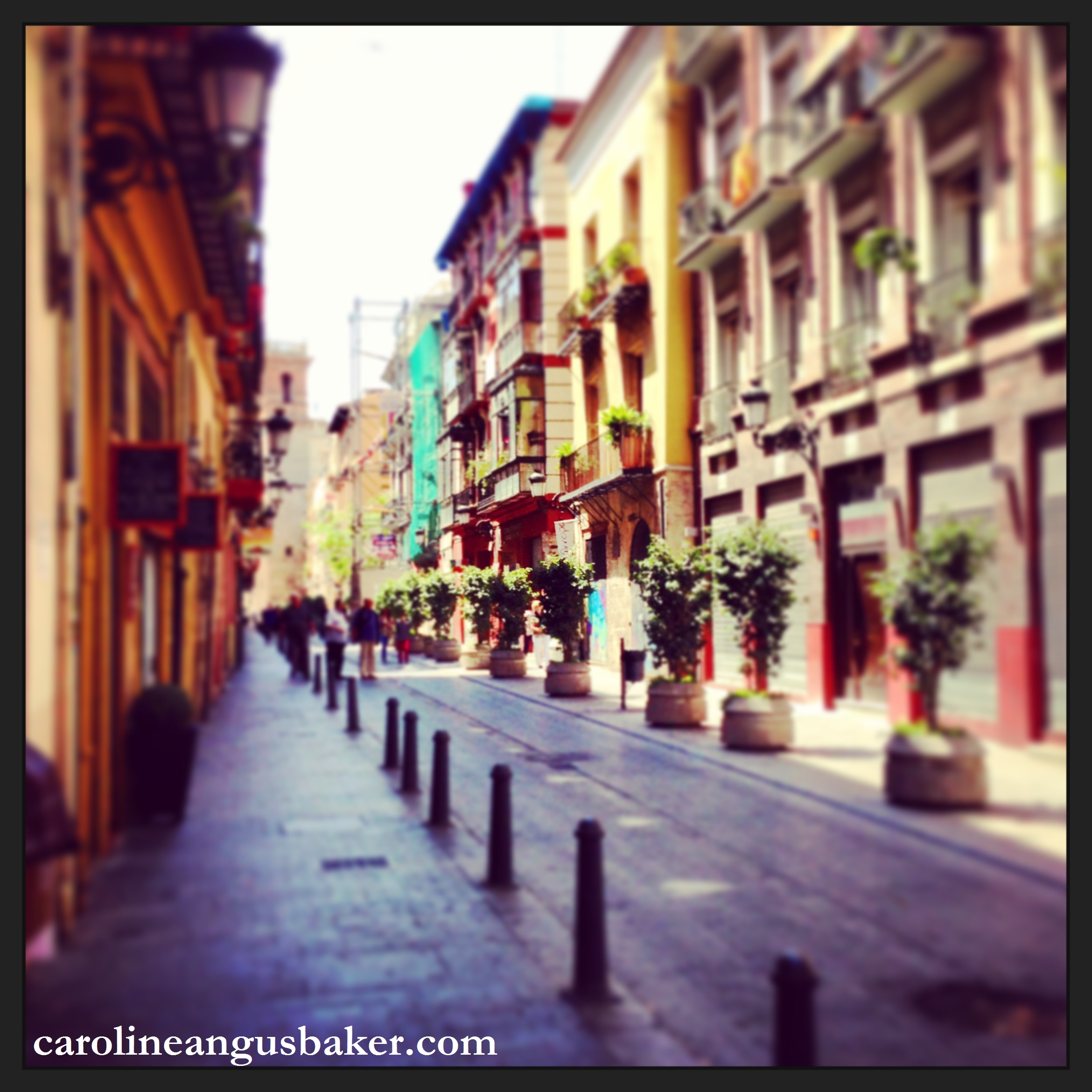
Calle Miguelete at Plaza de la Virgen, both Jose’s 1957 and Luna’s 2010 reality 

8) Are there any storyline pieces you are worried about? Does reaction to the book worry you?

Does it worry me? Only all the time. Writing a book is like walking around naked, you are fully exposed to embarrassment and ridicule. I feel like a running joke – an author with an anxiety disorder. I dream about being teased about typos. After writing a  chapter, I put on a cynical hat and question its believability. With the Luna Montgomery series, I want things to be as realistic as possible. Fortunately, by following real-life scenarios, the possibility of the storyline being over-the-top is nigh impossible. With the flood, it’s all real, as is the babies stolen by the church. None of that needed to be made up. The 2010 storyline gave me more worries. The medical details were something I was careful with – there’s nothing worse than reading/watching something and a character is sick and makes an instant miracle recovery. Anyone who suffered or nursed someone with a serious illness or injury will see right through it. I had to check the detail very carefully. I fight constantly with Luna and Cayetano, to make sure they are believable and full of flaws. Perfection doesn’t exist and neither of them can appear to have the upper hand over the other. They both make mistakes, they both say stupid things, like any couple. I worried, about halfway through, that Luna was being too needy, and then wasn’t being strong enough. At the end, I did worry if all the feminists out there will be disappointed with her life choices, but to me, she does all she needs to do for all around her. She doesn’t have the luxury of making decisions to suit herself. I also worry if Cayetano comes off as arrogant or selfish at times, but have tried to suitably redeem him. You aren’t supposed to like every character all the time anyway.

9 )Why give Luna two children? What’s the point?

There is plenty of point. From the very beginning, I imagined Luna with two sons. Luna is the very first character I ever created, back in 2009 when I was still finding my feet. (You can’t accuse me of not taking my time with the characters. I took 18 months off these characters to work on Canna Medici while I got this series together.) Luna meets Cayetano and their lives are a mess. They meet to uncover murdered relatives, so it’s not a love story. From the very beginning, Cayetano always had María, his wife. That in itself is a nightmare, but to have Luna as a single woman would be too easy, and make her too perfect. I made her a parent because it suits her, she’s the type to cope well with sons. I had to also make her a widow, because that was the only way to make her solo mother, no other scenario worked on Luna and Fabrizio as a couple. I’ve been the child of a solo mother, and know just how amazing they are. To have a male and female lead character makes it easy for them to fall into a relationship, or at least an affair, and by making Luna a widowed solo mother, and Cayetano already married, it gave me far more scope to develop the characters and their interactions. They come from totally different perspectives, and not just because their families sit on opposite sides of the political and religious divide. They cannot understand each other’s situations because they are so bogged down in their own realities. Just when the path seems smooth for a quiet life, I have something to throw in the mix. This isn’t a romance novel (but if you like romance, I have one in the pipeline to come out after my next civil war book, so bear with me!)

10 ) Which of the two books (Blood in the Valencian Soil and Vengeance in the Valencian Water) have you enjoyed writing the most….and why?

That is a really hard choice. BITVS was my baby, I nursed her for quite some before I got the book I wanted. It is centred in the civil war, something that gives me enough inspiration to write 100 books. It is set around a murdered grandfather, something very close to home for me. The issue of relative killed in the civil war and hidden away also hits close to home for me. The story of a kiwi nurse in Spain is something I took the time to understand, follow and genuinely care about. It was great to meet the family of Renee Shadbolt, the real Scarlett Montgomery, and how proud they were of her. Real people in real scenarios flourishing and despairing was what I wanted to create. I will always love BITVS.

one place – three periods in the series

VITVW is totally different. Writing one book and making it my baby seems easy compared to following it up with a suitable sequel. I wanted to continue the series, but at the same time, make a story that can stand on its own. It needed to pack all the punch of the first book, without going over old detail. I can’t remember when I decided to write a Valencia flood novel, but I don’t think it’s been done before (feel free to correct me). It would have been easy to have Luna and Cayetano go back through another civil war story and it probably would have worked, too. But going back to the 1950’s instead of the 1930’s gave the series new life. The third book goes to the 1970’s, so the state of Spain under Franco through the years can be seen in long form. From war in the 30’s, to the heavy-handed rule of the 50’s, to the unstable 70’s, the story of the Beltrán and Morales families can tell a huge story. The present day storyline also gives that chance. BITVS is set in 2009, VITVW in 2010 and then Death in the Valencian Dust in 2013, and Spain changes in this tiny time frame, giving me plenty to work with. As long as Rajoy is in power, enough things will be screwed up, providing plenty of ideas.

I would have to say BITVS is my favourite to write because it was the first in this big project, but VITVW gave me huge satisfaction too, as I feel I have done a really good job with it. I wouldn’t change a thing, and feel my writing style is much better now.

Click here to read the Part 1 with the free book offer Q+A. Part 3 will have all remaining questions, Part 4 is Valencia in photos, and Part 5 is the first chapter, available January 24, the same day as the book release.

Thanks to Graham Hunt for the video, and Juan Antonio Soler Aces for the historical Valencia photos

Part 1: Vengeance in the Valencian Water Q+A (plus a FREE book)

Valencia, Spain: October 1957 – After a long hot summer, Guardia Civil officers José Morales Ruiz and Fermín Belasco Ibarra have had enough of their lives. Sick of dealing with lowlifes and those left powerless under Franco’s ruthless dictatorship, the friends devise a  complex system of stealing babies, to be sent away to paying families. But as the October rains fall, the dry Valencian streets fill with muddy water, and only greed and self-preservation will survive…

It’s 2010, and Luna Montgomery is busier than ever. With the mystery of her murdered grandfather solved, she reluctantly prepares to be the bride in Spain’s ‘wedding of the year’. But four more bodies lie hidden at Escondrijo, Luna’s farm in the Valencian mountains. Her fiancé, bullfighter Cayetano Beltrán Morales, is not eager to have his name brought up in a post-civil war burial excavation. When Cayetano’s grandfather José, an evil Franco supporter, starts to push his ideals on Luna, her decision to join the Beltrán family comes under scrutiny.

The Tour de France is fast approaching, and Luna’s position as a bike mechanic on Valencia’s new cycling team begins to come under pressure. When an ‘accident’ occurs at Escondrijo, lives hang in the balance as more of Spain’s ghosts come to life and tell the story of a flood in 1957…

It’s that time again. With time ticking away until Vengeance in the Valencian Water is released on January 24, it’s time I got onto answering some of your questions! I have merged some questions together, to answer as many as possible, but will post in a few parts. Let’s jump right in.

book covers

1 ) What is Vengeance in the Valencian Water all about?

VITVW is the second in the Luna Montgomery ‘Secrets of Spain’ series, which continues right where Blood in the Valencian Soil left off. VITVW follows the same vein – two different time periods, with their own themes that are bound together by similar circumstances. VITVW is centred in Valencia 1957, with a Guardia Civil officer, José Morales and his battle against the struggles of Franco Spain. Common in this time period was the horrendous baby-stealing practices in hospitals, where the church would steal babies from mothers at birth and sell them, with the law on their side. José gets caught up in this vicious circle, only to find his real adversary is the Valencia flood of October 14 the same year. The story runs alongside the 2010 storyline of Cayetano Beltrán, José’s grandson, and his life with Luna Montgomery, which is under pressure. With the financial crisis weighing down Cayetano’s career as a bullfighter and the impending bankruptcy of his grandfather’s huge business, life is increasingly difficult. Luna is still struggling after the recession claimed her job in the first novel, and just as she finds some stability, her late husband’s alleged drug cheating as a professional cyclist rears its head. The long-awaited trial of a Spanish doctor caught doping Tour de France riders leaves Luna to face a legacy she never wanted to be part of. Luna continues pushing to dig up unidentified Spanish civil war bodies, the common clash in Luna and Cayetano’s relationship in BITVS. All the themes in both 1957 and 2010 interlink as ‘coincidence versus fate’ is again explored.

DSCF5338

Pretending to be researching in Segovia

2 ) How long did it take to write Vengeance in the Valencian Water?

I started writing in February ’13, with the intention of having the bulk of the storyline completed before my research trip in May. That failed dismally but while in Spain, I learned so many things. Once back from Spain I was busy with Violent Daylight‘s August release and the story went on hold. I didn’t get back to VITVW until October and finished at the end of November. The book dragged out longer than ever planned, and many ‘real-life’ things got in the way. I had the background for the book, with the research on the Valencian flood, the baby black market and the drugs in cycling done a year in advance, so when it came time to flesh out the book, there was no delay. Going to Spain to learn more about bullfighting and the reality of the recession in Spain really helped with the final touches. Because this book had swirled in my mind for so long, the writing was the final piece of the puzzle, rather than just writing and seeing where the book led, as I have done in the past.

BXR-AKQIAAEkSOK

wonderful photo by @v_puerto

3 ) How can you justify being a fan of bullfighting? Bullfighting is grotesque, so why do you condone animal cruelty? 

I have heard it all. I have three things that attract internet trolls – bullfighting, supporting cycling (in NZ) and being a feminist. Bullfighting tends to bring out the animal in people themselves. I have been told I am vile, I am cruel, I don’t deserve to be a parent, I am disgusting, my family deserves to be hurt… the list goes on. Are all these people interesting in the way their meat was raised and processed? Bulls raised on ganaderías and sent to bull fights are treated like kings. Quality healthcare, exercise regimes, carefully controlled diets… none of those things are taken into consideration for the chicken or pork in your fridge. Yes, bulls are taunted and exhausted in the ring, surrounded by the real beast of bullfighting – the crowd – who hungers for the animal to die. Is that degrading? Yes – that is without question. Do I feel sorry for the bulls while they stand disoriented and weakened as they get stabbed to death? Absolutely! The combination of watching the animal die, combined with sitting beside people who love to watch the event is not a nice feeling at all. Am I trying to promote bullfighting? I’m not sure if that is even possible – people can make up their minds about the corrida long before they get there. Many argue on the side of tradition, and I can identify with that. Bullfighting is more than killing an animal. The toreros are fascinating men and their dance with death is something I could write about forever. They are brave, proud and skilled. They have a talent that is frowned upon in the modern age, and stand in the ring to cheat death of its right to claim them, and are both reviled and revered every time they do so. (Numbers of men wanting to be toreros is up, not down as expected). I have great respect for these men, but I have no desire to promote cruelty to animals. I don’t plan on opening minds to both sides of the argument – many minds cannot be opened. The bull is the orchestra, the torero is the conductor. The crowd chants for a kill. I don’t write to glamourise the event – in fact, if you read, you’ll find the books regularly grapple with the subject, and show there is more to a torero than his sword.

4 ) Do you need to read Blood in the Valencian Soil before you read Vengeance in the Valencian Water?

A tricky one. Yes and no. Book one tells the story of a lonely bullfighter and a grieving bike mechanic teaming up to unearth a civil war grave, running parallel to the 1939 storyline of their grandparents trying to flee Valencia at the end of the civil war. The story tells of how Luna and Cayetano meet and how unorthodox they are as a team. However, book two tells the story of them battling through the trials of 2010 Spain, alongside unearthing an all-new grave. The story does stand alone, and the book should give you enough of background that you don’t feel like you’ve been denied any detail. But they are designed to run together, with VITVW starting off just a month after BITVS ended.

5 ) Why have alternate storylines? Isn’t that complicated?

I’ve never had anyone tell me that alternate storylines is complicated. I personally feel that VITVW is even easier to follow than BITVS with the different time periods. The series tells the story of Spanish families throughout the civil war and Franco time period. BITVS is a snapshot of life in 1939, VITVW tells of 1957 Valencian life, and the third book (out 2015) tells the story of 1976 Spain, as the country comes to terms with Franco’s recent death. These times are pitted alongside modern Spain and the very real struggles that the nation is facing. Given the laws that the current Spanish government passes, there is no need to imagine fantastical fiction; reality continues to inspire in depressing ways.

Portal de la Valldigna ’57/’13 – Different and yet the same (photo courtesy of Juan Antonio Soler Aces)

I will be back with part two of the book Q+A in a few days, so if your question hasn’t been answered, have no fear! In the meantime –

For 48 hours only – Blood in the Valencian Soil is free on Kindle/Kindle App. Catch up for free before Vengeance in the Valencian Water is released!

(promotion runs from midnight January 9 until midnight January 11 PST)

‘LA RIUÁ’ October 14, 1957: The Flood That Changed Valencia Forever

On October 14, 1957, a little known disaster occurred in the Spanish city of Valencia. When I first moved to Valencia in 2005, I heard the story of the Turia (the Valencia river) flooding the city in the 50’s. Now, the city has the beauty of a park in place of the dry riverbed. Years after I first moved to Spain, I decided to research the event  in more depth (excuse the pun), and it is the backdrop for my second Secrets of Spain novel, Vengeance in the Valencian Water (out Jan. 2014).

Many people are finding this old post and linking it to stories about climate change after the 2024 Valencia flood. What happened to south Valencia on 29 October 2024 is totally different to what happened in Valencia’s previous 80 floods. Climate change is absolutely a factor in Valencia’s floods, the rainfall was heavier than ever, in a shorter space of time than ever before, and flooded an area not given any consideration around safety of climate effects. Valencia is a flood plain, and that doesn’t mean climate change isn’t real. 

In my first book of the series, Blood in Valencian Soil, Cayetano, a bullfighter from Madrid and Luna, a bike mechanic from Valencia, team up to find the burial-place of a murdered Republican soldier and his involvement with an International Brigade nurse, who disappeared from Cuenca in 1939.  The second book of the series, while on the search for more civil war mass graves,  Cayetano’s Falange member grandfather, José, is forced to tell his story of survival  during the Valencian flood which changed his life forever.

city map

The Turia wasn’t always a flowing torrent of water. While there has been recorded flood records since the 1300’s, the riverbed spent most of its time dry, where people would walk to the tiny stream, to wash their clothes. Shack houses sprung up in the riverbed. Sales of animals were held down in the riverbed. It was not a year round flowing river. Serious floods had happened every century the modern city was based against the Turia, the most recent in only 1949 when several dozen people drowned. Even so, they were unprepared for October 1957.

Before you read on, here is the link to a documentary made in 2007 by Valencia University, with radio reports, video footage and eyewitness accounts of the flood. It’s all in Spanish, but if you don’t speak the language, you could just mute the sound and watch the video if you want, you will get the idea. Floods pretty much speak for themselves.

Each October, rain comes to the Valencia region, not so much in the city area, but in the surrounding plains and mountainous area that separates the city from inland Spain (If you’re new to this area, Valencia is both a city and a province of Spain. Just a heads-up). The rainfall surges during this change in autumn, onto land that is very dry after a long year without much rain. On Saturday 12 October, 1957, the heavens opened up over Valencia city, in conjunction to the torrential rains in surrounding villages in the Turia (plains around the city) region. On the morning of Sunday 13 October, Las Provincias newspaper noted that the outlying towns of Lliria, Segorbe, Chelva, Requena and Buñol had received rainfall of 500 millimetres in only two days. The Barranco del Carraixet and Palancia rivers north of the city, and the Magre river to the south, along with the Turia river through than ran Valencia city had all risen, but said there was no reason to worry. The rain began to die down in the city, and by late evening, had stopped completely. What the people of Valencia didn’t know was the immense torrent that was gushing its way down the Turia river towards them.

At around 9.30pm, an emergency call came through from the towns of Pedralba and Vilamarxant, 40 kilometres from Valencia, announcing that both towns had been flooded by a deluge of water as the river swelled beyond breaking point. At 11pm, an alarm sounded in the city, notifying all Guardia Civil and Police to be on alert, as the flood was heading directly towards the populated city.

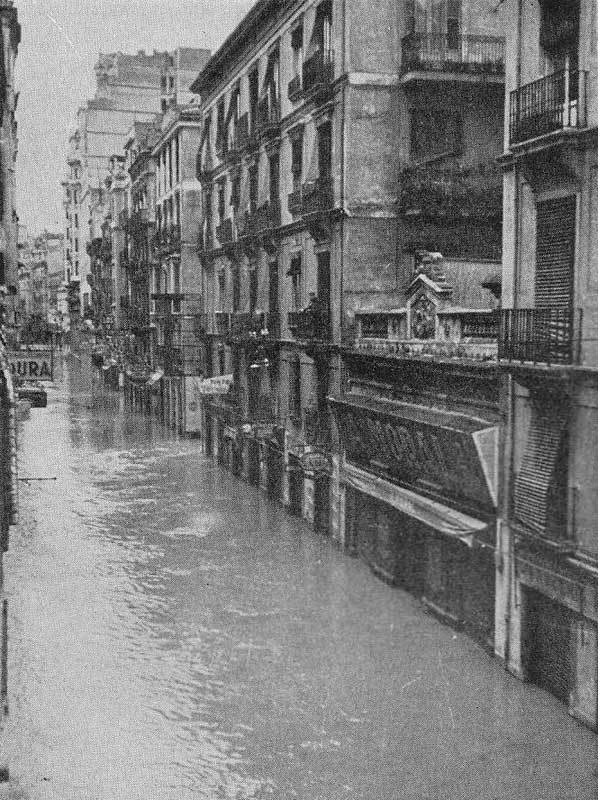
Just after midnight, with the absence of rain, the river continued to swell, and logs and debris began floating through the city, blocking the bridges that connected the two sides of Valencia. Alarms sounded to alert people, and messengers knocked on doors in the El Carmen and Campanar areas, both the closest barrios on each side of the river’s edge. Radio messages went out with a flurry as police rushed to warn people of impending water. Soon after, the first waves began crashing over the edge of the riverbed, instantly flooding the flat streets on both sides, just as the torrential rains returned. In one hour, the water height pouring against the central city was between one to two metres and rising, cutting people off from any escape in the dark. More than 1000 cubic metes of water per second flowed into the streets, reaching over two metres in some areas. The Manises Dam at the edge of the city rose to seven metres above normal height as the river tripled its width and swallowed up much of  the city and surrounding area. All water, power and phone connections were swamped and collapsed under the water. Reports say manhole covers exploded into the air followed by a violent shot of muddy water  as the water took the city one street at a time.

ciudadinundada-1

(If you don’t speak Spanish – blue: river, green: populated flooded farming areas, purple: city/town flooded, grey: not flooded populated areas. Notice the tiny safe area in the centre of the disaster zone?)

In the centre of the old town lies the Plaza de la Virgen and Plaza de la Reina, where today stands the Valencia cathedral,  the Basilica and the archbishops palace just behind them. Along with  Calle Micalet, this tiny pocket was once home to a mosque and before that a Roman city. This area is built on the slightest, and almost impossible to see, ridge in the land, resulting in these treasures not getting any water and instead were surrounded. (Coincidentally, in my novel, the main character lives one street over from Calle Micalet in this magical pocket of space, but don’t be fooled into thinking they are all going to be safe – you know I don’t write happy endings!)

At 4am, the flood reached its peak of approximately 2,700 cubic metres of water per second, but then quickly tapered off. As the sun rose on Monday October 14, the water continued to decrease and the Manises dam was no longer inundated. From the peak of around eight metres above average to only two metres at the dam, Valencians thought the worst was over. A single telephone line to Castellon in the north remained, so emergency services could get word to Madrid, calling for help. All roads and rail lines leading out of the city towards Madrid, Barcelona and Albacete were blocked, damaged or completely swept away. Many of the bridges that crossed the Turia were damaged or destroyed, along with the beautiful stonework  that lined the river one day earlier.

riada10

As people ventured out into the water and mud-filled streets, the government received a message around midday that things were about to get worse. The towns of Pedralba to Vilamarxant had again been inundated with a second flood, washing away all  landmarks. The water took two more hours to reach Valencia city, with 3,500 cubic meters of water per second hitting around 2pm, accompanied by the worst downpour of rain yet seen; around 100 millimetres in just half an hour, enough that people couldn’t even see in front of them. By 3.30pm, the flood reached its peak of around 6,000 cubic metres of water per second, enough to start washing away  buildings that had been weakened in the first flood. The river had expanded to cover 2,200 hectares. While Valencia city gave many the luxury of multi-story buildings to find shelter above the water line, which rose between 2-5 metres above street level in places, the more outlying areas by the beach and port, including the towns of Nazaret, El Cabanyal and Malvarrosa at the mouth of the river, were on flat land and single level buildings, resulting in a complete catastrophe and loss of life as the water poured into the sea. Only five bridges, the longest-standing stone ones remained in place, though some were damaged and impassable. The worst had finally passed, and the riverbed emptied out into silence again. The final death toll was recorded as 81, though the actual figure remains unknown.

riada07

In the coming days, the army came in by truck and helicopter, bringing up to 500,000 kilos of bread to feed stricken residents. Many needed to be airlifted from rooftops and isolated pockets of dry land as the water receded. Much of the city, port and beach areas were filled with a heavy mud and debris, resulting in a ‘on hands on deck’ response from army and locals alike to clean up. On October 24, dictator Francisco Franco arrived (when much was cleaned already, of course) to survey the damage and have his loyal (oppressed, whatever) subjects cheer for him for coming to the disaster zone. As people lived on bread brought north from Gandia and milk given out by the ladle-load, the long process of rebuilding began. The mud was not completely cleaned away until the end of November.
In June 1958, the outlying port and beach areas suffered a second minor flood, as their drains were still clogged with mud, and the following month ‘Plan Sur’ began, a project to divert the river. The plan had initially been designed over a decade earlier but sidelined due to excessiveness (which is ironic considering the ‘excessiveness’ of everything the Valencian government spends money on). A plan to build an enormous green space in the city was put up against building a huge highway to get people from Madrid to the beach a fraction faster. In 1965 construction began to divert the river south of the city, resulting in  water  flowing around the city for the first time in 1972. At the same time, land cleared by the flood on the other side of the river from the old town was used to create many new buildings, mostly apartments, giving Valencia a construction boom (that’s a whole other tale). The flood had accidentally given Valencia a whole new chapter in its story, already thousands of years old. (I have never seen any water in the river diversion, other than the tiny part where the sea flows into the river mouth. If you have a photo of the Plan Sur river diversion (any  year) with water in it, I would love to see it).

Here is a short clip (in Spanish) made as they designed Plan Sur in the 60’s, with some aerial shots of Valencia if you’re so inclined

In 1976, on his first visit to Valencia as head of State, King Juan Carlos I gifted the dry riverbed to the city, and the highway plan was shelved forever; the 7 kilometre park won its place in Valencia’s history. Construction on the final part of the Turia riverbed park continues today, with most of the park now complete. The ‘top’ of the park has Valencia’s zoo, the Bioparc, and footpaths and bike lanes weave though gardens, streams, sports fields, playgrounds to the other end, home to Valencia’s massive Arts and Sciences complex. The final part, where the old riverbed meets the sea is still to be completed.

While Valencia is an amazing city, the park is the jewel in the crown.

This is a tourism video was taken a few years ago, but shows Valencia from the air, over the park and areas rebuilt after the flood, plus many of the great sights you can read about in my books.

riada1

All photos in 1957 are courtesy of Juan Antonio Soler Aces and 2013 photos are author’s own. 

A LITTLE JAUNT TO SPAIN – REVIEW PART 6: Bullfighting in Spain – Madrid vs. Valencia

IMG_3616

“Bullfighting is the only art in which the artist is in danger of death and in which the degree of brilliance in the performance is left to the fighter’s honor.”

– Ernest Hemingway, Death in the Afternoon

Hemingway sung of praises and pitfalls in Death in the Afternoon. Generations past flocked to the ring. Protestors now stand outside the bullring and argue, as if they can change the minds of those going inside. Some people screw their faces up at the very notion of watching a bullfight.

The first time I was offered a slice of afternoon death in 2005, I didn’t flinch. I didn’t protest, I didn’t go on the offensive. From a young age I ran around on my nanny’s farm, probably terrifying the animals that we loved, fed and named. I also stood with a straight face the day I saw them slaughtered and turned into steaks, lamb chops or bacon strips. That is how the world works. Every animal you have ever eaten was killed, it lay bleeding out before cut up nicely for city folk to buy in little portions.

However, there is the fact that bullfighting taunts the animal before it meets its (hopefully) swift and bloody end. People who have never been to a bullfight can be very vocal of their opposition. That’s fair enough – I don’t need to watch child porn to know that I am steadfastly against it. Those who support bullfighting say it’s a tradition, part of Spain’s culture. Bullfighting is not considered a sport; rather it appears in the art and culture pages of the Spanish papers. I have studied and followed bullfighting in an attempt to learn more whilst writing the art into the storyline of my Secrets of Spain series. No matter how much you discuss bullfighting, no matter your opinions, an afternoon at the plaza de toros can have an effect.

“Bullfighting is like dancing the tango. It is a collection of human emotions – passion, love, anger, jealousy, happiness… all illuminated distinctly in the performance” – Cayetano Beltrán, Blood in the Valencian Soil

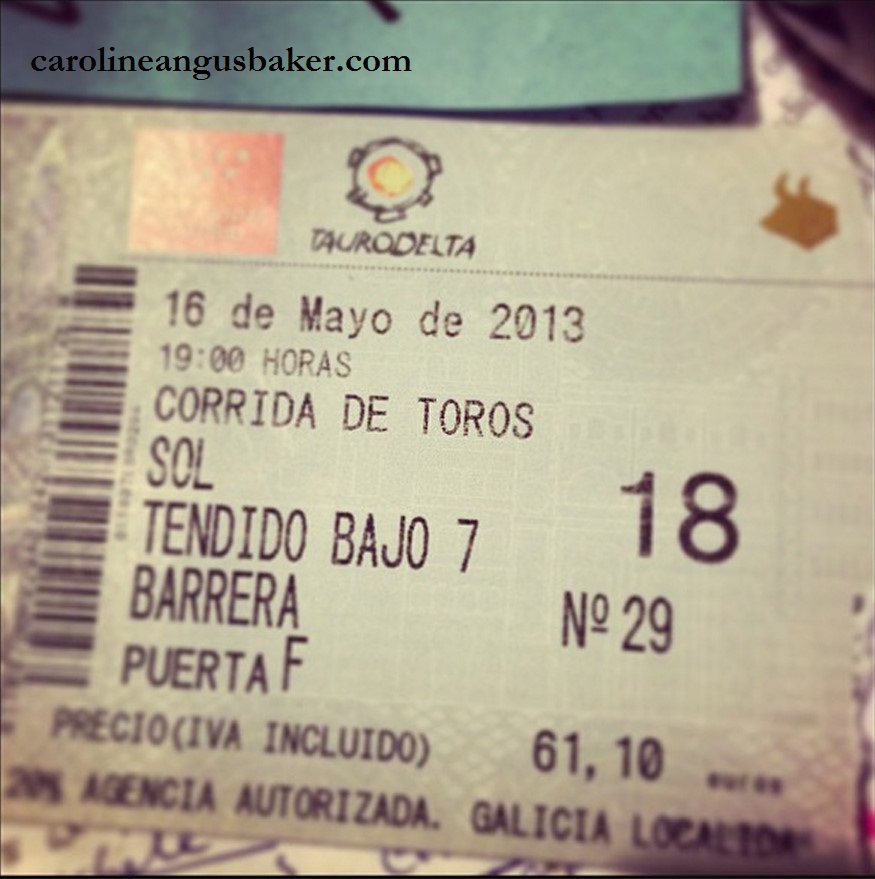
With the storyline of my second novel in the Secrets of Spain series, there are fights in both Valencia and Madrid. As the main character is the top billing at Las Ventas, the Madrid bullring, for San Isidro, a premier fiesta in the city, I decided to coincide my Spanish road-trip with this event. I booked a front row spot four months in advance, and lucky thing, because it was a sell-out. I wanted to look the animal in the eye and see how it feels down against the barrier.

To my surprise (or forgetfulness) there was also a one-off bullfight in Valencia for the Virgen de los Desamparados fiesta. Return to the same ring that I had been given tickets to in 2005? Why not? Suddenly my trip had two bullfights – and they couldn’t have been more different.

IMG_2572

Valencia – the cheap seats

I got a seat right at the very back, very top, very last spot of the bullring. If you’re unsure about bullfighting, then this is the place for you. Up high, looking out over the entire ring, you are wholly disconnected from what is happening on the sand. What else could you expect for €15? In saying that, the enthusiasm from my fellow spectators wasn’t diminished. All men, aged over 60, with fat cigars in their hands found it amusing to help a woman find her seat. Poor hapless girl needs help from a Spanish man. (Hey, okay, enjoy while it lasts, dudes. Lung cancer can’t be far away!)

The ring was half empty, but those who had made the trip were keen to see three toreros (or matadors if you’re Anglosaxon), each having two fights. Here’s a very basic rundown of how it works, starting with the pasodoble played with a band headed up by a trumpet.

ring1

Out they come in Madrid

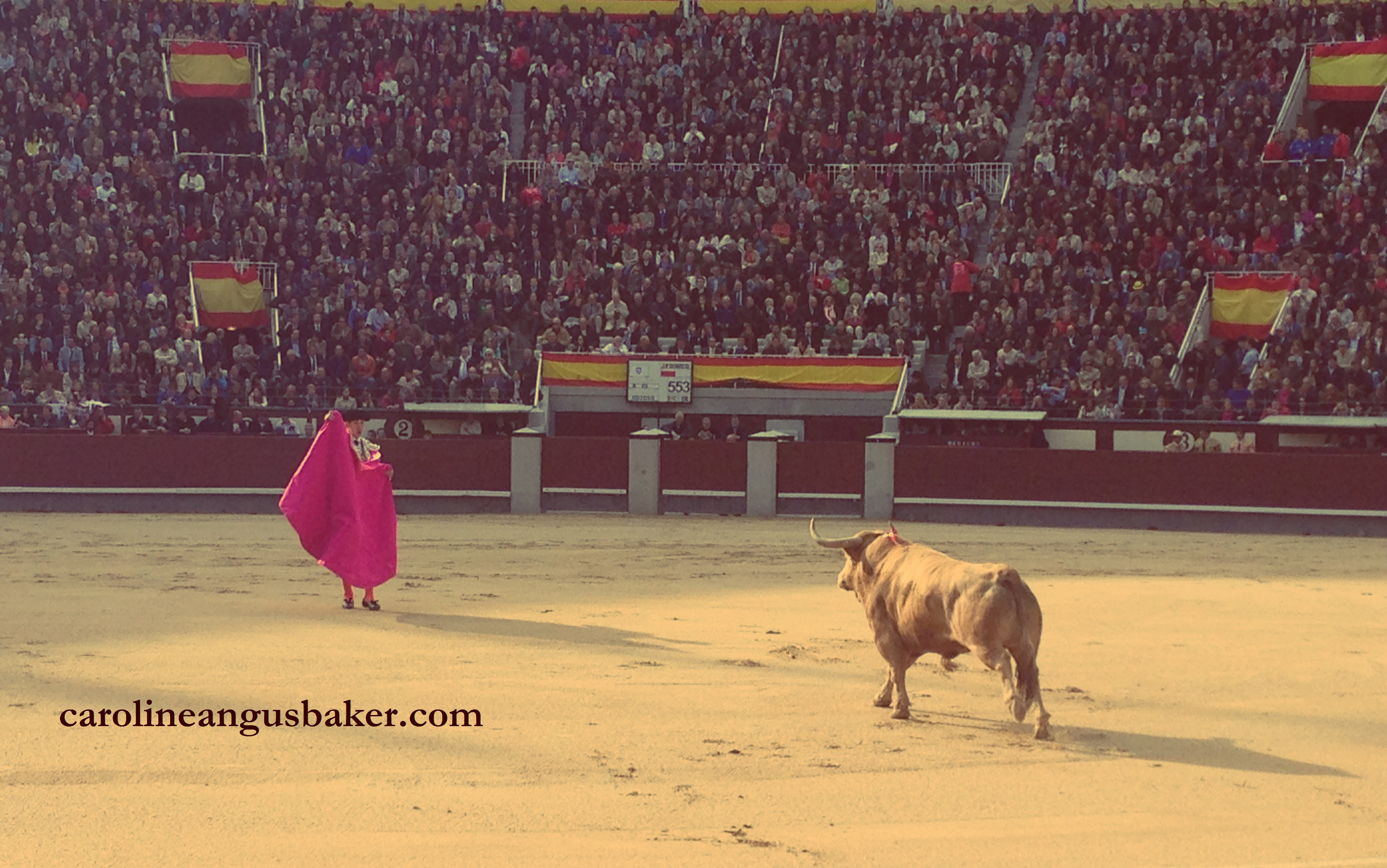
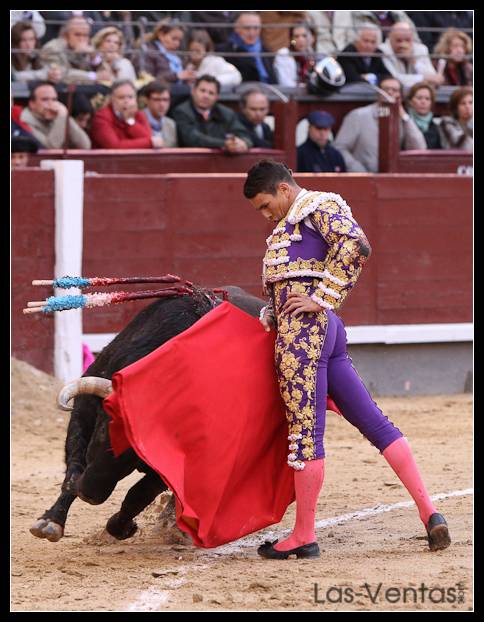
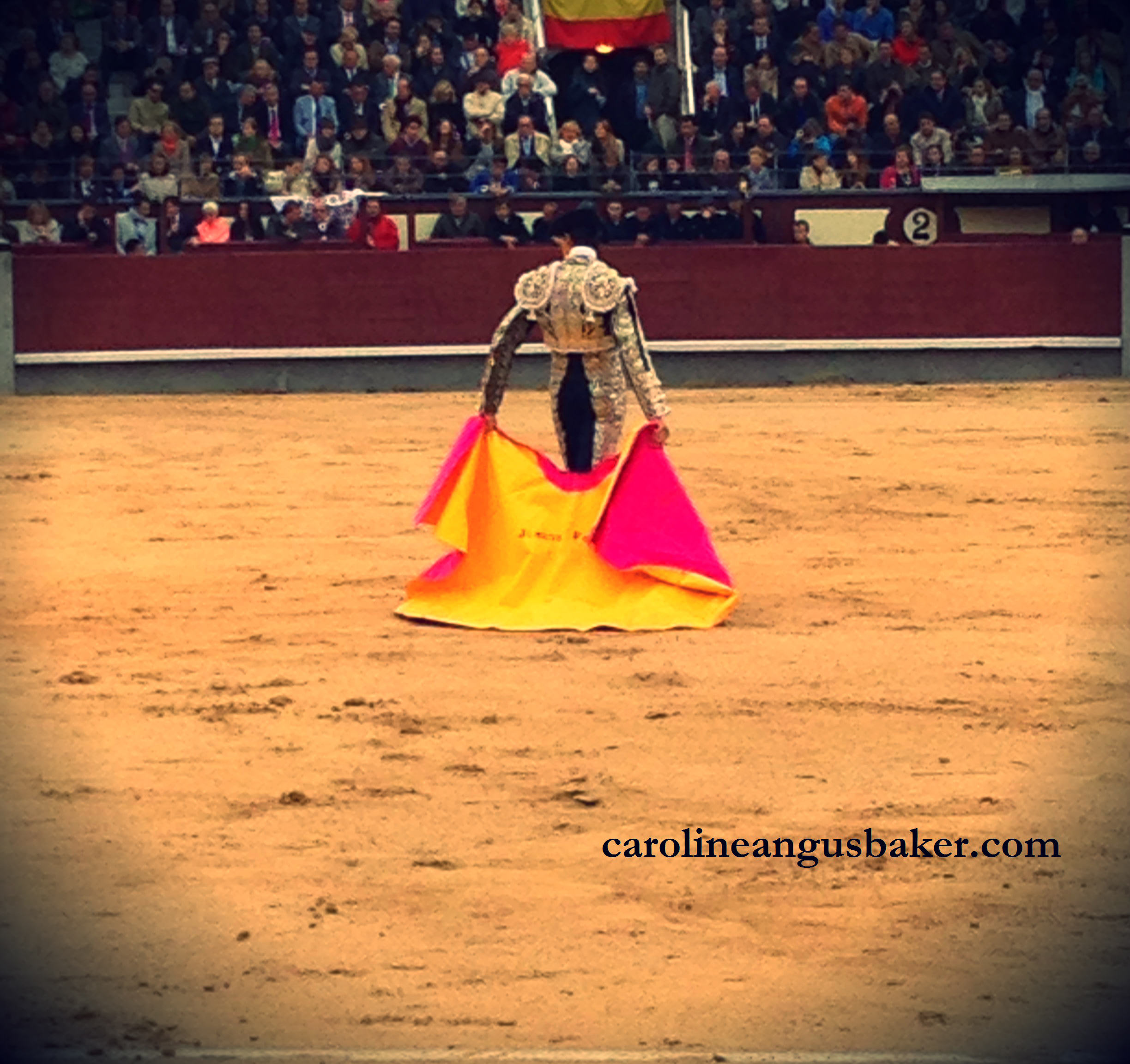
A torero isn’t alone, he has a cuadrilla (entourage, if you will). To start with his three banderilleros (let’s call them pink cape guys in full dress), taunt the bull a little, allowing the torero to get a look at the animal, how it moves, etc. This is a bit of entertainment; the pink cape guys tease the animal, let him run around, get nice and angry. The torero can come in and do what is called the suerte de capote (act of the cape), making passes with the animal. This is the fun thing about bullfighting. When the torero gets it just right, the crowd all let out a ‘ooooh’ at the same time, me included. You don’t need to understand passes (like the veronica, where the torero holds his posture as the bull goes under the cape) to know when it’s done well. It’s like watching a flawless ballet dancer and you can see the gracefulness in the moves. You don’t need to know how to do it to know it’s being done well.  

ring2

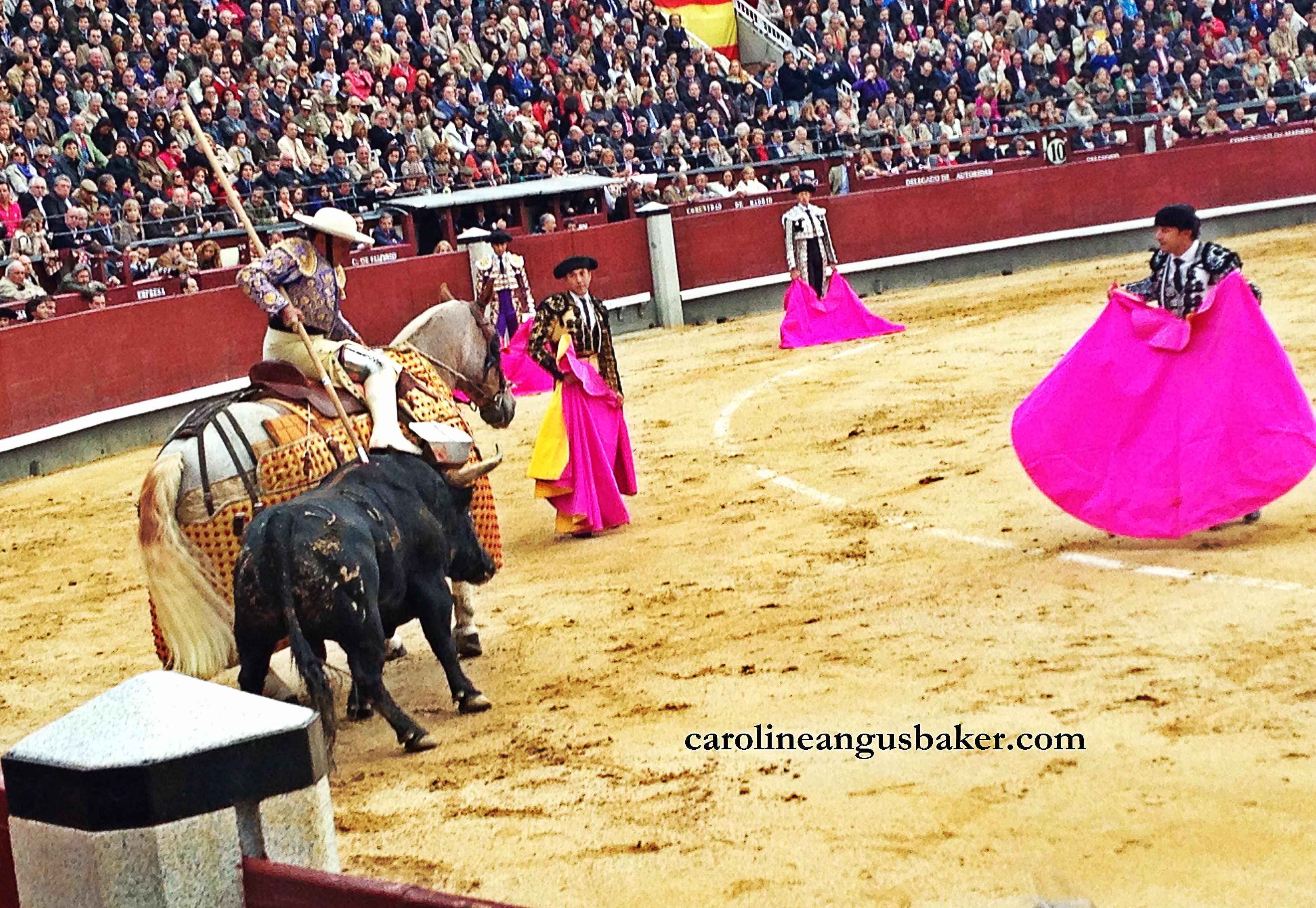
Banderilleros in Madrid

Next is the bit I find a little pointless, other than the bloody great point on the end of the lance, that is. In come two picadores (guys with lances on horseback). The horses are very well padded and have their eyes covered. They appear calm, but if you think they are innocent to the situation, I reckon that’s bollocks. Horses are too intuitive for that. Anyway, the bull is suitably pissed off and charges the horses, and the picador jabs his lance into the muscle at the back of the bull’s neck. It’s bloody, meaty and weakens the angry animal.

ring3

Picador gets his lance in the bull in Madrid

Then comes some more taunting, when the three banderilleros attempt to stab multi-coloured banderillas into the neck of the beast. Whether you like bullfighting is irrelevant when assuming that you need to be pretty brave to give it a try, because the bull is mad by this stage and ready to gore you in the guts.

IMG_3547

España coloured banderillas in Madrid

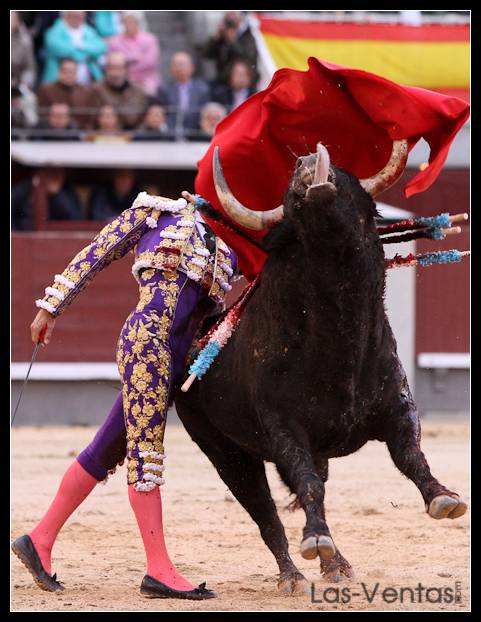
Next is the real action, the tercio de muerte. In comes the torero alone with his red cape and his sword. The torero makes a number of passes with the bull, attracting it with the movement of the cape (bulls are colour-blind) and allowing it to charge past him at close range, the closer the better. (Time for more ‘oooohs and olés’) The graceful movement comes into play and it’s great to see those smooth and precise movements if they get it right.

t2015

José Maria Manzanares can get it right

While you’ll be hearing a few “¡oles!” at this point, the crowd need to shut up for sword time. In theory the torero rams his long sword in cleanly (called the  estocada) and the animal falls and dies. The beast has been pieced in the heart, the aorta severed. The whole faena should be done in about 20 minutes.

IMG_2647

The final bull dies in Valencia

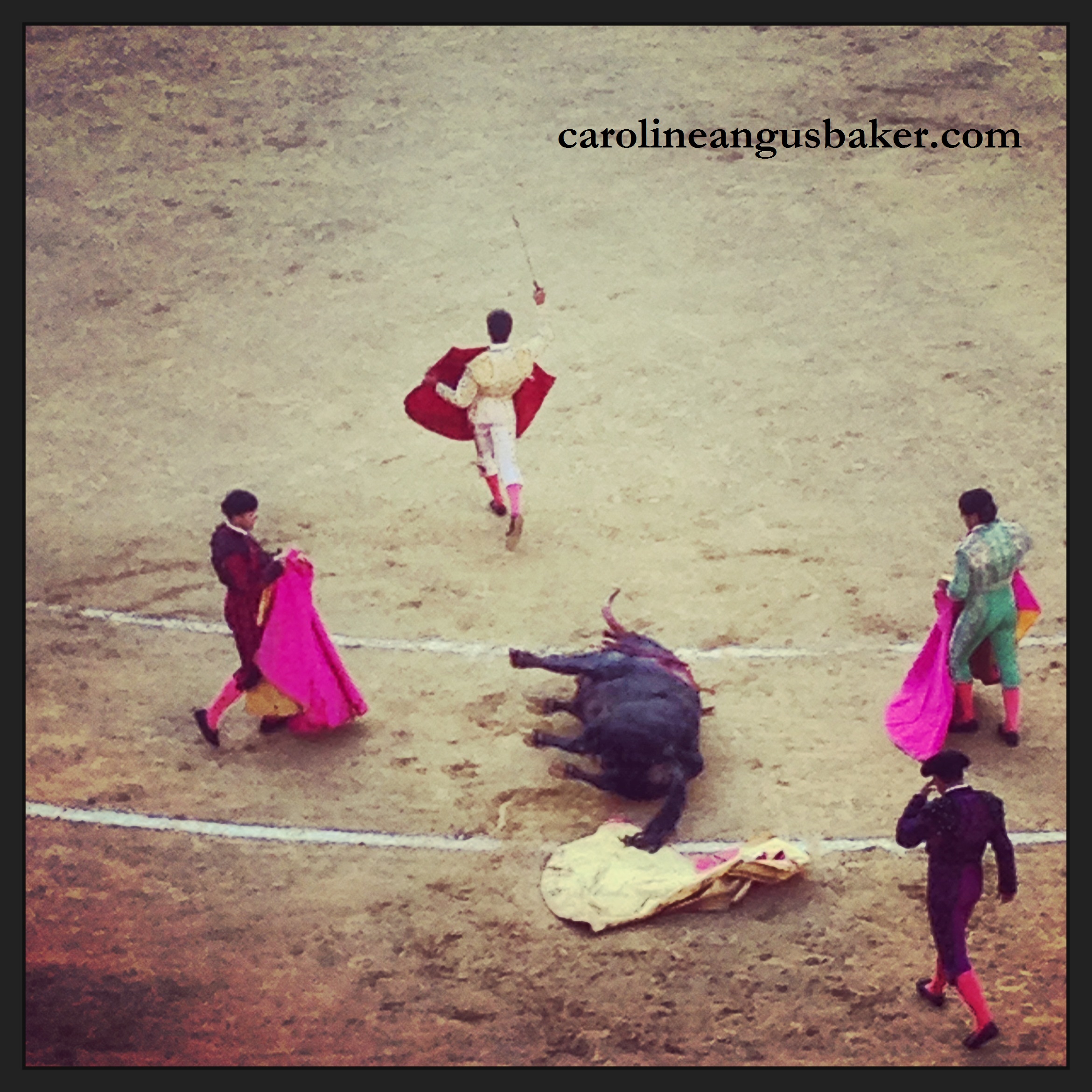
That’s all fine and well, if it works. I watched the full six fights in Valencia, and some were better than others. Unfortunately, the sword didn’t always go in, and it took several, what I would imagine as painful, attempts to sever the heart. All bulls get a puntillero, a dagger, jammed in to make sure they’re really dead. In some fights, the bull had the sword inserted and it stumbled around before dying. That is jeered by the crowd (at the torero, not the bull) and it does highlight the unfairness of the performance. The Valencian crowd (in a half-filled ring) were treated to three reasonable fights, two less than impressive performances, and one I have to admit was well done, with clean passes and a single blow with the sword. That was the only beast that appeared to die right away. In response, the crowd did the customary waving of white handkerchiefs, the indulto, to show their support to have the torero awarded an ear before the check-its-dead-dagger is inserted. Yep, an ear cut from the animal and handed to him in all it’s still warm and bloody glory. At least we got one ‘good’ performance! A torero can be awarded up to two ears and/or a tail.

ring4

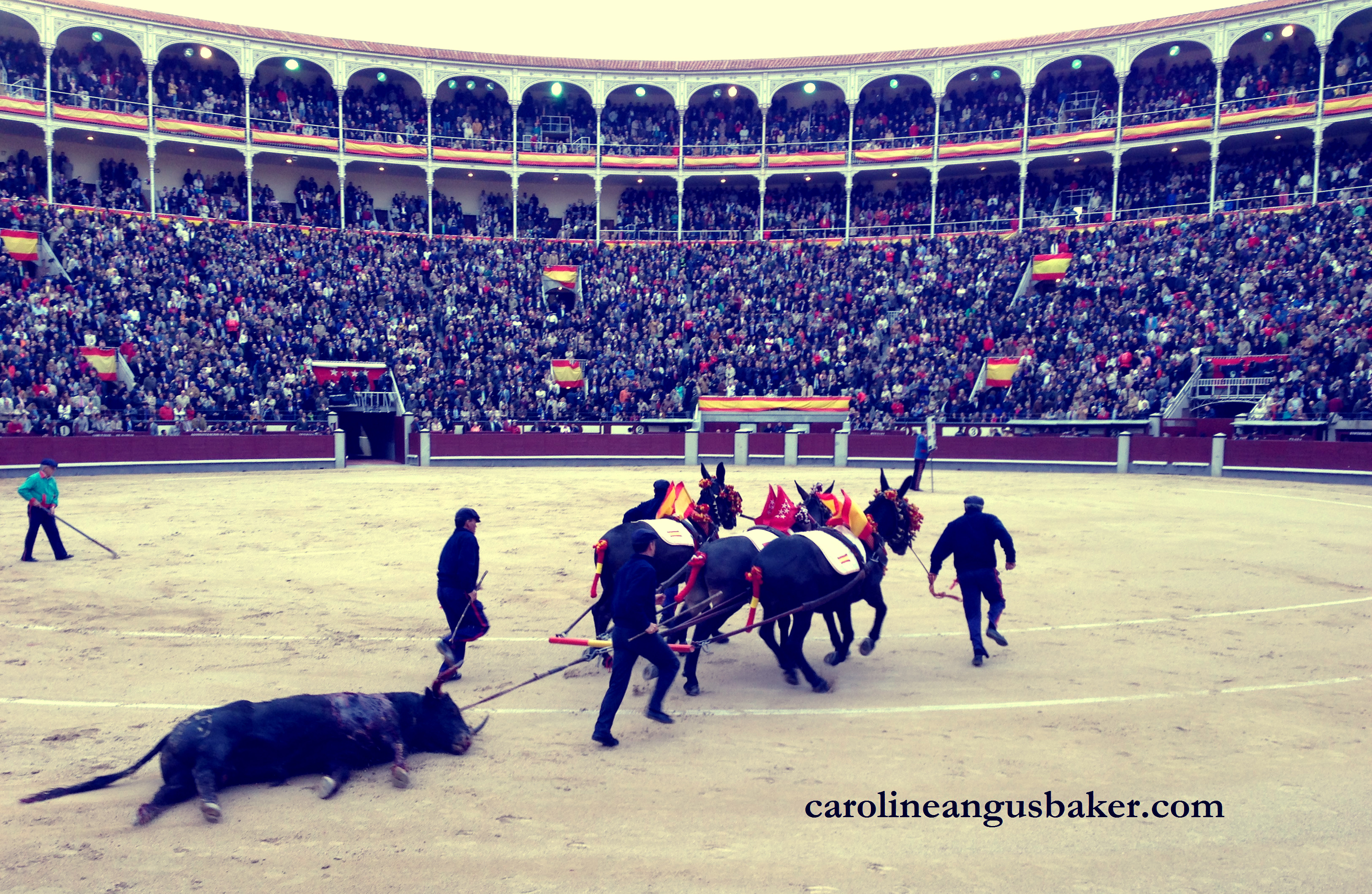
A very dead bull gets removed Madrid. I have picture of it being removed and sliced up, but decided not to post it

~~~

IMG_3802

High times in Madrid

2013-06-20

Onto Madrid and Las Ventas for the sold-out San Isidro fights. Wow, what a difference! Once the toreros all came in, they held one minute’s silence for José Gómez Ortega, or Joselito, who was gored to death in Talavera de la Reina aged 25, in 1920. It was his idea to have a premier ring built in Madrid. One humorous moment came during as entire 25,000 sell-out crowd stood in silence. About halfway through, a lone voice cried out “Viva España!” The crowd erupted into wild cheering and clapping, which appeared to make the Police in front of me a little nervous. It eventually died down and we had to start the silence all over again.

t2010

Time for silence and prayer

Madrid was cold. Cold on a level I don’t care to enjoy in Spain. The uncharacteristic weather certainly made it hard to enjoy my time on my concrete seat, though the barrier directly in front of me did provide some shelter from the wind. I was blessed with a seat in the sun and I needed every drop I could get! The guy next to me had frozen his way through the fights the previous night in the shaded area, but the problem was that the sun was already beginning to fade. However, as the sun sets and the lights come on, the torero’s suit, traje de luces, glitter and sparkle which is rather beautiful all on its own.

t2018

This is how I see it – anyone could sit in the Valencian sunshine and watch from above. Even someone who doesn’t feel happy about animal killing could cope. Sitting in the front row at Las Ventas gives a far more real experience of the situation. The first bull ran out and I sat close enough to be able to see the bull. It seemed genuinely afraid, lost and confused. You imagine the bull to be angry and this beast was not. As the dance of taunting began, I sat shivering (and politely rebuffing all the coats from gentlemen twice my age. Gracias, caballeros, muy amable) and felt really sorry for this bull. Once the horses had come and gone, the lances were removed from the ring. The guys carrying the weapons stopped right in front of me, giving me the chance to see the spears covered in blood and flesh. I wanted up close, and I got it!

ring5

Preparing for a bull in Madrid

Six fights – and none of them spectacular. To be honest, it can get very repetitive very quickly. For those who thoroughly watch the events and can pick subtle differences, I’m sure it felt different, the same way others find yachting boring when I’m into the action. One thing I noticed in Valencia was that after the first round, many people, primarily tourists, got up and left. Las Ventas – not so. In fact, because I entered the ring early (and thanks to the strapping young chap who accompanied me to my spot and asked me out on a date) I had a chance to watch the crowd. Around a third there were women, a big difference to Valencia, and the average age of the crowd was much younger than Valencia (though not in the prime seats).

Not all the bulls seemed as nervous as the first, some charged out and were keen to get their horns caught in the wooden barrier in their quest to catch a torero or two. Still, when up really close, you not only see but can hear the animal panting. Its tongue, which hangs and drips as the animal tires, quivers with every laboured breath. The further through the faena the bull progresses, the more it begins to moan and grunt, something you don’t hear in the cheap seats. At times, the toreros yelled to the bull to get its interest, as it look bored and exhausted. There were moments when the animals were fired up and ready to hurt someone; the risk is certainly there. But often it looked like a tired animal who really couldn’t give a damn.

t2013

This bull wanted some action

“The animals are brave, noble, and majestic. While it would be a disgrace to allow the bull to live at the end of its performance, it dies with consummate gallantry. He bursts through the gate of fear into the ring and is powerful against the torero.” –  Paco Beltrán, Vengeance in the Valencian Water

t2016

Seconds from death as in goes the sword 

I don’t mean to sound critical of any of the fighters I saw in either Valencia or Madrid. I’ve poked bulls with sticks and run through their paddocks as a kid, but I wouldn’t want to jump in that ring! There is not just the wrath of the bull, but also of the audience. When the crowd became tired of the time taken to kill the bull, they didn’t hold back in criticism. When the sword didn’t go in cleanly (and that was a lot in Madrid) the crowd jeered, me among them. The thing I learned above all else is that the true beast is the crowd, who urge for the kill. The bull and the torero are puppets in a game of cultural bloodlust.

t2001

What did I get out of going to bullfights? In the case of Valencia, not a lot. Judging by the crowds, you can tell it’s not a quintessentially Valencian pastime. Many there were tourists (and there’s a lot of those in V-Town these days), and the place was half empty. Luckily, for my efforts, I got to see a good clean death and and ear awarded (if you consider that good).

In the case of visiting Las Ventas, I got a lot for writing. When Cayetano Beltrán steps out onto the sand in Vengenace in the Valencian Water, to face off against the ghosts of Las Ventas, I’m going to know how it feels to be there, at the barrier, watching him. I don’t doubt the men who take on the bulls, they love it and believe in what they’re doing. There are more men wishing to become toreros than in the past thanks to the recession (so they tell me). I don’t wish to sound negative about their talents, performances or desires to maintain this Spanish tradition.

Is the whole process cruel to bulls, even though they were lovingly bred for this exact purpose? Yes. I don’t see the value in killing for entertainment, and I didn’t think I would feel as strongly about that as I do now. While I respect the rights of those who participate and support, I have no need to ever go back. I didn’t expect to have a feeling of disappointment as I left Las Ventas. Will you ever see me at the plaza de toros in the future? Maybe, who knows.  I’ve had my day at the barrier, and I have many feelings and thoughts to savour and translate into novels, but not all of them good.

t2009

Once back in ‘my’ part of Madrid for some quiet (or not-so quiet) vermouths, I discovered that I had missed the protest against Franco and his wartime slaughtering of Republicans. I would have much rather have been in Puerta del Sol, holding a sign with the face of a loved one attached, one of the ‘disappeared’, as that is in my Secrets of Spain series and close to my heart. A little bit of my ancestral blood is somewhere in Spain’s soil, hidden away. At least that’s one thing I can write in the series without the need to go looking for it. Some people are holding up tradition at the bullring, and some are fighting for Spain’s past and future. Either way, Spain may be suffering economically, but its soul is as alive as ever.

IMG_2648

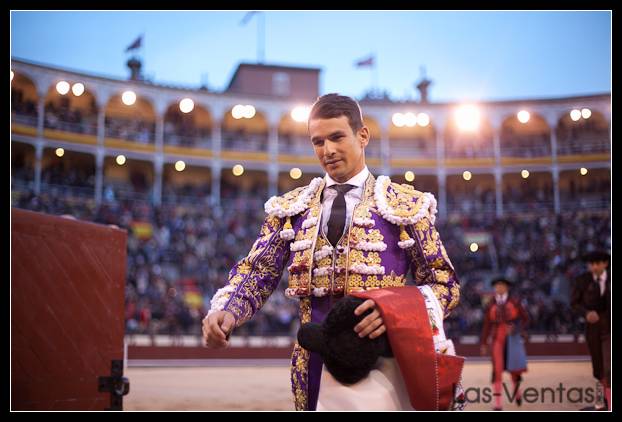
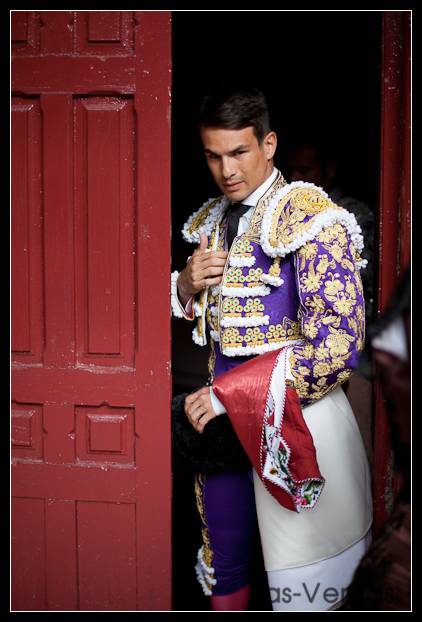
Un beso muy grande y gracias to a very (handsome in purple) helpful and inspirational torero  – José Maria Manzanares

Watch the video replay of Las Ventas 16 May – San Isidro 16.5.13

Visit Las Ventas website – Las Ventas

Up next… A Little Jaunt to Spain – Part 7 – Valle de los Caídos: Spain’s most terrifying location (prepare for some strong opinions now)

Click here for past installments – Spain 2013 in Review series

*all photos author’s own, or courtesy of Las-Ventas.com

A LITTLE JAUNT TO SPAIN – REVIEW PART 4: On the road with ‘Blood in the Valencian Soil’

me book park

The traveller sees what he sees, the tourist sees what he has come to see – Gilbert K Chesterton

There are two things I don’t like – being mistaken for a romance novelist, and being called a tourist. I went to Spain without maps, guidebooks, or a plan for my trip. Yet, I decided to do something that would mix in two things I don’t like, and walked around like a tourist, taking photos of a book about love affairs destroyed by the Spanish Civil War. People in Valencia didn’t look twice at me, such is their relaxed nature. Madrileños looked at me like I was crazy, which was pretty fun. Either way, for several hours, I took photos of my last novel in some of the locations in the book.

me book

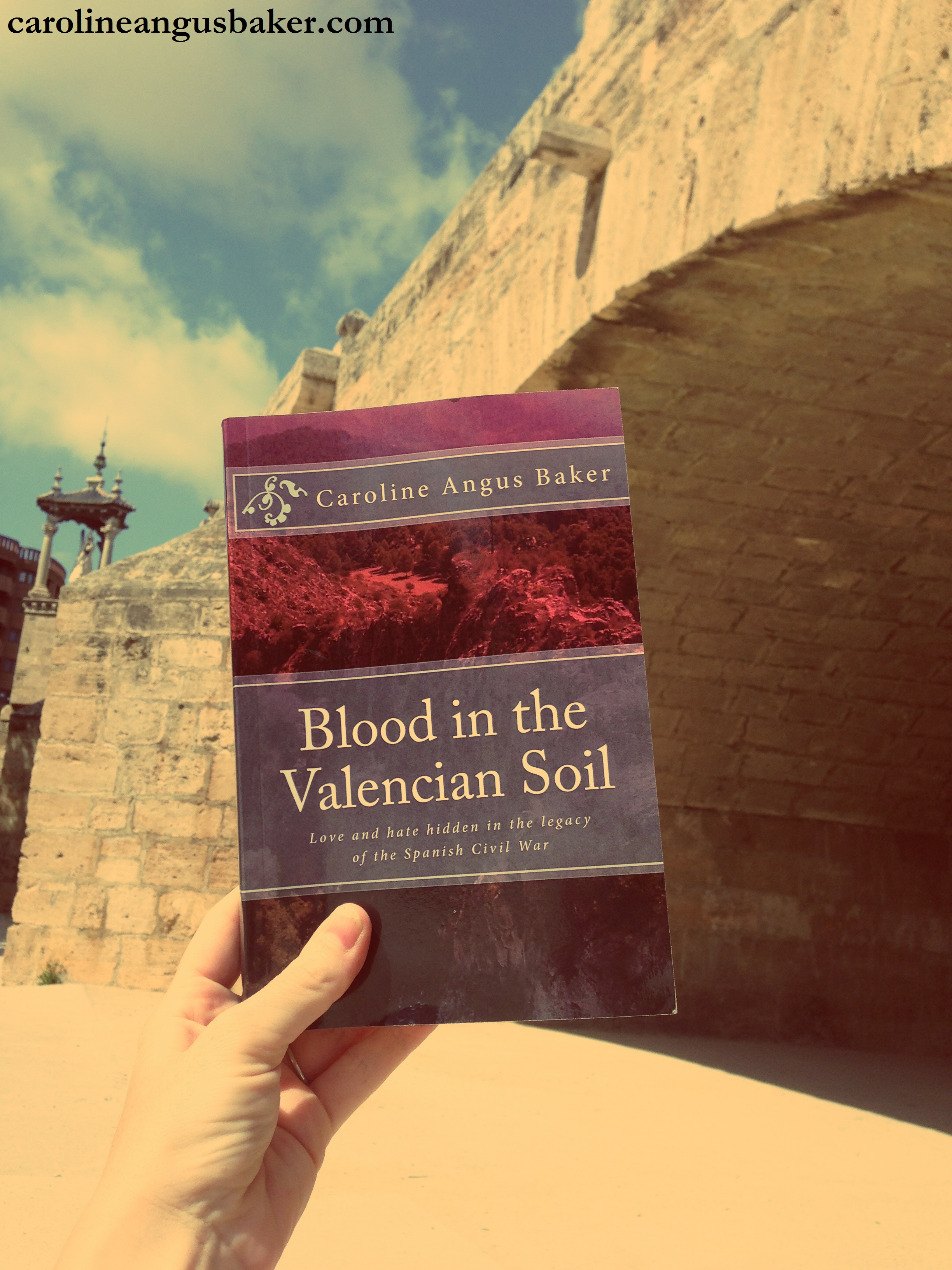
Caught being a tourist at Valencia’s Pont del Real

book brdge

Valencia’s Turia is a central point in the book through most of the novel, and in the titles to come in the ‘Secrets of Spain’ series. Who wouldn’t want to visit? I enjoyed sitting in the grass every day of my time in the city.

So here we are, in rough order as they appear in the novel, photos of my book and locations in BITVS. Even if you haven’t read the novel, you can still enjoy some beautiful parts of Spain –

B&W book cuenca

Chapter one – 1939: view of the Cuenca Convent San Pablo from the Beltrán family home in Barrio San Martín

IMG_3670

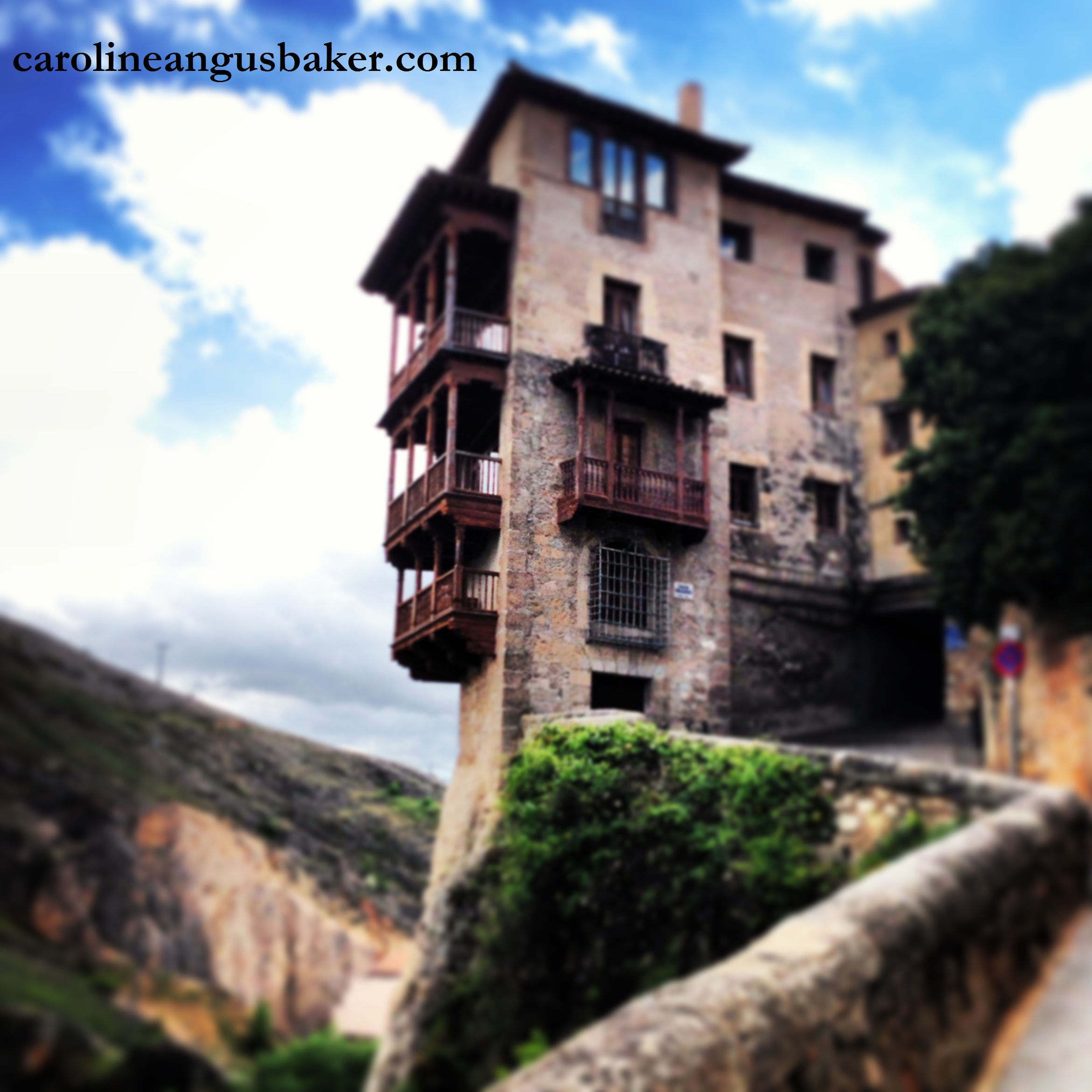
Chapter one – 1939: Cuenca’s Casas Colgadas, Hanging Houses, where Cayetano, Alejandro, Scarlett, Luna and Sofía discuss the civil war

IMG_3802

Chapter two – 2009: Madrid’s Plaza de Toros near where Luna meets Cayetano ‘the bull-minder’

madrid

Chapter two – 2009: a walk in Madrid’s Retiro park

ritz book door

Chapter three – 2009: a night at Madrid’s Ritz hotel

IMG_3828

luna house 1939 book

Chapter seven – 1939: the drop from Luna’s window

book park

Chapter eight – 2009: Cayetano follows Luna in Valencia’s Turia

cuenca bridge book

cuenca

Chapter 11 – 2009: Luna and Cayetano go to Cuenca in search of their namesakes

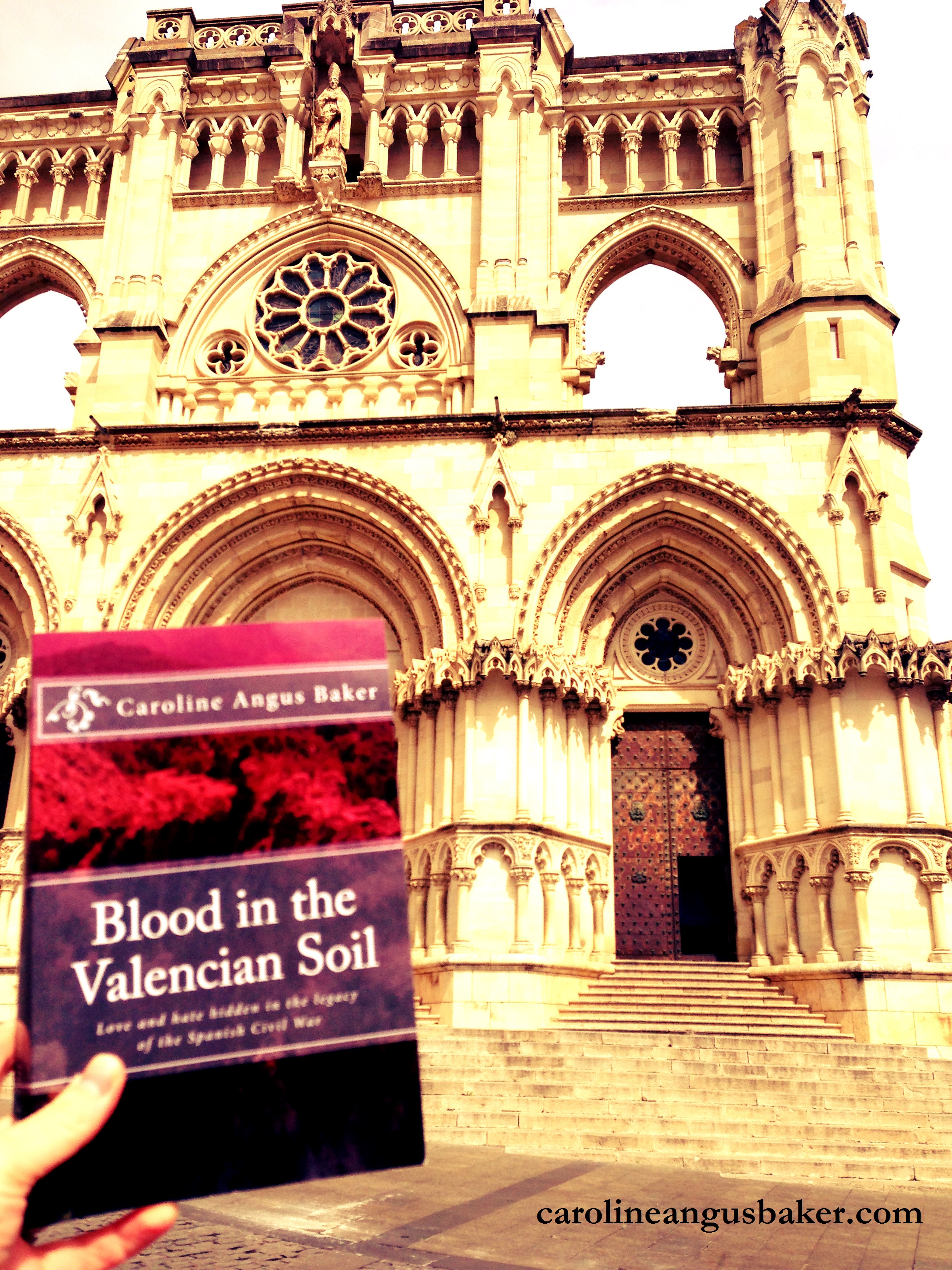
cuenca cathedral

cathdral book

Chapter 12 – 2009: Cayetano and Luna get into a fight at Cuenca’s cathedral

san martin book 1

Chapter 13 – 1939: Luna, Cayetano and Scarlett panic run up Cuenca’s Barrio San Martín steps

IMG_3795

parador book

Chapter 14 – 2009: a stolen night in Cuenca’s parador

park madrid book 2

Chapter 19 – 2009: another visit to Madrid to uncover the Beltrán family secret

luna 2

Chapter 21 – 1939: a secret burial in the Valencian mountains

book torre up close

me torre

Chapter 21 – 1939: arriving in Valencia as the war comes to an end

palca del angel book

valencia 8

Chapter 21 – 1939: Placa del L’Angel, where a plan to survive the war is hatched

serrano

IMG_2885

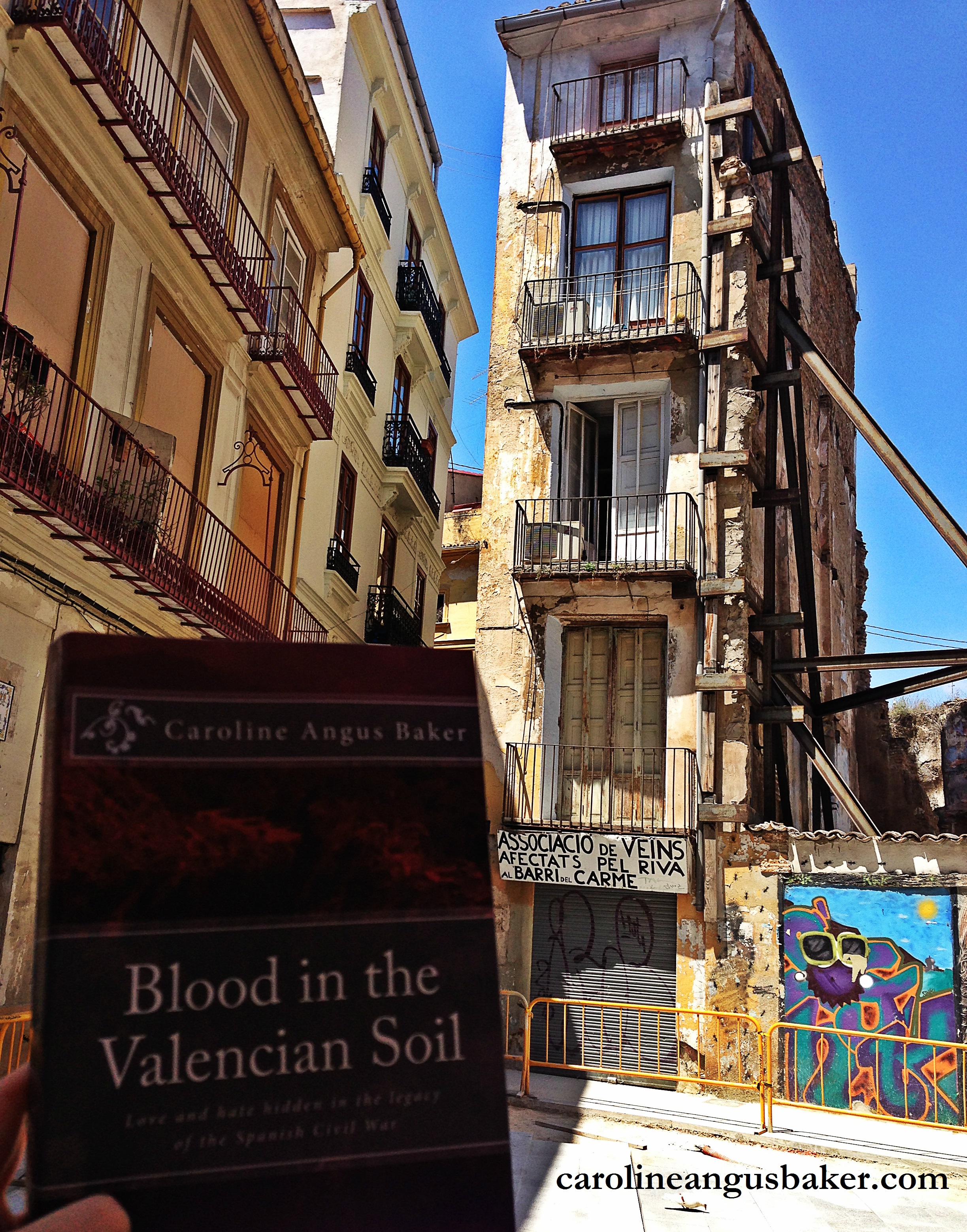
el carmen

Chapter 24 – 2009: a disasterous night out in Valencia’s El Carmen district

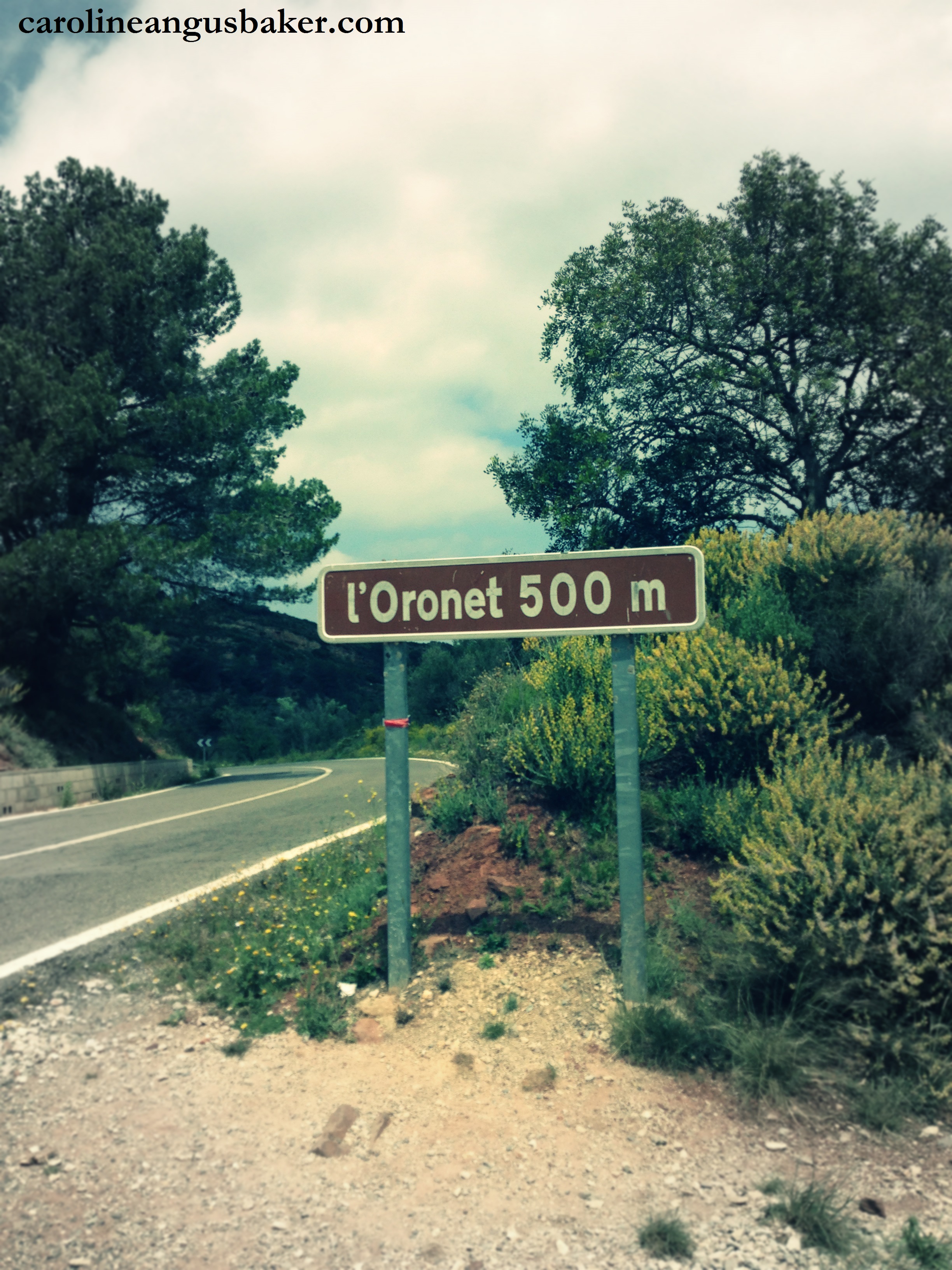
L 'Oronet

book mountain

Chapter 26 – 2009: a secret hideaway in the Valencian mountains is found

cloxck tower

Chapter 29 – 1939: panic at the clock tower at Valencia’s port

IMG_3618

Chapter 33 – 2009: Luna goes back to work as a Valencian bike mechanic

bridge names

Chapter 34 – 2009 and 1939: a declaration of love (written on Cuenca’s gorge bridge) that is broken and forgotten

IMG_3616

Chapter 35 – 2009: Cayetano hears a painful truth, another barrier to getting back in the bullring

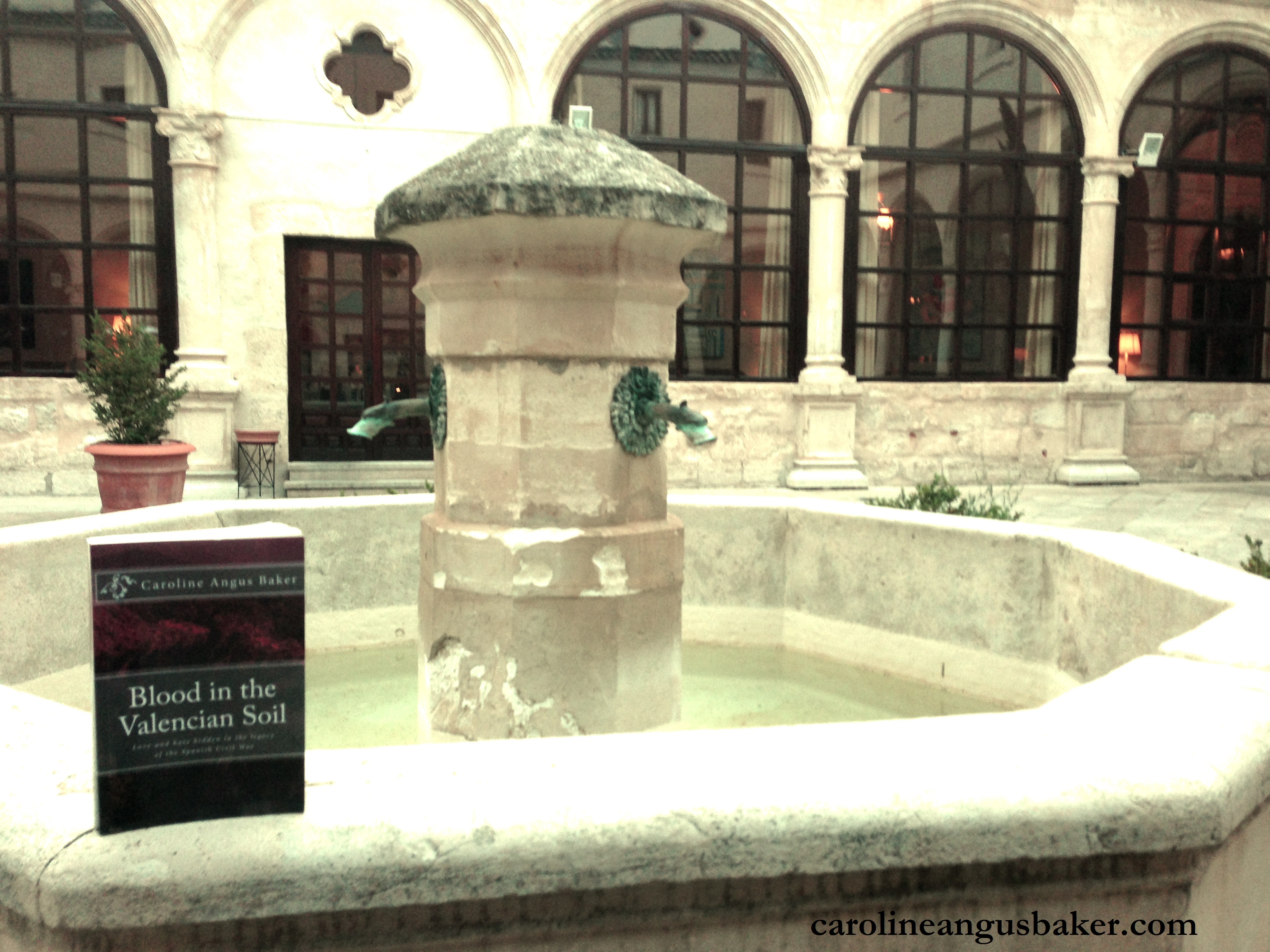
virgen

Chapter 39 – 2009: a bullfighter and a bike mechanic at the Valencia’s Plaza de la Virgen fountain

water court

Chapter 39 – 2009: the entrance to the Valencia cathedral where the Water Court meet

luna 1

Chapter 45 – 2009: a new grave discovered in the Valencia mountains

There you have it! Because I am doing posts on Valencia, Madrid and Cuenca, I didn’t feel the need to go into specific detail about each location, I will save that for other posts. In the spirit of not planning my trip, I unexpectedly ended up in Xátiva. I didn’t want to visit the town again, but the fun trip gave me this photo, standing in the spot where, in 2005, my husband took a random scenic photo. It ended up being the photo that graces the cover of BITVS, but I didn’t have a copy of the book on me that day!

IMG_2521

So, what happened to the copy of the book in the photos? It got autographed and given to a friend who was kind enough to accompany me on a very cold day out in Madrid as I took the photos. Thank you for your good humour and an arm-in-arm stroll in Retiro, in the spirit of the novel. Being able to talk about Spain and the civil war every day was the highlight of my trip.

Up next… Part 5 (of 10) – Madrid Tapas and History Tour with James Blick

*all photos are authors own, with the exception of photos 1 & 2. Owner – Sabine Kern.