HISTORICAL BOOK REVIEW SERIES: ‘Heroines of the Medieval World’ by Sharon Bennett Connolly

These are the stories of women, famous, infamous and unknown, who shaped the course of medieval history. The lives and actions of medieval women were restricted by the men who ruled the homes, countries and world they lived in. It was men who fought wars, made laws and dictated religious doctrine. It was men who were taught to read, trained to rule and expected to fight. Today, it is easy to think that all women from this era were downtrodden, retiring and obedient housewives, whose sole purpose was to give birth to children (preferably boys) and serve their husbands. Heroines of the Medieval World looks at the lives of the women who broke the mould: those who defied social norms and made their own future, consequently changing lives, society and even the course of history.

Some of the women are famous, such as Eleanor of Aquitaine, who was not only a duchess in her own right but also Queen Consort of France through her first marriage and Queen Consort of England through her second, in addition to being a crusader and a rebel. Then there are the more obscure but no less remarkable figures such as Nicholaa de la Haye, who defended Lincoln Castle in the name of King John, and Maud de Braose, who spoke out against the same king’s excesses and whose death (or murder) was the inspiration for a clause in Magna Carta.

Women had to walk a fine line in the Middle Ages, but many learned to survive – even flourish – in this male-dominated world. Some led armies, while others made their influence felt in more subtle ways, but all made a contribution to their era and should be remembered for daring to defy and lead in a world that demanded they obey and follow.

cover and blurb viz amazon

~~

I have spent a long time with my head in academic history books, so to read something that reads more like a story was a welcome relief. Heroines of the Medieval World is a book hard to get here in NZ, so when a copy generously floated my way, I grabbed it with both hands. The first thing I thought was – do we still use the word ‘heroine?’ Should it not just be ‘heroes?’ But then people may purchase and then get their egos crushed by finding out all the heroes are women. That only made me like this book more.

The book is great, separated into chapters about women from all over Europe. The book writes about the women of England and France, but also from Spain (yay!) and even as far east as Kiev. There are Warrior Heroines, Literary Heroines, Religious Heroines and Scandalous Heroines. You can read them in order, or however you like depending on your mood. I enjoyed how The Pawns weren’t simply bartering gifts, but smart women in their own right, and the Medieval Mistresses were more fleshed out (excuse the pun) than the simply fallen women ideal.

You won’t be confused between your Eleanors, your Matildas or your Isabels, and while you will read about well-known heroines, they are also great forgotten women given fresh air. The women are not viewed as heroines through 21st century eyes, rather they are simply celebrated for their strength in the time period while on their own crusades. They are heroines for all centuries. Putting together such a thorough assembly of women must have taken considerable time and energy, so treat yourself to the author’s hard work and gain further insight to the women that came before us. Heroines have far more skills and techniques than any hero.

HISTORICAL BOOK REVIEW SERIES: ‘Mary: Tudor Princess’ by Tony Riches

From the author of the international best-selling Tudor Trilogy, the true story of the Tudor dynasty continues with the daughter of King Henry VII, sister to King Henry VIII. Mary Tudor watches her elder brother become King of England and wonders what the future holds for her. 

Born into great privilege, Mary has beauty and intelligence beyond her years and is the most marriageable princess in Europe. Henry plans to use her marriage to build a powerful alliance against his enemies. Will she dare risk his anger by marrying for love?

Meticulously researched and based on actual events, this ‘sequel’ follows Mary’s story from book three of the Tudor Trilogy and is set during the reign of King Henry VIII.

~~

I have read Owen, Jasper and Henry, and also Warwick, by this author, so having a woman as a title character is an exciting addition! But it is not about Mary I, but Princess Mary Tudor, Henry VIII’s sister. That’s when I really jumped for the book, as I love both Mary and Margaret, forever eclipsed by their king brother.

The book starts in 1509, and Princess Mary is but 13 years old. Her brother Henry is only five years older but has just been crowned King of England. Henry knows who he shall marry – Katherine of Aragon, widow of Arthur, and now Mary is going to be an equally powerful princess – powerful in that selling her to the highest bidder will help increase Henry’s power.

Mary has, in the past, been written as a fool, a simple girl interested in princes and gowns, no head for politics. What a silly notion, because Mary is the daughter of Henry VII and Elizabeth of York, her sister is Queen of Scots, Arthur was to be king, before Henry took poor Arthur’s place. How could Mary possibly be dim? Here, Mary is educated, confident and a brave young woman at the heart of a very serious political match for her country. Yes, she may break down in private, but her public face is one of total poise, the way only a royal upbringing could provide.

Mary considers Katherine of Aragon a sister when she marries Henry (Mary was very young when Katherine married Arthur). Henry and Mary are close, even though Henry is never an easy man to love, and is often heartless to Katherine. Mary has lost both her parents, and Henry breaks her betrothal to the  Holy Roman Emperor Charles, also just a child, and instead gives Mary in marriage to King Louis of France.

Mary may be a queen, but is also Europe’s most beautiful princess of 18 years when she marries the frail 52-year-old Louis. Mary does as she is bid (and has a child Anne Boleyn in her household, just a little side bonus) and marries the old Frenchman. But first Mary told her brother – I shall marry Louis if  can choose my second husband.

That is where Mary is so grand. Louis kicks the bucket three months in, and kings and dukes are clamouring for Mary less than a week into widowhood. But Mary has her suitor all ready, Charles Brandon, Henry’s best friend and (while the Duke of Suffolk) not at all good enough for her. Secretly married, Mary defies her brother and King, and is banished from court and from his kindness.

Never mind all these details; Mary is written as a woman, a wife, a mother, a sister. She becomes a queen of France (who killed her old husband with too much sex, so they gossiped, eww), then a woman who married for love, then a wife who had to endure infidelity, the births and deaths of children, the heartache she felt for Queen Katherine and the fortunes of all around her. Mary also suffered with her health for her whole life.

Mary was an important princess in the royal history of the time, and is not prone to being frivolous, and so is written as an educated woman. While the Tudor world is filled with politics, law, religion, it is also filled with love, friendship, parties and jousts, colour and excitement, and the book weaves all together.

Did Brandon love Mary back? The book gives hints about such as Mary’s life is followed. Mary’s death is beautiful and tragic, and the process starts over, as Brandon marries a child as a firm alliance just a few months later (he was a lucky man to capture both Princess Mary and Catherine Willoughby!). Mary’s granddaughter Jane would become queen for nine days many years later, and must have had the blood of THIS type of Princess Mary in Jane’s veins.

Thank you, Tony, for a wonderful novel!

~~

About the Author Tony Riches is a full-time author of best-selling historical fiction. He lives in Pembrokeshire, West Wales and is a specialist in the fifteenth century, with a particular interest in the Wars of the Roses and the lives of the early Tudors. For more information about Tony’s other books please visit his website tonyriches.com and his popular blog, The Writing Desk and find him on Goodreads as well as Facebook and Twitter @tonyriches

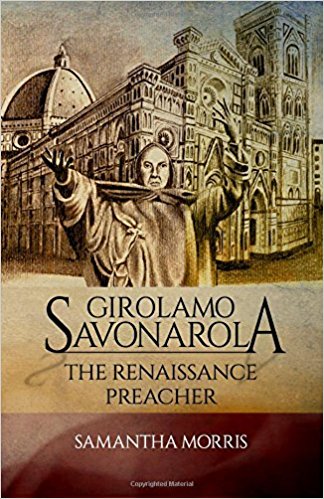
HISTORICAL BOOK REVIEW SERIES: ‘Girolamo Savonarola: The Renaissance Preacher’ by Samantha Morris

Born on 21 September 1452, the very same year that Leonardo Da Vinci was born, Girolamo Savonarola: The Renaissance Preacher tells the story of a man who believed so wholeheartedly in God and the message that He was giving, that he gave his life for it.

The book is an introduction to the life and times of this infamous preacher, a man who was witness to the dramatic downfall of the Medici dynasty in fifteenth-century Florence, who instigated some of the most dramatic events in Florentine history and whose death is still commemorated today.

cover and blurb via amazon

~~

If you are new to Savonarola, here is a great place to begin. Savonarola was a Dominican friar and preacher up until 1498 when he was excommunicated and executed for throwing out prophesies and for calling for the end of corruption, the type of thing that gets you killed in Italy during this period. Yet he is constantly made out to be a crazy man, who preached as a friar, who was mad as a hatter, pretended to see the future and callously destroyed priceless art in the process. This time, Morris has created a different man, a portrayal given time and clarity.

Savonarola began life in 1452, and entered life as a friar in 1475. After studying and praying, he gained momentum in 1494, when he set off to preach in Florence, and bumped heads with the most powerful men around at that time. In four years, he would be burned in public for his work. How? By hitching his wagon to the current anti-Medici feelings in Florence at the time. Florence, a Republic then, was in the Medici grip, but only for the last 16 years, so they still had plenty of enemies to go around. Combined with the fact that the French king wanted to storm through Italy and there was the great Borgia Pope on the papal throne, Florence was a jittery mess and Savonarola was right in the middle.

Savonarola believed he could see the future, and began preaching that he was destined to save Florence and its people from sin. He also thought the French king Charles was placed on Earth by God to restore Italy to the ways of 2000 years earlier. Charles himself wanted the Kingdom of Naples, though places such as Florence and Rome stood in his way. But while Savonarola was crushing on the French, he was also busy hating the powerful Medicis, masters of Florence, the Borgia Pope and the strong Sforza family of Milan.

Foretelling the future and also preaching chastity, poverty, piety and repentance, Savonarola hit out against the friars of Florence who lived luxurious lives. He hated the art and beauty of Florence, the greatest to be found in Europe. He was a huge homophobe, so much so that maybe he was possibly over-compensating? (That’s my theory). Savonarola was desperate to make sodomy a crime. He also hated the Church in general for its lavish lifestyle, massive wealth and for its corruption, crimes, whores, nepotism, you name it. Savonarola seemed to think himself the great saviour of everyone.

Along with two others, Savonarola was arrested and tortured, and he caved very quickly, unlike nutters or those desperate to cling to martyrdom. He confessed to everything he had said and done against the Church and Pope. The sad thing is, Savonarola wasn’t some bigot crying in the streets while living it up in private; he seemed to believe what he said completely. It gives the man a little sympathy, as he was not looking for personal gain, just had a desire to change the world order, but it was all in his head.

Poor Savonarola was taken out as a defeated crazy man and set alight, his ashes scattered in the Arne river so they wouldn’t be relics. Savonarola was a victim of his own delusions, of his own pride and vanity, and he burned just like the books and artwork, clothes and wigs he had his faithful followers destroy.

I love Morris’ enthusiasm for Savonarola, a man largely overlooked, always written the same way. Anyone who loves the Medici like Morris is bound to be an authority on all the big players of Florence.


HISTORICAL BOOK REVIEW SERIES: ‘Pustules, Pestilence and Pain: Tudor Treatments and Ailments of Henry VIII’ by Seamus O’Caellaigh

Henry VIII lived for 55 years and had many health issues, particularly towards the end of his reign.

In Pustules, Pestilence, and Pain, historian Seamus O’Caellaigh has delved deep into the documents of Henry’s reign to select some authentic treatments that Henry’s physicians compounded and prescribed to one suffering from those ailments.

Packed with glorious full-colour photos of the illnesses and treatments Henry VIII used, alongside primary source documents, this book is a treat for the eyes and is full of information for those with a love of all things Tudor. Each illness and accident has been given its own section in chronological order, including first-hand accounts, descriptions of the treatments and photographic recreations of the treatment and ingredients.

cover and blurb via amazon

~~

The title doesn’t exactly make someone dash to the store for this book, but to miss out would be a real shame. O’Caellaigh has dived into a complex subject and combined it with a visually stunning piece of work to create a detailed life story of Henry and his illnesses, a book which came in very handy for me personally, as well as a great read.

Much is known of Henry’s health, combined with letters written by his doctors and those who were close to the king. Henry’s health changed dramatically throughout his life and had a stark impact on the relationship he had with his wives. Because of this behaviour with these queens, the Tudors have become infamous.

Anyone who has looked for info on Henry’s health will know there is much out there, and not all of it accurate. The author has tried to use primary sources, a great challenge for the time period, as doctors did not keep records as they now do. But through sheer determination it seems, O’Caellaigh has tracked down Henry’s prescription book as well as handwritten records from the Royal British Library. This is combined with letters in the court at the time, and the author has had to push through the accounts to separate truth from rumour.

One original and lucky bonus in this book is the photographs. As Henry was a handsome man, then a huge man, physical appearance would have been important in Tudor times. So this book has been dressed accordingly, with lavish photos of Tudor medicine and history. The photos are a welcome addition to the book.

While there are numerous books that look at Henry’s wives and the destruction of the church, this book looks at Henry from a unique angle, and also catalogues the changes and advancements made during Henry’s life. As Henry’s health and recovery from injuries made such a  difference to his reign, to makes sense to write a book on the details of how people survived during this period. I got a copy of this book not expecting a long read, and yet, to my delight, found it to be fascinating and well-researched. I am extremely pleased to have this book in my digital library and will definitely go back to it time and again.


HISTORICAL BOOK REVIEW SERIES: ‘The Raven’s Widow: A Novel of Jane Boleyn’ by Adrienne Dillard

The river was as calm as I had ever seen it. Ordinarily, the tide would have been wild by this time of year, and woe unto any man unfortunate enough to fall into the fierce currents of the Thames. Tonight the tides were still, and the surface of the water appeared glassy. When I peered down into the dark depths, I saw my tired, drawn face wavering in the reflection. I quickly turned away as I fought back a wave of nausea, frightened by the anguish I saw etched there.

“Only a few moments more my lady, the Tower is just ahead.”


Jane Parker never dreamed that her marriage into the Boleyn family would raise her star to such dizzying heights. Before long, she finds herself as trusted servant and confidante to her sister-in-law, Anne Boleyn; King Henry VIII’s second queen. On a gorgeous spring day, that golden era is cut short by the swing of a sword. Jane is unmoored by the tragic death of her husband, George, and her loss sets her on a reckless path that leads to her own imprisonment in the Tower of London. Surrounded by the remnants of her former life, Jane must come to terms with her actions. In the Tower, she will face up to who she really is and how everything went so wrong.

cover and blurb via amazon

~~

No one with the name Boleyn has fared well through history or fiction, and Jane Boleyn is definitely no exception. In recent times, Jane has been pained as a snitch, a mean, meddling and jealous woman, one who helped get her husband beheaded. Here, Dillard sets out to paint a very different woman.

Jane Parker was born in around 1505 to Henry Parker, Baron Morley and Alice St John (so through her mother’s family, a distant relative of King Henry). By 1520 Jane was in service to Queen Katherine, and considered an attractive woman for her time. By 1525, marriage had been arranged to George Boleyn, brother of two women, Anne and Mary Boleyn, whom also served Queen Katherine. As the Boleyn family were of little consequence at the time, little is recorded about the marriage, or Jane herself. It seems they had a loving marriage, though no children were ever born to the pair. Here, possible miscarriages and losses are added to the book to gain a different insight with artistic licence.

After Mary Boleyn’s time as the king mistress ended, it was Anne’s turn to fall prey to Henry, whom loved her deeply right through the 1520’s, and it was then that the Boleyns rose in the court and public eye. By 1533, Anne was queen of England, and Jane was in her service, now Viscountess Rochford. No part of Jane’s life could have prepared her for such circumstances. Jane is written as caring, emotional, irrational but interesting through the trials of being the queen’s sister-in-law, through the eyes of a courtier not often chosen as a main protagonist.

History remembers Jane as the one who told Cromwell that Anne and George were committing incest to gain a child to claim as King Henry’s. But Jane n reality was a woman married to a man who was a womaniser (though is portrayed as kinder and more chaste in this book), and, when George lost his head, she had to plead and bow to regain favour.

In this book, as in life, Jane is a character who manages to survive, to serve Anne of Cleves and then Katherine Howard as queens, before Jane too loses her head for helping Queen Katherine set up dates with her secret lover in 1542. The twist in this book is how Jane is not written as the scheming bitch who happily served her husband and sister-in-law to the axe so she could continue to survive. Also, Jane’s breakdown right before death is also given a fresh look. A book for those who are on the look out for something new.