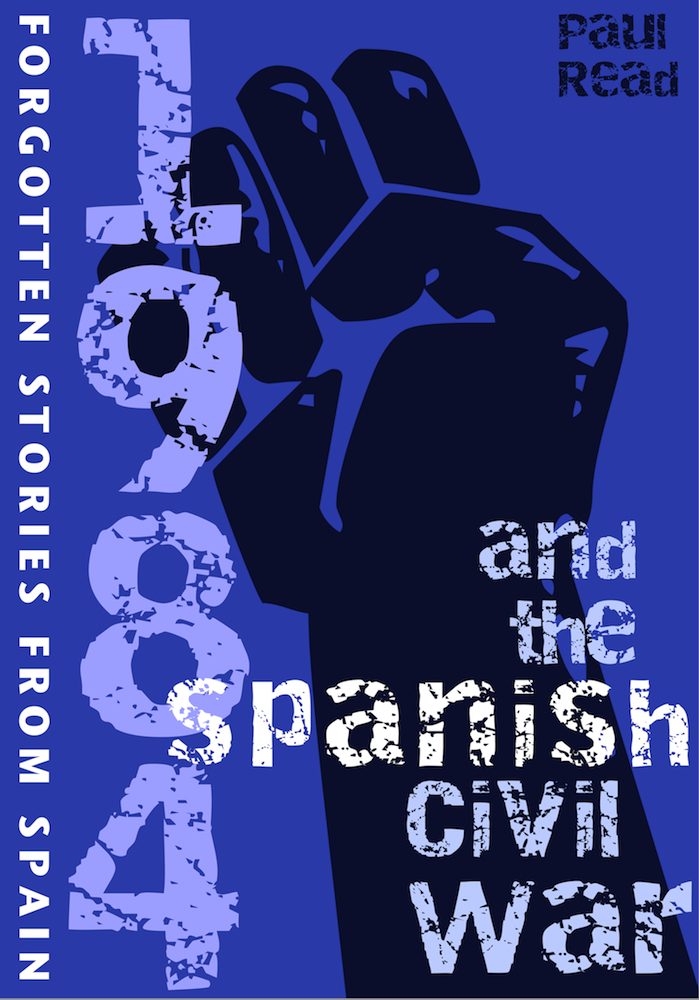
SPAIN BOOK REVIEW: ‘1984 and the Spanish Civil War’ by Paul Read

1984

In 1937, George Orwell spent six months in Catalonia, witnessing the rise and fall of the popular revolution on the streets of Barcelona and Catalonia. Alone amongst his contemporaries, Orwell understood what the success or failure of that Spanish Revolution would mean for the rest of the world. The lessons he learnt, were explained in the three books he wrote upon his return.

1984 And The Spanish Civil War – the 2nd book in the ‘Forgotten Spain Series’ – tells the story of Orwell’s relationship with Spain and the legacy he has left us:

*How far was ‘1984’ and ‘Animal Farm’ the inevitable conclusion to all Orwell had witnessed in those brief months he spent in Spain?
*Why was his work so unanimously rejected by his contemporaries in England?
*Was the revolution Orwell witnessed in Barcelona crushed forever by the end of the war, or did it slide into hibernation, awaiting the present conditions for revival?

If you want to understand Spain today, you need to understand Orwell. If you wish to understand the work of Orwell, you need to understand the history of Spain in 1937.

~~

1984 and the Spanish Civil War is the second book in Paul Read’s Forgotten Stories from Spain series. George Orwell, now synonymous with ‘privacy, procedure and responsibility’ has much to thank from his time in Spain in regards to his greatest works. His theory on the ‘thought police’ , of big brother and their CCTV cameras are part of common culture, and he was the man who gave a face to big corporates and hierarchies that control the populace. While the reclusive Orwell (real name Eric Blair) died aged just 46, his work lives on.

His work, Homage to Catalonia, is the best piece of work that embodies the Spanish Civil War from a personal point of view, by a man who didn’t fall for ideals of either side of the fight, and dared to stand up and question Spain’s situation. With suspicion from the right and criticism from the left, he was able to produce three of his great works – Homage to Catalonia, Animal Farm and 1984.

Between 30-35,000 people joined the civil war as volunteers, the International Brigades, organised mostly by the Communist Party, but Orwell slipped into Spain through a Marxist militia and fought for the POUM, which would eventually be his downfall in Spain. He was able to assess the different sides of the left in the war – Socialists, Anarchists, Communists, Republicans, Basques, Catalonians and the big unions in Barcelona, the UGT and CNT. 1984 and the Spanish Civil War is a great way to understand why Orwell came to the conclusions he did, what he faced in his desire to fight and come to grips with Spain unlike anyone before him. The book also details what Orwell and his wife went through in escaping Spain.

1984 and Spanish Civil War discusses how criticism of Homage to Catalonia led Orwell to use satire in writing both Animal Farm and 1984 to relate his ideals and knowledge. In learning how power can destroy ideals and morals, and seeing the left coalition the civil war collapse under ‘folding lies’, fighting for something to save face rather than believing in the facts, Orwell was able to produce these stunning works.

The book also goes on to talk about how, in many ways, Spain has not changed. In these times of austerity, many of the original ideas that spurred the civil war have come alive again: the left wing and anarchism in its root form – with the indignados, occupation movements, desahucios (evictions and related occupations) and also escrache, calling people to account in public settings (humiliation protests if you will). Orwell may be proud that some of his ideas are alive and in practice today, who knows.

Paul Read has written an excellent book on the subject of Orwell and the effect of the war on the Englishman. 1984 and the Spanish Civil War is insightful, well-researched and written in a smooth, satisfying pace, giving out so many details, and informing the reader on many certitudes that they may not have known. A highly recommended book.

See book one in the series – Forgotten Stories from Spain: The Ambulance Man and the Spanish Civil War

See more from Paul Read on Speaking of Spain

SPAIN BOOK REVIEW: ‘The Ambulance Man and the Spanish Civil War’ by Paul Read

Paul Read


The Ambulance Man and the Spanish Civil War is the first book in the Forgotten Stories from Spain series by Paul Read, giving readers a chance to learn tales of the ‘bravery, humanity and vision’ which existed in 1930’s Spain. But never fear – there is no need to have a great understanding of the time period, as this book caters to both seasoned and new readers of the subject. The book leaps into the time period with a prologue outlining Spain during the war for anyone in need of background details.

This book is the story of Canadian Norman Bethune, a man passionate about public healthcare and social justice. Around 1600 Canadians joined the fight in Spain as volunteers during the war. Bethune started his time in Madrid, noted for both his work, and his fondness of women, drinking and criticism of the regimes operating during that time. Like George Orwell in Barcelona, Bethune became ‘known’ to the Communists and their strict rules, only to have this backfire against him later on in his tour of duty.

The Andalucian city of Malaga, deep in southern Spain, was suffering heavily. The ancient city had a massive disparity in land and wealth, and looked forward to revolution in 1931 at the start of the Second Spanish Republic, but had become tired of waiting for change when war broke out in 1936. But by February 1937, Franco and his troops, with help from the Italians, were advancing fast on the poor city with little way of defending itself. The people had two choices – run or die. People decided to walk the 200km to Almeria and potential safety – not an easy feat with children, elderly, no food or supplies, and carrying everything dear to them.

Along the road, the ‘Carretera de la Muerte’, or Highway of Death, there was only one hope against the bombing, shooters and endless sun. Norman Bethune was the only soul keen enough to do something about the people and their desperate need for help. While thousands died, Bethune had a simple yet brave plan to help the people of Malaga. The book tells of the plan and of what greeted everyone in Almeria, and of Bethune’s escape from Spain after his daring plot. The book also goes on to tell the stories of Bethune’s time in China, and who does and doesn’t remember his work today.

The author uses a fast, smooth, no-nonsense style to recall this forgotten tale, peppering the story with important details, and uses interviews with survivors, and information on how a large percentage of Spain doesn’t know their own history. This book is an easy read, giving people a short yet important insight to a man whose bravery still needs to be shared. The Ambulance Man and the Spanish Civil War is a terrific opening for the Forgotten Stories from Spain series for anyone to enjoy.

Next week I will review the second book in the series Forgotten Stories from Spain: 1984 and the Spanish Civil War

You can find more about Paul Read on his fantastic website – Speaking of Spain

SPAIN BOOK REVIEW: ‘Into the Arena’ by Alexander Fiske-Harrison

IntoTheArena

Alexander Fiske-Harrison spent a season studying and travelling with the matadors and breeders of famous “fighting bulls” of Spain (and France and Portugal. ) He ran with the bulls in Pamplona and found himself invited to join his new friends in the ring with 500lb training cows. This developed into a personal quest to understand the bullfight at its deepest levels, and he entered into months of damaging and dangerous training with one of the greatest matadors of all, Eduardo Dávila Miura, to prepare himself to experience the bullfight in its true essence: that of man against bull in a life or death struggle from which only one can emerge alive.

cover and blurb via amazon

~~

Every time I write something regarding bullfighting, I get plenty of hate mail, regardless of the content. Just the mere word ‘bullfighting’ sends people into a spin. There are those who constantly come on here and say I deserve to endure genital mutilation for my writing (which only makes you as grotesque as how you view bullfighting, so STFU). I find it interesting that no one who comes to my site to hound me has ever actually asked my personal view on bullfighting, and logic of abusers seems so ridiculous. When I wrote about rape or spousal abuse, no one asked me if I endorsed those subjects, so for that reason, I have decided to leave comments closed on this new post. Putting up with harassment is not a sign of strength. I shall not be passive, and I shall not be attacked either.

Into the Arena by Alexander Fiske-Harrison is a book I read a few years ago, but never reviewed. I decided to read it again recently, while doing some bullfighting research. I have been reminded how much I enjoyed this account on the subject.

It is argued that bullfighting, when done well, is a work of art, and a sin when done poorly. These two differences are a beautiful reflection of the arguments for and against the battle of death. The author shows how, after first seeing fights in 2000, until his full-fledged love affair with the art form years later, the only way to truly understand bullfighting is to be emerged in the world of the toreros. Bullfighting in the 21st century has triple the number of fights of the so-called golden-age of fighting in the 1930’s. Bullfighters earn enormous sums like football stars, marry beautiful girls and appear on magazine covers. Between the fights, the endorsements, and the celebrity caper, there is an industry worth over €2 billion a year. It would be easy to be swept away by the glamour aspect.

Fiske-Harrison is staunch defender of bullfighting. Some could say it could be a case of being caught in the bright lights of the toreros. Instead, the author turns to some of the greatest names of the current era – Cayetano Rivera Ordóñez, a celebrity wherever he goes, and who speaks of the death in his life as part of a weekly routine.  José Tomás, ‘The Phenomenon’, some say the greatest performer of the age – who performs with great skill and nearly dies in the process. A horrific goring in Mexico shows the lengths the man will go to for what he believes is greatness. Then there is Juan José Padilla, known famously for being the torero who had his eye gored from his face. One famous fight shows Padilla fighting in the same event as Tomás, and nearly gets gravely injured due to vanity, wishing to be the most beloved of the night. Padilla is the epitome of those who live for the skill and thrill.

But this book doesn’t seek to raise the profiles or talk up the participants. This book also addresses the moral conundrum of the event. The hate of bullfighting can be as strong as the love, and the book does its best to counter some of the arguments – that the bulls are treated more humanely than your standard animal raised to become a steak (which I would agree with). Many who argue against bullfighting think little of the grotesque nature of the death of their dinner (or, like me, find steak-eating appalling). The book also discusses the economic and ecological benefits of bullfighting. While these arguments do have their merit, those opposed to the spectacle would no doubt be able to dismiss the claims.

Bullfighting is Spain’s ‘feast of art and danger’. That is mostly certainly true. The book takes a turn as Fiske-Harrison attempts to get into the ring himself, to learn the moves and nature of the animals. You can hate bullfighting all you like, but rarely does anyone have the courage to face one of these strong and aggressive animals. The animals are bred specifically for their speed and aggressive behaviour, and are fast learners. There will also be bulls who do not show the enthusiasm for death that the crowd would want (I’ve seen scared and disinterested bulls in the ring myself). The toreros have a great affinity for the graceful animals, but they must be killed. In the end, the audience is the beast while the man and animal square off for entertainment.

The world of bullfighting is a mixture of death and machismo – two things that can seem extremely unappealing. The author manages to sneak in and out of the world with great fluidity, makes up his own mind based on research and personal effort, and doesn’t waver from his personal opinion. While some see bullfighting as men with inflated egos killing animals to show off for a crowd, where the death of animals is both cruel and pointless, Fiske-Harrison attempts to portray the world of culture, tradition, respect and of bullfighting’s essence – the struggle of life and death. This is a great book told through one man’s perspective, but whether you enjoy the read may depend on your position on the subject.

Because the subject is so decisive, I will continue to both read and write about it, from both sides of the argument.  However, I’m not sure there is any piece of work that will ever sway a reader from their opinion. Some may get caught up the glamour and popularity, and many can respect the animals, but can readers endorse the kill? Who knows. You need to look past the kill to see the men and culture behind it, an action not everyone wants to try.

SPAIN BOOK REVIEW: ‘Nada’ by Carmen Laforet

nada

One of the most important literary works of post-Civil War Spain, Nada is the semi-autobiographical story of an orphaned young woman who leaves her small town to attend university in war-ravaged Barcelona. Edith Grossman’s vital new translation captures Carmen Laforet’s feverish energy, powerful imagery, and subtle humor. Nada, which includes an illuminating Introduction by Mario Vargas Llosa, is one of the great novels of twentieth-century Europe

~~

Nada is one of those books which sat in my to-read pile for far too long. Classics sit waiting while newer releases get sent to me for reviewing. Now, after reading this book in one day, I feel the need to facepalm for sidelining such a novel for so long. I find it difficult to connect with fiction (yes, I know…) but this book is an instant hit.

Nada is the story of 18-year-old Andrea, an orphan who moves to Barcelona from the country, to live with maternal relatives while starting university. Andrea had visited her grandparents’ home before the civil war as a very young child, and was filled with loving memories of city life. But life on Calle de Aribau has become a nightmare.

Gone is the lavish apartment of her family; now they in one half of the house, a dark, scary place filled with odd objects like a grand piano, huge mirrors, big heavy unused furniture and a candelabra, a hint of the former life of the family. As time passes, each of these expensive once-loved items gets sold off to pay for food and hope of survival. The opening chapter where Andrea meets her family is dark enough – they are like skeletons, ghosts in the night, in a home where a cold shower is relief from company, but the damp stains on the wall look like evil clutching hands. Andrea’s grandmother is a starving, frail old woman, surrounded by her adult children – Román, a vile man with hidden depths, tortured by the Republicans for being a Francoist spy. His brother, Juan, an artist who hates his life, beats his wife without remorse, with a demeanor of a broken man who has deeply suffered during the war. Gloria, Juan’s wife, a beautiful but simple-minded woman, who feeds everyone by leaving her baby son at home and winning card games in Barrio Chino. Andrea’s grandfather has died, like her own parents, and are unexplained, by it’s easy to imagine what may have happened to them.

The creepiest character lies in Angustias, the aunt from hell. She is a religious fanatic, who, in standing with her high and mighty attitude, sees Andrea as her charge, who needs to be broken and obedient. Angustias is hell-bent on making sure Andrea has no life, sees nothing, hears nothing, experiences nothing. As Angustias fails and hates Andrea, who has done nothing wrong, she tells her that she should have been beaten to death as a child. Angustias has been hiding a hypocritical lifestyle for so long that she has become almost insane. Even the crazy maid, Antonia, is a horrid and bewildering.

Andrea is a saint for coping with these vicious and hateful people in a dark, freezing cobwebbed environment. While the past hurts and torments her family, Andrea tries to break out – she makes friends, hangs out with artists, meets boys she doesn’t really like much, but reality  is still in the way. Andrea’s close friend Ena is wealthy, which puts a gap between the pair. Ena has the attitude of a child who has wanted for nothing, and has the luxury of wanting and experimenting. Andrea is starving, resorting to drinking water the family’s vegetables have been boiled in. Old pieces are bread are treats.

The book shows the pain of Barcelona post-war in human terms. With its will crushed by Francoism, some have flourished and the losers have been ground down to nothing. Being sniffed out by police for being a ‘red’ is still a threat. Work is hard to find, and money is only for some. The cathedral, in its religious beauty, shines like a beacon while people starve in the alleys nearby. There is little hope for people like Andrea. As the stories of all the characters come together, the haves and have-nots have history that provides both a big twist, and ultimately, a vicious death.

While the Barcelona that Andrea lives in no longer exists, the book gives a perfect feeling to post-war reality. The book was autobiographical, written after Carmen Laforet went to study in Barcelona, before moving on to Madrid. This book will leave you wondering about the long-term fates of all the characters (and their real-life counterparts), if indeed they had one at all.

Nada was published in 1945, the first of LaForet’s novels. If you prefer English, it was excellently translated by Edith Grossman in 2007. Don’t wait to read another week to read Nada.

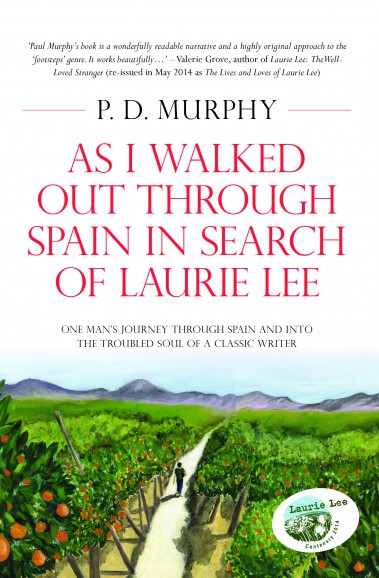
SPAIN BOOK REVIEW: ‘As I Walked Out Through Spain in Search of Laurie Lee’ by P D Murphy

As-I-Walked-Out

Have you ever read a book that changed your life? Had a hero who shared your life? Wanted a second chance in life?

In the summer of 2012, Paul’s life is falling apart: he needs to change things; find some inspiration; he needs to walk out.

Paul sets out across Spain to retrace the footsteps of his literary hero, Laurie Lee. He walks from the Atlantic Ocean in the north all the way down to the Mediterranean Sea. Lee made the same journey in 1935 and walked straight into the perfect storm of the Spanish Civil War and described the experience in his rite-of-passage book As I Walked Out One Midsummer Morning.

Like so many, as a young man, Paul read the book and fell in love with both Spain and Lee. Paul, like Lee, has always dreamed of walking down those white, dusty roads, lined by orange groves, all the way to Seville.

Paul looks deep into the troubled soul of the English national-treasure writer on an emotional journey that stretches to breaking point his relationship with Lee.

Paul is the first writer to fully retrace Laurie Lee’s classic 1935 journey through Spain.

Book cover and blurb via amazon.com

~~

Paul Murphy had a great plan – to retrace Laurie Lee’s step around Spain, as chronicled in his classic As I walked Out One Midsummer Morning. In seeing all the similarities and differences between 1935 and 2012, the author also found himself.

Anyone who has read Lee knows of his style, his matter-of-fact yet poetic prose. British born Murphy has delivered a book with a similar manner – all the details and facts on the trek, along with florid descriptions, amusing anecdotes and a style that is enjoyable to read. Visiting Spain very regularly since 1970, Murphy decided to set out across Spain in Lee’s footsteps, to be written and ready by June 2104, Lee’s 100th birthday. As I Walked Out One Midsummer Morning is a true classic, and to take on this trek would be no easy task, and that is evident throughout reading the book. As I Walked Out Through Spain in Search of Laurie Lee battles many internal demons, such as the issue that heroes can be easily shattered when examined close up. It is easy to idolise, something Murphy did with Lee, but when faced with the reality of Spain, with its powerful emotional pull, Murphy begins to see Lee in a whole different light, far from his pedestal.

Laurie Lee took a long route through Spain, a ferry from the UK to Vigo, and walked to Madrid via Zamora, Valladolid and Segovia. Then we went to Malaga via Toledo,  Valdepeñas, Cordoba, Seville, Cadiz and Gibraltar. Murphy altered the course a little, skipping Gibraltar and visiting Aracena and Ronda. The two-year task from the first steps taken until the release of the book has produced a quite a tale.

The book is laid out as a series of observations by Murphy, peppered with meetings along the journey, with those who fill the author’s conscience and pull him from his beaten path. From flamenco music, to bullfighting, to the fascist call-to-arms, the legacy of the war and Franco years, and lost loves along the way, Murphy delivers all the things people know about Spain, along with finding himself in among the contrasting nation. The book delves deep in the author’s personal life and feelings – lost love, divorce, his relationship with his own family – as a man in his fifties, Murphy goes through an immense change, one many could sympathise with, but perhaps not have the courage to fully understand, let alone express. Spain with its sights, sounds, smells, characters, noise and enlightenment can also be a lonely place, one that can invoke melancholy and a sense of feeling flat. Murphy goes through all the emotions of Spain and sugar coats nothing.

Many of Lee’s writings are open to interpretation and some believe his view too rose-tinted, or even outright lies, but irrespective of these opinions, Murphy does find some of Lee’s Spain still lurking, away from the main centres. Larger towns and cities seem to both educate and show a more modern Spain, with plenty of old opinions still interacting with the 21st century. Like Lee, Murphy is most comfortable in Granada, a wondrous place well described in the book.

We are all searching for something in life, things happen, people change, and Spain is a marvellous place to effect new directions. This huge challenge has been written up by Murphy as if this book was waiting for him all along. Of the 100-plus books I have read this year, only a few have held my interest as much as As I Walked Out Through Spain in Search of Laurie Lee. 

Whether you’re in your late teens like Laurie Lee, your mid-fifties like Paul Murphy, or somewhere in the middle like myself, this book will have something to take away and ponder. Murphy doesn’t try to become Lee, or copy him, but finds his own voice. Honest, fresh and motivating.

Read Fiona Flores Watson’s interview with Paul Murphy here – As I Walked Out: One man’s journey in the footsteps of Laurie Lee