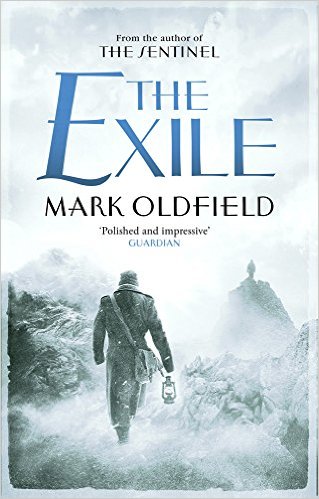
1954: Comandante Guzmán is out of favour and in exile. Franco’s one-time favourite secret policeman has been posted to the Basque country, a desolate backwater – in his eyes – of simmering nationalism, unlikely alliances and ancient vendettas.
Guzmán was last here during the war, at the head of a platoon of bloodthirsty Moorish irregulars. Personally, he’d rather forget all that – but up in the hills, he’ll find that he hasn’t been forgotten at all.
2010, Madrid: Forensic Investigator Ana María Galindez has been sent to the Basque country where, sealed in the cellar of a ruined building are three skeletons, each bound to a chair, each savagely hacked to death. In the debris surrounding them, a scimitar, stamped with a name: Capitán Leopoldo Guzmán.
Guzmán is the key that will unlock Spain’s darkest secrets. Guzmán’s name, she’ll discover, is a death sentence.
cover art and blurb via amazon.co.uk
~~~
Here we are at last: The sequel to Mark Oldfield’s The Sentinel. If you are new, the Vengeance of Memory trilogy is based around Guzmán in the 1950’s, and Ana María Galindez in present day, with a few 1930’s war-time chapters for added plot twists. Sounds tricky? Keep up.
The Exile takes a slight leap forward from the end of The Sentinel which (potential spoilers ahead), left Ana María in a messy state, and Guzmán surrounded by dead bodies. In 2010, Ana María is reinstated in the Guardia Civil, to continue her work as a forensic investigator. Off to the Basque country in northern Spain, she has to examine a scene of a multiple slasher-type killing spree from the 1930’s. The murder weapon is found – and it’s Guzmán’s. Ana María finally feels as if she is getting close to the man. But the bones are quickly forgotten when Ana María is put in charge of an investigation into the stolen babies of the Franco era, which started during the civil war and outlived Franco until around 1991. All the while, she is still suffering from past injuries thanks to Guzmán’s chamber of secrets and not at all over the murder of her father by Basque terrorists, something her memory has blacked out. Ana María believes in science, and with her new assistant Isabel, they come up with statistics – not only were a large majority of babies stolen from private clinics, most of the parents who complained were then killed. When a mother claiming to have had a daughter stolen at birth winds up dead, Ana María finds this old and vicious crime is still going on. The corruption and cover-ups run deep, and has the ability to kill anyone who pokes into fascist business.
Meanwhile, Guzmán is tramping around the wilderness of the Basque country in 1954, with his sidekick Ochoa. Guzmán has freshly killed a terrorist cell, but more remain at large. El Lobo (The Wolf), a mysterious bandit is riding through the forests, killing people and robbing banks. Guzmán has to kill him in order to go home to Madrid. Flashback chapters to 1937 show Guzmán and Ochoa have been north before – and straight away, faces in the small town are very familiar. Everyone wants to be Basque, speak Basque, but it is illegal. No one can be trusted and traitors lurk everywhere. Guzmán has full powers over everyone. With insane killers in power in the region and running loose in the forest, Guzmán needs to fight for his career and his life if he is see through all the murders, terrorists, special informants, inept Guardia Civil men, stupid-hat wearing French smugglers, and traitors on both sides of the political divide. He meets Magdalena Torres, beautiful daughter of a general, and while she seems perfect for Guzmán, with lives on the line and missions to complete, literally no one is who they seem.
I have waited three years to read The Exile after the release of The Sentinel. The format, chapters alternating timelines is the same as I have written, as is the stolen babies of the Franco-era storyline, along with Brigada Especial men like Guzmán. I have finished my series and it is fun to see someone else taking the ideas down a very different path. There is only one side to Guzmán – perverse and savage. Whether he is thinking, talking or acting, he is cruel. He hates everyone, especially himself. So when he is taking a dinner break rather than murdering or intimidating, he hooks up with Magdalena, who is ready to jump into bed with this emotionless man. She too is cold and emotionless. The spark between them doesn’t exist, they instead gravitate toward one another, similar beings in a land of haters. Every speaking male character in this book (almost the entire cast) are perverts. They look every woman up and down with sexual ideas. Women are kept in cells, raped and tortured. Every woman is a whore. A general holds parties where local girls, keen to avoid jail time (for invisible crimes) attend parties naked, there for gratification, to be raped, tortured and/or murdered. One is there purely to be placed naked on a garrotte machine. Women as entertainment for the depraved and over-empowered. Guzmán spends little time on anything except thinking or discussing murder or what’s under a woman’s clothing. I kept telling myself that women where treated poorly under Franco and that was part of the story, but still, the level of violence to women is explosive. Women are only good for two things in Guzmán’s world. Sex and death. One character, a young Basque woman Nieves, someone Guzmán should respect, is still watched naked, and exists for gratification, for torture, beatings, sexual assault by the whole damn world. The constant leering by every male character at every woman is truly evil. Men are in power; women are only whores. There is no other way.
In the 2010 storyline, things are no better. Ana María, a lesbian (which is not made a big deal of in this book, covered in the first installment) is leered at by men everywhere she goes. Every step and a man seemed to be leering or making a sexual innuendo. Ana María attacks a man early on; she shouldn’t be popping painkillers (addiction in disguise), she should be in therapy and on antidepressants. The crime scene early on in the book gets forgotten as the stolen babies take priority, and it takes a long time for her storyline to run parallel with Guzmán’s – almost the end of the book, but it all makes sense over time. One thing Ana María is – BADASS! Going for babysitting and ending up in a gun battle is no problem for fearless Ana María. Her storyline suggests baby stealing continued well into the 1990’s and parents were murdered; let’s hope that part never turns out to be true!
The storylines move nice and quick – accidentally skip a paragraph in 1954 and Guzmán’s body count has risen or another person has turned traitor. In 2010, in a matter of 2-3 pages, Isabel is introduced, decides to be author, Ana María agrees to work with her, and both are hired by the government. Fast work for life-changing decisions I thought. People with little in common come together in brisk writing so the juicy details can emerge. There is a dam-full amount of juicyness, too. The first 200 pages set the scene, Guzmán being the book’s leader. After that, both 1954 and 2010 battle for supremacy. Guzmán’s end turned out just as I expected, but the twists and turns of Magdalena, Nieves and Bogeña left me feeling flat. In 2010, poor Ana María gets insanely accused, threatening her entire life, stumbles upon an old film reel laden with coincidence (and I mean insane levels) and yet, in the final sentences, ends as I expected – and (almost) hoped for (I had imagined her at least wearing undergarments and/or pants).
I would recommend this book to anyone. There is no detail on Spain’s situation in either periods, the book jumps straight in and readers get pulled along. Reading the first book would definitely be an advantage. I re-read it before picking up The Exile. The violence against women, the leering and innuendo, and the sexually frustrated losers of the book are hard to stomach, yet with all that, the twisting plot, the traitors and unlikable characters like Guzmán and Ana María, the author has produced a hell of a novel. While I liked The Sentinel, The Exile is so much better again, worth the wait for sure.
One tip – Don’t get attached to anyone (that’s easy, everyone’s horrible), because the body count is so high, the Game of Thrones writers should take notes. No one is safe. How the third book winds all the dangling storylines together will be a treat to read. I really don’t know how I want the series to end.
Read my review of the first installment – The Sentinel by Mark Oldfield


 CAROLINE ANGUS