While this letter does not have a year on the letter itself, Cromwell talks of Parliament, and Parliament only sat twice in the 1520s (mid-1523 and late 1529). The messy handwriting is an honest and casual letter to one of Cromwells closest friends, John Creke, who was in Bilbao, Spain, working as a merchant. Creke regularly wrote long letters despairing at being apart form Cromwell.
THOMAS CROMWELL TO JOHN CREKE, 17 August 1523* (SP 1/28 f. 154)
To my special and entyrelye belouyd Frende John Creke be this youyn Bylbowe in Biscaye.
Master Creke, as heartily as I can, I commend me, and in the same way thank you for your gentle and loving letters to me at various times. I accordingly have not likewise remembered and written, as it has been that I have not had anything to write or which to advertise to you. I assure you if it were in my little power, I could be well contented to favour you as far as any one man living. But at present, I am somewhat intending to remember and remunerate old acquaintances, and to renew our not forgotten various communications. Supposing you desire to know the current news in these parts, it is said that news refreshes the spirit of life.
You shall understand that for a long time, I among others have endured a Parliament which contended the space of 17 whole weeks where we communed of war, peace, strife, contention, debate, murmured grudges, riches, poverty, penury, truth, falsehood, justice, equity, distaste, oppression, magnanimity, accurate force, intemperance, treason, murder, felony, consuls… and also how a common wealth might be edified and continued within our realm. However, in conclusion we have done as our predecessors have done, that is to say, that we left where we began.
You should also know the Duke of Suffolk is furnished with a great army to go with all goodly haste when I know not, when I know I shall advertise you. Our Parliament granted the King’s Highness a right large subsidy, the like whereof was never granted in this realm. All your friends, to my knowledge, be in good health and especially those that you want of: you know what I mean. I think it best to write in parables because I am in doubt. Master Vaughan fares well, and also Master Munkcaster. Master Woodall is merry without a wife and I commend you. So is Nicholas Longmede, who has paid William Wilford. And thus, fare you well as I would do myself. At London, the 17th day of August by your friend to all his possible power
Thomas Manner, 1st Earl of Rutland by Jeremiah van der Eyden (1635–1695)
Cromwell wrote to John Manners, the 1st Earl of Rutland, to arrest of Friar John Colsell, a friar who was just eighteen yet ‘schoolmaster’ at the Grantham Greyfriars in Lincolnshire, accused of magic and astrology. Rutland’s men captured Colsell on 23 August, who accused many others at Grey Friars in Grantham of similar crimes. Colsell, while in prison, was accused of being a performer of divination and teaching 13-year-old novice friar William Nobul, ‘ to bear false witness.’ The case overturned significant issues with Colsell and the house, but they were not dissolved until 1539.
SECRETARY THOMAS CROMWELL TO JOHN MANNERS, EARL OF RUTLAND, 9 August 1535 (Belvoir Castle MSS)
To the right honourable my lord the Earl of Rutland be this given.
My lord, after my right hearty commendations this shall be to advertise to your lordship that having received your letters and declared the effects of the same to the king’s highness, who for your diligent advertisement of such things as do touch his majesty, and for your goodwill showed towards the correction of such transgressions given to you, his Grace’s hearty and consigned thanks, Forasmuch as the king’s highness is informed that the warden of those friars which have spoken those seditious words, is a right honest person and that it may be that he is accused by such light persons as perchance cannot justify the same. The king’s highness therefore requires your lordship to call before you the warden and all other his friars and to take some pains thoroughly and exactly to hear debate and examine the matter with them and their accusers, so as the truth and the whole circumstances of the matter may truly and substantially appear in such ways as every man may have his merits and desserts according to good justice. And of your lordship’s proceedings in that behalf, and what matter you shall find upon the said examination, it may please your lordship to signify the same with the circumstances to the king’s highness or his council, upon the which advertisement your lordship shall know further of the king’s pleasure. Touching the other friar named Friar John Colsell using the deceitful art of magic and astrology, the king’s pleasure is that you shall cause him to be taken and apprehended and detain him in ward until you shall have other knowledge and advertisement of the king’s pleasure in that behalf. And thus, the Holy Trinity preserve your lordship in long life and health with the increase of honour. At Berkeley Herons, the 9th day of August.
‘A true Christian confession of the L. Cromwel at his death.’
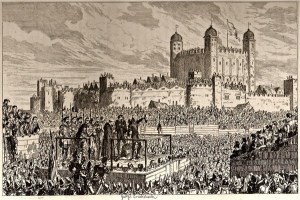
July 28 marked a dramatic day at Tower Hill. The most powerful man in England was to die due to forces entirely outside of his control. Cromwell had selected the perfect queen in Anna of Cleves, a beautiful, well-connected duchess, whose brother Duke Wilhelm of Jülich-Cleves-Berg, and her sister Electress Sybilla of Saxony, had powerful allies and the Schmalkaldic army on their side. But when Duke Wilhelm threatened war with Emperor Charles over the duchy of Guelders while Anna was travelling to England to her marriage, suddenly the duchess who promised powerful allies now also tied King Henry to enter a war he could not win, and would not benefit from at all. Cromwell’s paperwork on the marriage was as strong and watertight as all his work; it could not just be undone, and Henry wed a woman who tied him to war. Henry believed in Cromwell still, even making him an earl in April 1540, but when sexual humiliation reared its head (excuse the pun), Henry snapped and arrested his most faithful servant. Cromwell undid the marriage contract from his room in the Tower, bolstered by fabricated affidavits, talking of Anna being so ugly that Henry couldn’t consummate. An annulment would stop Emperor Charles’ anger at England potentially allying against him, but there needed to be proof, there needed to be someone to blame for the marriage to a duchess who linked England to war. With statements about throwaway comments made to his enemies, Cromwell was attainted for heresy and treason, and conspiring to marry Princess Mary (based on literally no evidence). Even though Henry started to realise his mistake on 9 July, a man attainted could not have his sentence wiped; it would set a legal precedent. But as much as Cromwell’s enemies wanted him dragged on a hurdle to Tyburn and hanged, drawn and quartered as a traitor, or burned at the stake as a heretic, Henry granted Cromwell’s cry for mercy and ordered a beheading.
While primary sources of the day offer sketchy detail, the works Foxe, Hume, Cox, Galter, Herbert, and Hall all offer insights to the day. It is suggested that Cromwell only learned of his style of execution on the morning from William Laxton and Martin Bowes, two sheriffs at the Tower, who came to him after breakfast, which he had just after dawn on a sunny summer’s day. Hume wrote that one thousand halberdiers were there to flank Cromwell’s short walk from the Tower to the scaffold on the hill, for an unfounded fear that Cromwellians would mount an escape bid. There, Cromwell met Walter Lord Hungerford, who was also destined to die for the crimes of incest, buggery and wife-beating, and had lost his mind by the time of his death. The men knew one another through their work for the king, and Foxe wrote that Cromwell tried to comfort the mad baron:
“There is no cause for you to fear. If you repent and be heartily sorry for what you have done, there is for you mercy enough from the Lord, who for Christ’s sake, will forgive you. Therefore, be not dismayed and though the breakfast which we are going to be sharp, trusting in the mercy of the Lord, we shall have a joyful dinner.”
Final words on the scaffold were not a time to defend oneself, fire anger at your enemies or beg for freedom. Cromwell had to deliver a speech to cement his legacy and save his son Gregory, daughter-in-law Elizabeth and their three sons, as well as Richard and Frances Cromwell and Ralph and Ellen Sadler, their very young children, and Cromwell’s wide extended family. Cromwell, accompanied by Thomas Wyatt on the scaffold for support, gave his final speech.
“I am come hither to die, and not to purge my self, as some think peradventure that I will. For if I should so do, I were a very wretch and a Miser. I am by the Law condemned to die, and thank my Lord God, that hath appointed me this death for mine Offence. For sithence the time that I have had years of discretion, I have lived a sinner, and offended my Lord God, for the which I ask him heartily forgiveness. And it is not unknown to many of you, that I have been a great Traveller in this World, and being but of a base degree, was called to high estate, and sithence the time I came thereunto I have offended my Prince, for the which I ask him heartily forgiveness, and beseech you all to pray to God with me, that he will forgive me. And now I pray you that be here, to bear me record, I die in the Catholic Faith, not doubting in any Article of my Faith, no nor doubting in any Sacrament of the Church. Many have slandered me and reported that I have been a bearer of such as have maintained evil Opinions, which is untrue. But I confess, that like as God by his holy Spirit doth instruct us in the Truth, so the Devil is ready to seduce us, and I have been seduced; but bear me witness that I die in the Catholic Faith of the holy Church; and I heartily desire you to pray for the Kings Grace, that he may long live with you in health and prosperity; and that after him his Son Prince Edward that goodly Imp may long Reign over you. And once again I desire you to pray for me, that so long as life remaineth in this flesh, I waver nothing in my Faith.”
Cromwell then went on to pray:
“O Lord Jesus, which art the only health of all men living, and the everlasting life of them which die in thee; I wretched sinner do submit my self wholly unto thy most blessed will, and being sure that the thing cannot Perish which is committed unto thy mercy, willingly now I leave this frail and wicked flesh, in sure hope that thou wilt in better wise restore it to me again at the last day in the resurrection of the just. I beseech thee most merciful Lord Jesus Christ, that thou wilt by thy grace make strong my Soul against all temptations, and defend me with the Buckler of thy mercy against all the assaults of the Devil. I see and knowledge that there is in my self no hope of Salvation, but all my confidence, hope and trust is in thy most merciful goodness. I have no merits nor good works which I may allege before thee. Of sins and evil works, alas, I see a great heap; but yet through thy mercy I trust to be in the number of them to whom thou wilt not impute their sins; but wilt take and accept me for righteous and just, and to be the inheritor of everlasting life. Thou merciful Lord wert born for my sake, thou didst suffer both hunger and thirst for my sake; thou didst teach, pray, and fast for my sake; all thy holy Actions and Works thou wroughtest for my sake; thou sufferedst most grievous Pains and Torments for my sake; finally, thou gavest thy most precious Body and thy Blood to be shed on the Cross for my sake. Now most merciful Saviour, let all these things profit me, which hast given thy self also for me. Let thy Blood cleanse and wash away the spots and fulness of my sins. Let thy righteousness hide and cover my unrighteousness. Let the merit of thy Passion and blood shedding be satisfaction for my sins. Give me, Lord, thy grace, that the Faith of my salvation in thy Blood waver not in me, but may ever be firm and constant. That the hope of thy mercy and life everlasting never decay in me, that love wax not cold in me. Finally, that the weakness of my flesh be not overcome with the fear of death. Grant me, merciful Saviour, that when death hath shut up the eyes of my Body, yet the eyes of my Soul may still behold and look upon thee, and when death hath taken away the use of my Tongue, yet my heart may cry and say unto thee, Lord into thy hands I commend my Soul, Lord Jesus receive my spirit, Amen.”
Cox wrote that Cromwell then turned to Wyatt and sad “farewell, Wyatt,” and that his friend was deeply upset at this stage, and Cromwell added, “gentle Wyatt, pray for me.” Cromwell removed his gown, gave forgiveness to his executioner and prayed him to take his head with a single blow. Conflicting reports exist of what came next. The news of the execution travelled Europe, changing with every letter. Hume wrote Cromwell’s head came off with a single blow. But Galton wrote that the axeman, a “ragged and butcherly wretch” and that the first blow instead hit Cromwell’s skull, and that it took half and hour to cut through Cromwell’s neck. While that seems like a story built on dramatics and exaggeration, regardless of the number of blows required, Cromwell would have been unconscious or dead within seconds.
Hungerford, however, was quickly killed without fanfare or wise words, and Cromwell’s mangled head went on London Bridge like all the rest, his body buried at St Peter ad Vincula, close to Anne Boleyn, whom the king had ordered killed during an Easter conversation with Cromwell only four years earlier. King Henry married Katheryn Howard at Oatlands the same day, not that any knew that at the time. No one who rose in the English court escaped eventual fates like this; it would be surprising if Cromwell had never considered this as his eventual fate.
Thomas Cromwell was undoubtedly the genius of the English court, a man whose mind far exceeded those about him. While his genius was exploited by King Henry, whose orders Cromwell could not refuse, it meant that many never truly appreciated Cromwell, too busy sneering at the rank of his birth. These people were only in power due to their birth, and should have been grateful to breathe the same air as a man who far exceeded them in intelligence, generosity and charm.
~~~
Cromwell’s final speech: Passages from Foxe’s Ecclesiastical History, Vol. ii. p 433
John Foxe, Acts and Monuments, 1563
Arthur Galton, The Character of Times of Thomas Cromwell, 1887
Edward Hall, The Triumphant Reigne of Kyng Henry the VIII, vol 2, p306-7
Edward Herbert, Life and Raigne of King Henry the Eighth, Bodleian Library Oxford, Folio 624, 462
Richard Cox, Elizabethan Bishop of Ely, Corpus Christi College Cambridge, Parker Society MS 168 f. 209rv
Martin Hume, The Chronicle of King Henry VIII 1889, p104
On 24 July 1540, Thomas Cromwell wrote his final letter from the Tower, and discussed none of the issues you would expect. Those in the Tower who were awaiting execution generally knew their time was coming, and set about making sure their debts were paid. If found guilty of heresy and/or treason, or attainted (declared guilty without a trial), all possessions were forfeit to the crown, and so no will was required. Even so, many wrote notes asking for help for others, to pay bills or pass on messages. Sadly, nothing remains of Cromwell making preparations at the end of his life, or even how far in advance Cromwell knew of the end of his days. While Henry nicely planned his wedding to Katheryn Howard to coincide with Cromwell’s execution, precious few knew of the alignment, and certainly not Cromwell himself.
So the final letter written by Cromwell is one that centres on none of his situation. Rather, his letter to the Privy Council instead is over what is now called The Rochepot Affair. To cut a long story short and to simplify (I do explain it properly in my book), François de Montmorency, Sieur de la Rochepot (brother to the Constable of France, Anne deMontmorency) had a ship confiscated in London, on Cromwell’s orders in 1538. A year earlier, the ship of one of three which attacked and robbed German merchants (Easterlings). While the ship could be held for the crime of attacking the Germans, a second incident had occurred. The French were withholding Cromwell’s precious English bibles, which were printed in Paris, and Rochepot’s ship could be exchanged for the bibles. But after the French released the captive bibles and they went to England in 1539, Cromwell never released the ship, and it sat idle. Jurisdiction on the case, which would see the ship released, took time. Cromwell had no interest in Rochepot’s ship; it was merely a pawn. But the king of France argued that Cromwell kept the ship in order to plunder its valuable goods. There is no proof of this, and nor did even Cromwell’s biggest enemies, all also on the panel to oversee the ship’s release, accuse him, only the French. But as Cromwell was attainted, he became a good scapegoat in the saga of the ongoing litigation, and Cromwell’s final letter attempts to clear his name of any wrongdoing over the “prize” aboard the Rochepot ship.
THOMAS CROMWELL TO THE LORDS OF THE PRIVY COUNCIL, 24 July 1540 (SP i 642)
It pleases your good lordships to understand that I have read the letter sent to the king’s Majesty, sent from the French king, touching Monsieur de Rochepot, in which it appears that the French king supposes that, by my means, the said matter has not been ordered, and that I should have a great part of that prize. My lords, first, as I shall answer to God, I never bore favour in the matter otherwise than to justice appertaining, which was that Easterlings, who said they were, being in league with the French king, robbed by his subjects, desiring that forasmuch as their goods were safe within the king’s ports that they might have justice here. Whereupon, the matter was committed to the hearing of the Judge of the Admiralty, and the Proctor of Monsieur de Rochepot agreed and consented to the jurisdiction of the court, and so the French party as well as the Easterlings contended upon the matter as to whether it should be tried in France or England. Thereupon, as I remember a sentence was given that the matter should be tried in England, whereupon the French party departed and after sent hither an advocate of France, who took himself to be satisfied with the order taken, and also departed. After the ambassador, now present here, made suit to the king to have the matter remitted to be determined in France, at which time a consultation of learned men before the king’s honourable council was had at Gilford, and there it was thought that the king’s Majesty might, with his honour, remit the matter into France. But it was agreed on the king’s part that if the French king would send his commissary to a place indifferent, then his Majesty would the like and whatsoever should be determined there should be performed. My Lord of Norfolk, me Lord Privy Seal, my Lord of Durham and my Lord of Winchester were at that Council, and my Lord of London was at that time, being the king’s ambassador, fully instructed of the whole matter, but that ever I had any part of that prize or that I were promised any part thereof, my lords, assure yourselves I was not, as God shall and may help me. This, my good lords, I pray the eternal Redeemer to preserve you all in long life good health with long prosperity.
At the Tower, the 24th day of July with the trembling hand of your beadsman.
John Chekyng, who had custody and care of Gregory Cromwell, Christopher Wellyfed and Nicholas Sadler, had written to Cromwell complaining that he got the impression Cromwell was upset with the lack of progress on the boys’ education.[1] Given that Cromwell had been a widower only about six months and was clearly in a low state may have contributed to this demeanour. But the same day that Cromwell received the letter from Chekyng, he drafted his letter in his own hand, offering to send his niece Alice Wellyfed to the Chekyng household, to work alongside Chekyng’s wife. This letter has suffered mutilation and is only a partial record.
CROMWELL TO JOHN CHEKYNG, 5 July 1529 (LP iv no. 5757 ii)
… as heartily as I can, I commend me to you and marvel greatly that you have made no better speed for your chaplain, in whose favour I have written to Mr. Chancellor of Winchester (Stephen Gardiner), trusting that he will be good master to him. For my sake, I would be very loathed that you should miss your purpose.
Sir, I pray you be so good to me as to let me send my sister’s daughter to the Gentlewoman your wife, and that you will, on my behalf, convince her to take her and to bring her up, for her goodness, if she will be content so to do. I should reckon myself most bound both to you, and here (I shall) besides the payment for her board. I will so content your wife, as I trust she shall be well pleased. That I may know your answer herein, I heartily pray you, and thus heartily I fare you well. At London, the 5th day of July.